
 |
| Rohingya refugees holing placards, await the arrival of a UN Security Council team at the Kutupalong refugee camp in Bangladesh on Sunday. Source: AP |
By AFP/SBS
April 29, 2018
Representatives from the five permanent UN Security Council members are in Bangladesh to see the conditions endured by some 700,000 Rohingya Muslims.
Hundreds of Rohingya staged a demonstration Sunday as UN Security Council envoys visited refugee camps in Bangladesh where about 700,000 people who have fled Myanmar in the past year have sought sanctuary.
Some of the Muslim refugees broke down in tears as they told the ambassadors harrowing stories of murder and rape in Myanmar. The demonstrators waved placards demanding justice for atrocities against the refugees until they were dispersed by police.
Senior diplomats from the 15-member Security Council - including permanent members the United States, Russia, China, Britain and France - arrived in Bangladesh on Saturday for a four-day visit to the camps. They will go on to Myanmar where they are to meet civilian leader Aung San Suu Kyi.
Myanmar has faced intense international pressure over the military clampdown against the Rohingya launched last August that the United Nations has called "ethnic cleansing".
The Security Council has called for the safe return of the Rohingya and an end to the discrimination against them.
 |
| Members of the UN Security Council, who promised Sunday to work hard to resolve a crisis. AP |
However, deputy Russian ambassador Dmitry Polyanskiy, whose country has supported Myanmar, warned that the council did not have a "magic stick" to resolve what is now one of the world's worst refugee crises.
"We are not looking away from this crisis, we are not closing our eyes," the Russian diplomat told reporters.
Britain's UN ambassador Karen Pierce said the Rohingya "must be allowed to go home in conditions of safety".
"It may take some time but we'd like to hear from the government of Myanmar how they wish to work with the international community," she said.
Safety needed
The UN envoys first visited Konarpara camp, a no man's land between Bangladesh and Myanmar where some 6,000 Rohingya have been trapped on bleak scrubland since the bloodshed began last year.
The camp's Rohingya leader Dil Mohammad said council envoys spoke with some women victims of the violence in Myanmar's Rakhine state, as well as community elders.
"We told them that we're staying here to save our lives. We're very much eager to go back to our land, provided our security is ensured by the UN," Mohammad told AFP.
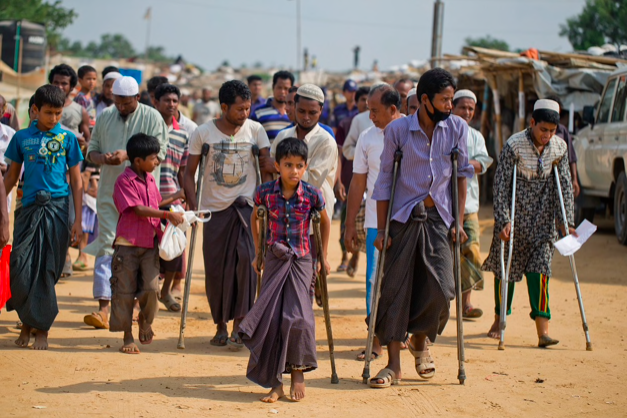 |
| Wounded Rohingya refugees walk with the help of crutches at the Kutupalong Rohingya refugee camp. AP |
Later, the diplomats went to the giant Kutupalong camp where hundreds of Rohingya staged the protest that was dispersed by police before the envoys arrived. A second was later held in the camp.
"We want restoration of our citizenship under Rohingya ethnicity. We want security and return of our confiscated land and properties," said Rohingya leader Mohibullah.
The council members were "shocked" by the accounts of rapes, murders and torture endured by the Rohingya in Rakhine, according to Mohibullah.
Myanmar has said the military operation in Rakhine was to root out extremists and has rejected nearly all allegations that its security forces committed atrocities.
The Security Council delegation is to meet with Bangladesh's Prime Minister Sheikh Hasina on Monday before leaving for Myanmar.
They are to go on a helicopter flight over Rakhine to see the remains of villages torched during the violence.
Kuwait's Ambassador Mansour al-Otaibi said the visit was not about "naming and shaming" Myanmar, but that "the message will be very clear for them: the international community is following the situation and has great interest in resolving it."
On Friday, Human Rights Watch called for the Rohingya crisis to be referred to the International Criminal Court.
"The lack of a UN Security Council resolution has left the Myanmar government convinced that it has literally gotten away with mass murder," HRW executive director Kenneth Roth told reporters in Yangon.

April 27, 2018
Extended conversation with Rohingya activist Tun Khin, who visited the world’s most densely populated refugee camp in Cox’s Bazar, Bangladesh, earlier this month. The UN Security Council is visiting Burma and Bangladesh starting this week to assess the state of the Rohingya. Hundreds of thousands of registered Rohingya refugees now live in the Cox’s Bazar district in southeastern Bangladesh after fleeing a Burmese military campaign of rape, murder and arson that the U.N. has called a “textbook example of ethnic cleansing.” Now Aid agencies are scrambling to relocate tens of thousands of Rohingya refugees from crowded camps in Bangladesh ahead of the monsoon season in June. The United Nations High Commissioner for Refugees says at least 150,000 people are at “high risk from mudslides and floods” from the heavy rain in the next few months. This comes as more refugees are still crossing over from Burma. Last week, Burma’s Social Welfare, Relief, and Resettlement Minister Win Myat Aye said Burma will start repatriation of Rohingya refugees from Bangladesh ahead of the monsoon. But Tun Khin, President of the Burmese Rohingya Organisation UK and a member of the Free Rohingya Coalition, says repatriation without international protection will have devastating effects. We are joined in our New York studio by Tun Khin. He was born in Burma, but in 1982 he was rendered effectively stateless along with a million other ethnic Rohingya under a nationality law.
April 27, 2018
Aid agencies are scrambling to relocate tens of thousands of Rohingya refugees from crowded camps in Bangladesh ahead of the monsoon season in June. Hundreds of thousands of registered Rohingya refugees now live in the Cox’s Bazar district in southeastern Bangladesh after fleeing a Burmese military campaign of rape, murder and arson that the U.N. has called a “textbook example of ethnic cleansing.” Now the United Nations High Commissioner for Refugees says at least 150,000 people are at “high risk from mudslides and floods” from the heavy rain in the next few months. Some could be moved to a recently formed island at the mouth of the Meghna River. This comes as more refugees are still crossing over from Burma. We are joined in our New York studio by Tun Khin, President of the Burmese Rohingya Organisation UK and a member of the Free Rohingya Coalition. He was born in Burma, but in 1982 he was rendered effectively stateless along with a million other ethnic Rohingya under a nationality law.


Transcript
AMY GOODMAN: This is Democracy Now! I’m Amy Goodman with Nermeen Shaikh.
NERMEEN SHAIKH: We end today’s show looking at how aid agencies are scrambling to relocate tens of thousands of Rohingya refugees from crowded camps in Bangladesh ahead of the monsoon season in June. More than a million registered Rohingya refugees now live in southeastern Bangladesh after they fled in 2017 amid a Burmese military campaign of rape, murder, and arson that the U.N. has called a “textbook example of ethnic cleansing.” Now the United Nations High Commissioner for Refugees says at least 150,000 people are at “high risk from mudslides and floods” from the heavy rain in the next few months. Some could be moved to a recently formed island at the mouth of the Meghna River. This comes as more refugees are still crossing over from Burma.
AMY GOODMAN: For more, we are joined in our New York studio by Tun Khin, President of the Burmese Rohingya Organisation UK, a member of the Free Rohingya Coalition. Born in Burma, but in 1982, he was rendered effectively stateless along with a million other ethnic Rohingya under a new nationality law. Welcome back to Democracy Now! You were just in the area. You have just returned. Tell us what you saw and your deep concerns about the moving of the Rohingya in Bangladesh who have fled what many are calling genocide, in Burma.
TUN KHIN: Yes. These are victims of genocide. They fled because they’re facing serious mass atrocities in their homeland. That’s why they fled. What I have seen—there is many Rohingyas—women are not getting proper medical aid. At least 30,000 Rohingya women are pregnant. There are some rape victims there, raped women also. At least 25,000 unaccompanied children there.
AMY GOODMAN: You’re talking about Cox’s Bazar, where you were—
TUN KHIN: [inaudible]
AMY GOODMAN: —home to the most densely populated refugee camp in the world?
TUN KHIN: Yes. So the challenge in here is now coming after a few weeks, when heavy rain comes up. Half million population will—their lives will be in danger because of flood and because of heavy rain. That is what happens normally in that area. So it is very important international community must focus on that to protect these people. Because I worry there will be next another natural disaster these Rohingya people will face. Last year, they faced man-made disaster, what we have seen as genocide, completely. Completely their atrocities against Rohingya has been going [inaudible] of genocide, I should say.
NERMEEN SHAIKH: Can you talk about what plans are in place to relocate the Rohingya from Cox’s Bazar?
TUN KHIN: As far as what I learned from international NGOs, they’re trying to relocate. They’ve mapped up the—some places and they’re trying to relocate some Rohingyas. But we still do not know when and how they will do that.
NERMEEN SHAIKH: And what about the question of repatriation? Have any of the Rohingya returned to Burma?
TUN KHIN: For me, there is—it cannot be happening, repatriation. Because the Burmese military and government systematically driven them out from their homeland. So they created—the Burmese military and government created impossible situation for the Rohingyas. When I was there, last three weeks, the people are still fleeing from Burma to Bangladesh. And last two days ago, I received five families fled. Every day, Rohingya families are fleeing. At least one week, 10 to 15 families are fleeing, because Burmese military and government is arresting many Rohingyas with false allegation, threatening them. “We do not want to see you in this country.”
AMY GOODMAN: Tun Khin, the UN Security Council is going to Bangladesh this weekend. What do you want to come out of this visit?
TUN KHIN: Firstly, as I met also the victims, they told me they want to see justice before they are returned. They want see these perpetrators where their children been burned alive, where their daughters been raped in front of them, where their sons been slaughtered in front of them. They want justice. They want to see these perpetrators in international criminal court. So this is important we bring them international criminal court, firstly.
Secondly, when we talk about repatriation, we want to return our homeland. That’s what a refugee told me. But they want protection. That is why we are calling here protected return to protected homeland, in Myanmar. So that international protection is needed. In Burma as a whole country—USDP party, NLD party, military, security forces, Buddhist monk—they do not want to see Rohingya as citizens. They’re saying illegal immigrants. So any time mass atrocity we will face again—before this happen, protection is needed when you return these refugees.
AMY GOODMAN: Tun Khin, we want to thank you for being with us. President of the Burmese Rohingya Organisation UK. And this breaking news—Presidents Trump’s nominee to head the VA, Dr. Ronny Jackson, has withdrawn from consideration. Democracy Now! is accepting applications for our year-long paid social media fellowship. Check it out at Democracynow.org. I’m Amy Goodman with Nermeen Shaikh.
 |
| Famous Burmese dissident Dr. Maung Zarni speaks to Anadolu Agency on heartrending plight of Rohingya Muslims and what can be done to resolve it, in Istanbul, Turkey on April 24, 2018. ( Selin Çalık Muhasiloviç - Anadolu Agency) |
Famous Burmese dissident Dr. Maung Zarni speaks to Anadolu Agency on heartrending plight of Rohingya Muslims and what can be done to resolve it
By Selin Calik Muhasilovic
April 26, 2018
ISTANBUL -- In a rare exclusive interview, Myanmarese scholar and democracy advocate Dr. Maung Zarni spoke to Anadolu Agency on the ongoing humanitarian crisis involving Rohingya Muslims fleeing violence and persecution in the Rakhine state and Turkey’s important role specifically to help them return to the ‘Protected Homeland’.
- ‘The Rohingya are misframed as a proxy for terrorists’
You are a Buddhist academic but you support the Rohingya Muslims. How did the genocide take place? Why do you oppose the genocide as a Buddhist?
Well, I am not supporting Rohingya Muslims because they are Muslims.
I am supporting that they are fellow humans from my country and they are oppressed not because they take up arms, not because they are trying to gain independence or separate from Burma, but because they are Rohingya and they are misframed as a threat to national security.
As you know, they are misframed as a proxy for the terrorists in the Middle East. They are also seen and misperceived basically as local proxies for Bangladesh, if Bangladesh were ever to decide to take the Rohingya region.
So, essentially the Rohingya are innocent and they have a small number of radical or young angry Rohingya who want to fight back because they do not have any option because they have lost everything.
But, that does not justify what the Burmese military has been doing, which is essentially “genocide”.
If I do not speak out and oppose, I would be less than a human being, because this kind of genocide can destroy our community and poses a threat to the territorial integrity of Burma.
In the case of the Rohingya, we have been engaged in different ways of killings since 1978 when the Burmese military decided that this community must not be allowed to exist as Rohingya or their numbers must be reduced by terrorizing them so that they would run away to Bangladesh or other places.
So, on the religious or philosophical ground, the killings must not be condoned, especially given that I know that the Burmese military destroys their livelihood, food systems, and restrict their access to farms where they can raise or harvest food crops like rice.
If I do not speak out, then it is my responsibility, then I am complicit.
In this kind of situation when you keep your mouth shut, you know that a large number of human beings are being slaughtered; then I am complicit.
Similar to the situation in the Nazi Germany, when some decent and good Germans kept their mouth shut as they were afraid for their lives.
But, there were also a very small number of Germans who said Nazism was bad for everybody, including the Germans.
So, they opposed when a lot of people were executed by the SS, or the Hitler regime. In my case, I have been declared the top enemy of the state and a national threat.
But, if you do not want your children to be raped and killed, you should not want any other people’s families to be hurt either.
The Rohingya are not small in number. We are talking about 800.000 Rohingya who have run away from their lands.
They are someone else’s wife, husband, brother, teacher... They are human beings like us. I personally know some of the people that rewrote the citizenship law against the Rohingya in 1982.
I also know the top leader of the military that organized the genocide. As a researcher, I know. So, on these grounds, I have no choice but to oppose these inhumane acts.
That’s why I am the first Buddhist who publicly says this is wrong. I named these acts as crimes as early as 2013 when everybody basically ridiculed me, saying that I was exaggerating because they did not see the large numbers of people being killed.
The government has often restricted access to the northern Rakhine State for journalists and aid workers. What kind of restrictions have you experienced as an academic and activist? What kind of price have you paid? Has this price been worth paying?
Firstly, let me tell you that I have been active for 30 years in different campaigns or movements to try to stop the military government in Burma and to introduce the principles of human rights, women’s rights, environmental protection etc.
Rohingya is the latest issue that I want to do something about, to end the genocide. In the last 30 years, I haven’t suffered in the form of imprisonment, torture, or restrictions as I come from a privileged, urban, and educated family.
But I do get some “treats” from time to time. When I was living in Brunei and teaching there, the Burmese Embassy tried to have me fired from the Brunei University because the Brunei government wanted to do business with the Burmese government.
Brunei is a Muslim country but they are more interested in making money with the Buddhist government. So, unfortunately I resigned from my position under pressure because I had written a number of articles in support of the Rohingya Muslims.
- ‘Kofi Annan Commission is a failure’
In September 2016, an advisory commission headed by Kofi Annan was established to sustain the peace and stop the massacre of the Rohingya Muslims. Do you think that this commission has been successful in its efforts?
The Kofi Annan Commission is a huge international shield to protect the Burmese government because Kofi Annan is seen as a credible individual.
I have never held Kofi Annan in any high regard particularly because Kofi Annan was the man on whose watch two genocides took place.
The first genocide was that of the Bosnian Muslims in Srebrenica, who were slaughtered in 1995 when Kofi Annan was the head of the UN peacekeeping mission in New York.
The second one was Rwanda. 800.000 people were slaughtered and Kofi Annan concealed the telegram that had come from the head of the peacekeeping mission in Rwanda to his office in New York.
Additionally, Kofi Annan did nothing in South Sudan when the South Sudanese were being killed by the regime. Nonetheless, he was awarded the Nobel Peace Prize jointly with the UN.
His commission had two other foreign members; the former Dutch ambassador and the former Lebanese minister of culture.
On this issue, their mandate was not to document the human rights abuses or decide whether a genocide is being committed in Burma. Their mandate was to look at the situation from our conflict-mediation perspective.
His commission’s framework is fundamentally flawed because the nature of the Rohingya persecution is not a conflict; it is a genocide. Genocides are not conflicts.
Genocide is essentially the destruction of an ethnic or religious or racial group of people by the political state that is controlled by the majority ethnic or religious group.
In our case, the Buddhist majority that controls the arm forces and the Rakhine state wanted to get rid of all the Rohingya or a large number of Rohingya who happen to be Muslims from their own homeland.
In ignoring the international criminal nature of the Burmese state and its policies and then taking a “conflict resolution” or “conflict management” approach, the Kofi Annan commission is deeply flawed conceptually.
But even with that conceptual flaw, I would say that maybe some of the recommendations are worthy, like granting the Rohingya citizenships. The Kofi Annan Commission was never ever accepted by the Burmese military anyway.
We have a situation in Burma, where the government is kind of hybrid; there is the military and the Aung San Suu Kyi government. They jointly run the country depending on the issues.
On the Rohingya issue, the military never accepted Kofi Annan’s involvement, because he was widely seen within the military leadership as someone connected with the responsibility to promote an intervention, although our responsibility to protect has never been mentioned and used by the UN to stop the mass atrocities.
So, his commission had absolutely no chance of succeeding from day one. The military attempted to derail his commission within the parliament by introducing a motion that would oppose Kofi Annan’s involvement.
The military worked with the Rakhine nationalists to stage protests whenever Kofi Annan and his commission came to the Rakhine state. The military also encouraged the Rakhine people not to collaborate with Kofi Annan. So, this commission is a complete failure.
- ‘Serious leadership from a powerful state like Turkey is needed’
According to a Turkish government statement, President Erdogan was the first to manage to get permission for humanitarian aid to enter Myanmar. The Burmese government had, at the peak of the violence, blocked all UN aid for the Rohingya. How does Turkey support the oppressed Rohingya?
On the issue of Rohingya, Turkey has been extremely good. Turkey apparently highly prioritized the oppression of the Rohingya people.
Turkey’s first lady (Emine Erdogan) visited Rohingya and Cox’s Bazaar and met with the Rohingya. Turkey has provided humanitarian aid by the help of TIKA, AFAD and other NGO’s of Turkey.
I think the support that the Turkish leadership has shown towards Rohingya Muslims seems to be genuine and that is very commendable from a human rights perspective.
I think there are two things Turkey can do: one is to increase the level of humanitarian assistance to Rohingya very significantly. There are about one million Rohingya in Bangladesh alone, 200,000 Rohingyas are in the IDP (internally displaced person) camps.
The other is that Turkey can mobilize the political opinions among the governments within Muslim blocs, the 57-country OIC (Organization of Islamic Cooperation), and Western blocs such as Canada, France, Germany and others with the purpose of holding high-level international conferences to discuss the future of the Rohingya people and what they need to rebuild their communities.
They were expelled from the region where they were born and raised in. There is a 100-km stretch of land where the Rohingya people used to live.
They were driven out violently, a massive number of the Rohingya were slaughtered and women raped. We are looking at the killing fields of the northern Arakan, a stretch of a hundred kilometers.
Turkey and other governments around the world should mount a serious opposition against the Burmese government’s plan to turn the killing fields of northern Arakan to economic zones.
Turkey’s leadership and role would be the most important contribution; Turkey can do more than feed the Rohingya and give them medicine.
In reality, no one can keep feeding one million people forever. What the Rohingya need is essentially their homeland, where they can grow their own rice or they can set up little shops. Their area is also not landlocked. They can do cross-border trade.
So, what is needed is serious leadership from a powerful state like Turkey. Western governments are not showing any commitment to address the issue.
They keep framing this as a conflict but there is actually a genocide being committed by a state against a people who just want to simply live in peace in that country.
That’s why Turkey needs to step in more to stop the hegemony of the Western governments on the Rohingya issue.

Boston, United States -- During a recent visit to the United States, Dave Eubank spoke with PRI’s The World regarding the Rohingya crisis, ARSA, and what the future may hold for Rohingya refugees. To listen to the interview, click the clip below.
American aid worker and former special forces officer David Eubank recently returned from Rohingya refugee camps in Cox’s Bazar, Bangladesh where he met with the insurgents of the Arakan Rohingya Salvation Army. Eubank tells The World’s Marco Werman the group is poorly trained and funded but determined to offer armed resistance to Myanmar’s government.
 |
| Rohingya refugee children fly improvised kites at the Kutupalong refugee camp near Cox's Bazar, Bangladesh, on Dec. 10, 2017. (Photo: Damir Sagolj / Reuters) |
By Reuters
April 26, 2018
The interviewers in the camps asked the refugees to recount their experiences during the wave of violence unleashed against Myanmar’s Rohingya Muslims.
WASHINGTON/COX’S BAZAR, Bangladesh — The U.S. government is conducting an intensive examination of alleged atrocities against Myanmar’s Rohingya Muslims, documenting accusations of murder, rape, beatings and other possible offenses in an investigation that could be used to prosecute Myanmar’s military for crimes against humanity, U.S. officials told Reuters.
The undertaking, led by the State Department, has involved more than a thousand interviews of Rohingya men and women in refugee camps in neighboring Bangladesh, where almost 700,000 Rohingya have fled after a military crackdown last year in Myanmar’s northwestern Rakhine State, two U.S. officials said. The work is modeled on a U.S. forensic investigation of mass atrocities in Sudan’s Darfur region in 2004, which led to a U.S. declaration of genocide that culminated in economic sanctions against the Sudanese government.
The interviews were conducted in March and April by about 20 investigators with backgrounds in international law and criminal justice, including some who worked on tribunals for Rwanda and the former Yugoslavia, the U.S. officials said.
The information will be analyzed in Washington and documented in a report to be sent to the State Department’s leadership in May or early June, the officials said. It’s unclear whether the Trump administration will publicly release the findings, or whether they will be used to justify new sanctions on the Myanmar government or a recommendation for international prosecution.
“The purpose of this investigation is to contribute to justice processes, including community awareness raising, international advocacy efforts, and community-based reconciliation efforts, as well as possible investigations, truth-seeking efforts, or other efforts for justice and accountability,” said a document used by the investigators in the sprawling refugee camps and reviewed by Reuters.
Three U.S. officials in Washington and several people involved in the investigation on the ground in Bangladesh disclosed details of the fact-finding operation to Reuters.
A State Department official, asked to confirm the specifics of the investigation conducted in the refugee camps as reported by Reuters, said “the program details are accurate.” The official, speaking on condition of anonymity, said the U.S. government was using all available information and a wide range of tools, but added: “We cannot get ahead of the deliberative, policymaking process.”
As of publication, the Myanmar government and military had not responded to questions from Reuters. Myanmar has said its operations in Rakhine were a legitimate response to attacks on security forces by Rohingya insurgents.
The interviewers in the camps asked the refugees basic demographic questions, the date the person left Myanmar, and to recount their experiences during the wave of violence unleashed against the Rohingya in Rakhine State by the Myanmar military and local Buddhist residents.
The investigators also asked refugees to describe the battalions and weaponry used by the Myanmar military in Rakhine State during operations against the Rohingya, said one person involved with the investigation in the camps, which are located in the Cox’s Bazar district in southern Bangladesh. The investigators have received names of individual perpetrators and the identities of specific battalions allegedly involved, this person said.
A second person involved in the project on the ground said 1,025 refugees have been interviewed and the assignment may include a second phase focused on military units.
Zohra Khatun, 35, a Rohingya refugee in the camps, said she told investigators that soldiers waged a campaign of violence and harassment in her village in Rakhine State starting last August. They made arrests and shot several people, driving her and others to flee, she said.
“One military officer grabbed me by the throat and tried to take me,” she told Reuters, clutching her shirt collar to demonstrate. The military, she said, burned homes in the village, including hers.
The investigation coincides with a debate inside the U.S. government and on Capitol Hill over whether the Trump administration has done enough to hold Myanmar’s military to account for brutal violence against the largely stateless Rohingya.
The Rohingya are a small Muslim minority in majority-Buddhist Myanmar. Though they have been present in what’s now Myanmar for generations, many Burmese consider them to be interlopers. Violence against them has increased in recent years as the country has made a partial shift to democratic governance.
In November, following the lead of the United Nations and the European Union, then-Secretary of State Rex Tillerson declared that the Rohingya crisis constituted “ethnic cleansing,” a designation that raised the possibility of additional sanctions against Myanmar’s military commanders and increased pressure on its civilian leader, Nobel peace laureate Aung San Suu Kyi. The Myanmar government has denied the accusations.
The United States responded in December by imposing targeted sanctions on one Myanmar general and threatening to penalize others. Washington has also scaled back already-limited military ties with Myanmar since the Rohingya crisis began. Human rights groups and Democratic lawmakers in Washington have urged the Republican White House to widen sanctions and designate the violence as “crimes against humanity,” a legal term that can set the stage for charges at the International Criminal Court in The Hague.
“No decisions have been made on that front, but it’s something being looked at very carefully,” a senior Trump administration official told Reuters.
A Reuters investigation published in February provided the first independent confirmation of what had taken place in the village of Inn Din, where 10 Rohingya Muslim men and boys were hacked to death by Rakhine Buddhist villagers or shot by security force members. The story was based on accounts not only from Rohingya refugees but also from soldiers, police officers and Buddhist locals who admitted to participating in the bloodshed.
Pictures obtained by Reuters showed the men and boys with their hands tied behind their backs and their bodies in a shallow grave. Two Reuters journalists were jailed while reporting the story and remain in prison in Yangon, where they face up to 14 years in jail on possible charges of violating Myanmar’s Official Secrets Act.
So far, there has been resistance by lawyers in the White House and State Department to adopt the terms “crimes against humanity” or “genocide” in describing deaths of Rohingya in Myanmar, the U.S. officials said.
The State Department itself has been divided over how to characterize or interpret the violence against the Rohingya, the officials said.
The East Asian and Pacific Affairs Bureau, staffed largely by career diplomats and representing the view of the embassy in Myanmar, has held at times “to a success narrative” on Myanmar since the lifting of sanctions was announced in October 2016 and the strong public role played by the U.S. government in the historic 2012 opening of the country after decades of military rule, one official said.
Diplomats in Yangon have also been reluctant to jeopardize Washington’s relationship with Suu Kyi, a democratic icon who has faced criticism for failing to do more to rein in the violence against the Rohingya. Some senior U.S. officials still believe Suu Kyi remains the best hope for a more democratic Myanmar, one official said. “They are reluctant to upset that relationship.”
That contrasts with the State Department’s Bureau of Democracy, Human Rights and Labor, based in Washington, which has pushed for tougher sanctions, the officials said. Bridging that gap has been made more difficult because the State Department under President Donald Trump has yet to fill many important diplomatic positions, the officials said.
Officials described the process in the refugee camps of documenting the abuses as rigorous. Each interview was coded with key words according to the alleged crime, such as killing, rape, sexual violence and lynching. Different categories of alleged perpetrator also have codes — from civilians to insurgents, Myanmar military personnel and police.
“After the 1,000 interviews and statistical analysis, we can draw certain conclusions about the perpetrators of crime and patterns of crime,” one official said.
The official said one possible result from the documentation of abuses against the Rohingya could be a vote by the United Nations General Assembly to establish an international body to investigate the most serious crimes committed against the Rohingya, similar to what it’s done with Syria.
The State Department did not respond to questions about divisions within the administration over how to characterize the violence and criticism that the administration was too slow in acting to halt abuses.
Subiya Khatun, 29, who fled her Rakhine home in September and reported seeing three dead bodies in a canal on her way to the Bangladesh border, said she hoped for justice and a safe return to Myanmar.
“They said they have come from America. ‘This investigation will be used for your help,’” she said she was told by the people who interviewed her in the camps. “If Allah wishes, we will get justice and our demands will be fulfilled.”
 |
| Ethnic Rohingya women rest at a temporary shelter in Bireuen, Aceh province, Indonesia, April 20, 2018. Indonesian fishermen rescued dozens of Rohingya Muslims from a boat stranded off Aceh province on Friday, police said, in the latest attempt by members of the persecuted ethnic group to flee Myanmar by sea. |
By Associated Press
April 21, 2018
BIREUEN, INDONESIA — A Rohingya Muslim man among the group of 76 rescued in Indonesian waters in a wooden boat says they were at sea for nine days after leaving Myanmar, where the minority group faces intense persecution, and were hoping to reach Malaysia.
The eight children, 25 women and 43 men were brought ashore Friday afternoon at Bireuen in Aceh province on the island of Sumatra, the third known attempt by members of the ethnic minority to escape Myanmar by sea this month. Several required medical attention for dehydration and exhaustion, local authorities said.
 |
| An ethnic-Rohingya man, center, is assisted by a paramedic after a group of Rohingya Muslims was brought ashore in Bireuen, Aceh province, Indonesia, April 20, 2018. |
Fariq Muhammad said he paid the equivalent of about $150 for a place on the boat that left from Myanmar’s Rakhine state, where a violent military crackdown on the minority group sparked an exodus of some 700,000 refugees over land into neighboring Bangladesh since August.
The refugee vessel was intercepted by a Thai navy frigate and later escorted by a Thai patrol vessel until sighting land, Fariq said. The group believed the Thais understood they wanted to reach Malaysia and were dismayed when they realized they were in Indonesia, said Fariq, who gave the identification numbers of the Thai vessels.
'We could not stay'
“We were forced to leave because we could not stay, could not work so our lives became difficult in Myanmar. Our identity card was not given so we were forced to go,” he told The Associated Press on Saturday.
Local officials and a charitable group are providing shelter and food for the refugees. The International Organization for Migration said it has sent a team from its Medan office in Sumatra, including Rohingya interpreters, to help local officials with humanitarian assistance.
Rohingya, treated as undesirables in predominantly Buddhist Myanmar and denied citizenship, used to flee by sea by the thousands each year until security in Myanmar was tightened after a surge of refugees in 2015 caused regional alarm.
Third attempt in April
In April, there has been an apparent increase in Rohingya attempts to leave the country by sea. An Indonesian fishing boat rescued a group of five Rohingya in weak condition off westernmost Aceh province April 6, after a 20-day voyage in which five other people died.
Just days before, Malaysian authorities intercepted a vessel carrying 56 people believed to be Rohingya refugees and brought the vessel and its passengers to shore.
Mohammad Saleem, part of the group that landed Friday in Aceh, said they left from Sittwe in Rakhine state, the location of displacement camps for Rohingya set up following attacks in 2012 by Buddhist mobs.
“We’re not allowed to do anything. We don’t have a livelihood,” the 25-year-old said. “We can only live in the camps with not enough food to eat there. We have no rights there.”
-
ျမန္မာႏိုင္ငံဟာ အာရွအင္အားႀကီးႏိုင္ငံႀကီးေတြ ျဖစ္တဲ့ တရုတ္နဲ႔ အိႏၵိယ ႏွစ္ႏိုင္ငံအၾကားမွာ တည္ရွိေနတဲ့ ႏိုင္ငံတႏိုင္ငံ ျဖစ္ပါတယ္။ ႏွစ္ႏိုင္ငံအ...
-
ဓာတုေဗဒပါေမာကၡ ဦးေအာင္ခင္ DIC,ALRC တကၠသိုလ္ မြတ္စလင္မ္လူငယ္မ်ားအသင္း ဥကၠဌ ပါေမာကၡ ဦးေအာင္ခင္ ဆရာၾကီးသည္ ၁၉၁၈-ခုနွစ္ ဧျပီလ ၂၁ ရက္ေန့တြင္...
-
 ဇြန္လ ၁၇ ရက္ ၊ ၂၀၁၂ Source: guardian.co.uk ျမန္မာျပည္သစ္အတြက္ အနာဂတ္မွာ ေအာင္ျမင္မွာလား၊ က်ရွဳံးမွာလားဆိုသည္ကို ညႊန္ျပေသာ စမ္းသပ္မွဳ တစ...
 -
 လူသားတိုင္း ရသင့္ရထိုက္ေသာ ရပိုင္ခြင့္၊ ခံစားခြင့္ မ်ားကို လူမ်ိဳးဘာသာမေရြး ရရွိသင့္ပါသည္။ သို႔မွသာ Human Rights – (လူ႔အခြင့္အေရး) ကိုတန္ဖို...
 -
 ပါလီမန္အမတ္ဦးေရႊေမာင္ၿပည္သူ႔လြတ္ေတာ္တြင္ရခိုင္ၿပည္နယ္၌ၿဖစ္ပြါးခဲ့ေသာအေရးအခင္းနဲ့ ပတ္သက္၍ေဆြးေနြးတင္ၿပၿခင္း။ (14th day of regular ses...
 -
 ဦးေက်ာ္မင္း(CRPP) ဦးေက်ာ္မင္းႏွင့္မိသားစု၀င္မ်ားသည္ ၂၀၁၂ ခုႏွစ္ ဇန္န၀ါရီလ (၁၃) ရက္ေန႔တြင္ လြတ္ၿငိမ္းခ်မ္းသာခြင္ၿဖင့္ ျမင္းျခံအက်ဥ္း ေထာင္...
 -
 ၂၀၁၁ ဧၿပီလ ၅ ရက္ေန႔မွ ၂၀၁၂ ဇန္န၀ါရီလ ၃၁ ရက္ေန႔အထိ ႏိုင္ငံေတာ္သမၼတထံသို႔ တင္ျပစာ ၆၆၆၀ ေစာင္ တင္ျပတိုင္ၾကားသည့္ အထဲတြင္ တရားသူႀကီး၊ တရားစီရင္ ...
 -
 ၿမန္မာနိုင္ငံရိုဟင္ဂ်ာမ်ားအသင္း(ဂ်ပန္) ၊ကုလသမဂၢရံုးေရွ႔တြင္ဆနၵၿပေနၾကစဥ္။ ၿမန္မာနိုင္ငံရိုဟင္ဂ်ာမ်ားအသင္း(ဂ်ပန္) ၊ကုလသမဂၢရံုးေရွ႔တြင္ ၿမန္မာ...
 -
MP U Shwe Maung Explained on Amendment 1982 Citizenship Law on 25 July 2012. MP U Shwe Maung explained on amendment of 1982 Citizenship Law...
-
 ကုလသမဂၢ လူ့အခြင့္အေရး ဆိုင္ရာ မဟာမင္းျကီး နာဗီပီေလးက ရခိုင္ျပည္နယ္က လူ့အခြင့္အေရး အေျခအေနအတြက္ အထူး စိုးရိမ္မႈေတြ ရိွတယ္လို့ သတင္း ထုတ္ျပန္...

Popular Posts
Threatwiki

Amartya Sen: Burma's "slow genocide" of Rohingyas

Watch Professor Amartya Sen speak on what he calls Burma's 'slow genocide' of Rohingya, Harvard, 4 Nov 2014
