
 |
| ARU Director General, Prof. Dr. Wakar Uddin, addresses the Ambassadors of OIC members states at a special session at the United Nations in New York. |
RB News
May 18, 2013
Rohingya issues taken up by Ambassadors of OIC member states ahead of the UN Human Rights Council meeting in Geneva; ARU Director General addresses the delegates at the UN
The Director General of Arakan Rohingya Union, Prof. Dr. Wakar Uddin, addressed the special session of OIC member states that was convened at the United Nations in New York on May 17, 2013. Over 40 delegates from the 57 member states attended the event. The special session was arranged to formulate a strong resolution backed by a common position taken up by the OIC member states on Rohingya human right issues. The highlights of the session include safeguarding the Rohingya and Myanmar Muslim population in Myanmar, to reinstate all the human rights and political rights of Rohingya in Myanmar, to bring a durable peace and stability to Arakan and elsewhere in Central Myanmar, to mobilize a sustained effort to bring communal harmony and peaceful co-existence among the people all ethnicity and faith in Myanmar, and several other positive initiatives.
Dr. Wakar Uddin was given the floor to speak on the status of current situation in Arakan and Central Myanmar and the highlights of the Myanmar Government-appointed Commission Report. Dr. Uddin presented the Summary Report in English and the Full Report in Burmese language during his speech. He pointed out some particular inconsistencies between the two versions. “When one reviews the full version in Burmese, he/she will see how the Rohingya people were unfairly targeted by the Commission from the historical perspective to current status. On the other hand, the Summary Report in English version is relatively soft in tone; however, it also contained several highly objectionable terms and statements.” Dr. Uddin pointed out.
“The persistent designation of Rohingya as Bengali by the Myanmar Commission throughout the report, implying the requirement of approval by Rakhine for the return of Rohingya IDPs to their respective homes, language requirements for Rohingya only as a criterion for citizenship, unfairly targeting Muslim children schools and failing to mention radical Buddhist monks preaching hate crimes against Rohingya and committing violence, and several other false allegations against Rohingya clearly undermined the reports – it has defeated the purpose” Dr. Uddin added. “Having said that, with objectivity, we also would like to point out that there are also some positive recommendations with regards to education, economic, and social infrastructure development in Arakan; these all sound good if intended for all people of Arakan, including Rohingya”, he explained.
Dr. Uddin asked the OIC member states and the international community for appointment of an independent team of investigators by the United Nations. “The international community has given an opportunity to the Government of Myanmar to appoint a commission of inquiry to the violence in Arakan. Showing no respect for any standard of human ethics, the Myanmar commission has expressed its hostility towards Rohingya by not including a Rohingya member in the commission, expelling the Myanmar Muslim member from the commission, and finally compiling a report that is rife with allegations against Rohingya and siding with the Rakhine”, Dr. Uddin stated. “This is precisely why an independent team of investigators from the UN is needed – the international community deserves to know the truth with a fair, transparent, and balanced report”, he explained.
Ambassadors from Saudi Arabia, Egypt, United Arab Emirates, Albania, Bangladesh, Turkey, Iran, and Iraq were given the floor following Dr. Uddin’s speech. All the ambassadors spoke on a common and positive theme that called on all the 57 member states to dramatically increase the concerted efforts on Rohingya and Myanmar Muslim issues, to draft a strong resolution for the UN Human Rights Council meeting in Geneva, using each member state’s bilateral relation with the Government of Myanmar to the fullest to address the Rohingya issues, to work together with the Government of Myanmar for engagement with OIC for humanitarian supports for all the affected people in Myanmar, and some other constructive matters.
Dr. Uddin was given the floor for the second time after the ambassadors spoke, and he appealed to the OIC member states and the international community to take an initiative for appointment of an independent team of investigators by the United Nations; to insist for a humanitarian office of OIC in Myanmar to assist the affected people; and to the Governments of Malaysia, Bangladesh, Pakistan, and other countries to provide legal status to the undocumented Rohingya communities in these countries as done by the Government of Saudi Arabia.
 |
| Rohingya refugees camp in Pauktaw (Photo: RB News) |
Maung Aurther
RB News
May 18, 2013
Pauktaw, Arakan - The internally displaced Rohingyas in the camps of Sandama (Sin Tet Maw) are critically in need of humanitarian aids. The number of the displaced Rohingyas in Sin Tet Maw camp has increased as other internally displaced Rohingyas from the camps of Nget Chaung shifted to the camp ahead of the cyclone storm.
“We shifted here in search of the safer place ahead of the storm. We could hardly bring anything with us due to the different restrictions. We have no food, shelter and clothes here. And we are unable to go back to the previous places” a sad displaced Rohingya.
UNHCR provided them some roof covers yesterday. Food and other necessary materials have not been provided. “Yesterday, UNHCR provided us some plastic roof covers. Besides, we have not achieved any help from any other concerned quarter. We are really living in a critically miserable condition. We request of all the humanitarian agencies and all those who have feeling for us to come forward to help us” he exclaimed.
 |
| U.S. President Barack Obama sits alongside Myanmar's President Thein Sein in a US-Association of South East Asian Nations (ASEAN) meeting in Nusa Dua, Bali on November 18, 2011. © 2011 Reuters |
May 18, 2013
Obama Should Press Visiting Burmese President to Keep Past Rights Pledges
(Washington, DC) – The United States should use the upcoming visit by Burma’s president to ask tough questions about the slowing pace of human rights reforms and insist on implementation of past commitments, Human Rights Watch said today. President Barack Obama is hosting a visit to Washington, DC, by Burma’s president Thein Sein on May 20-21, 2013.
Six months after Obama’s visit to Burma, key pledges by the Burmese government remain unimplemented or unmet. With large numbers of political prisoners still not released, a May 17 release of about 19 political prisoners appeared to be more politically calculated than a genuine commitment to reform.
“The last year has seen devastating violence against minorities and a stalled reform process,” said John Sifton, Asia advocacy director. “President Obama should insist on steps to prevent further outbreaks of violence. He must also make it clear that there are consequences if the Burmese government fails to implement its previous human rights pledges.”
On November 18, 2012, just before Obama’s visit to Rangoon, Thein Sein issued a set of pledges on key reform issues, including promises to create a commission to review political prisoner cases, invite the United Nations High Commissioner for Human Rights to open offices in Burma, and “expedite its negotiations” with humanitarian organizations for access to conflict-affected areas.
Regarding violence against ethnic Rohingya and other Muslim communities in Burma’s western Arakan State, Thein Sein’s 2012 statement pledged the government would take “decisive action to prevent violent attacks against civilians,” hold perpetrators of abuses accountable, and “address contentious political dimensions, ranging from resettlement of displaced populations to granting of citizenship.”
Six months later, the Burmese government’s implementation of most of these pledges has faltered. No invitation has been issued to the United Nations High Commissioner for Human Rights, and negotiations for an agreement to set up an office have made no significant progress. Humanitarian aid organizations remain without full access to conflict areas in Kachin State, where a nearly two-year armed conflict between the Burmese army and Kachin rebels has displaced over 80,000 people, and in eastern Burma, where over 400,000 people are displaced from decades of civil war.
In February, the government formed a Political Prisoner Verification Committee comprising officials, members of Burmese civil society, and former prisoner groups, but the committee has only met three times.
The release of political prisoners on the eve of Thein Sein’s trip was done unilaterally by the president’s office – not through the committee. A political prisoner release in April was the result of a presidential amnesty, and the committee was not even informed in advance.
“Burma’s government still appears to be using political prisoner releases as a public relations tool, rather than to bring an end to politically motivated imprisonment,” Sifton said.
In Arakan State, over 140,000 Rohingya and other Muslims remain in closed displaced person camps, denied freedom of movement, without access to livelihoods, and lacking adequate shelter, humanitarian aid, and basic services. Anti-Muslim violence has continued, and there has been little accountability for local security forces implicated in crimes against humanity committed during a campaign of ethnic cleansing that began last year.
Obama and Thein Sein should acknowledge that persecution of minority Muslims threatens Burma’s reform process, and that the Burmese government should undertake diligent investigations of past violence and persecution. Thein Sein should also commit to major restructuring of border and police forces and an expedited plan for reintegration and reconciliation of displaced populations.
Human Rights Watch also called on Thein Sein to commit to amending Burma’s 1982 citizenship law to remove discriminatory provisions that effectively deny Rohingya and certain other ethnic groups the ability to obtain citizenship, even when their families have lived in Burma for generations.
Human Rights Watch urged Obama to comment publicly on the Burmese government’s lack of progress on the November pledges, and to press Thein Sein to ensure their implementation.
Both governments should acknowledge that the political reform process is incomplete, and that a key milestone of progress will be free and fair parliamentary elections in 2015, along with necessary amendments to the constitution to remove the Burmese military’s constitutional authority over civilian government. This includes removing the military’s authority to appoint 25 percent of the seats in the parliament, and to dismiss the parliament and president.
“There are negative consequences for rights when diplomatic rewards continue even as reforms stall,” Sifton said. “If the US keeps delivering carrots on the same schedule while Burma breaks its promises, Burma’s leaders will conclude that they are no longer under serious international pressure to follow through on reforms.”
Obama and US officials should also make it clear that support for the Burmese military is contingent on Burma meeting strict criteria of human rights improvement, including accountability for past abuses, and constitutional reforms to fully restore civilian rule.
“The reform process in Burma will ultimately require the military coming under civilian rule and formally and legally stepping aside from politics,” Sifton said. “The reform process by necessity involves the military relinquishing its powers, and both presidents should acknowledge this.”
May 17, 2013
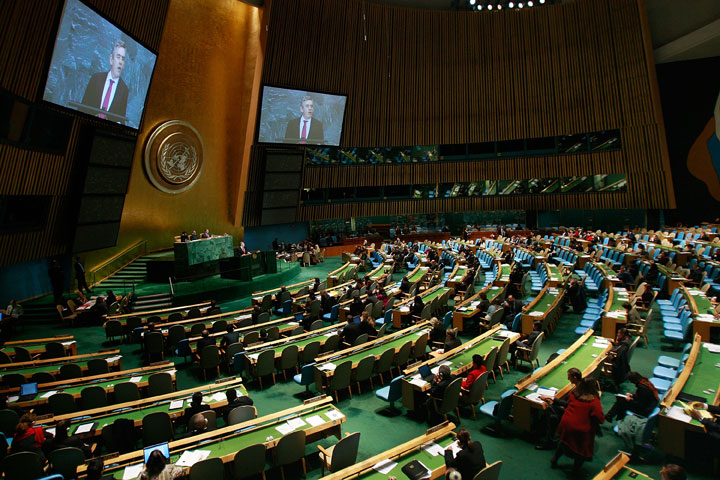
UNITED NATIONS -- Muslim nations at the UN will look into measures to highlight the plight of the Rohingya Muslims in Myanmar, making a solemn effort to bring the subject to the General Assembly, Permanent Representative of Egypt to the United Nations, Mootaz Ahmadein Khalil said.
In his letter to the UN Secretary General Ban Ki-Moon and President of the UN General Assembly Vuk Jeremic late Thursday, Khalil said that Muslim nations around the globe condemned the heinous acts perpetrated against the Rohingyas, stressing that the international community should act swiftly to end those people's suffering.
Muslim countries are contemplating a step to present a draft-resolution to the upcoming meeting of the General Assembly if the plight of the Muslim Rohingya continued, said Khalil.
He hoped that in the upcoming period, the situation of the Muslim Rohingyas would become better, urging the UN to take some serious to solve the matter.
Aye Nai
Democratic Voice of Burma (DVB)
May 17, 2013
May 17, 2013
Burma’s electoral commission has ordered a newly formed political party to expel six of its senior members for listing their ethnicity as “Rohingya” in their official biographies, according to party members.
Earlier this month, the Union Election Commission (UEC) forced the Democracy and Human Rights Party (DHRP), which was formed in March this year, to oust six of its central executive committee members for allegedly being “non-citizens”.
UEC director Tin Maung Cho told DVB that the six members had “breached” existing regulations for political parties as the Muslim Rohingya are not recognised as an official ethnic group in Burma.
According to Article 10(a) of the Political Parties Registration Law, a person can only become a political party member if they qualify as a Burmese citizen, an associate citizen, a naturalised citizen or a temporary certificate holder.
“They were listed as the ‘Rohingya’, which is not recognised by the state,” said Tin Maung Cho. “Foreigners are not allowed to take part in political parties,” he said, backing the government-held view that the Muslim minority are illegal immigrants from Bangladesh.
He added that the UEC had instructed the party to submit biographies of all other members of their central executive committee.
But the DHRP chairperson, Kyaw Min, insisted that members had already listed as “Rohingya” before the party was formally registered in March, but no issues had been raised at the time.
“We had to submit members’ biographies when we applied for the party registration and they were listed as [Rohingyas],” said Kyaw Min. “Now the [UEC] is asking us to re-submit everyone’s biographies.”
It appears that the six members are being regarded as “non-citizens” simply on the basis of calling themselves “Rohingya” – a term the government rejects – although they are likely to hold Burmese citizenship. “We have to look into this,” said Kyaw Min.
The term Rohingya is heavily disputed in Burma, with state officials and most Burmese people referring to the group as “Bengali”. But the Muslim group, which comprises some 800,000 people mainly residing in northwestern Burma’s Arakan state, insists the term had been used for centuries until the military junta stripped them of their citizenship in 1982.
Earlier this year, Shwe Maung, a self-proclaimed Rohingya MP from Maungdaw township, stirred controversy by calling for official recognition of the term, and prompted some nationalist groups to call for his citizenship to be “investigated”.
The Burmese government was recently implicated in ethnic cleansing against the stateless group, which has been described by the UN as one of the world’s most persecuted minorities.
But state officials have remained unrepentant. “How can it be ethnic cleansing? They are not an ethnic group,” Arakan state spokesman Win Myaing told Reuters this week.
The DHRP has played a vocal role in defending the rights of the Rohingya, which is likely to have irked members of Burma’s political elite. Both reformist President Thein Sein and opposition leader, Aung San Suu Kyi, have come under fire for refusing to speak up for the predominantly stateless minority.

Its chairman, Kyaw Min, originally won a seat in parliament for Buthidaung, northern Arakan state, in the annulled 1990 elections and has since worked with Suu Kyi’s National League for Democracy.
He was sentenced to 47 years in prison in 2005 for championing labour rights, but was released in a general amnesty in January 2012.

RB News
May 17, 2013
Maung Daw, Arakan - After the warnings on Mahasen cyclone had been issued, the displaced Rohingyas from the camps of Nget Chaung left by boat in order to go the safer place like the camps in Sandama (Sin Tet Maw). The boat that left on 13th May 2013 met with an accident and subsequently sunk in the river. Among the 81 people deaths, only two dead bodies were recovered.
Of the disappearing 79 dead bodies, 6 were found at the coastline of Myint Hlut (Merraullah) village. The eyewitnesses confirmed them to be the disappearing dead bodies of the people died in Pauktaw boat accident.
“We heard that many dead bodies were disappearing after the boat accident. These bodies found at the coastline still look fresh as it has not been many days after the accident. By their appearance and dress, we can confirm that they are Rohingyas who died during the boat accident” said local Rohingya in Southern Maung Daw.

The ashore dead bodies were taken away by NaSaKa (Border Security Force) under commandment area 8.
“The bodies were taken away by NaSaKa. Whether they were buried or not has not been known yet” he continued.
Of the dead bodies found on the beach, two were men, three women and one (girl) child. Besides, there are also reports that 19 dead bodies were found on the Bangladesh coast as well. But we could not have confirmed it yet.
(Translated into English by Maung Aurther)
(Translated into English by Maung Aurther)

Maung Aurther
RB News
May 17, 2013
Maung Daw, Arakan - This morning from 8 to 10 O’ Clock, three trucks of Burmese military stopped at the Bazaar of the village of Shikdafara (Myoma Kayintan). Then, they gathered some poor children and women begging at the Bazaar and took pictures of them in different positions in order to blindfold the world with the pictures portraying as if they helped Rohingyas ahead of the cyclone storm.
“Three trucks of military came from the squadron at the Maung Daw High School under the battalion number 352 at KyeMyaing, Southern Maung Daw. They stopped at the Bazaar of Shikdafara and gathered some poor children and women begging at the roadsides. And then they took a photograph of the poor people.
After that, Military put them on a truck and took another picture. Continuously, the people were taken to a place not so far from the previous one. Then, they were asked to get off. Military provided some biscuits and candies to the kids. Having received that, the kids smiled. Meanwhile, military took another photograph of them. They were released afterwards” said a local Rohingya.
“It is nothing but their desperate attempt to blindfold the world with their usual tactics. Yes, they did issue warnings about the storm but they didn’t help Rohingyas in going to the safer places at all. Rather, the government seems unhappy because Mahasen cyclone went off the tract of Arakan coast and didn’t destroy Rohingya people” he added.
 |
| Myanmar Muslims If Myanmar Wants a Democracy It Must Integrate Its Muslim Minority Reuters/ Damir Sagolj |
Policymic
May 17, 2013
Myanmar has experienced significant transitions in its economic and political institutions over the past year and half, but it has yet to respond to the recent burst of attacks against the country's Muslim minority. Muslims compose only 5% of Myanmar’s 60 million population, and with the displaced Rohingya minority among the country's population, the current government’s inability to seriously address this issue sets a dangerous precedent.
Muslims in Myanmar are often associated with the Rohingya population, a landless ethnic minority group who have been severely displaced, with neither Bangladesh nor Myanmar accepting them. The Myanmar government has described the Rohingyas as illegal immigrants who come from Bangladesh, while Bangladesh too has rejected the minority group, claiming they neither have the capacity nor land to allow another minority group to settle in a 100-million-person country the size of Iowa. This has led to displacement for the 800,000 Rohingyas, who often are drawn into conflicts with Buddhists.
What is concerning to many is the recent BBC footage in Myanmar where law-enforcement agents stood idly by as Buddhist monks and many others, often affiliated with the “969” movement, attacked different Muslim minorities in Rakhine and Meiktila. Violence between the two groups will not subside in the coming months. While the EU and many others have lifted trade restrictions, it is important to note how exactly Myanmar is going to handle this. Aung Sung Kyi, Myanmar’s most eminent leader has taken a more conciliatory approach in addressing this issue, emphasizing Myanmar’s, need to build a more unified society and have the Rohingyas integrated within a Buddhist-majority nation. Kyi mentions a notable point about integration, but the rise of Wirathu, a radical Buddhist monk who has called for the removal of Muslims and referred to them as the chief cause of these riots, has made this difficult.
The basic duty of any government is to protect its citizens. By not protecting its own people, the current Myanmar government is leaving a window of opportunity for more violence, less integration, and a more polarized society to develop. When communal tensions occur, we hear the voices that are projected the loudest. What we often don’t hear are the voices of the marginalized. These are the stories of the 5% of the Muslims there, and the many other minority communities all throughout the world.
Myanmar has many challenges ahead. Bringing an end to this violence and incorporating different ethnic groups into its democracy can help consolidate a smoother transition away from the military junta, which still has formidable power in the country. Picking on the minorities won’t solve the problem. Integrating them into a broader coalition in which their interests are represented will.
RB News
May 16, 2013
Sittwe, Arakan - Police vandalized the shelter tents of the internally displaced Rohingyas at Thay Chaung, Sittwe. The tents were used by the displaced Rohingyas came from Kyauk Phyu Township. Police destroyed the tents as the displaced Rohingyas evacuated them ahead of the Mahasen Cyclone.
“Most of our tents were crude and self-made. The government didn’t even help us in making them. We had left the camps ahead of the storm. Meanwhile, Police destroyed our shelters” said a displaced Rohingya from Thay Chaung.
Having issued the warnings on the Cyclone, the central government and the state government left no stone unturned to force the displaced Rohingyas to the nearest possible places towards the sea.
“The places the government planned for the displaced Rohingyas are the nearest to the sea. We are the people against whom genocide is being committed by the government. On top of that, they wanted to kill us in mass by forcing us to the nearest to the places to the sea during the storm. That’s why we refused to move to such places” he explained.
As the displaced people refused to move to the places nearest to the sea, Police and Hluntin (security forces) vandalized their self-made makeshift tents.
“Those police who were said to have come to help us behaved like murderers. That’s why people became afraid when Police come. As expected, Police destroyed our tents in our absence. Even though we had moved to the places nearest to the sea as the government wanted, we would not have had any places to stay either” he exclaimed about their crises.
(Translated into English by Maung Aurther)


 |
| Official Rohingya Refugees Camp in Bangladesh (Photo: Matias) |
Athena Yenko
May 16, 2013
U.N. Agency warns that 8 million people are most likely to be affected as strong Tropical Cyclone Mahasen looms over the Bay of Bengal, CNN reports. This estimated figure will likely to increase or decrease depending on the specific route that the cyclone will take when it hits landfall.
CNN international meteorologist Ivan Cabrera said that "the latest prediction suggests Mahasen will bring wind gusts of 85 to 90 kilometers per hour (53 to 56 mph) to the Bangladeshi coast. That puts it at the level of a tropical storm, weaker than 120 kilometer-per-hour gusts of hurricane. This will be a rain event for most in the area. If you are in a concrete building you will be fine outside of localized very heavy flooding."
Inhabitants alongside coastal areas of Bangladesh Myanmar are advised to prepare for the cyclone forecasted to make landfall either on Thursday night or early morning Friday. The cyclone would possibly bring strong wind and heavy rain in the neighboring southeastern Bangladesh, near the city of Chittagong.
Different agencies expressed deep concern for the thousands of Rohingya Muslims inhabiting makeshift camps in the low-lying areas. Agencies are doing their best efforts to evacuate residents to higher ground area. They make sure that emergency positions are at hand as soon as needed.
Valerie Amos, U.N.'s official for humanitarian affairs said that "Mahasen could be life threatening for millions of people in Bangladesh, Myanmar and India."
Andreas Von Weissenberg of the International Federation of the Red Cross and Red Crescent said that "There is a flurry of activity going on both in Bangladesh and in Myanmar ahead of the storm. It's really a race against time in many ways."
The Rohingya Muslims
Myanmar is mainly a Buddhist country and only about 5 per cent of its 60 million people are Muslims. This 5 per cent Muslims had to endure anti-Muslim campaign by Buddhist monks.
Rohingya is a stateless Muslim minority who endure long accounts of hardship all through the half century military rule in Myanmar.
As Reuters puts it, Rohingya is a group of impoverished and long persecuted people who was caught in between sectarian violence.
According to reports, there were 192 people killed in June and October of 2012 when aggression happens between Rakhine Buddhists and Rohingya. The violence resulted when Rohingya was denied citizenship and proclaimed immigrants by the Myanmar government.
In April 2013, Myanmar authorities were allegedly involved in a Buddhist campaign of "ethnic cleansing" against the Rohingya in Rakhine.
With their experience of violence, Rohingya living at the makeshift camps built with bamboo and thatch - refused to relocate out of distrust to government agencies.
The United nations Office for the Coordination of Humanitarian Affairs (OCHA) said that Rohingya "are reluctant to relocate and some communities have refused to use military vehicles or to shelter in military barracks."
Reuters reports that Rohigya declares that they want to die there. Some would not even dare to get near the army barracks.
Fatima Hadu, 65 years old, one of the Rohingya living in the makeshift camps, said that "If the storm comes, we want to die here."
Another Rohingya man told interviewers that "We didn't receive food assistance here. If we go to a new place, we won't receive food assistance. Whether there's a storm or not, we will die here."
 |
| Deputy Assistant Secretary for Population, Refugees and Migration, Kelly Clements, consults with the resident of the “Bu May” internally-displaced persons (IDP) camp in Sittwe Township. (Photo: US Embassy Rangoon) |
Maung Auther
Narrative Article
Rohingya Blogger
May 16, 2013
During the period natural disasters, any responsible government, in any corner of the world, remains engaged in evacuation programs and taking protective steps in order to save its citizens or people from disasters. And Cyclone storm approaches Arakan coast, which is now barely around 300 miles away from the coast. But Burmese regime is up to deceiving the world with its usual cunning and apartheid methods. And of course, the domestic media in Burma are not but on par with Burmese regime in deceptions and lying. The Burmese government is telling the world that it is relocating the displaced Rohingyas to the higher places in order to protect them from the possible disasters. The domestic media are biblically spreading the news as such.
But how is the regime helping Rohingyas in moving to the safer places? All the Rohingyas in all over Arakan have the same account to say. Let’s have a look into the miserable situation that Rohingyas say they are in. “There are some camps of Rakhines on the beach besides the Sittway Hotel. They are, in actual fact, are poor Rakhines who are made to pretend as if Refugees by authority in order to hide the reality of the one-sided violence targeted Rohingyas. At the same time, they are having International assistances pretending as if Refugees. Now, those Rakhines are being moved to the monasteries and schools.
Cruelly enough, the Arakan state administration asked the displaced Rohingyas in Sittway to move to the camps at the beach being evacuated by Rakhines. There is a possibility that this place will get in the water as the water level arises. By this, it will not be difficult for one to understand that the government just wants to kill Muslims” said a displaced Rohingyas from Sittway.
Another local Rohingya from southern Maung Daw states “what we are worried of is that the only government staffs and Rakhines have been moved to the safe places such as to the mountains. Rohingyas are still in their houses. In the villages such as Kunkara Fara, Baddil and Gojjon Dia of Padin village tract, Shikda Fara (Kayin Tan) and some other villages in Maung Daw, the authority officials are gathering Rohingyas by force and shooting videos to make up a fake scenario to deceive the world that they are helping Rohingyas. In reality, it is completely opposite situation.”
The head of the Maung Daw District Adminstration, in his interview to Radio Free Asia, said on 14th May 2013 night “we are trying to move Bengalis to the safe places. But they are not willing to go.” Concerning this, a Rohingya expressed his feeling “now, tell me who wants to die? Who doesn’t want to stay alive? If they are really willing to help us, we are ready to take it with an open arm. But they are lying and rather trying to make us suffer more by taking us to the empty places with no shelter and food. What they only did was just issuing warning to us about the storm.”
According a Rohingya in Southern Maung Daw, the authority in his region did ask some Rohingyas to go to the high lands taking some food rations for three to four days. Their saying of helping Rohingyas with food ration and shelter is said to be completely false. And in Padin village tract, Military and NaSaKa did promise to help Rohingyas with food rations. But no ration has been provided yet.
In Mrebun Township, no displaced Rohingyas and Kamans have been taken to the safe places yet. In the Pauktaw Township, the displaced Rohingyas are going through some disasters. Many displaced Rohingyas from the camps of Nget Chaung are moving to the Sin Tet Maw (Sandama). However, there are no shelter and food for them over the place. One Rohingya victim cried “Authority just screamed at us to move to wherever we feel to be safe. They will not help. They are just asking us to move but do not tell us where and how to move. The places they want us to go to are more dangerous. They just want to kill us. Many of us will die if we don’t get shelter and food in time.’
On Monday night, more than 150 Rohingyas from a village called Domfara leaving for Sandama (Sin-Tet-Maw) died as their boat sunk evacuating ahead of the storm. They had been blocked by Rakhine extremists and trying to escape secretly at night. To their misfortune, many people died.
It hardly came as a surprise to Rohingyas about double standard behavior of the Burmese. Saying something to the world and doing something else. “We expected that government would lie and cheat as usual. They like to lie and feel happy in doing so. Ultimately, they can kill more Rohingyas without using their guns” exclaimed elderly Rohingya from Sittway.
“We plead the international community not to simply believe the fascist Burmese official narratives and their racist media. If you find hard to believe, please come and see our situation on the ground” he added. As the consequences of the government’s deceptions and apartheid tactics, the fear among Rohingyas escalate day by day. The Cyclone is expected to hit Arakan soon. Rohingyas were forced to the sea beaches. Just prepare your popcorn to enjoy while watching the news of another catastrophe to come TV tomorrow. Their fear is turning into a reality. The entire humanity will regret for not preventing yet another manufactured humanitarian disaster in their capability.
The writer is an activist and student. He can be reached at Dhannyawadi@gmail.com
 |
| Women pass their time in a Rohingya internally displaced person (IDP) camp outside of Sittwe (Reuters) |
Gianluca Mezzofiore
International Business Times
May 15, 2013
Myanmar authorities have attempted to force Rohingya refugees in Sittwe, the capital of Rakhine state, to move closer to beach areas as the cyclone Mahasen approaches the exposed coast.
International Business Times
May 15, 2013
Myanmar authorities have attempted to force Rohingya refugees in Sittwe, the capital of Rakhine state, to move closer to beach areas as the cyclone Mahasen approaches the exposed coast.
Sources speaking to IBTimes UK said that Rohingya Muslims refused any attempt to relocate as the cyclone, which has already killed at least seven people and displaced 3,881 in Sri Lanka, nears.
The Myanmar government planned to move 38,000 internally displaced people, but many refused fearing the authorities’ intentions.
Nay San Lwin, a Rohingya living in Germany with contacts in Sittwe, claimed that Rohingya “were forced to go” but only five families agreed. “100% confirmed that the authorities are forcing Rohingya refugees in Sittwe to move to the beach,” he said. “State Chief Minister warned today that will take serious action and President Office Minister Aung Min also told the same like at meeting in Yangon today.”
His report was confirmed by Aung Aung, a Rohingya living in a refugee camp in Sittwe.
In reality, they evacuated only Rakhine, not #Rohingya, Rakhine authority has been trying to send all #Rohingya to the beach
— Aung Aung (@Aungaungsittwe) May 15, 2013
Rakhne authority wants to move all #Rohingya living in the huts to Pa Lin Pyin near the seaMark Farmaner, of the Burma Campaign UK, confirmed to IBTimes UK that he heard reports of Rohingya forced closer to the beaches but was unable to confirm it. “Rohingya are still not being moved [to safety],” he said.
— Aung Aung (@Aungaungsittwe) May 15, 2013
Hla Maung said he lost his mother and two young daughters during the clashes between Muslims and Buddhists.
He told the BBC: "I lost everything ... I don't want to go anywhere. I'll stay here. If I die, I want to die here," he said.
At least 192 people were killed in June and October last year in sectarian clashes between Rakhine Buddhists and Rohingya. Reuters reported that people at a camp near the sea by Hmanzi Junction near Sittwe said they would rather prefer to die in the storm than evacuate.
Farmaner said he is particularly concerned about the cyclone hitting Bangladesh. There are up to 250,000 Rohingya living in southern Bangladesh, many of whom fled from Myanmar in the early 1990s complaining of abuses by the army.
UN says storm expected to make landfall in Chittagong: “In its strongest force, the cyclone will be hitting area where hundreds of thousands of refugee are stacked,” he said. “There are people very vulnerable in terrible condition and we’ve not heard any attempt by Bangladeshi government to move them.
“Refugee living in official camps are already not in a very good condition. Those who live in unofficial camps, made of makeshift shelter, are in an appalling condition,” he added.
About 140,000 people were displaced in June and a second wave of violence in October in western Rakhine state.
Burma Campaign UK says the international community “applied the most low-level diplomacy” and failed to put pressure on the Burma government, who did nothing to prevent the crisis.
“It’s already a humanitarian crisis but it will become an humanitarian disaster. Lives will be lost. If the international community had put pressure on Burma that could’ve been avoided.”
Burma Campaign UK called on the British government and international community to take action to force President Thein Sein to allow unrestricted humanitarian aid, and stop violating international humanitarian law.
At least 50 Rohingya Muslims were feared drowned on Tuesday when boats evacuating them from the path of the cyclone capsized off western Burma.
In 2008, Cyclone Nargis killed more than 130,000 people in Myanmar.
 |
| Refugees Camp in Pauktaw (Photo: US Embassy Rangoon) |
Maung Maung
RB News
May 15, 2013
Pauktaw, Arakan- There are 7023 displaced Rohingyas living in the camps of Nget Chaung located nearby the sea of Hantha, Pauktaw Township. Being near to the sea, it is highly dangerous and can easily be affected by the coming cyclone. On 12th May 2013, the head of the township administration and the military officials came to camps and alerted the people about coming storm.
“Though they issued warnings, they didn’t help displaced Rohingyas in moving to the safer places. They irresponsibly told the displaced Rohingyas to go to wherever they feel safe by their own means” said a displaced Rohingya in Pauktaw.
Therefore, on 13th May 2013 night, more than 1200 people left the camps of Nget Chaung by six boats.
“Our people had to leave at night because of the life danger posed by the Rakhine extremists. And a boat sunk nearby a Rakhine village not so long after it had started off” he added.
According to the displaced Rohingyas in Pauktaw, 43 people escaped alive and two dead bodies were found. Meanwhile, 79 dead bodies have not been found yet. According to the UN Humanitarian Agencies’ statement to Associate Press, 8 dead bodies were recovered, 42 people remained alive and the dead bodies of other 50s have not been found yet.
A local Rohingya in Pauktaw said “we have done our best to list it in detail” concerning the differences in the accounts of deaths.
“On 13th and 15th of May, around 4000 displaced Rohingyas arrived to the camps of Sandama (Sin-Tet-Maw). Today, the head of the township administration and the military officials came to the camps screamed at the displaced people that they don’t want to see them (displaced people) any longer and so to go to wherever they (displaced people) wish. We are worried of the coming storm. We need to be afraid of Rakhine extremists. And on the hand, the government is also scaring the people. We are living in an extremely vulnerable situation” he continued.
The displaced Rohingyas arriving to the camps of Sandama (Sin-Tet-Maw) fall extremely short of food and shelter. The government is telling the world that they are trying to relocate the displaced to Rohingyas to the safer places. In reality, the places where the government wants the displaced Rohingyas to go are more dangerous and unavoidable from the consequences of the storm. Therefore, the displaced Rohingyas are reluctant to such places.
(Translated into English by Maung Aurther)
(Translated into English by Maung Aurther)

RB News
May 15, 2013
BRCNL was invited by Miss Sophie BUSSON, Sub-Directorate of Human Rights and Humanitarian Affairs & Sub-Directorate of the United nations, international organizations and the francophone of Ministry of Foreign Affairs of France and Miss Alexandra MIAS, Director of Southeast Asia Division of Ministry of Foreign Affairs of France for a meeting in order to discuss 2 subjects. 1. Situation of Rohingya in Arakan and 2. Crimes against humanity, ethnic cleansing of Rohingya in Arakan. The meeting was planned on 13th May 2013 from 15:30 pm to 16:30 pm at the Ministry of Foreign Affairs in Paris. Mr. Hla Aung, president of NDPHR in exile from Paris accompanied with the delegation of BRCNL.
In the meeting, Sazaat Ahammed, Chairman of BRCNL has discussed the present situation of Internally Displaced Rohingyas, Rohingyas in Camps, in Townships and in Villages of Arakan. And the worry of Rohingyas by the remarks of President Thein Sein; intention to deport all Rohingyas to third country and not to revise the by a group of dictators led by dictators General Nay Win imposed citizenship law of 1982 which makes Rohingyas deliberately stateless, that gives yet the Buddhist mobs the encouragement to attack not only the Rohingyas in Arakan but also all Muslims throughout Burma.

Sazaat Ahammed highlighted that killings, arbitrary arrests, torture, forcing to leave Arakan, restriction on movement, restriction on education, restriction on medication, restriction to marry, restriction to have baby, extortion of money, intimidation, rape, forcefully Bengalizing, looting, segregation and burning become the daily persecution of Extremist Rakhines and Security Forces of Burmese Government against the Internally Displaced Rohingyas, remaining Rohingyas in Townships and Villages of Arakan. Furthermore, Sazaat also discussed “cannot protect Rohingyas”, has been said by authority to Madam Melanie Teff from the Charity Refugees International who recently backed from Arakan.
With regard to the crimes against humanity, Sazaat Ahammed giving example of experts and specialists from different field said that the reports of experts and specialists are counted and taken into consideration in general. In the case of Rohingya, Professor Willem Schabas, the former president of International Association of genocide scholars said that it [persecution against Rohingyas] turns into the genocide by expressing that if peoples are forced to leave the place where they live, if peoples are restricted to move from one place to another within the place where they live, if peoples are restricted to access education, if peoples are restricted to access medication, if peoples are restricted to marry, if peoples are restricted to have baby and if peoples are restricted to daily activities those are all signs of genocide, which Rohingyas face daily in Arakan, Burma.
And discussed the report of Human Rights Watch [crimes against humanity, ethnic cleansing of Rohingya in Arakan, Burma]. According to International Law, International Community has the obligation to stop crimes against humanity, particularly the obligation of France, United Kingdom and United States of America because these countries committed to humanity and Human Rights. Sazaat has on the one hand appealed France through Miss Sophie BUSSON that France being a permanent member of Security Council to bring these crimes against Humanity to the Security Council of United Nations to get a Binding Resolution so that Peace Keeping Forces of United Nations must be sent to Arakan to stop crimes against humanity. On the other hand, Sazaat has humbly requested France Government through Miss Alexandra MIAS to strongly pressure the government of Burma to end killings, arbitrary arrests, torture, forcing to leave Arakan, restriction on movement, restriction to education, restriction to medication, restriction to marry, restriction to have baby, extortion of money, intimidation, rape, forcefully Bengalizing, looting, segregation, burning, to let domestic and international aids and aids workers reach the Rohingyas, to enforce law for the security of lives, faith, places of worship and properties, to revise the discriminatory citizenship law of 1982 with the international standards so that Rohingya gets the ethnic and civil rights back.
Mr. Hla Aung, has extensively discussed the report of Rakhine investigation commission, and rejected it. Further he highlighted how Burmese government brings the Bengali Rakhines from Bangladesh and resettles them in the lands of Rohingyas. At the end of the meeting Sazaat handed over a file to Miss Alexandra MIAS in which consisted of a letter, a copy of joint statement on the official report of Rakhine Investigation Commission issued on 3rd May 2013 and a document of 51 graphic photos of Rohingya Ethnic Cleansing.
 |
| Wadulae, a 16-year-old Rohingya Muslim boy with severe symptoms of rabies, is comforted by family members at a local clinic at a camp for people displaced by violence near Sittwe April 29, 2013. REUTERS/Damir Sagolj |
Jason Szep
May 15, 2013
A 16-year-old Muslim boy lay dying on a thin metal table. Bitten by a rabid dog a month ago, he convulsed and drooled as his parents wedged a stick between his teeth to stop him from biting off his tongue.
Swift treatment might have saved Waadulae. But there are no doctors, painkillers or vaccines in this primitive hospital near Sittwe, capital of Rakhine State in western Myanmar. It is a lonely medical outpost that serves about 85,300 displaced people, almost all of them Muslims who lost their homes in fighting with Buddhist mobs last year.
"All we can give him is sedatives," said Maung Maung Hla, a former health ministry official who, despite lacking a medical degree, treats about 150 patients a day. The two doctors who once worked there haven't been seen in a month. Medical supplies stopped when they left, said Maung Maung Hla, a Muslim.
These trash-strewn camps represent the dark side of Myanmar's celebrated transition to democracy: apartheid-like policies segregating minority Muslims from the Buddhist majority. As communal violence spreads, nowhere are these practices more brutally enforced than around Sittwe.
In an echo of what happened in the Balkans after the fall of communist Yugoslavia, the loosening of authoritarian control in Myanmar is giving freer rein to ethnic hatred.
President Thein Sein, a former general, said in a May 6 televised speech his government was committed to creating "a peaceful and harmonious society in Rakhine State."
But the sand dunes and barren paddy fields outside Sittwe hold a different story. Here, emergency shelters set up for Rohingya Muslims last year have become permanent, prison-like ghettos. Muslims are stopped from leaving at gunpoint. Aid workers are threatened. Camps seethe with anger and disease.
In central Sittwe, ethnic Rakhine Buddhists and local officials exult in what they regard as a hard-won triumph: streets almost devoid of Muslims. Before last year's violence, the city's Muslims numbered about 73,000, nearly half its population. Today, there are fewer than 5,000 left.
Myanmar's transformation from global pariah to budding democracy once seemed remarkably smooth. After nearly half a century of military dictatorship, the quasi-civilian government that took power in March 2011 astonished the world by releasing dissidents, relaxing censorship and re-engaging with the West.
Then came the worst sectarian violence for decades. Clashes between Rakhine Buddhists and stateless Rohingya Muslims in June and October 2012 killed at least 192 people and displaced 140,000. Most of the dead and homeless were Muslims.
"Rakhine State is going through a profound crisis" that "has the potential to undermine the entire reform process," said Tomás Ojea Quintana, U.N. special rapporteur on human rights in Myanmar.
Life here, he said, resembles junta-era Myanmar, with rampant human-rights abuses and a pervasive security apparatus. "What is happening in Rakhine State is following the pattern of what has happened in Myanmar during the military government," he said in an interview.
The crisis poses the biggest domestic challenge yet for the reformist leaders of one of Asia's most ethnically diverse countries. Muslims make up about 5 percent of its 60 million people. Minorities, such as the Kachin and the Shan, are watching closely after enduring persecution under the former junta.
As the first powerful storm of the monsoon season approached western Myanmar this week, the government and U.N. agencies began a chaotic evacuation from the camps, urging thousands of Rohingya Muslims to move to safer areas on higher ground across Rakhine State.
Some resisted, fearing they would lose all they had left: their tarpaulin tents and makeshift huts. More than 50 are believed to have drowned in a botched evacuation by sea.
"THEY ALL TELL LIES"
Sittwe's last remaining Muslim-dominated quarter, Aung Mingalar, is locked down by police and soldiers who patrol all streets leading in and out. Muslims can't leave without written permission from Buddhist local authorities, which Muslims say is almost impossible to secure.
Metal barricades, topped with razor wire, are opened only for Buddhist Rakhines. Despite a ban against foreign journalists, Reuters was able to enter Aung Mingalar. Near-deserted streets were flanked by shuttered shops. Some Muslims peered from doors or windows.
On the other side of the barricades, Rakhine Buddhists revel in the segregation.
"I don't trust them. They are not honest," said Khin Mya, 63, who owns a general store on Sittwe's main street. "Muslims are hot-headed; they like to fight, either with us or among themselves."
Ei Mon Kyaw, 19, who sells betel nut and chewing tobacco, said Muslims are "really dirty. It is better we live apart."
State spokesman Win Myaing, a Buddhist, explained why Aung Mingalar's besieged Muslims were forbidden from speaking to the media. "It's because they all tell lies," he said. He also denied the government had engaged in ethnic cleansing, a charge levelled most recently by Human Rights Watch in an April 22 report.
"How can it be ethnic cleansing? They are not an ethnic group," he said from an office on Sittwe's main street, overlooking an empty mosque guarded by soldiers and police.
His comments reflect a historic dispute over the origins of the country's estimated 800,000 Rohingya Muslims, who claim a centuries-old lineage in Rakhine State.
The government says they are Muslim migrants from northern neighbour Bangladesh who arrived during British rule from 1824. After independence in 1948, Myanmar's new rulers tried to limit citizenship to those whose roots in the country predated British rule. A 1982 Citizenship Act excluded Rohingya from the country's 135 recognized ethnic groups, denying them citizenship and rendering them stateless. Bangladesh also disowns them and has refused to grant them refugee status since 1992.
The United Nations calls them "virtually friendless" and among the world's most persecuted people.
BOAT PEOPLE EXODUS
The state government has shelved any plan to return the Rohingya Muslims to their villages on a technicality: for defying a state requirement that they identify themselves as "Bengali," a term that suggests they are illegal immigrants from Bangladesh.
All these factors are accelerating an exodus of Rohingya boat people emigrating in rickety fishing vessels to other Southeast Asian countries.
From October to March, between the monsoons, about 25,000 Rohingya left Myanmar on boats, according to new data from Arakan Project, a Rohingya advocacy group. That was double the previous year, turning a Rakhine problem into a region-wide one.
The cost of the one-way ticket is steep for an impoverished people - usually about 200,000 kyat, or $220 (144 pounds), often paid for by remittances from family members who have already left.
Many who survive the perilous journeys wind up in majority-Muslim Malaysia. Some end up in U.N. camps, where they are denied permanent asylum. Others find illegal work on construction sites or other subsistence jobs. Tens of thousands are held in camps in Thailand. Growing numbers have been detained in Indonesia.
MOB VIOLENCE
Rakhine State, one of the poorest regions of Southeast Asia's poorest country, had high hopes for the reform era.
In Sittwe's harbour, India is funding a $214 million port, river and road network that will carve a trade route into India's landlocked northeast. From Kyaukphyu, a city 65 miles (104 km) southeast of Sittwe, gas and oil pipelines stretch to China's energy-hungry northwest. Both projects capitalize on Myanmar's growing importance at Asia's crossroads.
That promise has been interrupted by communal tensions that flared into the open after the rape and murder of a Buddhist woman by Muslim men in May last year. Six days later, in retribution, a Buddhist mob beat 10 Muslims to death. Violence then swept Maungdaw, one of the three Rohingya-majority districts bordering Bangladesh, on June 8. Rohingya mobs destroyed homes and killed an unknown number of Rakhines.
The clashes spread to Sittwe. More than 2,500 homes and buildings went up in flames, as Rohingya and Rakhine mobs rampaged. When the smoke cleared, both suffered losses, though the official death toll for Rohingya - 57 - was nearly double that for Buddhist Rakhines. Entire Muslim districts were razed.
October saw more violence. This time, Buddhist mobs attacked Muslim villages across the state over five days, led in some cases by Rakhine nationalists tied to a powerful political party, incited by Buddhist monks and abetted at times by local security forces..
U.S. President Barack Obama, on a groundbreaking visit in November, urged reconciliation. "The Rohingya ... hold within themselves the same dignity as you do, and I do," he said. The week he visited, Thein Sein vowed to forge ethnic unity in a letter to the United Nations.
But the violence kept spreading. Anti-Muslim unrest, whipped up by Buddhist monks, killed at least 44 people in the central city of Meikhtila in March. In April and May, Buddhist mobs destroyed mosques and hundreds of Muslim homes just a few hours' drive from Yangon, the country's largest city.
Thein Sein responded by sending troops to volatile areas and setting up an independent commission into the Rakhine violence. Its recommendations, released April 27, urged meetings of Muslim and Buddhist leaders to foster tolerance, Muslims to be moved to safer ground ahead of the storm season, and the continued segregation of the two communities "until the overt emotions subside."
It sent a strong message, calling the Rohingya "Bengalis," a term that suggests they belong in Bangladesh, and backing the 1982 citizenship law that rendered stateless even those Rohingya who had lived in Myanmar for generations.
The Rohingya's rapid population growth had fuelled the clashes with Buddhists, it said, recommending voluntary family-planning education programs for them. It suggested doubling the number of soldiers and police in the region.
Rohingya responded angrily. "We completely reject this report," said Fukan Ahmed, 54, a Rohingya elder who lost his home in Sittwe.
Local government officials, however, were already moving to impose policies in line with the report.
THE HATED LIST
On the morning of April 26, a group of state officials entered the Theak Kae Pyin refugee camp. With them were three policemen and several Border Administration Force officers, known as the Nasaka, a word derived from the initials of its Burmese name. Unique to the region, the Nasaka consists of officers from the police, military, customs and immigration. They control every aspect of Rohingya life, and are much feared.
Documented human-rights abuses blamed on the Nasaka include rape, forced labour and extortion. Rohingya cannot travel or marry without the Nasaka's permission, which is never secured without paying bribes, activists allege.
State spokesman Win Myaing said the Nasaka's mission was to compile a list identifying where people had lived before the violence, a precondition for resettlement. They wanted to know who was from Sittwe and who was from more remote townships such as Pauktaw and Kyaukphyu, areas that saw a near-total expulsion of Muslims in October.
Many fled for what Win Myaing said were unregistered camps outside Sittwe, often in flood-prone areas. "We would like to move them back to where they came from in the next two months," said Win Myaing. The list was the first step towards doing that.
The list, however, also required Muslims to identify themselves as Bengali. For Fukan Ahmed and other Rohingya leaders, it sent a chilling message: If they want to be resettled, they must deny their identity.
Agitated crowds gathered as the officials tried to compile the list, witnesses said. Women and children chanted "Rohingya! Rohingya!" As the police officers were leaving, one tumbled to the ground, struck by a stone to his head, according to Win Myaing. Rohingya witnesses said the officer tripped. Seven Rohingya were arrested and charged with causing grievous hurt to a public servant, criminal intimidation and rioting.
Compiling the list is on hold, said Win Myaing. So, too, is resettlement.
"If they trust us, then (resettlement) can happen immediately. If you won't even accept us making a list, then how can we try and do other things?" he asked. The crisis could be defused if Rohingya accepted the 1982 Citizenship Law, he said.
But doing so would effectively confirm their statelessness. Official discrimination and lack of documentation meant many Rohingya have no hope of fulfilling the requirements.
Boshi Raman, 40, said he and other Rohingya would never sign a document calling themselves Bengali. "We would rather die," he said.
Win Myaing blamed the Rohingya for their misfortune. "If you look back at the events that occurred, it wasn't because the Rakhines were extreme. The problems were all started by them," the Muslims, he said.
SCORCHED EARTH
In Theak Kae Pyin camp, a sea of tarpaulin tents and fragile huts built of straw from the last rice harvest, there is an air of growing permanence. More than 11,000 live in this camp alone, according to U.N. data. Naked children bathe in a murky-brown pond and play on sewage-lined pathways.
A year ago, before the unrest, Haleda Somisian lived in Narzi, a Sittwe district of more than 10,000 people. Today, it is rubble and scorched earth. Somisian, 20, wants to return and rebuild. Her husband, she says, has started to beat her. In Narzi, he worked. Now he is jobless, restless and despondent.
"I want to leave this place," she said.
Some of those confined to the camps are Kaman Muslims, who are recognized as one of Myanmar's 135 official ethnic groups; they usually hold citizenship and can be hard to tell apart from Rakhine Buddhists. They fled after October's violence when their homes were destroyed by Rakhine mobs in remote townships such as Kyaukphyu. They, too, are prevented from leaving.
Beyond Sittwe, another 50,000 people, mostly Rohingya, live in similar camps in other parts of the state destroyed in last year's sectarian violence.
Across the state, the U.N relief agency has provided about 4,000 tents and built about 300 bamboo homes, each of which can hold eight families. Another 500 bamboo homes are planned by year-end. None are designed to be permanent, said agency spokeswoman Vivian Tan. Tents can last six months to a year; bamboo homes about two years.
The agency wants to provide the temporary shelter that is badly needed. "But we don't want in any way to create permanent shelters and to condone any kind of segregation," Tan said.
Aid group Doctors Without Borders has accused hardline nationalists of threatening its staff, impairing its ability to deliver care. Mobile clinics have appeared in some camps, but a U.N. report describes most as "insufficient."
Waadulae, suffering from rabies, was treated at Dar Paing hospital, whose lone worker, Maung Maung Hla, was overwhelmed. "We have run out of antibiotics," he said. "There is no malaria medicine. There's no medicine for tuberculosis or diabetes. No vaccines. There's no equipment to check peoples' condition. There are no drips for people suffering from acute diarrhoea."
State spokesman Win Myaing said Rakhine doctors feared entering the camps. "It's reached a stage where they say they'd quit their jobs before they would go to these places," he said.
The treatment of the Rohingya contrasts with that of some 4,080 displaced ethnic Rakhine Buddhists in central Sittwe. They can leave their camps freely, work in the city, move in with relatives in nearby villages and rebuild, helped by an outpouring of aid from Burmese business leaders.
Hset Hlaing, 33, who survives on handouts from aid agencies at Thae Chaung camp, recalls how he earned 10,000 kyat a day from a general-goods stall in Sittwe before his business and home went up in flames last June. Like other Muslims, he refuses to accept the term Bengali.
"I don't want to go to another country. I was born here," he says, sipping tea in a bamboo shack. "But if the government won't accept us, we will leave. We'll go by boat. We'll go to a country that can accept us."
(Edited by Andrew R.C. Marshall and Bill Tarrant.)
-
 "Although mass killings and exterminations of human races were some sort of things that the world experienced during Nazi German p...
 -
 More than 400,000 Rohingya have fled from Myanmar to neighbouring Bangladesh By BBC News September 17, 2017 Myanmar's de ...
 -
 ပါလီမန္အမတ္ဦးေရႊေမာင္ၿပည္သူ႔လြတ္ေတာ္တြင္ရခိုင္ၿပည္နယ္၌ၿဖစ္ပြါးခဲ့ေသာအေရးအခင္းနဲ့ ပတ္သက္၍ေဆြးေနြးတင္ၿပၿခင္း။ (14th day of regular ses...
 -
 RB News March 31, 2018 Minbya, Arakan State : On March 30 morning, a Prayer Leader or Imam was brutally beaten and injured by a Rakh...
 -
 ဇြန္လ ၁၇ ရက္ ၊ ၂၀၁၂ Source: guardian.co.uk ျမန္မာျပည္သစ္အတြက္ အနာဂတ္မွာ ေအာင္ျမင္မွာလား၊ က်ရွဳံးမွာလားဆိုသည္ကို ညႊန္ျပေသာ စမ္းသပ္မွဳ တစ...
 -
 Read letter here Read history of Rohingya here Download letter PDF here Download History of Rohingya PDF here credi...
 -
 At Baggona, a village three miles far from and lies to the South of Maung Daw of Arakan state, more than 80 Rohingya women and girls have be...
 -
 RB News May 17, 2013 Maung Daw, Arakan - After the warnings on Mahasen cyclone had been issued, the displaced Rohingyas from the ...
 -
 12/07/2012 Joint press release HUMANITY GONE ...
 -
 The custodian of Two Holy Mosques King Abdullah bin Abdul Aziz Al Saud Aug 11 The custodian of Two Holy M...

Popular Posts
Threatwiki

Amartya Sen: Burma's "slow genocide" of Rohingyas

Watch Professor Amartya Sen speak on what he calls Burma's 'slow genocide' of Rohingya, Harvard, 4 Nov 2014

