

Himaya Quasem
April 19, 2013
PHUKET - In a narrow, damp alley at the heart of this bustling tourist hotspot sits a row of tin-roofed shacks. Hidden from view, they house Rohingya Muslims who have fled sectarian bloodshed in neighboring Myanmar.
Described by the United Nations as one of the most persecuted minorities in the world, the Rohingya - including women and children - have been fleeing the country by boat in growing numbers to escape communal rioting, which has killed an estimated 200 people and left tens of thousands homeless.
Although Myanmar has been widely praised for adopting democratic reforms after years of isolation, a recent spate of ethnic clashes has raised fresh concerns about its stability.
Last month, Buddhist mobs were locked in deadly clashes with Muslims, burning homes and mosques, in the central part of the country. The carnage followed similar sectarian violence between Rakhine Buddhists and Rohingya Muslims in western Myanmar last year.
Denied citizenship by the authorities, the stateless Rohingya - who are categorized by the United Nations as a religious and linguistic minority from western Myanmar but widely viewed inside the country as illegal Bengali migrants - seek sanctuary in neighboring countries.
Some end up in parts of Thailand, including Phuket, which is better known for its sun-drenched beaches and raucous nightlife. Sitting cross-legged on the floor of a shack on the outskirts of Phuket town, Ismail, not his real name, tells a story of suffering and abuse that is a far cry from the carefree domain of the happy holidaymaker.
"I saw my neighbors' house being burnt to the ground," said the 47-year-old fisherman, recalling the gruesome scenes he witnessed during the violence in Rakhine state. "I could find no sign of my neighbors after that. People were being shot and stabbed. I saw a small child being hacked down like a sapling."
The conflict erupted in June amid reports that a young Rakhine Buddhist woman had been raped and murdered by Rohingya men. As retaliatory attacks spiraled out of control, entire villages were razed, leaving an estimated 125,000 people homeless, most of them Rohingya.
A state of emergency was declared, which briefly stemmed the bloodshed, but a fresh wave of violence broke out in October. This time it was not clear what sparked the clashes. Human rights groups have accused the Myanmar security forces of tacitly supporting Rakhine Buddhist outrages against the Rohingya as part of a policy to drive them out of the country.
The bloodletting certainly prompted Ismail to leave. His boat was destroyed in the rioting and he could no longer feed his family, so he decided to find work abroad. Along with 63 others, he boarded a rickety boat that sailed for 12 days, sometimes through storms, before nearing the Thai coast.
Ismail said the Thai navy captured them and sold them to people smugglers who took them by truck to a camp in southern Thailand. "We were stuffed into a small house like cattle. I had no idea where I was or what was going on."
He lived on mouthfuls of rice scooped from a single large bowl he shared with the other captives. They slept in a cramped room next to the only toilet, which was a fetid hole in the ground covered by a sheet, he said. Those were the least of Ismail's worries. The men who were holding him demanded 40,000 baht (US$1,400) as a "fee" for entering Thailand.
"Some days, without any reason, they would grab me, tie my arms and legs and lay me flat on my stomach," he said. "Then, they started hitting me on my back and legs with heated metal rods and rope. After three or four blows I would pass out."
Ismail understood that unless he could produce the money, the beatings would not stop. His captors allowed him to contact a fellow Rohingya living in Phuket, who managed to raise some of the funds. The rest came from his wife, who is still in Myanmar. To save her husband's life, she sold a cow and sent the money to his captors via a shadowy network of brokers who took a cut, Ismail said.
After 24-days in the camp, his ordeal ended and he was sent by bus to Phuket, where he is now living illegally. Down the road from where Ismail lives is a government-run shelter housing children who have recently arrived in Thailand by sea.
"We were on the boat for days without food, we just had a small amount of water to drink," one of the boys told this writer. "The youngest among us is four years old."
Although Thailand has provided temporary protection to Rohingya, the government does not register them as refugees. Instead, it adheres to an official policy of "helping on" boat people to a third destination by providing them with food, water and assistance to continue their perilous journey.
But the Thai Navy has been accused of abuses, like the ones that Ismail describes. These also include shooting at boatloads of Rohingya and selling others to human traffickers. The Thai government has said it will look into the allegations.
The situation for Rohingya heading to Bangladesh and Malaysia is also far from ideal. An estimated 200,000 Rohingya languish in squalid, unofficial camps on the Bangladeshi coast and only around 28,000 of them have been registered as refugees. After violence erupted in Rakhine, Bangladesh turned away boatloads of fleeing Rohingya.
While Malaysia takes in Rohingya who arrive at its shores, the country is not a signatory to the 1951 UN Convention on Refugees. This means asylum seekers are treated as illegal migrants, making it difficult for them to secure formal work.
Back in Myanmar, tens of thousands of displaced Rohingya living in overcrowded and unsanitary camps face food shortages and the threat of disease because the government has restricted the flow of aid, said Human Rights Watch deputy Asia director Phil Robertson.
However, there is little public support for the Rohingya in Myanmar, said Chris Lewa, head of human rights organization the Arakan Project, which specializes in the minority group. "One key reason is religion," she added. "There is a strong anti-Muslim discourse here."
Those simmering tensions bubbled to the surface again last month when an apparent argument between a Muslim gold shop owner and Buddhist customers provided the first spark for deadly clashes in the central city of Meikhtila which killed around 43 and left 12,000 homeless, mostly Muslims.
The latest violence against Muslims, most of whom were not Rohingya, and Buddhists represents a challenge for the nation's democratic reform progress.
"Who will be next?" said Akbar Ahmed, Ibn Khaldun Chair of Islamic Studies at American University in Washington, DC. "This kind of ethnic and religious violence is a slippery slope for a country at such a juncture."
Many of the Rohingya are just the latest of generations who have lived in Myanmar. Ahmed, who researched the group for his book The Thistle and the Drone, said the Rohingya should be granted citizenship. Such a move would bolster Myanmar's democratic "legitimacy", he added.
"Whether they can rise above issues of race and religion to be a united and democratic [Myanmar] will be their first and most important test."
Himaya Quasem, a former reporter for the Sunday Mail, is a Singapore-based journalist.
RB News
April 19, 2013
Kitchener: The Rohingya Association Canada based in Kitchener, Ontario sent the below letter to Canadian Foreign Minister Hon. John Baird today.
RAC also launched a petition “Hold Burmese government responsible for crimes against humanity”. The signatures will be delivered to Foreign Minister of Canada.


Gwynne Dyer
April 19, 2013
Last month, as the anti-Muslim violence in Myanmar spread from Rakhine state in western Myanmar to the central Burmese city of Meiktila, Aung San Suu Kyi sat among the generals on the reviewing stand as the Burmese Army marched past on Armed Forces Day. She is seen as a saint by many people — but she didn’t say anything about Meiktila, where just days before at least 40 people were killed and 12,000 made homeless.
She hasn’t condemned the far greater violence against the Muslim Rohingyas of Rakhine state during the past year either, but there she had at least the flimsy excuse that this group is portrayed by the military regime as illegal immigrants from Bangladesh. The military regime even revoked their Burmese citizenship in 1982, and they have never got it back.
The claim that the Rohingyas are foreigners is a despicable lie — the first written mention of Rohingyas in Rakhine dates back to 1799 — but Aung San Suu Kyi didn’t say that. She just murmured that “We have to be very clear about what the laws of citizenship are and who are entitled to them.” Meiktila, however, was different.
The Muslims of Meiktila, who make up a third of the city’s population, are not Rohingya, and there is no question about their Burmese citizenship. There is a large military base in Meiktila, and yet for two days the army did not intervene to protect the Muslims. And once again, Aung San Suu Kyi did not condemn what was happening. What is going on here?
There is a long game being played in Myanmar, and we will not know its outcome until the national elections scheduled for 2015. The officer who launched a democratic transition after he became president in 2011, Gen. Thein Sein, seems willing to return the country to civilian control after 50 years of military rule — but he certainly intends to retain a major role for the army in Myanmar’s politics.
Thein Sein’s main motive for withdrawing the military from power is probably to end the country’s pariah status. As a result of the brutal and corrupt rule of the generals, Myanmar has long been the poorest country in the region. But there are several reasons why he would want to keep the army’s influence high.
One reason is that his fellow generals would overthrow him if he did not protect them from future prosecution for their past crimes. Another is that the army is obsessed with maintaining Myanmar’s unity.
Only two-thirds of the country’s 60 million people are actually ethnic Burmese, living mostly in the Irrawaddy river basin. All around the frontiers are large ethnic minorities — Shan, Karen, Mon, Kachin — most of which have fought against the centralizing policies of the military dictatorship in the past.
The military don’t believe that a strictly civilian government would be tough enough to hold the country together, so they have no intention of giving up power completely. As things stand now, however, that is precisely what will happen: In last year’s by-elections, Aung San Suu Kyi’s National League for Democracy won 43 out of 44 parliamentary seats at stake. The military’s candidates would be simply wiped out in the 2015 elections. The army has to find some way to make itself more popular politically, and the obvious way is to position itself as the defender of Burmese unity against treacherous minorities. Then it might win support from the majority population — or so it clearly believes.
The real separatists are way up on the frontiers of the country, far from the view of the majority population — but the Muslim (5 percent), Chinese (2.5 percent) and Indian (1.5 percent) minorities live right amongst the ethnic Burmese majority. So far only the Muslims have been targeted, but there is reason to suspect that the military was implicated even in the first outbreak of anti-Rohingya violence in Rakhine.
There is no doubt that the army is now complicit in anti-Muslim violence elsewhere in Myanmar. The military is clearly hoping that Aung San Suu Kyi will speak out in defense of the Muslim Burmese, and thereby lose her popular support among the highly nationalistic majority. Knowing this, she has chosen to remain silent, presumably thinking that all this can be fixed after she wins the 2015 election. This is almost certainly a mistake.
The transition from a long-lasting tyranny to a democracy is particularly tricky in ethnically complicated countries, and there are two recent examples that might offer her some guidance.
One was the end of Communist rule in Yugoslavia in 1991, when the Serbian Communist elite, led by Slobodan Milosevic, tried to keep its hold on power by playing on Serbian resentment of the other nationalities. The result was a decade of war and the fragmentation of the former Yugoslav federation into seven successor states.
The other was South Africa, an even more complex ethnic stew. There the ruling white minority surrendered power voluntarily, and Nelson Mandela’s African National Congress did not pursue the politics of vengeance. As a result, the country is democratic, and it is still united and at peace.
At some point in the next two years, Aung San Suu Kyi is going to have to decide which way she wants to go.
— Gwynne Dyer is a London-based independent journalist whose articles are published in 45 countries.

Maha Min Khant
RB Article
April 18, 2013
For the last six months ago, district and township level authorities, comprising multi departments from Rakhine state, have been annoying to take fingerprints from Rohingya people on computer along Rakhine state by the help of the Union Ministries’ directions.
In fact, the program, under the headline of “ the list of illegal Bengali intruders into Rakhine state from Bangladesh” as a first test step which was started from Pauk-Taw township, the people from that town did not agree to follow the ideas task of the authorities to cooperate in this computer system program, because people believed that --the authorities might have secretly restored some ‘villain’ DATA, that worrying to Rohingya, and which has not been seen clearly to public -- and believed those secretly kept DATA should have been unacceptable and fatally concerned in the next time as a whole.
Nevertheless they (multi comprised authorities) only wanted collective fingerprints from local people on computer as “Bengali intruders” in the column of national identification-- which the Rohingya people, at this time strongly stand on to identify themselves as Rohingya only, strongly denied and disgusted to cooperate with authorities and since then the plan had been stopped by the Union government in some townships of the central Rakhine state in the past six months ago.
After having kept quiet for some time (6-7) months, that notorious ILLEGAL BENGALI INTRUDERS tasks have been started by NASAKA, border security forces, in Maung daw and Buthidaung Townships where there are more than (33) military stations since 1994.
The said electronic fingerprint operation has not been systematic in region-wise to be inclusive all groups but that has been sporadically targeting only on Rohingya Muslims and very few people, who are unaware of the fake data collection or totally inexperienced to guess the degree of the nasty piece of work by the authorities, were being ensnared to seize the mass fingerprints on computer.
Right now such kind of “Fingerprint dishonest operation” on local people in the region got totally unhappy to the residents after having been suffered multi sufferings particularly since 1990 by the colorful discriminatory policies --which the consecutive Myanmar governments simply adopted against helpless and innocent Rohingya people who the world community regards as the most persecuted people in the world.
To be able to crush the entire Rohingya community in the region, the then Saw Maung and Than Shwe military government have stationed at least thirty more than military regiments and some Buddhists from mainland were being implanted among Rohingya villages in the region to coordinate with military forces and border guard forces, NASAKA, in need of operation against Rohingya native people.
Every nation of the world whether small or big, no nation has ministry of attack, but there are ministry of defense to protect the homeland from enemies. But without having any strong intimidating reason or state to state hostilities between Bangladesh and Myanmar border, Myanmar government has stationed such a big sum of military forces since 1994 and so far maintains those forces– that only because to crush against Rohingya people without any reason. Nearly two decades station of the United Nations in the region may well better know and it has had experiences the magnitude of the sorts of oppressive cruelty magnitude against innocent Rohingya by the authorities and the UN may have contributed to the regional and international political arenas to have a lasting solution to the problem.
Such a guerrilla style fingerprint collecting operation threatens the local Rohingya people at this turmoil situation – meaning turbulent situation all around the country against collective punishment on Muslims which resulted many more fatality, and government could not and cannot handle interestingly to save minority Muslims’ lives, property, livelihoods, religious buildings such as mosques and teaching schools.
As more, there have been the consecutive governments’ inner schemes to make Rohingya people --as temporary, naturalized, associated and then at last full citizens’ status –after having been examined step by step as if a foreigner has to experience over the issue to become citizen, though Rohingya have never been foreigners in this country in accord to historical background.
At this point in time, under the pressure of international & regional governments and United Nations bodies which have been asking the government of Myanmar to repeal the 1982 citizenship law, which has been drafted by Ne Win with the help of some Rakhine obstinate educated scholars such as the then U Aye Kyaw and others with the intention of expelling Rohingya of today or to make aliens in their land, has been strictly ‘blocking stone’ particularly for Rohingya to become citizens of the nation and to enjoy that of the citizens rights from legal standpoint.
Inevitably, the 1982 citizenship law which has been depriving the basic rights of Rohingya people should be reconstructed as per the standard of international level to saving the vanished face of Myanmar democratic government, which has been earning the very bad profile through crisis after crisis, in the sight of world community --and equally the 2008 constitution, which was drafted by the military regime aiming to stop the rightful candidate to become president of the state, be redrafted by the hefty survey of the nationwide for the right man in the right place in the right time whether or not he or she from military background or public figure like Nobel Laureate Daw Aung San Su Kyi or anyone else, I don’t care.
Rohingya are the sons of the soil from time immemorial in this country or in their native land. They have been in the state of inhumane oppressive rule with iron hands of Myanmar consecutive governments with the help of ultra-nationalists Rakhine leaders and that of their followers – whom (Rohingya) to be eliminating, annihilating, depriving, frustrating, and at last leaving their native places to everywhere else whichever country they find in this universe.
Right now, the above-mentioned Fingerprint movement clearly exhibits that under the directions of Rakhine bigoted leaders such as Aye Maung, Aye Thar Aung and Aye Chan from Japan have been conducting to show up the thoughtless prove to international survey team which coming soon in Rakhine region-- and they have been restless to find some Rohingya scapegoats to reserve in electronic fingerprint as people of aliens and intruders by the combination of Rakhine people local staff from respective departments in the course of union government assistance so that the scheme can reduce a lot Rohingyas as aliens as per their belief.
Rohingya people after having perceived the real aim and object of the Fingerprint operation, which was handled by NASAKA, the local Rohingya decided not to participate in this obscure activities --feeling that the following clauses are being put and unseen by the individuals Rohingya under the headline of the “list of illegal Bengali intruders into Rakhine state from Bangladesh” --The local people are afraid of in cooperating with the team suspecting that the following clauses are included as “trap definition”. All individual Rohingya are afraid of Fingerprint that the following sentences and words are might have included in the Electronic Signature Screen Page.
- If they are illegal intruders from Bangladesh to Myanmar
- If they are illegal immigrants into Myanmar
- If they are currently applying for naturalized citizens and associated citizens of Myanmar
- If they are willingly leaving the country and going to third countries
- If they are willingly relinquishing the firms, cultivable lands, livelihoods, properties, buildings and houses so on.
- With own volition, if they are agreeing to live in Internally Displaced Camps which built by the local government and so on.
Rohingya have been afraid of being trapped in this opaque Fingerprint operation. Unless the operation is transparent with members of stratus, Fingerprint activities should not be conducted by one-sided because it hurts again and again on the most oppressed community of the world of seven billion people and they have no more get-up-and-go to bear the burden of operation after operation.
If the union government needs for such a census or sort of operation, the first-rate combined staffers inclusively Rohingyas local people and those honest ones, who are law abiding in line principal of national, regional and international community, be involved and typically surveyed to accomplish the operation instead of the exclusive staffers, such as Rakhine school teachers, students, immigration departments, and volunteers who are the members of RNDP, ALD and Arakan Liberation forces members. All Rakhine mass and class are in a good dream of annihilation of Rohingya people from our ancestral land.
Carlos Sardina Galache
April 14, 2013
Eyewitnesses to a massacre at an Islamic school say it was carried out by Buddhists, and many contend it stems from a coordinated effort with ties to the top
Mon Hnin, a 29-year-old Muslim woman from Meiktila, in central Myanmar, spent the night of March 20 with her daughter and mother-in-law hiding in terror in the bushes on the fringes of her neighbourhood.
A wave of murderous anti-Muslim riots led by Buddhist extremists had exploded earlier that day in the dusty town with a population of 100,000 people, located 130km north of the capital, Nay Pyi Taw. Like the houses of many other Muslims in the town, the one belonging to Mon Hnin, whose name has been changed for security reasons, had been destroyed by a Buddhist mob in the Mingalar Zay Yone quarter and she and her relatives had to take refuge in the first place they could find.
The next day, she witnessed something far worse than the destruction of her property, as she told Spectrum at a non-governmental refugee camp near Meitktila where she now lives with about 3,400 other Muslim refugees. The bushes where Mon Hnin, her daughter and her mother-in law had hidden the previous night are not far from a local madrasa _ an Islamic school _ where one of the worst episodes of the violence took place. According to several eyewitnesses, that morning a Buddhist mob attacked the school killing at least 30 students and four teachers.
 |
| KILLING FIELDS: Right, the madrasa where more than 40 Muslims were killed on March 21. |
Mon Hnin said she saw about 30 policemen arriving in trucks about 8am. From her vantage point, she saw how the students and teachers of the madrasa gave up to police the weapons they had improvised to defend themselves. She claimed that a group of them was offered the chance to be evacuated from the area in police trucks, but they were attacked by the mob before reaching the vehicles.
 |
| BADGE OF HATE: 969 stickers on sale in Yangon. |
One of those she saw being killed was her husband, a halal butcher who was stabbed to death. The policemen in the area did nothing to stop the carnage. Shortly afterwards, Mon Hnin, her daughter and mother-in-law were given shelter in the house of a Buddhist neighbour.
From March 20-22, this dusty garrison city was engulfed by the worst communal violence in Myanmar since the anti-Muslim pogroms that took place in Rakhine state in June and October of last year.
The trigger of the violence was a brawl between the Muslim owners of a gold shop and two Buddhists who tried to sell a gold hair clip on the morning of March 20. Several different, and often contradictory, accounts have emerged of the incident, but there is no doubt that a Buddhist mob responded by hurling stones at the shop and ended up wrecking the building.
 |
| FOMENTING DISCONTENT: Ashin Wirathu, famous for his inflammatory anti-Muslim speeches, at the Maseyein monastery in Mandalay. |
That evening the riots became deadly when about 5.30pm a monk was attacked by four Muslim men who torched him alive. The monk died in hospital that same evening. Just a few hours later the city was on fire when groups of Buddhists unleashed their fury on Muslims and their properties under the gaze of security forces, who for two days watched the violence without taking any action.
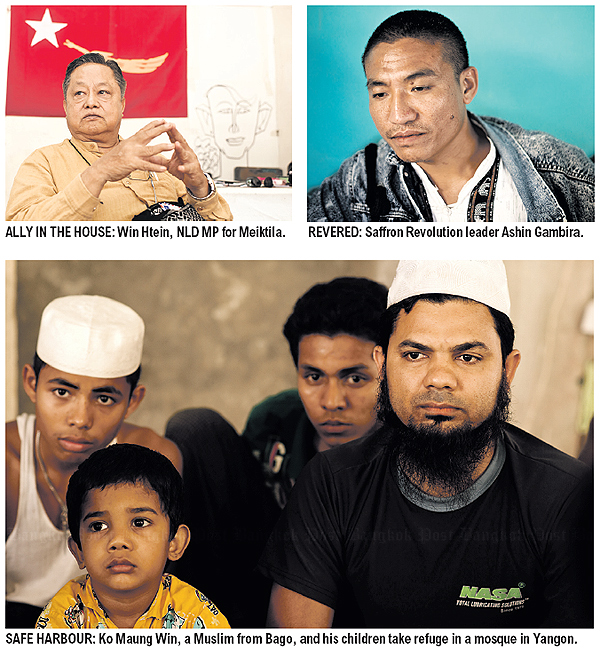
Many witnesses have confirmed the failure of the police to prevent the violence. One of them is Win Htein, the local MP of the National League for Democracy (NLD), the party of Aung San Suu Kyi. Win Htein, a former army officer who spent 20 years in jail for his political activities and used to organise security for ``the Lady'' after her release from house arrest on November 2010, told Spectrum in the ramshackle local NLD office that he witnessed the carnage in front of the madrasa.
"I saw with my own eyes two people already dead and five more put to death in front of me.''
He said he tried to protect the Muslims, but was threatened by the mob. Then he called the chief minister of Mandalay Division, Gen Ye Myint, and told him what was happening. ``He said he'd already given orders to the police to take action, but there was no action at all,'' Win Htein said.
It took a further day before the army stepped in and restored some order in the city. By then, at least 42 people had been killed and more than 60 were injured. Those are the official estimates, but the real figures are likely to be considerably higher, considering that at least 30 people died in a single incident at the madrasa.
One local reporter who witnessed the carnage, told Spectrum that she arrived at the scene at 5pm and saw a pile of several dozen corpses just metres from the madrasa. When she went back four hours later, the pile had been set on fire.
On March 21, the young reporter saw and filmed a group of Buddhists slit the throat of a Muslim man, before dousing him with petrol and setting him on fire. She continued recording despite being told to stop, but eventually had to flee the scene when six or seven Buddhist men chased her, hitting her on the back.
The reporter said that during the time she was in Meiktila, from March 20-22, she saw only Buddhists carrying weapons and the violence was fundamentally one-sided, with the Muslims always on the receiving end.
Win Htein said the attacks were spontaneous and perpetrated by Buddhist residents of the city, but others witnesses claimed the attackers were unknown to them and seemed to be following a well coordinated plan.
Three weeks after the riots, the Muslim quarters of Meiktila are large wastelands of destroyed buildings and charred cars, resembling the aftermath of a war or natural disaster, and where the poorest inhabitants of the city scavenge for scrap to sell. More than 18,000 residents, most of them Muslims, have been displaced by the violence and most of them are now living in government-controlled camps. The camps are off-limits to journalists, but there are also unofficial camps like the one where Mon Hnin lives.
The government has announced plans to rebuild the destroyed houses within two months, but few believe in its ability or even its willingness to do so. Many Muslim refugees fear their situation might become permanent, as happened to the Muslim Rohingya in Rakhine state, in western Myanmar. Unlike the Rohingya, however, the Muslims of central Myanmar are officially recognised as citizens of the country.
 |
| LAST DEFENCE: Barricades manned by Muslim residents in Mingalar Taungyungnunt, the main Muslim quarter in Yangon. Following the violence in Meiktila, residents there have begun conducting patrols at night. |
THE VIOLENCE SPREADS
After Meiktila, the anti-Muslim attacks spread to other parts of central Myanmar, getting dangerously close to the the nation's largest city, Yangon. In the Bago region, the pattern of violence against Muslim people and property was repeated in no less than 14 villages.
More than 80 refugees from Minhla, a town with a population of about 100,000, are now living in a mosque in Yangon after fleeing a wave of attacks on March 27.
Ko Maung Win (not his real name), a teacher at the local mosque recounted how a mob of Buddhist extremists attacked the mosque shortly after afternoon prayer. Nobody was killed or injured during the attacks.
 |
| LUNCHTIME LULL: Most of those displaced by ethnic violence are in government-controlled camps, however others are in unofficial camps such as this one. |
He and other refugees from Minhla told Spectrum that the attacks came out of the blue, without any prior threat or warning. They said, however, that relations between the two communities had steadily soured after a monk visited the city at the end of February and gave a speech telling Buddhists to shun Muslim people and their shops. A woman who owned a grocery store in the market, and is now one of the refugees in the mosque, said she lost many Buddhist customers after the speech. Nevertheless, when the attacks started she was given refuge in the home of a Buddhist neighbour.
The violence has not yet reached Yangon, but in some of its Muslim neighbourhoods there is an almost palpable tension, particularly at night. Since the attacks in Meiktila, the residents of Mingalar Taungyungnunt, the main Muslim quarter of the former capital, have set up barricades and conduct nightly street patrols.
 |
| WHIRLWIND OF HATE: The destroyed Mingalar Thiri Muslim quarter in Meiktila. |
Neighbours interviewed recently in the quarter said that, under the cloak of dark, people roam the streets in cars shouting threats and insults. Many of them are afraid that during the annual Songkran-like water festival there might be an attack similar to those in Meiktila and Bago. Many men sleep only a few hours a night, as they have to work at day and patrol the streets in the evening. Every entrance to the neighbourhood from the main streets is blocked with makeshift barricades manned by local men.
All of the men interviewed by Spectrum were keen to emphasise that their relations with an overwhelming majority of Buddhists have always been and continue to be peaceful and friendly. They put the blame on ill-defined groups of ``Buddhist terrorists''.
Like many other Muslims around the country, the residents of Mingalar Taungyungnunt feel unprotected and abandoned by local authorities and the central government. During two visits to the quarter at night, only a minimal police force could be seen on the streets.

"We don't know who these people are, but we are not afraid. If they attack us, we will fight back,'' said a young man in one of the barricades.
Many Muslims interviewed by Spectrum in Yangon and other places feel that Aung San Suu Kyi has also abandoned them. They expressed their disappointment with her inability to make a forceful defence of Myanmar's Muslim communities. One of the aspects of the crisis that has puzzled many international observers has been the conspicuous silence of ``the Lady'' and her party on the issue.
When we mentioned this to Win Htein, he said the party is willing to "accept the blame for not taking the necessary steps on behalf of the Muslims'', adding that it will ``repair the damage later, by getting involved in religious ceremonies and asking committees to get together, but it will be a hard task.''
He said he told Aung San Suu Kyi not to go to Meiktila. "I advised her not to come here, because people were blaming me when I supported the Muslims.''
He admitted that this decison was the result of political calculation, but added, ``She wouldn't be able to give a reasonable answer to the conflict, that's why I told her not to come.''
THE MONK THAT PREACHES HATE
While the gold shop dispute and torching of a Buddhist monk might have been the catalysts for the recent violence, the incidents are set against a general climate of distrust, which in this case was fostered by religious and political leaders.
The anti-Muslim sentiment finds its expression in a campaign called 969, which encourages Buddhists to shop only in Buddhist outlets and calls for a defence of Buddhism in Myanmar against the supposed threat of a Islamisation. The campaign is named after the ``three jewels'' of Buddhism _ the nine attributes of Buddha, the six attributes of his teachings, and the nine attributes of the Sangha. There are many 969 stickers in shops, taxis and cars around Yangon and other cities.
The most visible face of the 969 movement is Ashin Wirathu, a monk from Mandalay who is famous for his anti-Muslim speeches. The boyish-looking 45 year old with a calm demeanour and soft voice was jailed in 2003 for inciting anti-Muslim riots and released under an amnesty in 2012. Spectrum met him in Masoeyein, a monastery in Mandalay whose monks are famous for their political activism.
Sitting beneath several huge portraits of himself, Ashin Wirathu explained the ``Muslim conspiracy'' which, according to him, threatens to engulf Myanmar.
A man full of contradictions he seems consistent only in his criticism of and dislike for Islam. He denied at first that he mentions Muslims in his speeches at all, but later admitted that he does speak about them, but only because he wants to inform people of the reality.
At one point he even claimed that 100% of rapes in Myanmar are committed by Muslims, disregarding the fact that the army is known to use rape as a weapon in its wars against ethnic insurgents.
He traced his anti-Muslim activism to 1996, when a Muslim who had converted to Buddhism gave him a supposed ``secret message'' circulated among Myanmar Muslims laying out their conspiracy to Islamise the country. The message included a plan to marry Buddhist women in order to convert them, and taking over the economy. Ashin Wirathu also warned that if Myanmar Buddhists do not take action, by 2100 the whole country will resemble the Mayu region of Rakhine state, an area mostly populated by Muslim Rohingya.
Ashin Wirathu recognised that Buddhists have committed acts of violence, but refused to admit that his incendiary speeches have anything to do with them. He also refused to acknowledge that his discourses incite hatred towards Muslims, stating that he is just ``informing the public''.
He even claimed that, should people listen to him, no Buddhist would engage in violence, despite the fact that he gave one of his trademark speeches in Meiktila just four months before the recent violence. Eventually, as a solution to the ``Muslim problem'', he presented a simple formula: ``Buddhists can talk with Muslims, but not marry them; there can be friendship between them, but not trade.''
Ashin Wirathu's words enjoy widespread publicity in the country and he is well supported by the Buddhist community, which reveres monks as the ultimate depositaries of wisdom. According to Win Htein, the NLD MP from Meiktila, Ashin Wirathu's speeches are shown in the buses operated by companies owned by the military.
In a house in Meiktila, Aye Aye Aung, a 43-year-old Buddhist woman who owns three shops in the town, showed Spectrum a DVD of one of Ashin Wirathu's speeches in which he warns against the Muslim conspiracy. She also showed us the weapon, a knife tied to a long iron bar, that her husband made the day the violence started to defend his family and property against possible Muslim attackers. She said that she was willing to let Muslims live in Meiktila, but they should be completely segregated from the rest of the population.
Ashin Wirathu claimed that 969 is a grass-roots movement without funding from powerful or wealthy people. Its publicity stickers are printed and distributed by ordinary people who act out of concern for their country, he said.
Despite his claims, several vendors at Mandalay market said the stickers are distributed by monks from Ashin Wirathu's monastery.
Ashin Gambira, a former monk and leader of the 2007 ``Saffron Revolution'' is one of Ashin Wirathu's main critics. He said the monk is breaking the Buddhist precept of ``right speech'', which exhorts followers in part to avoid saying anything that could prove harmful to others. According to him, anti-Muslim sentiment was actively promoted by the army during its five decades of dictatorship and the hatred is now ``instilled in the minds of the people'' to such a degree that it would not take much of an effort to ``revive it at any moment''.
It is a mystery who is behind the campaign and Ashin Wirathu, but many believe they enjoy the financial support of powerful people. There are also claims that they are following the plans of hard-line elements in the military who are unwilling to renounce their power and are posed to create unrest to reassert their position. The fact is that the authorities have allowed him to go around the country preaching his hatred at a particularly delicate time.
Ashin Pum Na Wontha is a 56-year-old Buddhist monk with a long history of political activism dating back to 1988. He now belongs to the Peace Cultivation Network, an organisation established to promote understanding between different faiths and communities.
In a recent interview conducted at his monastery in Yangon, he told Spectrum that Ashin Wirathu is a merely a puppet ``motivated by his vanity and thirst for fame''.
"Wirathu and the 969 movement receive financial support from the cronies,'' he said, referring to a group of about 30 rich men linked to the military and the government who control the nation's economy. Several Muslim businessmen have huge assets and, according to Ashin Pum Na Wontha, the cronies would like to get their hands on them.
He said he also believes the military is involved in the violence, as a way to destabilise the country and have the chance to present itself as the sole institution capable of re-establishing the law and order. According to his analysis, the military does not want to recover full power, as it had following the 1962 coup of Gen Ne Win, but to ``go back to 1958''.
In that year, Ne Win took power temporarily from U Nu, the first prime minister of Myanmar, and established a caretaker government that lasted 18 months. At that time, the army was able to present itself as the defender of democracy and stability in the country.
Inter-religious and communal tensions had long existed in Myanmar before Gen Ne Win took full power in 1962. Anti-Indian and anti-Muslim riots exploded in Yangon in 1930 and 1938 due to the resentment of the Myanmar people towards Indians who had entered the country with the arrival of the British colonisers. As today, the riots were often incited by Buddhist nationalist monks.
Ne Win and the military junta that replaced him played this religious ultra-nationalist and racist card for the entirety of their rules. Muslims and other non-Buddhists were barred from the upper echelons of the army and, almost immediately after Ne Win's coup, he expelled hundreds of thousands of Indians from the country.
He also fostered a sense of a Myanmar identity strongly linked to ethnicity and religion, which has been the breeding ground for waves of anti-Muslim violence, like this most recent one, which threatens to spiral out of control and spread to large parts of the country.

RestlessBeings
April 18, 2013
The reports that the EU will now lift ALL but arms sanctions against Myanmar, coupled with the honouring of President Thein Sein for the In Pursuit of Peace Award by the International Crisis Group is shocking to hear! Once more, human rights of the most marginalised people of Myanmar, like the Rohingya and Karen, have been sidelined. Such governments cannot be appeased in return for international economic and political gains.
#PetitionForPeace
For The Urgent Attention of ICG Chairman Ambassador Thomas R. Pickering:
The ICG's decision to honour Thein Sein at the In Pursuit of Peace Award Dinner (22nd April, 2013) is utterly disrespecting the human rights of Myanmar's citizens, and as such is totally contradictory to your award's aim of "preventing and ending deadly conflict".
Thein Sein and his Government's inaction and involvement in recent and continued human rights massacres and abuses in Myanmar include:
- June and October 2012, more than 150,000 Rohingya displaced after violence which was NOT stopped by military and Government personnel
- Arbitrary arrests and imprisonment of Rohingya men and boys
- The continued use of sexual abuse of young women as a tool of terror against the Rohingya
- Confirmed mass graves found
- Apartheid style IDP camps established by Government for Rohingya
- Preventing aid missions such as OIC to open office in Myanmar blockading foreign aid for large parts of 2012
- In recent weeks the violence against Muslim citizens in Meikhtila and Yangon has led to almost 12,000 fleeing their homes. ‘969' terrorist group waging violence against Muslim citizens throughout Myanmar have gone unpunished despite heinous crimes against humanity including killing of children in schools
The UN's special rapporteur of Myanmar, T Quintana reported on February 16 2013 about the violence in Arakan state ‘a profound crisis that threatens to spread to other parts of the country and has the potential to undermine the entire reform process in Myanmar..'. On numerous occasions it has been reported across many international outlets such as BBC, CNN, Al Jazeera that Government forces had stood aside and allowed the violence against the Rohingya to spread. Despite such grave human rights abuses and concerns, earlier this week the European Union has stated that they are "to lift all sanctions with the exception of the embargo on arms which will remain in place".
Such appalling disregard for human rights and his Government's lack of pushing forward reform and the draconian 1982 Citizenship Law renders almost 1 million Rohingya stateless. Without providing adequate protection to the Rohingya and Myanmar's citizens, the ICG's decision to honour Thein Sein with its most prestigious award is premature, shocking and absurd.
We the undersigned urge you to reconsider this decision and award it to genuine contenders working towards peace and a conflict free world, with rights of all people recognised.

April 18, 2013
His name is Wirathu, he calls himself the "Burmese Bin Laden" and he is a Buddhist monk who is stoking religious hatred across Burma.
The saffron-robed 45-year-old regularly shares his hate-filled rants through DVD and social media, in which he warns against Muslims who "target innocent young Burmese girls and rape them", and "indulge in cronyism".
To ears untrained in the Burmese language, his sermons seem steady and calm – almost trance-like – with Wirathu rocking back and forth, eyes downcast. Translate his softly spoken words, however, and it becomes clear how his paranoia and fear, muddled with racist stereotypes and unfounded rumours, have helped to incite violence and spread misinformation in a nation still stumbling towards democracy.
"We are being raped in every town, being sexually harassed in every town, being ganged up on and bullied in every town," Wirathu recently told the Guardian, speaking from the Masoeyein monastery in Mandalay where he is based.
"In every town, there is a crude and savage Muslim majority."
It would be easy to disregard Wirathu as a misinformed monk with militant views, were it not for his popularity. Presiding over some 2,500 monks at this respected monastery, Wirathu has thousands of followers on Facebook and his YouTube videos have been watched tens of thousands of times.
The increasing openness of Burma, which was once tightly controlled under a military junta, has seen a wave of anti-Muslim sentiment spread across the 60 million-strong Buddhist majority – and Wirathu is behind much of it.
Rising to prominence in 2001, when he created a nationalist campaign to boycott Muslim businesses, Wirathu was jailed for 25 years in 2003 for inciting anti-Muslim hatred but freed in 2010 under a general amnesty.
Since his release, Wirathu has gone back to preaching hate. Many believe him to be behind the fighting last June between Buddhists and ethnic Rohingya Muslims in Rakhine state, where 200 people were killed and more than 100,000 displaced.
It was Wirathu who led a rally of monks in Mandalay in September to defend President Thein Sein's controversial plan to send the Rohingya to a third country. One month later, more violence broke out in Rakhine state.
Wirathu says the violence in Rakhine was the spark for the most recent fighting in Burma's central city of Meiktila, where a dispute in a gold shop quickly spiralled into a looting-and-arson spree. More than 40 people were killed and 13,000 forced to flee, most of them Muslims, after mosques, shops and houses were burned down across the city.
Wirathu says part of his concern with Islam is that Buddhist women have been converted by force and then killed for failing to follow Islamic rules. He also believes the halal way of killing cattle "allows familiarity with blood and could escalate to the level where it threatens world peace".
So he is back to leading a nationalist "969" campaign, encouraging Buddhists to "buy Buddhist and shop Buddhist" and demarcate their homes and businesses using numbers related to the Buddha (the number refers to his nine attributes, the six attributes of his teaching and the nine attributes of the Buddhist order), seemingly with the intention of creating an apartheid state.
Wirathu openly blames Muslims for instigating the recent violence. A minority population that makes up just 5% of the nation's total, Wirathu says Burma's Muslims are being financed by Middle Eastern forces: "The local Muslims are crude and savage because the extremists are pulling the strings, providing them with financial, military and technical power," he said.
Not everyone agrees with Wirathu's teachings, including those of his own faith. "He sides a little towards hate," said Abbot Arriya Wuttha Bewuntha of Mandalay's Myawaddy Sayadaw monastery. "This is not the way Buddha taught. What the Buddha taught is that hatred is not good, because Buddha sees everyone as an equal being. The Buddha doesn't see people through religion."
Critics point to Wirathu's lack of education to explain his extremism as little more than ignorance, but his views do have clout in a nation where many businesses are run successfully by Muslims.
The second son of eight children, Wirathu was born in 1968 in a town near Mandalay and only attended school until 14, after which he became a monk. Eager to leave "civilian life rife with its greed and spite", he said he had no intention of marrying: "I didn't want to be with a woman."
Wirathu claims he has read the Qur'an and counts Muslims among his friends, but said: "We're not so close because my Muslim friends don't know how to talk to Buddhist monks … I can accept [being friends] if they consider me an important and respected religious figure."
Despite spending seven years in prison for stoking religious violence, Wirathu won a "freedom of religion" award in February from the UK's foremost Burmese monastery, Sasana Ramsi in London, in the same week that he spread rumours that a Rangoon school would be developed into a mosque.
Analysts warn that Wirathu's seeming freedom to preach as he pleases – in addition to his influence over other monks, who have also started preaching against Islam – should be taken as a wake-up call to the rest of the world. "If a similar hate movement like Burma's '969' movement – which spreads hate speech and hate symbols – [existed] specifically against, say, the Jews in Europe, no European government would tolerate it," Burmese activist and London School of Economics visiting fellow Maung Zarni said.
"Why should the EU not take it seriously, in a major EU-aid recipient country?"
Both Thein Sein and opposition leader Aung San Suu Kyi have been criticised for not taking a greater stand against the violence that has racked Burma in recent months. Some have pointed to the seemingly planned nature of many of the attacks; UN special envoy Vijay Nambiar said the violence had a "brutal efficiency" and cited "incendiary propaganda" as stirring up trouble.
Multifaith activists in Burma recently took to the streets to counter the violence, distributing T-shirts and stickers with the message: "There shall be no racial or religious conflicts because of me." But the Buddhist-Muslim tension has already spread far and wide.
In Rangoon, a recent mosque fire that killed 13 children was widely believed to be a case of arson. And in Indonesia, eight Buddhists were beaten to death by Rohingya Muslims at a detention centre, in apparent retribution for incidents of sexual assault by Buddhist inmates against Rohingya women.
Rumours abound that those inciting the fighting, like Wirathu, are pawns for being used by Burma's military generals to stir up trouble in the nascent democracy. But Wirathu insists he is working alone: "These are my own beliefs," he said. "I want the world to know this."
In a chilling sermon last month, Wirathu warned that the "population explosion" of Burma's Muslims could mean only one thing: "They will capture our country in the end."
And just like his namesake, this "Burmese Bin Laden" made a brazen call to arms: "Once we [have] won this battle, we will move on to other Muslim targets."
Preacher of hate
1968 Wirathu is born in Kyaukse, near Mandalay
1984 Joins the monkhood
2001 Starts promoting his nationalist "969" campaign, which includes boycotting Muslim businesses
2003 Jailed for 25 years for inciting religious violence after distributing anti-Muslim leaflets, leading to 10 Muslims being killed in Kyaukse
2010 Freed under a general amnesty
June 2012 Violence breaks out between ethnic Rohingya Muslims and Rakhine Buddhists in Rakhine state
September 2012 Wirathu leads a rally of monks in support of President Thein Sein's proposal to send the Rohingya to a third country
October 2012 More violence breaks out in Rakhine state
March 2013 Inter-religious fighting in Meiktila sees 40 killed and nearly 13,000 displaced; "969" stickers and plaques distributed throughout Burma

RYM
RB News
April 18, 2013
Maung Daw, Arakan - At 8PM, on 17th April 2013, a group of NaSaKa (Border Security Force) from POE camp of Maung Daw raided the house of Zafar Ahmed @Laydu S/o Rashid Ahmed at the village of Lamaar Fara (Awk Rua) in the Italia village tract, Maung Daw. The raid was carried out under the false allegation of involving in narcotic drug business.
"NaSaKa raided the house of Zafar Ahmed at 8PM. Some NaSaKas were in their uniforms and some were in Police uniform. Normally, in legal raids, Police or NaSaKa etc is accompanied by the respective village administrator. However, for unknown reasons, they were, in this raid, accompanied by an unrelated person, the administrator of Quarter 5. Worse, NaSaKa were from POE Camp but the village is under the commandment of 3 Mile Camp. Although they found nothing in the search, yet they extorted Kyat 200,000 from his wife. And the husband, Zafar, is also under 10-year-imprisonment with false charges" said a villager.
"It was an unofficial, illegal and arbitrary raid. These kinds cases against Rohingyas are very usual today. The authority is just behaving like dacoits" he added.
(Edited by Maung Aurther)
 |
| ARU Director General, Dr. Wakar Uddin, with Turkish Foreign Minister, Dr. Ahmet Davutoğlu, at OIC Ministerial Contact Group Meeting. |
RB News
April 17, 2013
On behalf of Rohingya community in Myanmar and various regions around the world, the Director General of Arakan Rohingya Union, Prof. Dr. Wakar Uddin, expressed his deepest gratitude to the Secretary General of OIC, His Excellency Dr. Ekmeleddin Ihsanoglu, for convening the emergency OIC Ministerial Contact Group meeting at the OIC Headquarters in Jeddah, Saudi Arabia on April 14, 2013, to find a solution to the crisis faced by the Rohingya and Myanmar Muslim population in Myanmar. Dr. Uddin echoed what the Secretary General Dr. Ihsanoglu and the Political Officer Ms. Dina Madani have spoken about the current situation in Myanmar. Dr. Uddin reinforced the presentation by Ms. Madani that detailed the graphic nature of the violence against the Muslims in Myanmar. “I have been regularly in touch with our community in Arakan and Central Burma, and receiving reports of horrifying atrocities and gruesome murders of men, women, and children. It is humanly unthinkable in this day and age how anyone in Myanmar can commit such crimes against humanity. In fact, what the international community learning from the media is just a fraction of the bloodbath taking place in Myanmar.” Dr. Uddin said. He further stated “The campaigns to uproot Islam from Myanmar began with Rohingya in Arakan. The radical Buddhist elements started this with Rohingya first, claiming that they have to cut-off the roots before eliminating the tree ‘Islam’ in Burma - Rohingya being the roots.”
Dr. Uddin alerted the OIC member states and the Muslim Umma that the rapidly emerging Buddhist terror Network “969”, which seriously deviates from the original teaching of peace by Buddha, poses the most serious threat to Islam in Burma today and subsequently to the stability of Southeast Asia region. “You see the refugee crisis in Bangladesh, Malaysia, Indonesia, and other countries. At the same time some sorts of violence have started to spill over to these countries. Subsequently, violence has also erupted in Sri Lanka. The emergence of the radical Buddhist terror network could continue to cause the domino effects in the region and in other parts of the world.” he stressed.
Dr. Uddin expressed the gratitude by Rohingya people to the international community, including OIC and its member states, UN, the governments of US, Canada, and several European countries, and a number of NGOs for their tremendous efforts to stop the violence in Myanmar and find a durable solution to Rohingya and Muslim issues; but he also appealed to them to do more. He cautioned some of the OIC member states in the region that when the very existence of a community and the faith in a country is seriously threatened, the policy of “non-interference in another country’s internal matters” becomes counter-productive and serves as a tool for the aggressor. Dr. Uddin called on the OIC member states to use their bilateral relations as an avenue to persuade and pressure the Myanmar Government to resolve the issues with utmost urgency for the sake of humanity and the stability in the Southeast Asia region. “Your Excellency, it is no longer a Rohingya issue. It is becoming a regional and potentially global humanitarian crisis.” he concluded.
 |
| ARU Director General, Dr. Wakar Uddin, with Bangladesh Foreign Minister, Dr. Dipo Moni, at OIC Ministerial Contact Group Meeting. |
On the sideline, Dr. Uddin also met with dignitaries from some OIC member states, including the Foreign Ministers of Turkey and Bangladesh, and further discussed the pressing issues on Rohingya and violence against Muslims in Myanmar. “I am very satisfied with each meeting, and I can assure you that they are dedicated to bringing a solution to the issues faced by Rohingya and Myanma Muslims” Dr. Uddin replied, when asked by the Saudi-based ARU signatories about his separate meetings with the Foreign Ministers.

RB News
April 17, 2013
Mrauk-U: It is learnt that five Rohingya hailed from Paung Doak village tract of Mrauk-U Township, are alleged falsely and arrested forcibly. And it is also observed nowadays that the media itself untruthfully diffuse propaganda against the arrestees writing without any consideration justly .
The detail of occurrence is: around five half past o’clock in the early morning of 14th April, the 7 villagers hailed from Paung Doak village went to an owned betel farm which is located near Buddhist Rakhine village and plucked betel leaves. On that time, Rakhines surrounded crowding them and arrested violently accusing that they plucked betel leaves from the Rakhine owned farms. Amongst the 7 Rohingya, 2 were fled seeing the coming of Rakhine gangsters and the rest five have been beaten severely. It is also learnt over six o’clock on that morning they were handed over in police station After beating so as that.
Though the arrestees were sent as above on false allegation at police station, since 14th April media diffuse propaganda relevant to above dramatic issue untruthfully as such that they were caught due to reached in Rakhine village to set fire on.
It has been perpetually occurring brutalities on Rohingya from both government officials and Rakhine extremists according to their statement as below:
"We have been coming encountering such oppression suppressively with many strategic planning since many times ago. we are beaten severely when we meet soldiers on the way wherever we go for shopping. Also we are beaten whenever we meet unexpectedly with Rakhine groups.The goods which brought from shops are forcibly taken away by soldiers. And nowadays it is increasingly going on arresting on false allegation in the villages. We can even rely on none of concerned authorities because they more persecute inhumanely us using official power. Apparently, one resident told to RB News that The main motive of media to diffuse such propaganda untruthfully against us is merely to instigate more hatred upon us."
The five arrestees on false allegation unjustly are :
1. Saber Ahmed s/o Siddique, 40
2. Abdul Karim s/o Amir Hussein, 31
3. Shwe Maung s/o Abdul Malik, 18
4. Aung Shay s/o Sham Shu, 25
5. Yunus s/o Yusuf, 21
(Translated into English by Ibrahim Shah)
 |
| (Photo: AFP) |
April 17, 2013
TOKYO - Myanmar democracy icon Aung San Suu Kyi defended her conciliatory political style Wednesday, saying her focus was on building a more unified society rather than making headlines.
Suu Kyi, visiting Japan this week, said many interviewers have asked her why she does not speak more forcefully about the plight of minority groups in her nation.
She said she has been addressing those issues, albeit in ways that people may consider "boring".
"In fact, I have been speaking all the time about ethnic nationalities. But the point was that my statements were not colourful enough to please everybody," she told a press conference.
"Actually I am not very keen on colourful statements. I am sorry if people do not find my comments interesting enough to acknowledge them.
"But I have been speaking a lot about ethnic nationalities and problems of national reconciliation in our country, except that I speak in a way in which, I suppose, most people consider slightly boring."
The comments came as activists express disappointment that Suu Kyi, a Nobel laureate who was locked up for 15 years by Myanmar's then-ruling junta, has remained largely silent about several episodes of communal bloodshed.
At least 43 people were killed in March as mosques and Muslim homes were destroyed in central Myanmar, in a wave of violence that witnesses say appeared to have been well organised.
The recent disorder was the worst since an eruption of violence between Buddhists and Rohingya Muslims in the western state of Rakhine last year that left scores dead and tens of thousands -- mainly Muslims -- displaced.
The Rohingya have been described by the UN as one of the world's most persecuted minorities.
Suu Kyi said she has met with Muslim leaders and felt for their plight.
"It's very sad because none of them had ever known any other country except for this one, except for Burma," she said.
"They did not feel they belonged anywhere else and you are just sad for them that they are made to feel they did not belong to our country either. This is a very sad state of affairs."
But, she said: "With regard to whether or not Rohingya are citizens of the country, that depends very much on whether or not they meet the requirements of the citizenship law as they now exist.
"Then we must go on and assess this citizenship law to find out whether it is in line with the international standard," she said, stressing the importance of rule of law.
"We must learn to accommodate those with different views from ours," she said.
Chris Lewa, the Bangkok-based director of The Arakan Project, a non-governmental organisation that lobbies for the rights of the Rohingya told AFP that many Muslims in Myanmar were disappointed Suu Kyi had not been more forthright in their defence.
"People like Aung San Suu Kyi who have moral authority in Myanmar should be clearer about the rights of minorities," she said.
"She talks a lot about the rule of law, but that is not enough. We must protect minorities. Rohingyas had hoped that she might improve their lot, but they are beginning to lose hope that she can play that role."
Suu Kyi said she aspired to lead the nation and hoped to build a society in which opposing views can be discussed.
"I have always said our country is poor in the culture of negotiated compromise. But it is something we must work at to achieve," she said.
"I want changes in our country to be achieved through agreements between different forces in our country."She said the current regime under President Thein Sein lacked a "structure" for its reform initiatives, such as the priority and sequence of what needs to be done.

RB News
April 17, 2013
Kyauktaw: It is informed that in April 14, a villager was shot dead and three were injured from Taung Htaung village, Kyauktaw Township.
The detail of the occurrence is that about twenty Rohingya from Taung Htaung village belong to Kyauktaw Township went to a nearby forest to cut bamboo on midday of April 14 around 2pm. Suddenly, one villager was shot dead instantly on the spot and three were injured inside that forest.
It is learnt from those who came home alive getting away that the shooter was known absolutely since out of sight. It is also firmly learnt Rakhine extremists hide out nearby Forest of Kyauktaw Township last February according to the statement of eye-witness. The residents considered strongly that the current shot is, in reality, either from the government forces or Rakhine extremists.
Amid the shot, the one who has lost life is Zafar Ahmed s/o Hussain, 35 years aged. The injured three are:
1. Omar Ali s/o Dil Mohammed, 45
2. Karlu s/o Sultan Ahmed, 45
3. Mohammed Hussein s/o Ahmed Sabi, 20
When complained at concerned authority and police after the occurrence, the police autopsied the dead body in the hospital and ordered to bury without reporting any result. Eventually, it is learnt that none of the concerned authorities find the shooters yet.
(Translated into English by Ibrahim Shah)
-
 ဇြန္လ ၁၇ ရက္ ၊ ၂၀၁၂ Source: guardian.co.uk ျမန္မာျပည္သစ္အတြက္ အနာဂတ္မွာ ေအာင္ျမင္မွာလား၊ က်ရွဳံးမွာလားဆိုသည္ကို ညႊန္ျပေသာ စမ္းသပ္မွဳ တစ...
 -
 ပါလီမန္အမတ္ဦးေရႊေမာင္ၿပည္သူ႔လြတ္ေတာ္တြင္ရခိုင္ၿပည္နယ္၌ၿဖစ္ပြါးခဲ့ေသာအေရးအခင္းနဲ့ ပတ္သက္၍ေဆြးေနြးတင္ၿပၿခင္း။ (14th day of regular ses...
 -
ရက္စြဲ – ေမ ၂၉ ၊ ၂၀၁၂ သို ့ အယ္ဒီတာ၊ နိရဥၥရာ သတင္းဌာန နိရဥၥရာ သတင္းဌာနမွ ေမလ ၂၉ ရက္ေန ့ ထုတ္ျပန္သည့္ ရမ္းျဗဲတြင္ အသက္ ၁၆ ႏွ...
-
MP U Shwe Maung Explained on Amendment 1982 Citizenship Law on 25 July 2012. MP U Shwe Maung explained on amendment of 1982 Citizenship Law...
-
 The custodian of Two Holy Mosques King Abdullah bin Abdul Aziz Al Saud Aug 11 The custodian of Two Holy M...
 -
 ရခိုင္ျပည္နယ္သို.ေရာက္ရွိေ နေသာ ၈၈ မ်ိုးဆက္ေက်ာင္းသားမ်ား ယခုတေလာ ရခိုင္ျပည္နယ္တြင္ ျဖစ္ပြားေနေသာ ပဋိပကၡႏွင့္ပတ္သတ္၍ အဖြဲ႔အစည္းအသီးသီး...
 -
 Read More in PDF here Download here
 -
 Read letter here Read history of Rohingya here Download letter PDF here Download History of Rohingya PDF here credi...
 -
More than 40% of people living in Burma belong to one of the military-ruled nation's different minority groups. The government recognis...
-
 "Although mass killings and exterminations of human races were some sort of things that the world experienced during Nazi German p...

Popular Posts
Threatwiki

Amartya Sen: Burma's "slow genocide" of Rohingyas

Watch Professor Amartya Sen speak on what he calls Burma's 'slow genocide' of Rohingya, Harvard, 4 Nov 2014
