

On August 29th, the U.S. government waived travel sanctions against U Thein Sein, Burma’s President and former general of Burma’s dissolved military regime, allowing him to travel freely during his visit to the UN General Assembly this month. The United States also eased economic sanctions against Burma this year, allowing U.S. businesses to invest in the heavily sanctioned country.
The Obama Administration hopes to encourage further reforms by lifting sanctions. But in doing so, it is overlooking the suffering of a group the UN designates as one of the world’s most heavily persecuted communities, the Rohingya Muslims. When President Thein Sein makes his visit to New York next week, U.S. government officials should constructively press him on the Rohingya issue.
Visa and financial restrictions against certain Burmese government officials, members of their families, and their business associates;
Asset freezes;
Prohibitions on importation of Burmese goods; and
Restrictions on bilateral and multilateral assistance to Burma.
Beyond the now lifted travel sanction for Thein Sein, the United States maintains a number of sanctions against Burma, including:
Sanctions against Burma began in the 1990s following the military junta’s, Tatmadaw’s, violent suppression of popular protests. They continue todayin light of the government’s general disregard for the human rights and civil liberties. The recent easing off of sanctions are a reward for initiatives championed by President Thein Sein since August 2011, including deregulating the media, freeing political prisoners and halting the country’s controversial Chinese-led hydropower project.
Yet, as the Burmese government moves forward on these specific reforms, it continues to oppress its ethnic minorities, especially the Rohingya Muslims. Rohingya have lived in Burma’s Rakhine state for centuries, but Burmese authorities have viewed them as illegal immigrants from Bangladesh and successive Burmese governments have denied them citizenship. The Rohingya people who account for about 4% of the total Muslim population in Burma, are subjected to forced labor, extortion, restricted movement, the absence of residence rights, inequitable marriage regulations and land confiscation, amongst other constraints. With the passage of the 1982 Citizenship Act, they were officially rendered stateless.
In June, long simmering tensions between Buddhists and Muslims in Rakhine erupted into violence sparked by the alleged rape of a Buddhist woman by three Muslim men. The mob violence against Rohingya communities that followed this incident culminated in cries for a Rohingya-free Burma.
Historically, as this incident indicates, the Burmese government has not only failed in its responsibility to uphold the rule of law, it has also systematically failed to protect this stateless minority from targeted attacks and has itself been accused of pursuing a policy of persecution toward Rohingya. Human rights monitoring organizations have documented cases of Burmese security forces committing killings, rape, and mass arrests of Rohingya Muslims. Witnesses have recounted security forces torching their houses, looting, killing, and rounding up unarmed Rohingyas who have now been disappeared. Moreover, humanitarian agencies trying to provide aid have been threatened and their work brought to a standstill, depriving thousands of food, medical care and shelter.
The government made its intentions clear in July when President Thein Sein met the UN High Commission for Refugees Antonio Guterres and suggested that the only solution was to send the Rohingya to UN-administered camps or to a third country. Meanwhile, some 650 Rohingyas have been massacred, 1,200 are missing, and more than 80,000 are displaced. Fleeing from increasing discrimination and systematic persecution, thousands seek refuge in Bangladesh only to be rejected once again. Bangladesh has turned back more than 1,300 Rohingya refugees and banned humanitarian aid to the more than 200,000 Rohingya Muslims already in the country.
After many decades of political and economic isolation, the recent wave of reforms by President Thein Sein, steps that have ushered in hope of democratic reform, seem to be motivated by the government’s desire for international legitimacy and removal of economic sanctions. However promising these reforms may be, they do not relinquish Burma’s new government from its obligations under international law that require the state to protect its ethnic minorities – including the Rohingya. In fact, such pluralism and socio-political inclusion would be seen as an essential cornerstone to delivering real democratic reform.
The United States can play a critical role in preventing ethnic cleansing of Rohingya by addressing this issue directly with the Burmese government and through its newly created Atrocity Prevention Board, which should closely monitor this community as potentially at risk for mass atrocities. During President Thein Sein’s upcoming trip to New York for the U.N. General Assembly meeting, the United States Government should be clear that more decisive action is needed to fulfill Burma’s international obligation to protect the Rohingya. They must also make clear to President Thein Sein that he must hold accountable security forces guilty of targeting the group. The U.S. should leave no doubt that the lifting of U.S. sanctions will depend on President Thein Sein’s actual delivery on the full and broad panoply of promised reforms, including protection of all minorities. While easing of sanctions acts as an incentive to reformists in Burma, the United States must not ignore the plight of the Rohingya.
Source here

In an open letter to the US Senators and Congressmen Dr. Habib Siddiqui has urged the U.S. Congress not to lift its ban on any trade and commerce with Myanmar until a fundamental change takes place positively impacting the lives of those Rohingya and other minorities, guaranteeing their citizenship as equals and rights and privileges restored and secured.
Given below the full text of the letter by Dr. Habib Siddiqui :
Dear Congressman/Senator,
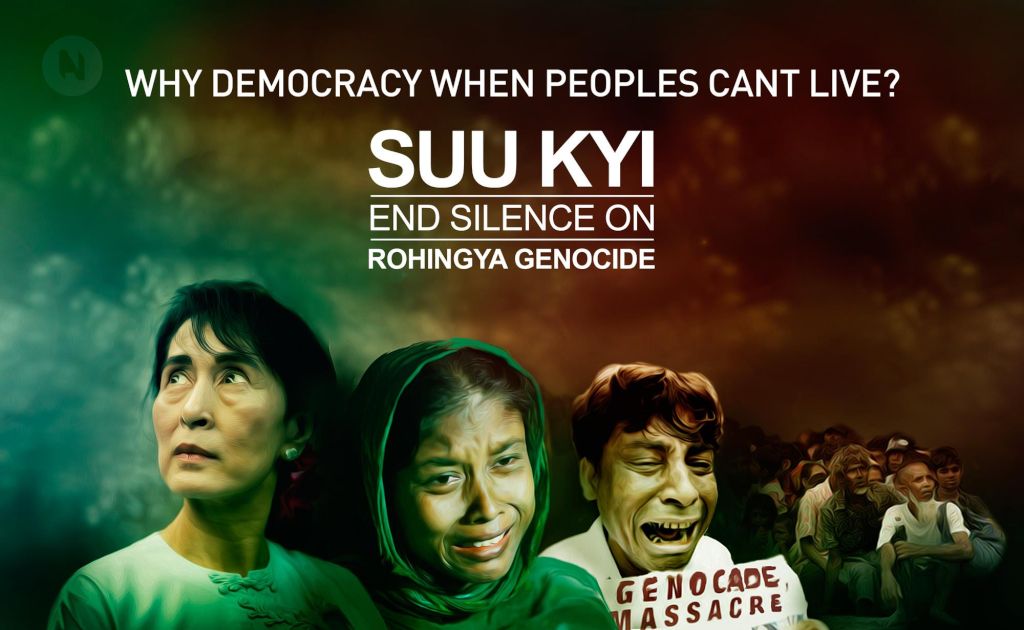
I was rather surprised to learn of the decision of the U.S. Congress to bestow its highest honor - the Congressional Medal of Honor to Suu Kyi of Myanmar. Through her silence and equivocation during the latest Rohingya crisis she has proven that she does not deserve such an honor, and that she is not a serious partner for either human rights or democracy. She remains a fanatic and racist Burman Buddhist, very similar to the very regime that she complained about while in house arrest.
In its entire history, racism and bigotry have defined, and sadly, continue to define Myanmar and there is no place for non-Buddhists in that Buddhist majority country of 56 million people today.
The so-called reform movement inside Myanmar, initiated by Thein Sein, remains all a part of a very calculated gimmick to lift official bans against Myanmar, which requires hard cash to get out of being the poorest country in the ASEAN. Suu Kyi was released by the civilian-dressed military regime so that she could work as its emissary. And that is what Suu Kyi has been doing to promote Myanmarism - an explosive cocktail of ultra-nationalism and Buddhist religious fanaticism. In this new Myanmarism, there is no place for people of other races, ethnic backgrounds and religions.
No, Myanmar does not deserve any benefit from our nation. Minorities like the Rohingya have been declared stateless, courtesy of a racist law - Burma Citizenship Law of 1982. As a result of this national project towards ethnic cleansing, half the 4 million Rohingyas have been pushed out of the country since 1962 who now live as unwanted refugees in places like Bangladesh, Thailand, Malaysia, Saudi Arabia, Pakistan, and UAE. And this in spite of the fact that they were one of the early inhabitants of the land of Arakan since time immemorial, predating Burmese or Tibeto-Burman influx to the soil of Arakan. The other half lives in the living hell inside Myanmar with no right of movement, education, health, safety, employment, property, marriage, religion, etc. The government does not honor any of the 30 rights of the UNDHR when it comes to the Rohingya and other persecuted minorities. It still holds on to the 1982 Citizenship Law and nullifies citizenship of millions simply because they are not Buddhists. It forces slave labor and even kills anyone suspected of being Rohingya. It is no accident that per UN and international agencies, the Rohingyas are considered the worst persecuted people on earth.
And yet, Suu Kyi is fine with such a marginalization of the Rohingya. What a shameful attitude for someone to be honored with a Nobel Prize for Peace, and now this Congressional Medal of Honor! These awards are becoming jokes like putting a pearl necklace on a swine!
Dear sir, as a result of government cover-ups, we may never know how many Rohingyas were killed during the latest pogrom that started in June of this year by a joint coordinated force of Buddhist mob and security forces. As a result, there is hardly a Rohingya town or village that is intact. They have been destroyed beyond recognition and look like as if they are bomb-ravaged places after a war. Not a single Rohingya place of worship is open; they are mostly burned down and demolished. The Rohingya-owned stores were looted and later gutted to fire.
Their homes were burned to ashes, and their paddy fields set on fire - forcing more than 200,000 internally displaced Rohingyas to live without any shelter or roof over their head. Not a single government aid came to them. Worse yet, the local Buddhist Rakhines (including racist monks) obstructed the sale of food and other necessities to these Rohingya victims.
And yet, the so-called Democracy Icon - Suu Kyi shamelessly did not utter a single word of condemnation against such gross violations of human rights. She is okay with such a savage 1982 law - formed during the dictator Ne Win's era - that nullified citizenship of millions of Rohingya people simply because they are non-Buddhists. Simply put, she is a Buddhist fanatic. She has been sent by the regime to soften the US attitude.
I would like to urge the U.S. Congress not to lift its ban on any trade and commerce with Myanmar until a fundamental change takes place positively impacting the lives of those Rohingya and other minorities, guaranteeing their citizenship as equals and rights and privileges restored and secured. If Suu Kyi is serious about Myanmar's future, let her behave like a leader that shuns racism and bigotry advocating for a change with the 1982 Citizenship Law, thus ensuring rights of the Rohingya people. She can't promote trade with Myanmar when it is still locked up in its savage past of racism and bigotry. For the U.S. to fall for such a gimmick would be utterly foolish!

WASHINGTON - The United States lifted sanctions on two of Myanmar's top leaders as the Congress hailed Aung San Suu Kyi as a hero of democracy in a lavish ceremony unthinkable only months ago.The move to end the sanctions on Myanmar President Thein Sein and parliamentary speaker Thura Shwe Mann came Wednesday, just hours after Suu Kyi had called for US sanctions crippling her impoverished nation to be lifted.She also met fellow Nobel Peace laureate President Barack Obama for the first time, after being presented with the Congressional Gold Medal in the imposing surroundings of the historical Rotunda on Capitol Hill.The White House said Obama reaffirmed US support for political and economic reforms in Myanmar, and full protection of human rights, in order to shape "a more peaceful, free and prosperous future" for the country.Myanmar was ruled by an iron-fisted junta for decades but, since taking office last year, a reformist government under former general Thein Sein has freed political prisoners and allowed Suu Kyi's party into electoral politics."From the depths of my heart I thank you, the people of America... for keeping us in your hearts and minds during the dark years when freedom and justice seemed beyond our reach," Suu Kyi said, as she was handed the award."We believe that we can go forward in unity and in peace," the Nobel Peace Prize laureate said."There will be difficulties in the way ahead, but I'm confident that we shall be able to overcome all obstacles with the help and support of our friends."The US Treasury later dropped both Thein Sein and Shwe Mann from its list of "Specially Designated Nationals," those individuals and companies sanctioned for links to terrorism, narcotics or other crimes.The two men "have taken concrete steps to promote political reforms and human rights, and to move Burma away from repression and dictatorship toward democracy and freedom," the Treasury said in a statement.They had been placed on the list in 2007 as the United States stepped up pressure on the then-ruling military junta, in which Thein Sein served as first secretary and Shwe Mann was joint chief of staff of the armed forces.Freed in 2010 after 15 years under house arrest, Suu Kyi received a rapturous welcome on her first visit to Washington since her release."It's almost too delicious to believe, my friend, that you are here in the rotunda of our great Capitol, the centerpiece of our democracy, as an elected member of your parliament," Secretary of State Hillary Clinton said.But Clinton said a different phase of Suu Kyi's work was just beginning as she helps build democracy in Myanmar."The United States will stand with her, with the president of Burma and those who are reformers... as they fan the flickers of democratic progress and press forward with reform," the top US diplomat vowed.Suu Kyi was also praised by veteran Republican Senator John McCain who, in a moving speech, called her "my personal hero.""I want to thank you... for teaching me, at my age, a thing or two about courage," said McCain, 76, who spent more than five years in the notorious "Hanoi Hilton" as a prisoner of war during the Vietnam conflict.Suu Kyi's own remarks, from a podium flanked by six US flags and white marble statues of Abraham Lincoln and US civil war general Ulysses S. Grant, were bookended by standing ovations."This is one of the most moving days in my life," said Suu Kyi, who modestly described herself as "a stranger from a distant land."The Obama administration has taken pains to ensure the celebration around her visit does not detract from a simultaneous trip to the United States by Thein Sein, who ushered in the reforms much to global surprise.US officials say Thein Sein - who will take part in the UN General Assembly next week - deserves to be recognized for pushing through such speedy changes. The United States began rolling back its economic embargo in July, opening Myanmar up to US investment despite Suu Kyi's earlier unease about US firms doing business with the state-owned oil and gas company."There are very many other ways in which the United States can help us to achieve our democratic ends and help us to build up the kind of democratic institutions that we are in such need of," Suu Kyi said on Tuesday."Sanctions are not the only way."Many US observers say Thein Sein launched the reforms out of concern over Beijing's overwhelming political and economic dominance in Myanmar.Clinton, however, has also called for Myanmar to address tensions in Rakhine state, where recent violence between majority Buddhists and the Muslim Rohingya minority left scores dead and displaced tens of thousands of people.Suu Kyi has come in for rare criticism from human rights activists, who have pressed her to speak out on behalf of the 800,000-strong Rohingya population.
Sources Here:

UNITED NATIONS, September 21 -- After Aung San Suu Kyi met with UN Secretary General Ban Ki-moon on Friday morning, a floor below a throng of media and even Ambassadors gathered. There was a smattering of applause as Aung San Suu Kyi walked from the elevator to the adjacent rostrums at the stakeout.
ASSK, as many here call her, was in the past a UN staff member, and now an icon. But still more messy questions exist, such as her silence on the plight of the Rohingya in Myanmar, or Burma, as some here call it.
Ban Ki-moon's summary of their meeting did not mention the issue; nor did ASSK or the questions Ban's spokesman selected. Yes, ASSK is in context a rare UN good news or success story. But particularly for that reason, questions of the stateless Rohingya who suffer religious prejudice in majority Buddhist Myanmar as Muslim should not be swept under the rug. Watch this site.
Footnote: In the crowd awaiting ASSK was the Permanent Representative of New Zealand, with his cell phone out to take a photo. Such is the star power of ASSK. Then, just after the stakeout, a meeting of the Latin American grouping CELAC was suspended, with "no consensus" after a Paraguay arrival. But that's another story - watch this site.
Sources Here:

Prof. Dr. Wakar Uddin, Director General of Arakan
Rohingya Union and Chairman of the Burmese Rohingya Association of North
America speaks at the Perdana Global Peace Conference on Plights of Rohingya.
Original Source : http://www.nst.com.my/nation/general/asean-un-nato-oic-urged-to-act-1.145056#ixzz272w5iAaR

ASEAN, UN, NATO, OIC urged to act
Kuala Lumpur, Malaysia. The international community, including Malaysia, must put pressure on the Myanmar government to cease the abuse of the Rohingya ethnic minority and recognise them as citizens of Myanmar.
Arakan Rohingya Union director-general Professor Dr Wakar Uddin cautioned that the Myanmar government was arrogant and would not respond to scattered messages from a few organisations.
"Countries need to come together and put concerted pressure on the Myanmar government to stop their systematic and persistent genocide of the Rohingya people in the Rakhine state of Myanmar.
"We need a multi-track approach. Not only must the Organisation of Islamic Cooperation (OIC) and the Association of Southeast Asian Nations (Asean) speak up, but the North Atlantic Treaty Organisation (Nato) and the United Nations (UN) should come in to condemn the violence towards the Rohingya Muslims," Wakar urged at the one-day international conference "Plight of the Rohingya: Solutions?" at the Islamic Arts Museum here yesterday.
He urged for a concerted international intervention effort to improve the plight of the Rohingya people and that it should be continued and sustained until the problem is solved.
"Being redundant can be good. It does not hurt the international community to repeat the same message again and again to the Myanmar government as this will drive the message home."
Panelists at the conference pointed out that the discrimination against the Rohingya people was a direct result of the Myanmar government's decision to strip them of their citizenship under the 1982 citizenship law and all agreed that the law be repealed.
"Once the Rohingya have citizenship, we have the basis to fight for the other violations of their human rights."
He said that the international media and monitoring teams also needed to be in the region to report the situation in Rakhine.
Wakar also proposed the international community ensure that Rakhine's current police force, which had allegedly participated in the abuse of Rohingya, is disbanded and replaced with a force that includes the Rohingya to keep the violence towards the community in check.

"Rohingya Ethnic Cleansing and Genocide in
Burma/Myanmar: A Crisis of Global Magnitude" presented by ARU Director
General at the Perdana Global Peace Conference.
The Rohingya people have been described as "among the world's least wanted" and "one of the world's most persecuted minorities."

President Tun Khin of Burmese Rohingya Organisation UK was interviewed by Radio 786, Cape Town, South Africa yesterday. During the interview he said, “We, Rohingyas need urgent safety, security and Humanitarian aid in Arakan State. President Thein Sein government and State Government (RNDP) systematically preplanned to take place the recent violence to eliminate Rohingya people of Arakan. He also mentioned urgent need Humanitarian intervention in Arakan State where people are continuously dying day by day. He also highlighted Rohingya people are he original people of Arakan and it Rohang is the old name of Arakan He strongly call on International community to put pressure on USDP government to provide safety and Security along with to restore ethnic Rohingya and citizenship rights

Introduction
It was exactly after Jumaa, Muslim-Weekly-collective Prayer, while like every other Fridays, I was sitting on my computer desk and doing customary activities, one of my face book friends messaged me that one man was shot dead in Maungdaw by the police. Who could have ever thought that that incident would take the whole of Rohingyas’ freedom, security and peace away?
I remained unconcerned (as seriously concerned as now I am) about the incident as thought that it was a minor problem and will soon be settled. The next day when I rang to my home, he was explaining me the whole incident that police open fired the Rohingya Muslims people while they were on their way to other Mosque for congressional prayer as they missed it in the Central Mosque. From that point, the sectarian violence has erupted the whole of Arakan between the two sister community Rohingya and Rakhines (Moghs) burning each other’s homes, destroying properties and killing innocent people. It is confirmed that the violence has got its pregnancy from the Taunggoke massacres; still one community is blaming the other. Whatever the reason and whoever is liable for the violence it is undeniable that the Muslim minorities of Rohingyas are passing their moments in deadliest situation while the Rakhines are being guarded and secured by the Government forces.
Whereabouts is not known
The last time I had conversation with him was two days before they were taken to an unknown location. I did not enjoy the last time phone conversation with him as if some fear was in each mind. I recognized this. That doubt was growing in my mind from that very time. Till 16/06/2012, they have attended two three meeting as village prominent leaders in sector head quarter organized by col. of sector HQ in concern of the current situation. Every time I talked with him on the phone it seemed to me that he knows something wrong will be going to befall on the whole community.
On 15/072012 the combined force including army and NaSaKa raided the villages and tortured every one young, old alike leaving all into the condition of partial or total disability. At that time they were preparing for Juma prayer at home as it was not allowed by authority to collectively perform Juma and were lucky enough to escape from being captured leaving house full of women and children whom were later driven out from the houses for checking against the family list and questioning by the combined forces and gathered in school like chickens threatening very inhumanly. The family list was confiscated and returned after one month. This was a close shape indeed.
On 11/07/2012 the shop line in front of the house was destroyed and looted the goods by the combined gang of army, NaSaKa and local Rakhines. No attack was made to the family members at that time. Still no one was aware of that the family was on the target. On 16th of June they were invited for the meeting as usual together with village chairman after which they still not return to their dearest ones.
Again on 25th of June the village was second time raided and 24 innocent people were arrested and tortured. Six people including one woman were later released on the same day after severely tortured. Their beard were burnt and tortured till bleeding from the mouths and noses making them life long suffering and disability. The other elderly man was punched on the face making him blind because eye ball has come out of the spot. Another child was wounded in shooting.
“They (combined force of Army,NaSaKa and Mogh) set fire on my beards and at the same time punched me over my faces till I got bleeding from nose and mouth”
(One of the victims)
Making the nights in the open-flooded-farm land
The military camped in the village school for 5 days and always took their regular patrol along road. Every adult are making their nights in flooded farm land in the fear of arrest and tortured, leaving children, mothers and sisters in the home defenseless and helpless. This is what the situation demanded. During the raids some jumped into the tidy creek and died due to strong flow of current. Some managed to get ashore after two three hours voyage in the dark cloudy night. During the raids they (combined forces) took away all the valuables found on their way. Cattles and Goats of Rohingya Muslims were slaughtered and celebrated as good dishes while those of the Rakhines were safeguarded. The human rights violation against the Rohingyas was immeasurable and grievous.
“I jumped into the tidy creek in dark cloudy night and after ride of several hours I managed to ashore by the Grace of ALLAH at last.” (One of the victims)
The situation of people especially children and elderly who were caged in the villages was very critical and are dying the everyday due to the starvation and lack of medical care. No one can out for food and no one work for money as the curfew is imposed only for Rohingyas. While Rohingya children are starving to death Rakhines are celebrating with full bundle of foods looted from Rohingyas shops and homes, and donation from international communities. At the time of writing this article Rakhines Moghs are selling 50 kgs of rice bag with 50,000 Kyat (Myanmar Currency) taking advantage of the situation the curfew being imposed on Rohingyas. All the Mosques are locked from the concerned authority barring the Muslims from praying during the Holy Month of Ramadan.
To be continued…………
RB News Desk.

Introduction
More than six million Jews
were systematically murdered and millions more were expelled from Europe by
Nazi German Fascists through severe persecutions during WWII. Among the major
architects of Nazi Holocaust of Jews, Adolf Eichmann was the one whose
task one was to uphold the killing capacity of the concentration camps by
allowing a steady flow of Jews victims. He was born in 1906 and sentenced to
death by Jerusalem court as a war criminal after his capture in Argentina in
1960. During his lifetime, his extermination camps were known as EICHMANN’s
HELL.
After this terrible holocaust
of Jews (human beings) influenced by Darwinism, the nations and people across
the globe deeply regretted and took oath to not let happen such kind of
atrocities, ethnic cleansing, genocides and the crimes against humanity take
place on the earth again. However, it went on in China led by Mao Zhe dong, in
Cambodia led by Pol Pot, in Rwanda etc. Yet, the some people did not seem to
take lessons from Jews Holocaust and people across the globe did not take any
effective measures to stop those massacres in time. But they did mourn after
those innocent people had been mercilessly murdered. But for what use is the
mourning like this?
The Rise of
Eichmann’s Hell
Today at this moment,
dreadfully, the similar kinds of atrocities and holocaust that occurred in a
certain Eichmann’s Hell are taking place at a corner of the world against a
people largely forgotten by the world. Like Jews in the past, they have been
systematically persecuted throughout historical periods based on their ethnicity,
race and their religion. Genocides against them were carried out in past too.
Yet, their vulnerable plights and helpless situation can hardly draw any
world’s attention. They are one of the world’s most persecuted people
recognized by the United Nations and the people who are in the danger of
extermination and extinction according to Human Rights Watch.
This unfortunate and largely
forgotten people are none other than the people who are known as Rohingya
today. They inhabit in Arakan, western-part of Burma which has long been known
as a country ruled by one of the world’s more oppressive and tyrannical
government in the world. They are descendants of Indo-Aryan people (original
Indian settlers of Arakan), whose settlement in Arakan dated back to Before
Christian Era, later ethnically mixed with other races and practice Islam in
the predominantly Buddhist country. Yet, they have been being branded as the
illegal Bengali settlers of British colonial era by Burmese Junta, bigotry and
ultra-nationalist Burmese people and some so-called democratic activists alike.
Burma is a multi-ethnic and
multi-religious country. And its almost all of the ethnic races are of
mongoloid origin. Unfortunately, Rohingyas happen to be only ethnic race of
Indian origin among mongoloid people. Furthermore, in a country which has high
degree of restrictions on other religions besides Buddhism, Rohingya practice
Islam.
Rohingyas
Accused of Being Illegal Immigrants!
It has become easier for
xenophobic Burmese to brand Rohingya as illegal Bengalis because of
similarities between their religion and physical appearance. They should be
more real, factual and logical than beating around the bush on the Rohingya
matter. Since Bangladesh and Arakan have existed since the beginning of the world,
it is quite natural that people would have migrated from one side to another
and vice versa from the time of immemorial. Why would their migrations only be
during British Colonial period and after the independence of Burma? Therefore,
the accusation that Rohingyas are recent illegal Bengali immigrants is
illogical and unnatural. Even if Rohingyas are descendants of Bengali
immigrants of British time, they cannot be called illegal ones because
migration from one place to another (within its colonized countries) was absolutely
legal.
Moreover, during the time of the agreement between Burmese
National Hero Gen. Aung San and Aktle, he (Aung San) promised that he would recognize everyone as citizen
of Burma who was living within its territory. Contrary to the very recent
accusation that Rohingyas entered Arakan illegally after 1948, Rohingyas have
only been leaving Arakan to escape the persecutions. One has to go and live
with Rohingyas in Arakan for one year to know their vulnerable plights. Anyway,
I wonder why people from Bangladesh, a
democratic country with equal rights and justice, should come to Burma ruled by
an oppressive Junta, less economic opportunities and poorer infrastructures
(even if Bangladesh has huge population)? Who will want to die after coming
into a country ruled by tyrants?
Rohingyas were recognized as
citizens by the then democratic government of U Nu, the only democratic
government in Burma history, after the independence of Burma. To the Rohingyas’
misfortune, a cruel and hardliner nationalist called General Ne Win toppled U
Nu’s democratic government and seized the power in 1962. This was the initial
point of the rise of an EICHMANN’s HELL in Burma for Rohingyas accompanied with
systematic oppressions, expulsion and untold massacres against Rohingyas.
Mohammed Sheikh Anwar is an activist studying
Bachelor of Arts in Business Studies at Westminster International College,
Malaysia

M.S. Anwar
RB News
September 19, 2012
Maung Daw, Arakan - While Daw Aung San Suu Kyi is celebrating and enjoying her visit in US showing no signs of care for the ongoing humanitarian disasters in her country, the atrocities, looting, arbitrary extortion of money and forced labouring continue there. On the other hand, Burmese regime is deceiving the world by declaring that they are carrying out investigations into the violence and the same regime is carrying out the atrocities against Rohingyas in cooperation with Rakhine extremists.
“At 5:30 PM on 17th September 2012, Salimullah son of Abdul Shukkur (35 years old) from Du Shira Dan village of southern Maung Daw was found dead nearby a forest. At 11 AM of the day, he left his house in order to pick up some vegetables from the forest and was subsequently got slaughtered and killed. It happened nearby the residential place of Rakhines. Later his dead body was taken to the NaSaKa (Border Security Forces) station at Magyi Chaung in southern Maung Daw. Besides, on 18th September 2012, one more Rohingya was found dead nearby a village of Rakhines in Baggona” said Nyi Nyi Aung from Maung Daw.
“Authority of southern Maung Daw announced that each and every Rohingya above the age of 12 in the village Baggona were involved in the violence. Hence, all Rohingyas in the village including under-aged children are portrayed as criminals irrespective to whether they have committed crimes or not. And authority is going to arrest all Rohingyas from the village as they announced. Therefore, the village is regularly raided by Police, NaSaKa etc. As result, most of Rohingyas in the village cannot stay in their homes and are on hiding. Is it according to the law or arbitrary arrests and tortures of Rohingyas. If it is according to the law, what kind of law is it?” A. Faiz, a Rohingya from Sothern Maung Daw, exclaimed.
“At 10:00 AM on 17th September 2012, Noor Hakim, an educated Rohingya youth from Quarter 5 of Maung Daw, was arrested by the police officer Hla Myint, a Rakhine. He was arrested when he was on his way to opening his shop and subsequently charged with unknown cases. (The government ordered to resume their businesses and reopen their shops. When Rohingyas do, they are arrested.) In addition, Noor Hakim was the sole caretaker of his whole family because his father, Abdul Razak, was arrested with other Rohingya scholars in 2008 and locked up for months. When he came out of the lock-up, he was forced to leave the country by the authority.
Similarly, at 4:00 PM on 18th September 2012, Rabiul Alam (28 years) son of U Ausi Rahman from Quarter 5, Maung Daw was arrested by the same police officer. He was arrested because he refused to give money demanded by the police officer. On top of that, at 8:30 AM on 19th September 2012, a Son of Amir Saab Kamal Uddin from Bohmuu Village of Maung Daw was arrested again by the same police officer. The police officer released him after extorting money amounting Kyat 6 Lakhs. The arrested Rohingyas are taken to the Buthidaung jail after following day of their arrests, where they are tortured to death. It is said that the police officer is the currently in charge of Maung Daw and he is doing all kind atrocities possible to Rohingyas. Besides, he has been a police officer in Maung Daw for decades without any transfer to other places.
According to district administrator of Maung Daw, the court released an arrest warrant to arrest 190 Rohingyas more. Additionally, he threatened that the actual arrests could exceed the number mentioned. Therefore, every Rohingya in Maung Daw is living his daily life in fear. Moreover, at 8:00 PM on September 19, 2012, a group of NaTaLa and Rakhine extremists together with Military went to attack the Rohingya villagers in DuChira Dang of southern Maung Daw. When the villagers resisted, they left. Yet, the villagers are not being able to sleep in the fear of possible forthcoming attacks” reported by Riyaz, a Rohingya youth, from Maung Daw.
Though the Burmese government is externally claiming that the situation has calmed down, they have been committing all the atrocities silently. In fact, Arakan has a silent killing field and mass graves of Nazi Extermination Camps where Rohingyas are being cleansed on daily basis.

CAIRO – Burma’s opposition leader and democracy icon Aung San Suu Kyi opened a two-week visit to the United States on Tuesday, September 18, with the persecution of Bengali-ethnic Muslims, known as Rohingya, overshadowing her tour.
“I am one of the internal refugees of your country living in a muddy and miserable camp of Sittwe,” a displaced Rohingya Muslim says in an open letter cited by Eurasia Review.
“The World knows the reason of being refugees in Arakan State.
Thousands of Rohingya Muslims were forced to flee their homes after ethnic violence rocked the western state of Rakhine in July after the killing of ten Muslims in an attack by Buddhist vigilantes on their bus.
The attack came following the rape and killing of a Buddhist woman, for which three Rohingyas were sentenced to death.
Human rights groups have accused Burmese police and troops of disproportionate use of force and arrests of Rohingyas in the wake of the riots.
Human Rights Watch has accused Burmese security forces of targeting Rohingya Muslims with killing, rape and arrest following the unrest.
“I attached you some statements of Rohingya raped victims,” the displaced Muslim writes in his letter.
“I was informed 500 rape cases. I have hundreds of photo and video evidences which are against human rights. If you want I can send all those evidences to you.”
Suu Kyi, who won the 1991 Nobel Peace Prize for championing democracy in opposition to a ruthless military junta that held her under house arrest for years, arrived in the US on a two-week visit on Tuesday.
The democracy icon will be feted by the US Congress, human rights groups and Washington think tanks.
She will also visit the large emigre community from her country in Fort Wayne, Indiana, and make a series of public speeches from New York to California.
But her visit is expected to be overshadowed by the ongoing persecution of Rohingya Muslims in Burma (Myanmar).
Sui Kyi has been under fire over being silent on the persecution on the sizable Muslim minority.
When asked during her recent visit to Europe, where she was feted as heroine of democracy, whether Muslim Rohingyas are citizens of Myanmar, Suu Kyi said she did not know.
"When you talk about the Rohingya, we are not quite sure whom you are talking about," she said.
"There's some who say those people who claim to be Rohingyas are not the ones who are actually native to Burma but have just come over recently from Bangladesh."
Muslim Rights
The displaced Muslim lamented the democracy icon’s silence on the suffering of the Rohingyas.
“When you said “I don’t know Rohingya” I was so shocked,” the open letter says.
“How could a Noble Prize Winner deny a reality?” the writer asks. “Could you please let us know that based on what documents did you dare to deny Rohingya?”
“If you think that Rohingya history is not reliable, and then you could better form a commission of World historians who could easily decide authenticity of Rohingya history, you shouldn’t deny its existence.”
The letter says many Rohingya Muslims have learnt from Sui Kyi’s struggle for democracy in Burma.
“You encouraged us not to be fear but why do you have fear now,” the writer says.
“Isn’t it for losing power by getting vote in the next election? Or could you please tell us the reason for denial of reality?”
The writer says that the Burmese democracy icon wrote very beautifully about human rights.
“Don’t you feel that Rohingya are also human being like you?”
Described by the UN as one of the world's most persecuted minorities, Rohingya Muslims are facing a catalogue of discrimination in their homeland.
They have been denied citizenship rights since an amendment to the citizenship laws in 1982 and are treated as illegal immigrants in their own home.The Burmese government as well as the Buddhist majority refuse to recognize the term "Rohingya", referring to them as "Bengalis".
Sources Here:

The victim was identifies as Arafa (45), wife of late Shafi, hailed from Khonza Bill of Maungdaw Township. She was severely beaten up at the Natala village of Udaung village tract.
On that day, in the morning, the two cattle of Arafa’s relatives was taken away by military along with Natala villagers ( Mogh) while the cattle were grazing in a field nearby Rohingya village.
On information, she went to the Natala village to bring the seized cattle from the hands of military and Natala villagers.
When she reached to the Natala village, she was coerced to bow down the Buddhist Pagoda with her forehead by the Moghs. When she refused, she was severely tortured by them, according to a close relative of the victim.
However, she was released with the cattle after taking Kyat 30,000. Army or Nasaka with the collaboration of Natala villagers are taking away the cattle of Rohingya villagers while grazing in the field, said a local youth preferring not to be named.
According to different sources, the persecutions and religious discrimination are increased against the Rohingya community in northern Arakan State day by day.
Source : KPN
 |
| Benjamin Zawacki says Myanmar should amend its citizenship law |
KUALA LUMPUR: A FORMER Amnesty International Thailand researcher said violence against the Rohingya in Myanmar was because of systemic discrimination, which was manifested in law, policy and practices of the Myanmar government.
In his presentation at the Perdana Global Peace Foundation international conference on "Plight of the Rohingya: Solutions?" on Monday, Benjamin Zawacki said the system made such direct violence against the Rohingya far more possible and likely than it would otherwise be.
"In the eyes of the Myanmar authorities, at least as evidenced by the lack of accountability for civilians and officials alike, discrimination also makes the violence and violations somehow justifiable. That is the problem."
The international consultant, a law graduate from Pennsylvania, the United States, said the Rohingya's sufferings began with the 1978 "Dragon King" operation, where the Myanmar army committed widespread killings and rape of Rohingya civilians and mass destruction of mosques and other religious persecution, resulting in the exodus of about 200,000 Rohingya to Bangladesh.
"A similar campaign of forced labour, summary executions, torture and rape in 1992 led to a similar number of Rohingya again fleeing across the border.
"In February 2001, communal violence between the Muslim and Buddhist populations in Sittwe resulted in an unknown number of people killed and Muslim property destroyed.
"Late 2009 featured the pushing back by Thai authorities onto the high seas."
He said that if Myanmar had never put its system of discrimination against the Rohingya into place, these events would not have occurred.
"Eliminating it (systemic discrimination) now is urgently required for a sustainable future peace in Rakhine state and is a human rights imperative."
Zawacki said the core of Myanmar's systemic discrimination against the Rohingya was its 1982 Citizenship Law, which denies the right of nationality to the Rohingya population.
"The law creates three classes of citizens -- full, associate, and naturalised -- none of which has been conferred on the Rohingya.
"Full citizenship is reserved for those whose ancestors settled in Myanmar before 1823 or are among Myanmar's more than 130 recognised national ethnic groups, of which the Rohingya are not one."
Zawacki said the Rohingya, lacking citizenship were, therefore, rendered stateless and subjected to policies and practices which constituted violations of their human rights and fundamental freedoms.
"These include restrictions on movement, forced labour, land confiscation, forced eviction, and destruction of houses, extortion and arbitrary taxation, and restrictions on marriage, employment and education.
A solution to the Rohingya problem, said Zawacki would be for the Myanmar government to amend the Citizenship Law or repeal it, so that the Rohingya could be made citizens.
Source here
My dear Mother Suu,
I am one of the internal refugees of your country living in a muddy and miserable camp of Sittwe, the World know the reason of being refugees in Arakan State.
Your father, our national independence architect, General Aung San, was brilliant national hero who sowed the seed of democracy in Myanmar soil, who made just and fair foundation of national constitution in 1947 in which all ethnic groups could happily participate including 2 Rohingya scholars. He knew both Rakhine and Rohingya very well, he was reported in detail information of Arakan State by Bo Yan Naing who was responsible for Arakan State in his time.
When you wrote “ Freedom from Fear”, we were very happy and learnt many things from your writing. We admire you and your father, our national hero. Your father and you gave us advices to follow the reality and to be honest, just, and kind.
Rohingya issue became an international issue since 1970s. UN, NGOs, and all of the World leaders know it. When you said “ I don’t know Rohingya “, I was so shocked. How could a Noble Prize Winner deny a reality? Could you please let us know that based on what documents did you dare to deny Rohingya? There are hundreds of historical documents and monuments, thousands of historians including Rakhine, Bamar, and foreign scholars wrote about Arkanese Muslims, Rohingya.
If you think that Rohingya history is not reliable, and then you could better form a commission of World historians who could easily decide authenticity of Rohingya history, you shouldn’t deny its existence.
There were more than 140 ethnic groups including Rohingya in Burma. Dictator Ne Win reduced the numbers to 135 which included Kokant, and Wa, two newly recognized ethnics, in order to deprive the right of Muslims and Christains minorities. You opposed Ne Win but you would like to agree his idea. I don’t hate dictators but I hate their ideas. You don’t like the name, Myanmar instead of Burma because it was not decided in democratic way. Why do you like dictators’ decision of annihilating Rohingya who were approved by your father , second national hero U Nu, and parliament democratic government. U Nu was accused of religious person who wanted to make Burma as a Buddhist country but he didn’t deny Rohingya like racist dictators.
You wrote: It is not power that corrupts but fear. Fear of losing power corrupts those who wield it and fear of the scourge of power corrupts those who are subject to it. Most Burmese are familiar with the four a-gati, the four kinds of corruption. Chanda-gati, corruption induced by desire,is deviation from the right path in pursuit of bribes or for the sake of those one loves. Dosagati is taking the wrong path to spite those against whom one bears ill will, and moga-gati is aberration due to ignorance. But perhaps the worst of the four isbhaya-gati, for not only does bhaya, fear, stifle and slowly destroy all sense of right and wrong, it so often lies at the root of the other three kinds of corruption. Just as chanda-gati, when not the result of sheer avarice, can be caused by fear of want or fear of losing the goodwill of those one loves, so fear of being surpassed, humiliated or injured in some way can provide the impetus for ill will. And it would be difficult to dispel ignorance unless there is freedom to pursue the truth unfettered by fear. With so close a relationship between fear and corruption it is little
wonder that in any society where fear is rife corruption in all forms becomes deeply entrenched.
You encouraged us not to be fear but why do you have fear now. Isn’t it for losing power by getting vote in the next election? Or could you please tell us the reason for denial of reality?
You wrote very beautifully regarding human right: In an age when immense technological advances have created lethal weapons which could be, and are, used by the powerful and the unprincipled to dominate the weak and the helpless, there is a compelling need for a closer relationship between politics and ethics at both the national and international levels. The Universal Declaration of Human Rights of the United Nations proclaims that ‘every individual and every organ of society’ should strive to promote the basic rights and freedoms to which all human beings regardless of race, nationality or religion are entitled. But as long as there are governments whose authority is founded on coercion rather than on the mandate of the people, and interest groups which place short-term profits above long-term peace and prosperity, concerted international action to protect and promote human rights will remain at best a partially realized struggle. There will continue to be arenas of struggle where victims of oppression have to draw on their own inner resources to defend their inalienable rights as members of the human family.
Don’t you feel that Rohingya are also human being like you? Do you want to implement neo-racism in Burma? I attached you some statements of Rohingya raped victims, I was informed 500 rape cases. I have hundreds of photo and video evidences which are against human rights.
If you want I can send all those evidences to you.
You wrote: Within a system which denies the existence of basic human rights, fear tends to be the order of the day. Fear of imprisonment, fear of torture, fear of death, fear of losing friends, family, property or means of livelihood, fear of poverty, fear of isolation, fear of failure. A most insidious form of fear is that which masquerades as common sense or even wisdom, condemning as foolish, reckless, insignificant or futile the small, daily acts of courage which help to preserve man’s self-respect and inherent human dignity. It is not easy for a people conditioned by fear under the iron rule of the principle that might is right to free themselves from the enervating miasma of fear. Yet even under the most crushing state machinery courage rises up again and again, for fear is not the natural state of civilized man.
You know the condition of iron rule but you don’t want to be practical regarding Rohingya issue, why? Could you please tell us the reason?
You said:
When I met Burmese migrant workers and refugees during my recent visit to Thailand, many cried out: “Don’t forget us!” They meant: “don’t forget our plight, don’t forget to do what you can to help us, don’t forget we also belong to your world.” When the Nobel Committee awarded the Peace Prize to me they were recognizing that the oppressed and the isolated in Burma were also a part of the world, they were recognizing the oneness of humanity. So for me receiving the Nobel Peace Prize means personally extending my concerns for democracy and human rights beyond national borders. The Nobel Peace Prize opened up a door in my heart.
Everyday people are dying in the Rohingya Camps, most of them died lack of health care; pregnant women, children, and aged people. Today, Fathawli, 26, daughter of Abul Kalam from Thechaung Camp died during the delivery, both mother and baby died. There is no medication in Muslim Camps. If you look Buddhist Rakhine so called Camp , you can see doctors, nurses, and medicine store. Where have your voices of human rights gone? Why are you so silent? Who forced you to close your mouth? Isn’t it fear?
Every human being has a right giving a name to his or her child. Every group has a right to give its own name even according to 2008 Myanmar law. Concerning Rohingya, you don’t want to recognize their name and you don’t like restoring their citizenship rights which was approved by the elected parliament democratic government. What is the reason for these double standards?
Since 1948, Rakhine people have been enjoying in full ethic rights, and in 1976 promoted them with State right too; for them, Rakhine State is a Paradise but for the Rohingya it is not more than hell-like prison since 1970s. Hundreds of operations had already been conducted by military, immigration staffs, and security forces to find out illegal immigrants from Bangladesh but they failed to prove even a single family. You can see thousands of Rohingya refugees all over the world, you may hear boat people, and thousands of Rohingya were killed while travelling to Yangon and other countries.
In Bangladesh, there were more than 3 million Rakhine Buddhists before Burmese Independence but now it reduced to less than one million, nobody asked where the rest has gone, why? You can not see any Myanmar ambassador who is Muslim, Bangladesh has many officers and ambassador who is Buddhists, current Bangladesh ambassador of Myanmar is a Buddhist.
Politic shouldn’t be a dirty game, it should be a way toward peaceful global family. In a family, everyone can eat according to his or her choice but no one has a right to force eating what he or she doesn’t like, no one has right to blame or criticize.
If you have a mother’s Metta, affection, please raise your voice for us too as you do for other ethnics.
Yours extremely suffering son,
Aung Aung Oo
Chain Pain Road
Kun Dan Quarter
Sittwe(Akyab)
Myanmar(Burma)
 |
| RFA Aung San Suu Kyi (l) speaks with RFA's Burmese service in Washington, Sept. 18, 2012. |
2012-09-18
Burmese democracy icon Aung San Suu Kyi says the Rohingya conflict should be resolved through negotiations.
Updated at 6:30 p.m. EST on 2012-09-18
Burmese opposition leader Aung San Suu Kyi called Tuesday for the removal of the "roots of hatred" that have fueled the conflict between ethnic Rakhines and Muslim Rohingyas in western Burma, saying the issue has to be resolved through respect for human rights and rule of law, and negotiations.
"Basically, whenever there is hate, there is fear. So, hate and fear are very closely related. You have to remove the roots of hatred—that is to say you have to address these issues that make people insecure and that make people threatened," she told RFA's Burmese service in an interview.
"Whenever people talk about conflict resolution, whatever kind of advice they give, there is one that is unavoidable—you have to talk to one another, you have to negotiate, you have to sort out your problems through speech rather than violence," she said.
Aung San Suu Kyi has been criticized by rights groups for not speaking out more forcefully on the Rohingya issue following bloody violence between the Rohingya and Rakhine communities in Rakhine state in June, which killed 80 people and left tens of thousands displaced.
The clashes had sparked international allegations that human rights violations were being committed against the Rohingya, who the United Nations says are the world's most oppressed group. The Burmese authorities do not regard them as an ethnic group even though they have lived for generations in the country.
Last week, exiled Tibetan spiritual leader the Dalai Lama told students in India that he had written to Aung San Suu Kyi about the Rohingya issue but did not receive a response.
"We wrote a letter to Suu Kyi regarding the violence but we got no reply. My representative in [New] Delhi even met the Burmese Ambassador here but it has been four weeks and we have not heard from them. There is no channel for us to approach," the Dalai Lama said, according to the Press Trust of India.
Silence
In an indirect reference to her relative silence on the Rohingya issue, Aung San Suu Kyi said earlier that many did not realize that her National League for Democracy (NLD), the main opposition party in parliament, was not in the government.
She said that the NLD is not in a "position to decide what we do and how we operate because we are not a government."
"This needs to be understood by those who wish the NLD to do more."
Aung San Suu Kyi, who arrived on Monday for a nearly three-week U.S. visit, also explained that her NLD gives top priority to human rights and the rule of the law in any resolution of the conflict, noting that such differences are a universal problem and not confined to Burma only.
"I have always said—this is the policy of my party—that human rights and rule of law are necessary in order to bring down tensions in such a situation."
"But in the long run, you have to build up harmony between the communities through understanding, through exchange."
She also stressed that human rights should be applied to "everybody and equally" to all groups.
"To ignore either human rights or rule of law or to insist on human rights and pretend rule of law is another matter will not work. These two have to go together."
Aung San Suu Kyi also said that her NLD party wants to help the government to end the crisis in Rakhine state.
"We [the NLD] do not want to make political capital out of the situation in Rakhine state. We want to give the government all the opportunities it needs to defuse the situation there," she said earlier when speaking at a Washington forum organized by the Asia Society.
"We want to help the government in any way possible to bring about peace in Rakhine state."
'Great concern'
Two weeks ago, the United States expressed “great concern” over the humanitarian situation in Rakhine state, following a visit by the American ambassador to the area.
"Broad swathes of both communities have been affected, and the humanitarian situation remains of great concern,” the U.S. Embassy in Rangoon said in a statement after the visit by a group led by newly appointed Ambassador Derek Mitchell and senior State Department official Joseph Yun.
“Going forward, it will be important to address the urgent needs, while also laying the groundwork for a long-term, sustainable and just solution” to the conflict, the embassy said.
Burmese President Thein Sein recently suggested that the Rohingyas should be deported, raising an outcry from rights groups. Thousands of Buddhist monks took to the streets to back his call and protest against the Rohingyas.
Aung San Suu Kyi also touched on the following subjects in her interview with RFA:
Transition to democracy:
Asked what her biggest concern was during the current transition in Burma, she said, “My great concern is to empower the people to be able to build the kind of society they want. That is what democracy means,” she said.
Consensus building:
Burma, she said, suffered a setback during years under a poor education system and has more work to do to build up a “healthy political culture” in which people are willing to compromise, she said.
“We are weak when it comes to negotiated compromise. It’s not part of our society or culture.”
But she said that the people were learning quickly. “If we had not been capable of negotiated compromise, we would not be where we are now.”
Speculations that Thein Sein will win the next Nobel Peace Prize:
Asked if Thein Sein could be awarded the next Nobel Peace Prize for spearheading Burma’s reforms since his government came to power last March, she said she had not heard it was a possibility.
“I don’t believe in engaging in speculation,” she said.
In her remarks at the Asia Society, she also spoke on:
2010 elections held by the previous military junta:
She said that the opposition had “grave doubts” about how the government conducted the 2010 elections, which were widely seen as “deeply flawed.”
The NLD had been banned for boycotting the 2010 elections, but the reformist President Thein Sein allowed the party to re-register after his nominally-civilian government took power in March last year.
Concerns over the Constitution framed by the junta:
Aung San Suu Kyi criticized the current government for requiring new members of parliament from her party to swear to promise to protect the 2008 constitution which “we felt was not conducive to the building of a genuine democratic society.”
The constitution guaranteed that the military would maintain a chokehold on the parliament.
Easing of sanctions:
"I do support the easing of sanctions because I think that our people must start to take responsibility for their own destiny," she said.
"We should not depend on U.S. sanctions to keep up the momentum for democracy. We have got to work at it ourselves."
Containing China:
“It does not mean that because the U.S. is engaging with Burma it should in any way be seen as a hostile step towards China,” she said. China was a key ally of Burma during the decades of military rule.
“We can use our new situation to strengthen relations between all three countries. For us—to put it very simply—it would be to our advantage for the U.S. and China to establish friendly relations.”
Reported by Nyein Shwe for RFA's Burmese service. Written in English by Parameswaran Ponnudurai, Joshua Lipes and Rachel Vandenbrink.
Burmese democracy icon Aung San Suu Kyi says the Rohingya conflict should be resolved through negotiations.
Updated at 6:30 p.m. EST on 2012-09-18
Burmese opposition leader Aung San Suu Kyi called Tuesday for the removal of the "roots of hatred" that have fueled the conflict between ethnic Rakhines and Muslim Rohingyas in western Burma, saying the issue has to be resolved through respect for human rights and rule of law, and negotiations.
"Basically, whenever there is hate, there is fear. So, hate and fear are very closely related. You have to remove the roots of hatred—that is to say you have to address these issues that make people insecure and that make people threatened," she told RFA's Burmese service in an interview.
"Whenever people talk about conflict resolution, whatever kind of advice they give, there is one that is unavoidable—you have to talk to one another, you have to negotiate, you have to sort out your problems through speech rather than violence," she said.
Aung San Suu Kyi has been criticized by rights groups for not speaking out more forcefully on the Rohingya issue following bloody violence between the Rohingya and Rakhine communities in Rakhine state in June, which killed 80 people and left tens of thousands displaced.
The clashes had sparked international allegations that human rights violations were being committed against the Rohingya, who the United Nations says are the world's most oppressed group. The Burmese authorities do not regard them as an ethnic group even though they have lived for generations in the country.
Last week, exiled Tibetan spiritual leader the Dalai Lama told students in India that he had written to Aung San Suu Kyi about the Rohingya issue but did not receive a response.
"We wrote a letter to Suu Kyi regarding the violence but we got no reply. My representative in [New] Delhi even met the Burmese Ambassador here but it has been four weeks and we have not heard from them. There is no channel for us to approach," the Dalai Lama said, according to the Press Trust of India.
Silence
In an indirect reference to her relative silence on the Rohingya issue, Aung San Suu Kyi said earlier that many did not realize that her National League for Democracy (NLD), the main opposition party in parliament, was not in the government.
She said that the NLD is not in a "position to decide what we do and how we operate because we are not a government."
"This needs to be understood by those who wish the NLD to do more."
Aung San Suu Kyi, who arrived on Monday for a nearly three-week U.S. visit, also explained that her NLD gives top priority to human rights and the rule of the law in any resolution of the conflict, noting that such differences are a universal problem and not confined to Burma only.
"I have always said—this is the policy of my party—that human rights and rule of law are necessary in order to bring down tensions in such a situation."
"But in the long run, you have to build up harmony between the communities through understanding, through exchange."
She also stressed that human rights should be applied to "everybody and equally" to all groups.
"To ignore either human rights or rule of law or to insist on human rights and pretend rule of law is another matter will not work. These two have to go together."
Aung San Suu Kyi also said that her NLD party wants to help the government to end the crisis in Rakhine state.
"We [the NLD] do not want to make political capital out of the situation in Rakhine state. We want to give the government all the opportunities it needs to defuse the situation there," she said earlier when speaking at a Washington forum organized by the Asia Society.
"We want to help the government in any way possible to bring about peace in Rakhine state."
'Great concern'
Two weeks ago, the United States expressed “great concern” over the humanitarian situation in Rakhine state, following a visit by the American ambassador to the area.
"Broad swathes of both communities have been affected, and the humanitarian situation remains of great concern,” the U.S. Embassy in Rangoon said in a statement after the visit by a group led by newly appointed Ambassador Derek Mitchell and senior State Department official Joseph Yun.
“Going forward, it will be important to address the urgent needs, while also laying the groundwork for a long-term, sustainable and just solution” to the conflict, the embassy said.
Burmese President Thein Sein recently suggested that the Rohingyas should be deported, raising an outcry from rights groups. Thousands of Buddhist monks took to the streets to back his call and protest against the Rohingyas.
Aung San Suu Kyi also touched on the following subjects in her interview with RFA:
Transition to democracy:
Asked what her biggest concern was during the current transition in Burma, she said, “My great concern is to empower the people to be able to build the kind of society they want. That is what democracy means,” she said.
Consensus building:
Burma, she said, suffered a setback during years under a poor education system and has more work to do to build up a “healthy political culture” in which people are willing to compromise, she said.
“We are weak when it comes to negotiated compromise. It’s not part of our society or culture.”
But she said that the people were learning quickly. “If we had not been capable of negotiated compromise, we would not be where we are now.”
Speculations that Thein Sein will win the next Nobel Peace Prize:
Asked if Thein Sein could be awarded the next Nobel Peace Prize for spearheading Burma’s reforms since his government came to power last March, she said she had not heard it was a possibility.
“I don’t believe in engaging in speculation,” she said.
In her remarks at the Asia Society, she also spoke on:
2010 elections held by the previous military junta:
She said that the opposition had “grave doubts” about how the government conducted the 2010 elections, which were widely seen as “deeply flawed.”
The NLD had been banned for boycotting the 2010 elections, but the reformist President Thein Sein allowed the party to re-register after his nominally-civilian government took power in March last year.
Concerns over the Constitution framed by the junta:
Aung San Suu Kyi criticized the current government for requiring new members of parliament from her party to swear to promise to protect the 2008 constitution which “we felt was not conducive to the building of a genuine democratic society.”
The constitution guaranteed that the military would maintain a chokehold on the parliament.
Easing of sanctions:
"I do support the easing of sanctions because I think that our people must start to take responsibility for their own destiny," she said.
"We should not depend on U.S. sanctions to keep up the momentum for democracy. We have got to work at it ourselves."
Containing China:
“It does not mean that because the U.S. is engaging with Burma it should in any way be seen as a hostile step towards China,” she said. China was a key ally of Burma during the decades of military rule.
“We can use our new situation to strengthen relations between all three countries. For us—to put it very simply—it would be to our advantage for the U.S. and China to establish friendly relations.”
Reported by Nyein Shwe for RFA's Burmese service. Written in English by Parameswaran Ponnudurai, Joshua Lipes and Rachel Vandenbrink.
Read more here
.jpg)
M.S. Anwar
RB News
September 18, 2012
Kuala Lumpur, Malaysia - The Conference on “On the Plight of Rohingyas: Solutions” organized by Perdana Global Peace Foundation (PGPF- Malaysia) in Kuala Lumpur, Malaysia successfully ended today, 17th September 2012. The conference began at 9:00 AM with the Keynote Speech of the honorable Tun Dr Mahathir Mohamad, the fourth prime minister of Malaysia and President of PGPF. It was followed by panel discussions among Academicians, Human Rights Workers, NGOs and Civil Society Members.
The distinguished panelists of the conference are as follow:
First Session (Morning Session)
- Tan Sri Razali Ismail, the former Malaysian Diplomat and UN Secretary General’s Special Envoy for Myanmar, as the moderator,
- Benjamin Zawacki, the Regional Representative of International Law Organization and a member of Council on Foreign Relations based in New York and Washington
- Dr. Maung Zarni, a Distinguished Burmese Political Activist and Research Fellow at London School of Economics
- Nurul Islam, President of Arakan Rohingya National Organization (ARNO)
- Jacob Zenn, Legal Advisor of International Center for Not-for-Profit Law (ICNL)
- Matthew Smith, a Researcher for New York based Human Rights Watch (HRW)
- Professor Dr Yunahar Ilyas, Leader of the Mohammdiyah Community, Indonesia.
Second Session (Afternoon Session)
- Tan Sri Muhammad Rais Abdul Karim, Secretary General of PERKIM Malaysia
- Professor Dr Wakar Uddin, Professor at Pennsylvania University and the Director Arakan Rohingya Union (ARU)
- Dr. H Anwar Abbas, Dosen at the Universitas Islam Negeri Syarif Hidayatullah, Jakarta
- Mr. Saiful Haque Omi, a Famous Photo-Journalist on Rohingya’s Plight and the Writer of the book “Heroes Never Die”
- Dr Sriprapha Petcharmesree, a Faculty Member of the Institute of Human Rights and Peace Studies, Mahidol University, Thailand
- Dr Abdullah Al-Ahsan, Professor and Deputy Dean at International Institute of Islamic Thought and Civilization (ISTAC), International Islamic University Malaysia (IIUM)
The third session (evening session) was among NGO members from different countries and they discussed about sending Humanitarian Aids to Arakan.
“Most of Chinese and Indians came to Malaysia during British Colonial Period. While some of them had gone back to their respective countries during great recession in 1930s, one million people of both Chinese and Indian Community decided to live in Malaysia and call it their home. Therefore, Malaysia has given them their human rights and citizenship rights. It was at a time when the total population of Malaysia was 5 Million. That is Malaysia gave citizenship to the people who counted 20% of its total Population.
Sadly, in Burma or Myanmar, although Rohingyas have been living there for more than thousand years, yet they are denied their citizenship rights. That is totally unacceptable in today’s time. Rohingyas are undeniably an ethnic group of Burma and they entitle citizenship. Therefore, Myanmar government is required to give full citizenship to these people and solve their other humanitarian problems” remarked by Tun Dr Mahathir Mohamad in his speech.
Other panelists discussed on Rohingya’s history, how the violence started and the government exaggerated the violence and how the Burmese regime grossly violated the human rights, while photo-journalist Mr. Saiful Haque Omi presented his video documentary on Rohingyas’ vulnerable situation. Especially, it was Dr. Maung Zarni who argued with the researcher of human rights watch (HRW) on their report “The Government Could Have Stopped This!” He argued that at a time when government themselves started the violence for the political gains, why should they have stopped this? He rightly pointed out many gaping holes in the regime’s conspiracies in Arakan violence. The main purpose of the regime in the violence is to militarize Arakan so that they can give securities to multi-billion Chinese investments in the region. Moreover, he said that it will be wrong to say that the government is favoring Rakhines in the violence because the regime itself has much dislikeness against Rakhine people. Rakhines are being used and they are happy to be being used. Why? Maybe they have their own reasons. He further said that Rohingyas didn’t create their own problems but the Military regime did. Rohingyas didn’t come to Burmese place but Burmese did to Rohingyas’ place.
Finally, after all discussions, arguments and debates, the conference passed the resolutions (attached below) to find out the solutions of the Rohingyas’ plight. The conference was successfully concluded with a speech by Tan Sri Norian Mai, the Chairman of Global Peace Foundation (PGPF).
FINDING RESOLUTION: Conference seeks solutions rather than to apportion blame, says Global Peace Foundation president

Perdana Global Peace Foundation president Tun Dr Mahathir Mohamad giving a keynote address at the International Conference ‘Plight of the Rohingya: Solution?’ international conference in Kuala Lumpur yesterday. Pic by Mustaffa Kamal
KUALA LUMPUR: THE violence and conflict surrounding the Rohingya community can only be resolved when the Myanmar government recognises the group as citizens, Tun Dr Mahathir Mohamad said.
The former prime minister said yesterday the country's inability to accept the Rohingya as an indigenous group had led to years of discrimination, oppression and sectarian clashes, most recently seen in this year's ongoing riots between the predominantly Muslim ethnic minority and ethnic Rakhine Buddhists.
"When one group is denied their rights, there will be clashes, there will be oppression.
"It is very unfortunate that people should be killed and houses burnt, simply because the Myanmar government refuses to recognise its own citizens," he said in his keynote address at the "Plight of the Rohingya: Solution?" international conference held at the Islamic Arts Museum yesterday.
Organised by the Perdana Global Peace Foundation (PGPF), of which Dr Mahathir is president, the conference was held to discuss and formulate solutions to the conflict and problems surrounding the Rohingya community, which include persecution, statelessness, violence and mass displacement.
Dr Mahathir said the conference was held not to place blame or judgment on any party, but to find solutions to the conflict.
He said such clashes over ethnic differences and citizenship were similar to Malaysia's experience at the end of the British colonial era, when there was little clarity over the status of Indian and Chinese immigrants, in the country then known as Tanah Melayu.
"We had the same problems as Myanmar upon independence. Initially, many of the Chinese and Indian immigrants who had been brought over by the British returned to their homeland, especially after the 1929 recession.
"However, there were many others who had chosen to stay here, to live here, to regard Malaysia as their home.
"So, when we were struggling for independence, the indigenous people, the Malays, decided that they should accept the Chinese and Indians as citizens of a larger, united state."
He said the Malays had accepted others despite the fact that most of the new citizens had settled in the country for only three generations or less.
In contrast, he said, Myanmar has refused to recognise Rohingya despite the fact that they had settled in the Arakan region since the 8th century.
"If other countries can accept foreigners as citizens, we cannot see why Myanmar should have a policy that excludes a group that has been in the country for more than a thousand years."
He said Myanmar's laws had in turn created problems for other countries, such as Thailand, Bangladesh and Malaysia, where many Rohingya had been forced to take refuge.
"Myanmar has shown its willingness to be part of a world community, as seen through its membership and involvement in Asean. It has shown that it is ready to transform itself from an authoritarian state to a democracy, where the people have to right to choose their own leaders.
"So it would be a shame and a gross injustice if large segments of its population are denied this right."
Sources Here:
-
 "Although mass killings and exterminations of human races were some sort of things that the world experienced during Nazi German p...
 -
 More than 400,000 Rohingya have fled from Myanmar to neighbouring Bangladesh By BBC News September 17, 2017 Myanmar's de ...
 -
 ပါလီမန္အမတ္ဦးေရႊေမာင္ၿပည္သူ႔လြတ္ေတာ္တြင္ရခိုင္ၿပည္နယ္၌ၿဖစ္ပြါးခဲ့ေသာအေရးအခင္းနဲ့ ပတ္သက္၍ေဆြးေနြးတင္ၿပၿခင္း။ (14th day of regular ses...
 -
 RB News March 31, 2018 Minbya, Arakan State : On March 30 morning, a Prayer Leader or Imam was brutally beaten and injured by a Rakh...
 -
 ဇြန္လ ၁၇ ရက္ ၊ ၂၀၁၂ Source: guardian.co.uk ျမန္မာျပည္သစ္အတြက္ အနာဂတ္မွာ ေအာင္ျမင္မွာလား၊ က်ရွဳံးမွာလားဆိုသည္ကို ညႊန္ျပေသာ စမ္းသပ္မွဳ တစ...
 -
 Read letter here Read history of Rohingya here Download letter PDF here Download History of Rohingya PDF here credi...
 -
 At Baggona, a village three miles far from and lies to the South of Maung Daw of Arakan state, more than 80 Rohingya women and girls have be...
 -
 RB News May 17, 2013 Maung Daw, Arakan - After the warnings on Mahasen cyclone had been issued, the displaced Rohingyas from the ...
 -
 12/07/2012 Joint press release HUMANITY GONE ...
 -
 The custodian of Two Holy Mosques King Abdullah bin Abdul Aziz Al Saud Aug 11 The custodian of Two Holy M...

Popular Posts
Threatwiki

Amartya Sen: Burma's "slow genocide" of Rohingyas

Watch Professor Amartya Sen speak on what he calls Burma's 'slow genocide' of Rohingya, Harvard, 4 Nov 2014
