

LONDON - Al Mustafa Welfare Trust (AMWT) Chairman Abdul Razzaq Sajid has said that his charity organisation is working for int’l humanitarian relief and disasters and he has approached UK PM David Cameron to take a stronger stance over the killing of Rohingya Muslims in Myanmar. He urged the UK govt that killing of Rohingya Muslims was a matter of basic human rights which cannot be ignored, says a press release. Sajid said in a statement on Wednesday that on the request of Al Mustafa Welfare Trust, Muslim Charities Forum (MCF), an umbrella of leading Muslim charity organisation in UK, has written a letter to the PM David Cameron.
and requested him to end the plight of Rohingya Muslims in Myanmar and Bangladesh. Sajid said that plight of the Burmese Rohingya has taken a significant turn for the worse following violent clashes with Rakhan community in western Myanmar.
Government restrictions on humanitarian access to the Rohingya community have left over 100,000 displaced people in desperate need of food, shelter and medical aid. Malnutrition rates in the northern Arakan state where some 800,000 Rohingya lives are far above the global indicator for a health crisis and are likely to further deteriorate as international NGOs have been forced to leave the area. Meanwhile, the tens of thousands of Rohingya that fled to neighboring Bangladesh to escape the brutal attacks have ended up as unregistered refugees with little access to aid or assistance.
The Bangladesh authorities have refused to help the refugees and have ordered several international charity organisations to cease essential humanitarian aid operations. Conditions in campsites where Rohingya are stationed are atrocious, with disease rampant and standard of living extremely poor.
Source here
 |
| Much has been said about Suu Kyi's stance on the Rohingya, who are denied citizenship by Myanmar [EPA] |
Suu Kyi's silence on the Rohingya does not necessarily reflect a cold heart, but shows that she has become a politician.
Washington's ambassador to Myanmar hinted last week that the US may have a new foe in the reforming dictatorship. Derek Mitchell, whose appointment this year marked a significant warming of relations between the two countries, spoke of the vile fallout from sectarian unrest in June that has overshadowed Myanmar’s reform efforts.
Challenges to the establishment of a democracy there are now "broader than what our traditional concern is, which is the system, or the government, or the military", Mitchell told the Wall Street Journal. Pointing a finger at the volley of abuse aimed at the Rohingya minority, who were pitted against Rakhine Buddhists in protracted rioting, Mitchell explained that the job of diplomacy had now become more complicated.
"This had to do with the deep-seated intolerance that seemed to be within the society writ large. So I think that's where the deep disappointment came. And it creates a division between them and us to a degree."
Suu Kyi's silence on the Rohingya
The "them" in question is the feted democrats whose decades-long struggle for equality in Myanmar had won them international admiration. But their reputation has begun to unravel over the past three months as they became party toa campaign of vilification against the stateless Rohingya, the Muslim untermensch of western Myanmar whose own harrowing story was forever peripheral to the wider narrative of Myanmar's quest for democracy.
The "them", however, must also include Aung San Suu Kyi, who will visit the US in the coming weeks to accept a belated Global Citizen Award and talk politics with top Washington officials. Much has been said about her stance on the Rohingya, who are denied citizenship by the Myanmar government and are considered one of the most persecuted minorities in Southeast Asia. Their plight appears, on the surface at least, extraneous to Suu Kyi's vision of a democracy, and she refuses to speak their name in public.
That may sound like a strong charge, but she has consistently shirked questioning on her position. While her silence on the Rohingya does not necessarily reflect a cold heart, it does show that she has become a politician. With that too, she becomes a figurehead to be challenged like any politician should be, but the air of sacrosanctity surrounding her remains, and continues to be unhelpful. In its place, consistency should be applied - last week Myanmar activists decried new media laws that bar criticism of the country’s political machine, of which she is now a part of. The democrats who have fought for free media, but attacked those who challenge Suu Kyi, should recognise this contradiction.
What lies behind her silence? When pressed on the subject in the wake of the June rioting, she talked of a need to "clarify" citizenship laws and urged the government to grant equal rights to "all ethnic minorities". It was deliberately vague and diversionary - Rohingya are not considered an ethnic minority by the powers that be in Myanmar, meaning she quietly avoided angering her supporters.
Essentially, if she does take the moral high ground and pushes for citizenship for the Rohingya, she risks losing a huge number of votes come 2015. Not only will she upset the Rakhine population who reluctantly share the volatile western state with the Muslim minority, but also further inland and abroad. Many inexplicably see the Rohingya - quarantined though they are in a pocket of coastline on the periphery of Myanmar - as a threat to their wellbeing and allege they are illegal Bengali immigrants, and even terrorists.
There is also the very real danger that with an issue so hot-blooded as the fate of the Rohingya, she could lose chunks of her support base to military hardliners who oppose granting the Rohingya citizenship, regardless of whether their other policies impede democratic progress or not. The intensity of hostility towards the minority group has been so fierce as to make this a distinct possibility.
Consequently, an argument could be made that Suu Kyi is pushing for the "greater common good" - i.e., biding her time until 2015 when she can cement more progressive policies - but many, myself included, will claim the means do not justify the ends. Indeed, she touched on that broader philosophy herself in her Nobel Prize acceptance speech in June, when she spoke of the tens of thousands of Kachin refugees lacking aid in Myanmar's north: "Is the cost of meeting the needs of refugees greater than the cost that would be consequent on turning an indifferent, if not a blind, eye on their suffering?" Do the benefits of silence then outweigh the political costs of placing demands on the future of the Rohingya? Her reluctance to speak out provides something of clue to that.
Sein's record on the Rohingya
Now contrast Suu Kyi with President Thein Sein, a man who during his term as prime minister under Myanmar's former junta was party to attempts to cleanse the ethnically diverse border regions of "the other". In a report for parliament this week, and seen by AFP, he writes: "Political parties, some monks and some individuals are increasing the ethnic hatred [towards Rohingya]. They even approach and lobby both the domestic and overseas Rakhine community."
To be sure, Thein Sein's record on the Rohingya is far from exemplary - in July, he lobbied the UN to help resettle all 800,000-odd Rohingya living in Rakhine state abroad, a move that drew accusations that he was attempting a mass deportation. One can also make the argument that he is buying international support and has otherwise shown apathy towards ethnic minorities. Regardless, however, this report goes further than any politician in Myanmar has so far done by highlighting a current of animosity and a concerted attempt by members of the Buddhist community, including the revered monks, to kindle enmity.
This is much needed. Observers who attempted the same were attacked by many in the pro-democracy movement, while foreigners were branded "neo-colonialists" and told to keep their noses out. Not surprisingly, the leading Rakhine political party, whose leader Dr Aye Maung recently responded to the "trespassing" Rohingya with calls for Burma "to be like Israel", will challenge the report.
Thein Sein isn't playing the same political game as Suu Kyi, given he is already in office and probably doesn't want to stay on beyond 2015. He also knows that the unrest does nothing to help Myanmar's image as an emerging hotspot for international business, and needs to demonstrate a degree of attentiveness to the situation.
But the contrast between his statement and Suu Kyi's exemplifies the transformation she has undergone since being elected to parliament and the bind she is now in. Hillary Clinton has already lamented the difficulties for the Nobel Peace Laureate in "balancing ideals and aspirations" now she is a politician. Peter Popham, a journalist and biographer of Suu Kyi, eloquently noted last week that, "it is only when you are wandering in the wilderness of dissent that you can be everybody's darling".
Now with that wilderness receding behind her, Suu Kyi must answer to the demands that accompany her ascent to parliament, and possibly the top seat in three years. Although one can fully understand why Myanma put so much faith in her during the years of trickery and abuse by the junta, there are few things more dangerous than a deified politician in whose inviolable hands lay key decisions about the future of a country and its people. The taboo surrounding criticism of her must be dispelled.
Her visit to the US next month may be an opportunity for international figureheads like Clinton to constructively press Suu Kyi on the Rohingya issue; to help her find a platform in that fraught middle ground between ideals and aspirations on which Suu Kyi can return to the values she has espoused over the past 24 years. Failure to do so could further blur an increasingly unclear line between Myanmar's heroes and villains.
Francis Wade is a freelance journalist and analyst covering Myanmar and Southeast Asia.
Follow him on Twitter: @Francis_Wade
 |
| Ambassador Obaid Salem Al Zaabi, Permanent Representative of the UAE to the United Nations |
Geneva: The UAE condemns the violations of the rights of Rohingya Muslims in Myanmar and the recent acts of violence against them which included killings, threats and displacing innocent people and burning down their houses and villages, according to Ambassador Obaid Salem Al Zaabi, Permanent Representative of the UAE to the United Nations and other International Organisations.
The UAE, represented by Shaikh Abdullah Bin Zayed Al Nahyan, Foreign Minister, was the first country to call the international community to take steps to protect Myanmar’s Rohingya Muslims and stop violence against them through supporting initiatives by OIC and calling the UN Human Rights Council to hold an extraordinary meeting on Rohingya Muslims human rights, Al Zaabi said at a meeting for the Ambassadors of the member countries of the Organization of Islamic Cooperation (OIC) in Geneva on Tuesday to discuss human rights in Myanmar.
At the meeting, the UN’s High Commissioner for Refugees (UNHCR) Antonio Guterres gave a presentation on the humanitarian situation of Myanmar’s Rohingya Muslims.
The UAE Ambassador also said the UAE backs a decision by the OIC’s 4th extraordinary summit in Makkah, Saudi Arabia which was held on August 14, to set up a contact team to study the issue of Rohingya Muslims.
Makkah summit is the fourth emergency conference to be convened by OIC since it was formed in 1969.
Source : Gulf News

[Author’s Note: Keynote speech delivered at the International Conference on “Contemplating Burma’s Rohingya People’s Future in Reconciliation and (Democratic) Reform,” held on August 15, 2012 at the Thammasat University, Bangkok.]
As a conscientious global citizen of our planet, I have been writing for the past 32 years since my days as a university student on a plethora of issues, which include history, culture and civilization of the peoples of the South Asia and the Middle East. I have also studied and written on international politics, human rights and terrorism. In my decades of studies I have not found a people that are more persecuted than the Rohingyas of Myanmar, or what used to be called Burma.
It is, therefore, necessary that we learn of this greatest tragedy of our time so that we can work towards finding a lasting solution to it. On a personal level, I consider it to be a privilege to be able to speak on the plight of this persecuted people in front of an audience that care and want to stop their misery. I take this opportunity to thank the organizers, esp. Mrs. Chalida Tajaroensuk (People’s Empowerment Foundation), Mr. Salim Ullah (JARO or Arakan Rohingya Organization-Japan) and Mr. Anwar Burmi (Rohingya National Organization in Thailand) for inviting me to this international conference. My thanks are also to the university administrators, and faculty, staffs and students of the Political Science department of the Thammasat University, Bangkok, Thailand for hosting this much-needed event. Thank you all for joining us here, esp. those who came from different parts of the world (e.g., Japan, Canada, USA, Myanmar, Malaysia, Australia, Bangladesh, Cambodia and Singapore).
I have come here not to debate but to discuss. I have come here not to talk as an expert on Arakan but to speak as a human being who cares deeply about our humanity. After all, what is more important than being an intelligent and rational person who can think, analyze and offer solutions that bind us all together on common themes that go beyond our identity as a race or an ethnicity?
The great Persian poet Shaykh Sa’di (1231-1291 C.E.) wrote:
“Adam’s sons are body limbs, to say;
For they’re created of the same clay.
Should one organ be troubled by pain,
Others would suffer severe strain.
Thou, careless of people’s suffering,
Deserve not the name, “human being”.”
[Tr. H. Vahid Dastjerdi (Mashriq-e-Ma'rifat)]
I would like to believe that we care and want to stop the suffering of the persecuted Rohingya people. As such, we deserve the name “human beings.”
International Laws on Fundamental Rights
Who would have thought that in our time, some 64 years after the Universal Declaration of Human Rights was adopted by the world community to guide its behaviors and actions we would see so much of intolerance and persecution of peoples based on their race or ethnicity? The Preamble of UDHR reads:
“Whereas recognition of the inherent dignity and of the equal and inalienable rights of all members of the human family is the foundation of freedom, justice and peace in the world,… Whereas the peoples of the United Nations have in the Charter reaffirmed their faith in fundamental human rights, in the dignity and worth of the human person and in the equal rights of men and women and have determined to promote social progress and better standards of life in larger freedom, Whereas Member States have pledged themselves to achieve, in co-operation with the United Nations, the promotion of universal respect for and observance of human rights and fundamental freedoms, Whereas a common understanding of these rights and freedoms is of the greatest importance for the full realization of this pledge, Now, Therefore THE GENERAL ASSEMBLY proclaims THIS UNIVERSAL DECLARATION OF HUMAN RIGHTS as a common standard of achievement for all peoples and all nations, to the end that every individual and every organ of society, keeping this Declaration constantly in mind, shall strive by teaching and education to promote respect for these rights and freedoms and by progressive measures, national and international, to secure their universal and effective recognition and observance, both among the peoples of Member States themselves and among the peoples of territories under their jurisdiction.”
There are 30 Articles of the UDHR, starting with “All human beings are born free and equal in dignity and rights…” The second one reads: “Everyone is entitled to all the rights and freedoms set forth in this Declaration, without distinction of any kind, such as race, colour, sex, language, religion, political or other opinion, national or social origin, property, birth or other status…” When it comes to the Rohingya, ladies and gentlemen, not a single one of these rights is honored by the Myanmar government. These unfortunate people are denied their right to citizenship while the 15th Article clearly states: “(1) Everyone has the right to a nationality. (2) No one shall be arbitrarily deprived of his nationality nor denied the right to change his nationality.”
The preamble of the United Nations says, “WE THE PEOPLES OF THE UNITED NATIONS DETERMINED to save succeeding generations from the scourge of war, which twice in our lifetime has brought untold sorrow to mankind, and to reaffirm faith in fundamental human rights, in the dignity and worth of the human person, in the equal rights of men and women and of nations large and small, and ….”
And yet, the Myanmar government, being a member of the United Nations, denies citizenship right to the Rohingya people. By doing so, it is committing a terrible crime.
What’s wrong with Burma Citizenship Law (1982)?
The Burma Citizenship Law (1982) states:
Chapter II – Citizenship
3. Nationals such as the Kachin, Kayah, Karen, Chin, Burman, Mon, Rakhine or Shan and ethnic groups as have settled in any of the territories included within the State as their permanent home from a period anterior to 1185 B.E., 1823 A.D. are Burma citizens.
4. The Council of State may decide whether any ethnic group is national or not.
The name Rohingya was deliberately expunged from the list of 135 national races (which includes 1 Burman major race plus 7 deputy races plus 127 sub-races) of Burma, thus, opening the door for all types of discrimination. [A comparison with the 1948 Union Citizenship Act, as shown below, would reveal that the 1982 Law altered the word Arakanese to Rakhine, thus effectively excluding the minority Rohingyas of Arakan from their shared national status. Similarly, the word ‘ethnic’ was put in place of ‘races’.] Because of their racial and religious ties with the people of Bangladesh – living on the other side of the Naaf River, they are treated as if they have migrated from there since the days of British annexation of Arakan in 1826 C.E., after the First Anglo-Burman War of 1824-26. Forgotten there is the historical evidence that the ancestors of today’s Rohingyas have lived in Arakan from time immemorial (see the history books written by experts like Professor Abdul Karim, Dr. Moshe Yegar and many others).
Interestingly, the author of this highly discriminatory law during the military dictator Ne Win era was (late) Dr. Aye Kyaw, a Rakhine academic who was a key figure in the formulation of racial policy of the ANC (Arakan National Congress). Through this ‘criminal’ law, Dr. Kyaw ensured virtual elimination of the Rohingya people from his native Arakan, where they comprised roughly half the population (i.e., 47.75% according to the estimate of Dr. Shwe Lu Maung in 2005).
As I have noted elsewhere ANC’s doctrine is Rakhine neo-Nazi Fascism, which espouses superiority of the Rakhine race over all other races in Arakan. [See the book – The Price of Silence: Muslim-Buddhist War of Bangladesh and Myanmar, A Social Darwinist's Analysis by Shwe Lu Maung alias Shahnawaz Khan, DewDrop Arts & Technology, USA (2005), pp. 232-244.] Interestingly, Dr. Kyaw had no moral bite to deny the Rohingya of their due share in citizenship while he himself became a naturalized U.S. citizen. He and many of his Rakhine racist followers (including Aye Chan, Khin Maung Saw), of course, did not have to prove ancestral ties of more than 160 years for acquiring citizenship in their adopted countries, something that they demanded that the Rohingyas and many other minorities must now do to be eligible for such rights! What hypocrisy and what a grave crime to rob an entire people!
Note that according to the draft constitution for the Arakan state, formulated by the ANC, “The citizenship of the Republic of Arakan shall be determined and regulated by law. The citizen of Arakan shall be known as Arakanese. Buddhism shall be the state religion. Only the Arakan legal entities and citizens of Arakan nationality shall have the right to own land.” Since the Rohingyas are classified as Arakan Bengalis they will be subjected to a second class citizenship with no right to run for office or own land. It is an apartheid policy of exclusion, discrimination and marginalization of the Rohingya, who are derogatorily called the Kula (Kala) much like how the Afro-Americans were treated in the USA as the Black Niggers.
As noted by Dr. Shahnawaz Khan (Shew Lu Maung), the Rakhaing neo-Nazism is not an isolated small group, but it is a widespread phenomenon led by the umbrella group ANC and supported by most of the Rakhine intellectuals and professionals. The tactics of the ANC and hate provocateurs like Aye Chan, Aye Kyaw and Khin Maung Saw include the total marginalization of the Rohingya people by fomenting fear that if they are not “contained (or eliminated)” as a ‘virus’ they would take over the state. Some of the members openly state that “Save our land even as Hitler if necessary … instead of losing out in foreign hands,” “put the Rohingyas in a concentration camp under UN supervision or settle them in a third country,” “mono-ethnic and majority race should control almost all so that the country can be developed easily,” “there should be no compromise on rights of ethnic Rakhine who is the descendant of Tibeto-Burman tribes (and not Bangali or Indo-Aryan),” “we inevitably have to compose our nation similar to Israel,” and “If Rohingya is to be recognized as indigenous race, any one who claims himself should take DNA test… If his DNA is different from those of the Bangali, he or should be accepted as ethnic Arakan citizen. If not, he should be chased out to Bangladesh or anywhere else away from our land.”
Such utterly racist and hateful comments are enough to prove the Fascist leanings of many of the Rakhine leaders. Funny that racist Aye Chan’s father is Haradhan Barua (Bangali Magh) and mother is an ethnic Rakhine. I wonder if Mr. Chan, who had once again rather conveniently excused himself from defending his ‘influx virus’ thesis against us, would have passed the DNA test required by his fellow racists!
The Question of being Indigenous to Arakan
Are the Muslims of Arakan who identify themselves as the Rohingya indigenous to the soil of Arakan or Burma? Our studies show without any shadow of doubt that they are indigenous, something that has also been accepted by many historians (even within Burma, pre-dating the Ne Win era) and the founding fathers of the Union of Burma. Sao Shwe Thaike who led and organized the Panglong conference in March 1946 famously said, “If the Rohingyas are not indigenous, nor am I.” In 1946 General Aung San assured full rights and privileges to Muslim Rohingya Arakanese as an indigenous people saying: “I give (offer) you a blank cheque. We will live together and die together. Demand what you want. I will do my best to fulfill them. If native people are divided, it will be difficult to achieve independence for Burma.”
Under the First Schedule to the Burma Independence Act 1947, the Rohingya were considered citizens of the Union of Burma. “1. The persons who, being British subjects immediately before the appointed day, are, subject to the provisions of section two of this Act, to cease on that day to be British subjects are the following persons, that is to say -
(a) persons who were born in Burma or whose father or paternal grandfather was born in Burma, not being persons excepted by paragraph 2 of this Schedule from the operations of this sub-paragraph; and (b) women who were aliens at birth and became British subjects by reason only of their marriage to any such person as is specified in sub-paragraph (a) of this paragraph.”
Under Annex A of the Aung San-Attlee Agreement, 27 January, 1947, the Rohingya are citizens of the Union of Burma: “A Burma National is defined for the purposes of eligibility to vote and to stand as a candidate of the forthcoming elections as a British subject or the subject of an Indian State who was born in Burma and resided there for a total period of not less than eight years in the ten years immediately preceding either 1st January, 1942 or 1st January, 1947.”
Under Section 11 of the Constitution of the Union of Burma (1947), as shown below, the Rohingya are citizens of the Union of Burma: 11. (i) Every person, both of whose parents belong or belonged to any of the indigenous races of Burma; (ii) every person born in any of the territories included within the Union, at least one of whose grand-parents belong or belonged to any of the indigenous races of Burma; (iii) every person born in any of territories included within the Union, of parents both of whom are, or if they had been alive at the commencement of this Constitution would have been, citizens of the Union; (iv) every person who was born in any of the territories which at the time of his birth was included within His Britannic Majesty’s dominions and who has resided in any of the territories included within the Union for a period of not less than eight years in the ten years immediately preceding the date of the commencement of this Constitution or immediately preceding the 1st January 1942 and who intends to reside permanently there in and who signifies his election of citizenship of the Union in the manner and within the time prescribed by law, shall be a citizen of the Union.
The Nu-Attlee Agreement (1947), signed between Prime Minister U Nu (Burma) and Prime Minister Clement Attlee (Great Britain) on Oct. 17, 1947 on transferring power to Burma was very important as to the determination of the citizenship status of the peoples and races in Burma. Article 3 of the Agreement states: “Any person who at the date of the coming into force of the present Treaty is, by virtue of the Constitution of the Union of Burma, a citizen thereof and who is, or by virtue of a subsequent election is deemed to be, also a British subject, may make a declaration of alienage in the manner prescribed by the law of the Union, and thereupon shall cease to be a citizen of the Union.”
The Section 10 of the 1947 Constitution of the Union of Burma also states: “There shall be but only one citizenship though out the Union; that is to say, there shall be no citizenship of the unit as distinct from the citizenship of the Union.”
Article 3 (1) of the Union Citizenship Act, 1948 (original statement, and amended up to 1957) reads: “3. Any person:- (a) who was born in any of the territories which, at the time of his birth, was included in His Britannic Majesty’s dominions; (b) who had resided in any of the territories included in the Union for a period of not less than eight years in the ten years immediately preceding either the first day of January 1942 or the fourth day of January 1948; (c) who is of good character; (d) who has not done any act prejudicial to the security, peace or interest of the Union; and (e) who is not disqualified as defined in section 2 of the Union Citizenship Act, 1948, may apply to the officer in the district in which he resides for a certificate of citizenship.”
[As can be seen by comparison with the amended version of 1960 (see below), the original statement did not have the “indigenous” racial criterion for citizenship.]
Article 3 (1) of the Union Citizenship Act, 1948 (as amended up to 1960) states: “For the purposes of section 11 of the Constitution the expression “any of the indigenous races” of Burma shall mean the Arakanese, Burmese, Chin, Kachin, Karen, Kayah, Mon or Shan race and such racial group as has settled in any of the territories included within the Union as their permanent home from a period anterior to 1823 A. D. (1185 B.E.).” [Author’s note: Arakanese meant all residents of the state of Arakan, e.g., Rohingya and Rakhine.]
Article 4 (2) of the Union Citizenship Act, 1948 (as amended up to 1960) states: “Any person descended from ancestors who for two generations at least have all made any of the territories included within the Union their permanent home and whose parents and himself were born in any of such territories shall be deemed to be a citizen of the Union.”
These two categories of people and those descended from them are automatic citizens who did not require applying to court for naturalization. Rohingya are for all intents and purposes Arakanese and they are also a racial group who had settled in Arakan/Union of Burma as their permanent home from a period anterior to 1823 A. D. (1185 B.E.).
The Rohingyas were not subjected to any laws related to Registration of Foreigners before or after Burma’s independence such as the Foreigner Act (Indian Act III, 1846), the Registration of Foreigners Act (Burma Act VII, 1940) and the Registration of Foreigners Rules, 1948.
During colonial administration Rohingya representatives were elected from North Arakan as Burmese nationals from the national quotas.
The Rohingya people exercised the right of franchise (the right of citizenship and the right to vote) in all elections held in Burma from British colonial rule up to the present such as, 91 Department Administration election (1936), Aung San’s Constituent Assembly election (1947), all elections during parliamentary rule (1952, 1956, 1960), Ne Win’s BSPP (Burma Socialist Programme Party) constitutional referendum and election (1974) and SLORC military multiparty election (1990), military SPDC’s constitutional referendum (2008) and its multi-party election (2010).
There were Rohingya MPs. Minister, parliamentary secretaries, professionals, doctors, engineers, lawyers, academics, civil and military officers, and others who ran for the public offices. It is noteworthy that citizens whose parents hold FRCs (Foreign Registration Cards) are not allowed to run for a public office.
The parliamentary government (1948-1962) had officially declared Rohingya as one of the indigenous ethnic groups of Burma. The declaration from Prime Minister U Nu said: “The people living in Maungdaw and Buthidaung regions are our national brethren. They are called Rohingya. They are on the same par in status of nationality with Kachin, Kayah, Karen, Mon, Rakhine and Shan. They are one of the ethnic races of Burma.”
As can be seen, the Rohingyas were accepted as indigenous to Arakan by all Burmese government that preceded Ne Win. Yet, they were rendered stateless through the highly racist 1982 Law.
What’s wrong with the Burma Citizenship Law of 1982?
As duly noted by Mr. Nurul Islam of ARNO, a lawyer by training, Burma Citizenship Law of 1982 is the most restrictive citizenship law in the world promulgated by late dictator Ne Win’s BSPP regime on October 15, 1982. It violates several fundamental principles of international customary law standards, offends the Universal Declaration of Human Rights and leaves Rohingyas exposed to no legal protection of their rights. It is conflicting government’s obligation to fulfill the rights of the child as stipulated by Article 7(1) of the UN Convention on the Rights of the Child, 1989 which states that the Child shall be registered immediately after birth and shall have the right to a name, and to acquire a nationality. The Burmese government ratified this convention in 1991 and is obliged to grant citizenship to Rohingyas.
Note also that the 1982 Citizenship Law violates:
(1) Article 24(3) of the UN International Covenant on Civil and Political Rights 1966 also states, “Every child has the right to acquire a nationality.”
(2) Article 9 of the UN Convention on the Elimination of All Forms of Discrimination Against Women (CEADAW), 1979.
(3) Article 5(d) (iii) of the UN Convention on the Elimination of All Forms of Racial Discrimination 1965.
The 1982 Law promotes discrimination against Rohingya by arbitrarily depriving them of their Burmese (Myanmar) citizenship. The deprivation of one’s nationality is not only a serious violation of human rights but also an international crime.
The law continues to create outflows of refugees, which overburden other countries posing threats to peace and security within the region. Of the Rohingya Diaspora an estimated 1.5 million now live in Saudi Arabia, Bangladesh, Pakistan, UAE, Thailand, Malaysia, India, Indonesia, USA, UK, Republic of Ireland, Australia, Canada, New Zealand, Japan, and any other place they can find a shelter. The Rohingya refugee crisis with their boat people has become a regional problem of international dimension.
In his report to the United Nations in February 1996, the Special Rapporteur on Burma Professor Yozu Yokota stated, “Muslim population of Rakhine (Arakan) State was not recognized as citizens of Myanmar under the existing naturalization regulations and they were not even registered as so-called foreign residents …Their status situation did not permit them to travel in the country…They are also not allowed to serve in the state positions and are barred from attending higher educational institution.”
He recommended: “The 1982 Citizenship Law should be revised or amended to abolish its over burdensome requirements for citizens in a manner which has discriminatory effects on racial or ethnic minorities particularly the Rakhine (Arakan) Muslims. It should be brought in line with the principles embodied in the Convention on the Reduction of Statelessness of 30 August 1961.”
Another 16 years have passed by since 1996, and a new regime, headed by a retired general, purporting to be reform-minded has been sworn in, and yet the apartheid 1982 Law remains intact in Myanmar. A new pogrom has started and the suffering of the Rohingya continues. In July of this year, President Thein Sein said Rohingyas were not an ethnic group of Myanmar and asked the UN refugee group to help solve their problem by taking over responsibility for the Rohingyas in refugee camps or by sending them to third counties. Simply put, his government does not want them in Myanmar.
The 1982 Citizenship Law sanctions an apartheid policy, which epitomizes neo-Nazi Fascism. As I see, it is a blueprint for elimination or ethnic cleansing of ‘other’ races. Period! The United Nations define ‘Ethnic Cleansing’ as: “Purposeful policy designed by one ethnic or religious group to remove by violent and terror-inspiring means the civilian population of another ethnic or religious group from certain geographic areas.”
Thus, the latest pogrom against the Rohingyas of Myanmar is a continuation of that policy of total elimination of the Rohingya people, one way or another.
New ‘Myanmarism’
Since the days of military dictator Ne Win, the successive Myanmar regimes (military or quasi-civilian) have learned to exploit racial and religious sentiments to persecute minorities and non-Buddhists. As correctly noted in an earlier Karen Human Rights Group report, their power is rooted in the deep racism that has permeated Burmese society since its beginnings; not only the racial supremacy complex which many Burmans are brought up with, but the racism of the Karen against the Burmans, the Burmans against the Shan, the Shan against the Wa, the Wa against the Shan, the Mon against the Burmans, the Rakhine against the Rohingyas, the Burmans against the Chinese, the Christians against the Buddhists, and everyone against the Muslims. The list goes on and on, and the military has always exploited it to turn people against each other and thereby increase its hold onto power.
The government propaganda continues to encourage a blind racist nationalism, full of references to ‘protecting the race’ — meaning that if Burmans (the majority Bamar people) do not oppress or eliminate other nationalities or races then they will themselves be oppressed, ‘national reconsolidation’ – meaning forced assimilation (through Burmanization and Buddization), and preventing ‘disintegration of the Union’ – meaning that if the Army (Tatmadaw) falls then some kind of ethnic chaos would ensue destabilizing the state. The regime has perfected this art of Myanmarism since the days of General Saw Maung who was handed down power after the bloody crackdown of 1988. [The same recipe of containing the minority Rohingya is followed in the Rakhine state by the majority Buddhist Rakhine.]
The traditional Myanmarism has been Buddhism and militarism since the days of King Anawrahta (ca. 1044-1077 C.E.). The new Myanmarism is a toxic cocktail of ultra-nationalism and religious fanaticism (or religio-racial ultra-nationalism, as coined by Dr. Shahnawaz Khan) as coded in the Lauka-thara-pyo, which is the skeleton of the Buddhist political theology (based on the Buddha, the Dhamma and the Sangha).
If the old one was dirty and ugly, the new Myanmarism is dirtier and uglier. In this, the ends justify the means; lies and deceptions are all too natural and acceptable strategies to rule and govern. It is a feudal recipe for disaster, which shuns pluralism, diversity and multi-culture – the very trend-setters for progress in our time. The 1982 Citizenship Law thus provides the very justification for the Myanmar regime towards elimination of the minority races like the Rohingya.

Since May of this year, Burma has witnessed an escalation of simmering tension between two groups in Rakhine state.Photo: REUTERS
Since May of this year, Burma has witnessed an escalation of simmering tension between two groups in Rakhine state. The violence between the Rakhines (Arakans) and Rohingyas has led to the death of 88 people (official figure as of August 22) and displacement of thousands of others.
Unofficial reports, however, put the number of deaths in the hundreds.
The immediate cause of the violence was the rape and murder of a Buddhist-Arakan woman on May 28 by Rohingyas. This was followed by the retaliatory killing of 10 Rohingyas by ethnic Rakhines on June 3. It must be noted here that the tension between these two groups has existed for decades.
Questions have been asked as to why little has been done to resolve the conflict and if there is a possibility of permanent solution to the protracted problem. Much of the blame has been assigned to both the Burmese government and the opposition.
As the international community is at the stage of promoting their own national interests in this fledgling democracy, sectarian violence such as this has not been paid serious attention to, especially by the Western powers.
While Human Rights Watch criticized the Burmese government for failing to prevent the initial unrest, nations such as Indonesia, Egypt, Saudi Arabia, Pakistan and Malaysia criticized alleged discrimination against the Rohingya Muslims because of their religious belief.
The sensitivity of the issue has prevented many, including the mavericks, from discussing it publicly. Even the internationally acclaimed human rights champion and leader of the Burmese opposition Aung San Suu Kyi has made only brief comments emphasizing the need for establishing proper citizenship law to address the problem.
THE ROOT of the problem begins with the nomenclature itself. Although they call themselves Rohingyas, the Burmese government calls them illegal Bengali migrants.
Since the governments of both Burma and Bangladesh have refused to accept them as citizens, the Rohingyas automatically become stateless people under international law. Under such circumstances, are there any possible solutions? President Thein Sein suggested that the United Nations Refugee Agency should consider resettling the Rohingyas to other countries. Although such proposal may sound ideal, there are challenges facing its implementation.
For example, will there be nations willing to welcome about a million Rohingyas? Moreover, the United Nations High Commissioner for Refugees (UNHCR) chief, Antonio Guterres, has rejected the idea of resettlement. Even if the agency reconsiders the case, do the UNHCR offices in Burma and Bangladesh have adequate resources to process such large number of refugees? One possible solution is for the governments of Burma and Bangladesh to reach an amicable arrangement to integrate the Rohingya population into their respective societies. Currently, there are approximately 800,000 Rohingyas inside Burma and another 300,000 in Bangladesh.
Similar to the first, this proposition has its own challenges. Will the indigenous Rakhines accept Rohingyas as their fellow citizens and live peacefully with them? On the other hand, will the Bangladesh government be willing to offer citizenship to the Rohingyas? Another possible solution is that Burma can amend its 1982 citizenship law to pave the way for the Rohingyas to apply for citizenship.
Under existing law, there are three categories of citizenship: full, associate and naturalized. In addition the governments of Burma and Bangladesh need to secure their porous international borders to prevent illegal movements.
None of the above suggested policies are simple or easy to achieve. Despite the challenges and difficulties, the problem of Rohingyas cannot be ignored for too long.
Without addressing the crux of the issue, the May incident could possibly be one of a series of events that would trigger greater consequences.
Before a solution is achieved, international institutions such as the United Nations and the Association of Southeast Asian Nations must put pressure on the Burmese government to resolve the problem. The conundrum needs to be addressed holistically rather than inciting hatred along religious or racial divide.
The writer is general secretary of the US-based Kuki International Forum. His general research interests include political transition, democratization, human rights, ethnic conflict and identity politics. His research focuses on the politics of South and Southeast Asia, with a concentration on Burma/Myanmar. He has written numerous academic (peer-reviewed) and nonacademic analytical articles on the politics of Burma and Asia that have been widely published internationally.

Turkey has collected roughly 60 million Turkish lira (US $33 million) for Rohingya Muslims in Arakan State, according to the Sunday Zaman, a Turkish newspaper. The money was collected by the prime minister’s Disaster and Emergency Management Directorate, the Turkish Religious Affairs Foundation and the Kimse Yok Mu Association, a charitable foundation. Earlier this month, Turkish Foreign Minister Ahmet Davutoglu and the wife of the Turkish prime minister traveled to Arakan State amid outrage in the Muslim world over alleged atrocities committed against the Rohingyas.
Sources Here :
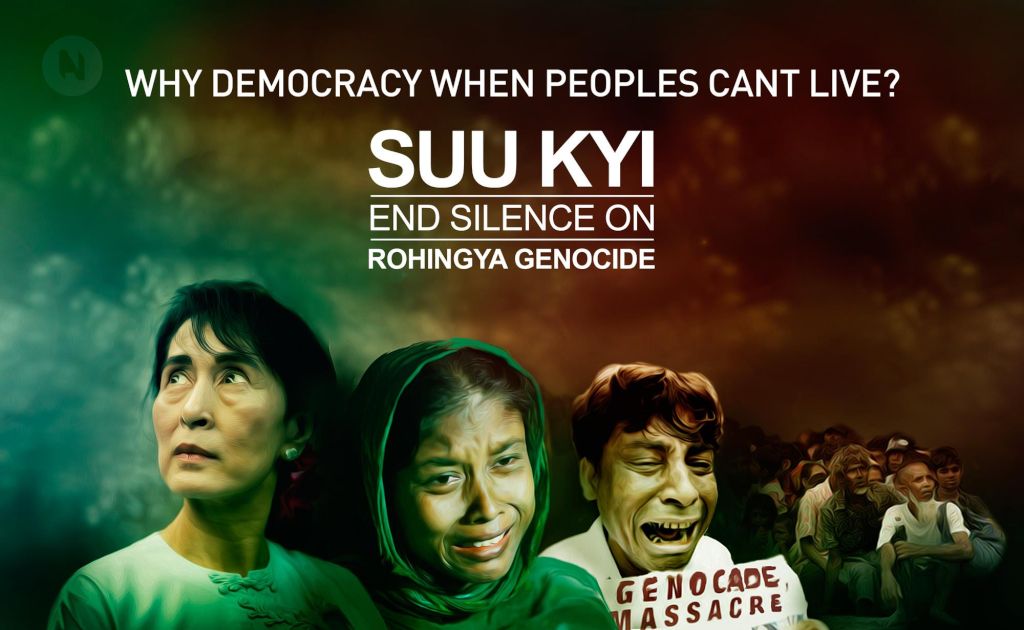
FOR the first time anyone could remember, Nobel Peace Prize laureate Aung San Suu Kyi has become the subject of criticism by the same pro-democracy advocates in the international community who have supported her and helped her rise into prominence on the world stage.
The sudden backlash came undone following her continuous dodging of the issue involving the systematic oppression and violence against the Muslim Rohingya minority by the Myanmar government.
Suu Kyi, who won the adoration of many human right advocates worldwide for championing democracy in strife-torn Myanmar, uncharacteristically chose the ‘safe way out’ when asked on her response on the routine discrimination against the Rohingya including the government’s refusal to grant them citizenship despite having lived in Burma for generations.
At a recent news conference held with singer Bono of rock band U2 in Dublin, she said, “The root of the problem is lack of rule of law (in Myanmar).”
Asked whether the Rohingya should be granted Myanmar citizenship, Suu Kyi replied curtly: “I don’t know.”
The news report from UK daily The Independent also described her responses to the issue at hand as “vague” and “scripted”.
Forsaking Democracy for Majority Buddhist Vote
No one except perhaps her closest supporters would have thought ‘The Lady’, who became widely known as the voice of Myanmar's downtrodden, would turn a blind eye on the plight of the Rohingya following the intensified conflict between the Muslim minority and Buddhist Rakhine in the last few months.
The Oxford-educated political activist-turned politician, who has been placed under house arrest for a total of 15 of the past 21 years since she began her political career, is apparently willing to forsake being labeled a hypocrite by the international community for political gain. Analysts say many of her political allies themselves vehemently oppose the Rohingya hence speaking out on the matter would only risk alienating the former and, ultimately, the Buddhist voters who make up the majority in Myanmar.
“She is no longer a political dissident trying to stick to her principles. She's a politician and her eyes are fixed on the prize, which is the 2015 majority Buddhist vote,” said a Myanmar expert and visiting fellow at the London School of Economics, Maung Zarni.
Plight of the Rohingya
Fighting between Buddhists and Muslims in the western coast state of Rakhine has left about 87 people from both sides dead since June, according to an official estimates, although rights groups fear the real toll is much higher. According to reports, the two groups attacked each other with spears and machetes and went on rampages burning homes and razing entire villages.
The Rohingya, who have been described as “among the world’s least wanted” and “one of the world’s most persecuted minorities”, have continued to suffer from human rights violations under the Burmese junta since 1978. They have been stripped of their citizenship since a 1982 citizenship law. They are also not allowed to travel without official permission, are banned from owning land and are required to sign a commitment to have not more than two children.
The government has been blamed by rights groups which claimed it did little to stop the violence in Rakhine initially before turning its security forces on the Rohingya with targeted killings, rapes, mass arrests and torture. Human Rights Watch which estimated that 100,000 people were displaced by the fighting has accused Burmese forces of opening fire on Rohingya. The New York-based organization also claimed that the government’s tally of 78 dead is “undoubtedly conservative.”
Last weekend, the government finally appointed a 27-member commission to look into the causes of the conflict and to propose solutions to the community mistrust between Muslims and Buddhists.
News reports claimed that the recent violence in Rakhine was initially triggered by allegations that a gang of Rohingya men had raped a local Arakanese woman. Apparently, the lynching of ten Muslims in response sparked days of rioting in the state formerly known as Arakan.
However, the tension between the immigrant minorities, namely from India, and majority Burmese have existed since the early part of last century. According to historian Thant Myint-U, the growing resentment against the minorities was due to the huge influx of Indian immigrants that resulted in the settlers outnumbering the Burmese (hence the two children per family restriction).
"At the beginning of the 20th century, Indians were arriving in Burma at the rate of no less than a quarter million per year. The numbers rose steadily until the peak year of 1927, immigration reached 480,000 people, with Rangoon exceeding New York City as the greatest immigration port in the world. This was out of a total population of only 13 million; it was equivalent to the United Kingdom today taking 2 million people a year." By then, in most of the largest cities in Burma, Rangoon (Yangon), Akyab (Sittwe), Bassein (Pathein), Moulmein, the Indian immigrants formed a majority of the population. The Burmese under the British rule felt helpless, and reacted with a "racism that combined feelings of superiority and fear."
The World Finally Responds
The long-standing conflict between the Rohingya Muslims and ethnic Rakhine Buddhists finally caught the attention of the international community following recent violence in Rakhine after decades of systematic persecution of the Rohingya. Various human rights, pro-democracy groups and Muslim nations have voiced deep concerns over the treatment of the stateless group.
The 57-nation Organization of Islamic Cooperation (OIC) condemned the violence at an emergency summit recently and said it will present its concerns to the upcoming United Nations General Assembly. At the summit, Saudi Arabia accused Myanmar of launching an "ethnic cleansing campaign" and King Abdullah announced that he would donate US$50 million in aid to the Rohingya in Myanmar. Meanwhile, Islamic hardliners in Indonesia and Pakistan have threatened attacks against the Myanmar government.
Democracy vs Hypocrisy
Sadly, the outrage against the persecution of the Rohingya stops at Myanmar's borders. As a politician, Suu Kyi is playing a different ballgame now that her opposition party is trying to consolidate political gains attained after they entered Parliament for the first time in April.
Suu Kyi is well aware that speaking out for the Rohingya is the right thing to do but Myanmar’s Buddhist majority appear to have resentment against these stateless Muslim minority. According to The Associated Press, the Rohingya are a deeply unpopular cause inside Burma, where much of the country's majority Buddhist population views them as illegal immigrants from Bangladesh. Not only that, the Muslim minority have also been labeled as terrorists.
On the first day of the Muslim Eid ul-Fitr celebration, up to 100 ethnic Rakhine held a rally near a regional parliament building in Rangoon to protest against the UN and various non-government organizations’ for providing assistance to the Rohingya . The protesters held signs and banners that said: “Stop Creating Conflicts” and “Don't Bring Terrorists to Our Land.”
Myanmar and the rest of the world are aware that if there was anyone who could effectively take on the Rohingya cause it would be Suu Kyi. However, the problem for Suu Kyi is, how would she, as the most celebrated champion of democracy and human rights, justify hatred towards a certain ethnic minority, especially in these day and age. Any attempt to do so will not only not fly well with the international community which will won’t hesitate to condemn her for being a hypocrite, it could also potentially have repercussions on her vote counts come election in 2015.
Christians Also Targeted
It also appears as if the widespread resentment against minorities has been deeply imbedded in the psyche of the Burmese population and, apparently, the Muslims are not the only ones being targeted. According to the Chin Human Rights Organization’s (CHRO) latest report, ‘Threats to Our Existence: Persecution of Ethnic Chin Christians in Burma’, there exist “a serious ongoing human rights violations, even as the government claims to deepen its reforms in the country.”
“For years, state-sanctioned deep-rooted discrimination against the Chin on the dual basis of their ethnicity and religion has given rise to widespread and systematic violations of fundamental human rights, particularly religious freedom. … the Chin continue to be denied religious freedom and are targeted for induced and coerced conversion to Buddhism, in pursuance of an unwritten State policy of forced assimilation.”
All eyes are on Suu Kyi now as the world waits for her to come out with an unequivocal stand over the Rohingya issue. People want to know what the National League for Democracy (NLD) leader has to say about being selective in her championing of democracy and human rights.
So far, as the world sees it, Suu Kyi has failed to live up to her stature as one of the world's most celebrated pro-democracy campaigners. To the dismay of many, she may well be an angel in disguise who is the lesser of two evils.

It's great that US Ambassador to Myanmar, Derek Mitchell, has finally spoken out on the ethno-religious riots between Rohingyas and Buddhist people in the Rakhine state.
He points out racism in Myanmar society at large, something some of us have been saying for so long.
But the problem with shifting the new focus onto popular racism is that it lets the real culprits - the generals and their troops - off the hook.
The Myanmar regime has a direct and immediate hand in the recent communal riots between the Rakhines and the Rohingya - who it only refers to as "Bengali Muslims" - by sending the message that these people do not belong in Myanmar, even though they were born on Rakhine soil and have been in the country for generations.
For the record, I place the ultimate responsibility for the outbreak of ethno-racial violence squarely on the Thein Sein government. Successive military regimes since Ne Win's reign (1962-1988) have used the tactic of ethnic and religious divide and rule. Precedents and contemporary cases abound. In 1967, Ne Win reportedly diverted attention from the failings of his socialist economy - which resulted in rice shortages across the country - by blaming "greedy Chinese merchants". That sparked anti-Chinese riots. When the mob in Yangon stormed the Chinese Consulate, the generally trigger-happy Burmese troops (when it comes to "restoring law and order") simply stood by and watched the mob kill the deputy chief of mission on the Chinese Consulate's premises. The regime is pursuing a scorched-earth military operation against the Kachins in the north while offering ceasefire deals to the other armed ethnic resistance groups.
This is the regime that has specialised in "law and order" for the past 50 years, since 1962. It deliberately let all hell break loose in western Myanmar because it suited the regime in multiple ways for the Rakhine and the Rohingyas to slaughter one another.
Burmese generals have never liked the Rakhines people, especially those who are ethno-nationalistic and want to push for genuine political autonomy for the Rakhine state.
Troops and all other security units stationed in western Myanmar, on the other hand, have turned all kinds of severe restrictions - in place for at least 30-40 years - into the basis for extorting and abusing the Rohingyas. For instance, the Rohingyas' physical movements and their ability to marry and have children were restricted, requiring permission from the authorities and security units. In effect, the Rohingyas were turned into cash cows by the local security units in western Myanmar.
For their part, the Rakhine people felt angry that the government security troops and authorities were benefitting economically from the Rohingya. (The Rohingya population in general are very poor, while there are a handful of wealthy Rohingya business families. Many Rohingyas who work abroad, however, remit money back to their families in western Myanmar.) Also, forced labour among the Rohingya population is disproportionately higher than in any other ethnic community including those in Myanmar's active war zones in the eastern and northern regions of the country. So, the authorities extract both cash and labour from the captive Rohingya population.
But the Rakhine people felt powerless in the face of the overwhelming might of the security forces on their soil, despite their perception of the regime's favouritism to the Rohingyas, whom the Rakhine have come to consider as "animals" on their soil.
So, naturally, the Rakhine people grew more hateful of the Rohingyas and the state security apparatus, and finally took it out on the weaker of the two - the Rohingyas.
When violence broke out, not only did the security forces not intervene to keep order and nip the initial violence in the bud, but troops - some Burmese and some Rakhine themselves - in places like Maungdaw decided to turn against their cash cows and forced labourers - the Rohingyas.
This time it wasn't the greed of the troops, who had long milked the Rohingyas for their money and extracted labour that led them to directly participate in the slaughter of the Rohingyas. Rather it was the Burmese and Rakhine people's general dislike of Muslims that finally compelled the troops in Maungdaw to machine-gun the Rohingyas in large numbers.
Evidence of the attacks keeps surfacing from various independent eyewitnesses. According to one local researcher in the country - whose account of the Rohingya slaughter at the hands of the Burmese and Rakhine security forces was published in Al Jazeera English ("Mass graves for Myanmar's Rohingya, August 9) - the troops that he interviewed openly talked about "how much they hate Muslims" and described coldly the manner in which they machine-gunned down the Rohingya.
This directly corresponds with the policies of Nay Pyi Daw. This is not simply troops in local areas shooting without orders from above and getting away with mass murder. In fact, the widespread view within the military is: "the bottom line is, we do not want more Muslims in our country". So there is not simply popular racism but vertical and official hatred of Muslims in general and the Rohingya Muslims in western Myanmar in particular.
To deny this is to add insult to injury. The focus of the current riot inquiry by the presidential commission and the international media coverage needs to focus on this direct connection between popular racism and the regime's racist and violent policies and practices of the last 40 years since Operation Snake King (or Nagamin) killed hundreds, if not thousands, of Rohingyas and drove hundreds of thousands more out of western Myanmar into Bangladesh in the 1970s, under the Ne Win-Sein Lwin regime. Ne Win was the godfather, and Sein Lwin was the butcher.
Muang Zarni is a visiting fellow at the Civil Society and Human Security Research Unit, the London School of Economics. A veteran founder of the Free Burma Coalition, Zarni advocated "principled and strategic engagement" with the regime as early as 2003. @ m.zarni@lse.ac.uk.
Sources Here:

On 19th June 2012, armed Rakhine terrorists, security forces and police (Note: security forces and police in Arakan state are made up of mostly Rakhines, no Rohingya at all) raided Baggona village in Maung Daw and arrested young and old Rohingyas alike which numbered almost 100 (age: 12-80). (They were taken to unknown locations and nothing had been heard from them since then.) Therefore while the remaining Rohingya men were on hiding in the fear of being arrested, they raped and ganged raped the Rohingya women left behind to their heart’s content. Besides, they robbed and looted 700 houses and took away gold, silver, money and whatever possible. For the worse, these terrorists destroyed furniture, cooking pots and other properties which they could not take away. Currently the people in the village are having serious crises and the raped Rohingya women are in troubles such as being pregnant with these unknown terrorists and others. Therefore, they plead international communities to help them out from the hands of evils rather than giving mere lips services.
Now President U Thein Sein has set up an inquiry commission into the violence of Arkan, which has 27 members, to investigate and find out the culprits of the violence. But sadly, the commission itself has the people who have committed the crimes against Rohingyas themselves. Therefore, the government will only be able to find out the real cause and culprits of the violence if they replenish the inquiry team with the representatives from the political parties of local Rohingyas and Union Solidarity Development Party (USDP) and use them to thoroughly investigate the real victims in the ongoing violence whether as a means of refilling to the present commission or to exactly find out the masterminds behind the brutal treatments of Rohingyas.
Below is the list of some Rohingya women and under-aged girls raped by military, Rakhine terrorists, police and security forces.
The list of Rohingya Women Raped in Baggona, a village three miles far from Maung Daw to its South
Reported by Khin Nyein Chan
Translated into English by M.S. Anwar
Reported by Khin Nyein Chan
Translated into English by M.S. Anwar

KUALA LUMPUR: Kelab Putera 1Malaysia (KP1M)'s humanitarian mission to Myanmar/ Bangladesh will be launched on Friday to help the oppressed Rohingya refugees.
KP1M president Datuk Abdul Azeez Abdul Rahim, who is also the head of the mission, said: "We are not going to interfere with the politics, we just want to help the Rohingya community.
"We hope this effort by KP1M will get Malaysians' blessing. Please pray that we will come back safely so that we can give more help in the future," he said yesterday.
KP1M's observer team had left for the border of Myanmar and Bangladesh yesterday to gauge the situation at the refugee camps there.
Its purpose is to coordinate and make preparations for the main team.
The main team will depart from Port Klang on a Royal Malaysian Navy ship to Chittagong Port in Bangladesh, bringing along 450 tonnes of aid. The team will consist of 40 members, including doctors and the media.
KP1M will set up a clinic in Myanmar, with medicines worth RM310,000 for treatment.
There are two camps under the auspices of the United Nations High Commissioner for Refugees (UNHCR) in Kutupalog and Nayapara on the border of Bangladesh with 30,000 refugees.
There are also camps that are not recognised in the vicinity with 100,000 refugees.
In Myanmar, there are two refugees camps in Maungdaw and Bathidaung under the UNHCR as well.
At the press conference here yesterday, about 2,000 Rohingya working in Malaysia came to give donations and moral support to the mission.
Sources Here :

Allegation #6
Rohingyas are terrorists. They have links with Al-Qaeda.
Refutation
It is really ridiculous to see how all Rohingyas are called terrorists as a whole. Why? Maybe because to some bigotry and ignorant people, all Muslims are terrorists. And on what basis are Rohingyas called terrorists? Those racist and ignorant people show a video leaked out on Wikileaks as their proof. [This information sent to US in 2002 by US embassy in Yangon was provided by the former MI (Military Intelligence) supervised by ex-general Khin Nyunt, who has been long known as anti-Rohingya] May be because their scholars dress like Arabs or Indians?
Some accuse them as terrorists because they have armed groups like RSO or ARNO. They had these groups but they don’t have them now. They were freedom fighters for the world’s most persecuted Rohingyas. When Karens, Kachins, Shans, even Rakhines take arms, they are called freedom fighters. But when Rohingyas take arms to save their lives and dignity, they are called terrorists. Why double standard?
What is the definition of the terrorist? If “terrorist” is a word used for people who are terrorized again and again, then Rohingyas are terrorists. It is quite natural that, when one is severely persecuted, made unemployed and restricted access to modern education, he or she might have tendency to behave like a terrorist or join terrorist gangs. Just like when someone is kept starved without any food, he or she will eat anything to survive. Who is responsible for that? Shouldn’t their government give them a good education to leave the way of extremism instead of killing them (human beings)? Yet till date, no terrorism occurred in Arakan because of Rohingyas. All are baseless and wrong-propaganda spread by the state-sponsored media and some extremists. No International Media or Independent Observers are given access to the region where the riot has been taking place. Therefore, the only terrorists there, I think, are the Military who have been playing games for their own benefits.
Allegation #7
Rohingyas have too many wives, too many children and too many grand children. And now they are outnumbering Rakhines in Arakan state.
Refutation
Islam itself only allows one marrying more than one woman but doesn’t encourage doing so. Permission is given only to those people who can treat their women equally in all aspects including sex and finance. Hardly any Rohingyas have four wives in Arakan. Restriction on their marriage is so much so that a Rohingya has to wait for permission (to marry even one) from the authority for one to two years despite the fact that they need to bribe huge amount of money. Yes, there are few Rohingyas who have two wives. What is it to other people? Rohingyas do not have “too many” Children and grandchildren but “many.”
Accusation against Rohingyas outnumbering Rakhines is a baseless one. Carry out a survey on the ground to know who outnumber whom. Contrary to accusations against Rohingyas, they are not Rohingyas who are sneaking into Arakan but Rakhines taking the advantage of the presence of their people in immigration in Arakan and other departments. Rohingyas have only been leaving Arakan to escape the persecutions since 1962. Rakhines are citizens of both Bangladesh and Burma but Ronhigyas are citizens of none.
Allegation #8
Rohingyas are lazy, don’t want to work and have low IQ.
Refutation
Rohingyas are not lazy. They are not given any opportunity either in government or in private companies in Burma. They work whenever and wherever they get opportunities unlike those useless Burmese (not referring to all Burmese) who waste their time in tea-shops, karaoke, gambling, watching movies, walking to and fro and drinking alcohol all the night and sleep all the day while making their women work for their daily income. Besides, inside Burma, Rohingyas are not given any opportunity to do tertiary education (especially professional courses) and banned from any kinds of educational campaigns to be able to show their intelligence. Outside Burma or in exile, Rohingyas excel. Carry out a survey if one finds it hard to believe.
Mohammed Sheikh Anwar is an activist, studying Bachelor of Arts in Business Studies at Westminster International College in Malaysia.
 |
| Members of the Organization of Islamic Cooperation (OIC) delegation meet Myanmar President Thein Sein in Yangon, Saturday. — Courtesy photo |
This was disclosed by Professor Wakar Uddin, director general of Arakan Rohingya Union (ARU), in an exclusive interview with The Gulf Today on Monday.
He was in the UAE for a short period after attending the fourth extraordinary OIC summit on August 14-15.
“Two weeks ago, the OIC had sent the first ever delegation along with the Red Crescent officials and others to Myanmar, who visited camps full of Rohingya Muslims after they were forced to leave their houses and stay in these camps in a pathetic condition. The second delegation is all set to leave for Myanmar next week and that will be led by the secretary general, OIC, as an exploratory visit to find out facts about the atrocities by the Myanmarese police and other groups on the Rohingya Muslims,” he said.
The ARU was formed on the directives of Dr Ekmeleddin Ihsanoglu, secretary general of the OIC, who called on the Myanmarese Muslims around the world to form a union.
“The ARU was formed in May 2011 and initially we had 25 organisations of Myanmarese Muslims working worldwide and soon others will joined us as a single platform to represent Rohingya Muslims,” he added.
Professor Wakar, while shedding light on the objectives of the ARU, said that they had three main objectives. “Our first objective is to engage with the Myanmarese government to reclaim our basic rights as minority, especially the citizenship right they have stopped since 1962.
“The second major task we have to fulfil is to bring overall development for the Rohingya Muslims in the sectors of education and economy, by providing them with basic infrastructure and the third is to start a dialogue between other Muslim minorities who arrived from China, India and other parts of the world and are residing in different parts of Myanmar and other minorities,” he said.
According to Professor Wakar, Myanmar has around 3 million Muslims of which 1.5 million are Rohingyas and are living in the Arakan state.
“The literacy rate among Rohingya Muslims is very low and only one per cent has higher education facility. We have a huge challenge in front of us to target this sector on a long-term basis once peace is restored in Arakan,” he said.
He further said that Dr Ekmeleddin Ihsanoglu had invited him to the recent session. “I was there to testify on behalf of ARU and present a 45-minute speech in front of the executive body and they were very emotional when they listened to accounts of atrocities by ethnic groups and now by the Myanmarese police against Rohingya Muslims,” he shared.
He added that next week a Malaysia-based NGO is planning to sent a flotilla consisting of over a dozen ships with relief goods to Myanmar. “This will be a major breakthrough and massive help for the Rohingya Muslims who are facing every type of discrimination, from proper food supply to a decent accommodation,” he added.
He stated that soon the Islamic Society of North America (ISNA) would organise a massive convention in Washington DC from Aug.31 to Sept.2 with the expected participation of 10,000 to 15,000 representatives from around the world to focus on Rohingya Muslims.
“All major Muslim bodies, humanitarian organisations and NGOs will have their representation in this annual three-day convention to raise the issue of Rohingya Muslims on a wide scale,” he said.
-
 "Although mass killings and exterminations of human races were some sort of things that the world experienced during Nazi German p...
 -
 More than 400,000 Rohingya have fled from Myanmar to neighbouring Bangladesh By BBC News September 17, 2017 Myanmar's de ...
 -
 ပါလီမန္အမတ္ဦးေရႊေမာင္ၿပည္သူ႔လြတ္ေတာ္တြင္ရခိုင္ၿပည္နယ္၌ၿဖစ္ပြါးခဲ့ေသာအေရးအခင္းနဲ့ ပတ္သက္၍ေဆြးေနြးတင္ၿပၿခင္း။ (14th day of regular ses...
 -
 RB News March 31, 2018 Minbya, Arakan State : On March 30 morning, a Prayer Leader or Imam was brutally beaten and injured by a Rakh...
 -
 ဇြန္လ ၁၇ ရက္ ၊ ၂၀၁၂ Source: guardian.co.uk ျမန္မာျပည္သစ္အတြက္ အနာဂတ္မွာ ေအာင္ျမင္မွာလား၊ က်ရွဳံးမွာလားဆိုသည္ကို ညႊန္ျပေသာ စမ္းသပ္မွဳ တစ...
 -
 Read letter here Read history of Rohingya here Download letter PDF here Download History of Rohingya PDF here credi...
 -
 At Baggona, a village three miles far from and lies to the South of Maung Daw of Arakan state, more than 80 Rohingya women and girls have be...
 -
 RB News May 17, 2013 Maung Daw, Arakan - After the warnings on Mahasen cyclone had been issued, the displaced Rohingyas from the ...
 -
 12/07/2012 Joint press release HUMANITY GONE ...
 -
 The custodian of Two Holy Mosques King Abdullah bin Abdul Aziz Al Saud Aug 11 The custodian of Two Holy M...

Popular Posts
Threatwiki

Amartya Sen: Burma's "slow genocide" of Rohingyas

Watch Professor Amartya Sen speak on what he calls Burma's 'slow genocide' of Rohingya, Harvard, 4 Nov 2014
