
.jpg)
.jpg)
.jpg)
(Reuters) - Homes burned, gunshots rang out and witnesses reported many dead as sectarian violence raged for a fifth day between Rohingya Muslims and Buddhists in northwest Myanmar on Tuesday, threatening the country's nascent democracy.
Security forces struggled to stem the worst communal violence since Myanmar's reformist government replaced an oppressive junta last year and vowed to forge unity in one of Asia's most ethnically diverse countries.Hundreds of Rohingyas have been turned away by authorities in neighboring Bangladesh after attempting to flee the fighting in boats, say officials and witnesses.
The fighting in Sittwe, capital of Myanmar's Rakhine State, has prompting President Thein Sein to declare a state of emergency, impose dawn-to-dusk curfews and warn that "vengeance and anarchy" could jeopardize the country's fledgling transition to democracy after nearly 50 years of army rule.
"Almost all of the shops have closed. We only have a little bit to eat because the market is also closed," said a worker at a hotel in the centre of Sittwe.
Witnesses reported black smoke over Sittwe, a port town riven by tensions between Buddhists and Muslims. Some Buddhists have been seen carrying bamboo stakes, machetes and sling-shots. Muslims and Buddhists were seen setting houses on fire.
The United States and European Union urged calm to prevent a derailing of Myanmar's fragile reforms.
"Violence between each group is still continuing and is getting worse today in Sittwe. One Rakhine man died in the rioting this morning," said Aung Myat Kyaw, a member of the Rakhine state parliament.
He said about 5,000 people had taken refuge in Buddhist monasteries and schools in Sittwe.
Shwe Maung, a Muslim lower house representative in the ruling Union Solidarity and Development Party for the town of Buthidaung, urged the army to intervene and accused police of allowing Buddhists to break the curfew and burn Muslim houses.
"Sittwe is like a war zone," he said, putting the death toll at 50 in the village of Narzi, not far from Sittwe.
Already, the unrest is undermining the image of ethnic unity and stability that helped persuade the United States and Europe to suspend economic sanctions this year.
WOMEN AND CHILDREN ADRIFT
The violence, which first erupted on Friday in the town of Maungdaw, could also force the government to confront a long-festering question of how to resolve the plight of thousands of stateless Rohingya Muslims on Myanmar's border with Bangladesh.
Many toil in abject poverty, often despised by ethnic Rakhine, members of Myanmar's Buddhist majority.
Medical aid group Medecins Sans Frontieres suspended its operations in the area on Tuesday, a day after the U.N. refugee agency pulled out its staff. More than 4,000 people driven from their homes are in six shelters, Myanmar state media said.
The official death toll remains eight people killed over several days, but witnesses said the number was substantially higher, although that this could not be independently confirmed.
Amid the violence, Bangladeshi paramilitaries, police and coastguard pushed back 12 wooden boats on Monday carrying 300 Rohingyas, mostly women and children, and witnesses said three more with some 150 people on board were drifting in waters close to the border.
Witnesses said they saw just 20 Rohingyas who had made it into Bangladesh, about half of whom were injured, but their whereabouts were not known. A Bangladeshi official on St Martin's island said the remaining boats had tried to reach the shore but were turned back.
"The boats moved around for a couple of days trying to land on this island but eventually were driven out of our water this morning," Mohammed Nurul Amin, head of a district council, told Reuters by telephone.
"Islanders are also keeping an eye out for any further crossing attempts," he said.
Buddhist-majority Myanmar's government regards the estimated 800,000 Muslim Rohingyas in the country as illegal immigrants from Bangladesh and denies them citizenship. Bangladesh has refused to grant Rohingyas refugee status since 1992.
Bangladesh's Foreign Ministry said it supported Myanmar's efforts to restore order and said it was acting in the best interests of both countries by ensuring developments in Myanmar "do not have any trans-boundary spill-over". The countries are separated by a river flowing into the Bay of Bengal.
Rohingya activists have demanded recognition as a Myanmar ethnic group, claiming a centuries-old lineage to Rakhine.
U.S. Secretary of State Hillary Clinton on Monday echoed Thein Sein's warning the unrest threatened to endanger democratic and economic reforms in the former Burma if it spiraled out of control."The situation in Rakhine state underscores the critical need for mutual respect among all ethnic and religious groups and for serious efforts to achieve national reconciliation," Clinton said in a statement.
"SPIRALLING OUT OF CONTROL"
U.S.-based Human Rights Watch called for diplomats and foreign journalists to be given access to the area and criticized Thein Sein for handing power to security forces. It said troops had opened fire on Rohingyas in Rakhine State, also known by its former name Arakan.
"Deadly violence in Arakan State is spiraling out of control under the government's watch," the group's deputy Asia director, Elaine Pearson, said in a statement.
What sparked the rioting is not known, but it came as tension between Buddhists and Muslims simmered in the wake of reports of a gang rape and murder of a Buddhist woman, widely blamed on Muslims.
That led to the killing of 10 Muslims on June 3, when a Buddhist mob stopped a bus they were travelling on. The dead bus passengers had no connection to the murdered woman; state media says three Muslims are on trial for the woman's death.
Curfews are in place in three Myanmar towns, including Thandwe, the gateway to tourist beaches, and Kyaukphyu, where China is building a port complex.
Chinese Foreign Ministry spokesman Liu Weimin urged Chinese citizens and companies to boost safety precautions and said China "supports Myanmar's efforts in maintaining stability and ethnic harmony".
(Additional reporting by; Nurul Islam in Cox's Bazar, Andrew R.C. Marshall in Bangkok, Sui-Lee Wee in Beijing; Writing by Martin Petty and Jason Szep; Editing by Alan Raybould and Ed Lane)
Rohingya activists have demanded recognition as a Myanmar ethnic group, claiming a centuries-old lineage to Rakhine.
U.S. Secretary of State Hillary Clinton on Monday echoed Thein Sein's warning the unrest threatened to endanger democratic and economic reforms in the former Burma if it spiraled out of control."The situation in Rakhine state underscores the critical need for mutual respect among all ethnic and religious groups and for serious efforts to achieve national reconciliation," Clinton said in a statement.
"SPIRALLING OUT OF CONTROL"
U.S.-based Human Rights Watch called for diplomats and foreign journalists to be given access to the area and criticized Thein Sein for handing power to security forces. It said troops had opened fire on Rohingyas in Rakhine State, also known by its former name Arakan.
"Deadly violence in Arakan State is spiraling out of control under the government's watch," the group's deputy Asia director, Elaine Pearson, said in a statement.
What sparked the rioting is not known, but it came as tension between Buddhists and Muslims simmered in the wake of reports of a gang rape and murder of a Buddhist woman, widely blamed on Muslims.
That led to the killing of 10 Muslims on June 3, when a Buddhist mob stopped a bus they were travelling on. The dead bus passengers had no connection to the murdered woman; state media says three Muslims are on trial for the woman's death.
Curfews are in place in three Myanmar towns, including Thandwe, the gateway to tourist beaches, and Kyaukphyu, where China is building a port complex.
Chinese Foreign Ministry spokesman Liu Weimin urged Chinese citizens and companies to boost safety precautions and said China "supports Myanmar's efforts in maintaining stability and ethnic harmony".
(Additional reporting by; Nurul Islam in Cox's Bazar, Andrew R.C. Marshall in Bangkok, Sui-Lee Wee in Beijing; Writing by Martin Petty and Jason Szep; Editing by Alan Raybould and Ed Lane)
Akyab (Sittwe), Arakan State: Killing, torching houses and looting the properties of the Rohingyas have been continued in Sittwe and Maungdaw by police, Hluntin and a group of Rakhine racists, said a trader from Sittwe.
“Today at about 11:30 am, the villages of Moliek, Hoshai Para, Amla Para, and Kun Dan Ward of Sittwe were torched by a group of Rakhine racists with the cooperation of police and Hluntin. Police and Hluntin fired on to the villages while the Rakhines set on fire to the Rohingya villages.
Some of the houses were burnt down into ashes and some people were killed and wounded by the firing of police and Hluntin.
According to different sources, Nur Jahan (70), daughter of Kader, Thura Shwe (8), son of U Tin Shwe and his twin sister Ma Ni Ni, Daw Lun Lun (29), daughter of Nuru Uddin and her sister Sajida (23), Daw Hla Thein (53), daughter of U Maung Pru, Maung Tu Shay were killed. They all are from Padi Like village.
Besides, from Rohingya village, Moluvi, Noor Hussain (32), son of Saley Ahamed, Imam (religious leader), Jalal (56), son of U Maung Bra, Khalu Maung (a) Aye Tun, son of Md. Ali. They are one family members and belong to Saccay Pyin village. They whole family members of advocate U Kyaw Myint were also killed by police and Hluntin.
In addition, Majibur Rahaman (24) son of Abdur Rahaman was shot dead by police and Tasmin Juhar (28) son of Anwar, Sadek Hussain (18) son of Kader (student) and Younus (14) son of Abdur Rahaman were wounded. They all belong to Kun Dan Ward of Sittwe.”
Yesteday, 21 Rohingyas from Sittwe were wounded by police and sent to Sittwe General Hospital for medical treatment, but all were dead for critical wounded, said a villager.
Amla Para Madrassa, Mosque of Kyaung Gyi Lan, Mosque and Madrassa of Kun Dan Ward, Mosque of Moliek, Mosque of Buhar Para, Mosque of Santawli, Mosque of Hoshai Para village, Mosque of Rohingya Para and Mosque of Bowmay Para were destroyed by police, Hluntin and Rakhines. The Nazir Para market was also burnt down.
According to sources, two police personnel and eight Rakhines were killed by army while they were firing to Rohingya villages and torching houses. The reason is that an army was killed by firing of police accidentally.
After the accident, Rohingya villages are under the control of army. However, the dead bodies of Rohingyas and the villagers of Nazir Para are brought to Thee Chaung village which is situated nearby the ocean.
Rohingyas are now in panic-stricken as well as they have no food, no rations, no medical access, said a villager who didn’t mention his name.
Recently, more than 11 engine boats with over 500 Rohingyas including women and children were floating in the Naff River. They try to land on Bangladesh soil but the authorities of Bangladesh don’t allow them. They are suffering from crisis of food, water and medicine.
In Maungdaw, Md. Zinna (50), son of Kasim, Jamil Hassan (25), son of Deen Mohamed, Azizul Hassan (20), Younus, Zahir Ahamed, Nurul Alam and four others were taken away by police and kept in police station where they were not provided adequate food, said an elder from Maungdaw.
Yesterday, an older woman accompanied by her daughter was shot dead by army while they were crossing from one house to another at about 7:00 pm. They belong to Honsara village of Zaw Mathet village tract, Maungdaw Township.
One youth named Hussain Ahamed 25 son of Nazir Hussain of north Ngakura village of Maundaw township was stabbed to death by Rakhine villagers while returning from his father-in-law’s house at 5:00 pm. He was newly married.
In Maungdaw south, Natala villagers tried to arson attack to a Rohingya village named Aley Than Kyaw. But, they were caught by army on the way and sent to the Nasaka camp. The Natala villagers are from Senda Para village, said a villager
Md. Khan, Hasina, wife of Md. Ali and Nurul Islam were picked up by police at night. They all belong to Bomu Para.
Jamil Ahmed and his son Yasin and another two villagers were also picked up by police in the evening today. They belong to Ward No. 5.
Another five villagers from Ward No. 4 were picked up by police today evening and four other Rohingya villagers were also brought to Maundaw town from the southern side Maungdaw. They all were sent to Maundaw police station, but reason is unknown, sources said.
Two Rakhine youths dressed with army uniforms entered the Rohingya Bagguna village and looted ornaments from Ms. Morina Khatun, Ms. Laruni and Ms. Toyuba Khatun and ran way.
KNP“Today at about 11:30 am, the villages of Moliek, Hoshai Para, Amla Para, and Kun Dan Ward of Sittwe were torched by a group of Rakhine racists with the cooperation of police and Hluntin. Police and Hluntin fired on to the villages while the Rakhines set on fire to the Rohingya villages.
Some of the houses were burnt down into ashes and some people were killed and wounded by the firing of police and Hluntin.
According to different sources, Nur Jahan (70), daughter of Kader, Thura Shwe (8), son of U Tin Shwe and his twin sister Ma Ni Ni, Daw Lun Lun (29), daughter of Nuru Uddin and her sister Sajida (23), Daw Hla Thein (53), daughter of U Maung Pru, Maung Tu Shay were killed. They all are from Padi Like village.
Besides, from Rohingya village, Moluvi, Noor Hussain (32), son of Saley Ahamed, Imam (religious leader), Jalal (56), son of U Maung Bra, Khalu Maung (a) Aye Tun, son of Md. Ali. They are one family members and belong to Saccay Pyin village. They whole family members of advocate U Kyaw Myint were also killed by police and Hluntin.
In addition, Majibur Rahaman (24) son of Abdur Rahaman was shot dead by police and Tasmin Juhar (28) son of Anwar, Sadek Hussain (18) son of Kader (student) and Younus (14) son of Abdur Rahaman were wounded. They all belong to Kun Dan Ward of Sittwe.”
Yesteday, 21 Rohingyas from Sittwe were wounded by police and sent to Sittwe General Hospital for medical treatment, but all were dead for critical wounded, said a villager.
Amla Para Madrassa, Mosque of Kyaung Gyi Lan, Mosque and Madrassa of Kun Dan Ward, Mosque of Moliek, Mosque of Buhar Para, Mosque of Santawli, Mosque of Hoshai Para village, Mosque of Rohingya Para and Mosque of Bowmay Para were destroyed by police, Hluntin and Rakhines. The Nazir Para market was also burnt down.
According to sources, two police personnel and eight Rakhines were killed by army while they were firing to Rohingya villages and torching houses. The reason is that an army was killed by firing of police accidentally.
After the accident, Rohingya villages are under the control of army. However, the dead bodies of Rohingyas and the villagers of Nazir Para are brought to Thee Chaung village which is situated nearby the ocean.
Rohingyas are now in panic-stricken as well as they have no food, no rations, no medical access, said a villager who didn’t mention his name.
Recently, more than 11 engine boats with over 500 Rohingyas including women and children were floating in the Naff River. They try to land on Bangladesh soil but the authorities of Bangladesh don’t allow them. They are suffering from crisis of food, water and medicine.
In Maungdaw, Md. Zinna (50), son of Kasim, Jamil Hassan (25), son of Deen Mohamed, Azizul Hassan (20), Younus, Zahir Ahamed, Nurul Alam and four others were taken away by police and kept in police station where they were not provided adequate food, said an elder from Maungdaw.
Yesterday, an older woman accompanied by her daughter was shot dead by army while they were crossing from one house to another at about 7:00 pm. They belong to Honsara village of Zaw Mathet village tract, Maungdaw Township.
One youth named Hussain Ahamed 25 son of Nazir Hussain of north Ngakura village of Maundaw township was stabbed to death by Rakhine villagers while returning from his father-in-law’s house at 5:00 pm. He was newly married.
In Maungdaw south, Natala villagers tried to arson attack to a Rohingya village named Aley Than Kyaw. But, they were caught by army on the way and sent to the Nasaka camp. The Natala villagers are from Senda Para village, said a villager
Md. Khan, Hasina, wife of Md. Ali and Nurul Islam were picked up by police at night. They all belong to Bomu Para.
Jamil Ahmed and his son Yasin and another two villagers were also picked up by police in the evening today. They belong to Ward No. 5.
Another five villagers from Ward No. 4 were picked up by police today evening and four other Rohingya villagers were also brought to Maundaw town from the southern side Maungdaw. They all were sent to Maundaw police station, but reason is unknown, sources said.
Two Rakhine youths dressed with army uniforms entered the Rohingya Bagguna village and looted ornaments from Ms. Morina Khatun, Ms. Laruni and Ms. Toyuba Khatun and ran way.
အယ္ခုိင္ဒါႏွင့္ဆက္သြယ္မႈရွိေၾကာင္း မသကၤာမႈျဖင့္ ဖမ္းဆီးထားသည့္ UNHCR မွ ေဒၚျမနႏၵာေအာင္ ကုိ ျပန္လႊတ္ေပးလိုက္ျပီ
UNHCR ေမာင္းေတာရုံးမွ အၾကီးတန္းလက္ေထာက္ ေဒၚျမနႏၵာေအာင္
ယမန္ေန့ (၁၁.၆.၂၀၁၂)ေန့လည္ ၁နာရီတြင္ ေမာင္းေတာ မွ စစ္ေတြ သုိ ့ ေရာက္ရွိလာေသာ
UNHCR ေမာင္းေတာရုံးမွ အၾကီးတန္းလက္ေထာက္ ေဒၚျမနႏၵာေအာင္ ကုိ
အယ္ခုိင္ဒါႏွင့္ဆက္သြယ္မွုရွိေၾကာင္းမသကၤာမွုျဖင့္ စစ္ေတြျမိဳ့၌ သက္ဆုိင္ရာမွထိန္းသိမ္းခဲ့ရာမွ
ယေန့ေန့လည္၁နာရီခန့္တြင္ ျပန္လည္လြတ္ေပးလုိက္ေၾကာင္း မိသားစု၀င္တဦးထံမွသိရွိရပါသည္။
၄င္းႏွင့္အတူ အျခားျမန္မာအမ်ိဳးသမီး၀န္ထမ္း ၃ ေယာက္ပါ ျပန္လည္လြတ္ေျမာက္လာျပီး
ရန္ကုန္ျမိဳ့သို့ ယေန့ေန့လည္ ေလေၾကာင္းခရီးျဖင့္ ျပန္လည္လိုက္ပါလာမည္ဟုလည္း
Myanmar News Now မွ စုံစမ္းသိရိွရပါသည္။
၄င္း ေဒၚျမနႏာေအာင္ဧ။္ ဖခင္ေဒါက္တာထြန္းေအာင္ မွာ UNHCR ၀န္ထမ္းတဦးမဟုတ္ဘဲ
သြားဆရာ၀န္တဦးသာျဖစ္ျပီး ခုအခါ ေမာင္းေတာ န.စ.ကမွ ထိန္းသိမ္းကာ ဆက္လက္
စုံစမ္းစစ္ေဆးေနဆဲဟုသိရပါသည္။

UNHCR ေမာင္းေတာရုံးမွ အၾကီးတန္းလက္ေထာက္ ေဒၚျမနႏၵာေအာင္
ယမန္ေန့ (၁၁.၆.၂၀၁၂)ေန့လည္ ၁နာရီတြင္ ေမာင္းေတာ မွ စစ္ေတြ သုိ ့ ေရာက္ရွိလာေသာ
UNHCR ေမာင္းေတာရုံးမွ အၾကီးတန္းလက္ေထာက္ ေဒၚျမနႏၵာေအာင္ ကုိ
အယ္ခုိင္ဒါႏွင့္ဆက္သြယ္မွုရွိေၾကာင္းမသကၤာမွုျဖင့္ စစ္ေတြျမိဳ့၌ သက္ဆုိင္ရာမွထိန္းသိမ္းခဲ့ရာမွ
ယေန့ေန့လည္၁နာရီခန့္တြင္ ျပန္လည္လြတ္ေပးလုိက္ေၾကာင္း မိသားစု၀င္တဦးထံမွသိရွိရပါသည္။
၄င္းႏွင့္အတူ အျခားျမန္မာအမ်ိဳးသမီး၀န္ထမ္း ၃ ေယာက္ပါ ျပန္လည္လြတ္ေျမာက္လာျပီး
ရန္ကုန္ျမိဳ့သို့ ယေန့ေန့လည္ ေလေၾကာင္းခရီးျဖင့္ ျပန္လည္လိုက္ပါလာမည္ဟုလည္း
Myanmar News Now မွ စုံစမ္းသိရိွရပါသည္။
၄င္း ေဒၚျမနႏာေအာင္ဧ။္ ဖခင္ေဒါက္တာထြန္းေအာင္ မွာ UNHCR ၀န္ထမ္းတဦးမဟုတ္ဘဲ
သြားဆရာ၀န္တဦးသာျဖစ္ျပီး ခုအခါ ေမာင္းေတာ န.စ.ကမွ ထိန္းသိမ္းကာ ဆက္လက္
စုံစမ္းစစ္ေဆးေနဆဲဟုသိရပါသည္။
သစ္ဖူးလြင္

Sectarian violence has engulfed Myanmar's frontier state of Rakhine in recent days, with clashes between Buddhist and Muslim ethnic groups. Tension between the two groups is not new and there are few solutions in sight.
The cycle of revenge attacks between ethnic groups in the border state of Rakhine is posing a new challenge to Myanmar's reformist government, with the repercussions now rippling across the border into neighboring Bangladesh.
The latest surge in sectarian unrest began with the rape and murder of a Rakhine Buddhist woman, allegedly by three Muslims, late last month. Within days, the response had turned more brutal, with at least 10 Muslims killed when they were pulled off a bus in the Taungup township.
Last Friday, Muslims belonging to the Rohingya ethnic minority are alleged to have run amok in the town of Maung Taw, burning down hundreds of houses and killing seven people.
By Monday, many Rohingya were taking flight, with groups of men - apparently ethnic Rakhine Buddhists - roaming the streets of the state capital Sittwe carrying sticks and knives.
Announcing a state of emergency in the region on Sunday, President Thein Sein warned of the possible terrible outcome, with security forces drafted into the area.
Attacks 'well-planned and organized'
However, the president of the British-based Arakan Rohingya National Organization (ARNO), Nurul Islam, said he believed that the attacks had in part been orchestrated by the security forces themselves.
He claimed Muslim residents had been fired upon for breaking a curfew when they fled homes that Rakhine extremists had set alight.
"All of this is well planned and organized. The leading Rakhine political organization is behind this," he told Deutsche Welle.
Under Myanmar law, the Rohingya are denied citizenship, with many of the Buddhist majority in the state describing them as illegal immigrants. Many Rohingya travel between Myanmar and Bangladesh and the government says their presence in Myanmar does not date back to 1814 - a requirement that needs to be met under the country's citizenship laws. Bangladesh claims the Rohingya are from Myanmar.
On Monday, the Bangladeshi authorities turned away boats carrying more than 300 Rohingya away.
Meanwhile, about 100 Rohingyas demonstrated at the UN's regional headquarters in Thailand calling for the organization to intervene to prevent "genocide."
"There's a humanitarian crisis looming," said Islam. "All the Muslim shops have been looted and food including rice has been seized and carried away. People are already starving."
"I blame the central government, as well," he added. "They could send armed forces and control the situation within minutes. They want to ethnically cleanse Arakhan state, if they don't, why don't they control the situation?"
'A familiar pattern'
However, Hans-Bernd Zöllner, an expert on Myanmar at Hamburg University, was skeptical. "The government's power is a little bit overestimated," he said. "They don't have the power to do whatever they might like to do. This is something that applies in many border regions where ethnic problems appear, not only Rakhine."
 Security forces have been sent in to the areaAccording to the UN, there are nearly 800,000 Rohingya living in Myanmar. Zöllner says the current crisis represents a fresh resurfacing of an old feud, in just one of a myriad of ethnic conflicts in the country. The latest events, he said, follow a typical pattern where sexual violence - or allegations of it - sparks ethnic conflict.
"There is a long tradition of Buddhist-Muslim tension in the country that goes back to the colonial period and the nationalist movement in the 1930s, when Muslim Indians were always scapegoated instead of the British because they were seen as weak. The British could not be attacked," said Zöllner. "From time to time, something will flare up."
"It seems to be a neverending story," he said. "It depends on so many factors. Unless the government in Myanmar can find a solution that satisfies the Rakhine people and come to terms with Bangladesh so that there might be some progress, there appears to be no solution in the pipeline."
Author: Richard Connor
Editor: Anne Thomas
Sources Here :
The latest surge in sectarian unrest began with the rape and murder of a Rakhine Buddhist woman, allegedly by three Muslims, late last month. Within days, the response had turned more brutal, with at least 10 Muslims killed when they were pulled off a bus in the Taungup township.
Last Friday, Muslims belonging to the Rohingya ethnic minority are alleged to have run amok in the town of Maung Taw, burning down hundreds of houses and killing seven people.
By Monday, many Rohingya were taking flight, with groups of men - apparently ethnic Rakhine Buddhists - roaming the streets of the state capital Sittwe carrying sticks and knives.
Announcing a state of emergency in the region on Sunday, President Thein Sein warned of the possible terrible outcome, with security forces drafted into the area.
Thein Sein has warned that the violence might spread
"The situation could deteriorate and could extend beyond Rakhine state if we are killing each other with such sectarianism, endless hatred, the desire for vengeance and anarchy," Thein Sein said.Attacks 'well-planned and organized'
However, the president of the British-based Arakan Rohingya National Organization (ARNO), Nurul Islam, said he believed that the attacks had in part been orchestrated by the security forces themselves.
He claimed Muslim residents had been fired upon for breaking a curfew when they fled homes that Rakhine extremists had set alight.
"All of this is well planned and organized. The leading Rakhine political organization is behind this," he told Deutsche Welle.
Under Myanmar law, the Rohingya are denied citizenship, with many of the Buddhist majority in the state describing them as illegal immigrants. Many Rohingya travel between Myanmar and Bangladesh and the government says their presence in Myanmar does not date back to 1814 - a requirement that needs to be met under the country's citizenship laws. Bangladesh claims the Rohingya are from Myanmar.
On Monday, the Bangladeshi authorities turned away boats carrying more than 300 Rohingya away.
Meanwhile, about 100 Rohingyas demonstrated at the UN's regional headquarters in Thailand calling for the organization to intervene to prevent "genocide."
"There's a humanitarian crisis looming," said Islam. "All the Muslim shops have been looted and food including rice has been seized and carried away. People are already starving."
"I blame the central government, as well," he added. "They could send armed forces and control the situation within minutes. They want to ethnically cleanse Arakhan state, if they don't, why don't they control the situation?"
'A familiar pattern'
However, Hans-Bernd Zöllner, an expert on Myanmar at Hamburg University, was skeptical. "The government's power is a little bit overestimated," he said. "They don't have the power to do whatever they might like to do. This is something that applies in many border regions where ethnic problems appear, not only Rakhine."
Security forces have been sent in to the area"There is a long tradition of Buddhist-Muslim tension in the country that goes back to the colonial period and the nationalist movement in the 1930s, when Muslim Indians were always scapegoated instead of the British because they were seen as weak. The British could not be attacked," said Zöllner. "From time to time, something will flare up."
"It seems to be a neverending story," he said. "It depends on so many factors. Unless the government in Myanmar can find a solution that satisfies the Rakhine people and come to terms with Bangladesh so that there might be some progress, there appears to be no solution in the pipeline."
Author: Richard Connor
Editor: Anne Thomas
Sources Here :
 (New York) – The government of Burma should take all necessary steps to protect communities at risk in Arakan State after violence between Buddhists and Muslims in western Burma left an unknown number dead. The government has taken inadequate steps to stop sectarian-violence between Arakan Buddhists and ethnic Rohingya Muslims, or to bring those responsible to justice.
Human Rights Watch urged the government to permit prompt access to international journalists, aid workers, and diplomats.
“Deadly violence in Arakan State is spiraling out of control under the government’s watch,” said Elaine Pearson, deputy Asia director at Human Rights Watch. “Opening the area to independent international observers would put all sides on notice that they were being closely watched.”
Brutal violence in Arakan State in western Burma erupted on June 3, 2012, when an estimated 300 Arakan Buddhists attacked a bus of traveling Muslims, killing 10 passengers. The angry mob was reacting to information that an Arakan girl was allegedly raped and murdered in late May by three Rohingya suspects. At the time of the attack, the suspects were reportedly in police custody. Clashes have intensified since, spreading to the state’s largest town, Sittwe, with Rohingya mobs burning Arakan homes and businesses, and the army opening fire and allegedly killing Rohingyas. Mobs of Rohingya and Arakanese, armed with sticks and swords, have reportedly committed violence that resulted in a number of deaths.
On June 7, the Burmese government announced an investigation into the violence. As clashes worsened, on June 10, President Thein Sein issued a state of emergency in the area, ceding complete authority to the Burmese army.
For decades, the Rohingya have routinely suffered abuses by the Burmese army, including extrajudicial killings, forced labor, land confiscation, and restricted freedom of movement. Arakan people have also faced human rights violations by the army. Using the army to restore order risks arbitrary arrests, enforced disappearances, and torture, Human Rights Watch said.
“Given the Burmese army’s brutal record of abuses in Arakan State, putting the military in charge of law enforcement could make matters worse,” Pearson said. “The government needs to be protecting threatened communities, but without any international presence there, there’s a real fear that won’t happen.”
Where security permits, international agencies such as the United Nations High Commissioner for Refugees should maintain an on-the-ground presence in Arakan State to provide assistance and protection as possible.
For decades the Rohingya have borne the brunt of the earlier military government’s brutal state-building policies. The Rohingya have been formally denied citizenship and were excluded from the last census in 1983. They are widely regarded within Burma as “Bengalis” – people of Bangladesh nationality. Since the 1960s there have been multiple campaigns led by the Burmese authorities to expel the Rohingya from Burma, resulting in a litany of human rights violations. There are an estimated 800,000 Rohingya in Burma, and about 200,000 live in Bangladesh, of which 30,000 live in squalid refugee camps.
“The Burmese government’s policies of exclusion have fostered resentment against the Rohingya,” said Pearson. “Longer-term, the government should be thinking about how to address the years of discrimination and neglect that the Rohingya have faced, provide some mechanism for accountability, and ensure the rights of Rohingya equally with other Burmese.”
The ongoing violence in Arakan State shows that despite the democratic progress of recent months, there are still formidable challenges for human rights in Burma, Human Rights Watch said. Many areas populated by ethnic minorities have seen few benefits from the reform process. International journalists and aid workers still face restricted access to large parts of the country.
Influential governments such as the US, Japan, Australia, and members of the European Union should continue to press for full civilian control over the military and building the rule of law, instead of giving up all its leverage at a moment when the reform process has barely begun.
Sources:
This Friday, the NGOs will hold a two-km peaceful march from the Tabung Haji mosque to hand over a memorandum to the Myanmar Embassy in Kuala Lumpur.
 GEORGE TOWN: A coalition of Malaysian NGOs has called on the Myanmar government to immediately stop the violence and arson attacks against the Rohingya Muslims in the western Rakhine state.
The coalition also wants President Thein Sein’s government to bring the criminals behind the violence to justice and compensate the Rohingya victims.
Currently Rohingyas are under arson attack and violence by Rakhinese ethnic group following an alleged rape – murder of a Rakhinese girl by three Rohingyas last month.
The arson attacks and violence against the community is said to have spread in many parts of Rakhine state.
The NGO coalition comprises Citizens International, UJN, ABIM, MAPIM, SHURA, KUMS-Malaysia, TERAS, PUM, WADAH, SALIMAH, GAMIS, PKPIM, PUK, MSA-Stevens and UNIROD.
In a joint statement, the coalition chairman SM Mohamed Idris condemned the killings and failure of authorities to protect the Rohingya civilian population.
The coalition would now lobby internationally to stop the violence, including submitting memorandums to United Nations and Prime Minister Najib Tun Razak.
This Friday, the coalition will hold a two-km peaceful march from the Tabung Haji mosque to hand over a memorandum to the Myanmar Embassy in Kuala Lumpur.
Both the US and EU recently eased sanctions on Burma amid a process of reform that began with the election of a military-backed nominally civilian government in November 2010 that ended decades of military rule.
Illegal immigrants from Bangladesh
Activists, however, have criticised Yangon for allowing troops to take control of the western province and have asked that journalists, aid workers and diplomats be allowed into the area.
“The violence is spiralling out of control under the government’s watch,” said Elaine Pearson, deputy Asia director at Human Rights Watch in a statement.
President Thein Sein declared a state of emergency late Sunday night after unrest over the weekend saw rival Buddhist and Muslim groups setting houses on fire.
Idris also called Yangon administration to recognise the Rohingyas as citizens with equal rights as other ethnic groups in Myanmar.
Rohingyas are a stateless Muslim group in Myanmar as Yangon considers them as illegal immigrants from Bangladesh.
Idris said the Rohingya community has faced discrimination and persecution from the Myanmar military regime for over 60 years.
He said it was wrong for Yangon to classify Rohingyas as illegal immigrants when the community had always been a permanent ethnic community in Myanmar.
Idris called on Myanmar opposition leader Aung San Suu Kyi and the National League for Democracy to convene a dialogue with the Rohingya community to address their grievances.
The coalition also wants President Thein Sein’s government to bring the criminals behind the violence to justice and compensate the Rohingya victims.
Currently Rohingyas are under arson attack and violence by Rakhinese ethnic group following an alleged rape – murder of a Rakhinese girl by three Rohingyas last month.
The arson attacks and violence against the community is said to have spread in many parts of Rakhine state.
The NGO coalition comprises Citizens International, UJN, ABIM, MAPIM, SHURA, KUMS-Malaysia, TERAS, PUM, WADAH, SALIMAH, GAMIS, PKPIM, PUK, MSA-Stevens and UNIROD.
In a joint statement, the coalition chairman SM Mohamed Idris condemned the killings and failure of authorities to protect the Rohingya civilian population.
The coalition would now lobby internationally to stop the violence, including submitting memorandums to United Nations and Prime Minister Najib Tun Razak.
This Friday, the coalition will hold a two-km peaceful march from the Tabung Haji mosque to hand over a memorandum to the Myanmar Embassy in Kuala Lumpur.
Both the US and EU recently eased sanctions on Burma amid a process of reform that began with the election of a military-backed nominally civilian government in November 2010 that ended decades of military rule.
Illegal immigrants from Bangladesh
Activists, however, have criticised Yangon for allowing troops to take control of the western province and have asked that journalists, aid workers and diplomats be allowed into the area.
“The violence is spiralling out of control under the government’s watch,” said Elaine Pearson, deputy Asia director at Human Rights Watch in a statement.
President Thein Sein declared a state of emergency late Sunday night after unrest over the weekend saw rival Buddhist and Muslim groups setting houses on fire.
Idris also called Yangon administration to recognise the Rohingyas as citizens with equal rights as other ethnic groups in Myanmar.
Rohingyas are a stateless Muslim group in Myanmar as Yangon considers them as illegal immigrants from Bangladesh.
Idris said the Rohingya community has faced discrimination and persecution from the Myanmar military regime for over 60 years.
He said it was wrong for Yangon to classify Rohingyas as illegal immigrants when the community had always been a permanent ethnic community in Myanmar.
Idris called on Myanmar opposition leader Aung San Suu Kyi and the National League for Democracy to convene a dialogue with the Rohingya community to address their grievances.
ရခုိင္ျပည္နယ္ စစ္ေတြျမိဳ႕မွာ ဒီကေန႔ အစိုးရက လံုျခံဳေရးတင္းတင္းၾကပ္ၾကပ္ ခ်ထားေပမယ့္ ျမိဳ႕ခံ လူထုအေနအထားကေတာ့ စိုးရိမ္ေနရဆဲျဖစ္ေၾကာင္း သိရပါတယ္။

ရခိုင္ျပည္နယ္၊ စစ္ေတြျမိဳ႕တြင္ လံုျခံဳေရး တပ္ဖြဲ႔ဝင္ တခ်ဳိ႕ကိုေတြ႕ရစဥ္။
ဒီကေန႔ ရင္ဆိုင္တိုက္ခိုက္မူ တခ်ိဳ႕ျဖစ္တာေၾကာင့္ လူအနည္းဆံုး ၁၀ ဦး ေသဆံုးတယ္ လို႔ ေဒသ ခံေတြ က ေျပာ ပါတယ္။စစ္ေတြျမိဳ႕မွာ ေရာက္ေနတဲ့ အာအက္ဖ္ေအ သတင္းေထာက္ ကိုေက်ာ္ေက်ာ္ေအာင္က စစ္ေတြျမိဳ႕ရဲ႕ လံုျခံဳေရးအေျခအေနကို ခုလိုေျပာျပပါတယ္။
"လံုျခံဳေရးကေတာ့ ဒီအစိုးရဘက္ကဆိုရင္ ဦးဥတၱမပန္းျခံတဝိုက္မွာ စစ္တပ္က လံုျခံဳေရး ေနရာယူ ထားပါတယ္။ ျပီးေတာ့ ေနရာေတာ္ေတာ္ မ်ားမ်ားမွာလည္း ရဲေတြကေပါ့ေနာ္။ ဒိုင္း၊ လႊားအျပည့္အစံု သူတို႔ ရဲ႕ လံုျခံဳေရး ကရိယာ အျပည့္အစံုနဲ႔ ကင္းလွည့္ေနၾကပါတယ္။ ရဲအရာရိွတစ္ဦးက အာအက္ဖ္ေအ ကို ေျပာ ဆိုခ်က္ အရဆိုရင္ ရန္ကုန္အမွတ္ (၆) ရဲတပ္ရင္းတစ္ခုလံုးက စစ္ေတြကိုေရာက္ေနပါတယ္"
စစ္ေတြျမိဳ႕လယ္မွာ လံုျခံဳေရး ရွိေနေပမဲ့ အနီးနားက ေက်းရြာေတြမွာေတာ့ ကိုယ့္ရြာကို ကိုယ္တာ၀န္ ယူထားၾကဆဲျဖစ္တယ္လို႔ ဆိုပါတယ္။ စစ္ေတြျမိဳ႕အနီး သံေတာ္သီရြာမွာ ဒီကေန႔ မြန္းလြဲပိုင္းက ထိတ္တိုက္ ရင္ဆိုင္တိုက္ခိုက္မႈေတြျဖစ္ခဲ့ျပီး အေသအေပ်ာက္ရွိခဲ႔ပါတယ္။
ရခိုင္အမ်ိဳးသား ေလးဦးေသဆံုးသလို ဘဂၤါလီမ်ားဘက္က သံုးဦးေသတယ္လို႔ ေဒသခံေတြက RFA ကိုေျပာျပပါ တယ္။ ဒါ့အျပင္ ဒီကေန႔ ညေနပိုင္းမွာ နာဇီရြာမွာ မီးေလာင္မႈျဖစ္ပြားသလို ဓည၀တီ ရပ္ကြက္မွာလည္း အျပန္အလွန္တိုက္ခိုက္မႈေတြ ျဖစ္ခဲ့ပါတယ္။
လံုျခံဳေရးအေျခအေနအရ နယ္ေတြမွာရိွတဲ့ အစိုးရ၀န္ထမ္းေတြကိုလည္း ျမိဳ႕ေတြေပၚကို ျပန္ေခၚေနတယ္လို႔ သိရပါတယ္။ ဘူးသီးေတာင္၊ ေမာင္းေတာတ၀ိုက္က ေက်းရြာေတြကေန ထြက္ေျပးၾကရတဲ့ ရခုိင္တုိင္း ရင္းသားေတြကို ဒုကၡသည္စခန္း ၄ ခုမွာ ေနရာခ်ထားျပီး လူဦးေရ ေျခာက္ေထာင္ေက်ာ္ ရိွတယ္လို႔ သိရပါတယ္။
ရခုိင္ျပည္နယ္ စစ္ေတြနဲ႔ အနီးနားက အေျခအေနေတြကို စစ္ေတြျမိဳ႕ကို ေရာက္ေနတဲ့ ကိုေက်ာ္ေက်ာ္ေအာင္ ကို ဦးတင္ေအာင္ခိုင္က ဆက္သြယ္ေမးျမန္းထားပါတယ္။
ရခိုင္ျပည္နယ္၊ စစ္ေတြျမိဳ႕တြင္ လံုျခံဳေရး တပ္ဖြဲ႔ဝင္ တခ်ဳိ႕ကိုေတြ႕ရစဥ္။
ဒီကေန႔ ရင္ဆိုင္တိုက္ခိုက္မူ တခ်ိဳ႕ျဖစ္တာေၾကာင့္ လူအနည္းဆံုး ၁၀ ဦး ေသဆံုးတယ္ လို႔ ေဒသ ခံေတြ က ေျပာ ပါတယ္။စစ္ေတြျမိဳ႕မွာ ေရာက္ေနတဲ့ အာအက္ဖ္ေအ သတင္းေထာက္ ကိုေက်ာ္ေက်ာ္ေအာင္က စစ္ေတြျမိဳ႕ရဲ႕ လံုျခံဳေရးအေျခအေနကို ခုလိုေျပာျပပါတယ္။
"လံုျခံဳေရးကေတာ့ ဒီအစိုးရဘက္ကဆိုရင္ ဦးဥတၱမပန္းျခံတဝိုက္မွာ စစ္တပ္က လံုျခံဳေရး ေနရာယူ ထားပါတယ္။ ျပီးေတာ့ ေနရာေတာ္ေတာ္ မ်ားမ်ားမွာလည္း ရဲေတြကေပါ့ေနာ္။ ဒိုင္း၊ လႊားအျပည့္အစံု သူတို႔ ရဲ႕ လံုျခံဳေရး ကရိယာ အျပည့္အစံုနဲ႔ ကင္းလွည့္ေနၾကပါတယ္။ ရဲအရာရိွတစ္ဦးက အာအက္ဖ္ေအ ကို ေျပာ ဆိုခ်က္ အရဆိုရင္ ရန္ကုန္အမွတ္ (၆) ရဲတပ္ရင္းတစ္ခုလံုးက စစ္ေတြကိုေရာက္ေနပါတယ္"
စစ္ေတြျမိဳ႕လယ္မွာ လံုျခံဳေရး ရွိေနေပမဲ့ အနီးနားက ေက်းရြာေတြမွာေတာ့ ကိုယ့္ရြာကို ကိုယ္တာ၀န္ ယူထားၾကဆဲျဖစ္တယ္လို႔ ဆိုပါတယ္။ စစ္ေတြျမိဳ႕အနီး သံေတာ္သီရြာမွာ ဒီကေန႔ မြန္းလြဲပိုင္းက ထိတ္တိုက္ ရင္ဆိုင္တိုက္ခိုက္မႈေတြျဖစ္ခဲ့ျပီး အေသအေပ်ာက္ရွိခဲ႔ပါတယ္။
ရခိုင္အမ်ိဳးသား ေလးဦးေသဆံုးသလို ဘဂၤါလီမ်ားဘက္က သံုးဦးေသတယ္လို႔ ေဒသခံေတြက RFA ကိုေျပာျပပါ တယ္။ ဒါ့အျပင္ ဒီကေန႔ ညေနပိုင္းမွာ နာဇီရြာမွာ မီးေလာင္မႈျဖစ္ပြားသလို ဓည၀တီ ရပ္ကြက္မွာလည္း အျပန္အလွန္တိုက္ခိုက္မႈေတြ ျဖစ္ခဲ့ပါတယ္။
လံုျခံဳေရးအေျခအေနအရ နယ္ေတြမွာရိွတဲ့ အစိုးရ၀န္ထမ္းေတြကိုလည္း ျမိဳ႕ေတြေပၚကို ျပန္ေခၚေနတယ္လို႔ သိရပါတယ္။ ဘူးသီးေတာင္၊ ေမာင္းေတာတ၀ိုက္က ေက်းရြာေတြကေန ထြက္ေျပးၾကရတဲ့ ရခုိင္တုိင္း ရင္းသားေတြကို ဒုကၡသည္စခန္း ၄ ခုမွာ ေနရာခ်ထားျပီး လူဦးေရ ေျခာက္ေထာင္ေက်ာ္ ရိွတယ္လို႔ သိရပါတယ္။
ရခုိင္ျပည္နယ္ စစ္ေတြနဲ႔ အနီးနားက အေျခအေနေတြကို စစ္ေတြျမိဳ႕ကို ေရာက္ေနတဲ့ ကိုေက်ာ္ေက်ာ္ေအာင္ ကို ဦးတင္ေအာင္ခိုင္က ဆက္သြယ္ေမးျမန္းထားပါတယ္။
RFA

By မခင္ျဖဴေထြး
ရခိုင္ျပည္နယ္မွာ အၾကမ္းဖက္မႈေတြ ဆက္လက္ျဖစ္ပြားေနတာနဲ႔ပတ္သက္လို႔ အထူးစိုးရိမ္ေၾကာင္းနဲ႔ တဘက္နဲ႔တဘက္ တိုက္ခိုက္မႈ ေတြကို ခ်က္ခ်င္းရပ္ဆိုင္းဖို႔ အေမရိကန္ႏုိင္ငံျခားေရး ၀န္ႀကီးဟီလာရီ ကလင္တန္က တိုက္တြန္းလိုက္ပါတယ္။ လူေတြ ေသဆံုးတဲ့အထိ ျဖစ္ပြားေနတဲ့ ဒီအၾကမ္းဖက္မႈေတြနဲ႔ ပတ္သက္လုိ႔ တုန္လႈပ္ရေၾကာင္းနဲ႔ အေျခအေနကို အနီးကပ္ ေစာင့္ၾကည့္ေနတယ္လို႔ ဥေရာပသမဂၢ ကလည္း ေျပာဆိုပါတယ္။ ဒီအေၾကာင္း အျပည့္စံုကို မခင္ျဖဴေထြးက ဆက္ၿပီး ေျပာျပပါမယ္ရွင္။
ျမန္မာႏုိင္ငံအေနာက္ဘက္ ရခိုင္ျပည္နယ္တြင္း လူမ်ဳိးေရးနဲ႔ ဘာသာေရး အဓိက႐ုဏ္းေတြ ဆက္ၿပီးျဖစ္ပြားေနတဲ့အေပၚ အထူးစိုးရိမ္မႈ ျဖစ္ရတယ္လို႔ အေမရိကန္ ႏုိင္ငံျခားေရး၀န္ႀကီး ဟီလာရီကလင္တန္ရဲ႕ မေန႔က ထုတ္ျပန္တဲ့ေၾကညာခ်က္မွာ ေဖာ္ျပထားတာျဖစ္ပါတယ္။ ႏွစ္ဘက္စလံုးက အေျခအေနေတြကို ထိန္းထိန္းသိမ္းသိမ္းနဲ႔ ကိုင္တြယ္ေျဖရွင္းၾကဖို႔နဲ႔ အၾကမ္းဖက္ တိုက္ခိုက္မႈအားလံုး ရပ္ဆိုင္းဖို႔ကိုလည္း သူက တိုက္တြန္းလိုက္ပါတယ္။ အခုအျဖစ္အပ်က္နဲ႔ပတ္သက္လို႔ ျမန္ဆန္ထိေရာက္ၿပီး ထင္သာျမင္သာရွိတဲ့ စံုစမ္းစစ္ေဆးမႈေတြ လုပ္ဖို႔နဲ႔ တရားဥပေဒနဲ႔အညီ ေဆာင္ရြက္ဖို႔ ျမန္မာအာဏာပိုင္ေတြ ကို ေတာင္းဆိုလိုက္သလို လက္ရွိျဖစ္ေပၚေနတဲ့ အၾကမ္းဖက္မႈေတြကို ၿငိမ္းခ်မ္းတဲ့ နည္းနဲ႔ ေဆြးေႏြး အေျဖရွာႏုိင္ဖို႔အတြက္ ေဒသခံ တိုင္းရင္းသား ကိုယ္စားလွယ္ေတြ၊ ဗုဒၶဘာသာ၀င္ေတြ၊ ႐ိုဟင္ဂ်ာအပါအ၀င္ မူစလင္ေတြ စတဲ့ ေဒသခံအဖြဲ႔အားလံုးနဲ႔ အတူတူ ပူးေပါင္း ေဆာင္ရြက္ဖို႔လည္း ျမန္မာအာဏာပိုင္ေတြကို မစၥ္ ကလင္တန္က တိုက္တြန္းလိုက္ပါတယ္။
ျမန္မာႏုိင္ငံတြင္း ႏုိင္ငံေရး ျပဳျပင္ ေျပာင္းလဲမႈ ႀကိဳးပမ္းခ်က္ေတြ၊ ဒီႀကိဳးပမ္းမႈေတြမွာ ပါ၀င္ၾကသူေတြ အားလံုးကို ႀကိဳဆိုတဲ့အေၾကာင္းနဲ႔ လက္ရွိ ရခိုင္ျပည္နယ္တြင္းက အေျခအေနေတြက ျမန္မာႏုိင္ငံတြင္း အမ်ဳိးသားရင္ၾကားေစ့ေရး ႀကိဳးပမ္းမႈေတြ ေအာင္ျမင္ဖို႔မွာ တိုင္းရင္းသားအဖြဲ႔ေတြ၊ ဘာသာေရးအုပ္စုေတြ အခ်င္းခ်င္းၾကား အျပန္အလွန္ နားလည္မႈတည္ေဆာက္ဖို႔ အေရးတႀကီး လိုအပ္ေနတဲ့ အေျခအေန ကို ေထာက္ျပေနတယ္လို႔လည္း ေၾကညာခ်က္မွာ ေဖာ္ျပထားပါတယ္။ မတူကြဲျပားတဲ့ အုပ္စုေတြအားလံုးရဲ႕ အခြင့္အေရးေတြကို ေလးစားတဲ့၊ ၿငိမ္းခ်မ္းၿပီး သာယာ၀ေျပာတဲ့ ဒီမိုကေရစီႏိုင္ငံတရပ္ ထူေထာင္ဖို႔ ျမန္မာႏုိင္ငံ သားေတြ အတူတကြ ပူးေပါင္း ေဆာင္ရြက္ သြားၾကဖို႔ကိုလည္း ၀န္ႀကီးကလင္တန္က တိုက္တြန္းသြားပါတယ္။
တခ်ိန္တည္းမွာပဲ ဥေရာပသမဂၢကလည္း ရခိုင္ျပည္နယ္မွာ လူေတြေသဆံုးတဲ့အထိ ျဖစ္ပြားေနတဲ့ လတ္ တေလာ အၾကမ္းဖက္မႈေတြနဲ႔ ပတ္သက္လုိ႔ တုန္လႈပ္ရတဲ့ အေၾကာင္း ေျပာဆိုပါတယ္။ လတ္တေလာ ျဖစ္ပြားေနတဲ့ အၾကမ္းဖက္ ျဖစ္ရပ္ေတြနဲ႔ ပတ္သက္လို႔ သမၼတ ဦးသိန္းစိန္ အစိုးရရဲ႕ ကိုင္တြယ္ေဆာင္ရြက္မႈေတြဟာ ေက်နပ္ အားရစရာ ျဖစ္ေပမဲ့ အေျခအေနေတြ ျပန္လည္ ေကာင္းမြန္ လာၿပီလို႔ေတာ့ ယူဆတာ မဟုတ္တဲ့အေၾကာင္းနဲ႔ အီးယူ ဥေရာပ သမဂၢ အေနနဲ႔ လက္ရွိ အေျခအေတြကို အနီးကပ္ ေစာင့္ၾကည့္ေနတဲ့အေၾကာင္းေတြကို ဥေရာသမဂၢရဲ႕ ႏိုင္ငံျခားေရး မူ၀ါဒဆိုင္ရာ အႀကီးအကဲ Catherine Ashton ရဲ႕ ေျပာေရးဆိုခြင့္ရွိသူ Maja Kocijanic က ဗြီအိုေအကို ေျပာပါတယ္။
“က်မအေနနဲ႔ ေျပာႏိုင္တာကေတာ့ ျမန္မာႏိုင္ငံ အေနာက္ပိုင္း ရခိုင္ျပည္နယ္က အေျခအေနကို အီးယူက အနီးကပ္ ေစာင့္ၾကည့္ေနတယ္ ဆိုတာပါ။ အၾကမ္းဖက္မႈ၊ ထိခိုက္မႈေတြနဲ႔ အသက္ဆံုး႐ံႈးရတဲ့ အထိ ျဖစ္ပ်က္ခဲ့ တဲ့ စိတ္မေကာင္းစရာ ျဖစ္ရပ္ေတြကိုၾကားရေတာ့ က်မတို႔ တုန္လႈပ္ရပါတယ္။ ဒီကိစၥနဲ႔ ပတ္သက္လို႔ ျမန္မာသမၼတရဲ႕ ေၾကညာခ်က္နဲ႔ ေၾကညာခ်က္ထဲမွာပါတဲ့ အခ်က္ေတြကို ထင္ဟပ္တဲ့ ကိုင္တြယ္ ေဆာင္ရြက္မႈေတြကို က်မတို႔ ႀကိဳဆိုပါတယ္။ အခုလို ေျဖရွင္းရခက္တဲ့ လူ႔အဖြဲ႔အစည္း အခ်င္းခ်င္း အၾကား ျဖစ္တဲ့ ပဋိပကၡမွာ လံုၿခံဳေရး တာ၀န္ရွိသူေတြ အေနနဲ႔ အေျခအေနကို မွန္ကန္တဲ့နည္းလမ္းေတြသံုးၿပီး ကိုင္တြယ္ ေဆာင္ရြက္ႏိုင္မယ္လို႔ က်မတုိ႔ ယံုၾကည္ပါတယ္။”
ျမန္မာႏုိင္ငံတြင္း တုိင္းရင္းသားအဖြဲ႔ေတြၾကား ၿငိမ္းခ်မ္းေရး တည္ေဆာက္ေရး လုပ္ငန္းေတြ နဲ႔ ျမန္မာႏိုင္ငံ ရဲ႕ ျပည္တြင္း ၿငိမ္းခ်မ္းေရး ႀကိဳးပမ္းမႈေတြအတြက္ အကူအညီေပးသြားေရး ဟာ ဥေရာပသမဂၢရဲ႕ ဦးစားေပး လုပ္ငန္းတရပ္ပါလို႔လည္း ဆိုၿပီးေတာ့ အခုကိစၥမွာလည္း သူတို႔ဘက္က ဘယ္လို အကူအညီေတြ ေပးႏုိင္မလဲ ဆိုတာကို ျမန္မာအာဏာပိုင္ေတြနဲ႔ ဆက္သြယ္ ေမးျမန္း ေဆာင္ရြက္မႈေတြ လုပ္ေနတယ္လို႔လည္း Maja Kocijanic က ေျပာပါတယ္။
ျမန္မာႏိုင္ငံမွာ ႏိုင္ငံေရး ျပဳျပင္ ေျပာင္းလဲမႈေတြ စတင္ ေဖာ္ေဆာင္လာခဲ့တဲ့ လြန္ခဲ့တဲ့ တစ္ႏွစ္ေက်ာ္ေလာက္က စလို႔ အခုတႀကိမ္ ရခိုင္ျပည္နယ္ တြင္း ျဖစ္ပြားတဲ့ အၾကမ္းဖက္မႈေတြဟာ အဆိုးရြားဆံုး ျဖစ္ပါတယ္။ အၾကမ္းဖက္မႈေတြအတြင္း အနည္းဆံုး လူ ၈ ေယာက္ ေသဆံုးခဲ့ ရၿပီး ျဖစ္သလို ဒဏ္ရာရသူေတြလည္း အမ်ားအျပား ရွိေနပါတယ္။ အေျခအေနေတြ ပိုၿပီး ဆိုးရြားလာေနတဲ့အတြက္ ၿပီးခဲ့တဲ့ တနဂၤေႏြေန႔က သမၼတဦးသိန္းစိန္က ရခိုင္ျပည္နယ္မွာ အေရးေပၚအေျခအေန ေၾကညာခဲ့သလို အဆံုးမသတ္ႏိုင္တဲ့ ရန္လိုမုန္းတီးစိတ္ေတြ၊ လက္စားေခ် လိုမႈေတြနဲ႔ မင္းမဲ့စ႐ိုက္ေတြ ႀကီးမားက်ယ္ျပန္႔လာေအာင္ မလုပ္ၾကဖို႔ လူထုကို တိုက္တြန္း ေျပာၾကားခဲ့ပါတယ္။
အၾကမ္းဖက္မႈေတြေၾကာင့္ ရခိုင္ဘက္က မူစလင္တခ်ိဳ႕ ဘဂၤလားေဒ့ရွ္ ႏိုင္ငံဘက္ကို ေလွနဲ႔ ထြက္ေျပးဖို႔ ႀကိဳးစားခဲ့ၾကေပမဲ့ ဘဂၤလားေဒ့ရွ္ အာဏာပိုင္ေတြက သူတို႔ကို ျပန္လည္ ေမာင္းထုတ္ခဲ့တယ္လို႔ ဘဂၤလားေဒ့ရွ္ နယ္ျခားေစာင့္ တပ္ဖြဲ႔ေတြက ေျပာပါတယ္။ တနဂၤေႏြေန႔က မူစလင္ ၂၀၀ ေလာက္ သယ္ေဆာင္လာတဲ့ ေလွ ငါးစီးကို ပင္လယ္ထဲကို ျပန္ၿပီး တြန္းပို႔ခဲ့တယ္လို႔ နယ္ျခားေစာင့္တပ္ဖြဲ႔ အရာရွိတဦးက ေျပာပါတယ္။
ၿပီးခဲ့တဲ့တပတ္ေက်ာ္က ရမ္းၿဗဲၿမိဳ႕နယ္၊ ေက်ာ္နီေမာ္ေက်းရြာသူ အမ်ဳိးသမီးတဦးကို မူစလင္လူငယ္တခ်ိဳ႕က အၾကမ္းဖက္ သတ္ျဖတ္ခဲ့တဲ့ ျဖစ္ရပ္ ျဖစ္ခဲ့ၿပီးေနာက္ပိုင္း အခုလက္ရွိ အၾကမ္းဖက္မႈေတြ စတင္လာခဲ့တာျဖစ္ၿပီး စစ္ေတြနဲ႔ ေမာင္ေတာၿမိဳ႕ေတြမွာ အေျခအေနေတြက ဆက္ၿပီး တင္းမာေနတုန္းပဲလို႔ ေဒသခံေတြက ေျပာၾကပါတယ္ရွင္။
Source : VOA burmese

U.S. DEPARTMENT OF STATE
Office of the Spokesperson
June 11, 2012
STATEMENT BY SECRETARY CLINTON
Violence in Burma’s Rakhine State
The United States continues to be deeply concerned about reports of ongoing ethnic and sectarian violence in western Burma’s Rakhine State and urges all parties to exercise restraint and immediately halt all attacks. The Burmese Government has announced a State of Emergency and curfews in Rakhine State, but reports of violence continue.
We join others in the international community and call on authorities to work with local leaders—together with Muslim, Buddhist, and ethnic representatives, including Rohingya—to halt the ongoing violence, begin a dialogue toward a peaceful resolution, and ensure an expeditious and transparent investigation into these incidents that respects due process and the rule of law.
The United States has welcomed Burma’s recent reform efforts and the important steps President Thein Sein, Aung San Suu Kyi, and other leaders inside and outside of government have taken. The situation in Rakhine State underscores the critical need for mutual respect among all ethnic and religious groups and for serious efforts to achieve national reconciliation in Burma. We urge the people of Burma to work together toward a peaceful, prosperous, and democratic country that respects the rights of all its diverse peoples.
Source here
XXXXXXXXXXXXXXXXXXXXXXXXXXXXXXXXXXXXXXXXXXXXXXXXXXXXXXXXXXXXXXXClinton voices deep concern on Myanmar sectarian unrest
(Reuters) - Secretary of State Hillary Clinton has voiced deep concern over sectarian violence in Myanmar, unrest that threatens to endanger democratic and economic reforms in the country after decades of military-ruled isolation.
Clinton and the European Union, which both recently suspended economic sanctions against Myanmar to recognize and encourage its transition to democracy, have appealed to the nation's rulers to calm the situation and bring reconciliation.
Tensions between Buddhists and Muslim Rohingyas, a stateless people, turned violent in Myanmar's northwest over the past week, after the gang rape and murder of a Buddhist woman, widely blamed on Muslims, sparked bloody reprisals.
"The situation in Rakhine state underscores the critical need for mutual respect among all ethnic and religious groups and for serious efforts to achieve national reconciliation in Burma," Clinton said in a statement on Monday.
"We urge the people of Burma to work together toward a peaceful, prosperous, and democratic country that respects the rights of all its diverse peoples."
At the weekend, mobs of Muslims and Buddhists torched houses in Sittwe, the biggest town in Myanmar's western Rakhine State. Hundreds of Rohingyas boarded boats to try to flee into neighboring Bangladesh but many were turned back.
It is the worst communal violence since a reformist government replaced a junta last year, began to allow political pluralism and vowed to tackle ethnic divisions.
The European Union said on Monday it was satisfied with the "measured" handling of the violence so far by Myanmar President Thein Sein, who has said the unrest could jeopardize the transition to democracy if allowed to spiral out of control.
"We believe that the security forces are handling this difficult intercommunal violence in an appropriate way," said Maja Kocijanic, spokeswoman for EU foreign policy chief Catherine Ashton. "We welcome the priority which the Myanmar government is giving to dealing with all ethnic conflicts."
RIGHTS GROUP CRITICISES GOVT
However, U.S.-based Human Rights Watch criticized Thein Sein's handling of the violence, saying he had effectively ceded control of the situation to the army and that troops had opened fire on Rohingyas since the unrest erupted in Rakhine State, also known by its former name Arakan.
"Deadly violence in Arakan State is spiraling out of control under the government's watch," Elaine Pearson, deputy Asia director at Human Rights Watch, said in a statement on Tuesday.
The group urged the government to allow international journalists, aid workers and diplomats into the area.
"Opening the area to independent international observers would put all sides on notice that they were being closely watched," Pearson added.
EU states suspended most sanctions against Myanmar after it released many political prisoners, allowed opposition leader Aung San Suu Kyi and her National League for Democracy to contest by-elections, and lifted some repressive measures.
They had previously frozen the assets of nearly 1,000 companies and institutions, and banned almost 500 people from entering the bloc.
The United States, which had imposed more stringent and comprehensive sanctions against Myanmar, has also suspended curbs on U.S. investment and the provision of financial services in response to changes in the country.
At least eight people were killed and many wounded, authorities said, after fighting erupted on Friday in the town of Maungdaw, and quickly spread to Sittwe and nearby villages.
Sate-run MRTV announced curfews in three towns, including Thandwe, the gateway to Myanmar's tourist beaches, and Kyaukphyu, where China is building a port complex. The curfews underline the risk to Myanmar's attempts to encourage tourism and foreign investment back into the country.
The United Nations said it had started evacuating staff from the area.
INVESTMENT NEED
Western firms are keen to help meet Myanmar's vast need for investment in health, telecommunications, housing, energy and other infrastructure after decades of isolation.
The country also has large untapped resources of oil and natural gas and the potential to be a major exporter of rice and wood. Moreover, Myanmar neighbors the world's two biggest emerging markets, China and India.
Buddhists and Muslims have long lived in uneasy proximity in Sittwe, where ethnic Rakhine Buddhists were carrying bamboo stakes, machetes, slingshots and other makeshift weapons at the weekend after Muslims were seen setting houses on fire.
Rohingyas live in abject conditions along Myanmar's border with Bangladesh and are despised by many Rakhine, who belong to the predominantly Buddhist majority.
About 100 Rohingyas tried to flee by boat into Bangladesh but were pushed back on Monday, Bangladesh's border guard said.
Five boats carrying about 200 Rohingyas were pushed back out to sea on Sunday, said Anwar Hossain, a major with the guard.
Rohingya activists have long demanded recognition in Myanmar as an indigenous ethnic group with full citizenship by birthright, claiming a centuries-old lineage in Rakhine State, where they number some 800,000.
But the government regards them as illegal immigrants from Bangladesh and denies them citizenship. Bangladesh has refused to grant Rohingyas refugee status since 1992.
The authorities have blamed Rohingya mobs for the violence. But Rohingya activists and residents accuse ethnic Rakhine of terrorizing their communities.
State media said three men had gone on trial on Friday for the rape and murder.
(Reporting by Reuters in Sittwe, Nurul Islam in Bangladesh and Sebastian Moffett in Brussels. Writing by Andrew R.C. Marshall and Sebastian Moffett.; Editing by Jason Szep and Mark Bendeich)

Diplomats fear violence will invite harsh military crackdown
Nirmal Ghosh
The Straits Times
Publication Date : 12-06-2012
With sectarian tension on the boil in Myanmar's Rakhine state, analysts and diplomats are worried about the spreading violence as well as a heavy- handed crackdown.
Yesterday, security forces sought to restore order after a weekend of violence in which Rakhine Buddhists and Rohingya Muslims set upon each other, torching houses in towns and entire hamlets.
At least seven people have died and 500 homes destroyed since the violence erupted last Friday in the town of Maungdaw and spread quickly to the state capital Sittwe.
Yesterday, plumes of black smoke still rose over parts of Sittwe, while Buddhists were seen wielding makeshift weapons such as bamboo stakes, said Reuters.
In a village near Sittwe, an unidentified ethnic Rakhine told Reuters: "We are burning Rohingya houses because they live near our village and they gather at night and try to attack us."
Muslims were seen setting alight houses as well.
Police retrieved four corpses, including one believed to be that of an ethnic Rakhine woman, reported the Associated Press. The other bodies were wrapped in blankets, and it was not clear who they were.
Signalling the gravity of the situation, President Thein Sein on Sunday night delivered a grim warning that the sectarian violence threatened the country's transition to democracy - a process begun with sweeping reforms under his presidency, after decades of repressive military rule.
"If we put racial and religious issues at the forefront, if we put the never-ending hatred, desire for revenge and anarchic actions at the forefront, and if we continue to retaliate and terrorise and kill each other," there was a danger the troubles could multiply and move beyond Rakhine, he said in a televised address.
If this happened, "the country's stability and peace, democratisation process and development could be severely affected and much would be lost".
The government imposed a state of emergency in areas of Rakhine state on Sunday. The order banned congregations of more than five people, including specifically in mosques. A night curfew was also in force.
Troops had been "ordered... to protect the airport and the Rakhine villages under attack in Sittwe", Zaw Htay, director of the President's Office, was quoted as saying by Reuters.
The United Nations yesterday pulled out staff and their families from its offices in Maungdaw, Buthidaung and Sittwe, and asked for government help to transport them to Yangon.
The cycle of violence followed the recent rape and murder of a Rakhine Buddhist woman, allegedly by three Muslim men. In retaliation, an angry Buddhist mob beat 10 Muslims to death on June 3.
But Rakhine has always been a potential tinderbox because of the majority Buddhists' resentment towards the minority Muslim population, comprising both ethnic Rakhine and the Rohingya, seen as immigrants.
At the same time, resentment has also built up in the Rohingya community after years of discrimination and harsh treatment. They are seen as illegal immigrants from neighbouring Bangladesh and denied citizenship.
However, Bangladesh does not see them as Bangladeshis. Some 800,000 of the effectively stateless Rohingya live in Rakhine, another 200,000 in Bangladesh - including some 30,000 in squalid camps - and there are a further one million scattered around the world.
The Rohingya's plight caught international attention in 2010 when five boatloads of migrants fleeing Myanmar were detained by the Thai authorities and allegedly set adrift at sea with little food and water. Hundreds were believed to have drowned.
This time, to escape the violence in Rakhine, some 300 Rohingya, mainly women and children, tried to flee to Bangladesh in eight boats. But Bangladeshi border guards yesterday turned them back after giving them food and water.
A Yangon-based diplomat, who asked not to be identified, told The Straits Times over the phone: "It is really tense right now. But the government is taking action and there is probably a cleaning-up process (by security forces) now."
He said there was a perception that this round of violence was not entirely locally fomented. The Myanmar navy has been deployed off the coast to intercept outsiders trying to land, he noted.
The diplomat said the conflict would not necessarily strengthen hardliners in the army, which has always feared the break-up of Myanmar along ethnic lines if the country were to embrace liberal democracy.
Aung Naing Oo, deputy director of the Thailand-based Vahu Development Institute, said: "When authoritarian rule is lifted, something like this is bound to happen."
Myanmar analysts have sounded warnings about the escalation of violence.
Phil Robertson, deputy director in the region for the New York-based Human Rights Watch, said: "This is a very worrisome escalation of tit-for-tat violence.
"Fundamentally, the government has to realise that its policy in Rakhine state is not working... They need a fundamental rethink on how they treat the Rohingya."
Independent Myanmar analyst Richard Horsey said: "In a mature democracy, there may be more understanding if you have to roll out a heavy-handed response, but in people's minds, it is going to be linked to old repression rather than an understanding that it is needed to restore law and order."
He warned that there was a risk that the state would be seen as partisan.
source here
Racial tensions are coming to a head in Myanmar between the Buddhist majority and the Muslim Rohingya minority.

The Rohingya are the "epitome of stateless, and spend their lives in unofficial camps where conditions are notoriously poor... their disaffection has made them ripe for Islamic militant groups and human traffickers" [REUTERS]
Chiang Mai, Thailand - The mob that set upon and killed a group of Muslims riding a bus through western Myanmar on June 3 displayed a depravity normally the hallmark of the country's military. News reports that emerged in the wake of the incident, allegedly in response to the gang rape and murder of a Buddhist girl by three Muslim men days before, described the ten victims of a frenzied beating being urinated upon before the bus was set ablaze.
Comments that circulated the internet in the wake of the massacre were almost as shocking. "Killing Kalars is good!" one person said, using the pejorative slur that has become a popular and casual way of referring to Muslims of South Asian decent (one that state media also regularly employs). It mattered little that the men accused of the rape had already been arrested.
"Medicins San Frontieres describes [the Rohingya] as being among the world minority groups 'most in danger of extinction'."
The attack was a rare incident; the reactions suggest however that heightened levels of resentment towards the presence of Muslims in Myanmar society exist on a much wider scale. This animosity is shared by senior figures in the government - current representative to the UN, Ye Myint Aung, once described the Rohingya, a Muslim minority in Arakan state who are singled out for particularly savage treatment, as "ugly as ogres", while since 1982 the government has denied them citizenship, claiming they are "illegal Bengali immigrants". Persecution of the group has been so protracted and debased thatMedicins San Frontieres describes them as being among the world minority groups "most in danger of extinction".
While Myanmar's myriad ethnic groups have all suffered egregious treatment at the hands of the military government, which has sought to bring the country "under one flag", the fear of Muslims is a particular one. On the website of The Voice journal, which issued an apology after being bombarded with threats following its coverage of the massacre, one visitor wrote: "We should either kill all the Kalars in Burma or banish them otherwise Buddhism will cease to exist".
The 'other'
Treatment of Muslims as the 'other' persists despite the country's push to embrace the outside world and everything it offers. There is something of a contradiction then in the population's desire to become global players, which will see it interacting far more with non-Myanmar, non-Buddhist ethnicities. In Arakan state, where tension between Buddhists and Muslims often spills over into violence, hypocrisy is also evident in attempts by Arakanese to goad public opinion against the Rohingya in the name of "nationalism". These are the same Arakanese who, ironically, regularly accuse the government of attempting to aggressively assimilate Arakanese into the Burman way of life.
"A Rohingya couple must apply well in advance before attempting to wed; the frequent denial by authorities, as well as a strict two-child policy... has led rights groups to accuse the government of attempting to slowly wipe out the population."
Such is the treatment of Rohingya that up to 300,000 now reside in Bangladesh, which in turn sees them as illegal immigrants from Myanmar and denies them citizenship. They are the epitome of stateless, and spend their lives in unofficial camps where conditions are notoriously poor (only 28,000 are registered by the UN). Their disaffection has made them ripe for Islamic militant groups and human traffickers. Many attempt the perilous sea journey from Bangladesh to Malaysia and beyond to find work - in December last year, a boatload of more than 60 who ran into trouble off the coast of southern Myanmar were detained by Myanmar police, ironically on immigration charges.
Accusations that the government has sought to dilute, or "Burmanise", Myanmar's 135 distinct ethnic groups have existed for decades, and factor in the apparently institutional practice of rape of ethnic women by Myanmar troops, as well as the forced learning of the Myanmar language in ethnic schools.
In Northern Arakan state, where the majority of Rohingya reside, and where foreigners are barred from entering, the practice is effectively official: government policy stipulates that Rohingya babies born out of wedlock be placed on blacklists that bar them from attending school and later marrying. A Rohingya couple must apply well in advance before attempting to wed; the frequent denial by authorities, as well as a strict two-child policy reserved only for Rohingya, has led rights groups to accuse the government of attempting to slowly wipe out the population.
Rohingyas facing brunt of Bangladesh-Myanmar border tension
Racism or religious discrimination?
Naypyidaw uses the premise of "illegal migration management" and "control on population growth" to justify the persecution of this group. The "immigrant" label however does not match with evidence that modern-era Muslim political participation in Arakan state goes back to the 1930s, while the Arakanese city of Mrauk U, in its zenith in the 17th century a key trading hub in Asia, was ruled by Muslim sultans.
Nor is this a consistent measure, given the millions of Chinese that have migrated to Myanmar in recent decades to become powerful players in the economy. Is there an issue then with the often darker skin of Muslim groups in Myanmar, or that their religion conflicts with Buddhism?
Few seem to know, but one major cause for concern is that this hostility exists across the entire spectrum of Myanmar politics. The post-colonial civilian government of U Nu in the early 1950s expelled the Burma Muslim Congress and made Buddhism the state religion; then came Myanmar's first dictator, Ne Win, who used anti-Muslim propaganda to powerful effect during the mass expulsion of Indians in the 1960s. He branded the tens of thousands brought in for work by the British as colonial stooges, and exploited the subsequent anti-Islam sentiment to ban all Muslims from the army. The same key issue that fuelled the infamous anti-Chinese riots of the late 1960s and 1970s - that Myanmar were aggrieved at jobs going to foreigners - had also driven the anti-Indian and anti-Muslim riots in 1930 and 1938.
Ne Win's propaganda may have had a lingering effect, given the marked levels of resentment and suspicion of Muslims that remain, particularly in the west of the country. Nicholas Farrelly, a Southeast Asia specialist at the Australia National University, thinks however that this is consistent with the attitudes that many Buddhists elsewhere in the region have towards Muslims:
"In general, they find their habits foreign, their lack of integration exasperating, and their proselytising unwelcome. When we compare them to other groups, Myanmar's Muslims enjoy none of the educational or international prestige that is widely associated with the country's Christian minorities. While Kachin and Karen Christians have suffered atrocious treatment I think there is at least some mainstream Myanmar Buddhist respect for their cultures and religion. Such respect is rarely accorded to Muslims."
"Myanmar's Muslims enjoy none of the educational or international prestige that is widely associated with the country's Christian minorities."
An 'open', but racist, Myanmar?
In an era of cautious opening, the continued inability of Myanma to debate the subject rationally is worrying. The opposition National League for Democracy, viewed by the outside world as the driving force for change in Myanmar, itself tiptoes around the subject - one party official told the BBC earlier this year that "even in our organisation the Rohingya question has not been settled". Ko Ko Gyi, a prominent pro-democracy activist, said last week that the Rohingya "are not a Myanmar ethnic race... It has become a national concern infringing on our sovereignty". Does he also think that Thailand, for example, should hold the same attitude towards the hundreds of thousands of refugees from Burma living on its soil?
Myanmar declares state of emergency in west
Aung San Suu Kyi, who has been criticised for failing to properly address the wider "ethnic issue" in Myanmar, urged the Buddhist majority to "have sympathy for minorities" in the wake of the June 3 killings, but refuses to weigh in heavily on the debate. She justified this tentativeness by saying that her party "must cautiously avoid amplifying the situation" - that may be true, but what could also be at stake is the risk of losing support from Arakan state's Buddhist population.
Even among the revered monastic community, often seen as staunch defenders of equality in Myanmar, there has been controversy. The Democratic Voice of Burma reported on a statement released by influential monk and former political prisoner, Ashin Virathu, that said: "I see that Muslims make up a larger percentage of the perpetrators in rape and murder cases". It was "reasonable", he continued, that the "[rape] victim's side see this as an insult to their people and [Buddhist] religion".
Now, despite the government announcing an investigation into the killings, race riots have erupted in western Myanmar and President Thein Sein on Sunday announced a state of emergency. At least eight people have been killed, some allegedly by government troops who opened fire on crowds.
Below the surface
The marked difference between now and past periods of heightened racial tension however is that there has been no major influx of Muslims in recent years - perhaps this points to a tension within Myanmar society that has simmered for years, unaddressed and awaiting a trigger.
"A census is due to take place in 2014 - the first time in 25 years - but at present around 800,000 Rohingya are unlikely to be included."
One hopes this grisly period will bring about some thorough and measured questioning of the catalysts behind the massacre and resultant crisis, but the often inflammatory nature of these discussions induces avoidance. Few therefore acknowledge that xenophobia and fear of "the other" exists in Myanmar, meaning it goes unchallenged.
A census is due to take place in 2014 - the first in 25 years - but at present around 800,000 Rohingya are unlikely to be included. Such discriminatory policies are a major blight on Myanmar's revamped international image, but are largely obscured by the taboo that surrounds exposure of it - observers are loath to broach the subject, given the ramifications that accompany accusations of racism.
But evidence of an ingrained hostility among civilians is there, and it needs to be recognised. The massacre is not the first such sign - a BBC report last year that carried a map depicting Arakan state as the home of the Rohingya sparked an alarming uproar, and online forums again became hubs of bitter discussions, including calls for a nationwide boycott of the BBC and demonstrations outside the British embassy in Yangon.
If Myanmar is to truly join the global community, the floor must be opened to debate. There must be acknowledgement that a malaise exists among the very Myanma that for decades have felt the pain of antipathy and isolation. Taking a sensitive but head-on approach to the problem, rather than the pussyfooting demonstrated even by powerful figures in the pro-democracy movement, would be the first step.
Francis Wade is a freelance journalist and analyst covering Myanmar and Southeast Asia.
Source here
The Rohingya are the "epitome of stateless, and spend their lives in unofficial camps where conditions are notoriously poor... their disaffection has made them ripe for Islamic militant groups and human traffickers" [REUTERS]
Chiang Mai, Thailand - The mob that set upon and killed a group of Muslims riding a bus through western Myanmar on June 3 displayed a depravity normally the hallmark of the country's military. News reports that emerged in the wake of the incident, allegedly in response to the gang rape and murder of a Buddhist girl by three Muslim men days before, described the ten victims of a frenzied beating being urinated upon before the bus was set ablaze.
Comments that circulated the internet in the wake of the massacre were almost as shocking. "Killing Kalars is good!" one person said, using the pejorative slur that has become a popular and casual way of referring to Muslims of South Asian decent (one that state media also regularly employs). It mattered little that the men accused of the rape had already been arrested.
"Medicins San Frontieres describes [the Rohingya] as being among the world minority groups 'most in danger of extinction'."
The attack was a rare incident; the reactions suggest however that heightened levels of resentment towards the presence of Muslims in Myanmar society exist on a much wider scale. This animosity is shared by senior figures in the government - current representative to the UN, Ye Myint Aung, once described the Rohingya, a Muslim minority in Arakan state who are singled out for particularly savage treatment, as "ugly as ogres", while since 1982 the government has denied them citizenship, claiming they are "illegal Bengali immigrants". Persecution of the group has been so protracted and debased thatMedicins San Frontieres describes them as being among the world minority groups "most in danger of extinction".
While Myanmar's myriad ethnic groups have all suffered egregious treatment at the hands of the military government, which has sought to bring the country "under one flag", the fear of Muslims is a particular one. On the website of The Voice journal, which issued an apology after being bombarded with threats following its coverage of the massacre, one visitor wrote: "We should either kill all the Kalars in Burma or banish them otherwise Buddhism will cease to exist".
The 'other'
Treatment of Muslims as the 'other' persists despite the country's push to embrace the outside world and everything it offers. There is something of a contradiction then in the population's desire to become global players, which will see it interacting far more with non-Myanmar, non-Buddhist ethnicities. In Arakan state, where tension between Buddhists and Muslims often spills over into violence, hypocrisy is also evident in attempts by Arakanese to goad public opinion against the Rohingya in the name of "nationalism". These are the same Arakanese who, ironically, regularly accuse the government of attempting to aggressively assimilate Arakanese into the Burman way of life.
"A Rohingya couple must apply well in advance before attempting to wed; the frequent denial by authorities, as well as a strict two-child policy... has led rights groups to accuse the government of attempting to slowly wipe out the population."
Such is the treatment of Rohingya that up to 300,000 now reside in Bangladesh, which in turn sees them as illegal immigrants from Myanmar and denies them citizenship. They are the epitome of stateless, and spend their lives in unofficial camps where conditions are notoriously poor (only 28,000 are registered by the UN). Their disaffection has made them ripe for Islamic militant groups and human traffickers. Many attempt the perilous sea journey from Bangladesh to Malaysia and beyond to find work - in December last year, a boatload of more than 60 who ran into trouble off the coast of southern Myanmar were detained by Myanmar police, ironically on immigration charges.
Accusations that the government has sought to dilute, or "Burmanise", Myanmar's 135 distinct ethnic groups have existed for decades, and factor in the apparently institutional practice of rape of ethnic women by Myanmar troops, as well as the forced learning of the Myanmar language in ethnic schools.
In Northern Arakan state, where the majority of Rohingya reside, and where foreigners are barred from entering, the practice is effectively official: government policy stipulates that Rohingya babies born out of wedlock be placed on blacklists that bar them from attending school and later marrying. A Rohingya couple must apply well in advance before attempting to wed; the frequent denial by authorities, as well as a strict two-child policy reserved only for Rohingya, has led rights groups to accuse the government of attempting to slowly wipe out the population.
Rohingyas facing brunt of Bangladesh-Myanmar border tension
Racism or religious discrimination?
Naypyidaw uses the premise of "illegal migration management" and "control on population growth" to justify the persecution of this group. The "immigrant" label however does not match with evidence that modern-era Muslim political participation in Arakan state goes back to the 1930s, while the Arakanese city of Mrauk U, in its zenith in the 17th century a key trading hub in Asia, was ruled by Muslim sultans.
Nor is this a consistent measure, given the millions of Chinese that have migrated to Myanmar in recent decades to become powerful players in the economy. Is there an issue then with the often darker skin of Muslim groups in Myanmar, or that their religion conflicts with Buddhism?
Few seem to know, but one major cause for concern is that this hostility exists across the entire spectrum of Myanmar politics. The post-colonial civilian government of U Nu in the early 1950s expelled the Burma Muslim Congress and made Buddhism the state religion; then came Myanmar's first dictator, Ne Win, who used anti-Muslim propaganda to powerful effect during the mass expulsion of Indians in the 1960s. He branded the tens of thousands brought in for work by the British as colonial stooges, and exploited the subsequent anti-Islam sentiment to ban all Muslims from the army. The same key issue that fuelled the infamous anti-Chinese riots of the late 1960s and 1970s - that Myanmar were aggrieved at jobs going to foreigners - had also driven the anti-Indian and anti-Muslim riots in 1930 and 1938.
Ne Win's propaganda may have had a lingering effect, given the marked levels of resentment and suspicion of Muslims that remain, particularly in the west of the country. Nicholas Farrelly, a Southeast Asia specialist at the Australia National University, thinks however that this is consistent with the attitudes that many Buddhists elsewhere in the region have towards Muslims:
"In general, they find their habits foreign, their lack of integration exasperating, and their proselytising unwelcome. When we compare them to other groups, Myanmar's Muslims enjoy none of the educational or international prestige that is widely associated with the country's Christian minorities. While Kachin and Karen Christians have suffered atrocious treatment I think there is at least some mainstream Myanmar Buddhist respect for their cultures and religion. Such respect is rarely accorded to Muslims."
"Myanmar's Muslims enjoy none of the educational or international prestige that is widely associated with the country's Christian minorities."
An 'open', but racist, Myanmar?
In an era of cautious opening, the continued inability of Myanma to debate the subject rationally is worrying. The opposition National League for Democracy, viewed by the outside world as the driving force for change in Myanmar, itself tiptoes around the subject - one party official told the BBC earlier this year that "even in our organisation the Rohingya question has not been settled". Ko Ko Gyi, a prominent pro-democracy activist, said last week that the Rohingya "are not a Myanmar ethnic race... It has become a national concern infringing on our sovereignty". Does he also think that Thailand, for example, should hold the same attitude towards the hundreds of thousands of refugees from Burma living on its soil?
Myanmar declares state of emergency in west
Aung San Suu Kyi, who has been criticised for failing to properly address the wider "ethnic issue" in Myanmar, urged the Buddhist majority to "have sympathy for minorities" in the wake of the June 3 killings, but refuses to weigh in heavily on the debate. She justified this tentativeness by saying that her party "must cautiously avoid amplifying the situation" - that may be true, but what could also be at stake is the risk of losing support from Arakan state's Buddhist population.
Even among the revered monastic community, often seen as staunch defenders of equality in Myanmar, there has been controversy. The Democratic Voice of Burma reported on a statement released by influential monk and former political prisoner, Ashin Virathu, that said: "I see that Muslims make up a larger percentage of the perpetrators in rape and murder cases". It was "reasonable", he continued, that the "[rape] victim's side see this as an insult to their people and [Buddhist] religion".
Now, despite the government announcing an investigation into the killings, race riots have erupted in western Myanmar and President Thein Sein on Sunday announced a state of emergency. At least eight people have been killed, some allegedly by government troops who opened fire on crowds.
Below the surface
The marked difference between now and past periods of heightened racial tension however is that there has been no major influx of Muslims in recent years - perhaps this points to a tension within Myanmar society that has simmered for years, unaddressed and awaiting a trigger.
"A census is due to take place in 2014 - the first time in 25 years - but at present around 800,000 Rohingya are unlikely to be included."
One hopes this grisly period will bring about some thorough and measured questioning of the catalysts behind the massacre and resultant crisis, but the often inflammatory nature of these discussions induces avoidance. Few therefore acknowledge that xenophobia and fear of "the other" exists in Myanmar, meaning it goes unchallenged.
A census is due to take place in 2014 - the first in 25 years - but at present around 800,000 Rohingya are unlikely to be included. Such discriminatory policies are a major blight on Myanmar's revamped international image, but are largely obscured by the taboo that surrounds exposure of it - observers are loath to broach the subject, given the ramifications that accompany accusations of racism.
But evidence of an ingrained hostility among civilians is there, and it needs to be recognised. The massacre is not the first such sign - a BBC report last year that carried a map depicting Arakan state as the home of the Rohingya sparked an alarming uproar, and online forums again became hubs of bitter discussions, including calls for a nationwide boycott of the BBC and demonstrations outside the British embassy in Yangon.
If Myanmar is to truly join the global community, the floor must be opened to debate. There must be acknowledgement that a malaise exists among the very Myanma that for decades have felt the pain of antipathy and isolation. Taking a sensitive but head-on approach to the problem, rather than the pussyfooting demonstrated even by powerful figures in the pro-democracy movement, would be the first step.
Francis Wade is a freelance journalist and analyst covering Myanmar and Southeast Asia.
Source here

TEKNAF, Bangladesh: Bangladesh border guards Monday turned back eight boats carrying more than 300 Rohingya Muslims, mostly women and children, fleeing religious violence in Myanmar, a border guard said.
Border Guard Bangladesh (BGB) and coastguard patrol teams, which have been ordered to prevent an influx of refugees, intercepted the boats on the Naf river that separates the two nations, BGB Major Shafiqur Rahman said.
"There were more than 300 Rohingya in the boats which are coming from the Myanmar city of Akyab (Sittwe). They were carrying mainly Rohingya women and children, many of whom were crying and looked extremely anxious," he told AFP.
"All eight boats have been pushed back to Myanmar territory," he added.
Akyab is the former name of Sittwe, the capital of Myanmar's western Rakhine state where sectarian violence flared last week, leaving at least 17 people dead and prompting the authorities to declare a state of emergency.
n AFP photographer at Teknaf in Bangladesh, near the border with Myanmar, saw smoke billowing from houses believed to be burnt in villages during the sectarian violence.
BGB men handed out water and food to the Rohingyas on the boats before they were turned back, Rahman told AFP.
Security has been stepped up along Bangladesh's 200-kilometre (125-mile) border with Myanmar to stem the influx of Rohingya refugees.
"We have been asked not to allow any illegal entry of Rohingya in Bangladesh. The authorities are concerned that their could be large-scale Rohingya entry from Myanmar," coastguard officer Badruddoza, who uses one name, told AFP.
Reinforcements have been sent to intensify patrols on the Naf river and the islands close to the Myanmar border. "We have also enhanced vigilance during night time," he added.
Bangladeshi officials estimate that a total of 300,000 Rohingya people live in the country, with only about a tenth of them in two official refugee camps in southern Cox's Bazaar.
Two injured Rohingya, including one who was hit by a bullet, entered Bangladesh illegally Saturday and were arrested, Rahman said.
Rohingya are a stateless people described by the United Nations as one of the world's most persecuted minorities.
The Myanmar government considers the Rohingya to be foreigners, while many citizens see them as illegal immigrants from Muslim-majority Bangladesh and view them with hostility.
- AFP/cc
n AFP photographer at Teknaf in Bangladesh, near the border with Myanmar, saw smoke billowing from houses believed to be burnt in villages during the sectarian violence.
BGB men handed out water and food to the Rohingyas on the boats before they were turned back, Rahman told AFP.
Security has been stepped up along Bangladesh's 200-kilometre (125-mile) border with Myanmar to stem the influx of Rohingya refugees.
"We have been asked not to allow any illegal entry of Rohingya in Bangladesh. The authorities are concerned that their could be large-scale Rohingya entry from Myanmar," coastguard officer Badruddoza, who uses one name, told AFP.
Reinforcements have been sent to intensify patrols on the Naf river and the islands close to the Myanmar border. "We have also enhanced vigilance during night time," he added.
Bangladeshi officials estimate that a total of 300,000 Rohingya people live in the country, with only about a tenth of them in two official refugee camps in southern Cox's Bazaar.
Two injured Rohingya, including one who was hit by a bullet, entered Bangladesh illegally Saturday and were arrested, Rahman said.
Rohingya are a stateless people described by the United Nations as one of the world's most persecuted minorities.
The Myanmar government considers the Rohingya to be foreigners, while many citizens see them as illegal immigrants from Muslim-majority Bangladesh and view them with hostility.
- AFP/cc
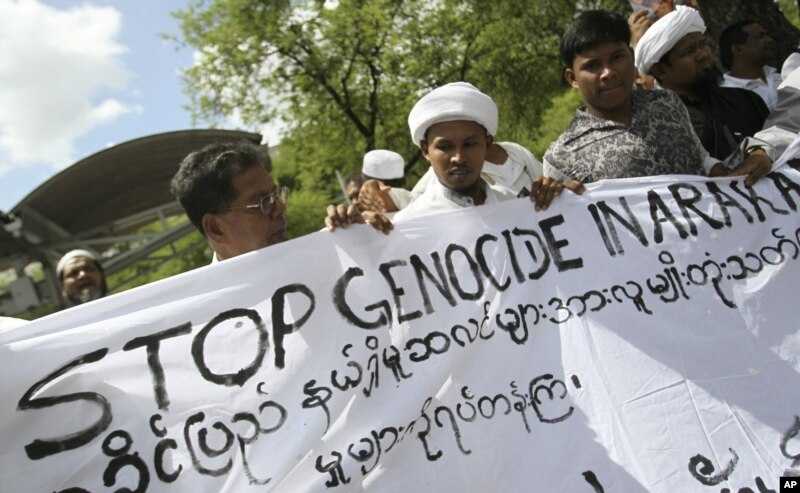 |
| Rohingya protesters gather in front of a UN regional office in Bangkok on to call for an end to the ongoing violence in Burma’s Rakhine State, June 11, 2012. |
BANGKOK - Northwest Burma’s Rakhine state remains tense after President Thein Sein dispatched troops to try to end religious and ethnic violence. The riots began after 10 ethnic-Rohingya Muslims were mobbed and murdered by ethnic Rakhines, in retaliation for the gang-rape of a Rakhine girl.
Local witnesses in villages in Burma’s western Rakhine state said fires continued to burn Monday, even after President Thein Sein declared a state of emergency and sent in troops to bring the riots under control.
The clashes that began on June 8th are the most severe in a string of violent attacks between ethnic Rakhine Buddhists, the state’s largest minority group, and ethnic Rohingya Muslims, who are denied citizenship in both Burma and Bangladesh.
“In the morning after leaving the army from the Maungdaw today morning, the police and the riot police they and the Rakhine people are trying to burn to loot and to kill the Rohingya people," said Tin Soe is the editor of Kaladan Press Network, a Rohingya news agency, which has been reporting on the riots. "Ethnic problem or religious problem, we don’t know which one we can say.”
Both minority groups in the region claim to be under attack, but the Rohingya have a history of being a target of racism. Although many Rohingya communities have lived in Burma for decades, the government refuses to grant them citizenship - a position that has broad support among other Burmese nationals.
Even democracy leader and former political prisoner Ko Ko Gyi recently said he believed "so-called Rohingya" not to be one of the recognized Burmese ethnic groups.
Nicholas Farelly, Burma analyst of Australia National University, says the Rohingya’s statelessness between Burma and Bangladesh is partially to blame for the conflict's escalation.
“The Rohingya, they fit somewhat awkwardly in that borderland between the two different political systems, they have nowhere to call home and, as a result from time to time, there are these episodes of conflict," said Farelly. "We have seen one of those very recently and it has in this case taken the form of Buddhist and Muslim mobs of varying sizes coming to blows.”
On Sunday, Thein Sein’s national address referenced what he called Burma’s “checkered” history of peaceful co-existence of among the country’s diverse ethnic groups. He condemned racial and religiously-based violence, which he said could jeopardize the country’s democratic reforms.
In Bangkok Monday, Maung Kyaw Nu of the Burmese Rohingya Association of Thailand asked the United Nations to intervene.
"Today, I am coming here to express, to hand over the letter to Mr. Ban Ki-moon, secretary general of the United Nations," said Maung Kyaw Nu. "I would like his intervention, U.N. intervention to save my people who are killed. Genocide is there. I'm coming here to ask his help, intervention as well as the global civil society's help."

The U.S. embassy issued a statement urging all parties to stop violent attacks and the government to hold a transparent investigation.
Sources:
XXXXXXXXXXXXXXXXXXXXXXXXXXXXXXXXXXXXXXXXXXXXXXXXXXXXXXXXXXXXXXXXXXXX
UPDATED
Troops, Riot Police Patrol NW Burma after Deadly Rioting
Posted Monday, June 11th, 2012 at 10:00 am
A tense calm settled over Burma's western Rakhine state Monday, as riot police intervened to curtail nearly a week of deadly violence between Muslims and Buddhists.
Ethnic Rohingya Muslims, speaking to VOA's Burmese service described scenes of devastation and fear in the border town of Maungdaw.
Right now (Monday), it is unsafe to go outside because yesterday a 12-year-old girl who went for routine shopping was shot to death by police. That's why we fear to go outside.”
To the south, in the nearby city of Sittwe, Buddhists voiced fears that security forces deployed in the city were not sufficient to control more than 3,000 Muslims who have flooded the city to escape the violence.
“The situation could (grow) worse because the numbers of security personnel are pretty small. There's no security personnel in important areas. They (Muslims) came in a large group and locals (were forced) to escape. Sittwe now has an estimated 3,500 refugees.”
Burmese President Thein Sein declared a state of emergency Sunday night, warning the nation in a televised address that the further could put the country's moves toward democracy in danger.
He invoked the emergency measure following days of violence in Rakhine state between Buddhists and Muslim Rohingyas, in which at least 17 people were killed and hundreds of buildings burned to the ground.
The president said that violent attacks fueled by “hatred and revenge based on religion and nationality” could spread to other parts of the country. He said if that happens, the country's stability and peace, democratization process and development, which are in transition right now, could be severely affected.
Tensions have been high in Rakhine since last Sunday, when a Buddhist mob attacked a bus and killed 10 Rohingya, mistakenly believing they were responsible for the recent gang-rape and murder of a Buddhist woman.
Burma, also known as Myanmar, does not consider the Rohingya to be Burmese citizens. According to the United Nations there are about 800,000 ethnic Rohingya in the country's western region.
Burma's government has recently begun implementing political reforms, earning approval from Western nations who had long called for change. State media have released an uncharacteristically large amount of information about last week's violent incidents.
Curfew in Burma's Rakhine state hitting Rohingyas hard - activists
Activists say muslim Rohingyas in Burma are running out of food, because of a curfew imposed under emergency rule in Rakhine state.
Curfew in Burma's Rakhine state hitting Rohingyas hard - activists (Credit: ABC)
The move follows a wave of violence, mainly targetted against Rohingya muslims.
Burma placed Rakhine, also known as Arakan, under emergency rule, after a wave of violence, targetted against Rohingya muslims.
Troops have been posted outside monasteries and mosques, but unconfirmed local reports say police are allowing Buddhist Rakhines to roam the streets, while Rohingya muslims were housebound and running out of food.
Tensions in the western region started after the rape and killing of a Buddhist woman, which then led to the reprisal killings of ten Muslims last week.
Presenter: Sen Lam
Speaker: Aman Ullah, general-secretary, Arakan Rohingya National Organisation
AMAN ULLAH: There're so many casualties, but people don't know how many, because no one can go out from their house. All are under curfew and an emergency, so villagers do not go from their houses. As far as I've collected the information, there're not fewer than 200 people killed there, from different sides of the town (Maungdaw).
LAM: Where did you get this information from?
AMAN ULLAH: I get from the local people, from them. There is some areas they can use telephones. Local telephones and communication are cut out.
LAM: So you're saying the communication lines are phone lines to much of Rakhine state have been cut off?
AMAN ULLAH: Ya, especially in these rural areas.
LAM: The President Thein Sein has announced a state of emergency in the region. Will this help?
AMAN ULLAH: The chief administrator of the Maungdaw township is now at the office of the Maungdaw. There is some military personnel also come to Maungdaw, but there're still so many Muslims' old buildings are burning, one mosque is still burning and so many houses are looted. It's still going on. He did not do anything to stop them.
LAM: So you're saying that burning and looting are still continuing in the town of Maungdaw?
AMAN ULLAH: Yes, and from another village too. And from one person who phoned me, I don't know which telephone he's using, but he got my number and he contacted me yesterday at 10pm. The situation is also very bad. This emergency government and the emergency did not stop it immediately. Still today, the local police and what we call 'hloonhtein' the riot police - most of them are Rakhine ethnic origin. With their protection, the Rakhines (Buddhists) go to the Muslim houses, and areas, and they loot and they killed the people.
LAM: So you're saying the police are local Rakhines, and they will not protect the Muslim Rohingyas?
AMAN ULLAH: No, instead of protecting, they're looting to the Muslims.
LAM: Can you tell us who are the people instigating the violence?
AMAN ULLAH: From the Rohingya side, they're doing peacefully, but accidentally, their sentiments went beyond their control, and they did attempt something, but later, when the curfew was declared, all Muslim villagers were inside their homes, they could not even go outside their houses. They had no rations at all - no rice, no dry food, no essential commodities in the house. All are in the market place - the Rakhine people are looting all these things, take away, and not a bit of rice left in the markets now.
LAM: The President has imposed a curfew in the state - are the military helping out? Are they trying to impose law and order there?
AMAN ULLAH: In the town, where security remains in the hands of police and 'hloontein' so with their protection, the mobs can do anything. Curfew was imposed on the Muslims, not on the Rakhines - they can go anywhere, they can do anything.
LAM: So the local Rakhine Buddhists are allowed to roam the streets freely?
AMAN ULLAH: With the protection of police.
LAM: What do you think the Burmese government should do?
AMAN ULLAH: The first thing is, that the government should do, is to stop these ongoing incidents. Number two, they have to distribute rations, rice and essential things to these people. They have to make one peace committee, like a peace committee, to include the Rakhines and the Rohingyas, to maintain peace and establish it there. All the violence are targetting the local Rohingyas.

Activists say muslim Rohingyas in Burma are running out of food, because of a curfew imposed under emergency rule in Rakhine state.
Curfew in Burma's Rakhine state hitting Rohingyas hard - activists (Credit: ABC)
The move follows a wave of violence, mainly targetted against Rohingya muslims.
Burma placed Rakhine, also known as Arakan, under emergency rule, after a wave of violence, targetted against Rohingya muslims.
Troops have been posted outside monasteries and mosques, but unconfirmed local reports say police are allowing Buddhist Rakhines to roam the streets, while Rohingya muslims were housebound and running out of food.
Tensions in the western region started after the rape and killing of a Buddhist woman, which then led to the reprisal killings of ten Muslims last week.
Presenter: Sen Lam
Speaker: Aman Ullah, general-secretary, Arakan Rohingya National Organisation
AMAN ULLAH: There're so many casualties, but people don't know how many, because no one can go out from their house. All are under curfew and an emergency, so villagers do not go from their houses. As far as I've collected the information, there're not fewer than 200 people killed there, from different sides of the town (Maungdaw).
LAM: Where did you get this information from?
AMAN ULLAH: I get from the local people, from them. There is some areas they can use telephones. Local telephones and communication are cut out.
LAM: So you're saying the communication lines are phone lines to much of Rakhine state have been cut off?
AMAN ULLAH: Ya, especially in these rural areas.
LAM: The President Thein Sein has announced a state of emergency in the region. Will this help?
AMAN ULLAH: The chief administrator of the Maungdaw township is now at the office of the Maungdaw. There is some military personnel also come to Maungdaw, but there're still so many Muslims' old buildings are burning, one mosque is still burning and so many houses are looted. It's still going on. He did not do anything to stop them.
LAM: So you're saying that burning and looting are still continuing in the town of Maungdaw?
AMAN ULLAH: Yes, and from another village too. And from one person who phoned me, I don't know which telephone he's using, but he got my number and he contacted me yesterday at 10pm. The situation is also very bad. This emergency government and the emergency did not stop it immediately. Still today, the local police and what we call 'hloonhtein' the riot police - most of them are Rakhine ethnic origin. With their protection, the Rakhines (Buddhists) go to the Muslim houses, and areas, and they loot and they killed the people.
LAM: So you're saying the police are local Rakhines, and they will not protect the Muslim Rohingyas?
AMAN ULLAH: No, instead of protecting, they're looting to the Muslims.
LAM: Can you tell us who are the people instigating the violence?
AMAN ULLAH: From the Rohingya side, they're doing peacefully, but accidentally, their sentiments went beyond their control, and they did attempt something, but later, when the curfew was declared, all Muslim villagers were inside their homes, they could not even go outside their houses. They had no rations at all - no rice, no dry food, no essential commodities in the house. All are in the market place - the Rakhine people are looting all these things, take away, and not a bit of rice left in the markets now.
LAM: The President has imposed a curfew in the state - are the military helping out? Are they trying to impose law and order there?
AMAN ULLAH: In the town, where security remains in the hands of police and 'hloontein' so with their protection, the mobs can do anything. Curfew was imposed on the Muslims, not on the Rakhines - they can go anywhere, they can do anything.
LAM: So the local Rakhine Buddhists are allowed to roam the streets freely?
AMAN ULLAH: With the protection of police.
LAM: What do you think the Burmese government should do?
AMAN ULLAH: The first thing is, that the government should do, is to stop these ongoing incidents. Number two, they have to distribute rations, rice and essential things to these people. They have to make one peace committee, like a peace committee, to include the Rakhines and the Rohingyas, to maintain peace and establish it there. All the violence are targetting the local Rohingyas.


We are deeply concerned by reports of ongoing violence in Burma’s Rakhine State. We are monitoring the situation and urge an immediate halt to violent attacks. We also encourage the government to pursue an investigation in an expeditious and transparent manner that respects due process and the rule of law.
Government armed forces fired on Rohingya Muslims Friday Prayers in
MaungDaw Township its general consequences.
Yangon---- June 8, 2012, According to MaungDaw Township dwellers’ hour ago
information, a man, age about 25 was shot dead and three more people were seriously
injured by the Police in MaungDaw Township at about 1:30pm.
Some people from MaungDaw Jamey Masjid around were normally arranged to pay a
collective special wishes to the ten dead people who were ruthlessly killed by Taunggoop
people on 4 June, 2012.
According to information received from MaungDaw, a man namely Qurban Ali, living in
Myo Ma Ngakura, No.2 Block was shot dead by police to disperse a tiny crowd in front of
the Jamey Mosque in MaungDaw Township. In accord to tittle-tattle, the dead body was
hurriedly picked up by the police and took away to unknown destination. Due to three
injured more persons, the details are unknown due to fall short telecommunication.
The situation in Maung Daw is tense and it is unknown whether the circumstances are
calm or not.
The situation in Mrauk Oo Township, Rakhine State is also tense. There, Muslims daily
laborers are roughly beaten by the Rakhine activists and the Muslims are running away
to escape the brutalities.
laborers are roughly beaten by the Rakhine activists and the Muslims are running away
to escape the brutalities.


We, the undersigned Rohingya organisations express our deep concern over the ongoing grave situation in Arakan causing great consternation to the people.
It appears that the communal tension arising out of the lack of rule of law in Arakan was engineered by the regime and its local Arakan State apparatus. This was further evident by the gunning down of Rohingya Muslims who were peacefully marching for a prayer for those Muslim pilgrims cruelly killed by Rakhine terrorists in Taunggup on 3 June 2012.
In fact, it was absolutely unnecessary on the part of the authorities and the armed forces to obstruct the mourners to say their prayers peacefully. But the shooting was a clear sign to ignite communal tension between the two communities.
However, it is deplorable that there have been killing of innocent people, destruction of houses and properties from both sides which could be well prevented by the government. At least 100 innocent Rohingyas were believed to have been killed while many others injured. Never the less, the government of U Thein Sein is fully responsible for the untoward situation.
It is unfortunate that media groups are bias producing one sided reports against the helpless Rohingyas. We, therefore, request local and international media groups to find out the facts and produce true information.
We appeal to all our compatriots in general and the Rohingyas and Rakhines in particular to exercise maximum restraint in the interest of ‘peaceful co-existence’ in Arakan and Burma. Meanwhile, we urge upon the religious leaders, politicians, MPs and fellow citizens to actively pursue peace and reconciliation in Arakan and Burma.
Last not least, we demand that the government immediately constitutes an independent and impartial inquiry commission to investigate the case and bring the culprits to justice.
Signatories to this joint statement:
National Democratic Party for Human Rights (NDPHR)
Arakan Rohingya National organisation (ARNO),
Burmese Rohingya Organisation UK (BROUK),
Burmese Rohingya Association Japan (BRAJ)
Burmese Rohingya Community in Australia (BRCA)
Burmese Rohingya Community in Norway (BRCN)
Burmese Rohingya Association in Thailand (BRAT)
Rohingya League for Democracy Burma (RLDB)
For more information, please contact:
Hla Aung +33 629258793
Aman Ullah +880-15584 86910
Tun Khin + 44- 788 871 4866
By Dr. Habib Siddiqui
The United States and European Union hinted that some sanctions - imposed over the past two decades in response to gross human rights abuses (e.g., against the minority Rohingya Muslims and Kachin and Karen Christians) - might be lifted, unleashing a wave of investment, which this impoverished but resource-rich country, bordering Bangladesh, Thailand, India and China, badly needs.
Last year the U.S. Secretary of State Clinton met with Burma’s leaders and opposition leader Suu Kyi. Soon after the election in April Japan has already promised to forgive $3.7 billion of Burma’s debt and resume aid as a way to support the country’s democratic and economic reforms. Last month during his visit to Myanmar, the first by an Indian Prime Minister in 25 years, Manmohan Singh held extensive talks with Myanmar President Thein Sein and extended a $ 500 million line of credit to Myanmar as it signed 15 agreements on fields like trade, energy and connectivity. On June 9, the Australian Foreign Minister pledged $100m aid to boost its education sector, where less than half of Burma's 18 million children complete five years of primary school and only about half of all teachers are qualified.
In spite of such positive developments in the international sector, the religious minorities remain disillusioned. "We have been forsaken by the world," a Rohingya human rights activist complained. Similar are the messages I receive about human rights abuses in Kachin, Shan and Karen states. My comrades at the U.S. Campaign for Burma remind me that this year alone there have been at least 750 incidents of human rights abuses committed by the Burmese troops against ethnic minority civilians, and that there are still hundreds of political prisoners behind the bar, and that more and more of the ethnic non-Buddhist minorities are forced out of their ancestral land to either replant such territories with Buddhist majority or make way for foreign investment.
The ongoing diplomacy and the so-called "cease-fires" in ethnic areas are seen for what they are—an alibi for the abdication of morality in the altar of profit-making and greed, and a lifeline for the regime.
Optimistic as I have always been, I try to comfort them that they are neither forgotten nor forsaken, and better days are ahead of them when they would be accepted as equal citizens in Myanmar.
As an outsider, living comfortably on the other side of the planet, little did I know that these unfortunate minorities of Burma would again be made a target of ugly face of religious and racial hatred. As I write, Maung Daw – located in northern Arakan (Rakhine state of Burma) is burning, as if mimicking the pogroms against the Rohingya and Muslim minorities of Burma that started in the 1930s [see, e.g., an excellent review – Rohingya Tangled in Burmese Citizenship Politics by Nurul Islam, UK].
Reliable sources within the territory tell me that on June 3, a mob of nearly hundred Rakhine Buddhist extremists attacked a bus that was carrying some ten Tablighi Muslims who were returning to Rangoon after their religious gathering. They were dragged from their bus by these brutes in Taungup, situated as the main gateway for travel to central Burma from the Arakan State. They were lynched to death and their bus was set on fire. Only the driver was able to flee the scene. It should be noted here that all this gruesome murder happened based on a false rumor that those Muslims had something to do with a recent murder of a Rakhine female teacher whose body was found in Sittwe (Akyab), the state capital with a mixed Rakhine-Rohingya population. While the subsequent inquiries had cleared Muslims of any complicity in the murder of the teacher, to many Rakhines who are prone to imagine the worst of the ‘other’ people that have as much contesting claim to the land, if not more, the culprit had to be a Muslim. So they savagely murdered those innocent Muslims that had visited the region. These innocent victims were at wrong time at a wrong place!
U Khin Hla, Secretary of the National League for Democracy in Taungup, told the VOA Burmese program, “I think such an incident happened due to the lack of law and order because it happened in broad daylight just around 4:30 pm, and it was also not just an incident in which a man hacked and killed another and ran away. On the contrary, I think the officials who are working for the rule of law and order in the country are responsible for such an incident.”
After the news of the inhuman act of gruesome murder reached the Muslim community, Muslims in Rangoon held a peaceful demonstration and asked the government officials to find and try the guilty ones of this heinous crime. The government promptly formed a 16-member committee to investigate the matter by June 30 and take legal actions against the perpetrators. Interestingly, the announcement for investigation came a day after the government was forced to print a retraction for referring to the victims as “kalar” – a racial slur for Muslims or persons of Indian appearance – in their official appeal for calm after the violence.
When approached at her NLD office, the Nobel Laureate Suu Kyi expressed concern at the handling of the situation by local Rakhine authorities, esp. their failure to dampen anti-Muslim sentiment after the woman was attacked. “If the very first problem was handled effectively and quickly, this flicker wouldn't have become a flame,” she said. Urging understanding between Rakhine's religious communities she advised, “don't base your actions on anger.”
Apprehensive of potential troubles to brew in Maung Daw, a Muslim majority district, close to Bangladesh border, the district administrator and police chief met with Muslim community leaders and sought cooperation against any retaliation. Muslim leaders assured them of their cooperation. A decision was taken by Muslim religious leaders to apprise the community on Friday, June 8, during the Jumu’aa prayer service, of the assurance that they had received from government and the absolute importance of peace and avoidance of trouble.
After Friday congregation prayer, when a group of Muslims were trying to join a payer at Kayandan Tabligh Centre in Maung Daw for those 10 Muslims who were murdered by the Rakhine extremists at Taunggup, the security forces, however, tried to stop them and then started firing at the crowd killing at least two people and injuring many others. Some extremist Rakhines, hiding behind the police, threw wine bottles against the Muslims, further fueling the already tense situation.
While curfew has been imposed in Maung Daw from dusk to dawn, several Muslim villages have already been gutted down. Almost all the Muslim shops and business centers have also been attacked and ransacked by the Rakhine mob. On Saturday armed security forces with Rakhine extremist equipped with lethal arms were seen roaming Maung Daw town and surrounding villages. That morning four Rohingyas were carried away from Fayazi village of Maung Daw. Their whereabouts still remain unknown.
Eye witness accounts have shown that the Rakhine extremists and the security forces Hlun Htein and NASAKA had jointly collaborated in causing such crimes. On Friday, Rakhines were seen piling up weapons in the Maung Daw main Buddhist temple (Phongyi Chaung) and planning attacks at nightfall. Since Friday, Buddhist monks and Rakhine extremists have been seen being escorted by security forces while they were announcing ‘War on Kalas’, (war on blacks, foreigners – meaning the Rohingyas) along the streets of Maung Daw. This dangerous message spread like a wild fire all over Maung Daw and Buthidaung townships. Many of the security forces, dressed in civilian clothes, were seen firing on the Rohingya Muslims. As a result, at least a hundred Rohingya Muslims have reportedly died. Several mosques have also been set on fire.
The Myanmar government has dispatched military troops and naval vessels to calm the violence. In a statement in official newspapers on Saturday, the All Myanmar Islam Association condemned "the terrorizing and destruction of lives and properties of innocent people" and called on Muslims across the country to live in peace.
How could this be happening when we thought that we had said sayonara to the old days of Burmese and Rakhine pogroms directed against the persecuted Muslims of Burma? In the Rakhine state where tensions between Muslims and Buddhists run high, and has been witnesses to such riots many times since at least the 1930s, a mere mention of the term ‘Rohingya’ is enough to ignite passion amongst the Rakhines who view them at best as unwanted immigrants from Bangladesh and at worst “invaders.”
The truth of the matter is Burma, in spite all the newer developments – mostly cosmetic or superficial – still remains our planet’s worst den of hatred by any name - bigotry, racism, xenophobia, etc. For many people in Burma, a Burmese is a Buddhist by definition; Buddhism forms an essential part of their identity; there is no place for people of other religious persuasions.
The decades-old military government in Burma has been replaced by a hybrid group of civil and ex-military personnel that promises change. However, the life of an ethnic minority, esp. if it is a non-Buddhist, has not improved an iota there. They are persecuted and are easy targets for ethnic cleansing. They are treated as if they don’t exist. As noted by Mr. Nurul Islam of ARNO, “U Thein Sein’s government has not changed their attitude towards our people. It is still holding onto to past policies which excluded, discriminated and persecuted the Rohingya population. We need to remind the government Rohingyas are an integral part of the Burma’s society regardless of the fact that their appearance, ethnicity and religion is different than the majority of the population.” He added, “Daw Aung San Suu Kyi so far has been surprisingly silent regarding the persecution of our people. As a democratic icon, advocating for human rights for all, we urge her to use her influence to speak out on behalf the Rohingya, who have no voice in Burma.”
There are clear evidences that the authorities in Arakan state have been guilty of collaborating with Rakhine leadership to sow anti-Muslim sentiment among the Buddhist people so that they can be terrorized, to help prevent Muslim migration and settlement into central Burma from the region.
As eye witness accounts and social media outlets show when the Rakhine mob attacked the Tablighi Muslims on June 3, the army and police personnel did not do anything to stop the carnage. One eye witness said, “The police and the army were there when the mob was beating the victims, but they did not do anything to control the mob or protect the victims.
The attack happened right in front of their eyes.” He added, ““If the army or police had controlled the mob, they would have been able to save the victims. They knew the situation well, but they did not do anything to control the mob or protect the victims.”
The level of deep-rooted Rakhine racism against the Rohingya can be understood from the hateful statement of Khaing Kaung San, a local Rakhine activist in Sittwe, who said, "They [Rohingyas] are fighting to own the land, occupy the entire state." "They don't need weapons; just by their numbers they can cover the entire land."
Obviously, such false assertions epitomizing intolerance, racism and hatred are not new and cannot disappear overnight when it is so deeply entrenched touching every walk of life in Burma, esp. in places like the Rakhine state. The politically dominant Rakhine community doesn’t want to share the state with others. This, in spite of the fact that serious works of research have proven convincingly that the Rohingyas are the descendants of the indigenous people (bhumi-putras) of this coastal region whose ties to the land precede those of the Rakhines by few centuries. [See, e.g., this author’s work - Muslim Identity and Demography in the Arakan State of Burma, Amazon.com; and Dr. Abid Bahar’s – Burma’s Missing Dots – the emerging face of genocide.]
The recent riots in the Rakhine state once again highlight the vulnerable status of the Rohingyas of Burma. Declared stateless, they are unwanted inside Myanmar and unwelcome as fleeing refugees in neighboring countries like Bangladesh and Thailand. This is the greatest tragedy of our time. They are caught between crocodiles in the sea and tigers on the ground.
Where would they go? Should they become an extinct community much like what had happened to so many others before in the annals of history? Or, must they wander in the wilderness for two millennia and suffer repeated persecution, humiliation and genocide to qualify as equals in our world?
For my part, I have petitioned my Congressman to cosponsor the Resolution H. J. Res. 109 to renew the Burmese Freedom and Democracy Act, which is the only leverage the U.S. has left to push the Burmese regime to move forward with positive changes and hold them accountable for widespread human rights abuses and mass atrocities they commit against the people of Burma.
It is not enough, but better than doing nothing and being a silent spectator to violence!
Lines in the margin:
General Aung San assured full rights and privileges to Muslim Rohingya Arakanese saying “I give (offer) you a blank cheque. We will live together and die together. Demand what you want. I will do my best to fulfill them. If native people are divided, it will be difficult to achieve independence for Burma."
"The former first President of Burma Sao Shwe Theik stated, “Muslims of Arakan certainly belong to one of the indigenous races of Burma. If they do not belong to the indigenous races, we also cannot be taken as indigenous races.”
"The previous parliamentary government listed 144 ethnic groups in Burma. But Ne Win put only 135 groups on a short list, and then was approved by his BSPP regime’s constitution of 1974. The three Muslim groups of Rohingya (Muslim Arakanese), Panthay (Chinese Muslims), Bashu (Malay Muslims) and six other ethnic groups were deleted. "
Color-coding of individuals - Hitler's Nazi regime was into color-coding and other forms of classification of peoples and individuals. "In 1989, colour-coded Citizens Scrutiny Cards (CRCs) were introduced: pink cards for the full citizens, blue for associate citizens and green for naturalized citizens. Rohingya were not issued with any identity cards which are very essentials in all their activities."
http://danyawadi.wordpress.com/2012/05/30/rohingya-tangled-in-burma-citi...
http://cbnbd.com/?p=6738
http://rafiquearakani.blogspot.com/2012/06/security-personnel-and-rakhin...
http://rafiquearakani.blogspot.com/2012/06/briefing-on-situation-in-nort...
http://www.thejakartaglobe.com/international/distrust-fuels-anti-muslim-...
- Asian Tribune –

-
 "Although mass killings and exterminations of human races were some sort of things that the world experienced during Nazi German p...
 -
 More than 400,000 Rohingya have fled from Myanmar to neighbouring Bangladesh By BBC News September 17, 2017 Myanmar's de ...
 -
 ပါလီမန္အမတ္ဦးေရႊေမာင္ၿပည္သူ႔လြတ္ေတာ္တြင္ရခိုင္ၿပည္နယ္၌ၿဖစ္ပြါးခဲ့ေသာအေရးအခင္းနဲ့ ပတ္သက္၍ေဆြးေနြးတင္ၿပၿခင္း။ (14th day of regular ses...
 -
 RB News March 31, 2018 Minbya, Arakan State : On March 30 morning, a Prayer Leader or Imam was brutally beaten and injured by a Rakh...
 -
 ဇြန္လ ၁၇ ရက္ ၊ ၂၀၁၂ Source: guardian.co.uk ျမန္မာျပည္သစ္အတြက္ အနာဂတ္မွာ ေအာင္ျမင္မွာလား၊ က်ရွဳံးမွာလားဆိုသည္ကို ညႊန္ျပေသာ စမ္းသပ္မွဳ တစ...
 -
 Read letter here Read history of Rohingya here Download letter PDF here Download History of Rohingya PDF here credi...
 -
 At Baggona, a village three miles far from and lies to the South of Maung Daw of Arakan state, more than 80 Rohingya women and girls have be...
 -
 RB News May 17, 2013 Maung Daw, Arakan - After the warnings on Mahasen cyclone had been issued, the displaced Rohingyas from the ...
 -
 12/07/2012 Joint press release HUMANITY GONE ...
 -
 The custodian of Two Holy Mosques King Abdullah bin Abdul Aziz Al Saud Aug 11 The custodian of Two Holy M...

Popular Posts
Threatwiki

Amartya Sen: Burma's "slow genocide" of Rohingyas

Watch Professor Amartya Sen speak on what he calls Burma's 'slow genocide' of Rohingya, Harvard, 4 Nov 2014

