

DHAKA, 12 October 2012 (IRIN) - Activists warn of further restrictions on Rohingya refugees in southeastern Bangladesh following recent communal violence.
“Rohingya refugees in Bangladesh will likely face more restrictions on their movement or arrests and push-backs,” Chris Lewa, director of the Arakan Project, an advocacy organization for the Rohingya, told IRIN on 12 October.
“We are seeing examples of that already on the ground.”
“Refugees International is concerned about the talk of further restrictions being imposed on Rohingya refugees in the Cox’s Bazar District of Bangladesh,” said Melanie Teff, a senior advocate with Refugees International.
The Rohingya - an ethnic, linguistic and religious minority who fled persecution en masse from Myanmar’s neighbouring Rakhine State decades ago - have long had a tenuous relationship with the Bangladeshi authorities who view them as illegal migrants.
Under Burmese law, they are de jure stateless and face constant persecution, say activists, while in Bangladesh they are barred from employment.
According to the UN Refugee Agency (UNHCR), there are more than 200,000 Rohingya in Bangladesh today, including more than 30,000 documented refugees living in two government-run camps [Kutupalong and Nayapara] within 2km of the Burmese border.
UNHCR has not been permitted to register newly arriving Rohingya since mid-1992. The vast majority of Rohingya are living in villages and towns in the area and receive little to no assistance as UNHCR is only allowed to assist those who are documented.
Blame game
On 1 October, Bangladesh Home Minister Mohiuddin Khan Alamgir accused the Rohingya of involvement in a series of attacks on minority Buddhist temples and homes in the southeast.
The violence was reportedly triggered by a photo posted on Facebook that insulted Islam at the end of September, resulting in some of the worst sectarian violence in Bangladesh in years.
Thousands of Muslims went on the rampage in predominately Buddhist areas, setting ablaze temples and monasteries, resulting in dozens of homes burned.
"The attacks on temples and houses in Buddhist localities in Ramu and neighbouring areas in Cox's Bazar (district) were perpetrated by radical Islamists," the minister told reporters.
"Rohingyas and political opponents of the government were also involved in the attack,” he added, describing the incident as a "premeditated and deliberate attempt" to disrupt communal harmony.
 Recent violence in Rakhine State has displaced thousands
Following the violence, law enforcement agencies were instructed to restrict the movement of Rohingya refugees and curb their interactions with the local community - a move confirmed by refugees on the ground.
“New check posts were established and we are facing abnormal restriction after the Ramu incident,” a 20-year-old Rohingya youth, who asked not to be identified, told IRIN by phone.
Impact in Myanmar
The impact of these events in Myanmar is also a concern. “What’s happening in Bangladesh will only exacerbate communal tension inside Rakhine State,” Lewa said.
In June 2012 violence flared in Rakhine State forcing tens of thousands of Rohingya to flee both within Myanmar and across the border.
According to Myanmar government estimates, more than 70,000 people are now living in temporary camps and shelters following inter-communal conflict.
Of particular concern is forced segregation and protracted displacement in the state capital, Sittwe, where Rohingya who lost their homes in the violence have been moved into camps, says Refugees International.
Despite repeated advocacy efforts by UNHCR, civil society and the diplomatic community, Bangladesh decided to close its borders to persons fleeing the country.
Those who managed to make it to Bangladesh were rounded up and sent back. However, there are no reliable figures on the number of arrivals and the number refouled.
Bangladesh is not a signatory to the 1951 Refugee Convention or its 1967 Protocol.
“Rohingya refugees in Bangladesh will likely face more restrictions on their movement or arrests and push-backs,” Chris Lewa, director of the Arakan Project, an advocacy organization for the Rohingya, told IRIN on 12 October.
“We are seeing examples of that already on the ground.”
“Refugees International is concerned about the talk of further restrictions being imposed on Rohingya refugees in the Cox’s Bazar District of Bangladesh,” said Melanie Teff, a senior advocate with Refugees International.
The Rohingya - an ethnic, linguistic and religious minority who fled persecution en masse from Myanmar’s neighbouring Rakhine State decades ago - have long had a tenuous relationship with the Bangladeshi authorities who view them as illegal migrants.
Under Burmese law, they are de jure stateless and face constant persecution, say activists, while in Bangladesh they are barred from employment.
According to the UN Refugee Agency (UNHCR), there are more than 200,000 Rohingya in Bangladesh today, including more than 30,000 documented refugees living in two government-run camps [Kutupalong and Nayapara] within 2km of the Burmese border.
UNHCR has not been permitted to register newly arriving Rohingya since mid-1992. The vast majority of Rohingya are living in villages and towns in the area and receive little to no assistance as UNHCR is only allowed to assist those who are documented.
Blame game
On 1 October, Bangladesh Home Minister Mohiuddin Khan Alamgir accused the Rohingya of involvement in a series of attacks on minority Buddhist temples and homes in the southeast.
The violence was reportedly triggered by a photo posted on Facebook that insulted Islam at the end of September, resulting in some of the worst sectarian violence in Bangladesh in years.
Thousands of Muslims went on the rampage in predominately Buddhist areas, setting ablaze temples and monasteries, resulting in dozens of homes burned.
"The attacks on temples and houses in Buddhist localities in Ramu and neighbouring areas in Cox's Bazar (district) were perpetrated by radical Islamists," the minister told reporters.
"Rohingyas and political opponents of the government were also involved in the attack,” he added, describing the incident as a "premeditated and deliberate attempt" to disrupt communal harmony.
Recent violence in Rakhine State has displaced thousands Following the violence, law enforcement agencies were instructed to restrict the movement of Rohingya refugees and curb their interactions with the local community - a move confirmed by refugees on the ground.
“New check posts were established and we are facing abnormal restriction after the Ramu incident,” a 20-year-old Rohingya youth, who asked not to be identified, told IRIN by phone.
Impact in Myanmar
The impact of these events in Myanmar is also a concern. “What’s happening in Bangladesh will only exacerbate communal tension inside Rakhine State,” Lewa said.
In June 2012 violence flared in Rakhine State forcing tens of thousands of Rohingya to flee both within Myanmar and across the border.
According to Myanmar government estimates, more than 70,000 people are now living in temporary camps and shelters following inter-communal conflict.
Of particular concern is forced segregation and protracted displacement in the state capital, Sittwe, where Rohingya who lost their homes in the violence have been moved into camps, says Refugees International.
Despite repeated advocacy efforts by UNHCR, civil society and the diplomatic community, Bangladesh decided to close its borders to persons fleeing the country.
Those who managed to make it to Bangladesh were rounded up and sent back. However, there are no reliable figures on the number of arrivals and the number refouled.
Bangladesh is not a signatory to the 1951 Refugee Convention or its 1967 Protocol.
Sources Here:

PHUKET: The Commissioner of the Thai Immigration Bureau announced yesterday that immigration officials from Australia will assist Thai officials in their handling of ethnic Rohingya refugees who enter Thai territorial waters illegally.
“They have a serious problem with Rohingya and Sri Lankans illegally entering their country,” Lt Gen Wiboon Bangphamai explained to the meeting of ASEAN immigration chiefs held at the Hilton Phuket Acadia Resort and Spa.
“We have the same problem. Once Rohingya arrive, we have to provide them basic assistance including food, water, propane and some money. We waste a lot of money every year on this issue alone…We usually take them to Songkhla, from which they are allowed to continue on their way to their preferred destination,” he added.
Gen Wiboon explained that Rohingya and Sri Lankans entering Thai waters were usually bound for Australia or New Zealand, which have signed an agreement with the United Nations to allow such arrivals to apply for citizenship.
“If they can make it to those countries, the authorities there have to take care of these people. Thailand is used as a transit route to the Rohingya’s preferred destinations. We would like to stop that,” he said.
Gen Wiboon delivered the news at the combined 16th ASEAN Directors-General of Immigration Departments and Head of Consular Affairs Divisions of the Ministries of the Foreign Affairs (16th DGICM) and the 8th ASEAN Immigration Intelligent Forum (8th AIIF) conference at the Hilton Phuket.
The five-day ASEAN conference, which began on Monday, is scheduled to conclude tomorrow.
Source here
By Anbarasan Ethirajan BBC News, Teknaf, near Bangladesh-Burma border

Zohara Khatun says she and her family ran for their lives - her father was killed
Zohara Khatun is still reeling from the trauma of seeing her father killed in western Burma in June.
"My father was shot dead by the Burmese military in front me. Our entire village was destroyed. We ran for our lives. I still don't know what happened to my mother," she said, sitting in a thatched hut in a fishing village near the town of Teknaf in south-eastern Bangladesh.
Ms Khatun is one of the Rohingya Muslims who have managed to cross into Bangladesh following the communal unrest in western Burma's Rakhine province.
The 30-year old broke down repeatedly as she tried to explain what happened over the border.
She says their village came under attack during clashes between majority Buddhists and local Muslims, mostly from the Rohingya minority. Nearly 80 people were killed in the fighting and thousands were displaced.
Human rights groups allege that Burmese security forces continue to carry out mass arrests, forcing many Rohingya Muslims to flee. A state of emergency declared last month is still in force in many places of the province. Unwanted
There is no independent confirmation of the claims of extra-judicial killings and other abuses - journalists are denied access to the area. Burma denies its security forces are responsible for human rights abuses.
Since the June clashes, thousands of refugees have been trying to get into Bangladesh, taking perilous boat journeys along the Bay of Bengal and across the river Naf, which separates the two countries.
"We were floating on water for six days. I could not feed my children for days," Ms Khatun said.
"When we tried to reach Bangladesh, we were not allowed to enter. We did not know where to go."
There are an estimated 800,000 Rohingya Muslims living in western Burma. The Burmese authorities argue that the Rohingyas are recent migrants from the Indian sub-continent.
But Dhaka says they belong to Burma, so they are not welcome in Bangladesh either. Dhaka says there are already 400,000 Rohingyas living inside the country, most of them, it says illegally.
Bangladesh has pushed nearly 1,500 Rohingya Muslims back into Burma since June saying it cannot afford to help them.
Some - like the family of Zohara Khatun - have managed to get in. The Rohingyas who came recently have been living in hiding among Bangladeshi villagers. They are afraid that if the authorities come to know about them they will be sent back to Burma immediately.
Bangladeshi authorities say they are determined to stop the latest influx.
Lt Col Zahid Hasan of the Bangladeshi border guards showed me how his men have been patrolling the river Naf to prevent Rohingyas from crossing into the country.
"It is really putting a direct effect on our social stability as well as the economy. If this influx continues then the problem of stability will be at stake," Col Hasan said.
"Sometimes these Rohingya people are involved in drug trafficking, human trafficking and other anti-social activities which are really affecting the social stability in this area."
The Rohingyas deny such allegations. 'We belong to Burma'
The refugees I spoke to accused Burmese security forces of turning a blind eye when their villages came under attack.

Sayeda Begum now has no husband and her children no father
"My husband was killed in the riots. The Burmese police were shooting only at the Muslims, not the Buddhists. The military was just watching from the rooftop and they did not intervene," said Sayeda Begum, another Rohingya Muslim woman.
Rohingya Muslims have flocked to Bangladesh over the past 30 years, bringing with them tales of oppression and exclusion.
They are denied citizenship and land rights in Burma. Human rights groups say they are among the most persecuted minorities in the world.
But Bangladesh's refusal to allow in the recent wave of refugees has also attracted criticism.
"We understand it is not that easy. So we advocate with the government of Bangladesh to give at least temporary protection status to those arriving from Rakhine state of Myanmar [Burma]," said Dirk Hebecker, a senior official from the UN Refugee Agency in the Bangladeshi town of Cox's Bazaar.
The Rohingyas who crossed into Bangladesh in the past three decades have been living in camps along the border. The unofficial refugee camps have no running water, drainage or health facilities. The Rohingyas live in abject poverty and squalor in these camps.

Conditions in the unofficial Rohingya refugee camps are squalid
The recent statement by Burmese President Thein Sein that the Rohingyas should be resettled in a third country has also added to the anxiety of Rohingya refugees in Bangladesh.
"We are concerned by the president's comments. We belong to Burma and we want to go back to our villages. It is difficult to live in refugee camps like this," said Ahmed Hossain, a Rohingya community leader in Kutupalong camp, near Cox's Bazaar.
"We are willing to go back to Burma only if our security and rights are guaranteed."
For years, Bangladesh has been urging the Burmese authorities to take back the Rohingya refugees living in various camps but without much success.
The latest crisis comes at a time when Burma is gradually moving towards democracy. But many here in Bangladesh argue that the process may not be complete unless the Rohingya issue is resolved.
On the eve of World Refugee Day on 20 June, Misha Hussain visited Rohingya refugees fleeing to Bangladesh. Over 90,000 have been displaced due to violence between Muslim Rohingya and Rakhine Buddhists in Burma, according to the UN. But the Bangladesh foreign minister, Dipu Moni, said her country is not obliged to take in the refugees as it is not a signatory of the 1951 refugee convention. Aung San Suu Kyi, the Burmese opposition leader, said this week she 'didn't know' if the Rohingya could be regarded as Burmese citizens
Sources Here:
Sources Here:

Meticulously planned by the hardliners of the quasi civilian government of Burma has successfully produced a sectarian violence between the Muslim and the Buddhist communities in Western Burma of Arakan State.
At the time of this writing the official figure shows more than 50 person were killed and thousands have been homeless, but the real figure will be as usual much higher. It is still very fragile
The Target
Their main aim is to:-
(1) Revitalise the importance of military and that in time of crisis only the military is reliable and capable to protect the people from violence and lawlessness and that NLD led by Daw Aung San Suu Kyi cannot do anything in time of crisis like this and this point has driven home.
(2) The government is very worried about the support commanded by Daw Aung San Suu Kyi at home and in her trip to Thailand which discredited the military and now in her trip to Europe want to discredit her by forcing her into a position where she has to make a pro-Rohingya public statement that could damage her popularity among Burma's Buddhists, where anti-Muslim sentiment runs high or on the other hand, if she remains silent she will disappoint those who support her firm stand on human rights. i.e. she is damned if she does and damned if she doesn't and put her in a very difficult situation, which could seriously damage her reputation and erode much of her popularity. In this respect they miserably failed because she was wise and target the absence of law and order (the current administration claims to be the ancestors of State Law and Order Restoration Council ) and internationally her popularity increase instead of being diminished.
(3) The government wants to lure the pro-democracy movements, particularly the exiled Burmese media and the 8888 generation leaders which are very influential, appeal to the resourceful Burmese Diaspora community and the other ethnic nationalities who agree with them that Rohingya is not from Burma and does not belong to the recognized ethnic nationalities of Burma. In this aspect it is partially successful as most of them like Ko Ko Gyi falls into their trap.
(4) To divert the attention from its prolong military offensive against the Kachin where more than half of the military strength has to be used and over 300,000 Kachin have become refugees while the military losses were substantial running into thousands.
(5) The Generals have successfully implement the policy of , “Let the minority fights the minority” a sort of a divide and rule strategy, where the soldiers came out as a victor.
Implementation
This was meticulously plan including the evil genius Than Shwe, who paints the picture that he was on his dead bed but actually is very active and slyly stay out of sight. He is very allergic to the name of Aung San Suu Kyi and at the same time want to divert the country's attention from his gross human rights violations and ethnic cleansing policy now going on with might and main in Kachin State.
The best way is sectarian violence and earlier Burmese Chinese incident sprang up in Mandalay but he knew the potential of the China and its influence and quickly squashed it. Now he found the scapegoat in Kalar a Burmese degrading term for the darker complexion of Indian origin. The Burmese saying of not being able to conquer Kalar beat up the Rakhine was skillfully turned into being unable to tackle the Chinese turned on to Kalar by giving authority to Aung Thoung who have now taken up a new influential position of one of Secretaries of USDP, the ruling party. Aung Thoung planned the secondDepaeyin Incident by going back to his native village WetLaung village near Kyaukse, in middle Burma and recruited all the bad hats, cut throats and after lavishing them with money and much needed resources transport them to Taunggoke. In the meantime Na Sa Ka via immigration has recruited one bad Rohingya, name Shaun Shou (aka Htet Htet or Phyo Zayyar Kyaw) by giving him some cash and Burmese citizen card, he in turned organise Marme (aka Yaw Pi or Hla Win) and Lu lu (aka Myint Swe, or Wushee) to go after a girl Thida who is quite flirt and to have sex with her,. The end result was a rape case but they did not rob the girl of her belonging. The next day it was highlighted in the media including the state control media. (1) How can the media be made known in minutes from such a remote area where there is no electricity if it is not pre arrange?
Then the Muslim pilgrims returning home were killed by a lynch mob, but my research indicates that it was not the mob but the bad hats and cut throats transported from Wetloung village by Aung Thoung. So the question is (2) Only the security persons at the check gate knew who were the people inside the car, they give word to these bad hats which explicitly means they were conniving. (3) The killing of these Muslim passengers were done in the vicinity of the town and yet none of the security intervene, Why. The confidential report which I got is that some of the dark skin security personals were torching the Buddhist villagers posing themselves to be Rohingya while some light skin torch the Muslim villagers as if they were Arakanese Buddhist youths. In some cased police were seen acting alongside Arakanese in torching homes of Muslims, while several reports have emerged of police opening fire on crowds of Muslims.
The end result of this orchestrated events led to sectarian violence and got out of hand resulting hundred killed (official figure put it as 50 plus) and thousands of home burned. But many people with enough brains suspected this set up and finally the accomplice Shaun Shou was silence in the custody and declared that he committed suicide. (4) How can a person commit suicide when his is in the custody of the security authorities?
Epilogue
In a place where the atomization of society on the laissez-faire economic held together solely by an economic nexus and had no social or cultural ties it became problematic. The ruling generals have effectively exploited it for their own agendas. By killing each other, the people themselves become the ultimate losers. It is the military that ends up as the clear winner. The government's initial passivity in enforcing law and order in Arakan state has led the public to demand decisive military intervention.
The longer the conflict goes on, the more likely it is that the army will emerge as the indispensible defender and savior of "national security." The timing of the conflict clearly benefits the rulers to coincide with Daw Aung San Suu Ky’s European tour in 24 years and the government's proxies painted that that she's promoting herself and her personal popularity while her people suffer back at home. Obviously they would be quite happy to see her on a perpetual world tour and media circus to keep the world's attention away from their wars against the "ethnic" nationalities, their rapes, murders, looting and atrocities against the population. Now the rapacious "developers" of EU led by Myanmar Egress and US led by Cheveron are smacking their lips to join in the rape of the human and natural resources of the country.
The Rohingya problem has to be decided by the people of Arakan and the government where humanitarian concern must be considered. Recognizing them as citizens who have been living in the country for more than centuries will have no problem at all but the individual verification will be problematic considering the rampant corruption among the security personals as many recent arrivals from Chittagong holds National Registration Cards. This is because of the long rule of the corrupt military administration especially among the immigration and the National Registration and there is no rule of law.
However, to recognize them as one of the ethnic races is out of question because the Yandabo Treaty Chronicles (In the final phase of the treaty of Yandobo when Burma was annexed to the British Empire in the 1850s,) the British had pain stain kingly collected the general census of all the ethnic tribes residing in British Burma and there was no Rohingya except it describe Mujahid a seasonal Muslim migrant workers from India (at that time there was no Pakistan or Bangladesh). Besides when the Union of Burma was born in 1948s the northern part of Arakan where these Mujahid resides went to Ali Jina founder of Pakistan imploring him to take this northern enclave of Arakan into East Pakistan. It was rejected. This authentically proved that the ancestors or Rohingya did not have any allegiance to the Union of Burma. Another factor to be noted is that all the ethnic nationalities residing in Burma recognize the lingua franca but not the Rohingya whose language is the same as Chittagonians, nor do their leaders attempted to do so. The majority of the Arakanese Buddhist construe them that there will be another attempt to take this northern part of Arakan into Bangladesh and probably will be the only ethnic race that is not genuine to the Union of Burma.
However, it must be admitted that Rohingya have been mistreated for decades in Burma, with Rohingya children born out of wedlock denied travel permits, the privilege of attending school or even the ability to obtain marriage certificates. This discrimination is even apparent among Burma’s pro-democracy leaders, the so-called “forces for change” in the country and harbour a wrong notion that “if western nations really believed in human rights, they would take the Rohingya from us.” Indeed most comments either in English or in Burma seldom tackles the unfolding crisis, but instead exploit it as a means to vent their own bigotry.
What has happened recently is just more of a symptom of a long history of really horrible discriminatory treatment of the Rohingya. The military administration that have ruled the country repressively for half a century have handled this situation very badly for decades and have encouraged this mentality. It made little efforts to integrate them or resolve this problem in a sustainable way and is not an integral part of any reconciliation program involving ethnic groups but instead the Generals have exploited the Rohingya by giving them voting rights in Burma’s landmark 2010 elections promising citizenship, if they voted for the military regime’s representatives. However the promise was never implemented. Hence as long as the vestiges of the Burmese generals are in power they will never really attempt to solve this problem and will even try to prevent anyone from doing so lest the raison d’ etre to have the army will be none.
However, a very strong international reaction, including a strong statement from the United States that put the Rohingya of Burma as “country of particular concern” in its annual surveys on international religious freedom is something to be thought of by the upcoming leaders of Burma. Let us see how the Generals will react to the Amnesty International call for investigation or probably will fall to deaf ears like UN Commission of Inquiry (CoI) and prevent the genuine reconciliation.
- Asian Tribune –
Source here

Rohingya refugees from Myanmar sit on a boat as they try to get into Bangladesh in Teknaf June 13, 2012. REUTERS/Andrew Biraj
SITTWE, Myanmar (Reuters) - Tens of thousands of displaced Muslim Rohingyas and ethnic Rakhine Buddhists were in need of food, water and shelter in northwestern Myanmar on Thursday after fleeing the country's worst sectarian clashes in years.
Houses were burnt down late on Wednesday in two villages near the Bangladesh border, but there were no reports of further deaths. Scores of people are feared to have been killed in the rioting that broke out in Rakhine state on June 8.
Places that were flashpoints earlier in the week, including the state capital Sittwe, were quiet as violence started to subside after days of arson attacks and killings that have presented reformist President Thein Sein with one of his biggest challenges since taking office last year.
The violence had killed 29 people as of Thursday and displaced more than 30,000, said Htein Lin, secretary of the Ministry for Border Affairs. Around 2,500 houses have been burnt down.
"Tensions between the two groups have eased. There are around 20,000 refugees in Sittwe. Most of them are from the villages where people fled in fear of the violence," Aung Myat Kyaw, a senator for Rakhine state, told Reuters.
"They are in need of food and, because of the heavy rain, there are concerns about the refugees' health and whether they have enough shelter," he added.
The army has taken hundreds of Rohingyas to Muslim villages outside Sittwe to ensure their safety.
"They are worried for their lives. The army is there so their life is secure," said Shwe Maung, a Muslim member of parliament for the ruling Union Solidarity and Development Party. "There are still so many Rohingyas in downtown Sittwe and they are afraid of being attacked."
The United Nations and a medical aid group said this week they were pulling staff out of the area because of the violence. U.N. special envoy for Myanmar, Vijay Nambiar, travelled to the area on Wednesday.
DELICATE SITUATION
Speaking at an International Labour Organization conference in Geneva, the first stop on a five-nation European tour, Myanmar Nobel laureate and opposition leader Aung San Suu Kyi expressed concern about the unrest and said laws needed to be enforced to prevent such conflicts from taking place.
"Without the rule of law, such communal strife will only continue," she told a news conference.
"The present situation will have to be handled with delicacy and sensitivity and we need the cooperation of all people concerned to rebuild the peace that we want for our country."
Food shortages could last three to four days as poor roads and infrastructure delayed supplies from aid organizations, said Htun Myit Thein of the Wan Latt Foundation, which is managing three camps that together hold about 12,000 people in Sittwe.
"The camps aren't clean enough and some of the men are getting ill," he said. "So far there is no support from the government or international groups."
It is unclear what sparked the rioting. Relations between the two communities have been uneasy for generations and tension flared last month after the gang rape and murder of a Buddhist woman that was blamed on Muslims.
That led to the killing of 10 Muslims in reprisal on June 3, when a Buddhist mob stopped a bus they were travelling on. The passengers had no connection to the murdered woman. State media said three Muslims are on trial for the woman's death.
The violence follows a year of dramatic political change after nearly 50 years of repressive military rule, which includes the release of hundreds of political prisoners and truces with ethnic minority rebels.
The government has also allowed trade unions and promised to get rid of forced labour. Recognizing this progress, the International Labour Organization lifted restrictions on Myanmar on Wednesday.
The communal violence in Rakhine state and the international reaction may prompt further change: the Rohingyas are not included among the officially recognized ethnic groups of Myanmar but Thein Sein may be forced to improve their plight.
Up to 800,000 Rohingyas live along Myanmar's border with Bangladesh in abject conditions. Neither country recognizes them as citizens and the Bangladeshi authorities have turned away boats of Rohingyas fleeing the violence this week.
(Reporting by Reuters staff reporters; Writing by Alan Raybould; Editing by Martin Petty, Robert Birsel and Roger Atwood)
Sources:
SITTWE, Myanmar (Reuters) - Tens of thousands of displaced Muslim Rohingyas and ethnic Rakhine Buddhists were in need of food, water and shelter in northwestern Myanmar on Thursday after fleeing the country's worst sectarian clashes in years.
Houses were burnt down late on Wednesday in two villages near the Bangladesh border, but there were no reports of further deaths. Scores of people are feared to have been killed in the rioting that broke out in Rakhine state on June 8.
Places that were flashpoints earlier in the week, including the state capital Sittwe, were quiet as violence started to subside after days of arson attacks and killings that have presented reformist President Thein Sein with one of his biggest challenges since taking office last year.
The violence had killed 29 people as of Thursday and displaced more than 30,000, said Htein Lin, secretary of the Ministry for Border Affairs. Around 2,500 houses have been burnt down.
"Tensions between the two groups have eased. There are around 20,000 refugees in Sittwe. Most of them are from the villages where people fled in fear of the violence," Aung Myat Kyaw, a senator for Rakhine state, told Reuters.
"They are in need of food and, because of the heavy rain, there are concerns about the refugees' health and whether they have enough shelter," he added.
The army has taken hundreds of Rohingyas to Muslim villages outside Sittwe to ensure their safety.
"They are worried for their lives. The army is there so their life is secure," said Shwe Maung, a Muslim member of parliament for the ruling Union Solidarity and Development Party. "There are still so many Rohingyas in downtown Sittwe and they are afraid of being attacked."
The United Nations and a medical aid group said this week they were pulling staff out of the area because of the violence. U.N. special envoy for Myanmar, Vijay Nambiar, travelled to the area on Wednesday.
DELICATE SITUATION
Speaking at an International Labour Organization conference in Geneva, the first stop on a five-nation European tour, Myanmar Nobel laureate and opposition leader Aung San Suu Kyi expressed concern about the unrest and said laws needed to be enforced to prevent such conflicts from taking place.
"Without the rule of law, such communal strife will only continue," she told a news conference.
"The present situation will have to be handled with delicacy and sensitivity and we need the cooperation of all people concerned to rebuild the peace that we want for our country."
Food shortages could last three to four days as poor roads and infrastructure delayed supplies from aid organizations, said Htun Myit Thein of the Wan Latt Foundation, which is managing three camps that together hold about 12,000 people in Sittwe.
"The camps aren't clean enough and some of the men are getting ill," he said. "So far there is no support from the government or international groups."
It is unclear what sparked the rioting. Relations between the two communities have been uneasy for generations and tension flared last month after the gang rape and murder of a Buddhist woman that was blamed on Muslims.
That led to the killing of 10 Muslims in reprisal on June 3, when a Buddhist mob stopped a bus they were travelling on. The passengers had no connection to the murdered woman. State media said three Muslims are on trial for the woman's death.
The violence follows a year of dramatic political change after nearly 50 years of repressive military rule, which includes the release of hundreds of political prisoners and truces with ethnic minority rebels.
The government has also allowed trade unions and promised to get rid of forced labour. Recognizing this progress, the International Labour Organization lifted restrictions on Myanmar on Wednesday.
The communal violence in Rakhine state and the international reaction may prompt further change: the Rohingyas are not included among the officially recognized ethnic groups of Myanmar but Thein Sein may be forced to improve their plight.
Up to 800,000 Rohingyas live along Myanmar's border with Bangladesh in abject conditions. Neither country recognizes them as citizens and the Bangladeshi authorities have turned away boats of Rohingyas fleeing the violence this week.
(Reporting by Reuters staff reporters; Writing by Alan Raybould; Editing by Martin Petty, Robert Birsel and Roger Atwood)
Sources:

“It is not in our interest that new refugees come from Myanmar,” Bangladeshi Foreign Minister Dipu Moni told reporters in Dhaka, the capital, on Tuesday.
Border guards “foiled two separate attempts of Rohingyas to enter” Bangladesh on Wednesday, the national news agency reported, sending 70 people back to Myanmar. About 1,500 Rohingya fleeing Myanmar in boats have been turned back since the weekend, when clashes broke out with the majority Rakhine Buddhist population, the Associated Press reported.
“It is not in our interest that new refugees come from Myanmar,” Bangladesh Foreign Minister Dipu Moni told reporters in Dhaka on Tuesday. She reiterated that position Wednesday, the national news agency said.
The United Nations' refugee agency has called on Bangladesh to provide a haven for people fleeing the fighting in coastal Rakhine state, where rival mobs of Rakhine Buddhists and Rohingya Muslims have burned homes and at least a dozen people have died. The violence in western Myanmar erupted after the lynching of 10 Muslims in retaliation for the rape and murder of a Buddhist girl, allegedly at the hands of three Muslims.
The Rohingya minority, estimated by the U.N. to number about 800,000, lack official acceptance from both Bangladesh and Myanmar, leaving them in effect stateless as the violence explodes. Bangladesh's Foreign Ministry has stressed that it is working with Myanmar “to ensure that developments in the Rakhine state do not have any trans-boundary spillover.”
The U.S. joined the public calls on Bangladesh on Wednesday, with State Department spokeswoman Victoria Nuland urging the country to ensure refugees aren't turned back to their persecutors, Agence France-Presse reported.
“By closing its border when violence in Arakan state is out of control, Bangladesh is putting lives at grave risk,” Human Rights Watch refugee program director Bill Frelick said Tuesday. “Bangladesh has an obligation under international law to keep its border open to people fleeing threats to their lives.”
Sources:

NEW DELHI -- Security forces struggled to contain clashes in western Myanmar on Tuesday after days of ethnic and religious violence left at least a dozen people killed and thousands displaced.
The fighting between majority Rakhine Buddhists and minority Rohingya Muslims is posing a serious challenge for the national government and its reform agenda as it seeks to end decades of isolation and military rule.
President Thein Sein declared a state of emergency in coastal Rakhine state Sunday night and ordered troops into the area to restore calm, but reports of violence continue and the United Nations announced it is evacuating staff from the area.
Police fired rounds into the air Tuesday to disperse Rohingya as houses burned in a neighborhood of the regional capital of Sittwe, the Associated Press reported.
In a refugee camp on the outskirts of New Delhi, Hafiz Ahmed, 42, said he was worried sick about the situation. "My parents are in Rakhine, I can't sleep at night," said Ahmed, who came to India three years ago to escape persecution in Myanmar. "Every three or four hours, I call them. I think the violence should stop now."
The unrest was sparked Friday following last month's rape and murder of a Buddhist girl, allegedly by three Muslims, and the lynching of 10 Muslims in retaliation. The weekend saw rival Muslim and Buddhist mobs burn houses. The government said about 4,100 people have lost their homes, many taking refuge in schools and Buddhist monasteries.
Analysts said that while the problem surfaced over the past week, the underlying conditions have developed over decades. A longstanding narrative of the military junta that had ruled the country for more than half a century was the preeminence of the ethnic Burman majority, which makes up about 68% of the population of Myanmar, also known as Burma.
"The rest, the non-Burmans, were pretty much persecuted," said Jan Zalewski, a London-based South Asia analyst with IHS Global Insight, a forecasting firm. "As you reform and open up the media, people have an opportunity to vent their anger over everything that's sitting quite deep. So you increase the polarization between groups."
"The rest, the non-Burmans, were pretty much persecuted," said Jan Zalewski, a London-based South Asia analyst with IHS Global Insight, a forecasting firm. "As you reform and open up the media, people have an opportunity to vent their anger over everything that's sitting quite deep. So you increase the polarization between groups."
Even among Myanmar's ethnic communities, however, the Rohingya are often discriminated against. Myanmar and neighboring Bangladesh officially refuse to accept them. In recent days, Bangladesh has turned back several boats filled with Rohingya, rendering them essentially stateless.
The U.N., which estimates that 800,000 Rohingya live in mountainous Rakhine state bordering Bangladesh, lists them as among the most discriminated communities in the world. Also driving prejudices, analysts said, is concern among Rakhine Buddhists that Rohingya will take scarce jobs.
The U.N., which estimates that 800,000 Rohingya live in mountainous Rakhine state bordering Bangladesh, lists them as among the most discriminated communities in the world. Also driving prejudices, analysts said, is concern among Rakhine Buddhists that Rohingya will take scarce jobs.
Mohammad Sadek, an activist with Malaysia's Rohingya Arakanese Refugee Committee, is bracing for more refugees into that country, which already has some 40,000 Rohingya living in camps or awaiting U.N. recognition.
"We are trying to call on the international community, especially the U.N., to send peacekeeping forces to mediate," he said. "Thousands of Rohingya are displaced, the wounded can't get medication, it's a crisis."
Though Myanmar's military-backed government has introduced a series of reforms in recent months, some analysts expressed concern that it could use the current crisis as a pretext to tighten control.
In recent weeks, the government has faced growing dissent across the country, including broad-based protests over endemic power cuts, demonstrations in Shan state over a destroyed market and angry workers blocking access to 12 gold mines in Mandalay Division over job cuts and labor conditions.
"As the government starts to see that things could get out of control, they're trying to divert attention, and gain popularity through [Burman] nationalism," said Khin Ohmar, a Thailand-based coordinator with Burma Partnership, a pro-democracy civic group. "It's the same old trick."
The European Union said Monday it was satisfied with Myanmar's "measured" response to the Muslim-Buddhist violence, while the United States called on all ethnic groups to work toward reconciliation.
"We urge the people of Burma to work together toward a peaceful, prosperous and democratic country that respects the rights of all its diverse peoples," Secretary of State Hillary Rodham Clinton said in a statement Monday.
"We are trying to call on the international community, especially the U.N., to send peacekeeping forces to mediate," he said. "Thousands of Rohingya are displaced, the wounded can't get medication, it's a crisis."
Though Myanmar's military-backed government has introduced a series of reforms in recent months, some analysts expressed concern that it could use the current crisis as a pretext to tighten control.
In recent weeks, the government has faced growing dissent across the country, including broad-based protests over endemic power cuts, demonstrations in Shan state over a destroyed market and angry workers blocking access to 12 gold mines in Mandalay Division over job cuts and labor conditions.
"As the government starts to see that things could get out of control, they're trying to divert attention, and gain popularity through [Burman] nationalism," said Khin Ohmar, a Thailand-based coordinator with Burma Partnership, a pro-democracy civic group. "It's the same old trick."
The European Union said Monday it was satisfied with Myanmar's "measured" response to the Muslim-Buddhist violence, while the United States called on all ethnic groups to work toward reconciliation.
"We urge the people of Burma to work together toward a peaceful, prosperous and democratic country that respects the rights of all its diverse peoples," Secretary of State Hillary Rodham Clinton said in a statement Monday.

TEKNAF, Bangladesh (AFP) - Rohingya Muslims from Myanmar living in refugee camps in Bangladesh called on Wednesday for democracy champion Aung San Suu Kyi to speak up for them and help end their persecution.
Bangladesh, which shares a 200-kilometre (125-mile) border with Myanmar, is home to an estimated 300,000 Rohingya refugees, about a tenth of whom live in squalid conditions in UN-assisted camps.
Around 25 people have been killed and a further 41 wounded in five days of unrest between Buddhists and Rohingya Muslims in Myanmar's Rakhine state, a Myanmar official told AFP on Tuesday.
"Our appeal is to the UN, foreign nations, the Myanmar government and especially to Suu Kyi," Mohammad Islam, leader of Rohingya refugees living in Nayapara camp in the Bangladesh border town of Teknaf, told AFP.
"Aung San Suu Kyi hasn't done or said anything for us, yet the Rohingyas including my parents campaigned for her in the 1990 elections. Like most other Burmese people, she is silent about the rights of Rohingya," he added.
In her first visit outside Myanmar in 24 years, Suu Kyi last month met thousands of Myanmar refugees now living in a Thai border camp. She promised to try as much as she could to help them return home, vowing not to forget them.
Islam said that while she had highlighted the plight of other Myanmar refugees, mostly Karen people, there had been no words of hope for the Rohingya.
"We heard the relations between the government and Suu Kyi have mended and there are now reforms sweeping the country. But for Rohingya, these changes mean nothing," Islam said.
Speaking a Bengali dialect similar to one in southeast Bangladesh, the Rohingya have long been treated as "foreign" by the Myanmar government and many Burmese, a situation activists say has fostered rifts with Rakhine's Buddhists.
Islam said that reports were filtering into the camps of new clashes targeting Rohingya people in Rakhine state.
He said that Buddhists and Myanmar security forces had besieged a mosque in Maidanpara village south of the town of Maungdaw.
"Many people were killed," he said.
In Sittwe, he claimed people had been confined to a cinema hall which was then set ablaze.
"It is all part of a masterplan to eliminate Rohingya from Myanmar. Security forces have joined hands with Rakhines in the slaughter," he said.
The allegations could not be independently verified by AFP.
Suu Kyi left Myanmar on Wednesday on her first trip to Europe since 1988 to formally accept the Nobel Peace Prize that thrust her into the global limelight two decades ago."I would like to do my best for the interests of the people," Suu Kyi told reporters before her plane left Yangon airport.
Bangladesh, which shares a 200-kilometre (125-mile) border with Myanmar, is home to an estimated 300,000 Rohingya refugees, about a tenth of whom live in squalid conditions in UN-assisted camps.
Around 25 people have been killed and a further 41 wounded in five days of unrest between Buddhists and Rohingya Muslims in Myanmar's Rakhine state, a Myanmar official told AFP on Tuesday.
"Our appeal is to the UN, foreign nations, the Myanmar government and especially to Suu Kyi," Mohammad Islam, leader of Rohingya refugees living in Nayapara camp in the Bangladesh border town of Teknaf, told AFP.
"Aung San Suu Kyi hasn't done or said anything for us, yet the Rohingyas including my parents campaigned for her in the 1990 elections. Like most other Burmese people, she is silent about the rights of Rohingya," he added.
In her first visit outside Myanmar in 24 years, Suu Kyi last month met thousands of Myanmar refugees now living in a Thai border camp. She promised to try as much as she could to help them return home, vowing not to forget them.
Islam said that while she had highlighted the plight of other Myanmar refugees, mostly Karen people, there had been no words of hope for the Rohingya.
"We heard the relations between the government and Suu Kyi have mended and there are now reforms sweeping the country. But for Rohingya, these changes mean nothing," Islam said.
Speaking a Bengali dialect similar to one in southeast Bangladesh, the Rohingya have long been treated as "foreign" by the Myanmar government and many Burmese, a situation activists say has fostered rifts with Rakhine's Buddhists.
Islam said that reports were filtering into the camps of new clashes targeting Rohingya people in Rakhine state.
He said that Buddhists and Myanmar security forces had besieged a mosque in Maidanpara village south of the town of Maungdaw.
"Many people were killed," he said.
In Sittwe, he claimed people had been confined to a cinema hall which was then set ablaze.
"It is all part of a masterplan to eliminate Rohingya from Myanmar. Security forces have joined hands with Rakhines in the slaughter," he said.
The allegations could not be independently verified by AFP.
Suu Kyi left Myanmar on Wednesday on her first trip to Europe since 1988 to formally accept the Nobel Peace Prize that thrust her into the global limelight two decades ago."I would like to do my best for the interests of the people," Suu Kyi told reporters before her plane left Yangon airport.
AFP

By Alan Morison and Chutima Sidasathian
PHUKET: Concern is mounting that the increasing signs of openness in Burma actually could mean harsher repression for the stateless Rohingya, and more boatpeople on the Andaman Sea off Phuket in coming ''sailing seasons''.
Feeling more free now to speak their minds, the neighbors of the Rohingya in Burma - also known as Myanmar - are openly expressing contempt for the minority Muslim group, according to those with contacts in the isolated Rakhine state.
Some onlookers assumed that increasing freedoms in Burma would benefit the Rohingya in their quest to be accepted as citizens. But the opposite has proven to be true so far, says Chris Lewa, founder and director of a rights group, The Arakan Project.
''There is some evidence that the people who do not want the Rohingya in the region have been emboldened to become more outspoken about their land and their jobs 'being stolen,'' she said.
''The Rohingya are not mentioned by name and what's being said does not constitute race hatred, but that could change.
''Although it is very difficult to make predictions, the reform agenda in Burma conscientiously excludes the Rohingya and they have very little support, even among Burma's opposition parties.''
Although Rohingya can now travel between villages without requesting official permission, they cannot stay away from home overnight. Jobs and an income are denied.
Fears are also growing among those Rohingya who have fled to neighboring Bangladesh, where life in or around refugee camps is no better, as talk grows of forced repatriation to Burma.
The outlook for the Rohingya is not promising elsewhere in the region.
In Malaysia, the target destination for many who take to the sea looking for a better life, acknowledgement of Rohingya as refugees has ceased for the time being, possibly in an effort to reduce Malaysia's appeal to others looking to escape.
There is growing concern now, as Western nations make concessions to a more liberal government in Burma, that the 800,000 stateless Rohingya will be the biggest losers.
Violence cannot be discounted.
Dr Wakar Uddin, chairman of the Burmese Rohingya Association of North America, was recently quoted as saying: ''If somehow the Burmese government [manages] to get sanctions lifted and the Rohingya issue is not resolved, we are finished.
"There is no hope because they will not revisit this. Whatever needs to be done about the Rohingya, it has to be done before the sanctions are lifted.''
Lack of hope was echoed by Nurul Islam, president of the London-based Arakan Rohingya National Organisation, who said: ''There is no change of attitude of the new civilian government of Thein Sein towards Rohingya people; there is no sign of change in the human rights situation of Rohingya people.
''Persecution against them is actually greater than before.''
The word ''Rohingya'' is seldom used by officials in any of the countries bordering Burma, even though they share the common problem of what to do with unwanted boatpeople.
In Thailand, where the inhumane ''pushbacks'' of hundreds of unwanted Rohingya boatpeople were exposed in 2009, the military continues to determine policy, with mixed results.
Although the military says about 5000 boatpeople were detected in or near Thailand in the latest November to April ''sailing season,'' others say the real number could be approaching twice that figure.
There have been no Rohingya held in detention in Thailand for about 12 months. There would be no point.
Those boatpeople who are apprehended cannot be sent back to Burma because they do not have Burmese citizenship.
The suspicion is that those who are apprehended are handed on to people traffickers, who pass them across the border, into Malaysia.
In looking for comparisons to the Rohingya and their treatment, apartheid in South Africa brings striking similarities.
While apartheid marked the subjugation of the black majority by a white minority, the persecution of the Rohingya Muslim minority appears to have the overwhelming support of most other Burmese.
There is no doubt that racism is at the heart of Burma's disdain for Rohingya. The shame is that the world is now openly embracing a regime that endorses racial segregation.
Greg Torode, a journalist on the South China Morning Post newspaper, first exposed the depth of Burmese racism back in 2009 when he reported that a Burmese envoy based in Hong Kong, Ye Myint Aung, described the Rohingya as ''ugly as ogres.''
In a letter to all heads of foreign missions in the city, Ye Myint Aung wrote: ''You will see in the photos that their complexion is 'dark brown','' noting that the complexion of Burmese is ''fair and soft, good-looking as well''.
Racism at its most blatant and insidious offers up the most logical explanation of all for Burma's treatment of the Rohingya.
Just as Ye Myint Aung was never held to account for his words, Burma has never been seriously questioned about its modern, apparently acceptable version of apartheid.
PHUKET: Concern is mounting that the increasing signs of openness in Burma actually could mean harsher repression for the stateless Rohingya, and more boatpeople on the Andaman Sea off Phuket in coming ''sailing seasons''.
Feeling more free now to speak their minds, the neighbors of the Rohingya in Burma - also known as Myanmar - are openly expressing contempt for the minority Muslim group, according to those with contacts in the isolated Rakhine state.
Some onlookers assumed that increasing freedoms in Burma would benefit the Rohingya in their quest to be accepted as citizens. But the opposite has proven to be true so far, says Chris Lewa, founder and director of a rights group, The Arakan Project.
''There is some evidence that the people who do not want the Rohingya in the region have been emboldened to become more outspoken about their land and their jobs 'being stolen,'' she said.
''The Rohingya are not mentioned by name and what's being said does not constitute race hatred, but that could change.
''Although it is very difficult to make predictions, the reform agenda in Burma conscientiously excludes the Rohingya and they have very little support, even among Burma's opposition parties.''
Although Rohingya can now travel between villages without requesting official permission, they cannot stay away from home overnight. Jobs and an income are denied.
Fears are also growing among those Rohingya who have fled to neighboring Bangladesh, where life in or around refugee camps is no better, as talk grows of forced repatriation to Burma.
The outlook for the Rohingya is not promising elsewhere in the region.
In Malaysia, the target destination for many who take to the sea looking for a better life, acknowledgement of Rohingya as refugees has ceased for the time being, possibly in an effort to reduce Malaysia's appeal to others looking to escape.
There is growing concern now, as Western nations make concessions to a more liberal government in Burma, that the 800,000 stateless Rohingya will be the biggest losers.
Violence cannot be discounted.
Dr Wakar Uddin, chairman of the Burmese Rohingya Association of North America, was recently quoted as saying: ''If somehow the Burmese government [manages] to get sanctions lifted and the Rohingya issue is not resolved, we are finished.
"There is no hope because they will not revisit this. Whatever needs to be done about the Rohingya, it has to be done before the sanctions are lifted.''
Lack of hope was echoed by Nurul Islam, president of the London-based Arakan Rohingya National Organisation, who said: ''There is no change of attitude of the new civilian government of Thein Sein towards Rohingya people; there is no sign of change in the human rights situation of Rohingya people.
''Persecution against them is actually greater than before.''
The word ''Rohingya'' is seldom used by officials in any of the countries bordering Burma, even though they share the common problem of what to do with unwanted boatpeople.
In Thailand, where the inhumane ''pushbacks'' of hundreds of unwanted Rohingya boatpeople were exposed in 2009, the military continues to determine policy, with mixed results.
Although the military says about 5000 boatpeople were detected in or near Thailand in the latest November to April ''sailing season,'' others say the real number could be approaching twice that figure.
There have been no Rohingya held in detention in Thailand for about 12 months. There would be no point.
Those boatpeople who are apprehended cannot be sent back to Burma because they do not have Burmese citizenship.
The suspicion is that those who are apprehended are handed on to people traffickers, who pass them across the border, into Malaysia.
In looking for comparisons to the Rohingya and their treatment, apartheid in South Africa brings striking similarities.
While apartheid marked the subjugation of the black majority by a white minority, the persecution of the Rohingya Muslim minority appears to have the overwhelming support of most other Burmese.
There is no doubt that racism is at the heart of Burma's disdain for Rohingya. The shame is that the world is now openly embracing a regime that endorses racial segregation.
Greg Torode, a journalist on the South China Morning Post newspaper, first exposed the depth of Burmese racism back in 2009 when he reported that a Burmese envoy based in Hong Kong, Ye Myint Aung, described the Rohingya as ''ugly as ogres.''
In a letter to all heads of foreign missions in the city, Ye Myint Aung wrote: ''You will see in the photos that their complexion is 'dark brown','' noting that the complexion of Burmese is ''fair and soft, good-looking as well''.
Racism at its most blatant and insidious offers up the most logical explanation of all for Burma's treatment of the Rohingya.
Just as Ye Myint Aung was never held to account for his words, Burma has never been seriously questioned about its modern, apparently acceptable version of apartheid.

Eighty-five Rohingya boatpeople who were picked up by Mon fishermen in the Andaman Sea have been landed at Aim Dein village in Ye Township, Mon State.
“They were at sea for two weeks,” said a local Mon woman had who voluntarily taken food and water to the destitute people. “Then they had engine problems during a storm and could go no further.”
According to local residents in Ye, only one of the boatpeople is a woman; the rest are men. They were put ashore at Aim Dein at 3 pm on Thursday by fishermen who picked them up while they were drifting at sea.
Aim Dein is a remote coastal village 10 miles from Ye in southern Burma or Myanmar.
“The boatpeople told us that 17 others had died at sea from starvation,” said an Aim Dein local. “They said they were en route to Malaysia.”
Later on Thursday, Mon township authorities, police and maritime officers interviewed the 85 boatpeople. No comment was made, however, on what would be done with the Rohingya boatpeople nor where they would be sheltered in the meantime.
On Wednesday, Maung Kyaw Nu, the president of the Burmese Rohingya Association of Thailand, appealed to Burmese MPs and to opposition leader Aung San Suu Kyi to assist the almost 2 million Rohingya living in Burma and elsewhere.
Rohingya people perennially leave their homes and families in Burma and Bangladesh where they face extreme discrimination and are denied citizenship.
The Muslim Rohingya often find they have little alternative but to try to travel illegally across the Andaman Sea to try to find work in Thailand, Malaysia or another third country.
They are frequently described by human rights groups as “one of the most persecuted people in the world.”
Thailand is among the countries criticized for treating Rohingya boatpeople inhumanely. The Rohingya issue drew international attention in 2009 when the Thai military was accused of intercepting boatloads of Rohingyas, sabotaging their vessels, and abandoning them at sea.
“They were at sea for two weeks,” said a local Mon woman had who voluntarily taken food and water to the destitute people. “Then they had engine problems during a storm and could go no further.”
According to local residents in Ye, only one of the boatpeople is a woman; the rest are men. They were put ashore at Aim Dein at 3 pm on Thursday by fishermen who picked them up while they were drifting at sea.
Aim Dein is a remote coastal village 10 miles from Ye in southern Burma or Myanmar.
“The boatpeople told us that 17 others had died at sea from starvation,” said an Aim Dein local. “They said they were en route to Malaysia.”
Later on Thursday, Mon township authorities, police and maritime officers interviewed the 85 boatpeople. No comment was made, however, on what would be done with the Rohingya boatpeople nor where they would be sheltered in the meantime.
On Wednesday, Maung Kyaw Nu, the president of the Burmese Rohingya Association of Thailand, appealed to Burmese MPs and to opposition leader Aung San Suu Kyi to assist the almost 2 million Rohingya living in Burma and elsewhere.
Rohingya people perennially leave their homes and families in Burma and Bangladesh where they face extreme discrimination and are denied citizenship.
The Muslim Rohingya often find they have little alternative but to try to travel illegally across the Andaman Sea to try to find work in Thailand, Malaysia or another third country.
They are frequently described by human rights groups as “one of the most persecuted people in the world.”
Thailand is among the countries criticized for treating Rohingya boatpeople inhumanely. The Rohingya issue drew international attention in 2009 when the Thai military was accused of intercepting boatloads of Rohingyas, sabotaging their vessels, and abandoning them at sea.
Blocking humanitarian aid to deter more Rohingya refugees is worsening a wider malnutrition crisis in Teknaf and Ukhia
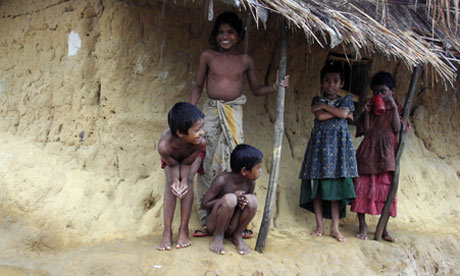
Global acute malnutrition in Rohingya children is now reaching 27% in the Kutu Palong makeshift refugee camp. Photograph: Misha Hussain
Rafiqul's arm is no wider than a tube of sweets. The 18-month-old Rohingya refugee suffers from acute malnutrition and, without medical treatment and nutritional therapy, his chances of survival are becoming slimmer.
The latest survey by Médecins sans Frontières found that global acute malnutrition, one of the basic indicators for assessing the severity of a humanitarian crisis, is as high as 27% in the Kutu Palong makeshift camp, where an estimated 20,000 unregistered refugees live. It is almost double the emergency threshold of 15% set by the World Health Organisation.
Yet the Bangladesh government refuses to formally allow humanitarian assistance into the camp or the surrounding border districts of Ukhia and Teknaf. The majority of the estimated more than 200,000 unregistered Muslim Rohingyas in Bangladesh live in these two districts after fleeing persecution in neighbouring Burma, which is predominantly Buddhist.
Government officials claim humanitarian aid would create a "pull factor" for other Rohingyas, putting even more pressure on an already strained local labour market. A recent article in the Samakal, a Bangla-language daily, quoted a foreign ministry source describing Rohingyas as "excess baggage on the economy, society and national security".
Ironically, the policy of blocking aid for the Rohingyas appears to be hurting the host population as much as the refugees. A report by Action Contre la Faim (ACF), released this month, found disturbing statistics for Bangladeshi children in the districts: 16.5% of children under five suffer from acute malnutrition in Ukhia while the rate is 21.5% in Teknaf.
According to the report, the prevalence of acute malnutrition in both districts, two of the poorest in the country, has increased since 2009. The report cited decreasing purchasing power parity of agricultural day labourers, floods and the lack of humanitarian assistance as possible reasons for the malnutrition crisis.
The seasonal rains also have an impact on the availability of day labour such as construction, fishing or rickshaw-pulling. "Neither my husband nor I have been able to find work for more than three weeks [because of the rains]. We have no income, and no food," said Rafiqul's mother, Rezana.
Clandestine humanitarian aid
The reports come exactly a year after the government rejected a $33m UN joint initiative aimed at reducing hunger and poverty for both Bangladeshis and refugees in the region. The government claimed it would draw more Rohingyas across the border.
However, Echo, the humanitarian aid arm of the European Commission, which funds three NGOs operating under the radar in Ukhia and Teknaf, is sceptical as to whether aid really does create a "pull factor". "Our funding in the Kutu Palong makeshift camp and surrounding populations has increased over the past two years. Yet there hasn't been a corresponding increase in camp numbers, which on the contrary [have] significantly decreased," says Olivier Brouant, an Echo humanitarian expert.
Nevertheless, the NGO Affairs Bureau, the department responsible for granting work permits to NGOs, has denied any organisation that mentions Rohingya in their application. None of the NGOs working in Ukhia or Teknaf has a permit, despite having permission to work in other locations. This has forced a handful of aid agencies to run clandestine humanitarian programmes, creating additional challenges.
Without the permit, NGOs struggle to bring in cash for day-to-day operations, import medical equipment and treatment or ready-to-use therapeutic food, which is essential for children suffering from malnutrition. The NGOs work under the threat of being shut down if they communicate the grim situation within the districts to the international press.
Bangladesh, like many other developing countries with large refugee populations, is in an unenviable position. Its political leaders have to solve worsening malnutrition in the host population while shouldering the ethical responsibility of taking in refugees despite not signing the 1951 Refugee Convention.
In recent months, positive steps have been taken to address the former concern. A $2m joint World Food Programme-ACF community-based nutritional programme started this year aims to treat more than 15,000 Bangladeshi children suffering from acute malnutrition, as well as 2,000 pregnant and nursing women.
Unfortunately for the Rohingyas, the situation across the border seems no better. Despite progress towards democracy in Burma, Aung San Suu Kyi's NLD party has been non-committal on the Rohingya issue. The situation in Burma remains too fragile for the refugees to return home safely.
While the Bangladesh government weighs up its duty to its citizens with its moral obligations to refugees, Rezana and thousands like her do not know where to turn. "I'm damned if I stay, I'm damned if I don't," says Rezana, "so where should I go?"
Global acute malnutrition in Rohingya children is now reaching 27% in the Kutu Palong makeshift refugee camp. Photograph: Misha Hussain
Rafiqul's arm is no wider than a tube of sweets. The 18-month-old Rohingya refugee suffers from acute malnutrition and, without medical treatment and nutritional therapy, his chances of survival are becoming slimmer.
The latest survey by Médecins sans Frontières found that global acute malnutrition, one of the basic indicators for assessing the severity of a humanitarian crisis, is as high as 27% in the Kutu Palong makeshift camp, where an estimated 20,000 unregistered refugees live. It is almost double the emergency threshold of 15% set by the World Health Organisation.
Yet the Bangladesh government refuses to formally allow humanitarian assistance into the camp or the surrounding border districts of Ukhia and Teknaf. The majority of the estimated more than 200,000 unregistered Muslim Rohingyas in Bangladesh live in these two districts after fleeing persecution in neighbouring Burma, which is predominantly Buddhist.
Government officials claim humanitarian aid would create a "pull factor" for other Rohingyas, putting even more pressure on an already strained local labour market. A recent article in the Samakal, a Bangla-language daily, quoted a foreign ministry source describing Rohingyas as "excess baggage on the economy, society and national security".
Ironically, the policy of blocking aid for the Rohingyas appears to be hurting the host population as much as the refugees. A report by Action Contre la Faim (ACF), released this month, found disturbing statistics for Bangladeshi children in the districts: 16.5% of children under five suffer from acute malnutrition in Ukhia while the rate is 21.5% in Teknaf.
According to the report, the prevalence of acute malnutrition in both districts, two of the poorest in the country, has increased since 2009. The report cited decreasing purchasing power parity of agricultural day labourers, floods and the lack of humanitarian assistance as possible reasons for the malnutrition crisis.
The seasonal rains also have an impact on the availability of day labour such as construction, fishing or rickshaw-pulling. "Neither my husband nor I have been able to find work for more than three weeks [because of the rains]. We have no income, and no food," said Rafiqul's mother, Rezana.
Clandestine humanitarian aid
The reports come exactly a year after the government rejected a $33m UN joint initiative aimed at reducing hunger and poverty for both Bangladeshis and refugees in the region. The government claimed it would draw more Rohingyas across the border.
However, Echo, the humanitarian aid arm of the European Commission, which funds three NGOs operating under the radar in Ukhia and Teknaf, is sceptical as to whether aid really does create a "pull factor". "Our funding in the Kutu Palong makeshift camp and surrounding populations has increased over the past two years. Yet there hasn't been a corresponding increase in camp numbers, which on the contrary [have] significantly decreased," says Olivier Brouant, an Echo humanitarian expert.
Nevertheless, the NGO Affairs Bureau, the department responsible for granting work permits to NGOs, has denied any organisation that mentions Rohingya in their application. None of the NGOs working in Ukhia or Teknaf has a permit, despite having permission to work in other locations. This has forced a handful of aid agencies to run clandestine humanitarian programmes, creating additional challenges.
Without the permit, NGOs struggle to bring in cash for day-to-day operations, import medical equipment and treatment or ready-to-use therapeutic food, which is essential for children suffering from malnutrition. The NGOs work under the threat of being shut down if they communicate the grim situation within the districts to the international press.
Bangladesh, like many other developing countries with large refugee populations, is in an unenviable position. Its political leaders have to solve worsening malnutrition in the host population while shouldering the ethical responsibility of taking in refugees despite not signing the 1951 Refugee Convention.
In recent months, positive steps have been taken to address the former concern. A $2m joint World Food Programme-ACF community-based nutritional programme started this year aims to treat more than 15,000 Bangladeshi children suffering from acute malnutrition, as well as 2,000 pregnant and nursing women.
Unfortunately for the Rohingyas, the situation across the border seems no better. Despite progress towards democracy in Burma, Aung San Suu Kyi's NLD party has been non-committal on the Rohingya issue. The situation in Burma remains too fragile for the refugees to return home safely.
While the Bangladesh government weighs up its duty to its citizens with its moral obligations to refugees, Rezana and thousands like her do not know where to turn. "I'm damned if I stay, I'm damned if I don't," says Rezana, "so where should I go?"

Abdul Rahim crossed the border into neighbouring Bangladesh late last year and secured passage on a rickety boat for the perilous 3,200-kilometre (2,000-mile) sea voyage to Malaysia.
"I could not stay (in Myanmar) anymore. We could not go to school, I could not get any job," said Abdul Rahim, 18, of the plight of the Rohingya, a Muslim minority that alleges particularly acute repression under Myanmar's government.
The newly civilian government's moves to relax decades of military rule have been hailed worldwide and provided hope of a new era for majority Burmese and ethnic minorities who have long claimed oppression.
But refugees and activists say initial optimism is fading among many Rohingya -- whom the United Nations calls one of the world's most persecuted minorities -- as repressive practices have continued and an exodus abroad shows no sign of abating.
"I don't want to go back. There will be no change," Abdul Rahim said in the Rohingya language through a translator.
Myanmar has an estimated 750,000 Rohingya, according to the United Nations, mainly in the western coastal state of Rakhine bordering Bangladesh. Another one million or more are believed to already live in exile in other countries.
A Muslim minority in mainly Buddhist Myanmar who speak a Bengali dialect, Rohingyas claim decades of persecution by a government that they say views them with suspicion.
Activists say forced labour is common and Rohingyas face discriminatory practices including travel restrictions, limits on family size, and a refusal to issue them passports that leaves them effectively stateless.
"There is no change at the moment. The Rohingya still see no future," said Chris Lewa, director of Bangkok-based The Arakan Project, an advocacy group monitoring the Rohingya.
An estimated 7,000 Rohingya, some from exile in Bangladesh but also directly from Myanmar, risked the voyage to Malaysia since October, she said.
Many still flee to Bangladesh but Muslim Malaysia has steadily become a magnet due to its more developed economy and because authorities have closed one eye to illegal migration in recent years due to a need for cheap labour.
Malaysia has an estimated two million illegal migrants, most seeking economic opportunities, but the UN refugee agency said there also are about 97,000 legitimate refugees fleeing persecution or other hardship, mostly from Myanmar and including 23,000 Rohingya.
"The new destination country is Malaysia. This year it could be more than ever coming here," Lewa said.
Once in Malaysia, Rohingya remain vulnerable to harrassment and have limited access to services such as health care.
Lewa said Myanmar invited Rohingya to vote, stand as candidates and form political parties in 2010 elections, but adds that a corresponding offer of possible citizenship never materialised, crushing the hopes of many.
"While the new government has engaged in a series of reforms toward democratisation, there has been no real progress for the Rohingya, no change at the policy level and very little on the ground," Lewa said.
"Forced labour, marriage restrictions, restrictions on movement and arbitrary arrests continue."
Abdul Rahim embarked on the dangerous journey south along the Myanmar, Thai and Malaysian coasts with two dozen others aboard a small boat in Bangladesh.
"I was very scared," he said.
Intercepted by Thai authorities, they were detained in a jungle camp for several weeks and fed just once a day until Abdul Rahim and several others bribed their way out.
They eventually made their way by bus and on foot to the Malaysian border.
Those who make it must dodge Malaysian authorities while scraping out a meagre living through manual labour.
In a bare room in a residential neighbourhood in Klang, a port town 30 kilometres west of the capital Kuala Lumpur, scores of young Rohingya men recounted their troubles back home as they sat together after an Islamic lesson.
Abdul Rahim said he was regularly snatched from his home to help build roads, cut down trees and perform other hard labour at the military camp.
"In Myanmar we can never sleep. Now we can sleep here," he said.
Several of the men said they paid smugglers up to $1,000 for passage, yet now earn just 30 ringgit ($10) a day transporting boxes of produce at a local fishmarket.
Some harbour dim hopes of resettlement through the UN refugee agency to a third country such as the United States or Australia.
But others embark on the even longer boat journey to Australia via Indonesia.
"They have no hope. If they die (at sea), never mind. (They may) find a better life," said a Rohingya exile who only gave his name as Yahya.
Sources:

The Hindu Members of a displaced Burmese refugee family who are regrouping to find their family members in New Delhi on Friday. Photo: S. Subramanium
Seeking refugee status, they are trickling back "in search of a home and access to better life"
Days after being forcibly evicted from Delhi, several hundred Rohingya asylum seekers, who participated in the protest demanding refugee status in India this past week, are now trickling back into the Capital “in search of a home and access to better life.”
“After the Indian government assured us that they will issue long-term visas, it directed the Delhi Police to immediately disperse the protesters and instructed us to return to our place of residence in the country. Several participants who came to Delhi from Rajasthan, Jammu and various parts of Uttar Pradesh were bundled into buses and abandoned at railway stations, bus stands and some people were left on the outskirts of the Capital without food, water or any means of communication with our friends. Many of them are now returning to the Capital to keep up the pressure on the Indian government and the United Nations High Commissioner for Refugees. We feel that being in the Capital gives us more security and better access to food, shelter and healthcare facilities,” said Zia-Ur-Rahman, who claims to have managed to return to the Capital to admit his seven-month-old son to a hospital for acute stomach infection.
Also forced to return in search of their family members, Mr. Zia said: “The eviction by the police was done in such haste that many people are now untraceable and several of us are coming back to Delhi to look for them.”
Non-government organisation ‘Zakat Foundation of India' is housing and taking care of 50 Rohingya families (over 200 people) in the Okhla area. It had to turn down the request of taking in 30 more people on Friday afternoon.
“We are in talks with the authorities to rent more space for the people coming in but as of now there is no space for more people. Friday witnessed several asylum seekers trickling back into the city. They tell us that Delhi seems to be a less hostile place,” said Dr. Najam-Us-Salam of the Foundation.
“We were forced to live without access to basic healthcare, food, shelter, work permits or any legal protection. We feel that living in the Capital gives us visibility and maybe also better opportunity,” said Mohammed Yusuf, who six months ago fled Myanmar with his wife, eight children and his 95-year-old mother-in-law in search of a better life in India.
“I came to Uttar Pradesh to a friend's house in the hope that in India I will find the home that was denied to me in my country of birth. However, me and my family have been vagabonds ever since. Desperate to end the uncertainty surrounding our future, we participated in the sit-in protest in Delhi demanding refugee status from the Indian government. Though we were picked up by the Delhi Police and left near Uttar Pradesh, we have come back to Delhi knowing that we will be better off here,” said Mr. Yusuf.
“We plan to stay in some area which has people from our community and hope that at least my children will have one meal a day. That is my aspiration for my family now, lets see what tomorrow brings in for us,” he said.
Keywords: Burma refugees, Rohingya asylum seekers, Delhi police, Dr. Najam-Us-Salam, United Nations High Commissioner for Refugees
 Adnan Abidi/ReutersA family that belongs to the ethnic Rohingya community from Myanmar gathered at a makeshift camp in New Delhi on May 14, 2012.
 Since descending upon New Delhi more than a month ago, ethnic Rohingyas from Myanmar have been rounded up twice by police and ordered to leave, but the stateless group is determined to get the Indian government to recognize them as refugees.
“India is a great democracy, and that is why we want to stay here,” said Ziaur Rehman, who heads the group of Rohingya asylum seekers who have been camping in India’s capital since April 9 to lobby the government for refugee status.
Mr. Rehman spoke to India Ink on Wednesday from the Okhla neighborhood in south Delhi. Until Tuesday morning, he, along with an estimated 2,500 people originally from the Rakhine state in Myanmar, had been living in a makeshift camp near Vasant Kunj in southwest Delhi.
The deserted piece of land upon which they had pitched their tarpaulin tents in Vasant Kunj belonged to the government, but their presence raised the ire of the local residents in the wealthy South Delhi neighborhood and resulted in the asylum seekers’ eviction. The police packed them into trucks and dropped them off at several locations, including the Delhi railway station and the main interstate bus terminal in Kashmiri Gate in north Delhi, Mr. Rehman said.
This was the second time that the Rohingya had been forced to move since they arrived in the capital. Initially, they had squatted outside the office of the United Nations High Commissioner for Refugees in the upscale Vasant Vihar area for nearly a month. They were demanding “refugee status, help with access to health care, school admissions for their children, resettlement and financial assistance,” said Nayana Bose, associate external relations officer for the organization in New Delhi.
India is not a signatory to the United Nations convention relating to the status of refugees, which defines who qualifies as a refugee and refugees’ rights in their host country. Since there is no national law that deals with foreign refugees, the government will decide whether or not to grant the Rohingyas refugee status on a case-by-case basis.
Asylum seekers can be given the United Nations refugee cards, but only at the discretion of the UN agency. The Rohingyas said that the agency told them that the process of granting such cards could take time.
The Muslim minority group has suffered persecution for decades in predominantly Buddhist Myanmar. A large number of Rohingya have fled to neighboring countries, including Indonesia, Malaysia and Bangladesh, and several thousand have entered India through Bangladesh.
Some of these people who gathered in the Indian capital have been living in the states of Jammu and Kashmir, Uttar Pradesh, Hyderabad and Rajasthan, for several years. “They first approached the UNHCR in 2009,” Ms. Bose said, referring to the refugee agency, “but many have lived for longer periods of time in India.”
The Rohingya presence in India is not officially documented, as they have not officially registered with the government’s foreigner offices. Only 1,800 Rohingyas have registered with the United Nations, while several thousand are estimated to be living in India.
A spokesman from the Ministry of External Affairs, Syed Akbaruddin, said that unlike people from other nationalities, like the Afghans or Tibetans, who have been living in India, the Rohingya are stateless. “They are not accepted as citizens in Myanmar,” he said.
 Pamposh Raina for The New York TimesYasmin Ara, 21, and her husband, Mohammad Zakaria, 22, pose with their UNHCR issued asylum seeker cards and the Myanmar government issued white colored “state guest” card, at a makeshift camp in New Delhi on May 11, 2012.
When India Ink visited the Rohingya camp last week near Vasant Kunj, several people flashed laminated white cards, which they said had been issued by the Myanmar government, that described the cardholders as “state guests” – meaning they were not entitled to any citizens’ rights in Myanmar.
Mr. Rehman said the Rohingyas had been imported as laborers from across the world during the British colonial rule in then-Burma, but they have never been recognized as citizens by the country.
Like many others in the camp, he landed in the northern Indian city of Jammu in 2011 after he crossed the border from Bangladesh, where several other Rohingyas worked as day laborers. After working as a medical assistant at a hospital in Jammu for three months, he moved on to Muzaffarnagar in Uttar Pradesh and taught at madrasas, or schools where instruction is based on the teachings of the Koran.
Other Rohingyas call the popular Mr. Rehman “doctor” even though he attended school only up to grade 10 in Myanmar. “They did not let us study any further,” he said, referring to the government.
The Rohingyas who approached the United Nations refugee agency have been issued asylum-seeker cards, which are valid for only four years from their date of issue. While that is the only proof of identification that they have in India, many of them say that it is useless.
Nazeer Hussain, 28, who worked as a laborer in Jammu, said, “Police in the state harassed me, asking me what my father’s name was, as this card does not have his name written on it.”
He said he was not paid for his work and that the United Nations asylum seeker card did not help resolve anything. “We will not leave till we get the refugee card,” he said.
The United Nations agency’s chief of mission, Montserrat Feixas Vihe, who met with representatives from the Rohingya community on Tuesday, said in a statement that the Indian government will be issuing long-term stay visas for asylum seekers from northern Rakhine state who are registered with the agency.
But G.V. Venugopala Sarma, the joint secretary in the Ministry of Home Affairs who deals with foreigners, said the Rohingyas need to go back to the Indian cities in which they were residing and register with the foreign regional registration office. The superintendent of police in their city, who serves as the foreign registration officer, will conduct a thorough verification based on the internal guidelines of the government of India, he said.
“Only after such a verification, a case-by-case assessment will be made whether the person has a well-founded fear of persecution or it is purely for economic reasons they want to seek the refugee status,” Mr. Sarma said. After that, a decision will be made on whether or not they will be granted a long-term visa, he added.
He defended the way the Indian government has dealt with refugees in the past, saying, “India has always had an impeccable record of taking care of refugees of all kinds in a humane manner.”
The Rohingya presence in New Delhi has not gone unnoticed by politicians. On Wednesday, the home minister, Palaniappan Chidambaram, was questioned in the Rajya Sabha, or upper house of the Parliament, by a fellow member, Balbir Punj, about the Rohingya camp in the capital.
“They demanded that they should be given refugee cards by the UNHCR,” said Mr. Chidambaram, “under the mistaken impression that the UNHCR will give a refugee card to anyone, who has come from any other country, and that the card will give them access to a number of benefits. Perhaps, they were misguided by some people. They have all been persuaded to go back to the places from which they came.”
Another member of Parliament, Sitaram Yechury of the Communist Party of India (Marxist), told the home minister: “If people from other religions have been allowed and Muslims have been denied, then it is very unfair.”
Mr. Chidambaram denied that there was any discrimination against the Rohingya asylum seekers on religious grounds.
As the politicians debate the plight of the Rohingyas’, the Rohingyas have defied the authorities as they continue to stay put in New Delhi, at least for now.
Asad Ghazi Ansari, the president of the nongovernmental organization Nawa-e-Haque, which has been helping the Rohingyas with food and medicine, said that most of the Rohingyas returned from where the police had left them.
On Wednesday, about 500 of them had assembled in Batla House, in the Okhla neighborhood in south Delhi, on what Mr. Ansari called “community land,” which meant that the land belonged to members of the Muslim community.
He said that his organization is making arrangements to get the other Rohingya together and set up another makeshift camp for them at Batla House.
“The issue was discussed in the Parliament today,” Mr. Ansari said. “As the movement is gaining momentum, we won’t let it die.”
NEW DELHI // A month-long standoff between the ethnic Rohingya people of Myanmar, backed by the United Nations High Commission for Refugees (UNHCR), and the Indian government ended yesterday with the government agreeing to grant long-term visas to the Rohingya.


The UNHCR called the government's decision "a huge step forward for their protection and safety in India". But the decision does not give the Rohingya what many of them sought - official refugee status. That would have allowed them access to a resettlement programme in a third country and financial assistance from UNHCR if they are unable to work.
Sujzaed Islam, 32, who has lived in India for the past four years, described the Indian government's visa decision as "muddy".
"We now have to go back to where we came from in India and apply for new visas. People already fear the Indian system, so this does not make it any easier," he said.
"I was reduced to being a porter for the [Myanmar] military even though I got the highest marks in school. I was not allowed to go to college."
Three decades ago, the government of Myanmar said the Rohingya, along with other ethnic minorities, did not qualify for citizenship, thus denying them many rights.
About 2,500 Rohingya, who are all Muslim, participated in the protest in New Delhi in an effort to obtain better access to refugee services in India, where about 7,000 refugees from Myanmar have registered with the UNHCR in New Delhi.
According to Human Rights Watch, there are an estimated 100,000 refugees from Myanmar living in the north-east of India. The UNHCR has no access to this part of the country because the border is contested. Travel, by both Indians and foreigners, to the region that borders China and Myanmar is carefully monitored by the Indian government.
Many of the protesters in New Delhi had feared they would be sent back to Myanmar as the April elections indicated the country, long ruled by a military junta, was embracing political reform.
A week ago the police removed the protesters from their makeshift camp in front of the UNHCR's office in Delhi.
They then squatted outside the Sultan Garhi tomb in Vasant Kunj in Delhi until yesterday.
The Rohingya who participated in the protest returned to their jobs across India yesterday, after assurances by the UNHCR that the government would provide the long-term visas.
Zaibur Rahman, 26, came to New Delhi with his wife and eight-month-old child, Misbah, to join the protest. He had been working as an electrician in the state of Uttar Pradesh for the past four years. He fled Myanmar after the military junta took away his uncle and his brothers for "being caretakers of a mosque", said Mr Rahman.
"We are stateless there and we are refugees here. All I want is for my child to not meet the same fate as the rest of my family."
India does not grant refugees and those seeking asylum the right to work in the country. Instead, they work in what Indians call the informal sector, as maids, waiters or in garment factories, where identification papers are rarely an issue.
The UNHCR said that India's ad hoc system makes protecting vulnerable people especially challenging.
"In India, there is no national legal framework for refugees and because of this, there are different approaches to different groups of people," said Nayana Bose, with the UNHCR. This means that the status and rights of each refugee group must be negotiated.
Despite the hurdles, Sayed Islam, who fled Myanmar for India a decade ago, has no intention of returning.
He brought his eight children and wife to the protests in New Delhi from their home in Jammu and Kashmir where he works as a day labourer.
Mr Islam always carries a one-kyat currency note to remind him of his home country, along with his Myanmar ID card.
"We are restricted in [Myanmar] and are not even allowed to travel to neighbouring villages without permission," he said. "Our daughters cannot get married without official consent. Our sons cannot attend college. Our land has been taken away from us."
"We left for a better life and we do not want to go back. We want to live here with better rights."
sbhattacharya@thenational.ae
Sujzaed Islam, 32, who has lived in India for the past four years, described the Indian government's visa decision as "muddy".
"We now have to go back to where we came from in India and apply for new visas. People already fear the Indian system, so this does not make it any easier," he said.
"I was reduced to being a porter for the [Myanmar] military even though I got the highest marks in school. I was not allowed to go to college."
Three decades ago, the government of Myanmar said the Rohingya, along with other ethnic minorities, did not qualify for citizenship, thus denying them many rights.
About 2,500 Rohingya, who are all Muslim, participated in the protest in New Delhi in an effort to obtain better access to refugee services in India, where about 7,000 refugees from Myanmar have registered with the UNHCR in New Delhi.
According to Human Rights Watch, there are an estimated 100,000 refugees from Myanmar living in the north-east of India. The UNHCR has no access to this part of the country because the border is contested. Travel, by both Indians and foreigners, to the region that borders China and Myanmar is carefully monitored by the Indian government.
Many of the protesters in New Delhi had feared they would be sent back to Myanmar as the April elections indicated the country, long ruled by a military junta, was embracing political reform.
A week ago the police removed the protesters from their makeshift camp in front of the UNHCR's office in Delhi.
They then squatted outside the Sultan Garhi tomb in Vasant Kunj in Delhi until yesterday.
The Rohingya who participated in the protest returned to their jobs across India yesterday, after assurances by the UNHCR that the government would provide the long-term visas.
Zaibur Rahman, 26, came to New Delhi with his wife and eight-month-old child, Misbah, to join the protest. He had been working as an electrician in the state of Uttar Pradesh for the past four years. He fled Myanmar after the military junta took away his uncle and his brothers for "being caretakers of a mosque", said Mr Rahman.
"We are stateless there and we are refugees here. All I want is for my child to not meet the same fate as the rest of my family."
India does not grant refugees and those seeking asylum the right to work in the country. Instead, they work in what Indians call the informal sector, as maids, waiters or in garment factories, where identification papers are rarely an issue.
The UNHCR said that India's ad hoc system makes protecting vulnerable people especially challenging.
"In India, there is no national legal framework for refugees and because of this, there are different approaches to different groups of people," said Nayana Bose, with the UNHCR. This means that the status and rights of each refugee group must be negotiated.
Despite the hurdles, Sayed Islam, who fled Myanmar for India a decade ago, has no intention of returning.
He brought his eight children and wife to the protests in New Delhi from their home in Jammu and Kashmir where he works as a day labourer.
Mr Islam always carries a one-kyat currency note to remind him of his home country, along with his Myanmar ID card.
"We are restricted in [Myanmar] and are not even allowed to travel to neighbouring villages without permission," he said. "Our daughters cannot get married without official consent. Our sons cannot attend college. Our land has been taken away from us."
"We left for a better life and we do not want to go back. We want to live here with better rights."
sbhattacharya@thenational.ae

Rohingya asylum seekers take shelter from the sun under a tarpaulin as they protest near the UNHCR's office in New Delhi. (Photo: Zarni Mann / The Irrawaddy)
Hundreds of Rohingya asylum seekers who have staged a protest in New Delhi since April 9 have been urged by a UN official to go back to their places of residence in India without delay, with assurances that the government of India will soon issue them long-term visas.
According to the official from the United Nations High Commission for Refugees (UNHCR), the Rohingyas will also be granted access to education and health care like other refugees or asylum seekers in India.
After staging a sit-in protest outside the UNHCR office, then at an ancient monument in the Indian capital, the Rohingya were dispersed by Delhi police on Tuesday. The UNHCR said they should now return home and apply for long-term visas at their regional Foreign Registration Offices.
However, several of the Rohingya protesters claimed that the police pressured them to go back to their residences but abandoned them at Delhi railway station.
“After our meeting with the UNHCR, the police brought us to the railway station in buses and just dropped us here,” said a spokesman for the group. “Those who live nearby at Kashmiri Gate [in Delhi] can go home directly, but the rest of us don’t know what to do and have no money to buy tickets.”
Meanwhile, a case to determine the legal status of these Rohingya people will be heard at Delhi High Court on Wednesday.
According to The Indian Express, the court was to hear an application by a lawyer who requested an official order by the government to provide free food, water, toilet facilities and medical assistance to the group.
A week ago, the Rohingyas were forced to leave a site where they had pitched tents and protested outside the UNHCR’s office in an upscale New Delhi neighborhood.
Many then relocated their protest to an open area near Sultan Garhi, a protected monument in the Indian capital.
Last Sunday, the police ordered the “squatters” to move following complaints from locals and resident welfare associations. Meanwhile, many students from the nearby Jawaharlal Nehru University showed solidarity with the protesters by providing them food and water.
According to the Hindustan Times, New Delhi’s Chief Minister Sheila Dikshit said on Sunday that she has asked officials to discuss and find a solution to the Rohingya issue before May 16, and that she was confident a way would be found to relocate them soon.
The Rohingya people live in different areas across India, including Jammu, Uttar Pradesh and Rajasthan. They are unable to apply for refugee status with the UNHCR, which said it has around 1,800 Rohingyas registered as asylum seekers in India.
The UNHCR said it has issued each one an identity card to protect them from harassment, arbitrary arrest, detention and expulsion, and to prevent them from being forced back to a country where their lives or freedoms may be in danger. The UNHCR said this gives them the same protection as other refugees.

Adnan Abidi/Rueters By Margherita Stancati ,A child belonging to the Burmese Rohingya community sat in a plastic tent at the makeshift shelter in a camp in New Delhi, Monday.
Myanmar may be gradually embracing political reform. But for 31-year-old Nasir Udin, returning to his country of origin is not an option – at least not yet.
Myanmar may be gradually embracing political reform. But for 31-year-old Nasir Udin, returning to his country of origin is not an option – at least not yet.
“I can only think of stepping foot in Myanmar once it becomes a democracy. We have suffered grave atrocities at the hands of our own people,” said Mr. Udin, who is a Rohingya, a Muslim minority in his native Myanmar.
Mr. Udin is one of around 2,500 Rohingya asylum seekers in India – many of them children and pregnant women – who were temporarily lodged in a makeshift camp set up in a patch of scrubland in the outskirts of New Delhi.
They gathered from around India in New Delhi last month to press the office of the United Nations High Commissioner for Refugees to recognize them as refugees in the hope this would guarantee them access to medical facilities and schools for their children.
The living conditions in the camp, which was set up last week, were dire: Many had little more than plastic sheets propped up with branches as shelter and complained they didn’t have medicines to treat those who fell ill.
Despite the victory of pro-democracy leader Aung San Suu Kyi in recent by-elections – a development that prompted the international community to rethink economic sanctions on the country – none of the asylum seekers interviewed in the camp expressed any interest in returning to Myanmar.
For the time being, their concerns are more local: they want a better life here in India.
“Government hospitals don’t want to treat us, schools don’t want to admit our children, nobody wants to employ us,” says Nazir Ahmed, a 51-year-old Rohingya asylum seeker who arrived in India three years ago and takes care of five daughters, his wife and his mother. Despite the hardship, he categorically dismissed the possibility of returning to his country of origin: “I will never ever go back,” he said, likening that possibility to “jumping into fire.”

- Manan Vatsyayana/Agence,FrancePress /Getty Images,A Burmese asylum seeker living at the makeshift camp gestured at the camera, Monday.
A significant step to improve the welfare of Rohingya people in India was made on Tuesday afternoon, when they were promised long-term stay visas in India.
UNHCR’s chief of mission, Montserrat Feixas Vihe, said in a statement she was confident this “will greatly increase their protection and safety in India.”
As asylum seekers, healthcare and education are services they are already entitled to in India, according to UNHCR. However, many Rohingya – especially those who are based outside Delhi – said local authorities often do not recognize this right.
While some members of the Rohingya community are still pushing for refugee status, many were satisfied with the visa agreement and were willing to return to their places of residence elsewhere in India.
However, even as talks with U.N. officials were ongoing, on Tuesday police dismantled their temporary dwellings in Delhi and forced them to leave. Rohingya asylum seekers had been complaining against police treatment ever since they settled there. For days, police did not allow them to leave the area, saying this was to ensure their safety, since they worried local residents would turn against them.
What rights asylum seekers and refugees are entitled to is a gray area because India does not have a comprehensive policy on refugees. New Delhi is not a signatory to the U.N. convention on refugees, nor does it have its own legal framework. As a result, rights and privileges vary depending on the community.
Rohingya are a stateless people. They come from Myanmar’s coastal Rakhine state, which borders Bangladesh, and look South Asian. This has made their acceptance in the country historically difficult. Three decades ago, the government of Myanmar made it clear that Rohingyas, along with other ethnic minorities, did not qualify for citizenship, effectively denying them most rights.
Many have escaped human rights abuses by fleeing to neighboring countries, with around 30,000 of them currently living in refugee camps in Bangladesh alone, according to U.N. data. They started crossing over to India more recently, arriving in significant numbers in 2009.
Rohingya are just one of many Burmese groups that escaped the widespread repression of Myanmar’s military government. On top of the Rohingya asylum seekers, India currently hosts roughly 7,000 Burmese refugees. Most of them are ethnically Chin and settled in India’s northeast in the early 1990s, when there was a major exodus from Myanmar.
No Burmese refugees or asylum seekers in India – Rohingya, Chin or other – have turned to the U.N. to help them repatriate in recent months, according to UNHCR.

- Adnan Abidi/Reuters
- Burmese families rested at the makeshift camp, Monday.
However, they are keeping an eye on political developments in their country of origin. “Refugees from Myanmar are following events in their country with great interest. It is too early to say what they feel— people are waiting and watching to see how developments unfold in the coming months,” says Nayana Bose, an officer at UNHCR in Delhi.
The recent Rohingya agitation in New Delhi comes as Indian Prime Minister Manmohan Singh is preparing to travel to Naypyitaw later this month, a trip that will test how India plans to deal with a reforming Myanmar.
Foreign governments and rights groups have called on India to take a bigger role in promoting democratic change in the Southeast Asian country.
“I think because of India’s democracy, India stands in a strong position to help the people of Burma as they look at a way to navigate their way forward with political and economic reforms,” U.S. Secretary of State Hillary Clinton said last week, speaking at an event in Kolkata.
Activists have similarly urged India to engage in the country’s democratic process. The Burma Centre Delhi, an Indian non-profit organization, called on Mr. Singh to address ethnic-based discrimination during his trip there. They said New Delhi could play a significant role in helping restore “the civil and democratic rights of the Rohingya” and in helping safely repatriate refugees.
Addressing the issue of Burmese refugees would be a chance for New Delhi to show that it is committed to a regional policy that goes beyond looking for investment opportunities, in keeping with its much-hyped “Look East” policy.
A spokesman for the Prime Minister said the agenda for Mr. Singh’s three-day trip, which is set to start May 27, “has not yet been decided.”

Rohingya, who originally come from Myanmar's northern coastal regions, are a stateless people. Many fled to neighboring Bangladesh in the early 1990s and some eventually made their way to India. Pictured, Rohingya asylum seekers stood in a makeshift camp in New Delhi on Monday.
-
 ဇြန္လ ၁၇ ရက္ ၊ ၂၀၁၂ Source: guardian.co.uk ျမန္မာျပည္သစ္အတြက္ အနာဂတ္မွာ ေအာင္ျမင္မွာလား၊ က်ရွဳံးမွာလားဆိုသည္ကို ညႊန္ျပေသာ စမ္းသပ္မွဳ တစ...
 -
 MP U Shwe Maung Explained on Amendment 1982 Citizenship Law on 25 July 2012. MP U Shwe Maung explained on amendment of 1982 Citizenship Law...
 -
ရက္စြဲ – ေမ ၂၉ ၊ ၂၀၁၂ သို ့ အယ္ဒီတာ၊ နိရဥၥရာ သတင္းဌာန နိရဥၥရာ သတင္းဌာနမွ ေမလ ၂၉ ရက္ေန ့ ထုတ္ျပန္သည့္ ရမ္းျဗဲတြင္ အသက္ ၁၆ ႏွ...
-
 Read letter here Read history of Rohingya here Download letter PDF here Download History of Rohingya PDF here credi...
 -
 RB News March 31, 2018 Minbya, Arakan State : On March 30 morning, a Prayer Leader or Imam was brutally beaten and injured by a Rakh...
 -
 "Although mass killings and exterminations of human races were some sort of things that the world experienced during Nazi German p...
 -
More than 40% of people living in Burma belong to one of the military-ruled nation's different minority groups. The government recognis...
-
 12/07/2012 Joint press release HUMANITY GONE ...
 -
 By Dr. Maung Zarni Since the first wave of Rohingya genocide in Feb 1978 which expelled nearly 200,000 refugees from all across Wester...
 -
 လူသားတိုင္း ရသင့္ရထိုက္ေသာ ရပိုင္ခြင့္၊ ခံစားခြင့္ မ်ားကို လူမ်ိဳးဘာသာမေရြး ရရွိသင့္ပါသည္။ သို႔မွသာ Human Rights – (လူ႔အခြင့္အေရး) ကိုတန္ဖို...

Popular Posts
Threatwiki

Amartya Sen: Burma's "slow genocide" of Rohingyas

Watch Professor Amartya Sen speak on what he calls Burma's 'slow genocide' of Rohingya, Harvard, 4 Nov 2014
