
Visit here for more information

UNHCR urges Bangladesh to lift NGO ban in southeast
GENEVA, 7 August (UNHCR) – UNHCR appealed on Tuesday to the government of Bangladesh to ensure that NGO assistance continues to be provided to unregistered people from Myanmar's Rakhine state.
Last Thursday, three non-governmental organizations -- Médecins Sans Frontières, Action Contre La Faim and Muslim Aid UK -- were ordered by the Bangladeshi authorities to stop activities in and around unofficial camps near Cox's Bazar in the southeast of the country.
"If the order is implemented, it will have a serious humanitarian impact on some 40,000 unregistered people who had fled Myanmar in recent years and settled in the Leda and Kutupalong makeshift sites," UNHCR spokesman Adrian Edwards told reporters.
"Local villagers nearby will also be affected as they, too, have been benefiting from basic services provided by the NGOs," Edwards told a news briefing.
UNHCR is urging the government of Bangladesh to reconsider its decision in line with its long tradition of hospitality towards people who have fled Myanmar over the years. In addition to the unregistered population, there are some 30,000 registered ones living in two official camps in Cox's Bazar.
Meanwhile in northern Rakhine state, UNHCR is watching developments closely following reports of renewed violence over the weekend. The UN refugee agency has received unverified accounts of some villages being burnt in the Kyauk Taw township north of the state capital, Sittwe. Many of the young men have reportedly fled, leaving mainly women and children behind.
The UN and its humanitarian partners have drawn up a response plan to assist some 80,000 people who have been displaced or are otherwise affected in Rakhine state since inter-communal clashes broke out in early June.
UNHCR has so far distributed emergency aid to more than 40,000 people: plastic sheets, blankets, sleeping mats, mosquito nets and kitchen sets. It is also mobilizing its stocks in Cox's Bazar for delivery by boat across the Naf river to Rakhine state once permission is in place.
GENEVA, 7 August (UNHCR) – UNHCR appealed on Tuesday to the government of Bangladesh to ensure that NGO assistance continues to be provided to unregistered people from Myanmar's Rakhine state.
Last Thursday, three non-governmental organizations -- Médecins Sans Frontières, Action Contre La Faim and Muslim Aid UK -- were ordered by the Bangladeshi authorities to stop activities in and around unofficial camps near Cox's Bazar in the southeast of the country.
"If the order is implemented, it will have a serious humanitarian impact on some 40,000 unregistered people who had fled Myanmar in recent years and settled in the Leda and Kutupalong makeshift sites," UNHCR spokesman Adrian Edwards told reporters.
"Local villagers nearby will also be affected as they, too, have been benefiting from basic services provided by the NGOs," Edwards told a news briefing.
UNHCR is urging the government of Bangladesh to reconsider its decision in line with its long tradition of hospitality towards people who have fled Myanmar over the years. In addition to the unregistered population, there are some 30,000 registered ones living in two official camps in Cox's Bazar.
Meanwhile in northern Rakhine state, UNHCR is watching developments closely following reports of renewed violence over the weekend. The UN refugee agency has received unverified accounts of some villages being burnt in the Kyauk Taw township north of the state capital, Sittwe. Many of the young men have reportedly fled, leaving mainly women and children behind.
The UN and its humanitarian partners have drawn up a response plan to assist some 80,000 people who have been displaced or are otherwise affected in Rakhine state since inter-communal clashes broke out in early June.
UNHCR has so far distributed emergency aid to more than 40,000 people: plastic sheets, blankets, sleeping mats, mosquito nets and kitchen sets. It is also mobilizing its stocks in Cox's Bazar for delivery by boat across the Naf river to Rakhine state once permission is in place.
Source here
 |
| After the violence, some Rohingya took shelter in school compounds such as this one, in Maungdaw |
Muslims in Burma's western Rakhine state have been subjected to attacks and arbitrary arrests in the weeks since communal violence erupted, Amnesty International says.
A state of emergency was declared in Rakhine in June after deadly clashes between Buddhists and Muslims.
Since then, hundreds of people have been detained in the areas where Muslim Rohingya people live, a spokesman said.
The government has dismissed the allegations as "groundless and biased".
Win Myaing, a government spokesman for Rakhine state, told the Associated Press news agency that the claims are "totally opposite of what is happening on the ground", adding that the region was calm.
But although communal violence has eased since the unrest in June, violations by the security forces appear to have increased, rights groups say.
A state of emergency was declared in Rakhine in June after deadly clashes between Buddhists and Muslims.
Since then, hundreds of people have been detained in the areas where Muslim Rohingya people live, a spokesman said.
The government has dismissed the allegations as "groundless and biased".
Win Myaing, a government spokesman for Rakhine state, told the Associated Press news agency that the claims are "totally opposite of what is happening on the ground", adding that the region was calm.
But although communal violence has eased since the unrest in June, violations by the security forces appear to have increased, rights groups say.
'Rohingyas beaten'
Amnesty accuses Burmese security forces as well as ethnic Rakhine Buddhist residents of assaults, unlawful killings of Muslims and the destruction of property.
"Most cases have meant targeted attacks on the minority Rohingya population and they were bearing the brunt of most of that communal violence in June and they continue to bear the lion's share of the violations perpetrated by the state security forces," Amnesty researcher Benjamin Zawacki told the BBC's Viv Marsh.
Chris Lewa, director of The Arakan Project, which focuses on Rohingyas in the region, also told our correspondent that hundreds of Rohingya Muslims had been arrested, with allegations that some had been beaten and even tortured.
"Shortly after the main violence... then we start seeing a new phase of, I would say, state-sanctioned abuses, where especially in Maung Daw... we heard on a daily basis about mass arrests of Rohingya," Ms Lewa told the BBC.
What sparked the violence in June?
The rape and murder of a young Buddhist woman in Rakhine in May set off a chain of deadly religious clashes.
Why was a state of emergency declared?
A state of emergency allows the introduction of martial law, which means the military can take over administrative control of the region.
Who are the Rohingyas?
The United Nations describes Rohingya as a persecuted religious and linguistic minority from western Burma. The Burmese government, on the other hand, says they are relatively recent migrants from the Indian sub-continent. Neighbouring Bangladesh already hosts several hundred thousand refugees from Burma and says it cannot take any more.
Reports from the group's network of sources in the area, mostly Rohingya, also said that authorities allowed Rakhine youth to assault Rohingyas in custody. The group also alleges that Burmese authorities took part in looting of shops and homes belonging to Rohingya.
The Burmese authorities denied similar allegations made by Amnesty International.
Some of the Rohingya Muslims arrested were held in connection with violence that erupted in Rakhine on 8 June, the day on which, observers say, violence was largely carried out by Rohingyas. The Arakan Project also says that some Rakhine, particularly those found with weapons, were arrested.
It is difficult to verify any of the information provided by such sources, as journalists cannot access the area.Long-standing tension
Violence between Buddhists and Muslims flared after the rape and murder of a Buddhist woman in May, followed by an attack on a bus carrying Muslims.
Communal unrest continued in parts of Maung Daw as Muslims attacked Buddhist homes. Reprisal attacks then targeted Muslim homes and communities. The attacks left many dead and forced thousands of people on both sides to flee their homes.
There have been long-standing tensions between Rakhine people, who are Buddhist and make up the majority of the state's population, and Muslims, many of whom are Rohingya.
Many Rakhine Buddhists have said that much of the violence in June was carried out against them by Rohingya groups. Rohingyas say they have been forced to flee because of the violence.
Earlier this month, Burma's President Thein Sein said the "solution" for the Rohingya was deportation or refugee camps.
source here
Amnesty accuses Burmese security forces as well as ethnic Rakhine Buddhist residents of assaults, unlawful killings of Muslims and the destruction of property.
"Most cases have meant targeted attacks on the minority Rohingya population and they were bearing the brunt of most of that communal violence in June and they continue to bear the lion's share of the violations perpetrated by the state security forces," Amnesty researcher Benjamin Zawacki told the BBC's Viv Marsh.
Chris Lewa, director of The Arakan Project, which focuses on Rohingyas in the region, also told our correspondent that hundreds of Rohingya Muslims had been arrested, with allegations that some had been beaten and even tortured.
"Shortly after the main violence... then we start seeing a new phase of, I would say, state-sanctioned abuses, where especially in Maung Daw... we heard on a daily basis about mass arrests of Rohingya," Ms Lewa told the BBC.
What sparked the violence in June?
The rape and murder of a young Buddhist woman in Rakhine in May set off a chain of deadly religious clashes.
Why was a state of emergency declared?
A state of emergency allows the introduction of martial law, which means the military can take over administrative control of the region.
Who are the Rohingyas?
The United Nations describes Rohingya as a persecuted religious and linguistic minority from western Burma. The Burmese government, on the other hand, says they are relatively recent migrants from the Indian sub-continent. Neighbouring Bangladesh already hosts several hundred thousand refugees from Burma and says it cannot take any more.
Reports from the group's network of sources in the area, mostly Rohingya, also said that authorities allowed Rakhine youth to assault Rohingyas in custody. The group also alleges that Burmese authorities took part in looting of shops and homes belonging to Rohingya.
The Burmese authorities denied similar allegations made by Amnesty International.
Some of the Rohingya Muslims arrested were held in connection with violence that erupted in Rakhine on 8 June, the day on which, observers say, violence was largely carried out by Rohingyas. The Arakan Project also says that some Rakhine, particularly those found with weapons, were arrested.
It is difficult to verify any of the information provided by such sources, as journalists cannot access the area.Long-standing tension
Violence between Buddhists and Muslims flared after the rape and murder of a Buddhist woman in May, followed by an attack on a bus carrying Muslims.
Communal unrest continued in parts of Maung Daw as Muslims attacked Buddhist homes. Reprisal attacks then targeted Muslim homes and communities. The attacks left many dead and forced thousands of people on both sides to flee their homes.
There have been long-standing tensions between Rakhine people, who are Buddhist and make up the majority of the state's population, and Muslims, many of whom are Rohingya.
Many Rakhine Buddhists have said that much of the violence in June was carried out against them by Rohingya groups. Rohingyas say they have been forced to flee because of the violence.
Earlier this month, Burma's President Thein Sein said the "solution" for the Rohingya was deportation or refugee camps.
source here
by Heather Marciniec

The Rohingya are from western Burma. As a Muslim minority group, they face systematic discrimination by the military regime. An outbreak of severe violence in the western Burmese state of Rakhine has refocused international and regional attention on the issue of the area’s estimated 800,000 stateless Muslim Rohingya threatening to destabilize the country’s wider transition away from military rule. The government declared martial law in Rakhine recently after an escalation of violence involving local Buddhist and Muslim communities that resulted in an unknown number of deaths and the burning of hundreds of homes. The Burmese government, including the military, police and local security forces, has responded with violence including mass arrests and the reported use of torture against the Rohingya population.
Tensions in the region, which borders Bangladesh, have historically been fueled by Burma’s denial of citizenship to the Rohingya who are also not recognized as one of the country’s official ethnic nationalities. Greg Constantine, a grantee of the Open Society Foundations, has spent the past several years documenting the plight of the Rohingya and believes their story is one of the most forgotten, neglected and worst cases of human rights abuse in Asia today. I had a chance to talk with him about his new book, Exiled to Nowhere: Burma's Rohingya.
Q: Congratulations on your new book. Why did you decide to write a book about the Rohingya?
For the past six and a half years I've been working on a long-term project called Nowhere People. The project documents ethnic groups around the world who have had their citizenship stripped or denied from them and they are now stateless. As a result, they belong to no country, are denied most rights, and are some of the most vulnerable people in the world.
One of the most extreme cases of statelessness in the world involves the Rohingya from Burma. I've spent the most time photographing them over the past six years primarily because I truly believe their story is one of the most forgotten, neglected, and worst cases of human rights abuse in Asia today. My project and the book it resulted in, Exiled To Nowhere: Burma's Rohingya, aim not only to show the neglect and exploitation the Rohingya face as both recognized and unrecognized refugees in Bangladesh, but it also to demonstrate the abuses they endure in Burma.
From my first trip in 2006 to my most recent trip in early 2012, Rohingya have shared amazing stories with me that, when woven together, create this narrative that I've always felt people need to see and understand. A handful of photos published here or there just doesn't do the Rohingya's story justice. I've always envisioned my work and their testimonies in book form as the most effective way to tell their collective story.
Q: Who are the Rohingya?
The Rohingya are a Muslim minority who have lived in the Arakan (or Rakhine) State of western Burma for generations. While Burma and Rakhine are predominantly Buddhist, the Rohingya have been the minority in Rakhine and their connection to Burma has been challenged and manipulated by successive Burmese governments. It's estimated that some 800,000 Rohingya live in the townships of North Rakhine, which is an area that is totally off limits to journalists and most other people.
The legacy of persecution against the Rohingya in Burma dates back decades and there have been waves of Rohingya fleeing Burma. Currently, there are up to 300,000 Rohingya living in Bangladesh—most are not recognized as refugees—and tens of thousands living in Malaysia, Saudi Arabia, and several other countries in the region.
In Burma, Rohingya people are subjected to forced labor, land seizures, religious persecution, arbitrary taxes, and constant harassment from the Burmese security force NaSaKa. For years they have been denied the freedom to travel and have faced serious restrictions on the right to get married. They have also been denied Burmese citizenship.
Q: When did the Rohingya become stateless and why?
Though some historians say the Rohingya have lived in Burma for hundreds of years, others challenge the fact that they legitimately belong there. This is a result of politics, perceived notions of national identity, and blatant discrimination and intolerance.
It’s true that there was some migration of people into Burma under British rule, but a large Rohingya community had lived in western Burma well before then.
Most of the problems for the Rohingya started when Ne Win, a military strongman and leader of Burma, seized power in 1962. His policies toward the Rohingya dramatically impacted the community for the next 30 years. The Burmese government consequently enacted the 1982 Burma Citizenship Law. The law provides “full” citizenship to those from Burma's 135 recognized “national races.” The Rohingya are not listed as one of these “national races” and as a result some 800,000 Rohingya have become stateless.
Q: Have they benefited from the recent reforms in Burma?
I don't think the Rohingya in Rakhine State have benefited at all from the new reforms, certainly not the Rohingya who live in North Rakhine State. But then again, in these times of euphoria over Burma, we have yet to see who will actually benefit from the reforms. Yangon is one thing, but it’s different for the millions of people who live in Burma's countryside or border regions.
The lives of most Rohingya are still tightly monitored and controlled by the Burmese security force NaSaKa. Rohingya in North Rakhine State still face severe restrictions on the right to get married—Rohingya wishing to get married must receive formal permission from NaSaKa first.
Many of the abuses the Rohingya are subjected to on a day-to-day basis are totally invisible to the international community. They haven't come in the form of violence or killing. These brutal administrative tactics make life so miserable and untenable for the Rohingya that many find they have no choice but to leave Burma in order to live—with dignity and a “normal” life. Rohingya will tell you that all the tactics of the Burmese authorities are motivated by one thing: to force the Rohingya into Bangladesh.
Q: How are the Rohingya different from or similar to other stateless populations around the world?
I think that one of the biggest differences I've seen between the Rohingya and other stateless communities around the world is that many people feel very little hope—at least right now—that their situation will improve in the near future. All the international players—Western governments, ASEAN nations, the United Nations and others—know how serious the situation is but have done little or nothing to improve it.
Q: How were you able to capture the life experiences of so many Rohingya?
I started photographing the Rohingya community in Bangladesh in early 2006 and have made eight trips in total. My last trip was in February 2012. Their situation is fluid, it changes nearly every year, and I've tried my best to chronicle this.
Each visit allowed me the opportunity to better understand their community and the complexities of their situation. Each visit provided some new piece to the puzzle and with each trip the network of people I met and situations they permitted me to photograph developed. As I’ve learned more about the Rohnigya community, their situation and their history, I’ve also learned what I want to capture in my photographs and what questions I want to ask them. One of my main objectives has been to use their stories and my work to show the abuse the Rohingya face in Burma.
Traveling to North Rakhine State is pretty much impossible for journalists—or anyone else for that matter. And even if I had managed to get there, getting access to Rohingya there and being able to talk honestly with them and take photographs would put their safety at great risk. Rohingya are constantly fleeing Burma to Bangladesh, bringing new and up-to-date stories. In Bangladesh, they can talk freely with me.
Finally, I think it’s important to point out that the treatment the Rohingya have received in Bangladesh—from denial of humanitarian assistance to exploitation and poverty—is another huge part of their story which also needs to be told. People need to know that while the root cause of their problems rests inside Burma, their plight has no borders.

Outcasts ... a man weeps after his arrest in Bangladesh. Photo: AP
The recent brutal religious violence in Burma's western Arakan state has cast a shadow on the country's democratic progress. Dozens of people have been killed and hundreds of homes destroyed as Buddhists and Rohingya Muslims clash near the Bangladeshi border in the country's worst sectarian violence in decades.
Even more shocking than the violence has been the public outpouring of vitriol aimed at the Rohingya, the stateless minority group at the centre of the conflict.
Considered ''illegal Bengali immigrants'' by the government, they are denied citizenship and are widely despised within Burmese society. Anti-Rohingya views have swept both social and mainstream media, seemingly uniting politicians, human rights activists, journalists, and civil society across Burma's myriad ethnic groups.
''The so-called Rohingya are liars,'' one pro-democracy group said on Twitter. ''We must kill all the kalar,'' another social media user said. Kalar is a racial slur applied to dark-skinned people from the Indian subcontinent.
Advertisement
Burmese refugees, who themselves have fled persecution, gathered at embassies around the world to protest against the ''terrorist'' Rohingya invading their homeland. Even the prominent student leader Ko Ko Gyi, who played a key role in the 1988 democratic uprising, lambasted them as impostors and frauds.
No doubt Burma's nascent media freedom has played a key role in stirring up religious tensions. Vast swaths of inflammatory misinformation are circulating inside Burma, with mainstream media largely accusing al-Qaeda and ''illegal Bengali terrorists'' of staging the violence in a bid to spread Islam in Asia. Many allege that the Rohingya are burning their own houses to attract attention.
One newspaper published a graphic photograph of the corpse of Thida Htwe, a Buddhist woman whose rape and murder - allegedly by three Muslim men - instigated the violence, prompting the President, Thein Sein, to suspend the publication using censorship laws.
These are the same papers that in recent months have openly criticised the government for the first time since a nominally civilian administration took over last year.
Ironically, this freedom has also led to a virulent backlash against foreign and exiled media, who have reported on the plight of the Rohingya, described by the United Nations as one of the world's most persecuted groups.
Following the latest violence, a number of online campaigns have been set up to co-ordinate attacks against news outlets that dare to report on the Rohingya's plight. Angry protesters rallied in Rangoon this week, brandishing signs reading ''Bengali Broadcast Corporation'' and ''Desperate Voice of Bengali''.
The latter was a reference to this reporter's employer, the Democratic Voice of Burma, the Norwegian broadcaster that has made a name for itself among many Burmese as one of the most reliable sources of information about their country.
Recently the broadcaster faced the biggest attack on its website in its history, and its Facebook page is still under constant assault from people issuing threats and posting racist material.
As the International Crisis Group explains, the violence is both a consequence of, and a threat to, Burma's political transition.
The ongoing crisis illustrates the need for Burma to embrace not only independent, but also responsible and inclusive, journalism. To facilitate this transition, the government must take concrete steps to address the underlying dispute about the Rohingya. The sheer level of racism against them in Burmese society, enforced by a government policy of discrimination and abuse, lies at the core of the matter.
A politician from the military-backed Union Solidarity and Development Party has called for a ''king dragon operation'', the name for a 1978 military operation run by the dictator General Ne Win to stamp out the Rohingya population from Northern Arakan state.
Meanwhile, reports of army complicity in attacks on Muslim homes are growing after a state of emergency was declared last month. The immigration minister, Khin Yi, has again reiterated that ''there are no Rohingya in Burma,'' while Aung San Suu Kyi's National League for Democracy continues to carefully sidestep the hot-button issue.
State media has also fanned tensions by using the racial slur kalar in their official appeal for calm after 10 Muslim pilgrims were murdered to avenge Htwe's death.
While the government has taken ostensible steps to calm the violence, including publishing a retraction for the racial slur, it is far from sufficient. Neither is invoking draconian censorship laws a viable solution.
There must be a rational public debate on the future of the Rohingya minority in Burma.
The issue is sensitive and complex, but it cannot be ignored. Political leaders, especially Thein Sein and Aung San Suu Kyi, along with the international community, have an obligation to drive this process. A failure to do so threatens to unravel Burma's democratic reform at a time when it cannot afford to regress.
Sources Here:

Dr Mohammad Sayeedur Rahman Khan, Bangladesh's high commissioner to the UK, said that although he sympathised with the plight of the Rohingya refugees fleeing weeks of ethnic violence in north west Burma, they would continue to be sent back regardless.
On Monday, Channel 4 News revealed dramatic footage of dozens of refugees wailing uncontrollably as they were being sent back after reaching Bangladeshi shores.
One man being dragged back onto a boat after reaching the shore was heard saying "they'll kill me". The coastguard sending him back replied: "Allah will save you. Now go back."
Others who had managed to get inside the country described how their children and relatives had been burned alive in the violence sweeping through the Rakhine state.
"It's an unfortunate incident that's taken place in Bangladesh and the Rakhine state of Myanmar (Burma)," Mr Khan said. "Bangladesh expresses all its sympathy to those people being displaced from their own country."
But he added: "It's not possible on the part of the government of Bangladesh to accept further Rohingyas. Bangladesh is trying to improve its relationship with Myanmar. Myanmar is moving towards democracy, and we appreciate that.
"We want to improve our relationship with them further. We are in the process of repatriating 30,000 registered Rohingya. We believe we have done the right thing, because at the end, it's going to solve the problem instead of keeping it alive."Watch the Channel 4
News report on Rohingya refugees fleeting ethnic violence in Burma
The United Nations estimates that around 90,000 people have been displaced by the recent violence in the Rakhine state. Ethnic Buddhists and the Muslim Rohingya blame each other for it.
The refugees fleeing Burma, who have not been identified for their protection, told Channel 4 News that helicopters, believed to be Burmese, had fired on boats carrying refugees which were behind theirs, causing them to burst into flames. The claims were denied by the Burmese authorities.
Mr Khan conceded that the Rakhine state is facing a crisis, but denied that many were refugees fleeing persecution, saying many were also economic migrants.
He added: "Bangladesh has its own problems. So we have to look at the greater interest of the country as well.
"We already have 400,000 to 500,000 Rohingyas. The government of Bangladesh has given law-enforcing authorities [orders] to check if there are elderly people or children or sick people, or those who need treatment, and these things have been provided by the government of Bangladesh."
Mr Khan also claimed that "many, many Rohingyas are creating many problems. Social, environmental." He said: "They have been linked with militant activities, terrorist activities. They're cutting down the forest and settling down there. There are many cases of crimes, and most of these are committed by Rohingyas."
The United Nations estimates that around 90,000 people have been displaced by the recent violence in the Rakhine state. Ethnic Buddhists and the Muslim Rohingya blame each other for it.
The refugees fleeing Burma, who have not been identified for their protection, told Channel 4 News that helicopters, believed to be Burmese, had fired on boats carrying refugees which were behind theirs, causing them to burst into flames. The claims were denied by the Burmese authorities.
Mr Khan conceded that the Rakhine state is facing a crisis, but denied that many were refugees fleeing persecution, saying many were also economic migrants.
He added: "Bangladesh has its own problems. So we have to look at the greater interest of the country as well.
"We already have 400,000 to 500,000 Rohingyas. The government of Bangladesh has given law-enforcing authorities [orders] to check if there are elderly people or children or sick people, or those who need treatment, and these things have been provided by the government of Bangladesh."
Mr Khan also claimed that "many, many Rohingyas are creating many problems. Social, environmental." He said: "They have been linked with militant activities, terrorist activities. They're cutting down the forest and settling down there. There are many cases of crimes, and most of these are committed by Rohingyas."
source here
2012-06-20
Rohingya Muslim refugees from Burma who managed to sneak into neighboring Bangladesh speak of their ordeal at sea.

Saiful Huq Omi/Polaris.
One of the Rohingyas who was pushed back to sea by Bangladesh authorities, June 18, 2012.
Helicopters opened fire on boats carrying Rohingya Muslims heading to Bangladesh and fleeing sectarian violence in west Burma, according to refugees who survived the sea ordeal.
The refugees said they witnessed children drowning and starving to death during their perilous journey.
The shooting took place after Bangladesh border guards turned back six boats of refugees as they tried to enter the country from neighbouring Burma across the river Naf to Teknaf town in the southernmost part of mainland Bangladesh, the witnesses told RFA.
"We floated in the sea for four days and my younger brother starved to death," said Minara Begum, a 10-year-old girl, speaking through an interpreter.
"We had six boats. Then a helicopter came and opened fire, and three boats were lost, all of those people [in them] were killed," She did not specify the exact date of the incident, which occurred earlier this month, or whether the helicopters were from Burma or Bangladesh.
Minara Begum, who is from Sittwe, the capital of violence-hit Rakhine state in Burma, is among a group of refugees sheltered and hidden from the authorities by a Bangladeshi woman.
The woman said she was moved by the plight of the Rohingyas, a stateless people described by the U.N. as one of the world's most persecuted minorities.
Helicopter fire
Mohammed Islam, a young father also from Sittwe, said he was among those who left in the group of six boats, three of which he said came under helicopter fire.
"Because we couldn't endure the torture, we took six boats and left our homeland," he said, citing burning of homes and mosques and killings and other sectarian violence triggered in the first week of June in which he said two of his children and up to 25 of his relatives died.
"Three [boats] were together and three became separated from the group," he said. "These three that fell behind were set on fire by the helicopters."
"At first, we couldn’t be sure that the boats were being fired on because of the sound of our engine but then we saw the boats catch fire."
Mohammed Islam said three children died on his boat. "We threw them into the sea because they were dead."
Another 10-year-old girl, Nahida Begum, said she was the only child who managed to swim ashore after their boat was turned back. The vessel, carrying her grandmother and many other children, including a nursing infant, was very small, not seaworthy, and possibly took on water.
Third attempt

A woman, Shahra Khatun, said her boat was turned back twice and although it managed to land on its third attempt, three children on the vessel, including two of her's, died while waiting out at sea.
"My five-year-old boy died of starvation and heat on the boat," she said. "They burned all of our homes and killed my sisters and brothers. That's why I came here," she said referring to the violence in Rakhine state which has left about 60 dead with tens of thousands displaced, according to official estimates.
At least 2,000 Rohingyas have tried to enter Bangladesh following the violence between Muslims and Buddhists in Rakhine state in Burma since early June but most were either turned back or detained.
In a June 18 incident cited by witnesses who spoke to RFA, the Bangladesh authorities turned back about 130 mostly young Rohingya men.
"This is the first time I have ever done anything like this," said a Bangladesh security officer, identifying himself as Major Salif, who oversaw a feeding program for the 130 Rohingyas before they were put back on their boats and sent away.
"According to my understanding, this [turning back the refugees] will go on for sometime but God willing it will take its natural course and settle down soon," Salif, the commanding officer at the Shapuri Dip Jetty in Teknaf, told RFA.
Strained
Bangladesh says its resources are already too strained and has refused to accept the Rohingyas despite appeals from the United Nations to grant them refugee status.
Bangladeshi officials estimate that a total of 300,000 Rohingya people live in the country, with only about a tenth of them in two official refugee camps in the southern district of Cox's Bazaar.
Burma considers the Rohingya to be illegal immigrants from Bangladesh and denies them citizenship while Bangladesh says Rohingya have been living in Burma for centuries and should be recognized there as citizens.
Reported by an RFA correspondent in Bangladesh.
Source here
By Celine Fernandez
 Agence France-Presse/Getty Images Rohingya Muslims from Myanmar, who tried to cross the Naf river into Bangladesh to escape sectarian violence, cry as they receive news that they cannot find refuge in the country.
A recent protest by 2,000 Rohingya Muslims in Kuala Lumpur illustrates how the stateless ethnic group’s plight has become a regional problem rather than just a bilateral issue between Myanmar and Bangladesh.
Tensions between the Rohingyas and the Buddhists in western Myanmar’s Rakhine State erupted in recent weeks after a local woman was raped and murdered on May 28th, allegedly by three Rohingya Muslim men. Subsequent fighting left at least 50 people dead and more than 2,000 homes and buildings destroyed. As tensions flared, Bangladeshi officials refused to accept boatloads of Rohingya refugees who tried to flee the area. Myanmar security forces have appeared to tamp down the violence in recent days, though emotions remain raw and many residents fear further outbreaks of trouble.
Whatever happens, anger over the situation is appearing far away from the central fighting zone. At the protest held Friday in Kuala Lumpur, Rohingyas marched from a mosque after prayers shouting “Allahu Akhbar” or “God is great” en route to the Myanmar embassy to hand over a protest note. Some held placards that read “stop the genocide” and “stop the religious violence.” The demonstration lasted for about an hour before the protestors were told to disperse by the police.
Myanmar Ethnic Rohingya Human Rights Organization Malaysia (MERHROM) President Zafar Ahmad Abdul Ghani told Southeast Asia Real Time that the protesters were not able to meet with any oficials from the Myanmar embassy because “no one wanted to come out and see us.” Efforts to reach Myanmar officials at the embassy for comment were unsuccessful. Mr. Zafar said the group handed a copy of its protest statement to security guards at the U.S. embassy instead.
According to Mr. Zafar, there are about 30,000 Rohingyas spread throughout Malaysia.
The presence of so many Rohingyas in Malaysia helps underscore how they continue to look for a permanent home across Asia after years of persecution along the Myanmar-Bangladesh border. Myanmar officials regard the Rohingyas in Rakhine State to be illegal immigrants from Bangladesh and denies them citizenship. Bangladesh, meanwhile, says Rohingyas have settled in Myanmar for centuries and argues that it has too few resources to offer refuge to any of the estimated 800,000 Rohingyas living in Myanmar in abject poverty.
Left without passports, many of the Rohingyas have fled Myanmar in rickety boats, hoping to land in Malaysia or other countries where they can find a new life. Many are lost at sea. Some find land, only to be towed out by local authorities and set adrift once more, as happened in Thailand in 2009.
Others have actually made it to other countries such as Malaysia, where they are increasingly pressing for recognition.
Mr. Zafar, who is 42, hails from the township of Buthidaung in Myanmar. After a student uprising in Myanmar in 1988, he fled to Malaysia, where he has lived the past 22 years, marrying a local woman.
“The media in Burma is not giving the correct report,” said Mr. Zafar, using Myanmar’s colonial name of Burma. Although the government says the situation is okay now, “I am receiving news daily that the violence is continuing.”
Myanmar officials have said they are working hard to control the situation but have also warned that if the violence continues, it could set back reforms aimed at creating more political and economic freedoms in the country over the past year.
Malaysia’s Ministry of Foreign Affairs likewise has expressed concern over the sectarian violence, saying in a statement that it welcomed a Myanmar government effort to establish an investigation committee to probe the conflict. “Malaysia is also ready to extend humanitarian assistance deemed necessary by the government of Myanmar for the people affected by this conflict,” it added.
Of course, there’s another concern for Southeast Asian governments: The possibility that more boats filled with Rohingya refugees could start flowing their way if the conflict intensifies and Bangladeshi authorities refuse to take them in.
Agence France-Presse/Getty Images Rohingya Muslims from Myanmar, who tried to cross the Naf river into Bangladesh to escape sectarian violence, cry as they receive news that they cannot find refuge in the country. A recent protest by 2,000 Rohingya Muslims in Kuala Lumpur illustrates how the stateless ethnic group’s plight has become a regional problem rather than just a bilateral issue between Myanmar and Bangladesh.
Tensions between the Rohingyas and the Buddhists in western Myanmar’s Rakhine State erupted in recent weeks after a local woman was raped and murdered on May 28th, allegedly by three Rohingya Muslim men. Subsequent fighting left at least 50 people dead and more than 2,000 homes and buildings destroyed. As tensions flared, Bangladeshi officials refused to accept boatloads of Rohingya refugees who tried to flee the area. Myanmar security forces have appeared to tamp down the violence in recent days, though emotions remain raw and many residents fear further outbreaks of trouble.
Whatever happens, anger over the situation is appearing far away from the central fighting zone. At the protest held Friday in Kuala Lumpur, Rohingyas marched from a mosque after prayers shouting “Allahu Akhbar” or “God is great” en route to the Myanmar embassy to hand over a protest note. Some held placards that read “stop the genocide” and “stop the religious violence.” The demonstration lasted for about an hour before the protestors were told to disperse by the police.
Myanmar Ethnic Rohingya Human Rights Organization Malaysia (MERHROM) President Zafar Ahmad Abdul Ghani told Southeast Asia Real Time that the protesters were not able to meet with any oficials from the Myanmar embassy because “no one wanted to come out and see us.” Efforts to reach Myanmar officials at the embassy for comment were unsuccessful. Mr. Zafar said the group handed a copy of its protest statement to security guards at the U.S. embassy instead.
According to Mr. Zafar, there are about 30,000 Rohingyas spread throughout Malaysia.
The presence of so many Rohingyas in Malaysia helps underscore how they continue to look for a permanent home across Asia after years of persecution along the Myanmar-Bangladesh border. Myanmar officials regard the Rohingyas in Rakhine State to be illegal immigrants from Bangladesh and denies them citizenship. Bangladesh, meanwhile, says Rohingyas have settled in Myanmar for centuries and argues that it has too few resources to offer refuge to any of the estimated 800,000 Rohingyas living in Myanmar in abject poverty.
Left without passports, many of the Rohingyas have fled Myanmar in rickety boats, hoping to land in Malaysia or other countries where they can find a new life. Many are lost at sea. Some find land, only to be towed out by local authorities and set adrift once more, as happened in Thailand in 2009.
Others have actually made it to other countries such as Malaysia, where they are increasingly pressing for recognition.
Mr. Zafar, who is 42, hails from the township of Buthidaung in Myanmar. After a student uprising in Myanmar in 1988, he fled to Malaysia, where he has lived the past 22 years, marrying a local woman.
“The media in Burma is not giving the correct report,” said Mr. Zafar, using Myanmar’s colonial name of Burma. Although the government says the situation is okay now, “I am receiving news daily that the violence is continuing.”
Myanmar officials have said they are working hard to control the situation but have also warned that if the violence continues, it could set back reforms aimed at creating more political and economic freedoms in the country over the past year.
Malaysia’s Ministry of Foreign Affairs likewise has expressed concern over the sectarian violence, saying in a statement that it welcomed a Myanmar government effort to establish an investigation committee to probe the conflict. “Malaysia is also ready to extend humanitarian assistance deemed necessary by the government of Myanmar for the people affected by this conflict,” it added.
Of course, there’s another concern for Southeast Asian governments: The possibility that more boats filled with Rohingya refugees could start flowing their way if the conflict intensifies and Bangladeshi authorities refuse to take them in.
Source here
Monday, 18 June 2012 15:14 Mizzima News
With unrest in Burma’s Rakhine State, many Muslims and Buddhist are now unable to receive adequate health care, says Médecins Sans Frontières, which has been forced to suspend its operations in the area.

With unrest in Burma’s Rakhine State, many Muslims and Buddhist are now unable to receive adequate health care, says Médecins Sans Frontières, which has been forced to suspend its operations in the area.
When sectarian violence erupted on June 9, it put its local clinic staff in danger, MSF said in a statement on Monday.
“MSF is extremely worried that victims of the clashes are not receiving emergency care, and about the ongoing healthcare needs of our patients,” said Joe Belliveau, MSF operations manager. “Our immediate concerns are to provide emergency medical services, get food and supplies to people, and get our HIV patients their lifesaving treatment.”
In their effort to find a safe haven from the threat of continued violence, people are trying to flee to southern Bangladesh. MSF said it is concerned by reports that the Bangladesh government has denied access to people attempting to flee the violence and seek healthcare across the border. MSF also provides medical services in Bangladesh, and is ready to treat anyone in need of assistance, regardless of their origins, it said.
“People seeking refuge and in need of food, water and medical care should be allowed to cross the border,” said Belliveau. “In both Myanmar and Bangladesh, MSF is trying to reach those affected by the violence, but they should also be allowed to reach us.”
In Rakhine (Arakan) State, MSF has provided medical services for 20 years focusing on maternal health and infectious diseases such as malaria, diarrhea, HIV/AIDS and tuberculosis. In 2011, MSF conducted more than 487,000 consultations, and had over 600 patients on anti-retroviral treatment for HIV/AIDS. In addition to meeting immediate emergency needs, the return to a safe environment is needed to get MSF programmes back on track for longer-term health and well-being of people from all communities throughout the state, said the non-profit health service.
It said the MSF medical programme in Burma is one of its largest in the world. MSF is the country's main AIDS treatment provider and has been at the forefront of the fight against malaria.
“MSF is extremely worried that victims of the clashes are not receiving emergency care, and about the ongoing healthcare needs of our patients,” said Joe Belliveau, MSF operations manager. “Our immediate concerns are to provide emergency medical services, get food and supplies to people, and get our HIV patients their lifesaving treatment.”
In their effort to find a safe haven from the threat of continued violence, people are trying to flee to southern Bangladesh. MSF said it is concerned by reports that the Bangladesh government has denied access to people attempting to flee the violence and seek healthcare across the border. MSF also provides medical services in Bangladesh, and is ready to treat anyone in need of assistance, regardless of their origins, it said.
“People seeking refuge and in need of food, water and medical care should be allowed to cross the border,” said Belliveau. “In both Myanmar and Bangladesh, MSF is trying to reach those affected by the violence, but they should also be allowed to reach us.”
In Rakhine (Arakan) State, MSF has provided medical services for 20 years focusing on maternal health and infectious diseases such as malaria, diarrhea, HIV/AIDS and tuberculosis. In 2011, MSF conducted more than 487,000 consultations, and had over 600 patients on anti-retroviral treatment for HIV/AIDS. In addition to meeting immediate emergency needs, the return to a safe environment is needed to get MSF programmes back on track for longer-term health and well-being of people from all communities throughout the state, said the non-profit health service.
It said the MSF medical programme in Burma is one of its largest in the world. MSF is the country's main AIDS treatment provider and has been at the forefront of the fight against malaria.
Source here

The root cause of the problems in Rakhine State is unabated and systematic discrimination suffered by the Rohingya at the hands of government authorities, including severe restrictions on movement, employment, right to marriage, and right to a family which are linked to the Citizenship Law of 1982 that rendered them stateless.
The Myanmar government has responded to the violence by imposing a state of emergency, but there have been worrisome reports that local authorities in Maungdaw and other areas may not be applying the restrictions of the state of emergency equally, with the result of further targeting and persecuting an extremely vulnerable religious and ethnic minority.
There are also reports that the Bangladesh government has increased security on its border with Myanmar, and closed parts of the frontiers, thereby preventing people from fleeing the violence in Rakhine state.
The Asia Pacific Refugee Rights Network (APRRN) calls on:
The Government of Myanmar to,
Protect equally all people living in Rakhine State.
Initiate an independent investigation into the human rights abuses and bring the perpetrators to justice, including their trial in an independent and fair court of law.
Permit access to international monitors based in Myanmar, such as representatives of the UN Country team, and Yangon-based diplomats and the media, to assess the situation and make recommendations for further action.
Amend the 1982 Citizenship Law to accommodate the Rohingya as an ethnic group of Myanmar and guarantee that they are not excluded in the forthcoming 2014 national census.
Ensure freedom of movement, employment, right to marriage and right to a family that are now denied to the Rohingya, and also ensure that local authorities and military/police commanders cease atrocities like forced labor against the Rohingya.
The government of Bangladesh to,
Immediately open its borders, for humanitarian reasons, to allow people to escape from the violence and to provide them with basic assistance until they can return to their homes in Myanmar in safety.
The international community to,
Take appropriate measure to pressure the Myanmar government to halt the ongoing violence in Rakhine State, while also recognizing the Rohingya as legitimate citizens of Myanmar, enjoying equal protection of the state.
Encourage UNHCR and other international NGOs to maintain their presence in Rakhine State during this state of emergency.
Offer both strong support and vigorous pressure to the Bangladesh Government so that it will open its borders to refugees.
Endorsers as of 14/6/2012
ANCORW Cooperative Ltd Australia
Centre of Refugee Research Australia
Motra Hayward Australia
Refugee Council of Australia Australia
Tyrell Haberkorn Australia/US
Altsean-Burma Burma
Cambodian Volunteers for Society (CVS) Cambodia
Monireth Cambodia
University of Cambodia Cambodia
Egyptian Foundation for Refugee Rights Egypt
Development and Justice Initiative India
Loyola College India
Socio Legal Information Centre. India
LBH Jakarta Indonesia
Health Equity Initiatives Malaysia
Vivienne Chew Malaysia
Cassandra Pillay Malaysia
Pak Leh Malaysia
Lawyers For Liberty Malaysia
SEACeM Malaysia
Tenaganita Malaysia
The National Human Rights Society (HAKAM), Malaysia Malaysia
Myanmar Youth Knowledge Initiative Myanmar
SalusWorld Myanmar
Scholar Research and Development Journal Myanmar
Wimutti Volunteer Group and Political Prisoners’
Families Beneficial Network Myanmar
INHURED International Nepal
PPR Nepal Nepal
New Zealand National Refugee Network New Zealand
PIHRO Pakistan
Jose Maria Dimaandal Philippines
The Arakan Project Regional
Korean Public Interest Lawyers Group GONG-GAM Republic of Korea
Alistair D. B. Cook Singapore
The National Council of YMCAs of Sri Lanka Sri Lanka
Taiwan Association for Human Rights Taiwan
ForDIA Tanzania
Asian Forum for Human Rights and Development Thailand
Chin Human Rights Organization Thailand
COERR of Caritas Thailand Thailand
Human Security Alliance Thailand
Sara Baumann Thailand
Jesuit Refugee Service Asia Pacific Thailand
Thai Committee for Refugees Foundation (TCR) Thailand
Asylum Access Thailand Thailand
AMIT KUMAR SINGH Thailand
Fahamu Refugee Programme UK
The Equal Rights Trust UK
Nicola Tannenbaum USA
University of Southern California USA
The Asia Pacific Refugee Rights Network(APRRN)is an open and growing network of over 116 civil society groups and individuals from 18countries committed to advancing the rights of refugees in the Asia Pacific Region.

Victoria Nuland
Spokesperson
Daily Press Briefing
Washington, DC
June 13, 2012
QUESTION: Just – can we get back on the issue of Burma?
MS. NULAND: Mm-hmm.
QUESTION: As we discussed yesterday, there have been a number of calls by the United States for an end to the violence, but specifically on the issue of Bangladesh, there have been some concerns about whether Bangladesh is giving access to Rohingya fleeing Burma. Is there anything that the U.S. has to say about its communication with Bangladesh on the issue?
MS. NULAND: Thanks for that, Shaun. We are concerned that Bangladeshi authorities appear to have intercepted and turned back persons fleeing the ethnic and religious violence in Burma. So we have been urging the Government of Bangladesh to respect its international obligations under the relevant refugee conventions and to continue its longstanding policy of non-refoulement of refugees. So those are points that we are making. We are also continuing to make the point to all sides in Burma that it is important to settle these issues not through violence but through dialogue, and to put down their arms and start talking to each other.
QUESTION: What was the word you used? Its longstanding policy of non-refoulement?
MS. NULAND: Refoulement. R-e-f-o-u-l-e-m-e-n-t. That’s a good Scrabble word.
QUESTION: What’s the level of communication with the Bangladeshis? Has it been through the Embassy in Dhaka or --
MS. NULAND: Yes. And I believe that we’ve also had communication from this building as well.
QUESTION: Is – this issue has come up now upstairs with the Indian foreign minister as far as situation in Burma is concerned?
MS. NULAND: They did talk about Burma and they did talk about the ethnic issues and the Rohingya issues when the Secretary had her brief meeting with Foreign Minister Krishna before starting the broader Security Dialogue.
Staff Reporter

The Hindu UNITED WE SIT: Jawaharlal Nehru University Students’ Union activists along with Myanmar refugees protesting in New Delhi on Sunday. Photo: Sandeep Saxena
JNU students prevented from reaching relief materials to them
Jawaharlal Nehru University students on Sunday were prevented by the Delhi Police from reaching relief materials to hundreds of Rohingya asylum-seekers from Myanmar camping at the Sultan Garhi Dargah in South Delhi for the past several days, raising fears that they would soon be evicted from their temporary dwelling.
The asylum-seekers were earlier camping outside the office of the United Nations High Commissioner for Refugees, from where they were shifted to the dargah over a week ago. “Over 2,500 people have applied for asylum during the past several months, but none of them have been granted refugee status. What we have is an asylum-seekers card. We are now being asked to vacate this place,” said Zia-ur-Rehman, an asylum seeker.

JNU Students' Union president Sucheta De said after the heavy rain in the city on Saturday, she along with another office-bearer went to the dargah to check on the refugees. “The police did not allow us entry and asked us to come the next day. However, they stopped us again on Sunday morning claiming there were orders prohibiting entry, though they did not have anything in writing to that effect. We then met the area Station House Officer and informed him that the JNU students had collected some relief material in the form of cash and other necessities like medicines for the refugees and we should be allowed access. We also sought a copy of the order issued to stop us from meeting the refugees. The SHO did not even receive our application and we were physically pushed out,” said Sucheta.
“We suspect that the police are planning to drive these people out of this place. We have been told that the police also asked the refugees to leave the area. We urge the authorities to let them stay there till May 15, the day they have a crucial meeting with the UNHCR,” said Sucheta, adding that the JNUSU members and students have demanded that the asylum-seekers be immediately provided relief on humanitarian grounds and also be granted refugee status.
Nasiruddin, an asylum-seeker, said: “We along with our children and women have been spending the nights out in the open with no roofs over our heads. The situation got worse on Saturday evening in the wake of a heavy downpour. Without any medical assistance, two women delivered babies. A medical team visited the camp on Sunday morning, which was a big relief for all of us.”
Recounting his days in Myanmar, Nasiruddin said: “We are from the Arakan region located close to the Myanmar-Bangladesh border. We are being persecuted by the Myanmarese Government, which has never treated us as citizens. We cannot travel from one town to the other without permission. In Myanmar, we are considered descendents of Indians who were taken there as bonded labourers by the British in the early 19th Century. Instead of citizenship, they have provided us ‘State guest' cards. Over the years, we have been subjected to unnecessary restrictions, physical and mental torture, because of which lakhs of Rohingya Muslims have been forced to migrate to different countries,” he said, urging the Indian authorities to intervene.
The Hindu UNITED WE SIT: Jawaharlal Nehru University Students’ Union activists along with Myanmar refugees protesting in New Delhi on Sunday. Photo: Sandeep Saxena
JNU students prevented from reaching relief materials to them
Jawaharlal Nehru University students on Sunday were prevented by the Delhi Police from reaching relief materials to hundreds of Rohingya asylum-seekers from Myanmar camping at the Sultan Garhi Dargah in South Delhi for the past several days, raising fears that they would soon be evicted from their temporary dwelling.
The asylum-seekers were earlier camping outside the office of the United Nations High Commissioner for Refugees, from where they were shifted to the dargah over a week ago. “Over 2,500 people have applied for asylum during the past several months, but none of them have been granted refugee status. What we have is an asylum-seekers card. We are now being asked to vacate this place,” said Zia-ur-Rehman, an asylum seeker.

JNU Students' Union president Sucheta De said after the heavy rain in the city on Saturday, she along with another office-bearer went to the dargah to check on the refugees. “The police did not allow us entry and asked us to come the next day. However, they stopped us again on Sunday morning claiming there were orders prohibiting entry, though they did not have anything in writing to that effect. We then met the area Station House Officer and informed him that the JNU students had collected some relief material in the form of cash and other necessities like medicines for the refugees and we should be allowed access. We also sought a copy of the order issued to stop us from meeting the refugees. The SHO did not even receive our application and we were physically pushed out,” said Sucheta.
“We suspect that the police are planning to drive these people out of this place. We have been told that the police also asked the refugees to leave the area. We urge the authorities to let them stay there till May 15, the day they have a crucial meeting with the UNHCR,” said Sucheta, adding that the JNUSU members and students have demanded that the asylum-seekers be immediately provided relief on humanitarian grounds and also be granted refugee status.
Nasiruddin, an asylum-seeker, said: “We along with our children and women have been spending the nights out in the open with no roofs over our heads. The situation got worse on Saturday evening in the wake of a heavy downpour. Without any medical assistance, two women delivered babies. A medical team visited the camp on Sunday morning, which was a big relief for all of us.”
Recounting his days in Myanmar, Nasiruddin said: “We are from the Arakan region located close to the Myanmar-Bangladesh border. We are being persecuted by the Myanmarese Government, which has never treated us as citizens. We cannot travel from one town to the other without permission. In Myanmar, we are considered descendents of Indians who were taken there as bonded labourers by the British in the early 19th Century. Instead of citizenship, they have provided us ‘State guest' cards. Over the years, we have been subjected to unnecessary restrictions, physical and mental torture, because of which lakhs of Rohingya Muslims have been forced to migrate to different countries,” he said, urging the Indian authorities to intervene.
source here
With no water, food and toilet, Delhi Police have kept them in a jungle area of Vasant Kunj
New Delhi: Dildar Begum was around 13 when her parents with many others from their community and locality set out for India two years back as the cruelty of the military regime became unbearable. Miles and miles they walked on foot through the jungle on the India-Myanmar border to reach India. But two years later today, Begum, now 15, and several hundreds of the Muslim refugees of her country are still in jungle – now not on border, but in the national capital of Delhi.
The Delhi Police have kept them in a jungle area of Vasant Kunj locality on Mahipalpur Road in South-West Delhi. They have no access to water, food and toilet. There could a humanitarian crisis in a few days as the police are not allowing any relief to them.
Sucheta, Students Union president of Jawaharlal Nehru University, has been trying to provide them with some health aid. But the Delhi Police have denied them access to the refugees. “When I asked them to show the order, they just pushed us out of the Vasant Kunj Police Station,” Sucheta told TCN.
These Muslim refugees of Myanmar have been staying in different parts including Jammu & Kashmir of India for last several years. But a few months back they moved to Delhi collectively – they are around 3 thousand in number – to put pressure on the UN office that looks into the cases of refugees. They want official status of refugees. They have met UN officials but they are giving date after date. Next date of meeting is on 15th May
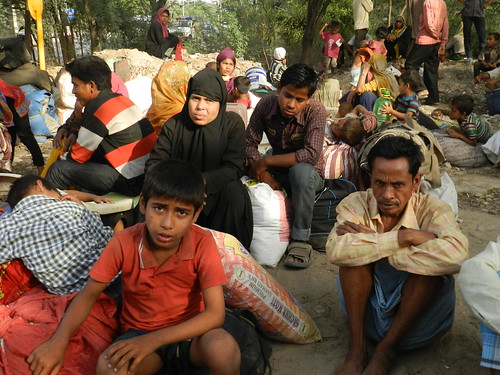
Naseeruddin, a young refugee, said “they (UN officers) are just holding meetings. They are not granting us refugee status.” Narrating the cruelty of the military regime in Myanmar he said: They had capture our property. They would use us as bonded labor. They took us to camps for hard labor and returned in the evening without money. When we reach home we found our women have faced their cruelty at home. In that situation we decided to leave our country.”
Dildar Begum says “not only Muslims, some other communities including Hindus have come to India, and they have been granted refugee status, but they are discriminating against us as we are Muslims.”
TCN told Naseeruddin that government is changing in Myanmar. Democracy is returning there. So he should think to return to his own country. He said: “Yes, we will go but only after the new government returns our property and all the communities who have migrated from Myanmar are ready to come back.”
Sucheta of JUN says humanitarian crisis is looming large here. “Last night when I came here I saw a woman refugee with a newborn baby was crying for help to reach hospital. I do not know whether her baby is alive or not. They have no access to water, leave alone medical facilities.” She demands the UN and Indian government that they should be given refugee status without any further delay.By Mumtaz Alam Falahi, TwoCircles.net,
Source here
New Delhi: Dildar Begum was around 13 when her parents with many others from their community and locality set out for India two years back as the cruelty of the military regime became unbearable. Miles and miles they walked on foot through the jungle on the India-Myanmar border to reach India. But two years later today, Begum, now 15, and several hundreds of the Muslim refugees of her country are still in jungle – now not on border, but in the national capital of Delhi.
The Delhi Police have kept them in a jungle area of Vasant Kunj locality on Mahipalpur Road in South-West Delhi. They have no access to water, food and toilet. There could a humanitarian crisis in a few days as the police are not allowing any relief to them.
Sucheta, Students Union president of Jawaharlal Nehru University, has been trying to provide them with some health aid. But the Delhi Police have denied them access to the refugees. “When I asked them to show the order, they just pushed us out of the Vasant Kunj Police Station,” Sucheta told TCN.
These Muslim refugees of Myanmar have been staying in different parts including Jammu & Kashmir of India for last several years. But a few months back they moved to Delhi collectively – they are around 3 thousand in number – to put pressure on the UN office that looks into the cases of refugees. They want official status of refugees. They have met UN officials but they are giving date after date. Next date of meeting is on 15th May
Naseeruddin, a young refugee, said “they (UN officers) are just holding meetings. They are not granting us refugee status.” Narrating the cruelty of the military regime in Myanmar he said: They had capture our property. They would use us as bonded labor. They took us to camps for hard labor and returned in the evening without money. When we reach home we found our women have faced their cruelty at home. In that situation we decided to leave our country.”
Dildar Begum says “not only Muslims, some other communities including Hindus have come to India, and they have been granted refugee status, but they are discriminating against us as we are Muslims.”
TCN told Naseeruddin that government is changing in Myanmar. Democracy is returning there. So he should think to return to his own country. He said: “Yes, we will go but only after the new government returns our property and all the communities who have migrated from Myanmar are ready to come back.”
Sucheta of JUN says humanitarian crisis is looming large here. “Last night when I came here I saw a woman refugee with a newborn baby was crying for help to reach hospital. I do not know whether her baby is alive or not. They have no access to water, leave alone medical facilities.” She demands the UN and Indian government that they should be given refugee status without any further delay.By Mumtaz Alam Falahi, TwoCircles.net,
Source here

Rohingya often destroy their boats to avoid being ‘pushed back’ out to sea. This boat, transporting 95 Rohingya, broke up before landing at Nai Harn Beach in February. Photo: Mark Dee

Maj Gen Manas Khongpanin, director of ISOC Region 4, said the goal when dealing with Rohingya boat people is to provide humane assistance, not sanctuary. Photo: Phuket Gazette file.
PHUKET: Region 4 of the Internal Security Operations Command (ISOC) has formulated a “Protecting the Andaman” strategy to prevent Rohingya boat people from illegally entering Thailand in Ranong, Phuket and other Andaman Coastal provinces.
Maj Gen Manas Khongpanin, director of the ISOC region, revealed that the security plan is to stop the Rohingya from entering Thailand, especially along the coastline of Ranong province.
ISOC region 4, together with at least 17 other government and private sector organizations in Ranong, collaborated on the plan.
The strategy is aimed at preventing the stateless Rohingya people from entering Thai territory, and helping those who are able to enter to get back into international waters in a humane way.
"This has been happening for more than 10 years. Since November last year, 2,522 Rohingya illegally entered Thailand, arriving in Ranong by boat,” he said.
"Rohingya always sneak into our country by sea along the Andaman coast. The first time was in 1998, when we caught 104 Rohingya who illegally crossed our border. After that there were a lot more Rohingya arriving every year, especially from November to April,” said Gen Manas.
November to April typically sees a weakening of the monsoon over the Andaman Sea, making sea conditions calmer offshore – although heavy seas are a possibility year-round due to storm activity.
"The Rohingya usually travel by old fishing boats from Rakhine State, on the western coast of Myanmar, or the southern part of Bangladesh. It is a journey of about 780 miles to reach the Thai border, and typically takes them about 15 days,” he said.
"In 2006, a reported 1,225 Rohingya entered our country. In 2007, the figure more than doubled to 2,763. In 2008 it reached a high of 4,886 people. In 2009, the number fell to 1,477 people, then dropped again in 2010 to just 93," he said.
"Last year 351 Rohingya arrived on our shores,” he added.
"I believe there will be more Rohingya coming this year. They are trying the find safe places to land, especially in Ranong and nearby provinces. Their main motive for leaving their country is the poverty and difficulty of life there. The Rohingya people are not considered citizens of Myanmar,” he noted.
In recent years the Rohingya had improved their tactics, making them more difficult to track, he said.
"Before, Rohingya typically came in large groups, choosing the mainland as their initial landing point. Now they have changed their tactics. They travel in smaller groups and land on islands first, then plan the trip to the mainland from there,” said Gen Manas.
"Normally they are assisted by human smugglers in Thailand, so we have to try to intercept them both at sea and on land,” he added.
Thailand's National Security Council tasked ISOC, a military unit dedicated to national security issues, with the difficult job of developing an integrated and humane solution to the Rohingya problem.
"We call our two-part plan ‘Protecting the Andaman’. The first part involves educating government officers likely to be involved on how to react when they encounter people who illegally enter Thailand by sea. In this way they can apply that knowledge as events are happening,” said Gen Manas.
The effort also involves preparedness by the public-at-large, he said.
"We will educate people in areas where Rohingya are known to land, asking for their help in the monitoring effort. If they see Rohingya approaching, they will know to report directly to us. We have already trained 400 people living in coastal areas and the islands off the Ranong mainland,” he said.
"We will also coordinate with fishing vessels working further out to sea to receive early warning of Rohingya as they approach our territorial waters. We plan to install radios on every island so islanders can inform us if they see any Rohingya approaching,” he said.
The second part of the plan is the reaction effort. Those who have been trained can be deployed to use "appropriate means" to stop Rohingya from entering Thailand.
"Locations where we expect to intercept Rohingya are Takrut Island, Sinhai Island, Chang Island, Phayam Island and Kangkow Island,” he said.
"Any of the trainees who see Rohingya attempting to land must first try to persuade them not to come ashore. They must provide them with enough food, water, medication, fuel, and other necessary supplies so that they may continue their journey for another 15-20 days to their desired destination,” he said.
In 2009, Thailand faced harsh international criticism when authorities arrested Rohingya refugees and sent them back out to sea with limited provisions. In February of that year the Lawyers' Council of Thailand (LCT) released a statement demanding the government “tackle Rohingya trafficking organizations”.
The statement followed a series of conflicting reports of transfers and possible human rights abuses by the Thai authorities on a group of 226 Rohingya migrants.
In February 2011, following appeals from the international community and local organizations, the United Nations High Commission on Refugees (UNHCR) visited 33 Rohingya men in custody at Phuket Immigration who had come ashore at Rawai the previous month. The UN team then went to Phang Nga to check on the well-being of another group held there.
Efforts to "repatriate" migrants is always difficult, but even more so when they are stateless. Burmese caught working illegally in Thailand are typically repatriated at Kawthaung, across the strait west of Ranong Town.
This is not an option for the stateless Rohingya.
On November 24, 2011, when a boat full of Rohingya were detained on an island off the Phang Nga coast, all 95 were transported to the 2nd Infantry Battalion, 25th Military unit, at Rattanarangson Camp in the Ratchakud District of Ranong province.
On that occasion, the Gazette, which has been monitoring and reporting on Rohingya developments closely for many years, was informed by an official from the camp that the Rohingya had been provided with a new boat, engine, fuel and enough food and water to take them on to their unspecified destination. Military personnel even went so far as to give the Rohingya 20 baht each from their own pockets before escorting them back out to international waters, the official said.
In one of the latest incident reported by the Gazette, Chalong Police rounded up 90 starving Rohingya who came ashore at Nai Harn Beach. The Rohingya, all males, were on their way to Malaysia when they ran out of food and their wooden boat began to fall apart at sea, forcing them to come ashore, they said.
However, not all of the refugees were accounted for. One member of the group said that more than 100 Rohingya were aboard when the vessel beached.
Despite media reports that Muslim Rohingya invariably try to make it to Malaysia, there is a small Rohingya community living in Phuket, the head of the Police Special Branch told the Gazette several years ago.
Many make a living selling roti, the Indian-style crepe popular across the South of Thailand.
Source here
The UNHCR Senior Protection Unit
Dhaka , Bangladesh
Date : 18/2/2012
Subject: An appeal for emergency equity and legal step against illegal hand
Persons Responsible:
1. Dr Jakarea (Jiko)
2. Dr Shahidduzzaman Chawdary
3.Nurse Rukiya
4. Nurse Shinku
5. Nurse Salena 6. Shajan
Dear Sir/Madam,
With humble and due respects to state that we, the general Rohingya refugee under UN Refugee Agency, would like to apprise the sorrow that befell on Nur Begum, wife of Hamid Hossain, MRC no. 80026, shed no. 43/E when she visited doctor for treatment on Feburary 18, 2012 at 12:30 pm.
The above mentioned Dr. Jakarea (Jiko) has beaten her inhumanly instead of providing medical treatment. Due to the abuse, she has been referred to Coxs Bazar Hospital for the emergency treatment. It is sadly to state that the doctors and nurses in the camps
always misconduct the codes of medicine and negelect their responsibilities treating Rohingya patients.
This is a case of violation of professionalism in medical field, as well as violation of human rights and abusing of weaker women by male and/or female healthcare providers.
Therefore, we are humbly requesting your office to look at the matter quickly and take necessary steps against the mentioned healthworkers.
Yours faithfully;
Rohingya Refugees, Kutupalong Camp
 |
| An MSF doctor examines a baby at the MSF project in Kutupalong makeshift camp. Bangladesh 2010 © Giulio Di Sturco/VII Mento |
The Rohingya are one of the most persecuted minorities in Burma. Forced labor, extortion, restrictions on movement, forced deportation, and rape (pdf) by Burmese authorities have all been documented by human rights groups.
Many Rohingya have fled the atrocities in Burma for neighboring Bangladesh. However, the situation there is nearly as bad. According to the UN High Commissioner for Refugees, only 28,000 out of some 400,000 Rohingyas are officially recognized by the Bangladeshi authorities as refugees.
The undocumented Rohingya live in squalor, are regularly harassed by the local police, and are not able to access international humanitarian aid. PHR’s March 2010 emergency report, Stateless and Starving: Persecuted Rohingya Flee Burma and Starve in Bangladesh, found atrocious water and sanitation conditions, severe food insecurity, and multiple human rights violations, including arbitrary arrest and forced expulsion by Bangladeshi authorities.
Little progress has been made on a political solution to this problem. In a December 2011 meeting between Burmese President Thein Sein and Bangladeshi Prime Minister Sheikh Hasina, Thein Sein said Burma would allow documented Rohingya refugees from Bangladesh safely back into Burma. But since the vast majority of Rohingya in Bangladesh are not documented, it is unlikely that they will be allowed to return. Agreements like this serve to improve Burma’s image in the international community, but in fact do nothing to alleviate the suffering of hundreds of thousands of Rohingya.
If the Burmese government is truly serious about building lasting peace, it should immediately change the way it treats Rohingya. PHR strongly urges the Burmese government to end forced expulsions of Rohingya individuals, and to recognize the rights of all Rohingya, documented and otherwise.
PHR calls on the Bangladeshi government to cease arbitrary arrests of Rohingya and to allow aid organizations to help all Rohingya refugees. The human rights violations that have happened for decades against Rohingya are far too serious to be ignored by Burma’s reforms.
Bill Davis is the Director of the Burma Project at PHR.
Source here
By Chutima Sidasathian and Nussara Lem
PHUKET: A boat containing 85 Rohingya men and boys was apprehended yesterday off the Thai province of Satun, south of Phuket.
 The would-be refugees, heading for Malaysia, were taken into custody by local police at La Ngu after being spotted by National Park rangers near Lidee Island.
It's believed their 12-metre vessel ran out of petrol and the sailors, all male, told villagers that they had been without food for four days.
According to officials who confirmed the capture of the men to Phuketwan, the would-be refugees were given food and drink by locals and will be handed over to Thai Immigration officials tomorrow.
The men said they had set off from Ranong, a port on the Thai-Burma border, and were aiming for Malaysia, with the blessing of local Thai officials.
A television camera captured the boat arriving in Satun and the footage has been posted at:
Boat arriving at Thailand
Despite the signs of a more open and free approach by the Government in Burma, the Muslim-minority Rohingya remain non-citizens, without the rights accorded to other residents.
Restrictions on movement and marriage inside Burma mean many Rohingya men and boys put to sea in ricketty boats in an attempt to begin a new life elsewhere.
A crackdown by authorities in northern Burma and neighboring Bangladesh, where many Rohingya have fled to become unwelcome refugees, briefly interrupted the flow of boats south. More boats have been sailing recently.
One vessel, apprehended in Phang Nga, north of Phuket, on January 28 contained 79 men, including at least one Thai who appears to have been the person who provided the boat. in Bangladesh.
That arrival and another arrival of 54 men on December 4 at Takuapa, the Phang Nga district capital on the Andaman coast, were also filmed. Another boatload of 54 Rohingya is reported to have landed in the Indonesian province of Aceh on February 1.
Although the Thai military continues to be involved in the covert detention of the men who land in Thailand, non-government organisations are confident that they are no longer being mistreated.
The policy of Thai Navy patrols which intercept Rohingya vessels at sea is to ''help on'' boats to Muslim-majority Malaysia, their preferred destination, with food, water and repairs if required.
It's a change from January 2009, when Phuketwan and the Hong Kong-based South China Morning Post newspaper revealed that hundreds of Rohingya were being ''pushed back'' in a secret operation from an island in Thailand.
Scores are thought to have perished at sea before survivors reached Indonesia and the Andaman and Nicobar islands, which belong to India.
The change in approach by the Thai authorities means that some of the men have been directed to an island off southern Thailand, where people-traffickers have picked them up for transfer to Malaysia.
It is believed that those who are taken back to the Thai-Burma border by the Thai Army are also quickly returned to brokers.
The policy of the Burmese navy is the same as that of the Thai navy, although the ''help on'' policy in Burma sometimes comes with beatings, boatpeople report.
The boats usually come ashore in Thailand of necessity when the Rohingya run out of food and water or experience mechanical problems.
Often, navigating by sight, the men have no idea whether they are off Thailand or have reached Malaysia.
In recent years there have been many landings north and south of Phuket, including one on southern Phuket in January last year.
Of concern to NGOs lately have been three capsize incidents involving four boats. Many men were picked up by local fishermen off the Bangladesh coast but it's believed as many as 200 may have drowned.
The annual ''sailing season'' for Rohingya begins each November and does not end until the monsoon arrives, usually in April, when putting to sea in the kind of boats they pay brokers to use becomes even more dangerous.
Source here
Inspired by The Body Shop founder Anita Roddick, a British woman is bringing hope to the forgotten Rohingya (Burmese Muslim) children filling refugee camps in Bangladesh.
Rachel Bentley flicks through some photographs on her laptop, stopping at one of a young woman with careworn features.
"We met her on the second day. Her husband had been badly beaten by the military as they were forced back across the border. She'd lost her week-old baby."
She then brings up another shot, this time of a sprawling, makeshift camp spreading over a lumpy landscape of mud and stunted trees.
"That's an unofficial refugee camp in Cox's Bazar district, in southern Bangladesh. Home to the Rohingya, Burmese Muslims who can neither marry, nor lead safe lives, inside Burma. They flee to Bangladesh, where they face an equally uncertain future."
 |
| Charity Children on the Edge helps thousands of marginalised children across the world. Photo: Children on the Edge |
 |
Bentley is currently focused on helping Rohingya (Burmese Muslim) refugee children in camps on the Bangladesh-Burma border |
"We met her on the second day. Her husband had been badly beaten by the military as they were forced back across the border. She'd lost her week-old baby."
She then brings up another shot, this time of a sprawling, makeshift camp spreading over a lumpy landscape of mud and stunted trees.
"That's an unofficial refugee camp in Cox's Bazar district, in southern Bangladesh. Home to the Rohingya, Burmese Muslims who can neither marry, nor lead safe lives, inside Burma. They flee to Bangladesh, where they face an equally uncertain future."
Bentley, 42, director of a ground-breaking international charity called Children on the Edge, looks over the sea of shacks and children's faces, then sighs.
"Since October 2009, the camp has grown by 6,000 people, with 2,000 of these arriving in January 2010 alone. It's grown by a quarter in just those few months, to around 30,000 people."
"Now the government are threatening to expel them all again and malnutrition and starvation are stalking the population," she adds. "They're trying to eke out a living as best they can and give the children what little schooling they can afford. But for how long? They don't belong … neither in Burma or in Bangladesh. It's a tragedy that few in the world know."
A life-changing trip
It was 1990, just a few months after the Berlin Wall had tumbled and Eastern Europe's most feared dictator, Nicolae Ceausescu of Romania, had been executed – much to the delight of his people.
For one young The Body Shop volunteer, it was also the start of a journey that would change her life and that of thousands of the world's most vulnerable children today.
"Everything was changing. For the first time we were seeing these awful images of orphaned children, abandoned, hungry and helpless, held in terrible conditions inside state institutions."
Rachel Bentley was a 22-year-old law graduate when she joined The Body Shop founder Anita Roddick and a small group of volunteers on a life-changing aid trip to Romania.
"The Body Shop had never done anything like this before," she says. "It was Anita's vision to put together a team, gathering whatever we could, to go and help refurbish the orphanages."
She adds: "We slept on the floor of a clinic in rural Romania; myself, a friend, and Anita and her two daughters. Anita was very motherly," Bentley smiles. "She would go down to the market every morning and just cook up this wonderful Italian food for us and the kids."
Roddick died of a brain haemorrhage in 2007, but Rachel Bentley has taken up her mantle. Children on the Edge, the children's rights charity which Bentley shaped and now heads, was born out of that first, desperate Romanian trip.
Still with strong The Body Shop links (both have their headquarters on England's Sussex coastline), it has gone on to help marginalised and vulnerable children across Eastern Europe as well as Asia: helping ravaged Indonesian communities cope after the Boxing Day Tsunami, building schools for the blind in Bosnia, and developing "child friendly spaces" (special community centres) in war-torn East Timor.
Without Children on the Edge's help, many of these youngsters or their families would never gain access to an education, a safe place to play or a chance to recuperate from trauma. In fact little stops the organisation which has earned a nickname in the aid fraternity as the "Médicins Sans Frontières of the education world".
"Ultimately it comes down to our name: Children on the Edge," says Bentley, speaking softly from her tidy office nestled above a bright-pink bakery in the picturesque city of Chichester. "We can go in, under the radar in many cases and help extremely marginalised children."
There are now dozens of former Romanian orphans, successful young men and women, who have her to thank for their education and livelihoods.
"For me, that's the reward," Bentley replies modestly.
Born near Birmingham, England, Bentley moved with her family to the island of Fiji when she was just two years old. She then spent the next 10 years of her life on the island whilst her father worked as an engineer for an international development agency. "I grew up running around barefoot," she smiles. "I was really at ease with different cultures from a very young age."
At nine she went to an international school, then the family returned to Britain two years later when she was 11. It must have been something of a shock to the girl running barefoot on beaches and mingling in the Pacific sun with all races of the Earth.
"It was quite a shock coming back!" Bentley agrees with an infectious giggle. "We came back in the middle of winter. I was horrified to suddenly have to put on this jumper and blazer. I remember being teased about my 'Australian' accent. It was all a bit alien. I now also know all the flora and fauna of these exotic plants where I grew up, but I'm not so great on the native British species!"
But instead of a quiet life in the beautiful Sussex countryside, it was to Burma, one of the world's most repressive military regimes, that Bentley became drawn.
Vulnerable children
Burma is ruled by one of the most brutal military dictatorships in the world, headed by General Than Shwe. The military junta, called the State Peace & Development Council (SPDC), refuse to hand power to the democratically elected National League for Democracy (NLD) led by Nobel Peace Prize winner Aung San Suu Kyi. Tens of thousands have been killed, imprisoned, tortured or forced into slavery by the brutal regime. Hundreds of thousands have fled to neighbouring Thailand, India, and Bangladesh as well as nearby Malaysia and the Gulf and Arabian states.
Bentley says that she went to the border area between Burma and Thailand [where over 100,000 Burmese have settled] in 2006, to simply meet as many groups as she could.
"You get introduced to one, then another. Often they're women's groups, but not always," she says. "It's eastern and western Burma where all the troubles are going on," she goes on to explain. "So it's people groups from western Burma living in exile who set up their own organisations helping their own people within the neighbouring countries like India and Thailand, but also organising cross-border support for their people back in Burma."
"Everywhere I travel I meet vulnerable children," continues the Sussex woman, with a sad smile. "Those who've lost out to war, famine, natural disaster … In Burma, there are thousands upon thousands of them in state institutions. We wanted to operate inside the country, to help those children, but our hands were tied by the dictatorship there. There would be no way we could operate effectively there with the military government."
Her kind-looking eyes flash with anger. "Did you know that the Burmese military has destroyed twice as many villages as in Darfur? Over 100 different minorities are threatened inside Burma – they face forced labour, rape, torture and some can't even legally marry."
"Once they [the refugees] get to places like Bangladesh or other nearby countries, they're regarded as illegal immigrants, unable to work, treated as slave labour, threatened with detention or, like the women we met, often violently expelled."
"And of course it's the children who suffer the most. There's really no life... no life at all," Bentley repeats, with a shake of her head.
Then the flicker of a smile returns as she remembers the children of the unofficial refugee camp in Bangladesh rushing out to meet her last year.
"They are Rohingya," she explains, pointing to the images on her laptop screen. "Burmese Muslims. One of the world's last great stateless nations."
Bentley is one of few western women to visit the Rohingya. Having spent the past three years travelling to Burma's neighbours – supporting basic "apartment schools" run by Chin [Burmese Christian refugees] in Malaysia and refugee schools for the Karen [also a Christian Burmese minority] in Thailand, even risking life and limb to go inside Burma where Children on the Edge brings education materials and provides teachers' stipends to minority groups running several children's nurseries – she was asked by the Rohingya to come and see their lives alongside the heavily-militarised Bangladesh-Burma border.
The conditions in the camps are some of the worst she has ever seen.
"It's become very bad. Squalid. When I spoke to the children and the mothers, I could see the fear in their eyes – they used to live alongside the Bangladeshis in their villages. Now they're being forced to move to these camps and live in terror of being sent back [to Burma]."
Most people have never heard of the Rohingya, she says. Last year boatloads of these refugees were intercepted at sea by the Thai army. After days in outdoor detention they were towed back out, then abandoned with no food or water and no motors to power their boats. Over 500 men, women and children died.
"It was shocking … disgraceful," says Bentley.
Alongside Children on the Edge, several international aid organisations and human rights groups are warning of starvation and beatings facing the Rohingya refugees living in Bangladesh.
Conditions in the camp are indeed tough. According to The New York Times, the dirt paths, flimsy shacks and open sewers have grown by 6,000 people to nearly 30,000, with 2,000 arrivals in January alone.
Denied the ability to work or receive aid in Bangladesh, the population has grown as Rohingya seek refuge from a wave of violence that has forced them out of their long-established homes in other Bangladeshi towns and villages.
Researchers from the Arakan Project, a human-rights group documenting the plight of the Rohingya, claimed children from the surrounding makeshift camp were begging for food from the refugees in the one "official" (government-sanctioned) settlement.
MSF reported that: "People are crowding into a crammed and unsanitary patch of ground with no infrastructure to support them. Prevented from working to support themselves, neither are they permitted food aid. As the numbers swell and resources become increasingly scarce, we are extremely concerned about the deepening crisis."
And in an emergency report released in March, "Stateless and Starving: Persecuted Rohingya Flee Burma and Starve in Bangladesh", a doctors' organisation called Physicians for Human Rights (PHR) also argued that there were critical levels of malnutrition and a surging refugee population in Kutupalong, one of the "unofficial" camps, without access to food aid.
"In recent months Bangladeshi authorities have waged an unprecedented campaign of arbitrary arrest, illegal expulsion, and forced internment against Burmese refugees," said the report. Deaths from starvation and disease were likely if the "humanitarian crisis" is not addressed.
PHR researchers observed children with severe protein malnutrition and those with swollen limbs and often distended abdomens. One out of five children with acute malnutrition, if not treated, would die, concluded the medical teams.
A European Union delegation fact-finding in Bangladesh earlier this year issued a resolution in the European Parliament on February 11 calling on the government in Dhaka to recognise the unregistered Rohingya as refugees and to extend humanitarian support.
"Since October 2009, the camp has grown by 6,000 people, with 2,000 of these arriving in January 2010 alone. It's grown by a quarter in just those few months, to around 30,000 people."
"Now the government are threatening to expel them all again and malnutrition and starvation are stalking the population," she adds. "They're trying to eke out a living as best they can and give the children what little schooling they can afford. But for how long? They don't belong … neither in Burma or in Bangladesh. It's a tragedy that few in the world know."
A life-changing trip
It was 1990, just a few months after the Berlin Wall had tumbled and Eastern Europe's most feared dictator, Nicolae Ceausescu of Romania, had been executed – much to the delight of his people.
For one young The Body Shop volunteer, it was also the start of a journey that would change her life and that of thousands of the world's most vulnerable children today.
"Everything was changing. For the first time we were seeing these awful images of orphaned children, abandoned, hungry and helpless, held in terrible conditions inside state institutions."
Rachel Bentley was a 22-year-old law graduate when she joined The Body Shop founder Anita Roddick and a small group of volunteers on a life-changing aid trip to Romania.
"The Body Shop had never done anything like this before," she says. "It was Anita's vision to put together a team, gathering whatever we could, to go and help refurbish the orphanages."
She adds: "We slept on the floor of a clinic in rural Romania; myself, a friend, and Anita and her two daughters. Anita was very motherly," Bentley smiles. "She would go down to the market every morning and just cook up this wonderful Italian food for us and the kids."
Roddick died of a brain haemorrhage in 2007, but Rachel Bentley has taken up her mantle. Children on the Edge, the children's rights charity which Bentley shaped and now heads, was born out of that first, desperate Romanian trip.
Still with strong The Body Shop links (both have their headquarters on England's Sussex coastline), it has gone on to help marginalised and vulnerable children across Eastern Europe as well as Asia: helping ravaged Indonesian communities cope after the Boxing Day Tsunami, building schools for the blind in Bosnia, and developing "child friendly spaces" (special community centres) in war-torn East Timor.
Without Children on the Edge's help, many of these youngsters or their families would never gain access to an education, a safe place to play or a chance to recuperate from trauma. In fact little stops the organisation which has earned a nickname in the aid fraternity as the "Médicins Sans Frontières of the education world".
"Ultimately it comes down to our name: Children on the Edge," says Bentley, speaking softly from her tidy office nestled above a bright-pink bakery in the picturesque city of Chichester. "We can go in, under the radar in many cases and help extremely marginalised children."
There are now dozens of former Romanian orphans, successful young men and women, who have her to thank for their education and livelihoods.
"For me, that's the reward," Bentley replies modestly.
Born near Birmingham, England, Bentley moved with her family to the island of Fiji when she was just two years old. She then spent the next 10 years of her life on the island whilst her father worked as an engineer for an international development agency. "I grew up running around barefoot," she smiles. "I was really at ease with different cultures from a very young age."
At nine she went to an international school, then the family returned to Britain two years later when she was 11. It must have been something of a shock to the girl running barefoot on beaches and mingling in the Pacific sun with all races of the Earth.
"It was quite a shock coming back!" Bentley agrees with an infectious giggle. "We came back in the middle of winter. I was horrified to suddenly have to put on this jumper and blazer. I remember being teased about my 'Australian' accent. It was all a bit alien. I now also know all the flora and fauna of these exotic plants where I grew up, but I'm not so great on the native British species!"
But instead of a quiet life in the beautiful Sussex countryside, it was to Burma, one of the world's most repressive military regimes, that Bentley became drawn.
Vulnerable children
Burma is ruled by one of the most brutal military dictatorships in the world, headed by General Than Shwe. The military junta, called the State Peace & Development Council (SPDC), refuse to hand power to the democratically elected National League for Democracy (NLD) led by Nobel Peace Prize winner Aung San Suu Kyi. Tens of thousands have been killed, imprisoned, tortured or forced into slavery by the brutal regime. Hundreds of thousands have fled to neighbouring Thailand, India, and Bangladesh as well as nearby Malaysia and the Gulf and Arabian states.
Bentley says that she went to the border area between Burma and Thailand [where over 100,000 Burmese have settled] in 2006, to simply meet as many groups as she could.
"You get introduced to one, then another. Often they're women's groups, but not always," she says. "It's eastern and western Burma where all the troubles are going on," she goes on to explain. "So it's people groups from western Burma living in exile who set up their own organisations helping their own people within the neighbouring countries like India and Thailand, but also organising cross-border support for their people back in Burma."
"Everywhere I travel I meet vulnerable children," continues the Sussex woman, with a sad smile. "Those who've lost out to war, famine, natural disaster … In Burma, there are thousands upon thousands of them in state institutions. We wanted to operate inside the country, to help those children, but our hands were tied by the dictatorship there. There would be no way we could operate effectively there with the military government."
Her kind-looking eyes flash with anger. "Did you know that the Burmese military has destroyed twice as many villages as in Darfur? Over 100 different minorities are threatened inside Burma – they face forced labour, rape, torture and some can't even legally marry."
"Once they [the refugees] get to places like Bangladesh or other nearby countries, they're regarded as illegal immigrants, unable to work, treated as slave labour, threatened with detention or, like the women we met, often violently expelled."
"And of course it's the children who suffer the most. There's really no life... no life at all," Bentley repeats, with a shake of her head.
Then the flicker of a smile returns as she remembers the children of the unofficial refugee camp in Bangladesh rushing out to meet her last year.
"They are Rohingya," she explains, pointing to the images on her laptop screen. "Burmese Muslims. One of the world's last great stateless nations."
Bentley is one of few western women to visit the Rohingya. Having spent the past three years travelling to Burma's neighbours – supporting basic "apartment schools" run by Chin [Burmese Christian refugees] in Malaysia and refugee schools for the Karen [also a Christian Burmese minority] in Thailand, even risking life and limb to go inside Burma where Children on the Edge brings education materials and provides teachers' stipends to minority groups running several children's nurseries – she was asked by the Rohingya to come and see their lives alongside the heavily-militarised Bangladesh-Burma border.
The conditions in the camps are some of the worst she has ever seen.
"It's become very bad. Squalid. When I spoke to the children and the mothers, I could see the fear in their eyes – they used to live alongside the Bangladeshis in their villages. Now they're being forced to move to these camps and live in terror of being sent back [to Burma]."
Most people have never heard of the Rohingya, she says. Last year boatloads of these refugees were intercepted at sea by the Thai army. After days in outdoor detention they were towed back out, then abandoned with no food or water and no motors to power their boats. Over 500 men, women and children died.
"It was shocking … disgraceful," says Bentley.
Alongside Children on the Edge, several international aid organisations and human rights groups are warning of starvation and beatings facing the Rohingya refugees living in Bangladesh.
Conditions in the camp are indeed tough. According to The New York Times, the dirt paths, flimsy shacks and open sewers have grown by 6,000 people to nearly 30,000, with 2,000 arrivals in January alone.
Denied the ability to work or receive aid in Bangladesh, the population has grown as Rohingya seek refuge from a wave of violence that has forced them out of their long-established homes in other Bangladeshi towns and villages.
Researchers from the Arakan Project, a human-rights group documenting the plight of the Rohingya, claimed children from the surrounding makeshift camp were begging for food from the refugees in the one "official" (government-sanctioned) settlement.
MSF reported that: "People are crowding into a crammed and unsanitary patch of ground with no infrastructure to support them. Prevented from working to support themselves, neither are they permitted food aid. As the numbers swell and resources become increasingly scarce, we are extremely concerned about the deepening crisis."
And in an emergency report released in March, "Stateless and Starving: Persecuted Rohingya Flee Burma and Starve in Bangladesh", a doctors' organisation called Physicians for Human Rights (PHR) also argued that there were critical levels of malnutrition and a surging refugee population in Kutupalong, one of the "unofficial" camps, without access to food aid.
"In recent months Bangladeshi authorities have waged an unprecedented campaign of arbitrary arrest, illegal expulsion, and forced internment against Burmese refugees," said the report. Deaths from starvation and disease were likely if the "humanitarian crisis" is not addressed.
PHR researchers observed children with severe protein malnutrition and those with swollen limbs and often distended abdomens. One out of five children with acute malnutrition, if not treated, would die, concluded the medical teams.
A European Union delegation fact-finding in Bangladesh earlier this year issued a resolution in the European Parliament on February 11 calling on the government in Dhaka to recognise the unregistered Rohingya as refugees and to extend humanitarian support.
Source Here
-
 "Although mass killings and exterminations of human races were some sort of things that the world experienced during Nazi German p...
 -
 More than 400,000 Rohingya have fled from Myanmar to neighbouring Bangladesh By BBC News September 17, 2017 Myanmar's de ...
 -
 ပါလီမန္အမတ္ဦးေရႊေမာင္ၿပည္သူ႔လြတ္ေတာ္တြင္ရခိုင္ၿပည္နယ္၌ၿဖစ္ပြါးခဲ့ေသာအေရးအခင္းနဲ့ ပတ္သက္၍ေဆြးေနြးတင္ၿပၿခင္း။ (14th day of regular ses...
 -
 RB News March 31, 2018 Minbya, Arakan State : On March 30 morning, a Prayer Leader or Imam was brutally beaten and injured by a Rakh...
 -
 Read letter here Read history of Rohingya here Download letter PDF here Download History of Rohingya PDF here credi...
 -
 ဇြန္လ ၁၇ ရက္ ၊ ၂၀၁၂ Source: guardian.co.uk ျမန္မာျပည္သစ္အတြက္ အနာဂတ္မွာ ေအာင္ျမင္မွာလား၊ က်ရွဳံးမွာလားဆိုသည္ကို ညႊန္ျပေသာ စမ္းသပ္မွဳ တစ...
 -
 At Baggona, a village three miles far from and lies to the South of Maung Daw of Arakan state, more than 80 Rohingya women and girls have be...
 -
 RB News May 17, 2013 Maung Daw, Arakan - After the warnings on Mahasen cyclone had been issued, the displaced Rohingyas from the ...
 -
 12/07/2012 Joint press release HUMANITY GONE ...
 -
 The custodian of Two Holy Mosques King Abdullah bin Abdul Aziz Al Saud Aug 11 The custodian of Two Holy M...

Popular Posts
Threatwiki

Amartya Sen: Burma's "slow genocide" of Rohingyas

Watch Professor Amartya Sen speak on what he calls Burma's 'slow genocide' of Rohingya, Harvard, 4 Nov 2014
