
RB News
September 12, 2013
Maungdaw, Arakan – According to locals, about 10 police officers robbed a Rohingya house Ngan Chaung village on the night of September 9th. The robbery was committed by the police, however the authorities arrested 5 Rohingya brothers for the crime. One brother was killed by police while in custody.
A large group of officers and other authorities went to Bura Shiddar Para and questioned the U Shin Gya village administrator and 5 Rohingya brothers. The authorities included:
The Maungdaw district police chief, The township police chief, Hlun Htaine battalion (2) commandant, Lt. Police Colonel of Areas 4, 5, and 6, The military commandant, Kyain Chaung police force, Kyain Chaing Special Branch police, Military Special Security (SaRaPha), Nga Ku Ra village administrator Zaw Win Aung, Chan Pyin village administrator Pho Chay, Ba Chit from Myo Thit village.
The names and ages of the five brothers are:
(1) Mohammed Amin (25-years-old),
(2) Shaw Muluk (32-years-old),
(3) Nur Hashim (30-years-old)
(4) Mohammed Hashim (28-years-old)
(5) Mohammed Salim (18-years-old).
As the five brothers were innocent, the military commandant released them after questioning. However, Nga Ku Ra and Chan Pyin villages administrators and Ba Chit from Myo Thit village wasn't satisfied with the decision of military commandant. They asked the others to arrest them. Finally the five brothers were arrested and brought to Kyain Chaung police outpost. They were pressured to admit that they robbed the house of Akbar in Ngan Chaung village. As the police tortured them one, Mohammed Amin died inside the lock-up. Time of death was 1 am on that day. Instantly the police sent the corpse to Maungdaw hospital.
The village administrator U Shin Gya was on his way to Maungdaw to see the township administrator while the police was sending the corpse to the hospital. U Shin Gya administrator got the news and went to see the corpse there. He asked the township administrator to handover the corpse to the family. After that the township administrator asked the district police chief to handover the corpse. The district police chief flatly denied giving up the corpse to the family.
The person who was tortured to death by police, Mohammed Amin is a rich businessman in U Shin Gya village. Moreover, he has been helping the authorities in the region for long time. A villager said Nga Ku Ra village administrator Zaw Win Aung, Chan Pyin village administrator Pho Chay and Ba Chit from Myo Thit hated him for having money. That’s the reason they went through the trouble to create a conspiracy against him.
Reportedly, Zaw Win Aung, Pho Chay and Ba Chit were instigators of 2012 June violence in Maungdaw and they are also somehow connecting to Rakhine rebels based in Bangladesh-Myanmar border. And they always are causing trouble for Rohingyas by collaborating with the local police.
At the end, the police chief didn’t return the corpse to the family. Today they buried him at the cemetery in Quarter 2 of Nga Ku Ra village tract. The police planned to avoid Islamic funeral prayer before the burial. However the relatives of dead person Mohammed Amin were watching from outside of the cemetery and they begged the police not to bury without prayer. The police eventually brought a religious cleric in and allowed the funeral prayer to happen. The police did not however, allow any family members to enter the cemetery. The family members could see only from outside as their loved one was laid to rest.

 |
| People at an Internet café in Rangoon in 2012. (Photo: The Irrawaddy) |
By Chen Shaua Fui
September 12, 2013
RANGOON — At a street corner in Rangoon’s Kamayut Township, a young man does what would have been odd in his country just three or four years ago—he lowers his head, fixes his eyes on his smartphone, swipes the screen and smiles.
He is probably in his 20s, dressed casually in a black striped shirt and dark jeans, which makes him stand out in the crowd of people wearing traditional longyis. Still, with the phone in hand, he is not uncommon among the Burmese of his generation, especially those on the streets of downtown Rangoon these days.
More and more young Burmese are joining their smartphone-toting peers elsewhere in the world, as their country transitions from nearly five decades of strict military rule.
The opening of telecommunications services in Burma has presented opportunities to connect to the global village. There is a strong hope that access to information can help the democratization process, especially during this transition period.
However, the online platform has also been used by some groups who, many fear, are trying to set malicious agendas by posting insensitive hate speech or remarks.
Recent outbreaks of sectarian violence between majority Buddhists and minority Muslims in the country—and between the majority Burman ethnicity and other minority ethnic groups—have driven some online users to take sides, resulting in inflammatory statements.
Some political observers, drawing lessons from history, suspect that religious clashes have happened when those in power feel threatened or challenged. This was common during the British colonial era. The view now is that the old dogs of the former military regime may want to further divide the fragmented country, while the pro-democracy movement is trying to hold it together.
Facebook, the most popular social media site in Burma, is becoming a new political battleground for the ruling Union Solidarity and Development Party (USDP) and the biggest opposition party, the National League for Democracy (NLD), which are both gearing up for the 2015 elections.
It is estimated that about 1 percent of Burma’s population of nearly 60 million are Facebook users, according to Nay Phone Latt, executive director of Myanmar ICT for Development Organisation (MIDO). It can be easier to contact a friend through Facebook than email, as many people in the country are able to access the social media side with their smartphones.
For Ye Naing Moe, director of Yangon Journalism School, although Internet penetration is just 1 percent of the population, those who have access to the Internet are influential. Online activities are increasing among the ruling elites, media practitioners, military officers and educated monks—people who can change the political and social landscape.
“Online people are influential people. They are able to shape the society. In small towns only a few people can go online, those who can serve as the eyes and ears of their communities,” Ye Naing Moe said.
Among the country’s big-name Facebook users is President Thein Sein, who actively communicates with the populace through his Facebook page, which features photos of his official events and statements. He has 11,800 followers.
Another USDP leader, Deputy Minister of Information Ye Htut, has 47,000 Facebook followers. Opposition icon Aung San Suu Kyi’s party, the National League for Democracy (NLD), has 221,000 followers on its official Facebook page.
According to statistics from various sources released last year, 29 percent of global Facebook users are mainly young people in the 25 to 34 age bracket, while 50 percent of users between the ages of 18 and 24 check Facebook when they wake up in the morning. Burma’s statistics are unavailable, but Internet usage is coming on strong in the country.
Thinzar Shunlei Yi, 21, is among those riding this wave following the opening up of telecommunications services in the country. She surfs the Web using her smartphone and checks her Facebook or email account in the morning.
However, the online life remains a distant reality for the majority of Burmese society.
Many in Rangoon earn US$1 a day, while a desktop computer with an LCD screen and operating system ready is about 400,000 kyats ($400) and a Lenovo Thinkpad is $1,300.
Even Thinzar Shunlei Yi, a fresh graduate of the Institute of Education who comes from a military family, can only own her very first phone with an Android 2.1 Eclair operating system. The phone cost a relatively moderate $100 and was given to her by her uncle as a gift this year.
“Unfortunately, it is version 2.1. I can’t use it as well as those belonging to other youths,” she said. She had to fork out about $ 10 for an initial sign-up of 2G service.
Currently, Android phone users are using the 4.3 Jelly Bean version.
On Bogyoke Aung San Road in Rangoon, people squat in front of a line of mats displaying goods, looking for scrap computer parts or testing out the latest smartphones on sale.
Before 2010, people in Burma needed to pay almost $3,000 for a subscription identity module, or SIM card. Now, they can buy one with 3G access on the black market for slightly over $400.
As mobile Internet service becomes more commonly available, many issues related to Internet usage have also arrived at Burma’s doorsteps.
The Double-Edged Sword
While Burma may be seen as a “late bloomer” in terms of online connectivity, it has caught on fast and furious. And like the rest of the world, it is a major player in determining the political climate—spreading news and influence, and fueling emotions.
Tension between Buddhists and Muslims that turned violent in Arakan State last year and spread to central Burma this year has wormed its way into the online space.
Hate speech circulating on Facebook has raised the eyebrows of many. Buddhists and Muslims are attacking each other openly online, at times inciting people to commit violent act against those of other faiths.
The failure of the government to contain the violence has also raised questions.
In late August, violence erupted in the Sagaing Division, an hour’s drive from Mandalay, Burma’s second-largest city after Rangoon. In the clashes, the homes of Muslim residents were burned down.
Clashes between Muslims and Buddhists have left about 200 dead and more than 250,000 displaced since last year.
“People say that social media or Facebook is like the walls of a toilet. You know in the very poor areas in our country, the toilet walls are very dirty. People write whatever they want on the walls,” said Khin Lay, founder of the Triangle Women Support Group.
Cheaper Internet access and mobile phones have provided a “license” for people from all strata of society—any background, any education level—to post “dirty” words online, she said.
Many online users who have harbored deep hatred toward people of other faiths now have a channel to vent their anger or provoke and stir sentiments.
Online hate speech is a worrying trend, and many media practitioners or social activists in Rangoon said they believed other forces were also at play. Could it be a pre-planned scheme to set back the democratization process in the country?
Nay Phone Latt pointed out that there are big groups with huge funding and backgrounds that intentionally create hate speech to incite violence around the country. “Our Constitution states that the military can seize power when there is violence,” he said.
Real or Manufactured?
Nay Phone Latt expressed doubts over “sources” of hate speech, because when online users post inflammatory remarks, they often get 150 shares within two to three minutes.
“The first source [of hate speech] is not from ordinary people,” he said.
Thiha Maung Maung, project coordinator of Yangon Journalism School, said some Facebook pages were camouflaged—as football fan pages or with humorous content—to attract followers. The pages then change their “personalities,” incorporating more nationalistic content as time goes by.
“These kinds of Facebook accounts and pages are very alike,” he said. “The status they have or photos they post are similar. It seems like the work of the same person or the same group of people.”
Thinzar Shunlei Yi felt uneasy when she saw a doctored photo of Suu Kyi with her face attached to the body of an exposed woman.
“There are two types of people—those who support the government, and those who support Aung San Suu Kyi,” she said. “They are fighting each other. The president and Aung San Suu Kyi are big figures. When someone posts something on Aung San Suu Kyi’s side, the pro-government users will say something nasty. They really hate her.”
Coming from a military family, Thinzar Shunlei Yi has two groups of Facebook friends. The critical university friends consist of Burman and other ethnic groups, while her high school friends enjoy their social status as members of military families.
As she was involved in organizing the International Day for Peace (IDP) and participated in a peace march last year, she says some of her old friends questioned her activist work. Once, a junior left the group she led because he believed it was better to stay away from politics. “He may have thought it was better not to be involved,” she said. “It’s not that he was frightened, but in his mindset, it was best to get away from politics.
“His parents are still government workers, but so are my parents. Sometimes, I feel guilty, too, if my activities affect my dad’s work. I’m not sure yet. So I decided that I won’t show up in media or the public, though I can’t help but be involved in political affairs as an active youth.”
Peter, 33, is also troubled by online hate speech, saying he was attacked on cyberspace when he called on others to discuss the issue rationally.
However, he believes that not everything is bad in the virtual world. People from different religious and political backgrounds can use online media as a platform to engage and negotiate, instead of hurling abusive words at one another in an attempt to express themselves, he said.
“They could use online media to find some common ground amid their differences, but it hasn’t happened that way,” he said.
But, he added, “They can’t find any common ground on the Internet. They just post abusive things, and when some people try to rationalize, they will just say ‘Don’t talk rubbish, I don’t believe in that.’”
Peter, who studied in the United Kingdom, pointed out that religious and political crises, natural or manufactured, have been common since Burma’s colonial days.
“Whenever people resisted or there was a political change, the government would start a Buddhist and Muslim crisis,” he said. “If you study our history, in the 1930s and after independence, there were many religious and political crises.
“That’s why we suspect the recent religious crisis was created by some groups who don’t want political changes in Myanmar. And online media have become a tool for such unscrupulous acts.”
Khin Lay from the Triangle Women Support Group said some of the tension between Buddhists and Muslims in the country could be traced back to economic issues, with Muslims—who make up about 5 percent of the county’s population—often perceived as wealthier than Buddhists.
She said a blend of nationalism and Buddhism by the outspoken 969 movement leader, U Wirathu, who claims Muslims are outsiders, had stirred up people’s emotions.
“These days, what the majority of Burmese say is that we don’t want democracy, we want our religion,” she said. “In the past, the popularity of the NLD was high, but currently it’s going down. Why? It [online hate speech] can be a tool and weapon of government against the opposition NLD, to bring their dignity down and reduce their popularity.
“Before the crisis, especially in the 2012 by-election, the NLD won a lot. And the Rakhine [Arakan] crisis happened just after that.”
Peter said there was growing criticism against Suu Kyi and the NLD for not being outspoken enough of the religious conflict in the country. He said this had affected Suu Kyi’s popularity, as she is expected to be a voice of conscience in the country.
Some analysts have said Suu Kyi has not taken a stronger stance against the violence due to the coming presidential election in 2015, as the majority of electorates are Buddhist.
NLD spokesperson Nyan Win denied that the crisis had affected the party’s popularity.
Freedom of Expression Versus Social Harmony
While irked by recent hate speech, Nyo Oho Myint, a peace facilitator of the Myanmar Peace Center, a center set up under the President’s Office, defended the online exchanges, saying the Burmese people were merely exercising their newfound freedom of expression after five decades of political suppression.
“Myanmar people are socially conservative but prefer liberal ideas politically,” he said. “They are outspoken and do not look at the consequences, thus these are not actually hate speeches, because they have no hidden agenda.
“Many people are using their freedom of speech now to express their feelings.”
However, he said he was concerned about unverified information spreading over social media.
Questions have arisen over how to allow greater freedom of expression while maintaining social harmony.
Striking a Delicate Balance
“We are freer now, but we are not safe,” said Nay Phone Latt, adding that the telecommunications bill, which provides for the establishment of a regulatory body for the ICT industry, is a reflection of the old mindset of the “new” government” seeking to extend control.
The bill is copied from the 2004 Electronic Transaction Act (ETA) that prescribes severe punishment for users who post content that may affect national security or the people’s interest. The related terms are vague and open for interpretation, Nay Phone Latt said.
Nay Phone Latt was arrested by the former regime for disseminating information about the 2007 military crackdown on the “Saffron Revolution” to the outside world. He was sentenced to 15 years of jail under the ETA but was released last year after receiving a presidential pardon.
MIDO submitted its input to the government on the draft bill, hoping to push for an independent regulatory body, as well as the removal of the seven to 15 years of jail time allowed.
The bill was passed by the Lower House and the Upper House, and will become law after the president signs it, said Nay Phone Latt, adding that he had not seen the final draft.
Deputy Minister of Information Ye Htut said via email, “The government notices that when we lift restrictions on the Internet, the emergence of racial and religious hate speech becomes a social problem and has been a factor in recent communal violence.
“Now we are working with civil society organizations for a social awareness campaign for Internet users about hate speech.”
Ye Htut did not elaborate on whether the government would exercise control over social media.
Asked about a Rohingya Muslim activist, Than Shwe, who was arrested in mid-August for posting a photo of security forces clashing with Muslims in Arakan State, the deputy minister said it was a crime to spread religious hate speech, warranting action against Than Shwe.
“We prefer an awareness campaign, and not another law, to control social media,” Ye Htut added, noting that the Ministry of Information and the US embassy in Burma had jointly conducted a workshop about the issue of hate speech on social media in July.
Although the level of maturity among most Internet users leaves much to be desired, Nay Phone Latt is of the view that the government should not control online expression, saying the people can regulate themselves.
“We can regulate each other. We can create an online culture among ourselves,” he said.
“I have 5,000 friends on Facebook. If they make any hate speech, I will give them a warning; if they do it again the next time, I will ‘unfriend’ them. Now I can safely say that my friends are not among those making hate speech.”
Nay Phone Latt also said Burma’s law enforcement and justice systems were not yet equipped to handle cases related to cyber crime.
“If you are a victim of a cyber crime and you tell the police, they don’t understand what you are saying,” he said.
Due to the relatively small online community in Burma, some would say the impact of online hate speech remains minimal.
However, a lack of institutions or organizations to respond to the growing challenges could affect the country’s online space in view of the expected boom of the telecommunications industry.
Norway’s Telenor will launch its voice and data services in the second quarter of 2014, covering 78 percent of the population, while Qatar’s Ooredoo will build 10,000 public access points nationwide, putting an estimated 84 percent of the population online by 2019.
To some, the Internet is a gateway to the world; to others, it is a political weapon. With the low Internet literacy of the Burmese people, the online space could be dictated by a small group of people, serving their own interests.
The opening of cyber space should not be done on a piecemeal basis, critics say. They say it needs to be open and transparent to empower the people constructively, and that all parties are equally responsible in deciding whether the online space is a platform for engagement or a battleground for ruling elites to gain political mileage.
Chen Shaua Fui is one of the six journalism fellows of the 2013 SEAPA fellowship program. This article is produced for the program, which carries a theme “Freedom of Expression – Challenges to Internet Government in Southeast Asia.” It was originally published on www.fz.com in September 2013.
RB News
September 11, 2013
Sittwe, Arakan – Six Rohingya fishermen from Ka Din Pike village tract in Sittwe Township of Arakan State were attacked in the river while going for fishing by Rakhine hooligans. Five of them believed to have died and one survived.
On September 10th, Tuesday at 6 pm, four Rohingya fishermen from Ka Din Pike Gyi hamlet and 2 Rohingya fishermen from Ka Din Pike Chay hamlet left for fishing on the sea. They were attacked by Rakhine hooligans when they arrived 6 miles away from Ka Din Pike village tract. The Rakhines attacked them by a big boat and their boat was sank. After that, the Rakhines picked them from the water and tied their hands and legs with ropes. They then brought them to the Rakhine village named Oo Ri Pyin and again brought back them to the middle of the river with the boat. The six Rohingyas were beaten very cruelly with a steel stick. The severely injured and were thrown into the water later.
Among six fishermen, a man could manage to remove the ropes from his hands and legs and could swim to shore. The survivor reached Ka Din Pike village on Monday morning at 7 am and informed the police about the incident. The police and the villagers tried to find the five people who were missing but there was no luck. They found the sunken boat near the Rakhine village. The missing five Rohingyas are believed to have died in the river.
The survivor with severe injured is Abdul Majed, son of Abdul Malik (30-years-old) and the missing five believed to have died are:
(1) Abdul Aziz, son of Abdul Malik (42-years-old)
(2) Nabi Hussein, son of Kala Miah (40-years-old)
(3) Shafi Ullah, son of Nur Ullah (18-years-old)
(4) Nabi Hussein, son of Sayed Hussein (22-years-old)
(5) Dil Mohammed, son of Mohammed Hussein

 |
| (Photo: Reuters) |
By Jared Ferrie and Min Zayar Oo
Reuters
Reuters
September 11, 2013
A government-appointed body that oversees Myanmar's Buddhist monkhood has issued a directive intended to check the influence of a monk-led movement accused of stoking violence against minority Muslims.
At least 237 people have died in sectarian violence since June last year and more than 150,000 have been displaced. The vast majority of the victims were Muslim.
The bloodshed, mirrored by increasing attacks on Muslims in Buddhist-majority Sri Lanka, has threatened to undermine political and economic reforms the government initiated two years ago after half a century of military rule.
In an order dated September 2, the State Sangha Maha Nayaka Committee of monks responsible for regulating the Buddhist clergy prohibited the creation of formal organizations based around the 969 movement.
"They didn't receive any permission, yet they want to form an organization and make nationality-protection laws," Ashin Baddanda Guna Linkara, the committee's vice-chairman for Yangon, told Reuters.
The committee did not object to monks promoting the 969 ideology, which urges Buddhists to protect their faith against a perceived threat from Islam, he said, but the movement's leaders had gone too far by drafting proposed laws, including one that would stop Buddhist women marrying outside their religion.
The numerals 969, which refer to the attributes of the Buddha, his teachings and the monkhood, have come to symbolize a movement aimed at isolating Muslims, who make up 5 percent of Myanmar's 60 million people.
Monks who lead the movement make speeches urging Buddhists to boycott Muslim-owned businesses, the message spread through CDs and DVDs sold widely in shops and on street stalls. Stickers bearing the movement's logo are plastered on businesses across the country, letting customers know they are Buddhist-owned.
The movement's leaders say they do not condone violence against Muslims but its rise has accompanied the communal unrest since last year.
In a September 10 statement, the movement's most visible leader, a monk named Wirathu, said he was "heartbroken" by the violence and pledged to help make peace between the communities. He has previously called mosques "enemy bases" and urged Buddhists to boycott Muslim businesses and shun interfaith marriage.
Speaking to reporters after signing the statement, he rejected the State Sangha Maha Nayaka Committee's ban on formal 969 organizations, calling the body undemocratic.
"Every procedure and rule in the Sangha Nayaka was written while under the gun," he said, pointing out the committee was formed under the former military regime.
It was created in 1980 as a way of controlling the monkhood, which has great influence over Myanmar's Buddhists, who make up most of the population.
The committee and its senior monks remain tarnished by their close links to the dictatorship, which ended in 2011 when a quasi-civilian government took office.
In September 2007 the committee issued a directive prohibiting monks from participating in "secular affairs", a clear message to the thousands of monks leading the "Saffron Revolution" pro-democracy protests across Myanmar at the time. The directive was largely ignored.
Some monks have taken part in clashes between Muslims and Buddhists over the past year. But Ye Htut, a spokesman for President Thein Sein, has told Reuters that only a handful of Myanmar's 500,000 monks hold extremist ideas and pointed out that monks helped save the lives of Muslims during the clashes.
(Editing by Alan Raybould and Nick Macfie)
 |
| Thousands of Rohingya refugees from Myanmar are expected in Thailand in the coming months. (Photo: AFP) |
September 11, 2013
A boat with more than 200 Rohingya men onboard has been found at a beach in southern Thailand, after fleeing ongoing and escalating violence at home.
The Phuketwan Tourism News reports that the men were found on a beach in Satun province, with thousands more expected to follow in coming months.
The boat has arrived well ahead of what is considered as the safe sailing season, which is only due to start in late October.
Three other boats are reported to have set off from Myanmar's troubled Rakhine state but their locations are unknown.
Local police have been holding the Rohingya while waiting for the Thai army to step in.
Desperate situation
It is unclear what will happen to the men as Thailand's immigration centres and prisons are already full with other Rohingya who have been arrested in the last 8 months.
But with the sailing season imminent, it is expected Thai authorities will continue to be confronted by more boats as conditions at home worsen.
Late last year, violence broke out between Buddhists and the Rohingya, a Muslim minority, in Myanmar's Rakhine state.
The fighting displaced 140,000 people, according to the United Nations.
It is estimated at least 35,000 Rohingya men, women and children fled the country by boat last season and some estimate that number could triple this year.
Thailand says it protects all Rohingya in custody, but there are reports 8 prisoners have died in prison, while many have become victims of human trafficking.
The Thai government now says it will take up to a year, compared to the 6-month deadline it initially set, to decide on what to do with the Rohingya being held in the country.
The decision is favoured by hardliners, who say it would send a strong message to other Rohingya that they cannot make Thailand their home.
 |
| Interactive presentations by the panel members, Prof. Dr. Amaney Jamal of Princeton University, Prof. Dr. Wakar Uddin of ARU & BRANA, and Vice-President Dr. Anwar Khan of Islamic Relief-USA, at the special session. |
RB News
September 11, 2013
Washington, D.C. 2013 Annual Convention of the Islamic Society of North America (ISNA) was held in Washington DC on August 30- September 1, 2013. A special session of Rohingya issues in Myanmar and two booths on Rohingya human rights were among many sessions and exhibitions. The special interactive session titled “Natural Disaster! Poverty! War! Responding to Crises Abroad” presided by Ms. Afeefa Syeed with the panel members, Prof. Dr. Amaney Jamal of Princeton University, Prof. Dr. Wakar Uddin of ARU & BRANA, and Vice-President Dr. Anwar Khan of Islamic Relief-USA. The first booth was displayed by Dr. Nora Rowley and Ms. Jennifer Quigley of U.S. Campaign for Burma in Washington, and the second booth was displayed by Burma Task Force-USA.
 |
| Dr. Wakar Uddin addresses the audience on current conditions at Rohingya and Myanmar Muslim IDP camps. |
The booths conveyed volume of information on violence and ethnic cleansing against Rohingya and Myanmar Muslims. The topics of the interactive session included natural and man-made disasters, including, genocide, ethnic cleansing, and mass murder in many parts of the world. Dr. Amanay covered numerous crises facing Muslim population in many parts of the world, and Dr. Wakar Uddin addressed issues facing Rohingya ethnic minority and Myanmar Muslims in Central Myanmar, while Dr. Anwar Khan addressed the timely and urgent needs for getting relief supplies to the displaced persons, refugees, war victims, and others. The panel also discussed the importance of the participation of international communities in reaching out to the victims of natural and man-made disasters. Dr. Wakar Uddin detailed the immense suffering of internally displaced Rohingya and Myanmar Muslim population (IDPs) in Myanmar as well as refugee communities in Bangladesh, Thailand, Malaysia, and Indonesia. Dr. Uddin called on Myanmar Government to give the international relief organizations unfettered access to Rohingya and Myanmar Muslim IDP camps because of the dire situation in IDP camps. “There are also numerous Rohingya and Myanmar Muslim villages that are seriously in need of food, medicines, clean water, and other supplies for subsistence” he added. He urged the international media establishments to make their best efforts in coverage of many serious issues faced by the victims of violence and ethnic cleansing in Arakan and Central Burma. “You are the key – you are the only sources that can effectively deliver the message of true horror and despair faced by Rohingya and Myanmar Muslim victims to the world community” Dr. Uddin concluded.
 |
| Jennifer Quigley, the Director of U.S. Campaign for Burma and Dr. Nora Rowley, the Human Right Activist at the ISNA Booth on Rohingya Human Rights. |
 |
| Dr. Wakar Uddin, Jennifer Quigley, and Nay San Oo of Free Rohingya Campaign and Burmese Rohingya Association of North America at the Rohingya Human Rights booth |
RB News
September 10, 2013
Maungdaw, Arakan – After the police robbed three Rohingya houses in Northern Maungdaw Township on September 8th and 9th, the authorities have pressured the Rohingya victims not to tell say they were robbed by the police.
On September 9th at 2 am, about 15 police robbed two Rohingya houses belonging to Abdul Rahman, son of Larlu and Shuna Miah, son of Shaker Ahmed in Fawki South hamlet. The houses are in the Laung Doun village tract of Northern Maungdaw Township. As the police asked them to open the door in the Burmese language to check the guests, they opened the doors. The police robbed gold and cash worth over 11 million kyats from those two houses. They opened fire twice to threaten the houses’ owners.
Before arriving to Fawki South village, the police passed by Kyain Chaung North village where the village security men (villagers) asked them who they were. Instantly, the four security men were beaten inhumanely by the police. One man got seriously injured and sent to Maungdaw hospital through Kyaing Chaung local hospital. After being beaten, one of the security men went to Kyain Chaung police outpost. He informed them that they were beaten. The police at the outpost said that the outpost officer was unavailable and they couldn't do anything. The police shouted at the security man to go back to the village and do his own work.
“The security men informed the outpost after they were beaten. But the outpost said the officer is not available and they can do nothing. Although our people informed the police station timely but it seems they are somehow connecting to this robbing case. That’s why they didn’t like to follow up immediately. Now the news spreading around that the police from that outpost, Zaw Zaw Aung is connecting to those police who robbed the houses. The responsibility of the police is to protect the properties of the public. But the central government is giving the salary to the police from our state to rob the Rohingya houses, to torture, to extort the money and to rape the Rohingya women.” a Rohingya told RB News.
The robbery victims families were brought to police station and they were threatened. They pressured them to say that the robbers were not wearing a police uniform but wearing some other uniform.
Similarly, about 10 police robbed a Rohingya house of Akbar in Ngan Chaung village of Northern Maungdaw Township on September 9th at around 12 midnight. The police repeated the same story as they wanted to check the guests. They robbed 2 pairs of earrings worn by two daughters of Akbar, as well as cash, totalling over 2 million kyats. The family of Akbar was brought to both the Kyain Chaung and Maungdaw police stations.
The authorities pressured them to tell that the robbers were not police but that they were from a neighbouring country. Although the robbers were police, the authorities are trying to hide the reality by pressuring and threatening the Rohingya victims.

 |
| Refugee camp near Sultan Garhi Dargah in south Delhi (Priyanka/Rediff) |
By Bibhas Bhattachrya
September 10, 2013
With neither the government of Myanmar nor Bangladesh ready to take responsibility for the Rohingya Muslims who are currently languishing in correctionals across the state, the Indian government is now eyeing funds to be released by the United Nations for proper rehabilitation of the displaced.
Caught while fleeing Myanmar and trying to sneak into India through the porous Bangladesh border, the Rohingya Muslims had been put behind bars and continue to await word on their fate.
“As many as 160 (displaced) Rohingya Muslims are currently in jail custody. Twenty of them have already served their sentence and another 130 were arrested while trying to sneak into India this year. With their identities disputed and nationalities unknown, neither the government of Myanmar or Bangladesh is ready to take any responsibility for them. However, the central government would soon avail funds from the UN, which would help in the rehabilitation of these Rohingya Muslims,” said an officer of the state home department.
The infiltration of the Rohingyas into India has been on since 1999. Held as Muslim migrants from Bangladesh, there have been reports of the Rohingyas being subjected to gross excesses and ethnic cleansing at the hands of majority Buddhists.
There have even been reports of many Rohingya homes and establishments being torched, leaving scores displaced.
Desperate to escape the alleged excesses and persecution, the Rohingyas started fleeing into India through the Bangladesh border.
Pockets of North 24-Parganas lying on the Indo-Bangla border have been marked as the entry points of the displaced Rohingyas.
“They are nabbed by the BSF jawans stationed in the fringe areas and handed over to us. They are then produced in court, which takes a call on their identity and sends them to prisons across the state. Swarupnagar, Gaighata and Basirhat areas of the North 24-Parganas, which line the IndiaBangladesh border, have been identified as the key entry points for the Rohingyas,” a top police officer in the North 24-Parganas told HT.
Praveen Togadia, international working president of the Vishva Hindu Parishad (VHP), recently wrote to Prime Minister Manmohan Singh, voicing concern over the continued infiltration of Rohingya Muslims.
The BSF had since stepped up vigilance on the fringe areas of the North 24-Parganas and caught many trying to sneak in from across the border.
“We were on guard and nabbed many Rohingya immigrants since last November,” a senior officer of the BSF told HT.
RB News
September 10, 2013
Buthidaung, Arakan – A 17-year-old innocent Rohingya girl from Buthidaung Township of Arakan State was arbitrarily arrested and the police have raped her continuously since arrest.
Over twenty police from Buthidaung police station raided Kyauk Hla Pyin village of Buthidaung Township on September 6th at 10:30 pm. They arrested the above mentioned 17-year-old Rohingya girl Ms. ------- and also three Rohingya men without any grounds for doing so. Reportedly, the police are keeping the Rohingya girl in separate room used for women held at the police station.
RB News was informed the police stripped the girl and she is kept naked in her cell. They have been raping her since she was arrested.
“They raided our village without any reason. As they usually do, to arrest and to extort the money. The Rohingya girl is the beautiful one in the village. That’s why they arrested her without any reason to do like the animals. They keep her naked inside the cell. And the police rape her continuously since she was arrested. She will die if this continues for another two or three days.” a Rohingya told RB News.
Although the Township administrator, district police chief and state police chief are aware of these heinous acts yet, there has been no action taken to stop them.
Two among three Rohingya men arrested together with the girl were released later after police extorted 200,000 kyats from each. A Rohingya man, Abu Sofian, son of Fawzaw Rahman is still under police custody and the two released are Zamir Hussein, son of Mamed Hussein and Mir Ahmed, son of Sultan Ahmed.
(The name of the rape victim left as blank for the privacy and dignity reason)

 |
| Rohingya Refugees at Kutupalong Camp in Cox's Bazar (Photo: UNHCR Cox's Bazar) |
By Song Jing
September 9, 2013
DHAKA, Bangladesh - As a journalist, Kyaw Zin Moe makes the news every day. But now he is in the spotlight for a different reason: Kyaw, his wife and baby have become the first Myanmar refugee family to be assisted home by UNHCR in Bangladesh.
Encouraged by positive developments in Myanmar in recent years, some refugee families have already returned on their own from neighbouring Bangladesh. Kyaw is the first to request UNHCR support for his journey. He is clearly excited about what is going on in his home country.
"Myanmar is establishing democracy," said the ethnic Rakhine refugee, aged 34. "Things will not change overnight. We shall all go back to make the changes happen."
On Friday, his family left Dhaka, flew to Bangkok and on to the Myanmar capital, Yangon, from where they took a bus back to their village in Myan Aung, west of Yangon. The return marks the end of a long journey for them.
Kyaw fled Myanmar in 1997 for Thailand, where he tried to survive by working on a fishing boat. After a few months, he was arrested by the Bangladesh Border Guard when his boat drifted into Bangladeshi waters. Charged with illegal entry, he was imprisoned for a year. As his term came to an end, he filed an asylum application with UNHCR in Bangladesh. He was recognised as a refugee and released in 2001 with the agency's help.
Kyaw completed Grade 10 before he left Myanmar. He never stopped studying in Bangladesh, learning the Bengali language and computer skills with UNHCR subsidies. He taught himself English. In recent years, he received journalism training and worked as a reporter for the Democratic Voice of Burma and Irrawaddy magazine. He also married a fellow refugee from Myanmar and has a son, now seven months old.
Last year Kyaw decided it was time to return home. He approached the Myanmar Embassy in Dhaka and applied for, and received, travel documents for himself and his family members after six months.
He sees a clear role for himself back home, and has accepted a job as a correspondent. "Journalism is weak in Myanmar," he said. "After returning home, I will work with my friends to train people to be reporters. It is important that the media can play a monitoring role in the country."
Inspired by similar enthusiasm, many of the 200 non-Rohingya refugees from Myanmar are considering return. Most of them have been displaced in Bangladesh for more than 10 years, and there are now indications that they may be able to go home soon.
However, this option does not exist for the over 200,000 Rohingya in Bangladesh, including 30,000 in two official refugee camps and an estimated 200,000 living in makeshift sites and in host communities. Some fled Myanmar's Rakhine state up to 20 years ago. Myanmar does not recognise them as citizens and there are no durable solutions in sight.
UNHCR has been advocating with the Myanmar government to urgently address the root causes of the Rohingya's displacement, including by promoting reconciliation, peaceful co-existence and economic development in Rakhine state. Practical measures could also be taken to ensure that all communities can enjoy basic rights and have access to citizenship. UNHCR has offered technical assistance to the Myanmar government in this respect.
 |
| (Photo: Bangkok Post) |
By Wassayos Ngamkham
Bangkok Post
Bangkok Post
September 9, 2013
Many incarcerated Rohingya migrants from Myanmar are asking to be sent home as their hope of being resettled in a third country fades following nine months in detention in Thailand.
Some 1,700 Rohingya asylum seekers are now incarcerated for illegal entry to Thailand in 15 Immigration Bureau detention centres across the country, mostly in southern provinces.
What to do about the detainees remains a big headache for authorities in charge of security, foreign policy and immigration.
The first deadline for the Muslim Rohingya to be deported from Thailand was in July, but a lack of any progress on where to send them meant the government had no choice but to grant them another six months to stay.
Immigration Bureau commissioner Pol Lt Gen Pharnu Kerdlarpphon said many Rohingya have told officials that they wanted to be repatriated to Myanmar, despite the fact the government there views them as illegal immigrants, not citizens.
Immigration police have been instructed to ask all individual Rohingya detained in Thailand if they would voluntarily choose to return home to Myanmar's troubled Rakhine state, and to give written consent for repatriation.
On proposals to establish a refugee camp for the Rohingya in Thailand, Pol Lt Gen Pharnu said state agencies are against the idea, because it could make the country vulnerable to an influx of illegal Rohingya immigrants, which would be against government policy.
“We understand that they’ve been under custody for nine months and until now there’s no answer where to take them. Malaysia doesn’t want them. Myanmar doesn’t want them. They don’t want to stay in Thailand either. Most of them want to go home," the immigration police chief said.
“We may have to send them directly to Rakhine and we are coordinating on the issue [with Myanmar authorities].The method of the repatriation will be further discussed after we get the exact number of the Rohingya who want to go home.”

By Dr. Habib Siddiqui
September 8, 2013
Most news reports coming from Myanmar are bad, often atrocious and painful to read or watch in video. But once in a while some good news reports are also showing up in the media these days.
Thanks to the world-wide condemnation of one-sided, anti-Muslim justice in this Buddhist country that has seen unfathomed savagery and crime by the Buddhist mobs, often aided and led by Buddhist monks, security forces and political leaders, in recent days, the Myanmar government has put some criminal elements within its Buddhist community behind the bar.
They have been found guilty for crimes that have resulted in internal displacement of some 140,000 Rohingya Muslims inside the Arakan (Rakhine) state, and tens of thousands of other Muslims in other parts of Myanmar, let alone wholesale destruction of Muslim-owned properties, including mosques, schools, orphanages, and hostels. Nothing was spared by the racist savages within the Buddhist community. And yet, as one may recall not a single Buddhist perpetrator of one of the worst crimes of this decade was apprehended or found guilty - well, until very recently.
We were shocked at justice in the Mogher Mulluk where the victims - the Muslims of this country - who were terrorized - were the only ones who were jailed and killed for resisting Buddhist-led pogroms. Not a single Buddhist was sentenced for such gruesome murders and destruction.
Things are now changing, or so it seems!
The latest news from the Irrawaddy shows that 4 Rakhine Buddhists have been sentenced to light terms for demonstrating against Rohingya resettlement in the Arakan state. As one may know, the Rohingyas are the original inhabitants of Arakan whose ancestors lived in the contested territory from time immemorial. The racist government there had denied their citizenship since the time of dictator Ne Win, merely because they are Muslims.
I applaud the government action to go after such preachers of intolerance and bigotry inside Myanmar.
These Buddhist criminals cannot hide their despicable crimes under the pretext of organizing so-called 'peaceful' demonstration protests. When such Nazi-type demonstrations provide the justification for on-going ethnic cleansing of a vulnerable minority, which Myanmar, especially, the Rakhine state, had amply demonstrated in the last two years, there is nothing peaceful about such demonstrations, and these criminals that organize must be hunted down like criminal thugs and murderers.
I urge the Thein Sein government for making sure that such demonstrations that breed hatred and intolerance are not tolerated inside Myanmar.
 |
| Mamuda, right, sits with her two children next to the body of her husband, Nasir, who had been fatally shot by police after clashes in an internally displaced person camp in Myanmar. "I cannot stay here in the camp, I must go," said Mamuda, who hopes to flee to Malaysia. (Photo: Andrew Stanbridge) |
By Danny Gold
September 7, 2013
SITTWE, Myanmar -- Driven from their homes by mob violence, many members of one of the world's most persecuted minorities face a harrowing dilemma: to tolerate horrendous conditions in sites likened to "prison camps" or to risk their lives fleeing aboard rickety boats.
"I cannot stay here in the camp, I must go," said Mamuda, a Rohingya Muslim, as she sat in a threadbare bamboo shelter, cradling her young children and watching her husband Nasir’s body be prepared for burial.
"He came home with a bullet wound," said the 27-year-old, who plans to make the perilous more than 1,000-mile sea journey to Malaysia as soon as she can. "He kept saying, 'It's too much pain, it's too much pain,' until he collapsed.”
According to Mamuda, police shot Nasir after he and other Rohingyas tried to stop them from reaching the site of an earlier clash.
Mamuda and her family are among tens of thousands living in internally displaced person (IDP) camps in Myanmar in the wake of sectarian violence. Since June 2012, Rohingyas have found themselves targeted by Buddhists in attacks that have left hundreds dead and entire villages razed.
A Human Rights Watch report released in April alleged that the Rohingya had been the victims of "crimes against humanity and ethnic cleansing."
The United Nations High Commissioner for Refugees estimates there are currently 92,000 refugees in 24 IDP camps around Sittwe on the western coast of Myanmar, with the overwhelming majority being Rohingya. Sprawling out over rice paddies, fields, swamps, and beaches, the camps are a mix of tents and bamboo huts, some with aluminum siding, spread out for miles. Sturdier longhouses have recently been constructed, but these are often overcrowded.
The summer rainy season, coupled with lack of medical care, has left some of the camps flooded and wracked by disease.
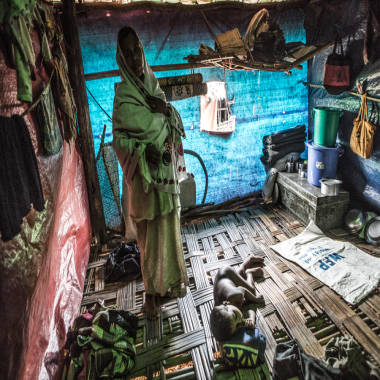 |
| A Rohingya child naps in the searing midday sun inside his familiy's 10-foot by 10-foot room inside a shelter provided by aid groups. (Photo: Andrew Stanbridge) |
Many Rohingya have now been living in these camps for more than a year, with little to no access to health care, education or employment and their movement restricted by armed guards. There is little hope that things will change.
Desperation is forcing more and more residents to consider dangerous boat journeys to Thailand or Malaysia.
"The living here is very dangerous and there's no future," said Aung Win, a Rohingya community leader who lives nearby and frequently visits the camps, where Dengue fever, tuberculosis and diarrhea are rife. "The people are sick of the conditions."
Conservative estimates put the total number of Rohingya who have turned to the high seas to leave Myanmar in the past year at 35,000. According to Refugees International, 785 Rohingya have drowned since October 2012, compared to 140 during all of 2011.
Matthew Smith, author of the Human Rights Watch report on the minority group's plight and executive director of Fortify Rights International, said that he expects an unprecedented number of Rohingya to give up on life in the camps.
"We're likely to see tens of thousands of more asylum seekers take to the sea in coming months," Smith said.
Many say they will flee as soon as the rainy season ends in October and the sea grows calmer.
The Rohingyas are a Muslim minority concentrated mostly in the western Myanmar state of Rakhine and in Bangladesh along the region that borders it. The United Nations has referred to the group as being among the world's most persecuted minorities. In 1982, Myanmar's military junta passed a citizenship law which excluded them from a list of 135 designated ethnic groups, a move which effectively left about 800,000 Rohingya stateless.
The contemporary conflict is traced back to the Second World War, where the Muslim Rohingya remained loyal to the British colonialists and the Buddhist Rakhine allied with the Japanese.
Since then “governments in the predominantly Buddhist country have routinely persecuted and forcibly displaced the Rohingya population,” according to the Human Rights Watch report, which pointed to vicious military efforts to drive the Rohingya out of the country in 1978 and 1991.
Ethnic and religious tensions were suppressed during nearly a half century of military rule that ended in 2011. However, the rape and murder of a Rakhine Buddhist women sparked sectarian violence the following June in western Myanmar. Another wave of violence in October resulted in the deaths of nearly 200 people and forced 140,000 people, mostly Rohingya, from their homes. Rohingya mobs have also attacked Rakhine villages.
A prominent monk has been dubbed the "Buddhist bin Laden" and the "face of Buddhist terror" after launching a campaign against Muslims in Myanmar.
In an unofficial camp called Then Taw Le, one resident responded harshly when asked if conditions had improved since he arrived last June.
"How can these conditions be better than our villages?" he said. When questioned whether he would like to return his village, the man said, "How can we go back? Our houses were burned down, there is no safety."
Phil Robertson, deputy director of the Asia division of Human Rights Watch, described the IDP sites as "prison camps surrounded by military personnel preventing them from moving back and forth."
 |
| A Rohingya man holds bullets and casings left behind after police shot at a mob of camp residents who were demanding the dead body of one of their villagers. (Photo: Andrew Stanbridge) |
He said the Rohingya were facing a situation "as bad as you can imagine."
"Imagine the rainy season in low-lying areas with no health services, no schools, and patrolled by hostile military personnel who will shoot you if you try to escape," Robinson said. "U.N. workers have said off the record, privately, that they have been in refugee camps around the world and they have not seen camps this bad anywhere. It's an entirely grim situation."
A Rakhine Buddhist IDP camp located closer to Sittwe presents a stark difference to the Rohingya camps, though they are not without issues. Single-family homes of solid construction are spaced out on land much closer to town, and school and medical services are clearly provided. Rakhine are also allowed to come and go freely.
In his newly built home, 41-year-old construction worker Kyawk Thein Shwe recalled how Rohingyas had burned down his house, forcing him to flee. He blamed them for initiating the violence. “They are very tricky," he added. "I would like to stay with them peacefully, but it’s not possible in this world. If we keep on living with them, the problem will come again.”
Fear of further attacks, however, has not deterred many Rohingyas from wanting to return home.
"If the government allowed us to go back to our old village, we'd go," said Mahmoud Hussein, a Rohingya boat driver who has lived in That Kay Bin camp since August 2012. He complained of the lack of employment and schooling for his children, and said that many of his neighbors had fallen ill.
"There's no business, there's no learning. If it continues like this in the future, it will be very bad," Hussein said. "I think they will keep making the people stay here, and they'll die of diseases."
Hussein worked for a Rakhine boat owner and would often eat dinner at his house. Now he lives in a 10 foot by 10 foot room, which he shares with nine other family members.
He said he plans to use his knowledge of the boat routes to flee as soon as the rains stop.
"I will go out to sea and go wherever Allah takes me," Hussein said.
Danny Gold's reporting was made possible by a grant from the International Center For Journalists. NBC News' Alexander Smith and Reuters contributed to this report.
RB News
September 7, 2013
Buthidaung, Arakan - On the evening of September 6th in Bagonna village in Buthidaung Township three soldiers were caught attempting to rob a Rohingya house. Two of the soldiers were sent to the police station later that night.
On Friday at 11:40 pm three men knocked on the door of Amnar Shah’s house in the Bagonna South hamlet. Since it was late at night, Amnar Shah questioned them as to why they wanted to enter the house. The three robbers answered him that they needed to check if there were any guests in the home. However, Amnar doubted that they were there to check for guests but were there for something else. Then he decided not to open the door. As the door remained close, the three robbers broke it and entered into the house. They tied Amnar and started take his things. They took about 75 grams of gold, 10,000 Kyats, and a mobile phone. Amnar ran out while they are trying to take the more items and asked for help from the villagers by shouting.
“At 11:40 pm, Amnar Shah didn’t open the door when they knocked the door. Then they broke it and tied the man. The man, Amnar ran out when two women inside the house were bothering with the robbers. He shouted and asked the villagers to help him. Our villagers caught 2 robbers but we couldn't catch one. The robbers took about 75 grams of gold, 10,000 kyats and a mobile phone,” a Rohingya villager told RB News.
Since the villagers could only catch two robbers wearing the army uniform; they informed the military regiment and police station immediately. The police arrived at 1 am and took the two robbers to the police station. After arriving to police station the robbers admitted that they were soldiers from BE regiment 908 based in Buthidaung Township. The Member of Parliament representing Buthidaung constituency, U Shwe Maung confirmed this robbery committed by three soldiers to Voice of America (VOA) Burmese service based in Washington D.C.
There had been many more robberies committed by the Rakhine rebels based in Bangladesh-Myanmar border. The villagers have said Rakhine rebel groups such as Arakan Liberation Army and Arakan Liberation Party forces frequently rob them. That’s why they thought the robbers on Friday night were Rakhine rebels. However, later they realized that the robbers were real soldiers from the Burmese Army.

 |
| Datuk Seri Anwar Ibrahim (Photo: AFP) |
By Zurair Ar & Alison Khong
September 7, 2013
SHAH ALAM — As the world holds its breath over a possible US attack on Syria, Datuk Seri Anwar Ibrahim hit out at Muslim world leaders for keeping mum on escalating conflicts against fellow followers of the same faith.
Amid worldwide condemnation for Syrian President Bashar al-Assad’s alleged use of chemical weapons on his own people, Malaysia’s opposition leader also asked Muslims here to not forget the plight of Egyptians in their own country following a military coup, and closer to home, the reported abuse of Myanmar’s Muslim Rohingya people.
“There is not even one voice who dares to speak up... The Muslim leadership has become gutless and laggard,” the PKR adviser told a gathering in solidarity in the country’s most developed state last night.
“Dark clouds are hovering over the Muslim world. It is an age of calamity for Muslims... We have leaders who cannot speak (their minds),” the 66-year-old added.
Anwar (picture) was the final speaker in a show of solidarity for Syria, Egypt, Palestine, Rohingya and Bangladesh, organised by local Muslim organisation, Malaysian Islamic Youth Movement, better known by its Malay name, Angkatan Belia Islam Malaysia (ABIM), which he had once led.
This despite Foreign Minister Datuk Seri Anifah Aman’s pledge last Thursday of Malaysia’s opposition to any US intervention in Syria despite an alleged chemical weapons attack.
Anifah was also reported saying last month that Putrajaya had written to the secretary-general of the Organisation of Islamic Cooperation (OIC) asking for a swift meeting to end the conflicts in Syria and Egypt.
Some 500 predominantly Malays turned up last night at the solidarity rally in Stadium Malawati here, which started off with a prayer session followed by speeches from Muslim non-governmental organisation leaders and preachers against what they called “infidel” forces.
Other opposition leaders in attendance included Anwar’s daughter and PKR vice-president Nurul Izzah Anwar, Selangor Mentri Besar Tan Sri Khalid Ibrahim, and PAS vice-president Datuk Mahfuz Omar.
“The remarks made by our prime minister seemed to endorse the regime of Mubarak,” said Mahfuz, referring to Egypt’s former president Hosni Mubarak, who was toppled in a revolution in 2011 and replaced by Mohamed Mursi in an election last year.
Less than a year in office, he was ousted in a military coup in July.
A movement called “Rabia”, which in Arabic means the number four, and which is also named after the Rabia al-Adawiya Square in Cairo, has been the rallying sign for Islamist supporters of Mursi.
The logo for the “R4BIA” movement, a black hand showing four fingers over a yellow background could be seen all over inside the stadium from banners, placards, to the headbands and t-shirts worn by ralliers here.
The stadium was also decked with banners proclaiming “Stop the killing! Egypt will be free”, “Free Syria, save Rohingya” and “Let UN/OIC peacekeepers enter Myanmar”.
Supporters also held the Palestine flag, and the alternative Syrian flag in support of the country’s opposition government.
The alternative flag has green, white and black stripes with three red stars, instead of the official flag of red, white and black stripes with two green stars used by Assad’s government.
ABIM’s programme will continue with the World Conference On Islamic Resurgence tomorrow, to be held in the Selangor state government complex.

By Al Jazeera
Standoff between detained Rohingya refugees and police enters its second day in northern Thailand.
In Northern Thailand, a standoff between detained Rohingya refugees and police has entered its second day.
The group is among the more than 35,000 people who are believed to have left western Myanmar since January.
They have fled anti-Muslim violence to uncertain futures.
Al Jazeera's Veronica Pedrosa reports from the scene in Nong Khai.
-
 "Although mass killings and exterminations of human races were some sort of things that the world experienced during Nazi German p...
 -
 ပါလီမန္အမတ္ဦးေရႊေမာင္ၿပည္သူ႔လြတ္ေတာ္တြင္ရခိုင္ၿပည္နယ္၌ၿဖစ္ပြါးခဲ့ေသာအေရးအခင္းနဲ့ ပတ္သက္၍ေဆြးေနြးတင္ၿပၿခင္း။ (14th day of regular ses...
 -
 ဇြန္လ ၁၇ ရက္ ၊ ၂၀၁၂ Source: guardian.co.uk ျမန္မာျပည္သစ္အတြက္ အနာဂတ္မွာ ေအာင္ျမင္မွာလား၊ က်ရွဳံးမွာလားဆိုသည္ကို ညႊန္ျပေသာ စမ္းသပ္မွဳ တစ...
 -
 More than 400,000 Rohingya have fled from Myanmar to neighbouring Bangladesh By BBC News September 17, 2017 Myanmar's de ...
 -
 The custodian of Two Holy Mosques King Abdullah bin Abdul Aziz Al Saud Aug 11 The custodian of Two Holy M...
 -
ရက္စြဲ – ေမ ၂၉ ၊ ၂၀၁၂ သို ့ အယ္ဒီတာ၊ နိရဥၥရာ သတင္းဌာန နိရဥၥရာ သတင္းဌာနမွ ေမလ ၂၉ ရက္ေန ့ ထုတ္ျပန္သည့္ ရမ္းျဗဲတြင္ အသက္ ၁၆ ႏွ...
-
 RB ANDROID APPLICATION LAUNCHED… Now, RB News Can Be Read On Smartphone With Android OS. RB News July 4, 2013 Here is a g...
 -
MP U Shwe Maung Explained on Amendment 1982 Citizenship Law on 25 July 2012. MP U Shwe Maung explained on amendment of 1982 Citizenship Law...
-
 Thousands of Rohingya flee religious persecution in Myanmar, many dying along the way. Thanks to Anonymous, #RohingyaNOW is trending on ...
 -
 At Baggona, a village three miles far from and lies to the South of Maung Daw of Arakan state, more than 80 Rohingya women and girls have be...

Popular Posts
Threatwiki

Amartya Sen: Burma's "slow genocide" of Rohingyas

Watch Professor Amartya Sen speak on what he calls Burma's 'slow genocide' of Rohingya, Harvard, 4 Nov 2014
