
 |
| U Wimala delivers a sermon to Buddhist followers. (Photo: JPaing / The Irrawaddy) |
Kyaw Zwa Moe
June 22, 2013
MAWLAMYINE, Mon State — It’s around 8 pm on a recent evening in Mawlamyine, the capital of Mon State, and U Wimala Biwuntha, a Buddhist monk, is about to arrive to deliver a sermon at a temple in the city’s Aut Kyin Quarter. Despite his reputation as a charismatic speaker, however, there are barely a hundred people inside the main religious hall, and perhaps another hundred—mostly children—outside.
“Please go in,” some women tell me and a few others who are standing outside. “There are not so many people here tonight, so the Sayadaw might be upset.”
A few minutes later, U Wimala, who looks much younger than his 40 years, makes his appearance. After chanting a short Buddhist prayer, he begins his sermon with an ominous warning: “We Buddhists are like people in a boat that is sinking. If this does not change, our race and religion will soon vanish.”
“And so,” he adds, “tonight’s sermon will be about 969.”
He pauses briefly, then asks, “What is tonight’s sermon about?”
“969,” his audience replies.
“What is it about?” he repeats through his microphone, raising his voice.
“969!”
“Louder! You have to shout it louder. Even if you make this Dhamma Yone [religious assembly hall] collapse, we can rebuild it.”
It was a strange scene, more reminiscent of a political rally than a Buddhist sermon. But it didn’t come as a surprise: U Wimala was well known as a firebrand monk and a leading exponent of the 969 movement that has in recent months attracted a great deal of attention in the country and, indeed, around the world. Regarded as a brand of extreme Buddhist nationalism, it has been linked to recent outbreaks of anti-Muslim violence in central Myanmar that many worry could turn into a nationwide conflagration.
The women who had guided us into the building also handed us pamphlets spelling out what 969 stands for. “We Buddhists must protect our race and religion by worshiping and applying 969,” the tracts say. Meanwhile, loudspeakers blare out a song with a similar message: “We Buddhists shouldn’t stay calm. If we are calm, our race and religion will vanish.”
U Wimala explains in his sermon that the numbers in 969 refer to the nine special attributes of the Buddha, the six special attributes of his Dhamma, or teachings, and the nine special attributes of the Sangha, or community of monks. While most regard 969 as a relatively new movement, for U Wimala it is as old as Buddhism itself.
“You must remember,” he says in a booming voice, “that 969 has existed for 2,600 years. Christianity emerged 620 years after 969, and Islam more than a thousand years after 969.”
At the same time, however, he acknowledges the movement’s newfound notoriety.
“Some people ask, ‘Is it legal?’ I don’t even know how to answer that question. Isn’t the Buddha legal? We monks are legal, aren’t we?”
He also insists that the movement is non-violent, relying only on boycotts of Muslim-owned businesses bearing the number 786, which is used by Muslims in Myanmar to mark halal restaurants and shops, to achieve its goals.
“We have never spoken of beating or killing people of different religions,” he insists. “Our Buddha taught us never to kill any creature, let alone people or members of different religions.”
But if these words were intended to reassure Muslims, who make up roughly half the population of Mawlamyine’s Aut Kyin Quarter, they failed.
“It’s scary, the way he speaks,” U Tin Aung, a 68-year-old Muslim man, told me outside the temple after the sermon. It wasn’t so much the words, he said, but the intensity with which they were delivered.
Distorting the Dhamma
Muslims are not alone in feeling that there’s something distinctly unnerving about the way the 969 movement seeks to instill fear in the hearts of Buddhists about a supposed Muslim conspiracy to drive their faith out of Myanmar, where it has taken firm root over the past two millennia.
“This is the first and last time,” said one of the organizers of the evening’s sermon. “We intended this for young people and kids. We didn’t know he would talk about all this 969 stuff.”
Others I spoke to were also less than impressed by U Wimala’s fiery rhetoric.
“He sounds like Hitler,” U Htun Than, a 57-year-old Buddhist and former political candidate in Myanmar’s 1990 elections, told me bluntly after we sat through the sermon. “It will be a big problem if his group becomes stronger.”
U Kyaw Kyaw, another local politician from the opposition National League for Democracy (NLD), agreed. “You heard the song: ‘We shouldn’t stay calm. If we stay calm, our race and religion will vanish.’ What is that supposed to mean? They are just agitating people. It has to stop.”
During our conversation, U Kyaw Kyaw reminds me that the 969 movement has its roots in Mawlamyine, a city long known as a bastion of the Buddhist faith.
It was here, nearly two centuries ago, that local protests forced the closure of a missionary school after a Buddhist student converted to Christianity. Since that incident, which occurred just 12 years after the British assumed control of the southern part of Myanmar in 1824, Mawlamyine has had a well-earned reputation for being staunchly Buddhist, even as British rule brought with it an influx of mostly Muslim migrants from India, whose descendants now make up roughly a fifth of the city’s population.
The 969 movement itself goes back to 1997, when a 40-page booklet titled “969” first appeared in Mawlamyine. Published by Hna Phet Hla (literally, “the beauty of both sides”) and penned under the name U Kyaw Lwin, this short manifesto urged Buddhists to openly display the numbers 969 on their homes, businesses and vehicles. It didn’t, however, single out any other religion for criticism. Instead, it merely called on Buddhists to be good people and support each other.
A few years later, however, another booklet started circulating that carried an overtly anti-Islamic message. Called “Worrying about the Vanishing of the Race,” it also emphasized the need to behave properly, but among its 17 prescriptions for protecting the Buddhist religion were some that encouraged active discrimination against Muslims.
The book, which first appeared around 2000 and was never legally published (meaning that anyone found in possession of it faced a seven-year jail sentence under Section 5 (j) of the 1950 Emergency Act), said that Buddhists should employ a “three cuts” strategy against Muslims. This entailed cutting off all business ties; not allowing Buddhists to marry Muslims; and severing all social relations with Muslims, including even casual conversation. It stopped short, however, of advocating violence.
Even now, the 969 movement disavows violence, even as it is increasingly seen as playing a key role in stirring up anti-Muslim sentiment. Ostensibly, at least, its activities are peaceful. U Wimala, for instance, has instituted Sunday schools to teach Buddhist children the basics of the Buddha’s teachings and social ethics. Some parents have been wary of sending their children to these schools, however, fearing they will be exposed to hate speech. But some of these schools attract as many as a hundred students, attesting to their popularity in some communities.
Buddhist Backlash
Proponents of the 969 movement insist that their goal is merely to protect their own religion, not attack the beliefs of others. But when asked why they urge Buddhists to boycott Muslim businesses, U Yaywata, the vice abbot of Mawlamyine’s Mya Sadi Nan Oo Monastery, tells me that it is no more than a reaction to a Muslims’ discrimination against Buddhists.
“I want to ask, who started this practice? For years, Muslims have refused to buy anything from Buddhist shops, even from betel nut sellers. They use 786 to support each other, so we have to do the same thing.”
Sitting next to a bag full of 969 stickers—the most visible symbol of the movement, and an increasingly common sight in many parts of Myanmar—the 38-year-old monk continues: “Why doesn’t Islam allow Buddhists to keep their religion if they marry Muslims? Their kids also have to become Muslims. Their religion doesn’t allow freedom of belief and worship. They are violating basic human rights.”
By adopting methods that they accuse Muslims of using against Buddhists, the followers of 969 are indeed having an impact. U Tin Aung, the Muslim man who spoke to me after U Wimala’s sermon, said that his son’s motorcycle spare parts shop has lost almost half its business in recent months. However, because his son’s shop has a reputation for offering fair prices and good service, many customers are returning, he added.
Meanwhile, some Buddhists who pasted 969 stickers on their vehicles and houses have started taking them off. A motorcycle taxi driver said that after he put a 969 sticker on his bike, he started losing Muslim customers. So he removed it—not just because it was costing him money, he said, but also because he realized that the 969 movement was fundamentally racist.
U Tin Aung said he believed the worst of the 969 movement’s misguided campaign to vilify Muslims had passed. “You know, people are interested in new things. It’s just human nature, but it doesn’t last,” he said.
“The essence of any religion is peace, sympathy and beauty,” he added.
The Politics of Religion
The 969 movement may be a relatively recent phenomenon in Myanmar, but intolerance is, unfortunately, nothing new to the country. While religion is occasionally seen as contributing to this problem, many observers would point a finger elsewhere, at state policies that have long exploited religious and ethnic differences to cement the military’s hold on power.
“Ne Win is the real culprit, not 969,” said U Htun Than, the politician who ran for election in 1990. Recalling that Muslims enjoyed equal status in Myanmar until Gen Ne Win seized power in a bloody coup in 1962, paving the way for half a century of military rule, U Htun Aung blamed the policies of the former ruling Burma Socialist Programme Party for deepening mistrust among Myanmar’s different religious groups.
“The BSPP made religious discrimination official policy, forcing Muslims to increasingly rely on each other for support,” he said. This, he added, resulted in growing resentment among Buddhists, who came to see Muslims as a people apart.
Despite decades of being treated with disdain, however, Muslims say they don’t mind social attitudes toward them so much as the failure of the country’s leaders to treat them as full Myanmar citizens.
“We don’t care about being called dogs or kalar [a derogatory term for people of South Asian descent], we just want our basic human rights,” said U Myint Lwin, a teacher at the Moree Mosque in Mawlamyine’s Swan Gyi Quarter.
Although Myanmar has recently undertaken reforms and President U Thein Sein has promised to protect the rights of Muslims in the wake of the latest outbreak of anti-Muslim violence that began in Meikhtila in late March, U Myint Lwin said that it is still far from clear where the government stands on this issue.
“Look at how quick the authorities were to crack down on protests against the Letpadaung copper mine,” he said, referring to a controversial Chinese-backed project in Sagaing Region. “Why were they so slow to take action in Meikhtila and other cities? If they had done their job there, the casualties and the loss of property would not have been so bad.”
Asked if he felt disappointed that NLD leader and Nobel Peace Prize laureate Daw Aung San Suu Kyi has not been more vocal about attacks on Muslims, he said it was probably for the best that she hasn’t spoken out on their behalf.
“We want her to be quiet on this issue. But we know that she feels sad for us,” he said, adding that he believed the situation would improve if Daw Aung San Suu Kyi became president.
A Community on High Alert
In the meantime, Myanmar’s Muslims are bracing for more attacks. Since the anti-Muslim riots in Meikhtila claimed 43 lives, there have been other attacks elsewhere in the country, most recently in Okkan Township, Bago Region, in early May.
“Since the Meikhtila riots, we haven’t been able to sleep well,” said U Zaw Naing, another Muslim man at the Moree Mosque.
In Swan Gyi Quarter, where the mosque is located, roughly 80 percent of the 1,400 or so households are Muslim, making it a likely target if the recent wave of violence spreads to the birthplace of the 969 movement.
There have been few incidents so far, but tensions are rising. A number of mosques, including Mawlamyine’s largest, have had stones thrown at them, and when strangers show up in Swan Gyi, local residents become nervous.
“I don’t want to blame anybody, because we don’t know who threw the stones, but these things only started after the 969 DVDs started circulating,” said U Myint Lwin.
“Actually, it doesn’t matter who threw the stones. What we care about is the instigators, the ones spreading hate speech,” he said. “And we know who they are: the 969 group.”
In the end, he added, if this conflict gets out of hand, it will hurt everybody. “Both the winners and the losers will suffer great losses,” he said.
This story appeared in the June 2013 print issue of The Irrawaddy magazine.
 |
| A Muslim religious leader speaks to Muslims seeking shelter at a monastery in Lashio township on 31 May 2013. (Reuters) |
Emanuel Stoakes
Democratic Voice of Burma
June 21, 2013
June 21, 2013
Over the past twelve months, brutal attacks on Burma’s Muslim community have taken place across the country, spreading from Arakan state in the west to, most recently, Shan state in the east.
Serious atrocities have occurred, including acts that allegedly amount to crimes against humanity. Many of the worst offences are believed to have perpetrated with the aid of state agencies; in other incidents, the police stood by and did nothing to prevent loss of life.
Such extremely grave abuses have elicited widespread concern, but in an alarming number of cases, perhaps even the majority, impunity for the perpetrators has followed. By contrast, Muslims accused of crimes related to the same incidents have felt the full force of the law quickly, excessively and unmistakably.
These patterns are disturbingly instructive and hint at institutional prejudices that have survived Burma’s recent reforms; insufficient responses to Muslim persecution from the international community, on the other hand, are far harder to explain.
Such moral laxity has helped to condemn the Burmese Islamic community to ongoing suffering and vulnerability in the face of increasingly militant Buddhist-chauvinist hostility. In lieu of adequate foreign or internal pressure, it falls to journalists, rights campaigners and other interested groups both within and outside of Burma to step up and confront this plague of violence and bigotry. The best way that this can be done, in my view, is to expose those most responsible for its recrudescence.
I say this with a conviction that there is some level of organisation behind the recent attacks on the Muslim community, and that the simplistic narrative that such acts are merely the product of relaxed state authoritarianism is pernicious and unconvincing. In fact, I felt prompted to write this op-ed precisely because of information that I have received from reliable sources on the issue.
Their claims were made prior to an important piece featured in the Straits Times recently by Nirmal Ghosh. Many will have read Mr Ghosh’s article “Old Monsters Stirring Up Trouble”, in which he cites a military source within Naypyidaw who points the finger at a notorious paramilitary group linked to the former regime and a controversial ex-minister- namely, the Swan Arshin and Aung Thaung respectively.
Prior to reading Ghosh’s article, I was told by a separate figure in Naypyidaw that Aung Thaung was central to the violence, and yet another reliable source within the Sangha asserted that the infamous anti-Muslim 969 movement had deep links to the Swan Arshin.
Another, very solid source with access to privileged government information shared with me his awareness that Wirathu, the demagogic monk famously associated with the 969 group, had been present in Lashio the day before the attacks in the town began. It is a claim that seems plausible given that it was reported he was spotted in Shan state in late May.
It is worth noting that Wirathu was also recognised to have been preaching in Meikhtila not long before the atrocities that took place there occurred, and was present in the city on the day of the attacks. Links between Wirathu and Aung Thaung in themselves have been subjected to a great deal of speculation, in particular the Abbot’s meeting with the former minister immediately prior to the attacks in Arakan state in October.
According to my own interviews with eyewitnesses to the attacks throughout the country, conducted both while I have been in Burma and from abroad, there are appear to be common features to most of the major anti-Muslim incidents.
Witnesses in Sittwe with whom I met were very clear that many of the ‘attackers were strangers’; in Meikhtila, this was again a recurrent message from sources I contacted; finally in Lashio the presence of outsiders was confirmed by multiple sources.
Another witness to a separate act of violence, this time in Rangoon, told me that he saw groups of young men attack a mosque near Annawratha Road from their vehicles with projectiles in the middle of the night. In his words it was ‘definitely an organised attack’, in keeping with many other reported mosque assaults. The presence of men on motorbikes behaving similarly was confirmed by another source who saw events take place in Oakkan.
I mention the above allegations without endorsing them, but acknowledging that they certainly merit reporting- and further investigation. Aung Thaung for his part has unsurprisingly denied the claims reported by the Straits Times.
Regardless, urgent questions need to be asked: who are these people that my sources- and many others- have seen in vehicles, throwing projectiles and coming from out of town? Why was it consistently reported that the outsiders in Lashio were heard singing Burmese nationalist songs, and being of Burmese not Shan appearance? What was Wirathu doing so close to the action, before and during several incidents?
Why are the perpetrators, and in the indeed the whole 969 operation not adequately subjected to the censure of the law; and why have police and firefighters been to reluctant to intervene as Muslims are being assaulted and their homes burnt, as has been so often reported?
It is up to responsible journalists to aggressively dig out the answers to these questions and expose the agendas at work behind the terror campaign being conducted against Muslims in Burma. In my opinion, not doing so would be yet another gutless betrayal of the victims of these egregious crimes by those with the power to do something to help.
Emanuel Stoakes is a freelance journalist based in the United Kingdom and New Zealand

STATEMENT ON WORLD REFUGEE DAY
Date: 20 June 2013
Today is the day of World Refugee and it was established by the United Nations to honor the courage, strength determination of men, women and children who are forced to flee their homes under threat of persecution, conflict and violence. It also concerned the Rohingya Refugees around the world who are forcefully made stateless and displaced eventually in their homeland by the successive military regime and democratically elected government of President U Thein Sein.
The Rohingya are a Muslim minority group who live in the Northern Arakan State and most of them work as casual labourers, farmers and fishermen. The Burmese Junta has always viewed them as illegal immigrants from Bangladesh, even though they had historically settled in Burma for centuries. The Burmese 1982 discriminatory citizenship law was enacted rendering them stateless. Since 1995, the authorities started issuing Rohingyas with a Temporary Registration Card (TRC), but these cards do not grant any right to citizenship. As a result of their lack of legal status, the Rohingyas thus have been subjected to many forms of discrimination and violations of their human rights. They are entitled to the restriction on their freedom of movement within their own village and must ask for travel permission and pay a fee to visit other villages. Their inability to conduct business or find outside their residing areas deprive them of economic means opportunities. It also effects their access to education and health care.
Rohingyas are forced to work as labor on numerous military projects and prawn bearing dams. Land used for agriculture by the Rohingyas is confiscated by the Burmese government for the expansion of military camps and given to the Buddhist new settlers brought in the area by the government. Establishment of Buddhist settlers model villages in the Rohingya areas exacerbated tension between the two sister communities. The Rohingya must apply to the NASAKA for permission in order to marry. This process can take up to two years or more and involve large bribes and the couple to be wed has to pledge that they will not have more than two children. And the Rohingyas are constantly subject to arbitrary taxations and various forms of extortions, systematic persecution, killing, arbitrary arrest and torture, raping Rohingya women and gross human rights violations on innocent Rohingyas. These, along with mistreatment and injustice by the Burmese government have caused Rohingya community to attempt to leave and migrate to the neighboring countries in fear for their life security and safety.
Moreover, the recent systematic and preplanned violence in the name of Rohingya Ethnic Cleansing that was caused by a rape and murder case of Ma Thida Htwe on 28 May 2012, a Rakhine Buddhist women in Kyauk Nimaw village, Rambri Township. The incident was allegedly committed by three local residents Htat Htat (a Rakhine), Rafik and Rashid (reportedly Rohingya) and police arrested them and later reported that Htat Htat was killed in the police custody. The remaining two are brought to the court and sentenced to death. These three men committed a crime found guilty in the court and punished them in accordance with law, this is publicly acceptable because this kind of crimes are frequently taking place around the world and the respective court pronounce verdicts how to punish them according to the law. But taking this opportunity three hundreds Arakanese Rakhine community surrounded a bus carrying 10 Muslim religious travelers at a government checkpoint in Taungup, Arakan State. Ten Muslims are forced off the bus and beaten to death mercilessly while nearby police and army soldiers look on but did not intervene to stop the violence, unfortunately, until now the government sponsored inquiry commission found no one guilty and establish any evidence of killing of these ten Muslims men in front of security forces.
The predominantly Rohingya area of Maung Daw Township, a group of people planned to say a prayer on 8 June Friday Jummah for those killed in Taungup, the local sister community collaborating with local security forces initiated riot killing unknown numbers of Rohingya people, burning homes, looting Rohingya property, raping Rohingya women. Thw violance spread to township in Arakan and the state security forces not only failed to stop violence but also participated in the violence against muslims in Arakan and Mettila. The Rakhine political parties, local monks associations and Rakhine civic groups made public statements and issued pamphlets that urged the ethnic cleansing of Rohingya from Arakan State. The participation of state security forces in the violence began a vigorous crackdown on Rohingya caused more lost of lives and dignity eventually displaced 140000 Rohingyas in their homeland Arakan. They conducted forcible mass arrests of Rohingya men and boys throughout the state.
Consequently, the perilous journey on boat, the route taken by the Rohingya is dangerous and risky: each journey is a gamble of life and death. Boats are generally in bad conditions, inexperience crews, most them have never sailed before and there are no guarantees that they would be reaching the shore. As a result unknowing number of Rohingyas are dying in the sea and though some managed to reach to the destined countries they are spending their horrible lives in the detention and facing life threat under the future of uncertainty and hopelessness in search of life security and safety.
Appeal and Recommendation to the concerned Authorities:
- UN, US, European Union and ASEAN must clear its position on the ongoing violence on Muslims around the country, exodus of Rohingya refugees in seeking protection and safe place in the region and review their diplomatic ties with Myanmar.
- We are deeply concerned that the root cause of violence on Muslims of Myanmar and also concerned over the detention, torture and abuse of Rohingya refugees which is a clear violation of international principle of humanitarian law and human rights.
- We condemn continued gross human rights violations taking place inside Myanmar and in particular the policies and practices which promotes discrimination, violence against Muslim community in Myanmar.
- We earnestly urge all exiled Rohingya leaders to find a durable solution for your own community and their rights to be recognized as the citizen and gain due human rights.
- Rohingya around the world must ensure that disunity, dispute and conflict among us do not help solve our problems we are facing but it clearly notify and sent a supportive message to our transgressors to commit more human rights violations and get rid of Rohingya from Arakan soil.
- Unity, respect, trust and recognize each other’s stance will explore a better way to come to the round table discussion and establish some effective measures to implement, it may save Rohingya rights and lives.
Burmese Rohingya Association in Japan (BRAJ)
 |
| Extremist Ashin Wirathu speaks with fellow monks during a national Buddhist clergy assembly in Hmawbi, Burma. (AP Photo/Gemunu Amarasinghe) |
Max Fisher
June 21, 2013
Members of Burma’s Buddhist majority, including some of its much-respected monks, are increasingly persecuting the country’s long-suffering Muslim minority and adopting an ideology that encourages religious violence. It seems a far way from the Buddhism typically associated with stoic monks and the Lama – who has condemned the violence – and more akin to the sectarian extremism prevalent in troubled corners of the Middle East. The violence has already left nearly 250 Burmese Muslim civilians dead, forced 150,000 from their homes and is getting worse.
“You can be full of kindness and love, but you cannot sleep next to a mad dog,” Ashin Wirathu, a spiritual leader of the movement and very popular figure in Burma, said of the country’s Muslims, whom he called “the enemy.” He told the New York Times, “I am proud to be called a radical Buddhist.”
Wirathu calls himself “the Burmese bin Laden” and was recently labeled on the cover of Time magazine as “the face of Burmese terror.” A prominent Burmese human rights activist, after a lifetime of fighting government oppression, now warns that Wirathu’s movement is promoting an ideology akin to neo-Nazism.
Already, the movement has expanded beyond this one self-styled radical Buddhist monk. It’s now expanding across Burma (also known as Myanmar) according to the Times article. The anti-Muslim sentiment has spread with alarming speed over just the last year, as Burma – which is finally opening up after years of military dictatorship – loosened its strict speech laws. It has prompted boycotts and sermons that can sound an awful lot like calls for violence against Muslims. Monasteries associated with the movement have enrolled 60,000 Burmese children into Sunday school programs.
By far the worst attack so far was in late March in the central Burmese city of Meiktila. Tellingly, the attack was not let by a single leader or religious figure but carried out by mobs of Buddhists, a worrying sign that Wirathu’s violent ideas may have taken hold in the city. A minor dispute at an outdoor jewelry stall between a Buddhist customer and a Muslim vendor escalated rapidly out of control. Buddhist rioters razed entire Muslim neighborhoods, burned several civilians alive and killed up to 200 more Muslims until, after three long days in which the army was conspicuously absent, troops intervened to stop the killing.
Here, from Human Rights Watch, is a set of before-and-after satellite images of one of the neighborhoods attacked, where Buddhist mobs destroyed a staggering 442 Muslim homes.


Heightening the fear is that none of Burma’s leaders has stepped in to end the bloodshed. The military rulers, though they once jailed Wirathu, have held back, perhaps reluctant to risk the backlash at a time when they are willingly abandoning much of their power.
Aung San Suu Kyi, the longtime democracy activist who became an international cause as a political prisoner, is so beloved in Burma that she may well become its first democratically elected president. But the Nobel Prize winner has also failed to fully condemn the violence. This has been typically seen as a political choice, meant to avoid angering too many Burmese voters if she wants to maintain national support. As the Economist points out, many Burmese were angered when Suu Kyi criticized a draconian new law that forbids some Burmese Muslims from having more than two children.
Unchecked, though, Burma’s self-declared radical Buddhists may show no interest in ending their campaign against the country’s Muslim minority.

June 21, 2013
YANGON, Myanmar — Upon seeing his photo splashed across the cover of Time magazine with the words “Face of Buddhist Terror,” Myanmar’s most-talked-about monk was unfazed, saying no amount of bad publicity could hurt him.
The 46-year-old is accustomed to — even flattered by — the foreign reporters who steadily parade through his monastery in the city of Mandalay to ask about religious violence that has swept his predominantly Buddhist nation in the last year — fueled in no small part by his anti-Muslim rhetoric.
Nearly 250 people have died and tens of thousands have fled their homes, threatening to destabilize the quasi-civilian government that came to power just two years ago after five decades of military rule.
“A genuine ruby will shine,” said Wirathu, “even if you try to sink it in mud.”
New freedoms of speech have made it easier to disseminate radical views, while exposing deep-seeded racism felt by much of the population toward Muslims and other minorities.
There has been almost no public outcry when Buddhist mobs have marched into villages brandishing machetes and clubs, but the appearance of a Burmese monk on the cover of the glossy international magazine with an inflammatory title was apparently too much.
The social networking site Facebook was alight with criticism.
Dozens changed their profiles to mock-covers of Time with the word “Boycott.” One person lamented that the image of his country — and faith — was being tarnished.
“Some people misunderstood the title ... seeing it as an insult to religion,” said Dr. Yan Myo Thein, a political analyst. “They believe it’s equating Buddhism with terrorism.”
Few took the opportunity to criticize Wirathu, however, saying it was further evidence of media bias. The monk has repeatedly called on Buddhists to unite against the “threat” Muslims pose to the country and its culture, accusing them of breeding too fast and hijacking the business community.
The Time article quoted him as saying this was not the time to stay calm.
“Now is the time to rise up, to make your blood boil,” he said.
 |
| Buddhist monk Ashin Wirathu in Mandalay, Myanmar on June 21, 2013. (Photo: Htoo Tay Zar/Global Post) |
Tin Aung Kyaw
June 21, 2013
The national '969' campaign threatens to block Burma's path to ethnic unity at a pivotal time. GlobalPost sits down with the campaign's leader in a rare interview.
Global Post Editor’s note: In a partnership between GlobalPost and the Open Hands Initiative, a team of top young reporters from Myanmar and theUnited States have set out on a reporting journey through a country inching toward a new democracy and undergoing dramatic change. One of the stories these reporters are following here is about rising extremism among a fringe group of Buddhist monks. In a rare interview, GlobalPost reporting fellow Tin Aung Kyaw sat down with the Buddhist monk whose anti-Muslim rhetoric has placed him at the center of rising ethnic and sectarian violence.
MANDALAY, Myanmar — The Buddhist monk arrived wrapped in saffron-colored robes with an entourage of muscular, younger monks who guarded him and hung on his every word at the sprawling monastery he runs and where his divisive, anti-Muslim teaching is gaining a strong following.
The monk, Ashin Wirathu, was unapologetic when asked about his role at the center of a rising tide of Buddhist extremism that has crested in a wave of anti-Muslim violence resulting in the deaths of more than 200 people and displacement of some 150,000 from their homes in recent months.
“Muslims are like the African carp. They breed quickly and they are very violent and they eat their own kind. Even though they are minorities here, we are suffering under the burden they bring us,” Wirathu, 48, said in a rare and wide-ranging interview with GlobalPost on Thursday.
“Because the Burmese people and the Buddhists are devoured every day, the national religion needs to be protected,” he said, announcing that he would push for a ban on interfaith marriage before the next parliamentary session and vowing to continue the so-called “969” campaign that calls for Buddhists to only do business with other Buddhists and exclude Muslims who have a strong tradition as merchants in Myanmar.
Myanmar, also known as Burma, is made of eight major ethnic groups, but 90 percent of the population is Buddhist. About 5 percent of the population is Muslim and the rest are a mix of Christian and Hindu.
Muslims live throughout the country, as they were merchants along the trade routes between India and China. They have settled in waves of immigration from throughout the Muslim world and neighboring India since at least the 19th century. More recently, Muslims are coming across the border from Bangladesh in search of work and opportunity in Burma’s Rakhine State, where much of the recent violence has been centered.
Wirathu’s sermons play on the fear among some Buddhists in certain parts of Myanmar of a rising Muslim population that some feel is threatening the majority Buddhist religion and its traditions. Wirathu and others have spurred a movement known as “969,” which calls for Buddhists to band together to defend their faith and for Buddhists to do business only with other Buddhists. The numerology of the “969” movement refers to the virtues of the Buddha, the practices of the faith and the community. The distinctive “969” stickers are ubiquitous on shops, motorcycles and car windows.
Wirathu has also pushed a ban against interfaith marriage, claiming that the Buddhist majority is diluted by such marriages and reeling off one anecdote after another of forced conversions of Buddhist women to Islam. Many critics here and abroad say Wirathu’s sermons are racist rants against Muslims who he has likened to “mad dogs” and “cannibals” and, in perhaps a more charitable and consistent reference, as simply “troublemakers.”
But Wirathu’s movement is gaining a wider and wider following.
He heads the Ma Soeyein monastery attended by some 2,500 monks, has an active Facebook page and leads speaking tours that attract thousands of followers. Wirathu is also gathering signatures for a petition to introduce the interfaith marriage legislation which he has titled, “Safeguarding the National Identity.”
“The people are requesting that we put forward the ‘Safeguarding the National Identity’ law,” he said, adding, “I am committed to working on this law until it is passed.”
This proposed law, if it does come to a vote, would likely put pro-democracy leader Aung San Suu Kyi, who was elected to parliament two years ago, and those who support her efforts in a difficult position.
Political observers say it will put them between their hopes to unify the many different ethnic groups that have been fighting a series of open conflicts with the previous military regime and a broad populist streak among the majority ethnic Burmans who are coalescing around this new brand of Buddhist nationalism.
The proposed ban on interfaith marriage is not new in Burma, and it has been implemented in other countries in the region, including Singapore. It is similar to a popular idea that first emerged in the 1930s and called for a strong nationalist movement. And this is not the first time that Buddhist monks have used their authority to influence the history of Myanmar. They have always been part of major political movements.
Wirathu himself is no stranger to activism; he was arrested in 2003 for political incitement and served seven years in prison before he was reportedly released as part of a government amnesty program. Buddhist monks were also at the head of the 2007 "Saffron Revolution,” in which monks took to the streets in large numbers to protest the rising prices of food and fuel. Images of the military cracking down on the monks with tear gas and batons were carried around the world and served to propel the pro-democracy movement.
The current Burmese parliament was elected two years ago in what was widely seen as Burma’s first free and fair elections in more than a half century. And if this proposed law banning interfaith marriage is indeed introduced, it will mark the first time in history that parliament will consider a law concerning a national religion.
Wirathu said that theological authorities were “shaping the movement.”
A few days ago in Mhawbi, just outside of Yangon, more than 200 monks gathered at what they called a "peace conference," where this law was given shape, he said.
“Legal experts are now writing up a rough draft of the law,” he said. “And there will be a public announcement of this law on the 27th of June.”
Wirathu continued, “We will finish collecting the signatures by the 30th of June. We have found parliamentary members who will introduce this legislation. We also have parliamentary members who will support this legislation. However, the final decision will have to be made through a vote.”
However, the “Safeguarding the National Identity” law is rejected by the intellectual community, human rights groups and many civil society organizations. Mandalay, a city where the “969” movement has taken root, is famous for a strong intellectual community that has supported the pro-democracy movement. One member of that community is Nyi Pu Ley, a writer and artist, who has soundly criticized Wirathu’s proposed legislation.
“Doing this is like raising the political flag unnecessarily because there are many laymen. This is popular among the laymen. The “969” group and the Mandalay people are not on the same page,” he said.
But many learned monks from the Buddhist university are lending support to Wirathu and his proposed law. In a country where monks have a great deal of moral authority, political observers including Nyi Pu Ley fear this could lead to a large nationalist movement.
Thant Myint–U, a historian, author and most recently an adviser to the president, said, “Monks in Myanmar should concentrate more on religious matters rather than political matters. Many people in Myanmar, including those in Mandalay, are worried that there will be more outbursts of religions violence in their communities. People do not want this killing and this violence.”
(Reporting for this story was also provided by GlobalPost reporting fellows Van Patrick King and Pailin Wedel.)
Rashvinjeet Singh Bedi
June 21, 2013

PETALING JAYA: Asean can persuade the United Nations to end the persecution of Rohingyas in Myanmar, said International Movement for Just World (JUST) president Dr Chandra Muzaffar.
“Asean has a major role in persuading the five members of the Security Council if they want the UN to act on the atrocities in Myanmar.
"Their voice carries more weight as Myanmar is part of the Asean family,” he said at a recent forum 'Plight of Muslims in Burma in the 21st Century: An Initiative for Solution and the Way Forward' organised by the International Institute of Advanced Islamic Studies (IAIS) Malaysia.
Dr Chandra said that the UN would be duty-bound to protect the Rohingya if the Security Council adopted a resolution that says they were victims of genocide.
He added that civil society group within Asean should pressure their governments to take a lead on these issues.
Dr Chandra said that although Myanmar appeared to be opening up to the international world, it was done within the backdrop of military rule.
“The root of the problem is the military regime which is cruel, harsh, brutal and barbaric,” he said.
The Rohingya are considered by the United Nations as one of the most persecuted minorities in the world. They are considered to be stateless and are often subjected to arbitrary violence and forced labour.
University Malaya's Faculty of Arts and Social Sciences visiting senior research fellow Dr Maung Zarni said that Asean should consider the genocide of Rohingya and the mass violence against Muslims in Myanmar as an issue of wide importance as there were regional consequences.
“Asean countries would be affected with the flow of refugees into their countries and the emergence of human trafficking gangs,” he said.
Dr Maung pointed out that eight people died in clashes between Buddhist and Muslim asylum seekers from Myanmar in a detention centre in Medan. Police also uncovered a plot to bomb the Myanmar embassy in Jakarta recently, he added.
“The Burmese government cannot say that Asean is interfering in their affairs,” he said.
As of April, there are almost 95,000 refugees and asylum-seekers from Myanmar registered with the UNHCR in Malaysia. An estimated 28,000 of them are Rohingya.

Hannah Beech
June 20, 2013
The fault lines of conflict are often spiritual, one religion chafing against another and kindling bloodletting contrary to the values girding each faith. Over the past year in parts of Asia, it is friction between Buddhism and Islam that has killed hundreds, mostly Muslims. The violence is being fanned by extremist Buddhist monks, who preach a dangerous form of religious chauvinism to their followers.
Yet as this week’s TIME International cover story notes, Buddhism has tended to avoid a linkage in our minds to sectarian strife:
“In the reckoning of religious extremism — Hindu nationalists, Muslim militants, fundamentalist Christians, ultra-Orthodox Jews — Buddhism has largely escaped trial. To much of the world, it is synonymous with nonviolence and loving kindness, concepts propagated by Siddhartha Gautama, the Buddha, 2,500 years ago. But like adherents of any religion, Buddhists and their holy men are not immune to politics and, on occasion, the lure of sectarian chauvinism.
When Asia rose up against empire and oppression, Buddhist monks, with their moral command and plentiful numbers, led anticolonial movements. Some starved themselves for their cause, their sunken flesh and protruding ribs underlining their sacrifice for the laity. Perhaps most iconic is the image of Thich Quang Duc, a Vietnamese monk sitting in the lotus position, wrapped in flames, as he burned to death in Saigon while protesting the repressive South Vietnamese regime 50 years ago. In 2007, Buddhist monks led a foiled democratic uprising in Burma: images of columns of clerics bearing upturned alms bowls, marching peacefully in protest against the junta, earned sympathy around the world, if not from the soldiers who slaughtered them. But where does social activism end and political militancy begin? Every religion can be twisted into a destructive force poisoned by ideas that are antithetical to its foundations. Now it’s Buddhism’s turn.”
Over the past year in Buddhist-majority Burma, scores, if not hundreds, have been killed in communal clashes, with Muslims suffering the most casualties. Burmese monks were seen goading on Buddhist mobs, while some suspect the authorities of having stoked the violence — a charge the country’s new quasi-civilian government denies. In Sri Lanka, where a conservative, pro-Buddhist government reigns, Buddhist nationalist groups are operating with apparent impunity, looting Muslim and Christian establishments and calling for restrictions to be placed on the 9% of the country that is Muslim. Meanwhile in Thailand’s deep south, where a Muslim insurgency has claimed some 5,000 lives since 2004, desperate Buddhist clerics are retreating into their temples with Thai soldiers at their side. Their fear is understandable. But the close relationship between temple and state is further dividing this already anxious region.
As the violence mounts, will Buddhists draw inspiration from their faith’s sutras of compassion and peace to counter religious chauvinism? Or will they succumb to the hate speech of radical monks like Burma’s Wirathu, who goads his followers to “rise up” against Islam? The world’s judgment awaits.
Click here to read Hannah Beech’s full story on the violence between Buddhism and Islam in Asian countries.
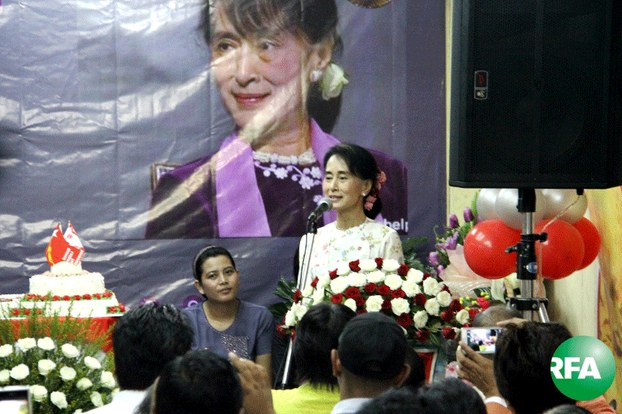 |
| Aung San Suu Kyi speaks at her 68th birthday celebration at her party headquarters in Bahan Township, Yangon, June 19, 2013. |
June 20, 2013
Myanmar's opposition leader Aung San Suu Kyi has criticized a proposed law by a group of nationalist Buddhist monks restricting Muslim men and those of other faiths from marrying Buddhist women, saying it was discriminatory and violated human rights.
Under the proposal, non-Buddhist men wishing to marry Buddhist women in Myanmar have to convert to Buddhism. They also have to gain permission from the parents of the Buddhist women and local government officials before tying the knot.
The proposed law was circulated at a conference of Buddhist monks recently amid continuing tensions following anti-Muslim violence since last year in Buddhist-majority Myanmar.
Aung San Suu Kyi told RFA's Myanmar Service that the proposal discriminated against women, violated human rights and the country's laws, and was contrary to Buddhism itself.
"This is one-sided. Why only women? You cannot treat the women unfairly," the 68-year-old Nobel laureate said. "There should not be any discrimination between the men and women."
"I also understand that this is not in accordance with the laws of the country and especially that it is not part of Buddhism," said Aung San Suu Kyi, who heads the opposition National League for Democracy.
"It is a violation of women's rights and human rights," said Aung San Suu Kyi, who is barred by the country's constitution from becoming the president because she had married a foreigner and her children are foreign citizens. She and her husband, the late British academic Michael Aris, had two sons who are British.
Signature campaign
The controversial proposal on marriage restrictions was led by nationalist monk Wirathu who, according to reports, wants to collect signatures to pressure the country's parliament to adopt the law.
Wirathu heads Burma's so-called "969" movement, which represents a radical form of anti-Islamic nationalism that urges Buddhists to boycott Muslim-run shops and services following sectarian violence since last year which has left about 200 people dead and displaced 140,000, mainly Rohingya Muslims.
He said the law would be modeled along regulations restricting interfaith marriage in other countries, such as those in neighboring Malaysia which forbids Muslims from marrying non-Muslims unless the non-Muslims embrace Islam.
Burmese women's rights groups plan to launch a public campaign to stop the contentious draft law, which also stipulates that those who flout the rule could face up to 10 years in prison and have their property confiscated.
Earlier this week, eight women's rights groups based in Myanmar's commercial capital Yangon issued a joint statement condemning Wirathu’s proposed draft law, which he had claimed would “protect Buddhist women’s freedom,” Myanmar's online Irrawaddy journal reported.
“Buddhist women are the target of this draft law, and we know nothing about it all. The ones who drafted the bill are monks. That means it doesn’t represent women,” Zin Mar Aung, a founder of the Rainfall Gender Studies Group and a well-known women’s rights activist, was quoted saying.
Reported by Khin Maung Soe for RFA’s Myanmar Service. Translated by Khin Maung Soe and Khet Mar. Written in English by Parameswaran Ponnudurai.

Jared Ferrie
June 20, 2013
YANGON – Her adoring compatriots believe democracy champion Aung San Suu Kyi is destined to become Myanmar’s next president. But don’t bet on it.
A year ago, the Nobel Peace Prize winner was feted at home and abroad and flush from her National League for Democracy (NLD) party’s landslide wins in April 2012 by-elections, which swept her into parliament.
Even a military-drafted constitution designed to exclude her from the highest office seemed a surmountable hurdle.
Now the journey from political prisoner to president appears much less certain, even as her ambition is clearer than ever.
“I want to be president and I’m quite frank about it,” she told journalists at the World Economic Forum in the capital Naypyitaw on June 6.
But to emerge as president after a 2015 general election, Suu Kyi, 68, must overcome challenges that would daunt a less formidable political survivor.
She must convince a military-dominated parliament to amend the constitution.
Even if she can do that, and the constitution can be amended in time, she could then face a voter backlash over her position on a violent and widening rift between her nation’s Buddhists and minority Muslims.
Her rare public expressions of support for Muslims, who have borne the brunt of waves of sectarian violence, put her in a politically fraught position in the Buddhist-majority country.
Some people wonder if the violence is being exploited by conservative opponents to chip away at her support.
To win power, she would also have to fend off two former generals who covet the top spot. The first is Shwe Mann, the influential speaker of Myanmar’s lower house.
The other is the popular incumbent Thein Sein, whose quasi-civilian government took power in March 2011 after nearly half a century of military rule and launched a series of political and economic reforms. Thein Sein might seek a second term despite health concerns.
NO EASY TASK
Suu Kyi’s most immediate problem is the constitution.
It bars anyone married to a foreigner or who has children who are foreign citizens. Suu Kyi and her husband, the late British academic Michael Aris, had two children who are British.
“By all accounts it was drawn up with her in mind,” Andrew McLeod, a professor at Sydney Law School and deputy director of the Myanmar Constitutional Reform Project, said of the constitution, drawn up under the former military junta.
Any constitutional amendment would require 75 percent support in parliament – no easy task when the constitution also reserves a quarter of seats for the military.
Most of the rest of the members of parliament are members of the Union Solidarity and Development Party (USDP), created by the old junta and largely made up of retired military officers.
If passed by parliament, an amendment must win more than half the vote in a referendum. Some analysts say there just isn’t enough time to do all that before the 2015 election.
But even if she can pull off the amendments, the reality of partisan politics could threaten Suu Kyi’s presidential hopes.
Suu Kyi, the daughter of the hero of the campaign for independence from Britain, faces pressure internationally to defend the persecuted, including Muslims. But when she does, her once-unassailable popularity is threatened.
At least 237 people have been killed in violence between Myanmar’s Buddhists and Muslims over the past year and about 150,000 people have been left homeless. Most of the victims have been stateless Rohingya Muslims in the western state of Rakhine.
Groups such as the New York-based Human Rights Watch have condemned Suu Kyi for not using her moral authority to speak in defence of the Rohingya for fear of upsetting the Buddhist majority ahead of the election.
A 1982 law bars most Rohingya from citizenship and the government – and many ordinary Buddhists – consider them illegal immigrants from Bangladesh even though many can trace ancestry in Rakhine state for generations.
ALIENATING VOTERS?
When asked about her failure to strongly condemn violence against the Rohingya, Suu Kyi said at the World Economic Forum she didn’t want to “aggravate the situation” by taking sides. But she has criticised a policy in Rakhine State limiting Rohingya women to two children.
Suu Kyi has also said the government should re-examine the 1982 citizenship law. But that prompted the Daily Eleven newspaper to warn that any attempt by her to change the law would alienate voters and cost her party the next election.
For Suu Kyi the presidency would crown a remarkable life.
The military put her under house arrest in 1989 following the suppression of pro-democracy protests. The NLDswept a 1990 election by a landslide but the junta ignored the result and kept Suu Kyi under house arrest for 15 of the next 20 years.
She was released in November 2010 a week after a general election, widely regarded as rigged, swept theUSDP to power. The NLD boycotted the election as undemocratic.
The European Union and United States have lifted or suspended most sanctions against Myanmar, although Washington warned they could be reimposed if it backtracked on reform.
Denying Suu Kyi a crack at the presidency could suggest to the world that Myanmar is doing just that, said McLeod. This could prompt Western companies to halt investment in one of Asia’s last frontier economies.
But Bertil Lintner, a veteran journalist and author of several books on Myanmar, said that was not likely.
“I think the foreign business community would prefer to have the USDP and the military in power,” he said. “For them, it means stability and continuity.”
(Additional reporting by Soe Zeya Tun; Editing by Andrew R.C. Marshall)

Md Subhan
June 20, 2013
Rohingya refugees from Burma continue to pour into Hyderabad and no proper account of them seems to be maintained. Though a humanitarian issue, the security risk involved is ignored.
From 5,000 a few months ago, the number of refugees from the strife-torn Myanmar (Burma) has risen to some 12,000 now in the absence of any check on the inflow of Rohingya refugees from the Rakhine state of Burma. Myanmar’s 8,00,000 Rohingyas are stateless people today after the ethnic Buddhists drove them out. They are denied citizenship in Myanmar and are rejected by Bangladesh. The UN calls them, “one of the most persecuted people in the world.”
In the past one month alone, 35 families totalling 200 members reached the City. A revisit to the camp in Balapur, Shaheennagar and surrounding areas shows that the government of India and the State government appear unconcerned about them. Many of them have no refugee status and some claim to have cards from the UN high commissioner for refugees (UNHCR). Local Muslim leaders are providing shelter and work for them. They are spread over Balapur, Hafizbabanagar, Shastripuram and Kishan Bagh.
Mustafa Faiz Ur Rahman, a Burmese refugee who has learnt Hindi, has emerged their leader. He mediates between the refugees and the local Muslim leaders who are giving support to the uprooted.
It is learnt that these refugees, desperate and helpless in an alien land, are being used by the local leaders. One thing that came out while visiting the camps was that they do menial jobs or construction works for far less than the market rates, which result in loss of jobs to the local people. The other is that the local leaders who provide them support probably see them as future investments.
Violence between Buddhists in Myanmar’s Rakhine state and the Rohingyas exploded in June 2012. At least 3,00,000 Rohingyas have taken refuge in squalid camps on Myanmar’s border with Bangladesh. But Bangladesh has prevented them from entering the country. And China does not allow them access even as refugees.
David L Phillips, director, programme on peace-building and rights, Columbia University Institute for the Study of Human Rights, says Bangladesh should be pressured to fulfil its obligations under international law and provide a safe haven to those fleeing violence. Despite its endemic poverty and sky-rocketing population, Bangladesh cannot be excused for barring Rohingyas. The fleeing Rohingyas are not entertained by either China or Bangladesh. They are all driven to India, where no convincing check is evident.
 |
| An ethnic Rohingya woman living in Malaysia, cries during a rally against sectarian violence in Burma (Reuters) |
Hanna Hindstrom
June 20, 2013
Human trafficking remains a significant problem in both Burma and Thailand, where the stateless Rohingya minority has become particularly vulnerable to exploitation and abuse, a leading US report warned on Wednesday.
The annual trafficking in persons (TIP) report released by the US state department accused the Burmese government of fuelling forced labour and trafficking among the Muslim Rohingya by denying them citizenship and stripping them of basic rights.
More than 20,000 Rohingyas are estimated to have fled on rickety boats from Arakan state in western Burma, since two bouts of ethno-religious clashes with Buddhists last year. Many end up paying hundreds of dollars to “brokers”, who either abandon them en route, or sell them to traffickers.
“There were reports that some Rohingya asylum seekers transiting Thailand en route to Malaysia were sold into forced labor on Thai fishing boats, reportedly with the assistance of Thai military officials,” said the report.
Thailand also regularly deports migrant Rohingyas back to Burma, despite protests from human rights groups, where they may be subject to re-trafficking, often in collusion with local authorities. The TIP report accuses elements in the ethnic rebel group the Democratic Karen Benevolent (formerly Buddhist) Army of participating in the trade of ethnic Rohingyas.
Burmese authorities in Arakan state have also been implicated in fuelling forced labour, sex slavery and abuse. According to the TIP report, military personnel have kidnapped several Rohingya women from the state capital Sittwe and subjected them to sexual slavery on military installations.
Earlier this year, media reports revealed that a growing number of Rohingya women were being sold as unwilling “mail order brides” to Malaysia in order to meet the growing demand for wives among the refugee population.
“As far as the Rohingya are concerned, Burma has greatly increased their vulnerability to trafficking,” Chris Lewa, head of the Arakan Project, an NGO that campaigns for the rights of Rohingyas, told DVB. “Segregation and restriction of movement have curtailed their access to livelihood; state’s persecution and arbitrary arrests have prompted many to flee abroad.“
Nearly 140,000 displaced Rohingya are currently estimated to be living in squalid camps in western Burma, where they are subjected to severe restrictions on their movements, work and family life.
Other ethnic minority populations in Burma were also identified as particularly vulnerable to trafficking and forced labour, especially in conflict-torn border regions, such as Kachin state.
“Military personnel and insurgent militia engage in the unlawful conscription of child soldiers and continue to be the leading perpetrators of forced labor inside the country, particularly in conflict-prone ethnic areas,” said the report, which ranks Burma on its Tier 2 “watch list” for the second year running.
The allegations came on the same day that the International Labour Organization (ILO) decided to lift all remaining sanctions against the former pariah state. Burma moved up from Tier 3 last year, the report’s lowest ranking, in large part due to its efforts to address forced labour in collaboration with the ILO.
Thailand, which was identified as a key destination country for Burmese trafficking victims, remained on the Tier 2 “watch list” for the fourth year running. It comes amid reports that three Burmese nationals were arrested in the Thai border town Mae Sot this week for running a prostitution ring using underage girls.
The report highlights the country’s sex tourism industry as a prominent incentive for the trafficking of women and girls. But labour rights campaigners in Thailand say the report is a “subjective” and “non-evidence” based study, which illustrates how poorly the US understands the sex industry.
Liz Hilton from the sex workers’ rights group, the Empower Foundation, insists that it is the criminalisation of sex work that is to blame.
“Look at New Zealand, where sex work is decriminalised — they’ve had no children in the sex industry, they’ve had no prosecutions for trafficking for nine years, and they’re Tier 1,” she told DVB. “So obviously the decriminalisation of sex work eliminates trafficking.”
Thailand spent US$3.7 million on anti-trafficking activities in 2012, but only assisted 270 victims. Hilton adds that this is a “bigger budget than they spend on climate change” or the women’s empowerment fund. Meanwhile, 350,000 migrants, mostly from Burma, were arrested for illegal entry in 2012, but only 57 were helped.
“[Forced work] is one tiny little tick of the exploitation in Thailand, whether it’s in the sex industry or the fishing industry or whatever,” said Hilton. “What needs to be reformed is the labour conditions in Thailand.”

RB News
June 20, 2013
A convention on the Muslim Genocide Awareness was held in Los Angeles, CA, USA, on June 9, 2013. The event was convened by the Maynmar Muslim and Rohingya leadership and activists in California to make the international community to make aware of the intensity of systematic violence and killing of Muslim population in Myanmar that have reached the level of genocide, according to experts on genocide. The event was opened by Culvar City Mayor Jeffery Cooper with a keynote speech, followed by a genocide video and a speech by Dr. Gregory Stanton, Professor of Genocide Studies and Prevention. Wai Hnin Pwint Thon of Burma Campaign UK, Gordon Welty of US Campaign for Burma, the spiritual leader of Venice Hongwanji Buddhist Temple Rev. John Iwohar, Omar Jubran of the Council of American Islamic Relations, and Matthew Rains of Rains Enterprises were also the distinguished speakers at the event.
June 20, 2013
A convention on the Muslim Genocide Awareness was held in Los Angeles, CA, USA, on June 9, 2013. The event was convened by the Maynmar Muslim and Rohingya leadership and activists in California to make the international community to make aware of the intensity of systematic violence and killing of Muslim population in Myanmar that have reached the level of genocide, according to experts on genocide. The event was opened by Culvar City Mayor Jeffery Cooper with a keynote speech, followed by a genocide video and a speech by Dr. Gregory Stanton, Professor of Genocide Studies and Prevention. Wai Hnin Pwint Thon of Burma Campaign UK, Gordon Welty of US Campaign for Burma, the spiritual leader of Venice Hongwanji Buddhist Temple Rev. John Iwohar, Omar Jubran of the Council of American Islamic Relations, and Matthew Rains of Rains Enterprises were also the distinguished speakers at the event.
The convention also included a panel of experts, various
speakers, and an exhibition. Arakan Rohingya
Union Director General Dr. Wakar Uddin, Scholar Dr. Maung Zarni, Genocide
Expert from Jewish World Watch Neema Haviv, Humanitarian Activist Physician
Dr. Nora Rowley, and Myanmar Muslim
Civil Right Activist Htay Lwin Oo have delivered speeches on various human
rights, ethnic cleansing, and genocide issues facing Rohingya and Myanmar Muslims
in Myanmar. Their speeches were followed
by a Q&A session. Additionally, there was a program of motivational speech
where Co-founder of Free Rohingya Campaign Nay San Oo and Myanmar Muslim
Activist Yusuf Iqbal spoke on current problems and strategies to resolve the
issues facing Rohingya and Myanmar
Muslims in Myanmar. A 10-point resolution was successfully adopted at the
convention.
During the event an extraordinary exhibition on violence
against Rohingya and Myanmar Muslim was displayed with photographic images by
Rains Enterprises.

Maung Aurther
RB News
June 19, 2013
Maung Daw, Arakan - Yesterday (June 18) at 9 A.M, around 20 Burmese military together with some Rakhine terrorists raided and looted six Rohingya houses in the eastern part of the village of Duchiradan (Kilaidaung), Southern Maung Daw. Besides, they bodily abused Rohingya women in the houses under raid in the name of so-called search for Bangladeshi mobile phones.
“20 Military and some Rakhine terrorists surrounded and looted six houses in Eastern Kilaidaung (Duchiradan). The raid was carried under the accusation of the possession of illegal woods and Bangladeshi mobile phones. Of the six robbed families, two are:
(1) Mv Moortobis S/o Abdu Jalil
(2) Abdul Kalam S/o Shukkor
They robbed jewelries, money and other valuable properties. They stripped some Rohingya women off their clothes in the name of so-called search for Bangladeshi mobile phones. No incidents of rapes against the women took place as it is said. However, stripping a woman off her clothes is of grave and serious concern. It is really humiliating” said an elderly Rohingya in a vulnerable tone.
He continued “one of the 12 Rakhine terrorists who were trying to torch a Rohingya house in the village on 8th June 2013 was caught by the villagers and got handed over to NaSaKa (Border Security Force). During investigation, the terrorist was proved guilty of. That’s why they (Rakhines in cooperation with their allied Military) are carrying out raids and torturing the villagers.
As usual and like the previous robberies, Captain Htaik Soe of the military light infantry unit 352 based at Kayemyaing, Southern Maung Daw, led the brutal raid and robbed the Rohingya houses. We plead to the central government of Myanmar to stop him from robbing and arbitrarily torturing Rohingyas on daily basis and international community to effectively come forward to helping us.”
-
 "Although mass killings and exterminations of human races were some sort of things that the world experienced during Nazi German p...
 -
 ဇြန္လ ၁၇ ရက္ ၊ ၂၀၁၂ Source: guardian.co.uk ျမန္မာျပည္သစ္အတြက္ အနာဂတ္မွာ ေအာင္ျမင္မွာလား၊ က်ရွဳံးမွာလားဆိုသည္ကို ညႊန္ျပေသာ စမ္းသပ္မွဳ တစ...
 -
 ပါလီမန္အမတ္ဦးေရႊေမာင္ၿပည္သူ႔လြတ္ေတာ္တြင္ရခိုင္ၿပည္နယ္၌ၿဖစ္ပြါးခဲ့ေသာအေရးအခင္းနဲ့ ပတ္သက္၍ေဆြးေနြးတင္ၿပၿခင္း။ (14th day of regular ses...
 -
 More than 400,000 Rohingya have fled from Myanmar to neighbouring Bangladesh By BBC News September 17, 2017 Myanmar's de ...
 -
 The custodian of Two Holy Mosques King Abdullah bin Abdul Aziz Al Saud Aug 11 The custodian of Two Holy M...
 -
ရက္စြဲ – ေမ ၂၉ ၊ ၂၀၁၂ သို ့ အယ္ဒီတာ၊ နိရဥၥရာ သတင္းဌာန နိရဥၥရာ သတင္းဌာနမွ ေမလ ၂၉ ရက္ေန ့ ထုတ္ျပန္သည့္ ရမ္းျဗဲတြင္ အသက္ ၁၆ ႏွ...
-
 RB ANDROID APPLICATION LAUNCHED… Now, RB News Can Be Read On Smartphone With Android OS. RB News July 4, 2013 Here is a g...
 -
MP U Shwe Maung Explained on Amendment 1982 Citizenship Law on 25 July 2012. MP U Shwe Maung explained on amendment of 1982 Citizenship Law...
-
 Thousands of Rohingya flee religious persecution in Myanmar, many dying along the way. Thanks to Anonymous, #RohingyaNOW is trending on ...
 -
 At Baggona, a village three miles far from and lies to the South of Maung Daw of Arakan state, more than 80 Rohingya women and girls have be...

Popular Posts
Threatwiki

Amartya Sen: Burma's "slow genocide" of Rohingyas

Watch Professor Amartya Sen speak on what he calls Burma's 'slow genocide' of Rohingya, Harvard, 4 Nov 2014
