

Earlier this week, I listened to the Turkish First Lady, the wife of the Prime Minister, Emine Erdogan, speak about her recent harrowing visit to the Rohingya people in the the federal state of Arakan (formerly now known as Rakhine) who are located in northwestern Burma (aka Myanmar). The Rohingya are a Muslim minority numbering over one million, long victimized locally and nationally in Burma and on several occasions over the years their people have been brutally massacred and their villages burned. She spoke in a deeply moving way about this witnessing of acute human suffering shortly after the most recent bloody episode of communal violence in June of this year. She lamented that such an orgy of violence directed at an ethnic and religious minority by the Buddhist majority is almost totally ignored by most of the world, and is quietly consigned by media outlets to their outermost zones of indifference and irrelevance. She especially appealed to the women present to respond with activist compassion, stressing that women are always the most victimized category in these extreme situations of minority persecution and ethnic cleansing.
The situation of the Rohingya is an archetypal example of acute vulnerability in a state-centric world. In 1982 the territorial government of Burma stripped away the citizen rights of the impoverished Rohingya Muslims who have lived in Arakan for many generations, but are cynically claimed by Rangoon to be unlawful new migrants from bordering Bangladesh who do not belong in Burma and have no right to remain or to burden the state or cause tension by their presence. Bangladesh, in turn, itself among the world’s poorest countries, already has 500,000 Rohingya who fled across the Burmese border after earlier attacks on their communities, and has closed its borders to any further crossings by those escaping persecution, displacement, destruction of their homes and villages, and threats to their lives. To deepen this aspect of the tragedy, only 10% of these migrants who fled from Burma have been accepted as ‘refugees’ by the UN High Commission of Refugees, and the great majority of the Rohingya living in Bangladesh for years survive miserably as stateless persons without rights and living generally at or even below subsistence levels. The Rohingya who continue to exist precariously within Arakan are stateless and unwanted, many are reported to wish openly for their own death. As a group they endure hardships and deprivations in many forms, including denial of health services, educational opportunity, and normal civil rights, while those who have left for the sake of survival, are considered to be comparatively fortunate if they manage to be accepted as ‘refugees’ even if their status as undocumented refugees means the absence of minimal protection, the denial of any realistic opportunity for a life of dignity, and the terrifying uncertainties of being at the continuing mercy of a hostile community and an inhospitable state.
The principal purpose of this educational conference sponsored by Mazlumder, a Turkish NGO with strong Muslim affinities, was to gather experts to report on the situation and urge the audience to take action and thereby mobilize public opinion in support of the Rohingya people. It served to reinforce the high profile diplomatic and aid initiatives undertaken in recent months by the Turkish government to relieve the Rohingya plight. It also called attention to the strange and unacceptable silence of Aung San Suu Kyi, the widely admired democratic political leader in Burma, herself long placed under punitive house arrest by the ruling military junta and recipient of the 1991 Nobel Peace Prize honoring her heroic resistance to dictatorship in her country. Her voice on behalf of justice for Burmese ethnic and religious minorities, and especially for the Rohingya, would carry great weight among Buddhists in the country and with world public opinion, and might shame the government into taking appropriate action. As it is, the present Burmese leadership and the prevailing tendency in domestic public opinion is to view the conflict as intractable, with preferred solutions being one or another version of ethnic cleansing, a crime against humanity—either forced deportation or the distribution of the Rohingya throughout the country so as to destroy their identity as a coherent people with deep historical roots in northern Arakan. Outside pressures from Saudi Arabia and the United States might help to rally wider international concern, especially if tied to Burma’s economic goals. Aside from Turkey, governments have been reluctant to put pressure on Rangoon in this period because the Rangoon leadership has softened their dictatorial style of governance and seem to be moving toward the establishment of constitutional democracy in the country.
What struck me while listening to the presentations at the conference was how powerful language can become when its role is to think with the heart. I have always found that women are far less afraid to do this in public spaces than men. We fully secular children of the European Enlightenment are brainwashed from infancy, taught in myriad ways that instrumental reason and logical analysis are the only acceptable ways to think and express serious interpretations of societal reality. Mrs. Erdogan not only thinks with her heart, but she infuses such thought with an obvious religious consciousness that conveys a spiritual commitment to empathy that neither needs nor relies upon some sort of rational justification.
Such a powerful rendering of suffering reminded me of James Douglass’s use of the realm of the ‘unspeakable’ (in turn inspired by the Catholic mystic author and poet, Thomas Merton) to address those crimes that shock our conscience but can only be diminished in their magnitude by speech. Their essential horror cannot be comprehended by expository language even if it is emotively heightened by an inspirational appeal. Only that blend of thinking with the heart combined the existential validation of direct witnessing can begin to communicate what we know, in the organic sense of knowing, to be the reality. I have discovered in my attempt to address the Palestinian ordeal as honestly as possible that direct contact with the actualities of occupation and the experience of listening closely to those who have been most directly victimized is my only way to approximate the existential reality. For this reason, my exclusion by Israel from visiting Occupied Palestine in my UN role does not affect the rational legal analysis of the violation of Palestinian rights under international law, but it does diminish my capacity as a witness to touch the live tissue of these violations, and erodes my capacity to convey to others a fuller sense of what this means for the lives and wellbeing of those so victimized. Of course, UN reports are edited to drain their emotive content in any event.
I recall also my experience with the world media after a 1968 visit to Hanoi in the midst of the Vietnam War. I had been invited by a European lawyers’ organization to view the bomb damage in North Vietnam at a time when American officials, especially the Secretary of Defense, Robert McNamara, were claiming ‘the most surgical strikes in the history of air warfare.’ I accepted this ‘controversial’ invitation to visit ‘the enemy’ during an ongoing war, although the fighting was somewhat paused at the time, as ‘a realist’ opponent of the war, basically accepting the position of Bernard Fall, George Kennan, and Hans Morgenthau that it was a losing proposition to suppose that the U.S. could achieve what the French colonial occupying power was unable to do and that it was a costly diversion of resources and attention from more important security concerns. My experience in Hanoi transformed my understanding and outlook on the war. It was a result of meeting many of the leaders, including the Prime Minister on several occasions, visiting bombed villages, talking with peasants and ordinary Vietnamese, and most of all, realizing the total vulnerability of the country to the military superiority of the United States with no prospect of retaliation—the concrete and cumulative terror of being on the receiving end of one-sided war that continues for years. I came away from North Vietnam convinced that ‘the enemy,’ and especially its people, was on the right side of history, and the United States, and the badly corrupted Saigon regime that it propped up, was on the wrong side; above all, I felt the pain of the Vietnamese and was moved by their courage, humanity, and under the dire circumstances, their uncanny faith in humanity and their own collective destiny as a free nation. It produced a sea change in my mindset concerning the Vietnam War, and ever since.
When I left Vietnam, and returned to Paris, I received lots of attention from mainstream media, but total disinterest from these prominent journalists in what was for me the most important outcome of the trip—the realization of what it meant humanly for a peasant society to be on the receiving end of a high tech war machine of a distant superpower whose homeland was completely outside what is now being called ‘the hot battlefield.’ The journalists had no interest in my (re)interpretation of the war, but they were keenly eager to report on proposals for ending the conflict that had been entrusted to me by Vietnamese leaders to convey to the United States Government upon my return. It turned out that the contour of these proposals was more favorable from Washington’s point of view than what was negotiated four years and many deaths later by Henry Kissinger, who ironically received a Nobel Peace Prize for his questionable efforts. My main reflection relates back to the Arakan meeting. The media is completely deaf to the concerns of the heart, and is only capable of thinking, if at all, with the head. It limits thought to what can be set forth analytically, as if emotion, law, and morality are irrelevant to forming an understanding of public events. What at the time interested the New York Times and CBS correspondents, who were sympathetic and intelligent individuals, was the shaping of a diplomatic bargain that might end the war, whether it was a serious proposal, and whether Washington might be interested. It turned out that Washington was not ready for even such a favorable compromise, and plodded on for several years, culminating in the unseemly withdrawal in 1975 in the setting of a thinly disguised surrender.
Poets in the West, caught between a cultural insistence on heeding the voice of reason and their inability to transfer feelings and perceptions into words, vent their frustration with language as the only available vehicle for truth-telling. As T.S. Eliot memorably expressed it in the final section of his great poem East Coker:
Trying to use words, and every attempt
Is a wholly new start, and a different kind of failure
Imagine if the master poet of the English language in the prior century gives voice to such feelings of defeat (paradoxically in one of the great modern poems), how must the rest of us feel! We who are mere journeymen of the written word fault ourselves for inadequacies of depictions and usually lack the temerity to blame the imperfect medium of language for the shortcomings of efforts to communicate that which eludes precise expression.
Earlier in the same poem Eliot writes some lines that make me wonder if I have not crossed a line in the sands of time, and should long ago have taken refuge in silent vigil:
…..Do not let me hear
Of the wisdom of old men, but rather of their folly
The situation of the Rohingya is an archetypal example of acute vulnerability in a state-centric world. In 1982 the territorial government of Burma stripped away the citizen rights of the impoverished Rohingya Muslims who have lived in Arakan for many generations, but are cynically claimed by Rangoon to be unlawful new migrants from bordering Bangladesh who do not belong in Burma and have no right to remain or to burden the state or cause tension by their presence. Bangladesh, in turn, itself among the world’s poorest countries, already has 500,000 Rohingya who fled across the Burmese border after earlier attacks on their communities, and has closed its borders to any further crossings by those escaping persecution, displacement, destruction of their homes and villages, and threats to their lives. To deepen this aspect of the tragedy, only 10% of these migrants who fled from Burma have been accepted as ‘refugees’ by the UN High Commission of Refugees, and the great majority of the Rohingya living in Bangladesh for years survive miserably as stateless persons without rights and living generally at or even below subsistence levels. The Rohingya who continue to exist precariously within Arakan are stateless and unwanted, many are reported to wish openly for their own death. As a group they endure hardships and deprivations in many forms, including denial of health services, educational opportunity, and normal civil rights, while those who have left for the sake of survival, are considered to be comparatively fortunate if they manage to be accepted as ‘refugees’ even if their status as undocumented refugees means the absence of minimal protection, the denial of any realistic opportunity for a life of dignity, and the terrifying uncertainties of being at the continuing mercy of a hostile community and an inhospitable state.
The principal purpose of this educational conference sponsored by Mazlumder, a Turkish NGO with strong Muslim affinities, was to gather experts to report on the situation and urge the audience to take action and thereby mobilize public opinion in support of the Rohingya people. It served to reinforce the high profile diplomatic and aid initiatives undertaken in recent months by the Turkish government to relieve the Rohingya plight. It also called attention to the strange and unacceptable silence of Aung San Suu Kyi, the widely admired democratic political leader in Burma, herself long placed under punitive house arrest by the ruling military junta and recipient of the 1991 Nobel Peace Prize honoring her heroic resistance to dictatorship in her country. Her voice on behalf of justice for Burmese ethnic and religious minorities, and especially for the Rohingya, would carry great weight among Buddhists in the country and with world public opinion, and might shame the government into taking appropriate action. As it is, the present Burmese leadership and the prevailing tendency in domestic public opinion is to view the conflict as intractable, with preferred solutions being one or another version of ethnic cleansing, a crime against humanity—either forced deportation or the distribution of the Rohingya throughout the country so as to destroy their identity as a coherent people with deep historical roots in northern Arakan. Outside pressures from Saudi Arabia and the United States might help to rally wider international concern, especially if tied to Burma’s economic goals. Aside from Turkey, governments have been reluctant to put pressure on Rangoon in this period because the Rangoon leadership has softened their dictatorial style of governance and seem to be moving toward the establishment of constitutional democracy in the country.
What struck me while listening to the presentations at the conference was how powerful language can become when its role is to think with the heart. I have always found that women are far less afraid to do this in public spaces than men. We fully secular children of the European Enlightenment are brainwashed from infancy, taught in myriad ways that instrumental reason and logical analysis are the only acceptable ways to think and express serious interpretations of societal reality. Mrs. Erdogan not only thinks with her heart, but she infuses such thought with an obvious religious consciousness that conveys a spiritual commitment to empathy that neither needs nor relies upon some sort of rational justification.
Such a powerful rendering of suffering reminded me of James Douglass’s use of the realm of the ‘unspeakable’ (in turn inspired by the Catholic mystic author and poet, Thomas Merton) to address those crimes that shock our conscience but can only be diminished in their magnitude by speech. Their essential horror cannot be comprehended by expository language even if it is emotively heightened by an inspirational appeal. Only that blend of thinking with the heart combined the existential validation of direct witnessing can begin to communicate what we know, in the organic sense of knowing, to be the reality. I have discovered in my attempt to address the Palestinian ordeal as honestly as possible that direct contact with the actualities of occupation and the experience of listening closely to those who have been most directly victimized is my only way to approximate the existential reality. For this reason, my exclusion by Israel from visiting Occupied Palestine in my UN role does not affect the rational legal analysis of the violation of Palestinian rights under international law, but it does diminish my capacity as a witness to touch the live tissue of these violations, and erodes my capacity to convey to others a fuller sense of what this means for the lives and wellbeing of those so victimized. Of course, UN reports are edited to drain their emotive content in any event.
I recall also my experience with the world media after a 1968 visit to Hanoi in the midst of the Vietnam War. I had been invited by a European lawyers’ organization to view the bomb damage in North Vietnam at a time when American officials, especially the Secretary of Defense, Robert McNamara, were claiming ‘the most surgical strikes in the history of air warfare.’ I accepted this ‘controversial’ invitation to visit ‘the enemy’ during an ongoing war, although the fighting was somewhat paused at the time, as ‘a realist’ opponent of the war, basically accepting the position of Bernard Fall, George Kennan, and Hans Morgenthau that it was a losing proposition to suppose that the U.S. could achieve what the French colonial occupying power was unable to do and that it was a costly diversion of resources and attention from more important security concerns. My experience in Hanoi transformed my understanding and outlook on the war. It was a result of meeting many of the leaders, including the Prime Minister on several occasions, visiting bombed villages, talking with peasants and ordinary Vietnamese, and most of all, realizing the total vulnerability of the country to the military superiority of the United States with no prospect of retaliation—the concrete and cumulative terror of being on the receiving end of one-sided war that continues for years. I came away from North Vietnam convinced that ‘the enemy,’ and especially its people, was on the right side of history, and the United States, and the badly corrupted Saigon regime that it propped up, was on the wrong side; above all, I felt the pain of the Vietnamese and was moved by their courage, humanity, and under the dire circumstances, their uncanny faith in humanity and their own collective destiny as a free nation. It produced a sea change in my mindset concerning the Vietnam War, and ever since.
When I left Vietnam, and returned to Paris, I received lots of attention from mainstream media, but total disinterest from these prominent journalists in what was for me the most important outcome of the trip—the realization of what it meant humanly for a peasant society to be on the receiving end of a high tech war machine of a distant superpower whose homeland was completely outside what is now being called ‘the hot battlefield.’ The journalists had no interest in my (re)interpretation of the war, but they were keenly eager to report on proposals for ending the conflict that had been entrusted to me by Vietnamese leaders to convey to the United States Government upon my return. It turned out that the contour of these proposals was more favorable from Washington’s point of view than what was negotiated four years and many deaths later by Henry Kissinger, who ironically received a Nobel Peace Prize for his questionable efforts. My main reflection relates back to the Arakan meeting. The media is completely deaf to the concerns of the heart, and is only capable of thinking, if at all, with the head. It limits thought to what can be set forth analytically, as if emotion, law, and morality are irrelevant to forming an understanding of public events. What at the time interested the New York Times and CBS correspondents, who were sympathetic and intelligent individuals, was the shaping of a diplomatic bargain that might end the war, whether it was a serious proposal, and whether Washington might be interested. It turned out that Washington was not ready for even such a favorable compromise, and plodded on for several years, culminating in the unseemly withdrawal in 1975 in the setting of a thinly disguised surrender.
Poets in the West, caught between a cultural insistence on heeding the voice of reason and their inability to transfer feelings and perceptions into words, vent their frustration with language as the only available vehicle for truth-telling. As T.S. Eliot memorably expressed it in the final section of his great poem East Coker:
Trying to use words, and every attempt
Is a wholly new start, and a different kind of failure
Imagine if the master poet of the English language in the prior century gives voice to such feelings of defeat (paradoxically in one of the great modern poems), how must the rest of us feel! We who are mere journeymen of the written word fault ourselves for inadequacies of depictions and usually lack the temerity to blame the imperfect medium of language for the shortcomings of efforts to communicate that which eludes precise expression.
Earlier in the same poem Eliot writes some lines that make me wonder if I have not crossed a line in the sands of time, and should long ago have taken refuge in silent vigil:
…..Do not let me hear
Of the wisdom of old men, but rather of their folly
Richard Falk is an international law and international relations scholar
who taught at Princeton University for forty years. Since 2002 he has
lived in Santa Barbara, California, and taught at the local campus of
the University of California in Global and International Studies and
since 2005 chaired the Board of the Nuclear Age Peace Foundation.
Read more articles by Richard Falk.
http://richardfalk.wordpress.com
http://richardfalk.wordpress.com
Sources Here:

WASHINGTON (Reuters) - The United States has concluded its first set of human rights talks with Myanmar and is confident it now has an "open channel" to discuss political prisoners and other sensitive subjects as ties improve, the State Department said on Wednesday.
Michael Posner, the State Department's top human rights official, led the U.S. team at the talks in Naypyitaw, the capital of Myanmar, which is also known as Burma.
The talks come as the Obama administration dismantles longstanding sanctions to reward Myanmar's leaders for political and economic reforms.
"The results of the dialogue were assessed to be very positive and we look forward to continuing these discussions with Burmese authorities," State Department spokeswoman Victoria Nuland told a news briefing.
"We weren't sure whether the Burmese would be open to addressing all of those issues, and they were," Nuland said.
"We are confident that we have now an open channel with the government of Burma to discuss human rights and to continue to work on bringing them where they want to be in terms of human rights standards for their government."
The U.S. delegation also included Deputy Assistant Secretary of Defense Vikram Singh and other U.S. military officials, a signal that the Pentagon also is watching closely as Myanmar begins moving out of the shadow of China, long its chief regional ally.
RAPID CHANGES
The United States has seen ties warm rapidly with Myanmar since a quasi-civilian government took office there in March 2011, ending five decades of military rule.
The new government has launched rapid reforms, including an overhaul of the economy, an easing of censorship, the legalization of trade unions and protests, and the freeing of political prisoners.
The United States has responded with diplomatic and economic gestures, sending Secretary of State Hillary Clinton to Myanmar last year and easing sanctions.
Myanmar released its latest group of political prisoners last month, just before Myanmar President Thein Sein and veteran pro-democracy leader Aung San Suu Kyi visited the United States on separate trips.
"We have all spoken out about the need to get to zero in terms of political prisoners and we're continuing to work with the government of Burma on that," Nuland said.
The United States has also expressed concern over ongoing fighting with ethnic minority groups and violence against ethnic Rohingya Muslims in Myanmar's western Rakhine state, as well as the government's continued military ties with North Korea.
Activists say the United States has pressed Myanmar consistently on human rights but warn that a surge in economic and other ties could may push the issue down the priority list.
"The simple fact is that U.S. policy toward Burma is no longer just about human rights," said John Sifton, Asia advocacy director at Human Rights Watch.
"Now human rights is just another sector that is part of the dialogue and there are other folks at the table, from the military to the business community, who have their own wish lists. As a result it is that much harder to focus the pressure."
(Reporting by Andrew Quinn; Editing by David Brunnstrom)
Michael Posner, the State Department's top human rights official, led the U.S. team at the talks in Naypyitaw, the capital of Myanmar, which is also known as Burma.
The talks come as the Obama administration dismantles longstanding sanctions to reward Myanmar's leaders for political and economic reforms.
"The results of the dialogue were assessed to be very positive and we look forward to continuing these discussions with Burmese authorities," State Department spokeswoman Victoria Nuland told a news briefing.
"We weren't sure whether the Burmese would be open to addressing all of those issues, and they were," Nuland said.
"We are confident that we have now an open channel with the government of Burma to discuss human rights and to continue to work on bringing them where they want to be in terms of human rights standards for their government."
The U.S. delegation also included Deputy Assistant Secretary of Defense Vikram Singh and other U.S. military officials, a signal that the Pentagon also is watching closely as Myanmar begins moving out of the shadow of China, long its chief regional ally.
RAPID CHANGES
The United States has seen ties warm rapidly with Myanmar since a quasi-civilian government took office there in March 2011, ending five decades of military rule.
The new government has launched rapid reforms, including an overhaul of the economy, an easing of censorship, the legalization of trade unions and protests, and the freeing of political prisoners.
The United States has responded with diplomatic and economic gestures, sending Secretary of State Hillary Clinton to Myanmar last year and easing sanctions.
Myanmar released its latest group of political prisoners last month, just before Myanmar President Thein Sein and veteran pro-democracy leader Aung San Suu Kyi visited the United States on separate trips.
"We have all spoken out about the need to get to zero in terms of political prisoners and we're continuing to work with the government of Burma on that," Nuland said.
The United States has also expressed concern over ongoing fighting with ethnic minority groups and violence against ethnic Rohingya Muslims in Myanmar's western Rakhine state, as well as the government's continued military ties with North Korea.
Activists say the United States has pressed Myanmar consistently on human rights but warn that a surge in economic and other ties could may push the issue down the priority list.
"The simple fact is that U.S. policy toward Burma is no longer just about human rights," said John Sifton, Asia advocacy director at Human Rights Watch.
"Now human rights is just another sector that is part of the dialogue and there are other folks at the table, from the military to the business community, who have their own wish lists. As a result it is that much harder to focus the pressure."
(Reporting by Andrew Quinn; Editing by David Brunnstrom)
Sources Here:
Efforts of Burma’s government-appointed commission to investigate the recent communal violence in Rakhine State have been blocked by local community members “from all sides” who refuse to cooperate, according to reports.

Political activist and well-known comedian Zarganar.
MizzimaZarganar, a popular entertainer who is one of 27 commission members, told Radio Free Asia (RFA), “At some point, things have become tougher as we do not have enough cooperation from all sides. For example the local ethnic Rakhine, Muslim community, government offices, and even the members of parliament have become increasingly less willing to participate.”
“I don't know the real reason behind their uncooperative manner,” he said, in an article on the RFA website on Thursday. “Maybe they don't trust us or maybe they simply don't want to talk to us. I can't say, but we aren’t getting what we want.”
Zarganar said there are “many more questions to ask” before the commission can submit its finding to the president’s office.
“I am afraid this may not be completed by the Nov. 14 date set by the president,” he said.
The commission, which includes members from a variety of ethnic, religious and professional backgrounds, was formed after community violence between Muslim Rohingya and Rakhine Buddhists in June left up to 90 people dead and displaced up to 70,000 people.
President Thein Sein set up the commission in response to international criticism over the government’s handling of the clashes. Rights groups say the minority Rohingya group bore the brunt of action by Burmese security forces. No Rohingyas are part of the investigating team.
Zarganar said that the commission had completed a preliminary report based on its investigation and interviews, but was continuing to update it as new information became available.
The team was nowhere near making a conclusion about the root cause of the ethnic unrest because of the complex nature of the crisis, he said.
“To tell the truth, I don't know what to say at all. Let alone drawing a conclusion, we are still in the stage of deliberations,” the comedian said.
“Sometimes we think we have the people we need to answer our questions, and they don't show up [for interviews]. Other times we ask for documents they have said they are in possession of, but then later they say they are lost,” he said.
“We just don't know how to follow through," he said.
Zarganar said that the investigation commission has been based in Rangoon and four days ago began preparations to open another office in Sittwe, the capital of Rakhine State and a center of much of the June unrest.
The United Nations regards the Rohingya as one of the world’s most persecuted minorities.
“I don't know the real reason behind their uncooperative manner,” he said, in an article on the RFA website on Thursday. “Maybe they don't trust us or maybe they simply don't want to talk to us. I can't say, but we aren’t getting what we want.”
Zarganar said there are “many more questions to ask” before the commission can submit its finding to the president’s office.
“I am afraid this may not be completed by the Nov. 14 date set by the president,” he said.
The commission, which includes members from a variety of ethnic, religious and professional backgrounds, was formed after community violence between Muslim Rohingya and Rakhine Buddhists in June left up to 90 people dead and displaced up to 70,000 people.
President Thein Sein set up the commission in response to international criticism over the government’s handling of the clashes. Rights groups say the minority Rohingya group bore the brunt of action by Burmese security forces. No Rohingyas are part of the investigating team.
Zarganar said that the commission had completed a preliminary report based on its investigation and interviews, but was continuing to update it as new information became available.
The team was nowhere near making a conclusion about the root cause of the ethnic unrest because of the complex nature of the crisis, he said.
“To tell the truth, I don't know what to say at all. Let alone drawing a conclusion, we are still in the stage of deliberations,” the comedian said.
“Sometimes we think we have the people we need to answer our questions, and they don't show up [for interviews]. Other times we ask for documents they have said they are in possession of, but then later they say they are lost,” he said.
“We just don't know how to follow through," he said.
Zarganar said that the investigation commission has been based in Rangoon and four days ago began preparations to open another office in Sittwe, the capital of Rakhine State and a center of much of the June unrest.
The United Nations regards the Rohingya as one of the world’s most persecuted minorities.
Sources Here:

The announcement of President Thein Sein’s government not to allow OIC offices in Myanmar did not surprise us at all because it was well predicted. We really were stunned to acknowledge that Burmese government had signed a MOU with OIC to allow them open offices in Yangon and Akyab. But we know that they will never tolerate any international body to observe how Rohingya Muslims and Burmese Muslims or other ethnic minorities are persecuted both by the regime and Rakhines especially in Arakan as racists Rakhine and monks are given licenses to kill, loot, rape and harass to the Rohingya Muslims. In our opinion the MOU was signed just to show the world that they were genuinely interested in bringing the peace and stability in Arakan State.
Four months after the violence which killed thousands of people and displaced more than 90,000 peoples in Arakan State, atrocities are still continuing in speed. Rohingya Muslims are being killed every day. Arbitrary arrests, torture, rapes and extortion of money by the security forces are still going on. As one activist described, Buthidaung jail has become killing place for Rohingyas. Scores of Rohingyas were brutally killed there. Too many youngsters and educated Rohingyas were still under detention. Furthermore they are still detaining Rohingyas under false allegation and without any reason.
Flow of food and essential goods to the Muslim areas are strictly blocked by the monks and Rakhine vigilantes. Rohingyas are unable to go out of their homes. Most of the peoples are hand to mouth. If they can’t go out and earn money how can they survive is a question that international community is obliged to ask? Famine is widespread all over the Rohingya population. One of the right group said that the condition of Rohingyas living in the camp are worse than animals. But according to our information Rohingyas living outside camps are in dire situation also. Most of the people are starving and having no health care or any kind of support. The whole is not less than a giant concentration camp for Rohingya.
Burma signed MOU with OIC to ease international pressure. At the same time they have back up plan to block it. They instigated and supported the monks to demonstrate against OIC and they created a sound reason to show the world that they have to block it because the majority of the people demanded so.
It seems to us that the Thein Sein government wants to proceed with its heinous plan of making the Arakan a rohingya free state as he openly called for it. The European Rohingya Council strongly condemns his decision to block OIC from opening liaison offices in the country. We call upon international communities to exert more effective pressure on Thein Sein government and save a minority from extermination.
Sincerely,
Vice Chairman
Four months after the violence which killed thousands of people and displaced more than 90,000 peoples in Arakan State, atrocities are still continuing in speed. Rohingya Muslims are being killed every day. Arbitrary arrests, torture, rapes and extortion of money by the security forces are still going on. As one activist described, Buthidaung jail has become killing place for Rohingyas. Scores of Rohingyas were brutally killed there. Too many youngsters and educated Rohingyas were still under detention. Furthermore they are still detaining Rohingyas under false allegation and without any reason.
Flow of food and essential goods to the Muslim areas are strictly blocked by the monks and Rakhine vigilantes. Rohingyas are unable to go out of their homes. Most of the peoples are hand to mouth. If they can’t go out and earn money how can they survive is a question that international community is obliged to ask? Famine is widespread all over the Rohingya population. One of the right group said that the condition of Rohingyas living in the camp are worse than animals. But according to our information Rohingyas living outside camps are in dire situation also. Most of the people are starving and having no health care or any kind of support. The whole is not less than a giant concentration camp for Rohingya.
Burma signed MOU with OIC to ease international pressure. At the same time they have back up plan to block it. They instigated and supported the monks to demonstrate against OIC and they created a sound reason to show the world that they have to block it because the majority of the people demanded so.
It seems to us that the Thein Sein government wants to proceed with its heinous plan of making the Arakan a rohingya free state as he openly called for it. The European Rohingya Council strongly condemns his decision to block OIC from opening liaison offices in the country. We call upon international communities to exert more effective pressure on Thein Sein government and save a minority from extermination.
Sincerely,
Vice Chairman
The European Rohingya Council (ERC)
Please Contact Media Person.
Mohamed Ibrahim
0049  15 737 444 515
15 737 444 515
JIDDAH, Saudi Arabia — The head of the world’s biggest Islamic political bloc says Myanmar seeks to delay the group’s plans to open an office there amid tensions between Muslims and majority Buddhists, but there is no word on whether the move is fully blocked.
Plans by the Organization of Islamic Cooperation to open an aid office in Yangon have brought a backlash. Sectarian tensions are high in Myanmar’s western Rakhine state after clashes in June between Buddhists and Muslims left nearly 90 dead.
The secretary-general of the 57-nation OIC, Ekmeleddin Ihsanoglu, says the group received an “indirect request” from Myanmar’s Border Ministry to postpone opening an office. But he told reporters Wednesday that there has been no official order.
The issue will be further discussed at an IOC meeting next month in Djibouti.
Sources Here:
Plans by the Organization of Islamic Cooperation to open an aid office in Yangon have brought a backlash. Sectarian tensions are high in Myanmar’s western Rakhine state after clashes in June between Buddhists and Muslims left nearly 90 dead.
The secretary-general of the 57-nation OIC, Ekmeleddin Ihsanoglu, says the group received an “indirect request” from Myanmar’s Border Ministry to postpone opening an office. But he told reporters Wednesday that there has been no official order.
The issue will be further discussed at an IOC meeting next month in Djibouti.
Sources Here:

"Although mass killings and exterminations of human races were some sort of things that the world experienced during Nazi German period, the similar or worse kinds of genocides and mass killings against a world's most forgotten people are being systematically implemented by the government in Myanmar now and at this moment. Specifically, since 1942, one of the historic and most horrendous mass killings has been being carried out against a Muslim Rohingya community, a community who have been living in the western part of Burma from the time of immemorial. The recent ethnic of cleansing of the mentioned community that was instigated in June 2012 is not stopped and over yet.
This documentary video on the genocides against Rohingyas is made by Myanmar government and leaked into the media through some government officials."
By looking at the video therein,
The entire atrocities have been well orchestrated by the government of the Rakhine State acknowledged by the Burmese government and implemented by the Mob, Police and the Burmese Army Brigade.
Based on the victim's testimony from the other video sources states that The police and the army came to their house and force them to evacuate from their dwelling in order to save the victims from getting under fire Instead of preventing the mob not to set fire on the victims dwelling area.
By looking at the event, Mob set the fire on the victims houses. Police and Army fail to stop the MOB during the conflict and fail to safe lives and properties of the victims. Rakine states government fail to put the mob on trial and take any kind of legal actions towards persons involved. Rather than that , Rakhine party leadership and the Monks promote the violence.
Therefore, more than 70,000 people forced to flee their homes and put into the concentration champs in order to deport and push them into the SEA.
The evidence of that is the Burmese president Thein Sein's speech to the people of Burma and the UNHCR chief. Is it not a crime against Humanity on forceful displacement of people?
Since they have put the Rohingya in the concentration champs. while Arakan states is under curfew, The army and police knowingly fail to stop the MOB from attacking the Rohinga victims as well as fail to bring the situation to normality. It is to suspect that, Why the army and the police forces fail to control the mob once they have been successfully control the similar mob in 2007 revolution and 1988 revolution and so on. Therefore, we see the Hippocratic and direct and indirect involvement of authority in this process of exodus to Rohingya.
The army, police and the State govern fail to provide and deliver the humanitarian aids to the victim on time as well as knowingly disturbing Local and International NGO's from helping the victims in the Concentration Champs.Therefore, many children and elderly people have lost their lives due to malnutrition and diseases.
When Rakhine mob attacking and stopping NGO personal from helping the victims , Police, Army and State authorities fail to stop the mob by ignoring the incident.
There is NO law and Order fairly enforced in the region and the victims are living under plight of none or minimal survival conditions.
That is to analyze that They have successfully implemented the project of Muslim free Zone in Sittwe and Arakan State. They are planning to do the similar
exercise in the mainland Burma. The small incident in Yamethin and other small area within Burma are starting examples.
Government will blame the outside Internet sources and the Monks at the end, but they are responsible to stop the promoter Monks and the people who spread the hate to the violence NOW.
In Video
.at 1:48 look at a man in a blue T-Shit holding a long stick.
. Army is systematically grouping the victims of the violence pushed by the another army troops in the slams to displace them to out of town.
. Army is systematically grouping the victims of the violence pushed by the another army troops in the slams to displace them to out of town.
. At 2:53 Soldiers lining up and marching in the operational style.
. What we see is army is busy with displacement of Rohingya rather than stopping the mob in the town from burning the victims homes more.
. At 5:01 Soldering are squatting as they are in the operation. We can tell army know exactly what they are doing during. This can be said they are doing military operation .
. At 5:54 Children are going to a small water pond to flush their face and drink form that pond due to the thirst.
. At 20:2 Please look at the Man in a Pink Shirt with a stick treating the victims as the kettle and cows
Thousands or people were displaced and forced to flee their home and business. This kind of systematic displacement is taken place by the brutality of the mob and the smile of the army officer in the name of saving the victims to the place where there is NO food, shades and shelter and no way of return to the place where they belong.
Where is the Justice ? What is the future of those people ? If it is not the crime against Humanity then what will we call that to ? What can we do to bring justice to the people that are voluntarily involve in this ?

Visit of International and Myanmar Investigation teams to this jail is a clarion call of Muslim Rohingyas.
(DHAKA, Bangladesh) - (Editor's note: I just wrote a brand new piece last night about the recovery of the body of a police jail torture victim: Tortured to Death in Burma - Extremely Graphic!. Needless to say, there appears to be a strong relationship in this new article by Nurul Islam)
The death of a Buddhist woman, Ma Thida Twe, Tongup in last May, 2012 brought peril for the vulnerable Muslim Rohingyas living in Burma's Arakan state.
The Buddhist Rakhines have been motivated the Ma Thida death case and view it as a political issue and in this context, the Rakhine villains with the help of Rakhine Police first killed 10 Muslim pilgrims (Non-Rohingya) and then torched Rohingya villages in Maungdaw, Rathedaung, Kyauktaw, Sittwe and in more places in early June.
This caused more than 1,000 Muslim Rohingyas to lose their lives; more than 4000 Muslim houses were burnt down and more than 100,000 Muslims were displaced and missing.
The displaced Rohingya refugees are living in unhealthy tents mostly in Sittwe and being faced starvation and falling sick due to inadequate food supply and lack of treatment and medicines.
Monks in Myanmar demonstrating against the opening of The Organization of Islamic Cooperation (OIC's) humanitarian aids providing offices in Myanmar and finally president, U Thein Sein expressed his solidarity with the demonstrators.
In fact, An agreement between OIC and Thein Sein govt was signed recently. It is no doubt that Thein Sein is playing double standard and he is a sham. The leaders of Rakhines Party RNDP are masterminds of the demonstrations against OIC.
The Maungdaw police arrested more than 1,000 innocent Rohingyas soon after ended sectarian violations and sent to Buthidaung jail (a living hell).
According to available reports from reliable sources, the jail authority kept the Rohingyas in a room bulit to hold 100 prisoners and the Rohingyas are living there 'squeezingly'.
The sources said, "unable to depict the story of police persecutions in jail and almost every day innocent Rohingyas are dying in jail. But the jail authority is not giving the dead bodies to their families and (they are) being buried in a secret place, near the jail where no one dare to go and see. The police did not show the list of arrestees and even dead list. The Rohingyas in jail are facing food and medicine crisis.
Every day morning the police reportedly take a group of Rohingyas to a dark room and torture them mercilessly for the whole day and in the evening bring them back to the jail room. Almost every day, Rohingyas are dying in jail.
The jail authority is not allowing family members to supply food, medicine and cloths in jail. Most are dying due to lack of treatment and medicines.
Now, police additionally prepared another arrest warrant list of 850 more Rohingyas and raiding villages with the list of arrest warrant and using it as a contrivance of money extorting from innocent Rohingyas.
The special UN envoy Quantana visited in Buthidaung jail revealed the real situation of the jail. But the Buddhists declined his neutral report and demonstrated against his report and demanded prohibiting him from visiting Myanmar.
The Myanmar investigation team also visited Buthidaung. But no proper investigation has been done in jail and they went back to Yangon.
How long such a fragile situation in Buthidaung jail be allowed to be continue?
The Muslim Rohingyas from Arakan highly demanded immediate visit of International and Myanmar Investigation teams in this notorious Buthidaung jail because Buthidaung jail becomes world worst persecuting center. They also humbly requested president U Thien Sein to allow visit of International reporters to this jail.
Nurul Islam is a Human Rights activist in Bangladesh
(DHAKA, Bangladesh) - (Editor's note: I just wrote a brand new piece last night about the recovery of the body of a police jail torture victim: Tortured to Death in Burma - Extremely Graphic!. Needless to say, there appears to be a strong relationship in this new article by Nurul Islam)
The death of a Buddhist woman, Ma Thida Twe, Tongup in last May, 2012 brought peril for the vulnerable Muslim Rohingyas living in Burma's Arakan state.
The Buddhist Rakhines have been motivated the Ma Thida death case and view it as a political issue and in this context, the Rakhine villains with the help of Rakhine Police first killed 10 Muslim pilgrims (Non-Rohingya) and then torched Rohingya villages in Maungdaw, Rathedaung, Kyauktaw, Sittwe and in more places in early June.
This caused more than 1,000 Muslim Rohingyas to lose their lives; more than 4000 Muslim houses were burnt down and more than 100,000 Muslims were displaced and missing.
The displaced Rohingya refugees are living in unhealthy tents mostly in Sittwe and being faced starvation and falling sick due to inadequate food supply and lack of treatment and medicines.
Monks in Myanmar demonstrating against the opening of The Organization of Islamic Cooperation (OIC's) humanitarian aids providing offices in Myanmar and finally president, U Thein Sein expressed his solidarity with the demonstrators.
In fact, An agreement between OIC and Thein Sein govt was signed recently. It is no doubt that Thein Sein is playing double standard and he is a sham. The leaders of Rakhines Party RNDP are masterminds of the demonstrations against OIC.
The Maungdaw police arrested more than 1,000 innocent Rohingyas soon after ended sectarian violations and sent to Buthidaung jail (a living hell).
According to available reports from reliable sources, the jail authority kept the Rohingyas in a room bulit to hold 100 prisoners and the Rohingyas are living there 'squeezingly'.
The sources said, "unable to depict the story of police persecutions in jail and almost every day innocent Rohingyas are dying in jail. But the jail authority is not giving the dead bodies to their families and (they are) being buried in a secret place, near the jail where no one dare to go and see. The police did not show the list of arrestees and even dead list. The Rohingyas in jail are facing food and medicine crisis.
Every day morning the police reportedly take a group of Rohingyas to a dark room and torture them mercilessly for the whole day and in the evening bring them back to the jail room. Almost every day, Rohingyas are dying in jail.
The jail authority is not allowing family members to supply food, medicine and cloths in jail. Most are dying due to lack of treatment and medicines.
Now, police additionally prepared another arrest warrant list of 850 more Rohingyas and raiding villages with the list of arrest warrant and using it as a contrivance of money extorting from innocent Rohingyas.
The special UN envoy Quantana visited in Buthidaung jail revealed the real situation of the jail. But the Buddhists declined his neutral report and demonstrated against his report and demanded prohibiting him from visiting Myanmar.
The Myanmar investigation team also visited Buthidaung. But no proper investigation has been done in jail and they went back to Yangon.
How long such a fragile situation in Buthidaung jail be allowed to be continue?
The Muslim Rohingyas from Arakan highly demanded immediate visit of International and Myanmar Investigation teams in this notorious Buthidaung jail because Buthidaung jail becomes world worst persecuting center. They also humbly requested president U Thien Sein to allow visit of International reporters to this jail.
Nurul Islam is a Human Rights activist in Bangladesh
Sources Here:
.png)
On 16th October, 2012, at around 10:00am, a Rohingya, Esuf (F) U Aman Ullah, 30 years, from Alel Than Kyaw, Mawttu La Ywa, Maungdaw south, was arrested by a policeman, Win Than Oo (Du Ray Oak- One Star in rank), Camp-in-charge for Maw Ra Waddy Police Camp, while the victim was having a tea in the teashop of Rofique in Alel Than Kyaw market. The arrester meaninglessly demanded one million Kyat from the arrestee soon after the incident occurred. As the arrestee was unable to comply the demand of the said police, the police hand-capped and brought the victim to his camp. According to the report received in the evening, he was sent to Maungdaw downtown Police Station. The arrester informed the family of the arrestee that the victim will be released immediately if five lakhs (half million Kyat) of cash money is given to the arrester. This is not the only incident occurred on Rohingyas. These types of incidents have been being occurred before and after the violence in Rakhine State upon Rohingyas.
The very policeman had taken Fifty Thousand Kyat from another Rohingya on 14th October, 2012, by arresting the victim, Mohammed Ali (F) U Jamal, 52 years from the same village aforementioned. Interesting as well as funny that the said policeman told the victim after release that he arrested him just to get money as a help.
Even disables inescapable from Police and Police Family
Hla Myint (One Star rank in Police) is an in-charge for Crimes Detection Group in Maungdaw Police Force, who and whose family live in Ward-1, Jetty Road, by hiring an apartment on second floor of U Shobbir’s Building. Near the ground floor of that building, his wife sells a pretending betel shop. In reality, by taking protection from her husband, she involves in many types of both legal and illegal businesses, such as servicing Bengla illegal mobile phone, selling Yaba tablets (famous as ‘WY’), and so on. Just for show as legal business, she also sells seasonal fruits and vegetables. As a businessman, she has interaction with different people including many Rohingyas. A Rohingya, who is the son-in-law of Mohammed Alom (F) U Futunnya from Ka Nyin Tan (Shiddah Fara), Maungdaw suburb, has some deals with her. Mohammed Alom is a dumb (cannot speak since born) and he works as a labourer in Ka Nyin Tan market. Before the violence in Maungdaw, the son-in-law of the dumb had bought some oranges from her and he had to pay back some amount of money to her. For this deal, her husband, Hla Myint, searched for the debtor. When he was not found, Hla Myint arrested the debtor’s father-in-law, who is a dumb as detailed above. After the arrest, Hla Myint brought the victim to his private hired apartment and the victim was inhumanly tortured the whole night. When Hla Myint observed that the victim seemed to be dying soon, he called two of his colleagues who are policemen as well, and handed over the victim to his colleagues to bring to police station in order to keep in detention. The fortune of the victim was unknown till reporting time.
Rohingya Youths,
RB News Desk

Most of the requests for the meat of animals to be sacrificed at next week's Feast of Sacrifice in the Islamic world came to humanitarian aid organizations for Arakan.
Chairman of the Executive Board of the Dost Eli Association, based in Konya province, Mehmet Secer said that they began accepting donations as part of the Feast of Sacrifice.
"90 percent of those making donations want their donation to be sent to Arakan state in Myanmar. Last year, most people wanted their donations to be sent to Somalia and in the year before that most people wanted their donations to go to Pakistan. There is high interest in Arakan where Muslims there face poverty and massacres. We expect to receive 2,000 donations overseas. One thousand of them would be sent to Arakan," Secer stressed.
On the other hand, Director of the Konya branch of Kimse Yok Mu Association, Hasan Kiratli said that they would assist animal sacrificing in 70 countries.
Deputy Chairman of the Humanitarian Aid Foundation (IHH), Durmus Aydin said that they had been organizing animal sacrifices for the past 20 years.
"We will sacrifice animals in 101 countries and regions across the globe," Aydin also said.
What is the Feast of Sacrifice
The Sacrifice Feast in Turkey is a four-day religious festival. The Sacrifice Feast traditions in Turkey include sacrificing an animal in a special ritual, visiting relatives and helping the poor.
The Sacrifice Feast is one of the oldest Islamic holidays in Turkey. It commemorates the story about Prophet Ibrahim (Abraham) who showed obedience to God by agreeing to sacrifice his son. God then sent him a ram to be sacrificed instead. The Sacrifice Feast comes about 70 days after the Ramadan Feast. According to old belief it is unlucky to get married or start a new business in the period between these two holidays.
Traditionally, on the first day of the Sacrifice Feast in Turkey, men of each family go to a mosque for a special morning prayer. Then the sacrifice ritual begins. In some regions in Turkey, people paint the sacrificial animal with henna and adorn it with ribbons. The butcher reads a prayer before slaughtering the animal. Families share about two-thirds of the animal-s meat with relatives and neighbors, and they traditionally give about one-third to the poor.
In recent years, some Turkish people started making donations to charity organizations instead of sacrificing animals. Many people in Turkey take special care to help the poor during the Sacrifice Feast.
People usually wear their best clothes during the Sacrifice Feast. They welcome guests to their homes or visit relatives or friends during the holiday. Many people in Turkey reserve the first day of the feast for visiting their closest relatives. Young people greet their older relatives and neighbors by kissing their hand as a sign of respect. Some people in Turkey may use the four-day holiday to go on a vacation.
Source here

Myanmar’s government will not allow the Organization of Islamic Cooperation to open a liaison office after thousands of Buddhist monks and laypeople marched to protest the plan.
Sectarian tensions have been running high in Myanmar’s western Rakhine state after clashes in June between Rakhine Buddhists and Bengali Rohingya Muslims which left nearly 90 people dead and displaced tens of thousands. Muslim mosques and Buddhist temples were burned down during the unrest.
Myanmar’s state press had reported that the government and the OIC agreed last month to open an office in Yangon to provide aid for people displaced by the fighting, and the OIC sent a team to investigate the violence.
On Monday, the Information Ministry cited the President’s Office as saying that “the opening of the OIC office will not be allowed as it is contradictory to the aspirations of the people.”
The OIC has 57 member states and seeks to be the voice of the Islamic world.
The anti-OIC protests were held in four Myanmar cities, including Yangon, the country’s largest city, where about 5,000 people participated. Some said they were marching to safeguard Buddhism.
Holding banners reading “We don’t want OIC” and “Long live Buddhism,” the protesters marched from the Shwedagon pagoda to Sule pagoda in the city center, shouting slogans against the OIC and paralyzing traffic in the area.
Similar protests were staged in the Rakhine state capital of Sittwe and the second-largest city, Mandalay.
Reflecting widespread public opinion, the head of an influential privately owned news magazine, Weekly Eleven, said there was no need for an OIC office because “we are not a member of the OIC and we are not an Islamic country.”
“If the OIC wants to provide humanitarian aid, they can do so through NGOs or the U.N.,” Than Htut Aung told The Associated Press. “The opening of an OIC office amounts to inflaming further tension between Rakhine people and the Bengalis, and we will not allow the opening of an OIC office in Myanmar.”
source here

The visit by 22 senior officials with support staff highlights a growing debate, in Europe and in other western countries, about greater engagement with the military, which for decades ruled the country with scant regard for human rights, prompting many governments to impose harsh sanctions.
The US maintained military attachés in Myanmar – even in the years when it imposed sanctions. However, the participation of senior US military officers such as Lt Gen Francis Wiercinski, head of the US Army’s Pacific command, in this week’s visit reflects the growing view in Washington that the support of Myanmar’s military is essential to any lasting reforms, or peace agreements with ethnic minorities.
In a recent report, the Washington-based Centre for Strategic and International Studies suggested that the US should start bilateral programmes of training and exchange visits as a precursor to normalising military relations.
This week’s visit follows successful trips to the US last month of President Thein Sein and Aung San Suu Kyi, the Nobel laureate and opposition leader who has indicated she welcomed the idea of US engagement with the military.
Myanmar’s government has forged ceasefire agreements with 10 of 11 main ethnic rebel groups. However, fighting continues in northern Kachin state amid reports of military offensives and displacement of villagers.
Even as the government struggles to engage Kachin commanders in peace talks, tensions within other large ethnic groups, particularly the Karen National Union on Myanmar’s eastern border with Thailand, have raised concerns about the fragility of agreements signed in the past eight months.
“This visit makes perfect sense,” said Thant Myint-U, who is involved in the government’s peace efforts. “It would be counterproductive for the peace process to proceed without involving Myanmar’s military.”
At the same time as the US delegation’s visit to Myanmar this week, William Burns, deputy secretary of state will also hold high-level talks. Other US officials include Vikram Singh, deputy assistant secretary of defense for East Asia, Derek Mitchell, US ambassador to Myanmar, and other senior officials from the state department, National Security Council, homeland security department, and USAid. They are due to meet Thein Sein, Min Aung Hlaing, commander-in-chief of the military, and other senior officials.
Outside of the government, the US group will meet leaders of ethnic groups. These groups will include Rohingya Muslims and Rakhine Buddhists from the western coastal state of Rakhine (formerly Arakan), where sectarian violence broke out in June. They will also meet trade unions and religious groups, as well as members of Ms Suu Kyi’s National League for Democracy and Generation 88, a group of former political prisoners.
● Myanmar’s ruling United Solidarity and Development party opened a three-day national meeting over the weekend to elect officials and appoint a chairman to replace Thein Sein, who vacated the role when he won the presidency early last year. The party will also discuss strategy for the 2015 presidential election.
U Htay Oo, the general secretary, told The Myanmar Times, an independent English-language newspaper, that the USDP would greatly expand its two main leadership committees and make other moves to “improve organisation”.
The weekly newspaper cited senior party sources as saying that the speaker of the lower house, Thura Shwe Mann, would be chosen as leader. The party will choose more than 200 executive committee members at the gathering, 35 of whom will be appointed to the central executive committee.
The USDP has been beset by tensions since losing by-elections on April 1 to Ms Suu Kyi’s party, which won 43 of 45 parliamentary seats.
Sources Here:

Myanmar's President Thein Sein has blocked the Organization of Islamic Cooperation’s (OIC) from opening an office for Rohingya Muslims, an official says.
Sein will not allow the opening of an office in the country "because it is not in accordance with the people's desires," said an official from the president’s office on Monday.
Sein made the decision after thousands of monks took to the streets in several cities to protest against his willingness to help Rohingya Muslims in the crisis-stricken Rakhine state in the west.
Shouting and holding banners reading "No OIC", the protesters said they would not accept any OIC office in the country.
Rohingya Muslims are currently under a brutal siege by the extremist Buddhists in the areas of the state capital Sittwe as well as the city of Maungdaw in the Rakhine state, according to recent reports.
Reports also say some 650 Rohingyas have been killed in the Rakhine state in the recent months. This is while 1,200 others are missing and some 80,000 more have been displaced.
The Buddhist-majority government of Myanmar refuses to recognize Rohingyas and has classified them as illegal migrants, even though they are said to be Muslim descendants of Persian, Turkish, Bengali, and Pathan origin, who migrated to Myanmar as early as the 8th century.
According to reports, thousands of Myanmar’s Rohingya Muslims are living in dire conditions in refugee camps after government forces and Buddhist extremists started burning down their villages on August 10.
The UN human rights authorities blame Myanmar’s security forces for the violence, who are believed to have been targeting the Muslims rather than bringing the ethnic violence to an end in the country.
Sein will not allow the opening of an office in the country "because it is not in accordance with the people's desires," said an official from the president’s office on Monday.
Sein made the decision after thousands of monks took to the streets in several cities to protest against his willingness to help Rohingya Muslims in the crisis-stricken Rakhine state in the west.
Shouting and holding banners reading "No OIC", the protesters said they would not accept any OIC office in the country.
Rohingya Muslims are currently under a brutal siege by the extremist Buddhists in the areas of the state capital Sittwe as well as the city of Maungdaw in the Rakhine state, according to recent reports.
Reports also say some 650 Rohingyas have been killed in the Rakhine state in the recent months. This is while 1,200 others are missing and some 80,000 more have been displaced.
The Buddhist-majority government of Myanmar refuses to recognize Rohingyas and has classified them as illegal migrants, even though they are said to be Muslim descendants of Persian, Turkish, Bengali, and Pathan origin, who migrated to Myanmar as early as the 8th century.
According to reports, thousands of Myanmar’s Rohingya Muslims are living in dire conditions in refugee camps after government forces and Buddhist extremists started burning down their villages on August 10.
The UN human rights authorities blame Myanmar’s security forces for the violence, who are believed to have been targeting the Muslims rather than bringing the ethnic violence to an end in the country.
Sources Here:

Today Rohingya are in critical situation not only in Myanmar but even in other countries where we think we will be safe. Among them one of the worst is Bangladesh where Rohingyas are living in dire situation. Why can’t we raise our voice for them, peacefully and logically. We are dying in our own country as well as in other countries too. While we are unable to save our lives inside our country, we can at least do something for the peoples who are suffering in other countries. It is our advice to our leaders that if we can outcry collectively with some of these 3 points.
1. We have spoken many Rohingya Refugees who said that they want to return to Myanmar as soon as their Citizenship Rights and Civil Liberties are guaranteed. Until these rights are guaranteed in Myanmar, they want to stay, work and educate their children in other countries. They feel that Bangladesh is too poor and the elite, administration and media in Bangladesh are very unfriendly. So they usually try to go to Arab countries, Malaysia, Singapore, Europe and USA. They need ID card as Myanmar Rohingya and want to travel with genuine legal travel documents. But at present for traveling to other countries they are obliged to obtain Bangladeshi Passports with false identity as Bangladesh National.
2. We think, international community should find out ways to convince Myanmar government to restore full citizenship rights and civil liberties of Rohingyas in Myanmar and expedite the process of voluntary repatriation of the Myanmar Refugees.
3. ID Card and Travel Document should be issued to all Rohingya Refugees and asylum seekers in Bangladesh – whether documented or undocumented. Otherwise, these Rohingya refugees may become stateless permanently, and Myanmar Junta’s cruelty & Human Rights abuses will increase and their military ambition may bolster to threaten the security of its neighbors.
Mohamed Ibrahim
3. ID Card and Travel Document should be issued to all Rohingya Refugees and asylum seekers in Bangladesh – whether documented or undocumented. Otherwise, these Rohingya refugees may become stateless permanently, and Myanmar Junta’s cruelty & Human Rights abuses will increase and their military ambition may bolster to threaten the security of its neighbors.
Mohamed Ibrahim
European Rohingya Council
(Secretary)
Media, Information and Organizing
Germany
RB News Desk.
RB News Desk.

Burmese regime and Rakhine extremists have lied, deceived and tried all the tricks to cover up their crimes against humanity. In fact, international community, today, knows Thein Sein more as a joker than a president because of his frequent self-contradicting statements regarding the situation. They have always tried to block any international investigations and independent observers, international media and worse still, even humanitarian assistances to the displaced people. All these attempts have been for these purposes: to cover up the grave crimes they have committed and to be able to kill more Rohingyas silently either by direct means or with starvation by blocking their access to foods and medicines. Rakhine community led by their extremist leaders and backed by the regime has been constantly holding protest against anything whichever they think can expose their crimes. Some of them are:
1) They have held protests against the visit of UN Special Rapporteur on Human Rights, Mr. Tomas Ojea Quintana
2) They have held protest against NGOs under UN and other NGOs and other INGOs. They (Rakhines) refused to accept their aids accusing that they are biased. Probably Rakhine defines helping the worst suffering victims, Rohingyas, too as BIASing. Anyway, Rakhines may not need foreign aids as they have stocked enough rations by looting Rohingyas’ properties
3) They always block foreign media and investigation teams visiting the places of victimized Rohingyas
4) They opposed the visit of the humanitarian mission team from Indonesia
5) They opposed Malaysian Humanitarian Mission, too
6) Finally, they are holding a popular protest against OIC’s presence in Arakan.
Unlike local Burmese NGOs and activists who didn’t give even a damn look into the Rohingyas’ sufferings let alone helping them, OIC, NGOs from Muslim countries as well as UN NGOs have been giving the aids to both Communities irrespective to race or religion. They are equally giving aids to the both communities even though Rakhines suffered little in the violence.
One might wonder, above all, why Rakhines are NAGGING too much and suffering from serious PARANOIA! It is because OIC’s presence in Arakan will discourage Rakhine extremists to continue their crimes to root out Rohingyas from Arakan and will further delay achieving their long-awaited dream of Maha-Rakkhita-Naing Ngan Daw Gri (an independent Arakan). That’s why Rakhine extremist leaders are making their ladies and the skinned-head fascists in saffron all out to the street to protest against OIC’s presence in Arakan. How coward they can be that they need to hide in their ladies’ sarongs to be able to do more crimes!! Shamelessness has also its limits!!
Look around the world. Religious figureheads anywhere in the world always try to broker peace among the communities in problems. But it is opposite in the context of Burma because the skin-heads in saffron (excluding few good monks) always incite more violence which itself against Buddhism. The edict NOT to kill or inflict pains on others (even on the smallest creatures) is integral to Buddhist thought. And see these skin-head fascists in saffron are doing what! Besides, most of the people in Burmese society are suffering from Kular-phobia and drowning in the sea of delusional hatred. Siddartha Gautama Buddha, a Kular, of Indian sub-continent would be much disgusted, were he alive, with the way how his peaceful philosophy is manipulated by some self-centered fascists.
Now Rakhines and their allies are protesting and demanding OIC to leave Arakan ignoring the agreement made with the government. The only purpose of OIC being there is just to give humanitarian aids to all the suffering people. Besides, some fascist Rakhines are claiming that they will accept the aids of any countries but of any Muslim countries. If so, why did they oppose and make false allegations against NGOs under UN? Are they Muslim NGOs? It is the insanity of Rakhine extremists to think that international community, too, will think as stupid as they do! There are thousands of Rohingyas who are at the moment critically facing starvation and suffering from different kinds of diseases.
Now, the Bohmu Zaw Htay, the director of president office, has declared that the government will temporarily make the agreement ineffective due to the demonstrations of the Monks and Rakhine extremists and will have tripartite meeting with OIC, government and the Monks. I hope OIC will be able to continue helping the victims regardless of race and religion.
Now, according to some reports, there will be more anti-Rohingya protests in Maung Daw, Buthidaung, Yangon and Mandalay etc. According to Rohingyas in Maung Daw, Rakhines have been planning to destroy the main mosque in Maung Daw. In fact, they did try once to torch the mosque recently. Now, Rohingyas are facing a do or die situation and they have nothing more to lose. They might embrace whichever choice they have for their survival as human beings. They are cornered so much so that they have nowhere to escape. A cat will certainly bite back when it is cornered and has no way to escape.
M.S. Anwar is an activist and student studying Bachelor of Arts in Business Studies at Westminster International College, Malaysia
RB News Desk
RB News Desk

14th October 2012,Maung Daw, Arakan- Yesterday (i.e. 13th October 2012) around 4AM, a group of armed Rakhine extremists numbering 20-30 attempted to carry out a terrorist attack on Munshir BarMasjid (Myoma Kyauk Pali Gyi), the main Mosque in Maung Daw. They destroyed the main gate and broke into the Mosque at a time when Curfew or Martial Law imposed in the region was in effect.
“Rakhine terrorists destroyed the main gate and got into the mosque around 4AM. Then, they destroyed the cupboards at the front in the mosque. Fortunately, there were Qurans in the cupboards. Then, they entered the religious school besides the mosque and threw away the Holy Qurans from the cupboards to the ground.
After that, they broke into the room of electricity generator and tried to take out petrol most probably to torch the mosque. When the two people who guard the mosque screamed seeing them, people who live around the area of the mosque gathered. And they had run away before Military came to the place of incidence and their attempt to torch the mosque failed. Later, people found shit in the mosque excreted by those filthy Rakhine extremists” said Nyi Nyi Aung, a Rohingya activist from Maung Daw.
Since 8th June 2012, all the mosques and Islamic religious schools in Maung Daw have been shut down by the authority. Besides, all the government schools in Rohingyas’ areas have been closed, too. Besides, since the martial law or curfew imposed in Arakan on 10th June 2012, the movement of Rohingyas has been banned and subsequently their access to foods and medicine have also been blocked, while Rakhine terrorists have been set free to do their barbaric acts.
Compiled by M.S. Anwar
RB News Desk

Thousands of Rohingya Muslims are living in refugee camps outside of Sittwe
The largest Muslim area in the Burmese city of Sittwe was razed to the ground in recent communal violence, a UK broadcaster has reported.
A team from the UK's Channel 4 News gained access to Sittwe, which has been off limits to reporters for months.
They filmed an area once home to 10,000 that had been reduced to rubble.
Days of violence in Rakhine state began in late May when a Buddhist woman was raped and murdered by three Muslims. A mob later killed 10 Muslims.
Sectarian clashes spread across the state, with houses of both Buddhists and Muslims being burnt down.
Most Rohingya Muslims have been moved out of Sittwe into temporary camps.
The Burmese government declared a state of emergency following the outbreak of violence and has since prevented foreign media from visiting the region.
However, the Channel 4 News team filmed the area of Sittwe known as Narzi, which it reported was once home to an estimated 10,000.
Local Rakhine Buddhists were picking through the debris of the houses, which had once been the Rohingya area of the city.
One man told reporters that the Muslims had set fire to their own homes in an attempt to burn down the whole community.
The UNHCR has said that about 80,000 people have been displaced in and around the Sittwe and Maungdaw by the violence.
UN human rights chief Navi Pillay has said that forces sent to quash the unrest were reported to be targeting Muslims.
She has called for an independent investigation.
There is long-standing tension between Rakhine people, who are Buddhist and make up the majority of the state's population, and Muslims.
Most of these Muslims identify themselves as Rohingya, a group that originated in part of Bengal, now called Bangladesh.
Sources Here:
A team from the UK's Channel 4 News gained access to Sittwe, which has been off limits to reporters for months.
They filmed an area once home to 10,000 that had been reduced to rubble.
Days of violence in Rakhine state began in late May when a Buddhist woman was raped and murdered by three Muslims. A mob later killed 10 Muslims.
Sectarian clashes spread across the state, with houses of both Buddhists and Muslims being burnt down.
Most Rohingya Muslims have been moved out of Sittwe into temporary camps.
The Burmese government declared a state of emergency following the outbreak of violence and has since prevented foreign media from visiting the region.
However, the Channel 4 News team filmed the area of Sittwe known as Narzi, which it reported was once home to an estimated 10,000.
Local Rakhine Buddhists were picking through the debris of the houses, which had once been the Rohingya area of the city.
One man told reporters that the Muslims had set fire to their own homes in an attempt to burn down the whole community.
The UNHCR has said that about 80,000 people have been displaced in and around the Sittwe and Maungdaw by the violence.
UN human rights chief Navi Pillay has said that forces sent to quash the unrest were reported to be targeting Muslims.
She has called for an independent investigation.
There is long-standing tension between Rakhine people, who are Buddhist and make up the majority of the state's population, and Muslims.
Most of these Muslims identify themselves as Rohingya, a group that originated in part of Bengal, now called Bangladesh.
Sources Here:
.png)
Saturday, 13th October 2012 ,Sittwe, Arakan- Last night (i.e. on 12th October 2012 night) Rakhine extremist in the downtown of Sittwe surrounded the remaining Rohingyas and their villages. Thousands of Rohingyas would have been killed in a few hours had not Military been there in time to control the situation. In reality, some current targets of Rakhine extremists are killing Rohingyas, burning down their properties, raping their women and under-aged girls and confiscation of their lands.
But the contradicting news (to the reality) broadcasted by VOA and RFA this morning shocked and awestruck the Rohingya community in Arakan. The news was baseless, biased and mishandling of the media. To tell the truth, spreading hatred, pretending and lying are some of the propaganda that Rakhine extremists are withholding to cover up their crimes. Rakhine media and other Burmese media are doing serious harms to Rohingya community in the ongoing violence.
Since 1942, Rakhine extremists have been planning to make Arakan free of Rohingyas and Muslims. In addition, a systematic ethnic cleansing of Rohingyas was initiated by the then dictator, Gen. Ne Win and his followers. Likewise, 1982 Citizenship Law was a creation of Ne Win and Rakhine radicals to depopulate Rohingya population number. As of today, the atrocities against Rohingyas are preplanned attempts by the Burmese regime and Rakhine extremists to root out Rohingyas from Arakan.
As to the false news broadcasted by VOA and RFA this morning, Rohingyas demand an apology and to make correction to the news.
Edited by M.S. Anwar
But the contradicting news (to the reality) broadcasted by VOA and RFA this morning shocked and awestruck the Rohingya community in Arakan. The news was baseless, biased and mishandling of the media. To tell the truth, spreading hatred, pretending and lying are some of the propaganda that Rakhine extremists are withholding to cover up their crimes. Rakhine media and other Burmese media are doing serious harms to Rohingya community in the ongoing violence.
Since 1942, Rakhine extremists have been planning to make Arakan free of Rohingyas and Muslims. In addition, a systematic ethnic cleansing of Rohingyas was initiated by the then dictator, Gen. Ne Win and his followers. Likewise, 1982 Citizenship Law was a creation of Ne Win and Rakhine radicals to depopulate Rohingya population number. As of today, the atrocities against Rohingyas are preplanned attempts by the Burmese regime and Rakhine extremists to root out Rohingyas from Arakan.
As to the false news broadcasted by VOA and RFA this morning, Rohingyas demand an apology and to make correction to the news.
Edited by M.S. Anwar

In order to understand how the ‘Rohingya crisis’ has come to pass we need to consider the narrative built by three groupings of international actors - the Burmese government, host countries for Rohingya who have fled and the international community at large.
‘Rohingya crisis’ is a much bandied phrase these days. Since June this year, arbitrary arrests, disappearances, burnings, beatings, rapes, killings and other forms of persecution against this most marginalised group have led to human rights and humanitarian crises which have tainted the landscape of Rakhine State in Western Burma and given substance to the term. In order to understand how these developments have come to pass, we need to consider the narrative built around the crisis by three groupings of international actors - the Burmese government, host countries for Rohingya who have fled and the international community at large. Amidst the jockeying for position in the discourse - and opportunities to define it - the human impact of the crisis appears to have been relegated to the background. As a result, it seems that we are no closer to a solution that is just and equitable and that respects the human rights of the Rohingya.
In the context of the Rohingya crisis, the international community at large comprises two main interest groups – the Organisation of Islamic Cooperation (OIC) and what can loosely be termed as the western block (the EU, US and Australia etc.). These countries have varying degrees of interest in the Rohingya issue specifically and conflicting economic and geo-political interests in Burma more widely. According to their narratives, the Rohingya are clear victims both within Burma and (to a lesser extent) in the countries to which they flee. A sub-text to the western block version of this narrative is that the Burmese democratic transition process is also suffering because of this and other 'communal conflicts' in Burma.
According to the narrative of Bangladesh, Malaysia, Thailand and other countries which host large numbers of Rohingya refugees, the ‘crisis’ endures because of the lack of straightforward solutions to the problem. Burma is responsible, but the Rohingya are both victim (inside Burma) and burden (in their own countries). It must be noted that Bangladesh and Malaysia are also member states of the OIC.
Burma views the crisis as one caused by the existence of these unwanted people and their encroachment into its territory.
The Burmese Narrative - The Illegal, Unwanted Migrant Bengali
Let’s begin with the most repellent narrative – the Rohingya are illegal immigrants; land stealing encroachers; criminals who procreate like rabbits; dark skinned and ugly. In this view they certainly do not belong in Burma. In fact, this narrative posits that the term ‘Rohingya’ is a fiction – they are all ‘Bengali’. This racist, totally unfounded and hate-inciting position is that of the Burmese regime. It is a narrative that is shared by many Burmese, including leaders of the democratic movement and those who have never seen a Rohingya in their lives. Dating back decades, it has been used to justify acute discrimination, exclusion, abuse and violence against the Rohingya. The power of this narrative is such that in 1982 it was the basis upon which the Rohingya were stripped of their nationality. They were thus rendered stateless, which means that they are not considered as nationals by any State under the operation of its law.
The main arena within which this narrative has played out is within Burma and amongst diaspora groups. However, the regime has not shied away from making formal statements along these lines internationally: at gatherings of the Association of Southeast Asian Nations (ASEAN), amongst diplomats and to the UN High Commissioner for Refugees. No doubt, words spoken internationally have domestic audiences in mind, but they probably also stem from an understanding that the ‘new’ Burma cannot continue to operate with the impunity and isolation of the old; that it needs to engage with and attempt to win over non-Burmese actors, or in the very least, make a strong case as to why it will not succumb to international pressure.
Contested histories are an extremely potent tool for those who engage in the business of lies – they shift focus from the present to the past and divert attention from the core issues. The Burmese regime has expertly negotiated the situation, playing Rakhine (the Buddhist majority population of Rakhine State) against Rohingya, drawing on absurd historical accounts and creating a Rohingya ‘fiction’ which they have used to justify their unjustifiable laws, policies and actions. Over time these laws, policies and actions have imposed a new reality on Rakhine state in which exclusion, discrimination and arbitrariness have become the norm; marriage without bribery-induced permission is a crime; forced migration is the most common type of movement and return to Burma is illegal. The untrue narrative of ‘illegal migrant’ has taken on a truth of its own as those who commit the crime of fleeing persecution cannot legally return. In 1978, about 200,000 Rohingya who fled the country and were forcibly returned thus substantiated the ‘illegal immigrant’ narrative. Similar numbers ‘illegally migrated’ out of and back into Burma in the 1990s.
Rohingya names are also being struck off ‘family lists’ – often the only type of documentation for Rohingya and consequently the only proof that they were born in Burma. After the violence erupted in June 2012, security personnel have reportedly been visiting Rohingya homes and striking off the family list the names of persons not present at the time. They may have gone to the shops, been in hiding or been ‘disappeared’ by those very security forces or fled to Bangladesh. Whatever the reason, their absence from home renders them ‘illegal’.
Over time, and perhaps because of international pressure, this narrative has become more nuanced. The Burmese President has in some forums admitted that illegal migration is minimal and that the real problem is the Rohingya population explosion. This shift in discourse adds another layer of complexity and confusion to the narrative, particularly because it hasn’t replaced the ‘illegal immigrant’ argument, but rather formed a parallel track. Both versions (they are illegal immigrants and they multiply too aggressively) stem from the xenophobic position that the Rohingya are foreign invaders taking over Burmese lands.
The narrative does not end there. It goes on to absolve the regime of any responsibility. The fact that the Rohingya are ‘illegal immigrants’ is meant to explain why they are hated by the rest of Burma, and particularly by the Rakhine whose lands they have encroached on. This, it is posited, has driven the local ‘legal’ population to violence – and understandably so. Accordingly, the Burmese regime does not endorse the violence but, in the face of such strong sentiment, it has been powerless to prevent it from happening.
The contradictions are plentiful: Burma blocks humanitarian aid being received by those most in need; Burmese security personnel have played an active role in the violence and other crimes committed; and any contention that this all-powerful regime that yesterday ruled with an iron fist is today unable to control civilians acting on their own accord is simply laughable.
‘Rohingya crisis’ is a much bandied phrase these days. Since June this year, arbitrary arrests, disappearances, burnings, beatings, rapes, killings and other forms of persecution against this most marginalised group have led to human rights and humanitarian crises which have tainted the landscape of Rakhine State in Western Burma and given substance to the term. In order to understand how these developments have come to pass, we need to consider the narrative built around the crisis by three groupings of international actors - the Burmese government, host countries for Rohingya who have fled and the international community at large. Amidst the jockeying for position in the discourse - and opportunities to define it - the human impact of the crisis appears to have been relegated to the background. As a result, it seems that we are no closer to a solution that is just and equitable and that respects the human rights of the Rohingya.
In the context of the Rohingya crisis, the international community at large comprises two main interest groups – the Organisation of Islamic Cooperation (OIC) and what can loosely be termed as the western block (the EU, US and Australia etc.). These countries have varying degrees of interest in the Rohingya issue specifically and conflicting economic and geo-political interests in Burma more widely. According to their narratives, the Rohingya are clear victims both within Burma and (to a lesser extent) in the countries to which they flee. A sub-text to the western block version of this narrative is that the Burmese democratic transition process is also suffering because of this and other 'communal conflicts' in Burma.
According to the narrative of Bangladesh, Malaysia, Thailand and other countries which host large numbers of Rohingya refugees, the ‘crisis’ endures because of the lack of straightforward solutions to the problem. Burma is responsible, but the Rohingya are both victim (inside Burma) and burden (in their own countries). It must be noted that Bangladesh and Malaysia are also member states of the OIC.
Burma views the crisis as one caused by the existence of these unwanted people and their encroachment into its territory.
The Burmese Narrative - The Illegal, Unwanted Migrant Bengali
Let’s begin with the most repellent narrative – the Rohingya are illegal immigrants; land stealing encroachers; criminals who procreate like rabbits; dark skinned and ugly. In this view they certainly do not belong in Burma. In fact, this narrative posits that the term ‘Rohingya’ is a fiction – they are all ‘Bengali’. This racist, totally unfounded and hate-inciting position is that of the Burmese regime. It is a narrative that is shared by many Burmese, including leaders of the democratic movement and those who have never seen a Rohingya in their lives. Dating back decades, it has been used to justify acute discrimination, exclusion, abuse and violence against the Rohingya. The power of this narrative is such that in 1982 it was the basis upon which the Rohingya were stripped of their nationality. They were thus rendered stateless, which means that they are not considered as nationals by any State under the operation of its law.
The main arena within which this narrative has played out is within Burma and amongst diaspora groups. However, the regime has not shied away from making formal statements along these lines internationally: at gatherings of the Association of Southeast Asian Nations (ASEAN), amongst diplomats and to the UN High Commissioner for Refugees. No doubt, words spoken internationally have domestic audiences in mind, but they probably also stem from an understanding that the ‘new’ Burma cannot continue to operate with the impunity and isolation of the old; that it needs to engage with and attempt to win over non-Burmese actors, or in the very least, make a strong case as to why it will not succumb to international pressure.
Contested histories are an extremely potent tool for those who engage in the business of lies – they shift focus from the present to the past and divert attention from the core issues. The Burmese regime has expertly negotiated the situation, playing Rakhine (the Buddhist majority population of Rakhine State) against Rohingya, drawing on absurd historical accounts and creating a Rohingya ‘fiction’ which they have used to justify their unjustifiable laws, policies and actions. Over time these laws, policies and actions have imposed a new reality on Rakhine state in which exclusion, discrimination and arbitrariness have become the norm; marriage without bribery-induced permission is a crime; forced migration is the most common type of movement and return to Burma is illegal. The untrue narrative of ‘illegal migrant’ has taken on a truth of its own as those who commit the crime of fleeing persecution cannot legally return. In 1978, about 200,000 Rohingya who fled the country and were forcibly returned thus substantiated the ‘illegal immigrant’ narrative. Similar numbers ‘illegally migrated’ out of and back into Burma in the 1990s.
Rohingya names are also being struck off ‘family lists’ – often the only type of documentation for Rohingya and consequently the only proof that they were born in Burma. After the violence erupted in June 2012, security personnel have reportedly been visiting Rohingya homes and striking off the family list the names of persons not present at the time. They may have gone to the shops, been in hiding or been ‘disappeared’ by those very security forces or fled to Bangladesh. Whatever the reason, their absence from home renders them ‘illegal’.
Over time, and perhaps because of international pressure, this narrative has become more nuanced. The Burmese President has in some forums admitted that illegal migration is minimal and that the real problem is the Rohingya population explosion. This shift in discourse adds another layer of complexity and confusion to the narrative, particularly because it hasn’t replaced the ‘illegal immigrant’ argument, but rather formed a parallel track. Both versions (they are illegal immigrants and they multiply too aggressively) stem from the xenophobic position that the Rohingya are foreign invaders taking over Burmese lands.
The narrative does not end there. It goes on to absolve the regime of any responsibility. The fact that the Rohingya are ‘illegal immigrants’ is meant to explain why they are hated by the rest of Burma, and particularly by the Rakhine whose lands they have encroached on. This, it is posited, has driven the local ‘legal’ population to violence – and understandably so. Accordingly, the Burmese regime does not endorse the violence but, in the face of such strong sentiment, it has been powerless to prevent it from happening.
The contradictions are plentiful: Burma blocks humanitarian aid being received by those most in need; Burmese security personnel have played an active role in the violence and other crimes committed; and any contention that this all-powerful regime that yesterday ruled with an iron fist is today unable to control civilians acting on their own accord is simply laughable.

Rohingya activists have alleged that Myanmar's Buddhist
protesters have launched fresh attacks on Muslims in retaliation to last
week's attacks by Muslims on Buddhist temples and houses in Bangladesh.
Nurul Islam, a Rohingya activist in Bangladesh, told DW that a number
of Myanmar Buddhists took out a protest rally on Sunday against the
attacks on Buddhist temples and houses in Bangladesh. He alleged that
the protesters attacked a 400-year-old mosque and burnt hundreds of
copies of the Muslim holy book, the Koran, and other religious texts.
"In the past few days, many Burmese Buddhists have launched a series of attacks on Muslims," Islam said. "They are posting derogatory texts and pictures about Islam on social networking websites. They seem to be retaliatory attacks.”
Last month, an outbreak of anti-Buddhist rioting in Bangladesh left at least four temples and dozens of homes gutted by fire. Muslims had taken to the streets to protest against an internet photo they said defamed Islam. At least 20 people were believed to have been injured in these riots. The rioters targeted the Bangladeshi town of Ramu and its adjourning villages, some 350 kilometers (216 miles) from the capital, Dhaka.
Deadly riots erupted in Myanmar's Rakhine state in June. Rohingya activists claim that more than 650 Rohingyas have so far been killed in these riots.
"After the violence broke out in Rakhine in June, the Buddhists started using social networking sites to organise attacks on Rohingyas," Aung Kyaw Oo, a member of the Rohingya community, told DW. "Now, after the attacks on Buddhists in Bangladesh, they have taken the anti-Rohingya campaign to a new height."
The prejudice
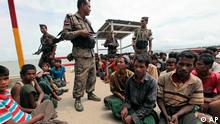 Bangladesh has started turning Rohingya away
Myanmar's Rohingyas live predominantly in the western state of
Rakhine. They are not officially recognized by the Burmese government as
an ethnic minority group, and for decades they have been subjected to
discrimination and violence by the Buddhist majority.
Viewed by the United Nations and the US as one of the world's most persecuted minorities, many Rohingyas have fled to neighboring countries such as Bangladesh and India to escape persecution.
Despite the fact that Myanmar has embarked on a series of political and economic reforms, human rights organizations and activists say the situation of Myanmar's ethnic communities has not improved significantly.
Mark Farmaner, head of the Burma Campaign UK, says that anti-Muslim prejudice is not restricted to the Rohingyas, and that it is certainly on the rise.
"While I was in Myanmar just before the start of the crisis, I came across anti-Muslim prejudice everywhere. This prejudice is encouraged by the Burmese government, with ministers making derogatory remarks about Muslims publicly," said Farmaner.
But experts say it is difficult to get credible information out of the region. They say it is hard to tell the difference between rumors, propaganda and the truth.
Sources Here :
"In the past few days, many Burmese Buddhists have launched a series of attacks on Muslims," Islam said. "They are posting derogatory texts and pictures about Islam on social networking websites. They seem to be retaliatory attacks.”
Last month, an outbreak of anti-Buddhist rioting in Bangladesh left at least four temples and dozens of homes gutted by fire. Muslims had taken to the streets to protest against an internet photo they said defamed Islam. At least 20 people were believed to have been injured in these riots. The rioters targeted the Bangladeshi town of Ramu and its adjourning villages, some 350 kilometers (216 miles) from the capital, Dhaka.
Deadly riots erupted in Myanmar's Rakhine state in June. Rohingya activists claim that more than 650 Rohingyas have so far been killed in these riots.
"After the violence broke out in Rakhine in June, the Buddhists started using social networking sites to organise attacks on Rohingyas," Aung Kyaw Oo, a member of the Rohingya community, told DW. "Now, after the attacks on Buddhists in Bangladesh, they have taken the anti-Rohingya campaign to a new height."
The prejudice
Bangladesh has started turning Rohingya awayViewed by the United Nations and the US as one of the world's most persecuted minorities, many Rohingyas have fled to neighboring countries such as Bangladesh and India to escape persecution.
Despite the fact that Myanmar has embarked on a series of political and economic reforms, human rights organizations and activists say the situation of Myanmar's ethnic communities has not improved significantly.
Mark Farmaner, head of the Burma Campaign UK, says that anti-Muslim prejudice is not restricted to the Rohingyas, and that it is certainly on the rise.
"While I was in Myanmar just before the start of the crisis, I came across anti-Muslim prejudice everywhere. This prejudice is encouraged by the Burmese government, with ministers making derogatory remarks about Muslims publicly," said Farmaner.
But experts say it is difficult to get credible information out of the region. They say it is hard to tell the difference between rumors, propaganda and the truth.
Sources Here :
.png)
The Best Solutions to Solve Rakhine and Rohingya issues in Arakan State Myanmar
I still remember every single day of my life where I grown up in Maungdaw Township, Arakan State. We went to school without any fear, bullying and discrimination. We also went to the Mosque, Arabic school for practising Islam. We also participated in various National Event day activities including sport. I also remember one of cousin who is also my neighbour won 26 miles marathon by completing his run with 2hrs and 23mins on Union day sport celebration which is on 12th of February every year. During the winter pick seasons from November to February, Rakhine and Rohingya were always involving together on early morning jogging on the main Road which is connected Maungdaw and Buthidaung townships. Rohingya and Rakhine were always sharing food which usually provide by Lord of the farmers mainly Rohingya. (Lay Pying Shin). We also share sports together such as football, volleyball, Chin Lone. The most amazing event is Buffalo fight during the winter where Rakhine and Rohingya were attended together to enjoy.
Rohingya and Rakhine fail to realise that the grass root of harmonies are slowly infecting with various poison since Ne Win implemented 1982 citizenship Law. My personal feeling is that Rakhine are a looser on failing to realise so. Arakan state is called Rakhine State. Rakhine state is branded to be own by Rakhine, not Rohingya but Rohingya are belong Rakhine state (Arakan State). No one can deny that. On every state in Burma (Myanmar) or perhaps in any part of the world people are to live together regardless of race, ethnicity and religious. It is just like an example of having different types of Flower in the Flower Garden. I personally don’t blame to neither Rakhine community nor Rohingya for the recent riot in Arakan and also their continually built hatred on Rohingya. I simply want to say that they are not clever enough by not realising that they are falling into well prepared Ne Win and Than Shwe poisonous weapon which were designed to divert their crime, Politics and to hold up power as long as they live in this world.
1982 Citizenship Law is the only physically visible document among the equipment which used to fix Ne Win and Than Shwe’s political black hole. There are many others which are invisible but can realise only if someone have been to Arakan State particularly northern part. The most powerful weapon beside 1982 citizenships law was implementing hatred and bullying through institutions such as school, government offices, and government departments. High ranking government officials never incite hate and bullying directly. They just ignite to implement hate and bully to their staffs who were Rakhine against Rohingya and Rakhine took advantage to start spreading. From school, it spread to young children, from government offices it spread to the parent, from government department it spread to the general public.
I started feeling racial discrimination, bullying and hate since 1990s when SLORC came to power. General Khin Nyint who is lefthand man of Nay Win succeeded his God father policy towards Rakhine and Rohingya. Khin Nyint is the person who understand very well on how to incite between Rakhine and Rohingya as he career grown from northern part of Maungdaw Townships in Rohingya village. He even called a Rohingya Person named Abdul Salam from Bolly Bazar as God father who always feed him the best foods, fruits and milk from his farm. Khin Nyint visited his house during his power several times when ever he went to Maung Daw townships. But on another side he is not loyal to his Rohingya God father instead he is more Loyal to his Military God father. 9 out 10 Rohingya believed that Khin Nyint is master mind on Rohingya extermination program by using Rakhine as a fuel to burn down.
Arakan State is fully infected with poisonous virus before 2010 election. No one from new government considered or considering to cure it on their effort to change the country from the darkness to the light for two reasons. First is as the Rohingya issues become so complicated due to Rakhine built up their hate on Rohingya as implemented by passed government and another is Government itself not taking it seriously because of worry that Rakhine may be fighting like Kachin to get Natural recourses share from Arakan State or separate state. President Thein Sein and most of his high level government official’s background is the same regimes as before 2010 who were familiar with rakhine state which is easy to turn political war fare to Communal Riot to divert attention.
I believed solving Rakhine state issues between rohingya and Rakhine can only be through institution such as school, Government offices and Government department. Thien Sein government need to remove all invisible poisonous system from Arakan State and develop institution which develop visible harmony. School teachers need to be trained to teach children against hate, racial discriminations and bullying. This shall be part of national school curriculum.A system need to set up for fairness, a law need to implement for Racial attack or harassment, equal opportunity shall be for both Rohingya, Rakhine and other ethnic need to be in place, Judgment on criminals for both Rohingya and Rakhine shall be according to Law but not according to their background. No matter how much UN, Europe, UK, USA, OIC AND ASEAN will try their best to bring peace in Arakan State, surely peace will not come until President Thein Sein has set up all of above through his Presidency Power and Parliament. Here are some my slogan to Rakhine;
Rohingya only want peace. Not Riot
I still remember every single day of my life where I grown up in Maungdaw Township, Arakan State. We went to school without any fear, bullying and discrimination. We also went to the Mosque, Arabic school for practising Islam. We also participated in various National Event day activities including sport. I also remember one of cousin who is also my neighbour won 26 miles marathon by completing his run with 2hrs and 23mins on Union day sport celebration which is on 12th of February every year. During the winter pick seasons from November to February, Rakhine and Rohingya were always involving together on early morning jogging on the main Road which is connected Maungdaw and Buthidaung townships. Rohingya and Rakhine were always sharing food which usually provide by Lord of the farmers mainly Rohingya. (Lay Pying Shin). We also share sports together such as football, volleyball, Chin Lone. The most amazing event is Buffalo fight during the winter where Rakhine and Rohingya were attended together to enjoy.
Rohingya and Rakhine fail to realise that the grass root of harmonies are slowly infecting with various poison since Ne Win implemented 1982 citizenship Law. My personal feeling is that Rakhine are a looser on failing to realise so. Arakan state is called Rakhine State. Rakhine state is branded to be own by Rakhine, not Rohingya but Rohingya are belong Rakhine state (Arakan State). No one can deny that. On every state in Burma (Myanmar) or perhaps in any part of the world people are to live together regardless of race, ethnicity and religious. It is just like an example of having different types of Flower in the Flower Garden. I personally don’t blame to neither Rakhine community nor Rohingya for the recent riot in Arakan and also their continually built hatred on Rohingya. I simply want to say that they are not clever enough by not realising that they are falling into well prepared Ne Win and Than Shwe poisonous weapon which were designed to divert their crime, Politics and to hold up power as long as they live in this world.
1982 Citizenship Law is the only physically visible document among the equipment which used to fix Ne Win and Than Shwe’s political black hole. There are many others which are invisible but can realise only if someone have been to Arakan State particularly northern part. The most powerful weapon beside 1982 citizenships law was implementing hatred and bullying through institutions such as school, government offices, and government departments. High ranking government officials never incite hate and bullying directly. They just ignite to implement hate and bully to their staffs who were Rakhine against Rohingya and Rakhine took advantage to start spreading. From school, it spread to young children, from government offices it spread to the parent, from government department it spread to the general public.
I started feeling racial discrimination, bullying and hate since 1990s when SLORC came to power. General Khin Nyint who is lefthand man of Nay Win succeeded his God father policy towards Rakhine and Rohingya. Khin Nyint is the person who understand very well on how to incite between Rakhine and Rohingya as he career grown from northern part of Maungdaw Townships in Rohingya village. He even called a Rohingya Person named Abdul Salam from Bolly Bazar as God father who always feed him the best foods, fruits and milk from his farm. Khin Nyint visited his house during his power several times when ever he went to Maung Daw townships. But on another side he is not loyal to his Rohingya God father instead he is more Loyal to his Military God father. 9 out 10 Rohingya believed that Khin Nyint is master mind on Rohingya extermination program by using Rakhine as a fuel to burn down.
Arakan State is fully infected with poisonous virus before 2010 election. No one from new government considered or considering to cure it on their effort to change the country from the darkness to the light for two reasons. First is as the Rohingya issues become so complicated due to Rakhine built up their hate on Rohingya as implemented by passed government and another is Government itself not taking it seriously because of worry that Rakhine may be fighting like Kachin to get Natural recourses share from Arakan State or separate state. President Thein Sein and most of his high level government official’s background is the same regimes as before 2010 who were familiar with rakhine state which is easy to turn political war fare to Communal Riot to divert attention.
I believed solving Rakhine state issues between rohingya and Rakhine can only be through institution such as school, Government offices and Government department. Thien Sein government need to remove all invisible poisonous system from Arakan State and develop institution which develop visible harmony. School teachers need to be trained to teach children against hate, racial discriminations and bullying. This shall be part of national school curriculum.A system need to set up for fairness, a law need to implement for Racial attack or harassment, equal opportunity shall be for both Rohingya, Rakhine and other ethnic need to be in place, Judgment on criminals for both Rohingya and Rakhine shall be according to Law but not according to their background. No matter how much UN, Europe, UK, USA, OIC AND ASEAN will try their best to bring peace in Arakan State, surely peace will not come until President Thein Sein has set up all of above through his Presidency Power and Parliament. Here are some my slogan to Rakhine;
Rohingya only want peace. Not Riot
Rohingya only want to live hormonally with Rakhine and all other ethnic in Arakan State.
Rohingya only want to live as a Citizen of Burma as they are before.
Rohingya only want equal rights same as all ethnic from Burma.
By
Ahamed Jarmal,
By
Ahamed Jarmal,
Arakan Born Senior Civil Engineer from London
RB News Desk.
-
 "Although mass killings and exterminations of human races were some sort of things that the world experienced during Nazi German p...
 -
 RB News March 31, 2018 Minbya, Arakan State : On March 30 morning, a Prayer Leader or Imam was brutally beaten and injured by a Rakh...
 -
 ဇြန္လ ၁၇ ရက္ ၊ ၂၀၁၂ Source: guardian.co.uk ျမန္မာျပည္သစ္အတြက္ အနာဂတ္မွာ ေအာင္ျမင္မွာလား၊ က်ရွဳံးမွာလားဆိုသည္ကို ညႊန္ျပေသာ စမ္းသပ္မွဳ တစ...
 -
 ပါလီမန္အမတ္ဦးေရႊေမာင္ၿပည္သူ႔လြတ္ေတာ္တြင္ရခိုင္ၿပည္နယ္၌ၿဖစ္ပြါးခဲ့ေသာအေရးအခင္းနဲ့ ပတ္သက္၍ေဆြးေနြးတင္ၿပၿခင္း။ (14th day of regular ses...
 -
 More than 400,000 Rohingya have fled from Myanmar to neighbouring Bangladesh By BBC News September 17, 2017 Myanmar's de ...
 -
 At Baggona, a village three miles far from and lies to the South of Maung Daw of Arakan state, more than 80 Rohingya women and girls have be...
 -
 The custodian of Two Holy Mosques King Abdullah bin Abdul Aziz Al Saud Aug 11 The custodian of Two Holy M...
 -
ရက္စြဲ – ေမ ၂၉ ၊ ၂၀၁၂ သို ့ အယ္ဒီတာ၊ နိရဥၥရာ သတင္းဌာန နိရဥၥရာ သတင္းဌာနမွ ေမလ ၂၉ ရက္ေန ့ ထုတ္ျပန္သည့္ ရမ္းျဗဲတြင္ အသက္ ၁၆ ႏွ...
-
 RB ANDROID APPLICATION LAUNCHED… Now, RB News Can Be Read On Smartphone With Android OS. RB News July 4, 2013 Here is a g...
 -
 Thousands of Rohingya flee religious persecution in Myanmar, many dying along the way. Thanks to Anonymous, #RohingyaNOW is trending on ...

Popular Posts
Threatwiki

Amartya Sen: Burma's "slow genocide" of Rohingyas

Watch Professor Amartya Sen speak on what he calls Burma's 'slow genocide' of Rohingya, Harvard, 4 Nov 2014
