

M.S. Anwar
RB News
September 19, 2012
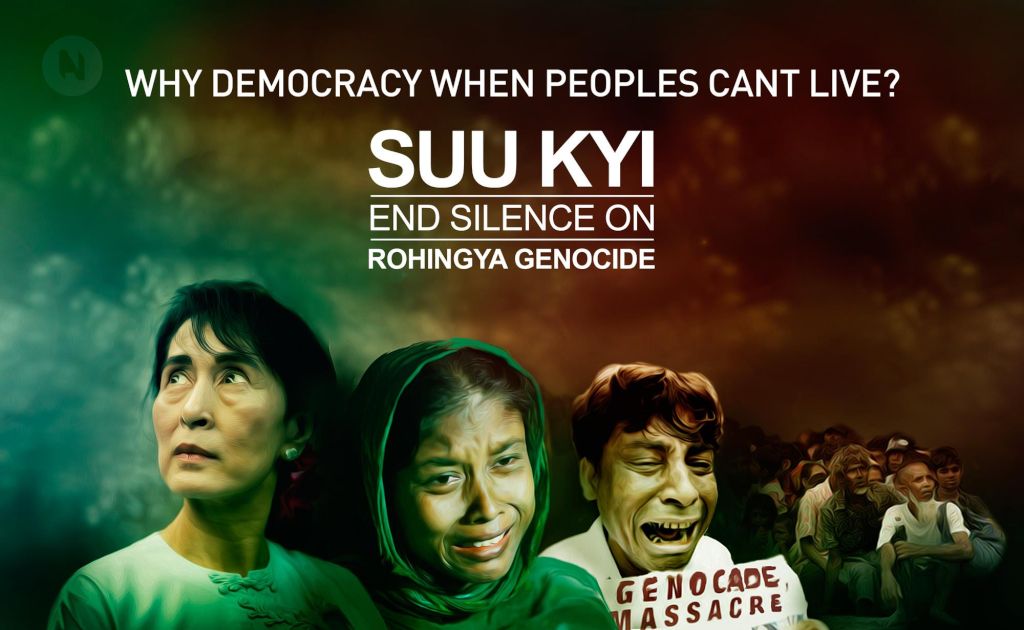
Maung Daw, Arakan - While Daw Aung San Suu Kyi is celebrating and enjoying her visit in US showing no signs of care for the ongoing humanitarian disasters in her country, the atrocities, looting, arbitrary extortion of money and forced labouring continue there. On the other hand, Burmese regime is deceiving the world by declaring that they are carrying out investigations into the violence and the same regime is carrying out the atrocities against Rohingyas in cooperation with Rakhine extremists.
“At 5:30 PM on 17th September 2012, Salimullah son of Abdul Shukkur (35 years old) from Du Shira Dan village of southern Maung Daw was found dead nearby a forest. At 11 AM of the day, he left his house in order to pick up some vegetables from the forest and was subsequently got slaughtered and killed. It happened nearby the residential place of Rakhines. Later his dead body was taken to the NaSaKa (Border Security Forces) station at Magyi Chaung in southern Maung Daw. Besides, on 18th September 2012, one more Rohingya was found dead nearby a village of Rakhines in Baggona” said Nyi Nyi Aung from Maung Daw.
“Authority of southern Maung Daw announced that each and every Rohingya above the age of 12 in the village Baggona were involved in the violence. Hence, all Rohingyas in the village including under-aged children are portrayed as criminals irrespective to whether they have committed crimes or not. And authority is going to arrest all Rohingyas from the village as they announced. Therefore, the village is regularly raided by Police, NaSaKa etc. As result, most of Rohingyas in the village cannot stay in their homes and are on hiding. Is it according to the law or arbitrary arrests and tortures of Rohingyas. If it is according to the law, what kind of law is it?” A. Faiz, a Rohingya from Sothern Maung Daw, exclaimed.
“At 10:00 AM on 17th September 2012, Noor Hakim, an educated Rohingya youth from Quarter 5 of Maung Daw, was arrested by the police officer Hla Myint, a Rakhine. He was arrested when he was on his way to opening his shop and subsequently charged with unknown cases. (The government ordered to resume their businesses and reopen their shops. When Rohingyas do, they are arrested.) In addition, Noor Hakim was the sole caretaker of his whole family because his father, Abdul Razak, was arrested with other Rohingya scholars in 2008 and locked up for months. When he came out of the lock-up, he was forced to leave the country by the authority.
Similarly, at 4:00 PM on 18th September 2012, Rabiul Alam (28 years) son of U Ausi Rahman from Quarter 5, Maung Daw was arrested by the same police officer. He was arrested because he refused to give money demanded by the police officer. On top of that, at 8:30 AM on 19th September 2012, a Son of Amir Saab Kamal Uddin from Bohmuu Village of Maung Daw was arrested again by the same police officer. The police officer released him after extorting money amounting Kyat 6 Lakhs. The arrested Rohingyas are taken to the Buthidaung jail after following day of their arrests, where they are tortured to death. It is said that the police officer is the currently in charge of Maung Daw and he is doing all kind atrocities possible to Rohingyas. Besides, he has been a police officer in Maung Daw for decades without any transfer to other places.
According to district administrator of Maung Daw, the court released an arrest warrant to arrest 190 Rohingyas more. Additionally, he threatened that the actual arrests could exceed the number mentioned. Therefore, every Rohingya in Maung Daw is living his daily life in fear. Moreover, at 8:00 PM on September 19, 2012, a group of NaTaLa and Rakhine extremists together with Military went to attack the Rohingya villagers in DuChira Dang of southern Maung Daw. When the villagers resisted, they left. Yet, the villagers are not being able to sleep in the fear of possible forthcoming attacks” reported by Riyaz, a Rohingya youth, from Maung Daw.
Though the Burmese government is externally claiming that the situation has calmed down, they have been committing all the atrocities silently. In fact, Arakan has a silent killing field and mass graves of Nazi Extermination Camps where Rohingyas are being cleansed on daily basis.

CAIRO – Burma’s opposition leader and democracy icon Aung San Suu Kyi opened a two-week visit to the United States on Tuesday, September 18, with the persecution of Bengali-ethnic Muslims, known as Rohingya, overshadowing her tour.
“I am one of the internal refugees of your country living in a muddy and miserable camp of Sittwe,” a displaced Rohingya Muslim says in an open letter cited by Eurasia Review.
“The World knows the reason of being refugees in Arakan State.
Thousands of Rohingya Muslims were forced to flee their homes after ethnic violence rocked the western state of Rakhine in July after the killing of ten Muslims in an attack by Buddhist vigilantes on their bus.
The attack came following the rape and killing of a Buddhist woman, for which three Rohingyas were sentenced to death.
Human rights groups have accused Burmese police and troops of disproportionate use of force and arrests of Rohingyas in the wake of the riots.
Human Rights Watch has accused Burmese security forces of targeting Rohingya Muslims with killing, rape and arrest following the unrest.
“I attached you some statements of Rohingya raped victims,” the displaced Muslim writes in his letter.
“I was informed 500 rape cases. I have hundreds of photo and video evidences which are against human rights. If you want I can send all those evidences to you.”
Suu Kyi, who won the 1991 Nobel Peace Prize for championing democracy in opposition to a ruthless military junta that held her under house arrest for years, arrived in the US on a two-week visit on Tuesday.
The democracy icon will be feted by the US Congress, human rights groups and Washington think tanks.
She will also visit the large emigre community from her country in Fort Wayne, Indiana, and make a series of public speeches from New York to California.
But her visit is expected to be overshadowed by the ongoing persecution of Rohingya Muslims in Burma (Myanmar).
Sui Kyi has been under fire over being silent on the persecution on the sizable Muslim minority.
When asked during her recent visit to Europe, where she was feted as heroine of democracy, whether Muslim Rohingyas are citizens of Myanmar, Suu Kyi said she did not know.
"When you talk about the Rohingya, we are not quite sure whom you are talking about," she said.
"There's some who say those people who claim to be Rohingyas are not the ones who are actually native to Burma but have just come over recently from Bangladesh."
Muslim Rights
The displaced Muslim lamented the democracy icon’s silence on the suffering of the Rohingyas.
“When you said “I don’t know Rohingya” I was so shocked,” the open letter says.
“How could a Noble Prize Winner deny a reality?” the writer asks. “Could you please let us know that based on what documents did you dare to deny Rohingya?”
“If you think that Rohingya history is not reliable, and then you could better form a commission of World historians who could easily decide authenticity of Rohingya history, you shouldn’t deny its existence.”
The letter says many Rohingya Muslims have learnt from Sui Kyi’s struggle for democracy in Burma.
“You encouraged us not to be fear but why do you have fear now,” the writer says.
“Isn’t it for losing power by getting vote in the next election? Or could you please tell us the reason for denial of reality?”
The writer says that the Burmese democracy icon wrote very beautifully about human rights.
“Don’t you feel that Rohingya are also human being like you?”
Described by the UN as one of the world's most persecuted minorities, Rohingya Muslims are facing a catalogue of discrimination in their homeland.
They have been denied citizenship rights since an amendment to the citizenship laws in 1982 and are treated as illegal immigrants in their own home.The Burmese government as well as the Buddhist majority refuse to recognize the term "Rohingya", referring to them as "Bengalis".
Sources Here:

The victim was identifies as Arafa (45), wife of late Shafi, hailed from Khonza Bill of Maungdaw Township. She was severely beaten up at the Natala village of Udaung village tract.
On that day, in the morning, the two cattle of Arafa’s relatives was taken away by military along with Natala villagers ( Mogh) while the cattle were grazing in a field nearby Rohingya village.
On information, she went to the Natala village to bring the seized cattle from the hands of military and Natala villagers.
When she reached to the Natala village, she was coerced to bow down the Buddhist Pagoda with her forehead by the Moghs. When she refused, she was severely tortured by them, according to a close relative of the victim.
However, she was released with the cattle after taking Kyat 30,000. Army or Nasaka with the collaboration of Natala villagers are taking away the cattle of Rohingya villagers while grazing in the field, said a local youth preferring not to be named.
According to different sources, the persecutions and religious discrimination are increased against the Rohingya community in northern Arakan State day by day.
Source : KPN
 |
| Benjamin Zawacki says Myanmar should amend its citizenship law |
KUALA LUMPUR: A FORMER Amnesty International Thailand researcher said violence against the Rohingya in Myanmar was because of systemic discrimination, which was manifested in law, policy and practices of the Myanmar government.
In his presentation at the Perdana Global Peace Foundation international conference on "Plight of the Rohingya: Solutions?" on Monday, Benjamin Zawacki said the system made such direct violence against the Rohingya far more possible and likely than it would otherwise be.
"In the eyes of the Myanmar authorities, at least as evidenced by the lack of accountability for civilians and officials alike, discrimination also makes the violence and violations somehow justifiable. That is the problem."
The international consultant, a law graduate from Pennsylvania, the United States, said the Rohingya's sufferings began with the 1978 "Dragon King" operation, where the Myanmar army committed widespread killings and rape of Rohingya civilians and mass destruction of mosques and other religious persecution, resulting in the exodus of about 200,000 Rohingya to Bangladesh.
"A similar campaign of forced labour, summary executions, torture and rape in 1992 led to a similar number of Rohingya again fleeing across the border.
"In February 2001, communal violence between the Muslim and Buddhist populations in Sittwe resulted in an unknown number of people killed and Muslim property destroyed.
"Late 2009 featured the pushing back by Thai authorities onto the high seas."
He said that if Myanmar had never put its system of discrimination against the Rohingya into place, these events would not have occurred.
"Eliminating it (systemic discrimination) now is urgently required for a sustainable future peace in Rakhine state and is a human rights imperative."
Zawacki said the core of Myanmar's systemic discrimination against the Rohingya was its 1982 Citizenship Law, which denies the right of nationality to the Rohingya population.
"The law creates three classes of citizens -- full, associate, and naturalised -- none of which has been conferred on the Rohingya.
"Full citizenship is reserved for those whose ancestors settled in Myanmar before 1823 or are among Myanmar's more than 130 recognised national ethnic groups, of which the Rohingya are not one."
Zawacki said the Rohingya, lacking citizenship were, therefore, rendered stateless and subjected to policies and practices which constituted violations of their human rights and fundamental freedoms.
"These include restrictions on movement, forced labour, land confiscation, forced eviction, and destruction of houses, extortion and arbitrary taxation, and restrictions on marriage, employment and education.
A solution to the Rohingya problem, said Zawacki would be for the Myanmar government to amend the Citizenship Law or repeal it, so that the Rohingya could be made citizens.
Source here
My dear Mother Suu,
I am one of the internal refugees of your country living in a muddy and miserable camp of Sittwe, the World know the reason of being refugees in Arakan State.
Your father, our national independence architect, General Aung San, was brilliant national hero who sowed the seed of democracy in Myanmar soil, who made just and fair foundation of national constitution in 1947 in which all ethnic groups could happily participate including 2 Rohingya scholars. He knew both Rakhine and Rohingya very well, he was reported in detail information of Arakan State by Bo Yan Naing who was responsible for Arakan State in his time.
When you wrote “ Freedom from Fear”, we were very happy and learnt many things from your writing. We admire you and your father, our national hero. Your father and you gave us advices to follow the reality and to be honest, just, and kind.
Rohingya issue became an international issue since 1970s. UN, NGOs, and all of the World leaders know it. When you said “ I don’t know Rohingya “, I was so shocked. How could a Noble Prize Winner deny a reality? Could you please let us know that based on what documents did you dare to deny Rohingya? There are hundreds of historical documents and monuments, thousands of historians including Rakhine, Bamar, and foreign scholars wrote about Arkanese Muslims, Rohingya.
If you think that Rohingya history is not reliable, and then you could better form a commission of World historians who could easily decide authenticity of Rohingya history, you shouldn’t deny its existence.
There were more than 140 ethnic groups including Rohingya in Burma. Dictator Ne Win reduced the numbers to 135 which included Kokant, and Wa, two newly recognized ethnics, in order to deprive the right of Muslims and Christains minorities. You opposed Ne Win but you would like to agree his idea. I don’t hate dictators but I hate their ideas. You don’t like the name, Myanmar instead of Burma because it was not decided in democratic way. Why do you like dictators’ decision of annihilating Rohingya who were approved by your father , second national hero U Nu, and parliament democratic government. U Nu was accused of religious person who wanted to make Burma as a Buddhist country but he didn’t deny Rohingya like racist dictators.
You wrote: It is not power that corrupts but fear. Fear of losing power corrupts those who wield it and fear of the scourge of power corrupts those who are subject to it. Most Burmese are familiar with the four a-gati, the four kinds of corruption. Chanda-gati, corruption induced by desire,is deviation from the right path in pursuit of bribes or for the sake of those one loves. Dosagati is taking the wrong path to spite those against whom one bears ill will, and moga-gati is aberration due to ignorance. But perhaps the worst of the four isbhaya-gati, for not only does bhaya, fear, stifle and slowly destroy all sense of right and wrong, it so often lies at the root of the other three kinds of corruption. Just as chanda-gati, when not the result of sheer avarice, can be caused by fear of want or fear of losing the goodwill of those one loves, so fear of being surpassed, humiliated or injured in some way can provide the impetus for ill will. And it would be difficult to dispel ignorance unless there is freedom to pursue the truth unfettered by fear. With so close a relationship between fear and corruption it is little
wonder that in any society where fear is rife corruption in all forms becomes deeply entrenched.
You encouraged us not to be fear but why do you have fear now. Isn’t it for losing power by getting vote in the next election? Or could you please tell us the reason for denial of reality?
You wrote very beautifully regarding human right: In an age when immense technological advances have created lethal weapons which could be, and are, used by the powerful and the unprincipled to dominate the weak and the helpless, there is a compelling need for a closer relationship between politics and ethics at both the national and international levels. The Universal Declaration of Human Rights of the United Nations proclaims that ‘every individual and every organ of society’ should strive to promote the basic rights and freedoms to which all human beings regardless of race, nationality or religion are entitled. But as long as there are governments whose authority is founded on coercion rather than on the mandate of the people, and interest groups which place short-term profits above long-term peace and prosperity, concerted international action to protect and promote human rights will remain at best a partially realized struggle. There will continue to be arenas of struggle where victims of oppression have to draw on their own inner resources to defend their inalienable rights as members of the human family.
Don’t you feel that Rohingya are also human being like you? Do you want to implement neo-racism in Burma? I attached you some statements of Rohingya raped victims, I was informed 500 rape cases. I have hundreds of photo and video evidences which are against human rights.
If you want I can send all those evidences to you.
You wrote: Within a system which denies the existence of basic human rights, fear tends to be the order of the day. Fear of imprisonment, fear of torture, fear of death, fear of losing friends, family, property or means of livelihood, fear of poverty, fear of isolation, fear of failure. A most insidious form of fear is that which masquerades as common sense or even wisdom, condemning as foolish, reckless, insignificant or futile the small, daily acts of courage which help to preserve man’s self-respect and inherent human dignity. It is not easy for a people conditioned by fear under the iron rule of the principle that might is right to free themselves from the enervating miasma of fear. Yet even under the most crushing state machinery courage rises up again and again, for fear is not the natural state of civilized man.
You know the condition of iron rule but you don’t want to be practical regarding Rohingya issue, why? Could you please tell us the reason?
You said:
When I met Burmese migrant workers and refugees during my recent visit to Thailand, many cried out: “Don’t forget us!” They meant: “don’t forget our plight, don’t forget to do what you can to help us, don’t forget we also belong to your world.” When the Nobel Committee awarded the Peace Prize to me they were recognizing that the oppressed and the isolated in Burma were also a part of the world, they were recognizing the oneness of humanity. So for me receiving the Nobel Peace Prize means personally extending my concerns for democracy and human rights beyond national borders. The Nobel Peace Prize opened up a door in my heart.
Everyday people are dying in the Rohingya Camps, most of them died lack of health care; pregnant women, children, and aged people. Today, Fathawli, 26, daughter of Abul Kalam from Thechaung Camp died during the delivery, both mother and baby died. There is no medication in Muslim Camps. If you look Buddhist Rakhine so called Camp , you can see doctors, nurses, and medicine store. Where have your voices of human rights gone? Why are you so silent? Who forced you to close your mouth? Isn’t it fear?
Every human being has a right giving a name to his or her child. Every group has a right to give its own name even according to 2008 Myanmar law. Concerning Rohingya, you don’t want to recognize their name and you don’t like restoring their citizenship rights which was approved by the elected parliament democratic government. What is the reason for these double standards?
Since 1948, Rakhine people have been enjoying in full ethic rights, and in 1976 promoted them with State right too; for them, Rakhine State is a Paradise but for the Rohingya it is not more than hell-like prison since 1970s. Hundreds of operations had already been conducted by military, immigration staffs, and security forces to find out illegal immigrants from Bangladesh but they failed to prove even a single family. You can see thousands of Rohingya refugees all over the world, you may hear boat people, and thousands of Rohingya were killed while travelling to Yangon and other countries.
In Bangladesh, there were more than 3 million Rakhine Buddhists before Burmese Independence but now it reduced to less than one million, nobody asked where the rest has gone, why? You can not see any Myanmar ambassador who is Muslim, Bangladesh has many officers and ambassador who is Buddhists, current Bangladesh ambassador of Myanmar is a Buddhist.
Politic shouldn’t be a dirty game, it should be a way toward peaceful global family. In a family, everyone can eat according to his or her choice but no one has a right to force eating what he or she doesn’t like, no one has right to blame or criticize.
If you have a mother’s Metta, affection, please raise your voice for us too as you do for other ethnics.
Yours extremely suffering son,
Aung Aung Oo
Chain Pain Road
Kun Dan Quarter
Sittwe(Akyab)
Myanmar(Burma)
 |
| RFA Aung San Suu Kyi (l) speaks with RFA's Burmese service in Washington, Sept. 18, 2012. |
2012-09-18
Burmese democracy icon Aung San Suu Kyi says the Rohingya conflict should be resolved through negotiations.
Updated at 6:30 p.m. EST on 2012-09-18
Burmese opposition leader Aung San Suu Kyi called Tuesday for the removal of the "roots of hatred" that have fueled the conflict between ethnic Rakhines and Muslim Rohingyas in western Burma, saying the issue has to be resolved through respect for human rights and rule of law, and negotiations.
"Basically, whenever there is hate, there is fear. So, hate and fear are very closely related. You have to remove the roots of hatred—that is to say you have to address these issues that make people insecure and that make people threatened," she told RFA's Burmese service in an interview.
"Whenever people talk about conflict resolution, whatever kind of advice they give, there is one that is unavoidable—you have to talk to one another, you have to negotiate, you have to sort out your problems through speech rather than violence," she said.
Aung San Suu Kyi has been criticized by rights groups for not speaking out more forcefully on the Rohingya issue following bloody violence between the Rohingya and Rakhine communities in Rakhine state in June, which killed 80 people and left tens of thousands displaced.
The clashes had sparked international allegations that human rights violations were being committed against the Rohingya, who the United Nations says are the world's most oppressed group. The Burmese authorities do not regard them as an ethnic group even though they have lived for generations in the country.
Last week, exiled Tibetan spiritual leader the Dalai Lama told students in India that he had written to Aung San Suu Kyi about the Rohingya issue but did not receive a response.
"We wrote a letter to Suu Kyi regarding the violence but we got no reply. My representative in [New] Delhi even met the Burmese Ambassador here but it has been four weeks and we have not heard from them. There is no channel for us to approach," the Dalai Lama said, according to the Press Trust of India.
Silence
In an indirect reference to her relative silence on the Rohingya issue, Aung San Suu Kyi said earlier that many did not realize that her National League for Democracy (NLD), the main opposition party in parliament, was not in the government.
She said that the NLD is not in a "position to decide what we do and how we operate because we are not a government."
"This needs to be understood by those who wish the NLD to do more."
Aung San Suu Kyi, who arrived on Monday for a nearly three-week U.S. visit, also explained that her NLD gives top priority to human rights and the rule of the law in any resolution of the conflict, noting that such differences are a universal problem and not confined to Burma only.
"I have always said—this is the policy of my party—that human rights and rule of law are necessary in order to bring down tensions in such a situation."
"But in the long run, you have to build up harmony between the communities through understanding, through exchange."
She also stressed that human rights should be applied to "everybody and equally" to all groups.
"To ignore either human rights or rule of law or to insist on human rights and pretend rule of law is another matter will not work. These two have to go together."
Aung San Suu Kyi also said that her NLD party wants to help the government to end the crisis in Rakhine state.
"We [the NLD] do not want to make political capital out of the situation in Rakhine state. We want to give the government all the opportunities it needs to defuse the situation there," she said earlier when speaking at a Washington forum organized by the Asia Society.
"We want to help the government in any way possible to bring about peace in Rakhine state."
'Great concern'
Two weeks ago, the United States expressed “great concern” over the humanitarian situation in Rakhine state, following a visit by the American ambassador to the area.
"Broad swathes of both communities have been affected, and the humanitarian situation remains of great concern,” the U.S. Embassy in Rangoon said in a statement after the visit by a group led by newly appointed Ambassador Derek Mitchell and senior State Department official Joseph Yun.
“Going forward, it will be important to address the urgent needs, while also laying the groundwork for a long-term, sustainable and just solution” to the conflict, the embassy said.
Burmese President Thein Sein recently suggested that the Rohingyas should be deported, raising an outcry from rights groups. Thousands of Buddhist monks took to the streets to back his call and protest against the Rohingyas.
Aung San Suu Kyi also touched on the following subjects in her interview with RFA:
Transition to democracy:
Asked what her biggest concern was during the current transition in Burma, she said, “My great concern is to empower the people to be able to build the kind of society they want. That is what democracy means,” she said.
Consensus building:
Burma, she said, suffered a setback during years under a poor education system and has more work to do to build up a “healthy political culture” in which people are willing to compromise, she said.
“We are weak when it comes to negotiated compromise. It’s not part of our society or culture.”
But she said that the people were learning quickly. “If we had not been capable of negotiated compromise, we would not be where we are now.”
Speculations that Thein Sein will win the next Nobel Peace Prize:
Asked if Thein Sein could be awarded the next Nobel Peace Prize for spearheading Burma’s reforms since his government came to power last March, she said she had not heard it was a possibility.
“I don’t believe in engaging in speculation,” she said.
In her remarks at the Asia Society, she also spoke on:
2010 elections held by the previous military junta:
She said that the opposition had “grave doubts” about how the government conducted the 2010 elections, which were widely seen as “deeply flawed.”
The NLD had been banned for boycotting the 2010 elections, but the reformist President Thein Sein allowed the party to re-register after his nominally-civilian government took power in March last year.
Concerns over the Constitution framed by the junta:
Aung San Suu Kyi criticized the current government for requiring new members of parliament from her party to swear to promise to protect the 2008 constitution which “we felt was not conducive to the building of a genuine democratic society.”
The constitution guaranteed that the military would maintain a chokehold on the parliament.
Easing of sanctions:
"I do support the easing of sanctions because I think that our people must start to take responsibility for their own destiny," she said.
"We should not depend on U.S. sanctions to keep up the momentum for democracy. We have got to work at it ourselves."
Containing China:
“It does not mean that because the U.S. is engaging with Burma it should in any way be seen as a hostile step towards China,” she said. China was a key ally of Burma during the decades of military rule.
“We can use our new situation to strengthen relations between all three countries. For us—to put it very simply—it would be to our advantage for the U.S. and China to establish friendly relations.”
Reported by Nyein Shwe for RFA's Burmese service. Written in English by Parameswaran Ponnudurai, Joshua Lipes and Rachel Vandenbrink.
Burmese democracy icon Aung San Suu Kyi says the Rohingya conflict should be resolved through negotiations.
Updated at 6:30 p.m. EST on 2012-09-18
Burmese opposition leader Aung San Suu Kyi called Tuesday for the removal of the "roots of hatred" that have fueled the conflict between ethnic Rakhines and Muslim Rohingyas in western Burma, saying the issue has to be resolved through respect for human rights and rule of law, and negotiations.
"Basically, whenever there is hate, there is fear. So, hate and fear are very closely related. You have to remove the roots of hatred—that is to say you have to address these issues that make people insecure and that make people threatened," she told RFA's Burmese service in an interview.
"Whenever people talk about conflict resolution, whatever kind of advice they give, there is one that is unavoidable—you have to talk to one another, you have to negotiate, you have to sort out your problems through speech rather than violence," she said.
Aung San Suu Kyi has been criticized by rights groups for not speaking out more forcefully on the Rohingya issue following bloody violence between the Rohingya and Rakhine communities in Rakhine state in June, which killed 80 people and left tens of thousands displaced.
The clashes had sparked international allegations that human rights violations were being committed against the Rohingya, who the United Nations says are the world's most oppressed group. The Burmese authorities do not regard them as an ethnic group even though they have lived for generations in the country.
Last week, exiled Tibetan spiritual leader the Dalai Lama told students in India that he had written to Aung San Suu Kyi about the Rohingya issue but did not receive a response.
"We wrote a letter to Suu Kyi regarding the violence but we got no reply. My representative in [New] Delhi even met the Burmese Ambassador here but it has been four weeks and we have not heard from them. There is no channel for us to approach," the Dalai Lama said, according to the Press Trust of India.
Silence
In an indirect reference to her relative silence on the Rohingya issue, Aung San Suu Kyi said earlier that many did not realize that her National League for Democracy (NLD), the main opposition party in parliament, was not in the government.
She said that the NLD is not in a "position to decide what we do and how we operate because we are not a government."
"This needs to be understood by those who wish the NLD to do more."
Aung San Suu Kyi, who arrived on Monday for a nearly three-week U.S. visit, also explained that her NLD gives top priority to human rights and the rule of the law in any resolution of the conflict, noting that such differences are a universal problem and not confined to Burma only.
"I have always said—this is the policy of my party—that human rights and rule of law are necessary in order to bring down tensions in such a situation."
"But in the long run, you have to build up harmony between the communities through understanding, through exchange."
She also stressed that human rights should be applied to "everybody and equally" to all groups.
"To ignore either human rights or rule of law or to insist on human rights and pretend rule of law is another matter will not work. These two have to go together."
Aung San Suu Kyi also said that her NLD party wants to help the government to end the crisis in Rakhine state.
"We [the NLD] do not want to make political capital out of the situation in Rakhine state. We want to give the government all the opportunities it needs to defuse the situation there," she said earlier when speaking at a Washington forum organized by the Asia Society.
"We want to help the government in any way possible to bring about peace in Rakhine state."
'Great concern'
Two weeks ago, the United States expressed “great concern” over the humanitarian situation in Rakhine state, following a visit by the American ambassador to the area.
"Broad swathes of both communities have been affected, and the humanitarian situation remains of great concern,” the U.S. Embassy in Rangoon said in a statement after the visit by a group led by newly appointed Ambassador Derek Mitchell and senior State Department official Joseph Yun.
“Going forward, it will be important to address the urgent needs, while also laying the groundwork for a long-term, sustainable and just solution” to the conflict, the embassy said.
Burmese President Thein Sein recently suggested that the Rohingyas should be deported, raising an outcry from rights groups. Thousands of Buddhist monks took to the streets to back his call and protest against the Rohingyas.
Aung San Suu Kyi also touched on the following subjects in her interview with RFA:
Transition to democracy:
Asked what her biggest concern was during the current transition in Burma, she said, “My great concern is to empower the people to be able to build the kind of society they want. That is what democracy means,” she said.
Consensus building:
Burma, she said, suffered a setback during years under a poor education system and has more work to do to build up a “healthy political culture” in which people are willing to compromise, she said.
“We are weak when it comes to negotiated compromise. It’s not part of our society or culture.”
But she said that the people were learning quickly. “If we had not been capable of negotiated compromise, we would not be where we are now.”
Speculations that Thein Sein will win the next Nobel Peace Prize:
Asked if Thein Sein could be awarded the next Nobel Peace Prize for spearheading Burma’s reforms since his government came to power last March, she said she had not heard it was a possibility.
“I don’t believe in engaging in speculation,” she said.
In her remarks at the Asia Society, she also spoke on:
2010 elections held by the previous military junta:
She said that the opposition had “grave doubts” about how the government conducted the 2010 elections, which were widely seen as “deeply flawed.”
The NLD had been banned for boycotting the 2010 elections, but the reformist President Thein Sein allowed the party to re-register after his nominally-civilian government took power in March last year.
Concerns over the Constitution framed by the junta:
Aung San Suu Kyi criticized the current government for requiring new members of parliament from her party to swear to promise to protect the 2008 constitution which “we felt was not conducive to the building of a genuine democratic society.”
The constitution guaranteed that the military would maintain a chokehold on the parliament.
Easing of sanctions:
"I do support the easing of sanctions because I think that our people must start to take responsibility for their own destiny," she said.
"We should not depend on U.S. sanctions to keep up the momentum for democracy. We have got to work at it ourselves."
Containing China:
“It does not mean that because the U.S. is engaging with Burma it should in any way be seen as a hostile step towards China,” she said. China was a key ally of Burma during the decades of military rule.
“We can use our new situation to strengthen relations between all three countries. For us—to put it very simply—it would be to our advantage for the U.S. and China to establish friendly relations.”
Reported by Nyein Shwe for RFA's Burmese service. Written in English by Parameswaran Ponnudurai, Joshua Lipes and Rachel Vandenbrink.
Read more here
.jpg)
M.S. Anwar
RB News
September 18, 2012
Kuala Lumpur, Malaysia - The Conference on “On the Plight of Rohingyas: Solutions” organized by Perdana Global Peace Foundation (PGPF- Malaysia) in Kuala Lumpur, Malaysia successfully ended today, 17th September 2012. The conference began at 9:00 AM with the Keynote Speech of the honorable Tun Dr Mahathir Mohamad, the fourth prime minister of Malaysia and President of PGPF. It was followed by panel discussions among Academicians, Human Rights Workers, NGOs and Civil Society Members.
The distinguished panelists of the conference are as follow:
First Session (Morning Session)
- Tan Sri Razali Ismail, the former Malaysian Diplomat and UN Secretary General’s Special Envoy for Myanmar, as the moderator,
- Benjamin Zawacki, the Regional Representative of International Law Organization and a member of Council on Foreign Relations based in New York and Washington
- Dr. Maung Zarni, a Distinguished Burmese Political Activist and Research Fellow at London School of Economics
- Nurul Islam, President of Arakan Rohingya National Organization (ARNO)
- Jacob Zenn, Legal Advisor of International Center for Not-for-Profit Law (ICNL)
- Matthew Smith, a Researcher for New York based Human Rights Watch (HRW)
- Professor Dr Yunahar Ilyas, Leader of the Mohammdiyah Community, Indonesia.
Second Session (Afternoon Session)
- Tan Sri Muhammad Rais Abdul Karim, Secretary General of PERKIM Malaysia
- Professor Dr Wakar Uddin, Professor at Pennsylvania University and the Director Arakan Rohingya Union (ARU)
- Dr. H Anwar Abbas, Dosen at the Universitas Islam Negeri Syarif Hidayatullah, Jakarta
- Mr. Saiful Haque Omi, a Famous Photo-Journalist on Rohingya’s Plight and the Writer of the book “Heroes Never Die”
- Dr Sriprapha Petcharmesree, a Faculty Member of the Institute of Human Rights and Peace Studies, Mahidol University, Thailand
- Dr Abdullah Al-Ahsan, Professor and Deputy Dean at International Institute of Islamic Thought and Civilization (ISTAC), International Islamic University Malaysia (IIUM)
The third session (evening session) was among NGO members from different countries and they discussed about sending Humanitarian Aids to Arakan.
“Most of Chinese and Indians came to Malaysia during British Colonial Period. While some of them had gone back to their respective countries during great recession in 1930s, one million people of both Chinese and Indian Community decided to live in Malaysia and call it their home. Therefore, Malaysia has given them their human rights and citizenship rights. It was at a time when the total population of Malaysia was 5 Million. That is Malaysia gave citizenship to the people who counted 20% of its total Population.
Sadly, in Burma or Myanmar, although Rohingyas have been living there for more than thousand years, yet they are denied their citizenship rights. That is totally unacceptable in today’s time. Rohingyas are undeniably an ethnic group of Burma and they entitle citizenship. Therefore, Myanmar government is required to give full citizenship to these people and solve their other humanitarian problems” remarked by Tun Dr Mahathir Mohamad in his speech.
Other panelists discussed on Rohingya’s history, how the violence started and the government exaggerated the violence and how the Burmese regime grossly violated the human rights, while photo-journalist Mr. Saiful Haque Omi presented his video documentary on Rohingyas’ vulnerable situation. Especially, it was Dr. Maung Zarni who argued with the researcher of human rights watch (HRW) on their report “The Government Could Have Stopped This!” He argued that at a time when government themselves started the violence for the political gains, why should they have stopped this? He rightly pointed out many gaping holes in the regime’s conspiracies in Arakan violence. The main purpose of the regime in the violence is to militarize Arakan so that they can give securities to multi-billion Chinese investments in the region. Moreover, he said that it will be wrong to say that the government is favoring Rakhines in the violence because the regime itself has much dislikeness against Rakhine people. Rakhines are being used and they are happy to be being used. Why? Maybe they have their own reasons. He further said that Rohingyas didn’t create their own problems but the Military regime did. Rohingyas didn’t come to Burmese place but Burmese did to Rohingyas’ place.
Finally, after all discussions, arguments and debates, the conference passed the resolutions (attached below) to find out the solutions of the Rohingyas’ plight. The conference was successfully concluded with a speech by Tan Sri Norian Mai, the Chairman of Global Peace Foundation (PGPF).
FINDING RESOLUTION: Conference seeks solutions rather than to apportion blame, says Global Peace Foundation president

Perdana Global Peace Foundation president Tun Dr Mahathir Mohamad giving a keynote address at the International Conference ‘Plight of the Rohingya: Solution?’ international conference in Kuala Lumpur yesterday. Pic by Mustaffa Kamal
KUALA LUMPUR: THE violence and conflict surrounding the Rohingya community can only be resolved when the Myanmar government recognises the group as citizens, Tun Dr Mahathir Mohamad said.
The former prime minister said yesterday the country's inability to accept the Rohingya as an indigenous group had led to years of discrimination, oppression and sectarian clashes, most recently seen in this year's ongoing riots between the predominantly Muslim ethnic minority and ethnic Rakhine Buddhists.
"When one group is denied their rights, there will be clashes, there will be oppression.
"It is very unfortunate that people should be killed and houses burnt, simply because the Myanmar government refuses to recognise its own citizens," he said in his keynote address at the "Plight of the Rohingya: Solution?" international conference held at the Islamic Arts Museum yesterday.
Organised by the Perdana Global Peace Foundation (PGPF), of which Dr Mahathir is president, the conference was held to discuss and formulate solutions to the conflict and problems surrounding the Rohingya community, which include persecution, statelessness, violence and mass displacement.
Dr Mahathir said the conference was held not to place blame or judgment on any party, but to find solutions to the conflict.
He said such clashes over ethnic differences and citizenship were similar to Malaysia's experience at the end of the British colonial era, when there was little clarity over the status of Indian and Chinese immigrants, in the country then known as Tanah Melayu.
"We had the same problems as Myanmar upon independence. Initially, many of the Chinese and Indian immigrants who had been brought over by the British returned to their homeland, especially after the 1929 recession.
"However, there were many others who had chosen to stay here, to live here, to regard Malaysia as their home.
"So, when we were struggling for independence, the indigenous people, the Malays, decided that they should accept the Chinese and Indians as citizens of a larger, united state."
He said the Malays had accepted others despite the fact that most of the new citizens had settled in the country for only three generations or less.
In contrast, he said, Myanmar has refused to recognise Rohingya despite the fact that they had settled in the Arakan region since the 8th century.
"If other countries can accept foreigners as citizens, we cannot see why Myanmar should have a policy that excludes a group that has been in the country for more than a thousand years."
He said Myanmar's laws had in turn created problems for other countries, such as Thailand, Bangladesh and Malaysia, where many Rohingya had been forced to take refuge.
"Myanmar has shown its willingness to be part of a world community, as seen through its membership and involvement in Asean. It has shown that it is ready to transform itself from an authoritarian state to a democracy, where the people have to right to choose their own leaders.
"So it would be a shame and a gross injustice if large segments of its population are denied this right."
Sources Here:
 |
| The senior Bangladeshi diplomat in Turkey |
The senior Bangladeshi diplomat in Turkey has said the international community, with Turkey as a leading Muslim figure, should step forward to put an end to the violence against Rohingya Muslims in Myanmar's Arakan state.
"The international community, I mean Muslim countries and Western countries who can afford, should come forward", Bangladeshi ambassador in Ankara Zulfiqur Rahman told AA in an exclusive interview.
"Bangladesh cannot do it alone, the international community, for example Turkey as a leading Muslim country should come forward," he said.
Rahman noted that Bangladesh had been facing the Rohingya Muslims issue for decades.
He said there had been two major migration flows from Arakan to Bangladesh in 1978 and 1991, as nearly 450,000 people had sought shelter in Bangladeshi territory.
The ambassador noted that most of these refugees had been sent back after talks between governments of Bangladesh and Myanmar, but in 2005 the Myanmar side had stopped the repatriation process.
We have two camps in Bangladesh and there are about 30,000 people still living there," he said, adding that there were about half a million Rohingya people who currently lived in Bangladesh as undocumented workers.
"We are actually in a big trouble. Because, we have been hosting these people on and off for the last 30 years and it is costing us huge," Rahman stated.
-Call for international assistance
The ambassador said the Bangladeshi government had decided that it could not take it anymore without international assistance.
"The international community is not coming forward, is not talking to the Myanmar government to find a permanent solution. This is an ethnic issue in Myanmar. Why people are fleeing their country? Nobody wants to leave their home. That's not their choice, they are forced to do that. So, international community should work with the Myanmar government to address that issue," he said.
Commenting on the latest incidents in Arakan, Rahman said this time Bangladesh told those trying to flee Myanmar not to cross the border, provided them with humanitarian aid on the river and sent them back.
"In principle, we decided that it is time for the international community to work with Myanmar, rather than with the government Bangladesh. Because, we cannot do anything to improve the situation in Myanmar," he said.
Rahman said Bangladesh was a small country with a population of 160 million, "We cannot afford to take more people actually. That is pure and simple," he said.
"With all our sympathy for these Muslim people across our border who have some similarities with us in terms of religion and language, we think that it is the time the international community looks at the issue very seriously and take the steps so that these people can go back to their home country," Rahman noted.The ambassador said Myanmar was now going through a transition process in terms of democratization and it was a good time to talk to the government of Myanmar to accept the Rohingya people as citizens and grant them rights.
"The international community should work with all the leaders in Myanmar and tell them 'These are your people and citizens, you have to take them as your citizens'," he said.
Rahman also said the official process between Bangladesh and Myanmar on the return of the Rohingya to Arakan had started, but it did not proceed well despite promises at highest level.
"We are in a very difficult situation. These are our Muslim population, we cannot ignore them, but also we cannot host them for indefinite future. There should be a solution and the only honorable solution is that they should be able to go back to their home with honor and dignity, and giving them all the rights," the ambassador said.
Source here

More than three months have passed since violent clashes erupted between Buddhist Rakhines and Rohingya Muslims in Western Myanmar.
Though the humanitarian conditions among the refugees of that violence have improved in recent weeks, the mutual hatred and suspicion between the two communities persists as reports of new violence emerge.
In Sittwe, the provincial capital, the Rakhine majority has reached an informal consensus that Rohingyas uprooted by the violence and now living in makeshift camps outside the town will not be allowed to return for any reason.
On September 4, a small group of Rohingyas came to Sittwe’s largest market to buy produce, accompanied by riot police for their protection.
As soon as news spread of their presence, a group of Rakhines armed with sticks came out to meet them and police moved quickly to return the Rohingyas to their camp on the outskirts of the town.
“We cannot let in any Rohingyas in the town again who are always plotting against us,” said Khin San Mu, a Rakhine shopper at the market. He added that the Rakhine shopkeepers would not sell anything to the Rohingyas even when they offered to pay twice the going price.
Animosity towards the Rohingyas has been so intense that even aid workers from international relief organizations operating in the region, many of whom are Muslims and mistakenly identified as Indian, have been the targets of mob attacks.
Ko Shine, a Muslim man from Yangon working as part of the Malaysian Relief Agency, was beaten last week on a street in Sittwe by a group of Rakhines in broad daylight and was forced to leave the town. He suffered minor head injuries.
“I would not go back again to Rakhine state,” said Ko Shine, who is now back in Yangon and receiving medical treatment for his injuries.
However, the violence has also affected the Rakhine community.
Rohingyas reportedly attacked two Rakhine men in separate incidents last week. One of the victims was later found dead in a paddy field.
These attacks took place as members of the state-backed Commission of Inquiry into violence in the state made their first visit to the region.
A member of the commission, who spoke on condition of anonymity, said the conflict on racial and religious lines was so complex, there was no easy solution to integrate the two communities.
Oo Hla Thein, attorney general for Rakhine state, said the official policy of integration has faced fierce local opposition from Rakhines.
“We want both communities to live in peaceful co-existence again,” he said. But what can we do when the local population is against it?”
For now, nearly 60,000 Rohingyas and 5,000 Buddhist Rakhines whose houses were burned down in the conflict are still homeless and living on food aid from the UN and other aid agencies.
“We want to go back to our homes and get recognized as full citizens. But we have no idea when that can happen,” said Mahmud Tayab, a 26-year-old Rohingya refugee.
Sources Here:

(Ahlul Bayt News Agency) - People have held a rally in Paris in support of minority Rohingya Muslims who have been mistreated by Myanmar government.
People gathered in the French capital to call for an end to discrimination and sectarian violence against Rohingya Muslims. The protesters held signs reading “Stop the killing of Muslims in Burma,” and “Don’t kill my brother.”
The Buddhist-majority government of Myanmar refuses to recognize Rohingyas, claiming they are not native to the country. This is while the Rohingyas migrated to Myanmar as early as the 8th century.
Hundreds of Rohingyas have been killed in recent months, with thousands more being displaced following rising concerns over a state-sponsored ethnic cleansing of Rohingya population in Myanmar.
“First of all their survival is very important. If we have no rights to survive on our homelands then democracy and human rights is nothing for us,” a pro-Rohingya activist, Maung Hla Aung, said.
“Local authorities as well as the police control each and every house of Rohingya people,” he added while describing the violent acts against Rohingyas.
Last month, Human Rights Watch (HRW) condemned the Myanmar government for the killing of minority Rohingya Muslims during a recent wave of sectarian violence in the country.
The UN earlier said that decades of discrimination have left the Rohingyas stateless, with Myanmar implementing restrictions on their movement and withholding land rights, education and public services.
“They are denied the citizenships, they are replaced, I think 3000 of Rohingyas are placed in camps, and in these camps one out of 5 children can’t live longer than 5 years,” said a French protester.
The protester criticized Myanmar’s Nobel Peace Prize winner and leading politician Aung San Suu Kyi for not taking enough actions to stop the violence, saying, “A woman who has been detained for her political views should have compassion to other people.”
Sources Here:

The United Nation's refugee agency calls them the world's most persecuted ethnic minority.
And almost half of the total population of three million people have already fled Myanmar in the face of discrimination and violence.
Their plight had rarely made headlines except briefly earlier this year, after attacks against Rohingya Muslims in their home state, which left hundreds dead and caused thousands to flee.
Mohamad Sadek, a Rohingya refugee in Malaysia, lost a relative in the recent violence in Rakhine or Arakan as it is also known.
Despite Myanmar's recent dramatic political reforms, there seems little hope that people like these impoverished refugees in Malaysia can ever return home.
The Myanmar government still refuses to recognize the Rohingya as citizens, saying they are migrants from Bangladesh.
Many people had high hopes that Myanmar's opposition leader, Aung San Suu Kyi, would speak out about the plight of the Rohingya. But she has remained silent and when questioned whether the Rohingya were citizens of her country, she said "I don't know".
At the Perdana Global Peace forum on the plight of the Rohingya, Malaysia's former prime minister Mahathir Mohamad said the conference wouldn't be looking to condemn Myanmar but rather seek long term solutions.
After a panel discussion with international speakers including the UN's former special envoy to Myanmar, the delegates passed a resolution to press the Myanmar government to recognize the Rohingya as its citizens.
Press TV

A one-day conference on the situation of Rohingya Muslims in Burma’s Arakan State was scheduled to take place in Kuala Lumpur, Malaysia, on Monday, according to the New Straits Times. Former PM Mahathir Mohamad was to deliver the keynote address, with other speakers including Burmese academic Dr Maung Zarni and Palestine Solidarity Campaign Thailand chairman Stuart Ward. Maung Kyaw Nu, president of the Burmese Rohingya Association in Thailand, said the purpose of the event was “to seek justice” for Rohingyas killed in recent communal violence in western Burma.

INTERNATIONAL CONFERENCE
ON THE PLIGHT OF THE ROHINGYA: SOLUTION?
KUALA LUMPUR
17 SEPTEMBER 2012
RESOLUTION
The “International Conference on the Plight of the Rohingya: Solution ” was convened by the Perdana Global Peace Foundation (PGPF), Kuala Lumpur, Malaysia on 17 September 2012.
The Conference was attended by participants comprising representatives from the diplomatic corps, international organisations, parliamentarians, human rights groups, academia, civil society, non-governmental organisations and media, as well as leaders of Rohingya organisations from several countries.
YABhg Tun Dr Mahathir Mohamad, the fourth Prime Minister of Malaysia and President of PGPF, delivered the Keynote Speech.
Other prominent Speakers included as in the appendix.
We, the undersigned organisations and undersigned participants of the Conference;
Acknowledging the minority Muslim Rohingya are an ethnic group numbering more than 1 million presently residing in the Rakhine state of Myanmar,
Recognising that Rohingyas have been living in Myanmar for centuries and had been recognised as full-fledged citizens of the state of Burma (Myanmar) by previous governments of Burma, the international community and the authorities during the British colonial period.
Mindful of the decision of the government of Myanmar to effectively strip the Rohingyas of citizenship under the 1982 Citizenship Law,
Observing with serious concern that the Rakhine Buddhist community and in particular the Rohingya Muslim community suffered from sectarian violence that erupted in Rakhine State in June 2012,
Observing the current tragic situation facing the Rohingya including violent acts of oppression and human rights violations by state security forces, widespread discrimination by the dominant ethnic Burman society, threats to their security by hostile local Rakhine populations, and continued statelessness that makes them highly vulnerable to abuses,
Concerned over the thousands of displaced and stateless Rohingyas living in Bangladesh, Thailand, Malaysia, Indonesia, Cambodia, Australia, India, Japan, Pakistan, the Middle East and throughout the world,
Gravely concerned that the government of Myanmar has failed to observe its responsibility to fulfil its international human rights and humanitarian obligations with respect to the Rohingyas
Fully cognisant of systematic crimes against the Rohingya community such as killings, forced labour, rape, and denial of access to adequate humanitarian aid,
Echoing the various concerns about the mistreatment and fate of the Rohingya held by the Organisation of Islamic Cooperation (OIC), non-governmental organisations (NGOs), and citizens concerned with global humanitarian issues,
Noting with disappointment the absence of a comprehensive solution in addressing the plight of the Rohingya,
Seriously concerned with the consequences of a prolonged non-resolution of the Rohingya issue including the segregation of displaced Rohingya in the Rakhine state capital of Sittwe, the continued lack of humanitarian access and sufficient aid to displaced Rohingya, and spill-over effects on neighbouring South Asian and ASEAN member countries,
Recognising the political and ethno-religious nature of the issue and human rights dimensions that require determined action by Myanmar’s leadership with the support of the people,
Unequivocally agree to;
Strongly condemn the continuing acts of violence, rape, beatings, burning of dwellings, killings, arbitrary arrests, detentions and enforced disappearances of the Rohingya,
Strongly deplore all forms of oppression, suppression, persecution, discrimination, intimidation and severe restrictions against the Rohingya on the grounds of ethnicity and religion,
Call on the government of Myanmar to recognise the legitimate rights of the Rohingyas to live in peace, to move freely within the country, and create conditions for the safe and voluntary return of displaced Rohingya to their homes or alternative locations of their choosing without persecution or discrimination including respect for the rights to shelter, food, water, health care, education and basic sanitation according to international human rights law, norms and standards,
Call on the government of Myanmar to amend the 1982 Citizenship Act to recognise or grant citizenship to persons of Rohingya ethnicity on the same basis as others with genuine and effective links to Myanmar by reasons such as birth, residency or descent, and treat them as equal citizens under International and Burmese Law. Ensure, in accordance to Article 7 of the convention on the Rights of the Child, that Rohingya children have the right to acquire a nationality where otherwise they would be stateless,
Strongly urge the government of Myanmar to stabilise the situation in the Rakhine state and to take the necessary administrative actions to protect, safeguard and uphold the lives, dignity and property of the Rohingyas as well as legally recognising them as one of Myanmar’s ethnic groups on the same basis as other ethnic group,
Call upon the government of Myanmar to carry out full and fair investigations and, where warranted, conduct trials meeting international due process standards against those individuals and state security forces who were responsible for criminal offenses, including rape, killings, arson and looting, during sectarian violence in Rakhine state,
Take note of the government of Myanmar’s decision to establish a 27- member Commission to probe the sectarian violence and recommend steps to resolve the crisis,
Welcome the government of Myanmar’s decision to allow diplomatic missions, independent observers and fact-finding teams including those from the OIC, ASEAN and the Perdana Global Peace Foundation to visit Rakhine state to ascertain the situation affecting the Rohingya,
Urge the government of Myanmar to recognise the multi-ethnic reality of the country and that its failure to resolve the Rohingya problem will undermine its current reform and progress towards national reconciliation, democracy and prosperity,
Call on Aung San Syu Kyi and the National League for Democracy Party as well as other political parties to promote ethnic rights and equality in Myanmar and take an unequivocal and proactive role in ending the plight of the Rohingyas,
Request the governments of Bangladesh and other destination countries to provide temporary protection to the Rohingya and to allow the international community to provide food and other humanitarian assistance to them pending a political solution of the Rohingya problem,
Urge ASEAN, to play a more proactive, substantive and effective role in resolving the Rohingya problem in the interest of regional peace and stability,
Call on Muslim groups and communities to show due solidarity and exert pressure on their governments, UN agencies civil and faith – based societies to actively support the rights of the Rohingya,
Strongly encourage ASEAN and OIC’s efforts in bringing up the Rohingya issue to the 67th Session of the United Nations General Assembly in New York,
Call on the UN to facilitate the establishment of a ‘cordon sanitaire’ for internally displaced Rohingyas to provide a safe and humane environment for the victims pending the attainment of a political solution,
Convey a copy of the Resolution to the Prime Minister of Malaysia, President of Myanmar, the Secretary General of ASEAN, the Secretary General of the OIC and the Secretary General of the United Nations.
Kuala Lumpur, Malaysia
17 September 2012
Sources Here:

PUTRAJAYA - THE Burmese Rohingya Association in Thailand (BRAT) wants the international court to take action against those who have persecuted, raped and killed its people in Myanmar.
Its president, Maung Kyaw Nu, will also call for the setting up of an inquiry by the international media to look into the number of victims in the latest flare up between the ethnic minority and the state, as well as a plea for the United Nations to lend a hand at the Plight of Rohingya Solution Conference to be held in Kuala Lumpur today.
The conference is organised by the Perdana Global Peace Foundation.
"We are here together to seek justice, to find the killers and haul them to the international court. This is the only solution. Punishing the wrongdoers with the law," he said at the Kuala Lumpur International Airport yesterday.
The one-day conference, to be held at the Islamic Arts Museum, will also feature speakers such as the Palestine Solidarity Campaign (PSC) Thailand chairman Stuart Ward, Myanmar academic Dr Maung Zarni and Thai Representative to the Asean Inter-Governmental Commission on Human Rights Dr Sriprapha Petcharameree.
Former prime minister Tun Dr Mahathir Mohamad will deliver the keynote address.
Maung, who said he had been a political prisoner since 1974, also hoped for protection to be given to the Rohingyas as there was none under the current regime.
Myanmar security forces are reported to have killed, raped or carried out mass arrests of Rohingya Muslims since sectarian violence erupted between Rakhine Buddhists in the northeast of Myanmar in June.
Myanmar considers the Rohingya to be illegal immigrants from Bangladesh and denies them citizenship.
Sources Here :
.JPG)
Free Rohingya Campaign organized signature campaign to be sent to US state Department to urge US government to engage actively to stop ethnic cleansing and Genocide of Rohingya at Arakan Burma. Five thousand signatures are expected to be collected from ten Islamic centers in Oregon State.
Muslim communities in Oregon are very touch by the plight of Rohingya and vow to work together with Free Rohingya campaign and Oregon Rohingya Society until permanent solution is achieved and Rohingya are on longer vulnerable for genocide.
Portland Muslim communities will organized a big rally together with Burma taskforce USA at September 22 as part of 100 cities rally to show solidarity with the persecuted Rohingya in Burma.
All ten Islamic centers will have exhibition about Rohingya for three days concurrently until Sunday September 16,2012.


Buthidaung, Arakan State: A Rohingya Muslim was killed in tortured by the concerned authorities in jail of Buthidaung on September 11, said a businessman on condition of anonymity.
“He was arrested from Maungdaw Township by the Nasaka personnel over allegation two years ago.”
The dead body was identified as Moulvi Mohammed Rafique son of Gul Mohamed, hailed from Gudu Sora of Maungdaw Township, Arakan State, Burma.
According to a reliable source, Rafique had completed his jail term over two years in the Buthidaung jail.
The source also said, he was severely tortured and beaten up furiously by the concerned authorities in the jail after occurred communal violence between Rakhines and Rohingyas. There were some spots in the dead body’s face and whole body.
Like Rafique, many Rohingya Muslim prisoners were severely tortured and killed by the concerned authorities and buried without knowledge of their relatives during the communal violence, different sources said.
However, the dead body was not handed over to his family members by the Burmese authority, but he was buried in a Rohingya cemetery nearby Buthidaung jail, a villager elder told at Kaladanpress.
The prisoners are now languishing in the critical condition. They are suffering from food, medical assistance and etc. They can’t bathe every day, but they can bathe once in a week and the water is very limited. The prisoners are provided food with Dal very imperfect twice a day, but no curry and no breakfast. So, many prisoners are suffering of skin diseases and food in the jail, said a man not to mention his name.
The man also said, the Rohingya prisoners had been severely tortured and beaten up by the concerned authorities since a month after arrest in communal violence. During the torturing, the concerned authorities ask, how to feel “Bangli Kala”? They (prisoners) could not talk with each other inside the jail before. Now, they can talk little bit with other there.
According to police and Hluntin from Maungdaw Township, about 450 prisoners are detained in the jail since (June the riot was occurred in Maungdaw. However, according to SBTO, of Buthidaung, over 880 prisoners are detained in the jail.
The situation of Maungdaw:
On September 16 at about 2:00 am, a group of Nasaka personnel (Burma’s border security force) from 3-mile went to Khanda Para (village tract) of Maungdaw township and arrested three Rohingyas from the houses, said a villager.
The arrested were identified as Younus son of Abdul Karim, Abdul Latif son of Abdur Rahim and Kasim, they belong to Khanda Para village of Maungdaw township, Arakan state, Burma.
They were arrested by the Nasaka personnel at night without giving any reason. The Nasaka personnel also destroyed Younus’s house.
According to sources, Nasaka personnel’s’ intention was to loot houses and rape women, but they failed. So, they were arrested by the Nasaka personnel. Now, they are detained in the Nasaka camp in 3-mile.
Sources also said, many Rohingya Muslims have been arbitrary arrested and harassed by the Nasaka personnel, Hluntin and police over allegation, but the persecution is not stopped after US team and the Foreign Minister of Turkey visited in Arakan State, Burma. The persecution is increasing and the situation is worse day by day.
Sources Here :

ICAPP vice chairman Abdul Matin Khasru has made clear Bangladesh's stand on the Rohingya issue that Dhaka would not accept any more Rohingya refugee, reports BSS.
"Bangladesh could no longer afford to accept any more Rohingya refugee from Myanmar," Mr Matin, also MP and Awami League law secretary, said while holding meetings with top leaders of the Union Solidarity and Development Party (USDP) and the National League for Democracy (NLD) during their visit to Myanmar from September 11-13.
The delegation held meetings with NLD Chairman and Member of Myanmar Parliament Aung San Suu Kyi, Myanmar parliament speaker Thura U Shwe Mann and USDP Secretary General U Htay Oo in Myanmar's new capital Nay Pyi Taw.
During the meeting with Suu Kyi, the Special Mission of the International Conference of Asian Political Parties (ICAPP) congratulated Aung San Suu Kyi on her party's victory in the last by-elections and especially on her becoming MP of Myanmar.
During the meeting with Aung San Suu Kyi, Mr Matin informed her about Bangladesh's position about preventing the influx of Rohingya refugees from Myanmar.
"They are neither recognised by Myanmar nor Bangladesh as their citizens and they are now stateless in the world of God", he said.
Mr Matin appreciated the actions and measures being taken by Myanmar in the Rakhine state and also Kyi's statement regarding the need for reviewing the Myanmar Citizenship Law of 1982.
He hoped that the untold miseries of these stateless people of the Rakhine state would lessen to a great extent on review of the citizenship law and action taken thereafter,.
He conveyed greetings of Bangladesh Prime Minister Sheikh Hasina and invited her (Suu Kyi) on behalf of the Bangladesh premier to visit Bangladesh.
Suu Kyi also stated that she was very concerned about the situation in the Rakhine state, especially because it had been happening from time to time.
She felt the need for looking at such untoward events pragmatically and for taking practical measures including the need for justice being done to all.
Mentioning the porous border between Myanmar and Bangladesh, she stressed the need for ensuring more vigilance and security at the borders to prevent cross-border movement.

The humanitarian mission to Myanmar should be further empowered by having the Indonesian government exert political pressure on Myanmar in order to ensure the protection of the Rohingya Muslims, lawyers have said.
“We are sending them logistical aid, treating them as though they were victims of natural disasters, when what they need most is legal status, adequate livelihoods and a stable future,” Mahendradatta, one of a team of Muslim lawyers, said in Jakarta on Saturday.
“The most significant problem is their legal status, and Indonesia’s government should put more pressure on the Myanmar government to grant them citizenship,” he added.
According to data from the Foreign Ministry, 394 Rohingya have sought refugee status in Indonesia, with 124 of them ready to settle in other third countries.
The remaining 270 displaced persons are being sheltered at a number of refugee camps in the country.
According to Mahendradatta, the Indonesian government cannot offer them citizenship because the law does not allow refugees to apply for citizenship.
“These people have no legal status. They can’t get jobs. They can’t own land. It is as if they were living dead,” Mahendradatta said.
“The only way is to force the Myanmar government to give them legal status, and to ensure their security as citizens,” he added.
Meanwhile, some of the Rohingya refugees who are in Indonesia have expressed their refusal to return home, fearing the ongoing dispute between the Muslims and the Buddhist majority.
Farouk Husein, 32, arrived in Medan, North Sumatra, in December 2010 after traveling for months, having escaped from Rakhine state.
He and his children fled first to Bangladesh, then moved to Thailand and ended up arriving in Indonesia, where they are waiting to move on again to seek asylum.
“We are heartened by the fact that Indonesians have welcomed us so warmly, and we have been given security and aid. But, please don’t send us home. We are in the process of seeking asylum in another country,” Husein told The Jakarta Post.
“I would rather kill myself than return home and face that torture again,” he added.
Husein is one of 173 Rohingya refugees who are living in Medan. He said that his brother had been killed in a clash between Muslims and Buddhists in 1992.
“Some of our people were killed when they tried to get away; but when I fled to Bangladesh, they just let us go. It’s as if they no longer want us there in the country,” said Husein.
Muhammad Kasim, 35, a Rakhine Muslim who has been in Medan since 2010, said he had left Myanmar to seek a better future.
“We were living like animals. We had no legal status. We had identity cards but it was written on them that we were only living in Myanmar temporarily, even though we were born there,” Kasim said.
Last week, the Indonesian Red Cross (PMI) signed a cooperation agreement with the Myanmarese Red Cross to provide financial and technical assistance for short- and long-term programs.
The PMI, chaired by former vice president Jusuf Kalla, had also sent personnel and humanitarian aid, comprising eight staff, 500 sanitary kits, 3,000 blankets and 10,000 sarongs, valued at more than US$100 million. (nad)
Sources Here:
-
 "Although mass killings and exterminations of human races were some sort of things that the world experienced during Nazi German p...
 -
 RB News March 31, 2018 Minbya, Arakan State : On March 30 morning, a Prayer Leader or Imam was brutally beaten and injured by a Rakh...
 -
 ပါလီမန္အမတ္ဦးေရႊေမာင္ၿပည္သူ႔လြတ္ေတာ္တြင္ရခိုင္ၿပည္နယ္၌ၿဖစ္ပြါးခဲ့ေသာအေရးအခင္းနဲ့ ပတ္သက္၍ေဆြးေနြးတင္ၿပၿခင္း။ (14th day of regular ses...
 -
 ဇြန္လ ၁၇ ရက္ ၊ ၂၀၁၂ Source: guardian.co.uk ျမန္မာျပည္သစ္အတြက္ အနာဂတ္မွာ ေအာင္ျမင္မွာလား၊ က်ရွဳံးမွာလားဆိုသည္ကို ညႊန္ျပေသာ စမ္းသပ္မွဳ တစ...
 -
 More than 400,000 Rohingya have fled from Myanmar to neighbouring Bangladesh By BBC News September 17, 2017 Myanmar's de ...
 -
 At Baggona, a village three miles far from and lies to the South of Maung Daw of Arakan state, more than 80 Rohingya women and girls have be...
 -
 The custodian of Two Holy Mosques King Abdullah bin Abdul Aziz Al Saud Aug 11 The custodian of Two Holy M...
 -
ရက္စြဲ – ေမ ၂၉ ၊ ၂၀၁၂ သို ့ အယ္ဒီတာ၊ နိရဥၥရာ သတင္းဌာန နိရဥၥရာ သတင္းဌာနမွ ေမလ ၂၉ ရက္ေန ့ ထုတ္ျပန္သည့္ ရမ္းျဗဲတြင္ အသက္ ၁၆ ႏွ...
-
 RB ANDROID APPLICATION LAUNCHED… Now, RB News Can Be Read On Smartphone With Android OS. RB News July 4, 2013 Here is a g...
 -
 Thousands of Rohingya flee religious persecution in Myanmar, many dying along the way. Thanks to Anonymous, #RohingyaNOW is trending on ...

Popular Posts
Threatwiki

Amartya Sen: Burma's "slow genocide" of Rohingyas

Watch Professor Amartya Sen speak on what he calls Burma's 'slow genocide' of Rohingya, Harvard, 4 Nov 2014
