

The UN High Commissioner for Refugees' report says 4.3 million people were newly displaced in 2011, with 800,000 fleeing their countries and becoming refugees.
A Bangladeshi security officer gives water to Rohingya Muslims, fleeing from ethnic violence in Myanmar between Buddhists and minority Rohingya Muslims, on a boat jetty at Shahporir Dwip in Taknaf, Bangladesh, Monday, June 18, 2012. A border guard official says they have detained 128 Rohingya refugees seeking shelter from sectarian violence in western Myanmar. Bangladesh has refused to allow the refugees in despite call by the United Nations. (AP Photo/Saurabh Das)
In total, 42.5 million people ended 2011 as refugees, internally displaced or in the process of seeking asylum.
The UNHCR report attributes the high numbers last year to a string of humanitarian crises brought on by drought and conflict in the Middle East and Africa.
"2011 saw suffering on an epic scale. For so many lives to have been thrown into turmoil over so short a space of time means enormous personal cost for all who were affected,” said Antonio Guterres, the UN’s High Commissioner for Refugees, in a statement.
“We can be grateful only that the international system for protecting such people held firm for the most part and that borders stayed open. These are testing times.”
Canada ranked ninth on a list of main destination countries for new asylum seekers, and together with the United States, admitted four-fifths of all the refugees resettled by the UN in 2011.
The UNHCR representative in Canada says the country is highly regarded for its work on helping people displaced around the world find a new home.
"Canada is a country that is very important to us with respect to the solutions of refugee problems," said Furio De Angelis.
But De Angelis says there are concerns about the Conservative government's recent changes to refugee laws.
Among other things, the UNHCR had originally sounded the alarm over provisions in Bill 31, also known as the Protecting Canada's Immigration System Act, which would have allowed for the detention, without review for one year, of people designated as being part of "mass arrivals" in Canada.
That provision was later amended by the government to require detention review at the 14-day mark and then again six months later.
But De Angelis said those and other changes made to the proposed law haven't alleviated all of the UNHCR's concerns.
He is expected to testify before a Senate committee Monday to address them.
Also, at the end of this month, most refugees will be losing access to extended health care benefits.
Currently, the federal government provides basic health care, dental and vision care and medication to all refugee claimants until they become eligible for provincial coverage.
The changes to the interim health care program sharply curtail the benefits, a move the government says will save more than $100 million over the next five years and ensure refugee claimants don't get better access to health care than Canadians.
Canadian doctors and other health care providers say the cuts are unjust and are planning a protest on Monday.
De Angelis said the UNHCR is concerned about the way the shaky global economy is affecting refugee protection.
"We know that there will be a challenge in resources with respect to meeting humanitarian needs and we have indications from donor countries that that will be the case for obviously reason, given the financial and economic downturn in so many traditional donor countries," he said.
The other concern facing the UNHCR is the fact there is no end in sight to the conflicts plaguing the top refugee producing countries, like Afghanistan, Somalia and Sudan.
"We really don't see the seeds of a durable political solution to such old conflicts," De Angelis said.
On average last year, one out of four refugees in the world were from Afghanistan, with the majority settling in Pakistan and Iran, the report said.
According to figures provided by Citizenship and Immigration, only 419 refugee claims from citizens of Afghanistan were received in Canada last year.
Sources Here:
Monday, 18 June 2012 15:14 Mizzima News
With unrest in Burma’s Rakhine State, many Muslims and Buddhist are now unable to receive adequate health care, says Médecins Sans Frontières, which has been forced to suspend its operations in the area.

With unrest in Burma’s Rakhine State, many Muslims and Buddhist are now unable to receive adequate health care, says Médecins Sans Frontières, which has been forced to suspend its operations in the area.
When sectarian violence erupted on June 9, it put its local clinic staff in danger, MSF said in a statement on Monday.
“MSF is extremely worried that victims of the clashes are not receiving emergency care, and about the ongoing healthcare needs of our patients,” said Joe Belliveau, MSF operations manager. “Our immediate concerns are to provide emergency medical services, get food and supplies to people, and get our HIV patients their lifesaving treatment.”
In their effort to find a safe haven from the threat of continued violence, people are trying to flee to southern Bangladesh. MSF said it is concerned by reports that the Bangladesh government has denied access to people attempting to flee the violence and seek healthcare across the border. MSF also provides medical services in Bangladesh, and is ready to treat anyone in need of assistance, regardless of their origins, it said.
“People seeking refuge and in need of food, water and medical care should be allowed to cross the border,” said Belliveau. “In both Myanmar and Bangladesh, MSF is trying to reach those affected by the violence, but they should also be allowed to reach us.”
In Rakhine (Arakan) State, MSF has provided medical services for 20 years focusing on maternal health and infectious diseases such as malaria, diarrhea, HIV/AIDS and tuberculosis. In 2011, MSF conducted more than 487,000 consultations, and had over 600 patients on anti-retroviral treatment for HIV/AIDS. In addition to meeting immediate emergency needs, the return to a safe environment is needed to get MSF programmes back on track for longer-term health and well-being of people from all communities throughout the state, said the non-profit health service.
It said the MSF medical programme in Burma is one of its largest in the world. MSF is the country's main AIDS treatment provider and has been at the forefront of the fight against malaria.
“MSF is extremely worried that victims of the clashes are not receiving emergency care, and about the ongoing healthcare needs of our patients,” said Joe Belliveau, MSF operations manager. “Our immediate concerns are to provide emergency medical services, get food and supplies to people, and get our HIV patients their lifesaving treatment.”
In their effort to find a safe haven from the threat of continued violence, people are trying to flee to southern Bangladesh. MSF said it is concerned by reports that the Bangladesh government has denied access to people attempting to flee the violence and seek healthcare across the border. MSF also provides medical services in Bangladesh, and is ready to treat anyone in need of assistance, regardless of their origins, it said.
“People seeking refuge and in need of food, water and medical care should be allowed to cross the border,” said Belliveau. “In both Myanmar and Bangladesh, MSF is trying to reach those affected by the violence, but they should also be allowed to reach us.”
In Rakhine (Arakan) State, MSF has provided medical services for 20 years focusing on maternal health and infectious diseases such as malaria, diarrhea, HIV/AIDS and tuberculosis. In 2011, MSF conducted more than 487,000 consultations, and had over 600 patients on anti-retroviral treatment for HIV/AIDS. In addition to meeting immediate emergency needs, the return to a safe environment is needed to get MSF programmes back on track for longer-term health and well-being of people from all communities throughout the state, said the non-profit health service.
It said the MSF medical programme in Burma is one of its largest in the world. MSF is the country's main AIDS treatment provider and has been at the forefront of the fight against malaria.
Source here

ေနာ္ေ၀ ႏိုင္ငံျခားေရ၀န္ၾကီး ႏွင့္ ေဒၚေအာင္ဆန္းစုၾကည္
ႏိုဘဲလ္ ၿငိမ္းခ်မ္းေရးဆုရွင္ ေဒၚေအာင္ဆန္းစုၾကည္က ရခိုင္ျပည္နယ္မွာ ျဖစ္ပြားေနတဲ့ ဆူပူမႈေတြနဲ႔ ပတ္သက္လို႔ စိုးရိမ္မကင္း ျဖစ္ရေၾကာင္း အေလးအနက္ ေျပာဆိုလိုက္ပါတယ္။ ေနာ္ေ၀ႏုိင္ငံျခားေရး၀န္ႀကီး ယူႏြတ္စ္ ဂါ စေတာ (Jonas Gahr Store) နဲ႔ ေတြ႔ဆံုစဥ္မွာ အခုလို ေျပာလိုက္တာပါ။ ဒါ့အျပင္လည္း တိုင္းရင္းသားေဒသေတြက ပဋိပကၡေတြ ေျပလည္ေရးအတြက္ ႀကိဳးပမ္း တဲ့ေနရာ မွာ ေနာ္ေ၀ႏိုင္ ငံ ရဲ႕ ေထာက္ ခံ ပံ့ပိုးမႈ အေျခအေနနဲ႔ ပတ္သက္ၿပီးေတာ့ လည္း ေျပာဆိုခဲ့ပါတယ္။ ဒီလို ေျပာခဲ့တာေတြနဲ႔ ပတ္သက္လို႔ ေနာ္ေ၀မွာေရာက္ေနတဲ့ ဗြီအိုေအ အယ္ဒီတာ ေဒၚခင္စိုး၀င္း က ႏုိင္ငံျခားေရး၀န္ ႀကီး ကို ေဒၚေအာင္ဆန္းစုၾကည္နဲ႔ ေတြ႔ဆံုအၿပီး ႏိုင္ငံျခားေရး၀န္ႀကီးနဲ႔ ေတြ႔ဆံုစဥ္မွာ ေမးျမန္းခြင့္ရလိုက္ပါတယ္။
ႏိုဘဲလ္ၿငိမ္းခ်မ္းေရးဆုရွင္ ေဒၚေအာင္ဆန္းစုၾကည္က သူ႔ရဲ႕ ဥေရာပခရီးစဥ္ ၅ ရက္ေျမာက္ေန႔ ဒီကေန႔ တနဂၤေႏြေန႔မွာ ေနာ္ေ၀ႏိုင္ငံျခားေရး၀န္ႀကီး ယူႏြတ္စ္ ဂါ စေတာ ေတြ႔ဆံုေဆြးေႏြး ခဲ့ပါတယ္။ ေဒၚေအာင္ ဆန္း စုၾကည္ဟာ ႏုိင္ငံျခားေရး ၀န္ႀကီးဌာန အ၀င္၀အေရာက္ ကားေပၚက ဆင္းဆင္း လာ ခ်င္း ဆိုသလိုပဲ က်မ ႏႈတ္ဆက္ခြင့္ ရခဲ့ၿပီး အစည္းအေ၀းၿပီးေတာ့ ကားေပၚျပန္မတက္ခင္ မွာလည္း ေမးခြန္းတခု အခုလို ေမးႏိုင္ခဲ့ပါတယ္။
မမ ေနေကာင္းပါလား မမ။
“ေကာင္းပါတယ္။”
မမ ဒီေန႔ ဘာေတြမ်ား ေထြေထြထူးထူး ေျပာျဖစ္ပါလဲ မမ။
“က်မတို႔ ျမန္မာႏုိင္ငံနဲ႔ ဆိုင္တဲ့ကိစၥေတြပါ။”
လတ္တေလာ ရခိုင္ျပည္နယ္မွာ ျဖစ္ပြားေနတဲ့ အၾကမ္းဖက္ ဆူပူမႈေတြနဲ႔ပတ္ သက္လို႔ ေဆြးေႏြးျ ဖစ္ တဲ့ အေၾကာင္း ကို ၀န္ႀကီး စေတာ က ဗြီအိုေအကို အခုလို ေျပာျပပါတယ္။
“အခုျဖစ္ပြားေနတဲ့ အၾကမ္းဖက္ ဆူပူမႈေတြနဲ႔ပတ္သက္လို႔ ေဒၚေအာင္ဆန္းစုၾကည္က စိုးရိမ္မ ကင္း ျဖစ္ရေၾကာင္း အေလးအနက္ ေျပာဆိုပါတယ္တဲ့။ သူကလည္း အလားတူ စိုးရိမ္တဲ့အေၾကာင္း၊ ဒါေၾကာင့္ ဘာေတြ လုပ္ေပးႏိုင္မလဲ ဆိုတာေတြကို ေျပေျပလည္လည္ ေဆြးေႏြးခဲ့ၾကတယ္လို႔ ဆိုပါတယ္။ ေနာက္ တုိင္းရင္း သား ေဒသေတြက အပစ္အခတ္ ရပ္စဲေရး လုပ္ငန္းစဥ္ေတြ ဆက္ၿပီး လုပ္ေဆာင္ရမယ့္အေၾကာင္း၊ ျပည္ပကေန ဒီလုပ္ငန္းစဥ္ေတြကို ပံ့ပိုးေပးတာ၊ ဖိအားေပးတာေလာက္ပဲ လုပ္ေဆာင္ႏုိင္တာ ျဖစ္ပါတယ္တဲ့။ တကယ္တမ္း လက္ေတြ႔ အေလးအနက္ထားၿပီး အေကာင္အထည္ေဖာ္ ရမွာက ျမန္မာအစိုးရနဲ႔ တိုင္းရင္းသား လက္နက္ကိုင္ အဖြဲ႔အေတြအၾကား ႏွစ္ဘက္စလံုးက တာ၀န္ ယူရမွာ ျဖစ္ တယ္လို႔ ေထာက္ျပ ေဆြးေႏြးခဲ့တဲ့အေၾကာင္း၊” ေျပာဆိုသြားပါတယ္။
အခုလုိ ေဒၚေအာင္ဆန္းစုၾကည္ရဲ႕ ထိုင္းႏိုင္ငံနဲ႔ ေနာ္ေ၀လို ဥေရာပခရီး စဥ္ေတြမွာ ႏုိင္ငံအႀကီးအကဲ တေယာက္လို သေဘာထားၿပီး ႀကိဳဆိုႏႈတ္ဆက္ၾကတာေတြနဲ႔ ပတ္သက္လို႔ ႏွစ္ႏုိင္ငံ ဆက္ဆံေရး ကသိကေအာက္ ျဖစ္ႏိုင္မလား ဆိုတာနဲ႔ ပတ္သက္လို႔ ၀န္ႀကီး စေတာ့ က အခုလို ေျဖပါတယ္။
“ေဒၚေအာင္ဆန္းစုၾကည္ကို ႏိုဘဲ ဆုရွင္တေယာက္အေနနဲ႔ ေနာ္ေ၀ႏိုင္ငံက လက္ခံႀကိဳ ဆိုေနတာ ျဖစ္ ပါတယ္၊ သူဟာ လြန္ခဲ့တဲ့ ၂၁ ႏွစ္ေလာက္ကတည္းက ဒီလိုပဲ လက္ခံႀကိဳဆိုသင့္ခဲ့တာပါ။” - လို႔ ဆိုပါတယ္။ ျမန္မာႏုိင္ငံအေနနဲ႔လည္း ဒီလိုမ်ိဳး ႏိုဘဲလဆုရွင္တေယာက္ ေပၚထြန္းလာတာကို ဂုဏ္ယူရ မွာပါတဲ့။ ျမန္မာျပည္သူလူထု အတြက္လည္း ဂုဏ္ယူလို႔ေကာင္းတဲ့ အမွာစကား ပါးလိုက္တာျဖစ္တယ္လို႔ ၀န္ႀကီး စေတာ့ က ေျပာဆိုသြားတာပါ။
တခ်ိန္တည္းမွာပဲ ေနာ္ေ၀ႏိုင္ငံျခားေရး၀န္ႀကီးက က်မတို႔နဲ႔ ေတြ႔ဆံု ေမးျမန္းၿပီးၿပီးခ်င္း ဆုိသ လိုပဲ ျမန္မာအစိုးရ ကိုယ္စား လွယ္ အဖြဲ႔တဖြဲ႔လည္း ေနာ္ေ၀ ႏုိင္ငံျခားေရး၀န္ႀကီးဌာနကို ဆိုက္ေရာက္ လာပါတယ္။ အဲဒီအဖြဲ႔ကို ဦးေဆာင္လာတဲ့ ျမန္မာအစိုးရ ျပည္ေထာင္စု စက္မႈ (၂) ၀န္ႀကီး ဦးစိုးသိန္းက လည္း ေနာ္ေ၀၊ ေအာ္စလို ဖိုရမ္ ႏွီးေႏွာဖလွယ္ပဲြမွာ ျမန္မာ့ၿငိမ္းခ်မ္းေရးနဲ႔ ပတ္သက္လို႔ ေဆြးေႏြးျဖစ္ ၾကတယ္လို႔ ဗြီအိုေအကို ေျပာျပပါတယ္။ ထုိင္းနဲ႔ ဥေရာပႏိုင္ငံေတြ က ေဒၚေအာင္ဆန္းစုၾကည္ ကို ႏုိင္ငံေခါင္းေဆာင္ အဆင့္အတန္းထားၿပီး ႀကိဳဆို ႏႈတ္ဆက္ၾကတာေတြနဲ႔ ပတ္သက္လို႔ ျမန္မာအစိုးရရဲ႕ သေဘာထားကို ၀န္ႀကီး ဦးစိုးသိန္းက အခုလို ေျပာပါတယ္။
“အားလံုး တိုင္းျပည္အတြက္ လုပ္ၾကတာပဲေလ။ အားလံုး တိုင္းျပည္အတြက္ ကိုယ့္လမ္းနဲ႔ကုိယ္ move လုပ္တာပဲ။ အားလံုး ေမတၱာပြားရမွာေပါ့။ ဒါ ေကာင္းတဲ့အလုပ္ပဲေလ။ မဟုတ္ဘူးလား။ ဒီလုိပဲ ႏိုင္ငံတ ကာမွာ က်ေနာ္တုိ႔ ႏုိင္ငံကို သိၾက၊ အေလးထားၾက၊ ကူညီၾက၊ ပံ့ပိုးၾက၊ အႀကံျပဳၾက၊ ဒီလိုပဲ သြားရမွာေပါ့။ ဒါက ေရွ႕သြားရမယ့္အလုပ္ေတြပဲ။”
ဒီေန႔ တနဂၤေႏြေန႔မွာ ေဒၚေအာင္ဆန္းစုၾကည္ဟာ ေအာ္စလိုၿမိဳ႕ကေန ဘာဂန္ၿမိဳ႕ကို ခရီးထြက္ခြာ မွာ ျဖစ္ ပါတယ္။ ဘာဂန္ၿမိဳ႕မွာ သူ႔ကို ပထမဆံုး ဆုေပးခဲ့တဲ့ ရက္ဖ္တို ေဖာင္ေဒးရွင္းကဆုကို လက္ခံရယူမွာ ျဖစ္ပါတယ္။ အဲဒီေနာက္ ဘာဂန္ၿမိဳ႕မွာရွိတဲ့ ျမန္မာ မိသားစုအသိုင္း အ၀ိုင္းကို ႏႈတ္ဆက္ေတြ႔ ဆံုမွာ ျဖစ္ပါတယ္။
ေဒၚခင္စိုး၀င္း ေနာ္ေ၀ႏုိင္ငံကေန သတင္းေပးပို႔ခဲ့တာပါ။
ေဒၚေအာင္ဆန္းစုၾကည္ဟာ မနက္ျဖန္ ဇြန္လ ၁၈ ရက္ေန႔ မနက္ပိုင္းမွာေတာ့ ေနာ္ေ၀လႊတ္ေတာ္ကိုသြားၿပီး လႊတ္ေတာ္ ဥကၠ႒နဲ႔ ေတြ႔ဆံုမွာ ျဖစ္ပါတယ္။ အဲဒီေနာက္မွာေတာ့ မနက္ပိုင္းမွာပဲ ျမန္မာအစိုးရ စက္မႈ၀န္ႀကီး ဦးစိုးသိန္းလည္း တက္ေရာက္မွာျဖစ္တဲ့ ေအာ္စလို ဖိုရမ္ ၿငိမ္းခ်မ္းေရး ေဆြးေႏြးပြဲကို တက္ေရာက္ ၿပီး ေန႔လယ္ပိုင္း မွာေတာ့ အိုင္ယာလန္ႏိုင္ငံ ဒက္ဘလင္ၿမိဳ႕ကို ခရီးဆက္မွာ ျဖစ္ပါတယ္။
By ေဒၚခင္စိုး၀င္း - VOA
ႏိုဘဲလ္ ၿငိမ္းခ်မ္းေရးဆုရွင္ ေဒၚေအာင္ဆန္းစုၾကည္က ရခိုင္ျပည္နယ္မွာ ျဖစ္ပြားေနတဲ့ ဆူပူမႈေတြနဲ႔ ပတ္သက္လို႔ စိုးရိမ္မကင္း ျဖစ္ရေၾကာင္း အေလးအနက္ ေျပာဆိုလိုက္ပါတယ္။ ေနာ္ေ၀ႏုိင္ငံျခားေရး၀န္ႀကီး ယူႏြတ္စ္ ဂါ စေတာ (Jonas Gahr Store) နဲ႔ ေတြ႔ဆံုစဥ္မွာ အခုလို ေျပာလိုက္တာပါ။ ဒါ့အျပင္လည္း တိုင္းရင္းသားေဒသေတြက ပဋိပကၡေတြ ေျပလည္ေရးအတြက္ ႀကိဳးပမ္း တဲ့ေနရာ မွာ ေနာ္ေ၀ႏိုင္ ငံ ရဲ႕ ေထာက္ ခံ ပံ့ပိုးမႈ အေျခအေနနဲ႔ ပတ္သက္ၿပီးေတာ့ လည္း ေျပာဆိုခဲ့ပါတယ္။ ဒီလို ေျပာခဲ့တာေတြနဲ႔ ပတ္သက္လို႔ ေနာ္ေ၀မွာေရာက္ေနတဲ့ ဗြီအိုေအ အယ္ဒီတာ ေဒၚခင္စိုး၀င္း က ႏုိင္ငံျခားေရး၀န္ ႀကီး ကို ေဒၚေအာင္ဆန္းစုၾကည္နဲ႔ ေတြ႔ဆံုအၿပီး ႏိုင္ငံျခားေရး၀န္ႀကီးနဲ႔ ေတြ႔ဆံုစဥ္မွာ ေမးျမန္းခြင့္ရလိုက္ပါတယ္။
ႏိုဘဲလ္ၿငိမ္းခ်မ္းေရးဆုရွင္ ေဒၚေအာင္ဆန္းစုၾကည္က သူ႔ရဲ႕ ဥေရာပခရီးစဥ္ ၅ ရက္ေျမာက္ေန႔ ဒီကေန႔ တနဂၤေႏြေန႔မွာ ေနာ္ေ၀ႏိုင္ငံျခားေရး၀န္ႀကီး ယူႏြတ္စ္ ဂါ စေတာ ေတြ႔ဆံုေဆြးေႏြး ခဲ့ပါတယ္။ ေဒၚေအာင္ ဆန္း စုၾကည္ဟာ ႏုိင္ငံျခားေရး ၀န္ႀကီးဌာန အ၀င္၀အေရာက္ ကားေပၚက ဆင္းဆင္း လာ ခ်င္း ဆိုသလိုပဲ က်မ ႏႈတ္ဆက္ခြင့္ ရခဲ့ၿပီး အစည္းအေ၀းၿပီးေတာ့ ကားေပၚျပန္မတက္ခင္ မွာလည္း ေမးခြန္းတခု အခုလို ေမးႏိုင္ခဲ့ပါတယ္။
မမ ေနေကာင္းပါလား မမ။
“ေကာင္းပါတယ္။”
မမ ဒီေန႔ ဘာေတြမ်ား ေထြေထြထူးထူး ေျပာျဖစ္ပါလဲ မမ။
“က်မတို႔ ျမန္မာႏုိင္ငံနဲ႔ ဆိုင္တဲ့ကိစၥေတြပါ။”
လတ္တေလာ ရခိုင္ျပည္နယ္မွာ ျဖစ္ပြားေနတဲ့ အၾကမ္းဖက္ ဆူပူမႈေတြနဲ႔ပတ္ သက္လို႔ ေဆြးေႏြးျ ဖစ္ တဲ့ အေၾကာင္း ကို ၀န္ႀကီး စေတာ က ဗြီအိုေအကို အခုလို ေျပာျပပါတယ္။
“အခုျဖစ္ပြားေနတဲ့ အၾကမ္းဖက္ ဆူပူမႈေတြနဲ႔ပတ္သက္လို႔ ေဒၚေအာင္ဆန္းစုၾကည္က စိုးရိမ္မ ကင္း ျဖစ္ရေၾကာင္း အေလးအနက္ ေျပာဆိုပါတယ္တဲ့။ သူကလည္း အလားတူ စိုးရိမ္တဲ့အေၾကာင္း၊ ဒါေၾကာင့္ ဘာေတြ လုပ္ေပးႏိုင္မလဲ ဆိုတာေတြကို ေျပေျပလည္လည္ ေဆြးေႏြးခဲ့ၾကတယ္လို႔ ဆိုပါတယ္။ ေနာက္ တုိင္းရင္း သား ေဒသေတြက အပစ္အခတ္ ရပ္စဲေရး လုပ္ငန္းစဥ္ေတြ ဆက္ၿပီး လုပ္ေဆာင္ရမယ့္အေၾကာင္း၊ ျပည္ပကေန ဒီလုပ္ငန္းစဥ္ေတြကို ပံ့ပိုးေပးတာ၊ ဖိအားေပးတာေလာက္ပဲ လုပ္ေဆာင္ႏုိင္တာ ျဖစ္ပါတယ္တဲ့။ တကယ္တမ္း လက္ေတြ႔ အေလးအနက္ထားၿပီး အေကာင္အထည္ေဖာ္ ရမွာက ျမန္မာအစိုးရနဲ႔ တိုင္းရင္းသား လက္နက္ကိုင္ အဖြဲ႔အေတြအၾကား ႏွစ္ဘက္စလံုးက တာ၀န္ ယူရမွာ ျဖစ္ တယ္လို႔ ေထာက္ျပ ေဆြးေႏြးခဲ့တဲ့အေၾကာင္း၊” ေျပာဆိုသြားပါတယ္။
အခုလုိ ေဒၚေအာင္ဆန္းစုၾကည္ရဲ႕ ထိုင္းႏိုင္ငံနဲ႔ ေနာ္ေ၀လို ဥေရာပခရီး စဥ္ေတြမွာ ႏုိင္ငံအႀကီးအကဲ တေယာက္လို သေဘာထားၿပီး ႀကိဳဆိုႏႈတ္ဆက္ၾကတာေတြနဲ႔ ပတ္သက္လို႔ ႏွစ္ႏုိင္ငံ ဆက္ဆံေရး ကသိကေအာက္ ျဖစ္ႏိုင္မလား ဆိုတာနဲ႔ ပတ္သက္လို႔ ၀န္ႀကီး စေတာ့ က အခုလို ေျဖပါတယ္။
“ေဒၚေအာင္ဆန္းစုၾကည္ကို ႏိုဘဲ ဆုရွင္တေယာက္အေနနဲ႔ ေနာ္ေ၀ႏိုင္ငံက လက္ခံႀကိဳ ဆိုေနတာ ျဖစ္ ပါတယ္၊ သူဟာ လြန္ခဲ့တဲ့ ၂၁ ႏွစ္ေလာက္ကတည္းက ဒီလိုပဲ လက္ခံႀကိဳဆိုသင့္ခဲ့တာပါ။” - လို႔ ဆိုပါတယ္။ ျမန္မာႏုိင္ငံအေနနဲ႔လည္း ဒီလိုမ်ိဳး ႏိုဘဲလဆုရွင္တေယာက္ ေပၚထြန္းလာတာကို ဂုဏ္ယူရ မွာပါတဲ့။ ျမန္မာျပည္သူလူထု အတြက္လည္း ဂုဏ္ယူလို႔ေကာင္းတဲ့ အမွာစကား ပါးလိုက္တာျဖစ္တယ္လို႔ ၀န္ႀကီး စေတာ့ က ေျပာဆိုသြားတာပါ။
တခ်ိန္တည္းမွာပဲ ေနာ္ေ၀ႏိုင္ငံျခားေရး၀န္ႀကီးက က်မတို႔နဲ႔ ေတြ႔ဆံု ေမးျမန္းၿပီးၿပီးခ်င္း ဆုိသ လိုပဲ ျမန္မာအစိုးရ ကိုယ္စား လွယ္ အဖြဲ႔တဖြဲ႔လည္း ေနာ္ေ၀ ႏုိင္ငံျခားေရး၀န္ႀကီးဌာနကို ဆိုက္ေရာက္ လာပါတယ္။ အဲဒီအဖြဲ႔ကို ဦးေဆာင္လာတဲ့ ျမန္မာအစိုးရ ျပည္ေထာင္စု စက္မႈ (၂) ၀န္ႀကီး ဦးစိုးသိန္းက လည္း ေနာ္ေ၀၊ ေအာ္စလို ဖိုရမ္ ႏွီးေႏွာဖလွယ္ပဲြမွာ ျမန္မာ့ၿငိမ္းခ်မ္းေရးနဲ႔ ပတ္သက္လို႔ ေဆြးေႏြးျဖစ္ ၾကတယ္လို႔ ဗြီအိုေအကို ေျပာျပပါတယ္။ ထုိင္းနဲ႔ ဥေရာပႏိုင္ငံေတြ က ေဒၚေအာင္ဆန္းစုၾကည္ ကို ႏုိင္ငံေခါင္းေဆာင္ အဆင့္အတန္းထားၿပီး ႀကိဳဆို ႏႈတ္ဆက္ၾကတာေတြနဲ႔ ပတ္သက္လို႔ ျမန္မာအစိုးရရဲ႕ သေဘာထားကို ၀န္ႀကီး ဦးစိုးသိန္းက အခုလို ေျပာပါတယ္။
“အားလံုး တိုင္းျပည္အတြက္ လုပ္ၾကတာပဲေလ။ အားလံုး တိုင္းျပည္အတြက္ ကိုယ့္လမ္းနဲ႔ကုိယ္ move လုပ္တာပဲ။ အားလံုး ေမတၱာပြားရမွာေပါ့။ ဒါ ေကာင္းတဲ့အလုပ္ပဲေလ။ မဟုတ္ဘူးလား။ ဒီလုိပဲ ႏိုင္ငံတ ကာမွာ က်ေနာ္တုိ႔ ႏုိင္ငံကို သိၾက၊ အေလးထားၾက၊ ကူညီၾက၊ ပံ့ပိုးၾက၊ အႀကံျပဳၾက၊ ဒီလိုပဲ သြားရမွာေပါ့။ ဒါက ေရွ႕သြားရမယ့္အလုပ္ေတြပဲ။”
ဒီေန႔ တနဂၤေႏြေန႔မွာ ေဒၚေအာင္ဆန္းစုၾကည္ဟာ ေအာ္စလိုၿမိဳ႕ကေန ဘာဂန္ၿမိဳ႕ကို ခရီးထြက္ခြာ မွာ ျဖစ္ ပါတယ္။ ဘာဂန္ၿမိဳ႕မွာ သူ႔ကို ပထမဆံုး ဆုေပးခဲ့တဲ့ ရက္ဖ္တို ေဖာင္ေဒးရွင္းကဆုကို လက္ခံရယူမွာ ျဖစ္ပါတယ္။ အဲဒီေနာက္ ဘာဂန္ၿမိဳ႕မွာရွိတဲ့ ျမန္မာ မိသားစုအသိုင္း အ၀ိုင္းကို ႏႈတ္ဆက္ေတြ႔ ဆံုမွာ ျဖစ္ပါတယ္။
ေဒၚခင္စိုး၀င္း ေနာ္ေ၀ႏုိင္ငံကေန သတင္းေပးပို႔ခဲ့တာပါ။
ေဒၚေအာင္ဆန္းစုၾကည္ဟာ မနက္ျဖန္ ဇြန္လ ၁၈ ရက္ေန႔ မနက္ပိုင္းမွာေတာ့ ေနာ္ေ၀လႊတ္ေတာ္ကိုသြားၿပီး လႊတ္ေတာ္ ဥကၠ႒နဲ႔ ေတြ႔ဆံုမွာ ျဖစ္ပါတယ္။ အဲဒီေနာက္မွာေတာ့ မနက္ပိုင္းမွာပဲ ျမန္မာအစိုးရ စက္မႈ၀န္ႀကီး ဦးစိုးသိန္းလည္း တက္ေရာက္မွာျဖစ္တဲ့ ေအာ္စလို ဖိုရမ္ ၿငိမ္းခ်မ္းေရး ေဆြးေႏြးပြဲကို တက္ေရာက္ ၿပီး ေန႔လယ္ပိုင္း မွာေတာ့ အိုင္ယာလန္ႏိုင္ငံ ဒက္ဘလင္ၿမိဳ႕ကို ခရီးဆက္မွာ ျဖစ္ပါတယ္။
By ေဒၚခင္စိုး၀င္း - VOA
An analysis by Parameswaran Ponnudurai
2012-06-12
As violence rages in Rakhine state, will the Burmese government confront head-on the long-running issue of a stateless Muslim group?

AFP
A Rohingya Muslim family seen in the Burmese-Bangladesh border after fleeing violence in Burma's Rakhine state, June 12, 2012.
The week-long sectarian violence between Buddhists and Muslims in Burma's western Rakhine state has thrown the spotlight on the Rohingya, one of the most oppressed groups in the country, and compels the government to address a burning issue that has been swept under the carpet for decades.
Most of the estimated 800,000-strong Rohingya Muslim minority in Burma live in Rakhine, a predominantly Buddhist state bordering Bangladesh where dozens of people have been killed in clashes triggered by the rape and murder last month of a Buddhist girl, allegedly by three Muslims, and the June 3 lynching of 10 Muslims in apparent retaliation.
In revenge attacks, Rohingya mobs in the state's capital Sittwe burned the homes and businesses of ethnic Rakhine Buddhists, and the army opened fire and allegedly killed Rohingyas, according to Human Rights Watch. Mobs of Rohingyas and Buddhists armed with sticks and swords have also gone on a rampage, burning hundreds of homes and resulting in numerous deaths.
Experts say Rakhine has always been a tinderbox of hatred between the two communities with the potential to explode, laying the blame largely on the Buddhist-majority government for regarding the Rohingya as illegal immigrants from Bangladesh and rendering them stateless even though many of them have lived in the country for generations.
"What has happened recently is just more of a symptom of a long history of really horrible discriminatory treatment of the Rohingya," Kelley Currie, a former Asia policy adviser in the U.S. State Department, told RFA.
Burmese authorities, particularly the military junta which ruled the country repressively for half a century until it was replaced by a nominally civilian government in March last year, "have handled this situation badly for decades, have encouraged this mentality among the people that these individuals are stateless, and made little efforts to integrate them or resolve this problem in a sustainable way," she said.
The religious dimension of the Rohingya problem is particularly troubling and one which people seldom talk about, said Currie, now an expert at the Washington-based Project 2049 Institute.
"The military junta over the past 20 years has really emphasized Buddhism as the religion of the 'true' Burmese people, and they have been cited repeatedly for religious persecution by the United States," she said.
Blacklisted
The government's refusal to recognize that the Rohingya are Burmese citizens is among reasons why Burma has been blacklisted by the U.S. State Department as a "country of particular concern" in its annual surveys on international religious freedom.
Aside from being stateless, the Rohingya are subject to a rule, embedded in marriage licenses, that they are only permitted to have two children, rights groups say. They lack access to health care, food, and education and are subject to forced labor and travel restrictions.
They are widely regarded within Burma as “Bengalis”—a term for people of Bangladeshi nationality.
The current government of President Thein Sein, which has been lauded for implementing political and economic reforms over the last year, has come under criticism for continuing the junta's discriminatory policies towards the Rohingya.
“There is no change of attitude of the new civilian government of U [honorific] Thein Sein towards Rohingya people; there is no sign of change in the human rights situation of Rohingya people. Persecution against them is actually greater than before,” said Nurul Islam, president of the London-based Arakan Rohingya National Organization, according to the IRIN humanitarian news agency in a March dispatch.
The Rohingya were given voting rights in Burma's landmark 2010 elections and, according to the report, were promised citizenship if they voted for the military regime’s representatives.
“Citizenship is still not restored,” said Islam. “Killing, rape, harassment, torture, and atrocious crimes by border security forces and armed forces have increased. The humiliating restrictions on their freedom of movement, education, marriage, trade, and business still remain imposed.”
Thein Sein has said that the violence in Rakhine, known as Arakan State in British colonial times, was fueled by dissatisfaction harbored by different religious and ethnic groups and the desire for vengeance, warning that it could scuttle his reform agenda which is key to lifting of international sanctions.
"Damage .. .could be done to the peace, stability, democratic process, and development of our country during its period of transformation, if the unrest spreads," he said.
Negotiations
Thein Sein's reform plans include negotiations with armed ethnic groups fighting for autonomy. Rohingya activists demand recognition as a Burmese ethnic group, claiming a centuries-old link to Rakhine state.
"The plight of Rohingyas should be an integral part of any reconciliation program involving ethnic groups," said T. Kumar, international advocacy director at Amnesty International.
"Ethnic minorities in general and Rohingyas in particular have been shortchanged," he said.
But even some pro-democracy dissidents from Burma's ethnic Burman majority, which makes up nearly 70 percent of the country's population, refuse to acknowledge the Rohingyas as compatriots.
“We have not said anything about this for a long time, but now we have to express our views on the Rohingya,” said Ko Ko Gyi, a prominent leader of the 88 Generation Students, a pro-democracy organization founded by leaders of 1988 anti-government street protests.
“The Rohingya are not a Burmese ethnic group. The root cause of the violence ... comes from across the border and foreign countries,” he said, adding that countries that criticize Burma for its refusal to recognize the Rohingya should respect its sovereignty.
Against the backdrop of the current Rohingya crisis, confronting the ethnic problem will be the "most difficult challenge" for Thein Sein's government, said Suzanne DiMaggio, the vice-president of New York-based Asia Society's Global Policy Programs.
"Unless and until the ethnic problems are resolved, all of the progress made in the reform area could be wiped away," she said. "Ultimately, if the country wants to have a cohesive population, the ethnic issues have to be looked at in a comprehensive way. That is very difficult to do."
Will the violence then force Thein Sein's government to confront the Rohingya issue head on?
"The fact that it has gotten a very strong international reaction, including a strong statement from the United States, I think has pushed this issue up their priority list and they will have to address it; they will have to do something about it," Currie of Project 2049 Institute said.
"But I wouldn't expect them to do anything to resolve this issue in a very sustainable way. I expect them to do whatever they need to do to get this off the front pages and get it out of people's attention and tamp it down for the time being so that people aren't bothering them about it."
Source here
2012-06-12
As violence rages in Rakhine state, will the Burmese government confront head-on the long-running issue of a stateless Muslim group?
AFP
A Rohingya Muslim family seen in the Burmese-Bangladesh border after fleeing violence in Burma's Rakhine state, June 12, 2012.
The week-long sectarian violence between Buddhists and Muslims in Burma's western Rakhine state has thrown the spotlight on the Rohingya, one of the most oppressed groups in the country, and compels the government to address a burning issue that has been swept under the carpet for decades.
Most of the estimated 800,000-strong Rohingya Muslim minority in Burma live in Rakhine, a predominantly Buddhist state bordering Bangladesh where dozens of people have been killed in clashes triggered by the rape and murder last month of a Buddhist girl, allegedly by three Muslims, and the June 3 lynching of 10 Muslims in apparent retaliation.
In revenge attacks, Rohingya mobs in the state's capital Sittwe burned the homes and businesses of ethnic Rakhine Buddhists, and the army opened fire and allegedly killed Rohingyas, according to Human Rights Watch. Mobs of Rohingyas and Buddhists armed with sticks and swords have also gone on a rampage, burning hundreds of homes and resulting in numerous deaths.
Experts say Rakhine has always been a tinderbox of hatred between the two communities with the potential to explode, laying the blame largely on the Buddhist-majority government for regarding the Rohingya as illegal immigrants from Bangladesh and rendering them stateless even though many of them have lived in the country for generations.
"What has happened recently is just more of a symptom of a long history of really horrible discriminatory treatment of the Rohingya," Kelley Currie, a former Asia policy adviser in the U.S. State Department, told RFA.
Burmese authorities, particularly the military junta which ruled the country repressively for half a century until it was replaced by a nominally civilian government in March last year, "have handled this situation badly for decades, have encouraged this mentality among the people that these individuals are stateless, and made little efforts to integrate them or resolve this problem in a sustainable way," she said.
The religious dimension of the Rohingya problem is particularly troubling and one which people seldom talk about, said Currie, now an expert at the Washington-based Project 2049 Institute.
"The military junta over the past 20 years has really emphasized Buddhism as the religion of the 'true' Burmese people, and they have been cited repeatedly for religious persecution by the United States," she said.
Blacklisted
The government's refusal to recognize that the Rohingya are Burmese citizens is among reasons why Burma has been blacklisted by the U.S. State Department as a "country of particular concern" in its annual surveys on international religious freedom.
Aside from being stateless, the Rohingya are subject to a rule, embedded in marriage licenses, that they are only permitted to have two children, rights groups say. They lack access to health care, food, and education and are subject to forced labor and travel restrictions.
They are widely regarded within Burma as “Bengalis”—a term for people of Bangladeshi nationality.
The current government of President Thein Sein, which has been lauded for implementing political and economic reforms over the last year, has come under criticism for continuing the junta's discriminatory policies towards the Rohingya.
“There is no change of attitude of the new civilian government of U [honorific] Thein Sein towards Rohingya people; there is no sign of change in the human rights situation of Rohingya people. Persecution against them is actually greater than before,” said Nurul Islam, president of the London-based Arakan Rohingya National Organization, according to the IRIN humanitarian news agency in a March dispatch.
The Rohingya were given voting rights in Burma's landmark 2010 elections and, according to the report, were promised citizenship if they voted for the military regime’s representatives.
“Citizenship is still not restored,” said Islam. “Killing, rape, harassment, torture, and atrocious crimes by border security forces and armed forces have increased. The humiliating restrictions on their freedom of movement, education, marriage, trade, and business still remain imposed.”
Thein Sein has said that the violence in Rakhine, known as Arakan State in British colonial times, was fueled by dissatisfaction harbored by different religious and ethnic groups and the desire for vengeance, warning that it could scuttle his reform agenda which is key to lifting of international sanctions.
"Damage .. .could be done to the peace, stability, democratic process, and development of our country during its period of transformation, if the unrest spreads," he said.
Negotiations
Thein Sein's reform plans include negotiations with armed ethnic groups fighting for autonomy. Rohingya activists demand recognition as a Burmese ethnic group, claiming a centuries-old link to Rakhine state.
"The plight of Rohingyas should be an integral part of any reconciliation program involving ethnic groups," said T. Kumar, international advocacy director at Amnesty International.
"Ethnic minorities in general and Rohingyas in particular have been shortchanged," he said.
But even some pro-democracy dissidents from Burma's ethnic Burman majority, which makes up nearly 70 percent of the country's population, refuse to acknowledge the Rohingyas as compatriots.
“We have not said anything about this for a long time, but now we have to express our views on the Rohingya,” said Ko Ko Gyi, a prominent leader of the 88 Generation Students, a pro-democracy organization founded by leaders of 1988 anti-government street protests.
“The Rohingya are not a Burmese ethnic group. The root cause of the violence ... comes from across the border and foreign countries,” he said, adding that countries that criticize Burma for its refusal to recognize the Rohingya should respect its sovereignty.
Against the backdrop of the current Rohingya crisis, confronting the ethnic problem will be the "most difficult challenge" for Thein Sein's government, said Suzanne DiMaggio, the vice-president of New York-based Asia Society's Global Policy Programs.
"Unless and until the ethnic problems are resolved, all of the progress made in the reform area could be wiped away," she said. "Ultimately, if the country wants to have a cohesive population, the ethnic issues have to be looked at in a comprehensive way. That is very difficult to do."
Will the violence then force Thein Sein's government to confront the Rohingya issue head on?
"The fact that it has gotten a very strong international reaction, including a strong statement from the United States, I think has pushed this issue up their priority list and they will have to address it; they will have to do something about it," Currie of Project 2049 Institute said.
"But I wouldn't expect them to do anything to resolve this issue in a very sustainable way. I expect them to do whatever they need to do to get this off the front pages and get it out of people's attention and tamp it down for the time being so that people aren't bothering them about it."
Source here
AP | By TODD PITMAN Posted: 06/14/2012 7:19 am
Updated: 06/15/2012 4:26 am

BANGKOK — They have been called ogres and animals, terrorists and much worse – when their existence is even acknowledged.
Asia's more than 1 million ethnic Rohingya Muslims are considered by rights groups to be among the most persecuted people on Earth. Most live in an anachronistic purgatory without passports, unable to travel freely or call any place home.
In Myanmar, shaken this week by a bloody spasm of violence involving Rohingyas in which dozens of civilians died, they are almost universally despised. The military junta whose half-century of rule ended only last year treated them as foreigners – fueling a profound resentment now reflected in waves of vitriol being posted online.
"People feel it very acceptable to say that 'We will work on wiping out all the Rohingyas,'" said Debbie Stothard, an activist with the Alternative ASEAN Network on Burma, referring to hyperbolic Internet comments she called "disturbing."
The Myanmar government regards Rohingyas mostly as illegal migrants from Bangladesh, even though many of their families have lived in Myanmar for generations. Bangladesh rejects them just as stridently.
"This is the tragedy of being stateless," said Chris Lewa, who runs a non-governmental organization called the Arakan Project that advocates for the Rohingya cause worldwide.
"In Burma they're told they're illegals who should go back to Bangladesh. In Bangladesh, they're told they're Burmese who should go back home," Lewa said. "Unfortunately, they're just caught in the middle. They have been persecuted for decades, and it's only getting worse."
That was made painfully clear this week as Bangladeshi coast guard units turned back boatload after boatload of terrified Rohingya refugees trying to escape the violence in Myanmar's Rakhine state. The clashes between Rohingyas and ethnic Rakhine Buddhists have taken a roughly equal toll on both communities, though each blames the other for the violence.
The boats were filled with women and children, and Bangladesh defied international calls to accept them, saying the impoverished country's resources are already too strained.
A few have slipped through, including a month-old baby abandoned Wednesday in a boat after its occupants fled border guards. Three other Rohingyas have been treated for gunshot wounds at a hospital in the Bangladeshi town of Chittagong, including one who died.
The unrest, which has seen more than 2,500 homes charred and 30,000 people displaced internally, erupted after a mob lynched 10 Muslims in apparent retaliation for the rape and murder last month of a 27-year-old Buddhist woman, allegedly by Muslims.
On Thursday, Rakhine state was reportedly calm. But Rohingyas living there "very much feel like they're trapped in a box," said Phil Robertson of Human Rights Watch. "They're surrounded by enemies, and there is an extremely high level of frustration."
The grudges go back far. Bitterness against the Rohingya in Myanmar has roots in a complex web of issues: the fear that Muslims are encroaching illegally on scarce land in a predominantly Buddhist country; the fact that the Rohingya look different than other Burmese; an effort by the former junta to portray them as foreigners.
Across the border in Bangladesh, civilians – not the government – are more tolerant. But even there, Rohingyas are largely unwanted because their presence in the overpopulated country only adds to competition for scarce resources and jobs.
Myanmar's government has the largest Rohingya population in the world: 800,000, according to the United Nations. Another 250,000 are in Bangladesh, and hundreds of thousands more are scattered around the world, primarily the Middle East.
Human Rights Watch and other independent advocacy groups say Rohingyas face discrimination routinely. In Myanmar, they are subjected to forced labor by the army, a humiliation not usually applied to ethnic Rakhine in the same area, Lewa said.
Rohingyas must get government permission to travel outside their own villages and to marry. Apparently concerned about population growth, authorities have barred Rohingyas from having more than two children.
In 1978, Myanmar's army drove more than 200,000 Rohingyas into Bangladesh, according to rights groups and the U.S. Campaign for Burma. Some 10,000 died in squalid conditions, and the rest returned to Myanmar. The campaign was repeated in 1991-1992, and again a majority returned.
In 2009, five boatloads of haggard Rohingya migrants fleeing Myanmar were intercepted by Thai authorities. Rights groups allege they were detained and beaten, then forced back to sea, emaciated and bloodied, in vessels with no engines and little food or water. Hundreds are believed to have drowned.
The same year, Myanmar's consul general in Hong Kong – now a U.N. ambassador – described the Rohingya as "ugly as ogres" in an open letter to diplomats in which he compared their "dark brown" skin to that of the "fair and soft" ethnic Burmese majority.
The latest unrest has focused fresh attention on the Rohingyas' plight, but it has also galvanized a virulent new strain of resentment. Many Burmese have taken to the Internet to denounce the Rohingya as foreign invaders, with some comparing them to al-Qaida and the Taliban.
While vitriol has come from both sides, what makes the latest unrest unique is that virtually "the entire population is openly and completely against" them, said Sai Latt, a writer and Myanmar analyst studying at Canada's Simon Fraser University.
"We have heard of scholars, journalists, writers, celebrities, even the so-called democracy fighters openly making comments against Rohingyas," Sai Latt said.
One Burmese actress posted "I hate them 100%" on her Facebook wall on Monday as the fires burned. By Thursday, her comment had nearly 250 "likes."
Prominent Burmese language journals have reported "only the Rakhine side," Sai Latt said. And many people have lashed out at foreign media, accusing them of getting the story wrong.
Ko Ko Gyi, a prominent former political prisoner released in January, has said Rohingyas should not be mistreated but added they "are not an ethnic group in Myanmar at all." He blamed the recent violence on illegal migrants from Bangladesh.
The longtime leader of Myanmar's democracy movement, Aung San Suu Kyi, has shied away from the blame game, saying the problem should be tackled by fair application of the law.
Speaking in Geneva on a five-nation European tour, she said that "without rule of law, such communal strife will only continue.
"The present situation will need to be handled with delicacy and sensitivity," she told reporters.
The tide of nationalistic sentiment against the Rohingya puts Suu Kyi in a difficult position. Her conciliatory message risks alienating large blocs of supporters at a time when she and her National League for Democracy are trying to consolidate political gains attained after they entered Parliament for the first time in April.
The Rohingya speak a Bengali dialect similar to one spoken by residents of southern Bangladesh. And physically, they are almost indistinguishable from their Bangladeshi counterparts, said Lewa, of the Arakan Project.
But their history – specifically the amount of time they've lived in Myanmar, and who among them qualifies as a legitimate resident – is bitterly disputed.
Some say the Rohingya are descended from Arab settlers in the 7th century, and that their state was conquered by the Burmese in 1784. Later waves arrived from British-run colonial India in the 1800s, but like the colonists themselves, they were regarded as foreigners.
That view persisted through half a century of military rule. Myanmar's post-junta government does not recognize them as one of the country's 135 indigenous ethnic groups. And many people stridently believe they are not even a real ethnic group – rather, they are only illegal migrants from Bangladesh.
President Thein Sein has warned that any escalation could jeopardize the nation's fragile democratic reforms.
The International Crisis Group said that ironically, the nation's newfound freedoms may have helped contribute to the unrest.
"The loosening of authoritarian constraints may well have enabled this current crisis to take on a virulent intensity," the group said. "It is not uncommon that when an authoritarian state loosens its grip, old angers flare up and spread fast."
___
Associated Press writers Xinyan Yu, Jocelyn Gecker and Grant Peck in Bangkok and Frank Jordans in Geneva contributed to this report.
BANGKOK — They have been called ogres and animals, terrorists and much worse – when their existence is even acknowledged.
Asia's more than 1 million ethnic Rohingya Muslims are considered by rights groups to be among the most persecuted people on Earth. Most live in an anachronistic purgatory without passports, unable to travel freely or call any place home.
In Myanmar, shaken this week by a bloody spasm of violence involving Rohingyas in which dozens of civilians died, they are almost universally despised. The military junta whose half-century of rule ended only last year treated them as foreigners – fueling a profound resentment now reflected in waves of vitriol being posted online.
"People feel it very acceptable to say that 'We will work on wiping out all the Rohingyas,'" said Debbie Stothard, an activist with the Alternative ASEAN Network on Burma, referring to hyperbolic Internet comments she called "disturbing."
The Myanmar government regards Rohingyas mostly as illegal migrants from Bangladesh, even though many of their families have lived in Myanmar for generations. Bangladesh rejects them just as stridently.
"This is the tragedy of being stateless," said Chris Lewa, who runs a non-governmental organization called the Arakan Project that advocates for the Rohingya cause worldwide.
"In Burma they're told they're illegals who should go back to Bangladesh. In Bangladesh, they're told they're Burmese who should go back home," Lewa said. "Unfortunately, they're just caught in the middle. They have been persecuted for decades, and it's only getting worse."
That was made painfully clear this week as Bangladeshi coast guard units turned back boatload after boatload of terrified Rohingya refugees trying to escape the violence in Myanmar's Rakhine state. The clashes between Rohingyas and ethnic Rakhine Buddhists have taken a roughly equal toll on both communities, though each blames the other for the violence.
The boats were filled with women and children, and Bangladesh defied international calls to accept them, saying the impoverished country's resources are already too strained.
A few have slipped through, including a month-old baby abandoned Wednesday in a boat after its occupants fled border guards. Three other Rohingyas have been treated for gunshot wounds at a hospital in the Bangladeshi town of Chittagong, including one who died.
The unrest, which has seen more than 2,500 homes charred and 30,000 people displaced internally, erupted after a mob lynched 10 Muslims in apparent retaliation for the rape and murder last month of a 27-year-old Buddhist woman, allegedly by Muslims.
On Thursday, Rakhine state was reportedly calm. But Rohingyas living there "very much feel like they're trapped in a box," said Phil Robertson of Human Rights Watch. "They're surrounded by enemies, and there is an extremely high level of frustration."
The grudges go back far. Bitterness against the Rohingya in Myanmar has roots in a complex web of issues: the fear that Muslims are encroaching illegally on scarce land in a predominantly Buddhist country; the fact that the Rohingya look different than other Burmese; an effort by the former junta to portray them as foreigners.
Across the border in Bangladesh, civilians – not the government – are more tolerant. But even there, Rohingyas are largely unwanted because their presence in the overpopulated country only adds to competition for scarce resources and jobs.
Myanmar's government has the largest Rohingya population in the world: 800,000, according to the United Nations. Another 250,000 are in Bangladesh, and hundreds of thousands more are scattered around the world, primarily the Middle East.
Human Rights Watch and other independent advocacy groups say Rohingyas face discrimination routinely. In Myanmar, they are subjected to forced labor by the army, a humiliation not usually applied to ethnic Rakhine in the same area, Lewa said.
Rohingyas must get government permission to travel outside their own villages and to marry. Apparently concerned about population growth, authorities have barred Rohingyas from having more than two children.
In 1978, Myanmar's army drove more than 200,000 Rohingyas into Bangladesh, according to rights groups and the U.S. Campaign for Burma. Some 10,000 died in squalid conditions, and the rest returned to Myanmar. The campaign was repeated in 1991-1992, and again a majority returned.
In 2009, five boatloads of haggard Rohingya migrants fleeing Myanmar were intercepted by Thai authorities. Rights groups allege they were detained and beaten, then forced back to sea, emaciated and bloodied, in vessels with no engines and little food or water. Hundreds are believed to have drowned.
The same year, Myanmar's consul general in Hong Kong – now a U.N. ambassador – described the Rohingya as "ugly as ogres" in an open letter to diplomats in which he compared their "dark brown" skin to that of the "fair and soft" ethnic Burmese majority.
The latest unrest has focused fresh attention on the Rohingyas' plight, but it has also galvanized a virulent new strain of resentment. Many Burmese have taken to the Internet to denounce the Rohingya as foreign invaders, with some comparing them to al-Qaida and the Taliban.
While vitriol has come from both sides, what makes the latest unrest unique is that virtually "the entire population is openly and completely against" them, said Sai Latt, a writer and Myanmar analyst studying at Canada's Simon Fraser University.
"We have heard of scholars, journalists, writers, celebrities, even the so-called democracy fighters openly making comments against Rohingyas," Sai Latt said.
One Burmese actress posted "I hate them 100%" on her Facebook wall on Monday as the fires burned. By Thursday, her comment had nearly 250 "likes."
Prominent Burmese language journals have reported "only the Rakhine side," Sai Latt said. And many people have lashed out at foreign media, accusing them of getting the story wrong.
Ko Ko Gyi, a prominent former political prisoner released in January, has said Rohingyas should not be mistreated but added they "are not an ethnic group in Myanmar at all." He blamed the recent violence on illegal migrants from Bangladesh.
The longtime leader of Myanmar's democracy movement, Aung San Suu Kyi, has shied away from the blame game, saying the problem should be tackled by fair application of the law.
Speaking in Geneva on a five-nation European tour, she said that "without rule of law, such communal strife will only continue.
"The present situation will need to be handled with delicacy and sensitivity," she told reporters.
The tide of nationalistic sentiment against the Rohingya puts Suu Kyi in a difficult position. Her conciliatory message risks alienating large blocs of supporters at a time when she and her National League for Democracy are trying to consolidate political gains attained after they entered Parliament for the first time in April.
The Rohingya speak a Bengali dialect similar to one spoken by residents of southern Bangladesh. And physically, they are almost indistinguishable from their Bangladeshi counterparts, said Lewa, of the Arakan Project.
But their history – specifically the amount of time they've lived in Myanmar, and who among them qualifies as a legitimate resident – is bitterly disputed.
Some say the Rohingya are descended from Arab settlers in the 7th century, and that their state was conquered by the Burmese in 1784. Later waves arrived from British-run colonial India in the 1800s, but like the colonists themselves, they were regarded as foreigners.
That view persisted through half a century of military rule. Myanmar's post-junta government does not recognize them as one of the country's 135 indigenous ethnic groups. And many people stridently believe they are not even a real ethnic group – rather, they are only illegal migrants from Bangladesh.
President Thein Sein has warned that any escalation could jeopardize the nation's fragile democratic reforms.
The International Crisis Group said that ironically, the nation's newfound freedoms may have helped contribute to the unrest.
"The loosening of authoritarian constraints may well have enabled this current crisis to take on a virulent intensity," the group said. "It is not uncommon that when an authoritarian state loosens its grip, old angers flare up and spread fast."
___
Associated Press writers Xinyan Yu, Jocelyn Gecker and Grant Peck in Bangkok and Frank Jordans in Geneva contributed to this report.
Source here

June 15, 2012 - 1:39 pm
We marvel slightly at the propensity to equivocate between Rakhine and Rohingya responsibility for this “burning.” The simple truth of the matter is that we’ve collected hundreds of instances of hideous hate speech directed against the Rohingya by extremist elements in Rahkine and elsewhere in Burmese society. Virtually all of these were prior to this “burning” beginning, in addition to the countless examples elsewhere. In the inverse case, virtually all of the negative speech directed from the Rohingya towards the Rakhines have begun after this incident.
Rakhine-Rohingya speech tends towards comments like “dog” and “scum” and “terrorist” and the like, while Rohingya-Rakhine speech tends towards “racist” and “extremist” and “fake Buddhist.” The former terms are purely negative hate speech. There is no call to use them and they are all needlessly inflammatory (the accusation of “terrorist” is particularly so since it is applied to invoke the spectre of al-Qaeda while virtually all credible scholars know that there is greater likely presence of these influences in Rangoon than Arakan) with no bearing to reality. The latter set of terms is fairly descriptive and focuses on behaviors rather than identity (and notably implies that “real” Buddhism is connected to peace even though the anti-Rohingya crowd seems hellbent on suggesting that “real” Islam is connected to hate/violence).
It is not acceptable to cite people that are “doctors” of academia when their research isn’t taken seriously by any credible or respected peers. It’s disappointing that the NLD and DASSK herself hasn’t taken a stronger line to affirm, perhaps via Buddhism itself, that there needs to be tolerance and existence or to flatly decry the Rakhine-grounded swell of hatred that racks Burma. It’s disappointing that there are still major advocacy organizations internationally who have failed to speak out and make an unequivocal statement that the time for hate speech directed towards anyone has passed and to acknowledge the history has been tilted against the Rohingya themselves by elements in Arakan.
There are a number of ethnic peoples with unknown origins and many others have origin stories that involve relatively recent migrations. Even the Bamar themselves allegedly came from Yunnan province (as did Tai peoples, the Kachin, and many others). Does this make them outsiders? Should everyone who can’t trace a bloodline to Bagan leave or register as a “resident alien”? Do Anglo-Burmese or Indo-Burmese have to leave? Are those refugees born outside of the country not allowed to become citizens? Do other ethnicities who transcend international borders (Naga, Chin, Kachin, Shan, Karenni, Karen, Mon, etc) find themselves suspect? Do migrant workers of even Bamar descent find themselves suspect?
The simple fact of the matter is that there are a great deal of places/cultures/nations that have had to grapple with these issues. The South in the United States, the entire nation of Germany, South Africa under the Apartheid regime, have all confronted their grim and complicit pasts and moved on to a brighter future. Importantly, it unquestionably involved those responsible to take responsibility and to acknowledge that they had been the prime actors in creating atmospheres of violence. To suggest that there is comparable agency here is like citing examples of criminality committed by American blacks, German Jews, or South African Indians: it misses the trend.
Violence of this sort is an unacceptable way to solve these problems. But to pretend that there is some sort of equivalent responsibility that rests on all shoulders is beyond delusional and a betrayal of the journalistic standard that once made “Irrawaddy” a great magazine and could again. But make no mistake and step up to the plate. Join the history of those media who have had the courage to swim against the populist tide to tell the truth:
1. This has largely been a war of words and hateful emotions directed against a people who make up less than 25% of a marginal state in an incredibly poor region.
2. The “multicultural” organizations who have so valiantly (and properly) defended the crises affecting Burma’s peoples along the Thai and Chinese borders are generally absent in selectively publicizing these things and almost invisible when it comes to the Rohingya and to do so is clearly related to race/religion.
3. It is hate speech when formerly respected leaders like Ko Ko Gyi and Moe Thee Zun speak negatively about a group more marginalized than they have ever been. It is a betrayal of a movement that has brought them to safety and international awareness. They are the Winnie Mandelas of the democracy dream of a multicultural federal union.
4. Making politically difficult statements is what gives politicians real value in the world. If any party in any country eschews its responsibility to adhere to principles of Human Rights, they are doomed to walk a low path indeed.
5. There is NO question that there needs to be a complete cessation of violence on all sides. But there’s a much larger question to be answered here: How can Burma include all of its peoples under principles of equality and mutuality? If this question isn’t answered, if this answer isn’t deployed? Burma is doomed more inevitably to failure than the Generals could have ever hoped. That would be tragic.
In closing, we note that we are two interns who were born in America to Americans who, in turn, were born to parents who were Bamar Buddhist and who have, in turn, bloodline connections to Arakan state and Rakhine blood relatives. Who are we? We do not read nor write Burmese very well (yet) and English is definitely our first language with Burmese a second. Are we Burmese? We feel it so in our very deepest thoughts and feelings as much as we are also indisputably American. And we would return to help build “our” country as soon as it can accept all of its peoples as heartily and happily as we feel accepted in America with our friends who are Muslim and Christian and Jewish and Hindu and Native American and Buddhist and people of all colors and gay and straight and young and old. We are sure that we are “real Burmese.” We’re not so sure about anyone from any group who uses hate speech. They’re not real Americans and they’re not real Burmese. We don’t need a regime to tell us who is and who is not “real.” We follow the words of our religion and our families and our hearts and our critical minds.
*We also note that this is OUR opinion and not that of the Roundtable or its convenors or advisory board and that we choose to risk our internship status to make this statement anyway. Thank you for your time.*
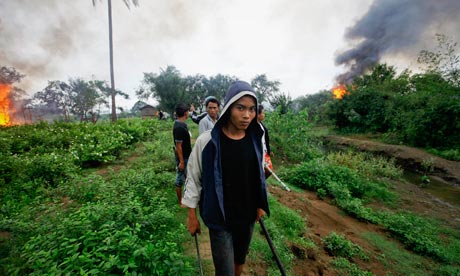
Men carry homemade weapons during the sectarian violence that has recently erupted in Burma's Rakhine state. Photograph: Reuters
Sunday 17 June 2012
As Aung San Suu Kyi is allowed to go to the UK ethnic violence threatens to undermine my country's transition to democracy
As a comedian, poet, film-maker and loudmouth, I often fell foul of the censors in Burma, where I was a political prisoner four times. Sometimes it was through deliberate provocation, such as my insistence on trying to include kidnap scenes in all of my films, where at some point the good guys would exclaim "we must free that lady!", a thinly veiled act of resistance which caught on in the industry and became obligatory for many film-makers during Aung San Suu Kyi's imprisonment.
My most recent sentence was for 35 years, imposed for criticism of the Burmese government's woeful response to Cyclone Nargis in 2008, and from which I was released last autumn as part of a mass amnesty. Yet I have also been imprisoned simply for using the internet. It might be interesting to learn that communications were policed by people who understood little about the technology they were patrolling. I don't think it takes a comedian to see the funny side of police confiscating my computer screen, but leaving the hard drive. Freedom of expression has been rigorously denied for a long time, but Burma is very definitely changing and, in this new world, new challenges are presenting themselves.
This week, Aung San Suu Kyi will visit Britain for the first time in 24 years. That she is now free to travel (as am I) is a hugely positive development. It reflects the changes taking place in Burma and there is much to be welcomed. Yet she and I are aware of an unwatched pot that is threatening to boil over at home – and may yet undermine the transition to democracy.
Last month sectarian violence erupted in Burma's Rakhine state on the Bangladesh border, where both Buddhist Rakhine (or Arakanese) and Muslim Rohingya minorities live. There is a history of inter-ethnic tension and violence dating back decades. The latest episode took place shortly after my arrival in London. I was sickened to read about the mob killing of 10 Rohingya men in retaliation for the alleged gang rape of a Rakhine teenage girl.
Now we are seeing a cycle of violence and reprisals, with homes and businesses burned to the ground and hundreds taking refuge in public buildings. A state of emergency has been declared in Rakhine state. There are reports of live ammunition being used to disperse crowds and curfews have been imposed.
The situation in the area is complex and dates back at least to our colonial history. There has been institutionalised discrimination against the Rohingya for decades. This is exacerbated by corruption among border enforcement officials, which has allowed illegal immigration and added to sectarian tensions.
The entire situation is a litmus test for reform in our country, including for improvements in freedom of expression. When I read some of the language being used on social media, both inside and outside the country, I am concerned that the Burmese people are using their new freedom to express views which incite racial hatred.
Distributing the Universal Declaration of Human Rights used to get you a jail sentence. Fortunately that is no longer the case. The declaration says all human beings are born free and equal in dignity and rights. So the Burmese government needs to exercise its responsibility to protect the rights of all those in Burma, whatever their religion or ethnicity. We need legal action to be taken against those who have committed murder and violence and damaged property. The government must restore the rule of law and end corruption and immigration abuse, but not while trampling on human rights like before. And we Burmese must use freedom of expression to promote peace, not conflict.
Sunday 17 June 2012
As Aung San Suu Kyi is allowed to go to the UK ethnic violence threatens to undermine my country's transition to democracy
As a comedian, poet, film-maker and loudmouth, I often fell foul of the censors in Burma, where I was a political prisoner four times. Sometimes it was through deliberate provocation, such as my insistence on trying to include kidnap scenes in all of my films, where at some point the good guys would exclaim "we must free that lady!", a thinly veiled act of resistance which caught on in the industry and became obligatory for many film-makers during Aung San Suu Kyi's imprisonment.
My most recent sentence was for 35 years, imposed for criticism of the Burmese government's woeful response to Cyclone Nargis in 2008, and from which I was released last autumn as part of a mass amnesty. Yet I have also been imprisoned simply for using the internet. It might be interesting to learn that communications were policed by people who understood little about the technology they were patrolling. I don't think it takes a comedian to see the funny side of police confiscating my computer screen, but leaving the hard drive. Freedom of expression has been rigorously denied for a long time, but Burma is very definitely changing and, in this new world, new challenges are presenting themselves.
This week, Aung San Suu Kyi will visit Britain for the first time in 24 years. That she is now free to travel (as am I) is a hugely positive development. It reflects the changes taking place in Burma and there is much to be welcomed. Yet she and I are aware of an unwatched pot that is threatening to boil over at home – and may yet undermine the transition to democracy.
Last month sectarian violence erupted in Burma's Rakhine state on the Bangladesh border, where both Buddhist Rakhine (or Arakanese) and Muslim Rohingya minorities live. There is a history of inter-ethnic tension and violence dating back decades. The latest episode took place shortly after my arrival in London. I was sickened to read about the mob killing of 10 Rohingya men in retaliation for the alleged gang rape of a Rakhine teenage girl.
Now we are seeing a cycle of violence and reprisals, with homes and businesses burned to the ground and hundreds taking refuge in public buildings. A state of emergency has been declared in Rakhine state. There are reports of live ammunition being used to disperse crowds and curfews have been imposed.
The situation in the area is complex and dates back at least to our colonial history. There has been institutionalised discrimination against the Rohingya for decades. This is exacerbated by corruption among border enforcement officials, which has allowed illegal immigration and added to sectarian tensions.
The entire situation is a litmus test for reform in our country, including for improvements in freedom of expression. When I read some of the language being used on social media, both inside and outside the country, I am concerned that the Burmese people are using their new freedom to express views which incite racial hatred.
Distributing the Universal Declaration of Human Rights used to get you a jail sentence. Fortunately that is no longer the case. The declaration says all human beings are born free and equal in dignity and rights. So the Burmese government needs to exercise its responsibility to protect the rights of all those in Burma, whatever their religion or ethnicity. We need legal action to be taken against those who have committed murder and violence and damaged property. The government must restore the rule of law and end corruption and immigration abuse, but not while trampling on human rights like before. And we Burmese must use freedom of expression to promote peace, not conflict.
Source here

THIDAR HTWE’s short life was not much older than Myanmar’s democracy movement. After a quarter-century of struggle the movement has scented victory of a kind, taking seats in parliament just this year. But now the untimely death of Miss Thidar Htwe, a 26-year-old from Thapraychaung village, has ignited a tinderbox of ethnic tensions. Violence is flaring around the western state of Rakhine. The president, Thein Sein, warned in a televised address that it could hinder the nascent reforms. As one of the worst episodes of communal violence the country has seen in decades, it also raises hard questions about the rights of minorities in a new Myanmar.
On May 28th, Miss Thidar Htwe, a Buddhist of the Rakhine ethnic group, was raped and killed, allegedly by three young Rohingya Muslims, as she made her way home from a nearby village. Six days later a mob of 300 Buddhist-Rakhine vigilantes stopped a bus carrying Muslim pilgrims was stopped in the town of Taungkok. The passengers were taken off the vehicle and ten of them were clubbed to death, and one of the women was sexually assaulted. The mob then poured alcohol on the corpses, in desecration. According to some accounts, one of the victims was a Buddhist, mistaken for a Muslim.
The local authorities in Thapraychaung had claimed to have detained the three rapists several days before the bus incident. The victims of the bus attack were not from Rakhine state, and were returning home to Yangon, the country’s commercial capital. Soon gruesome pictures of the victims were circulating the internet and small protests erupted within Yangon’s Muslim community.
This was not to prompt a moment of national soul-searching. Rather it marked the first salvo of fresh bigotry, unleashed against Myanmar’s Muslim minority on the internet and beyond. Discrimination against the Rohingyas has never been subtle. They are not allowed to travel within Myanmar, nor to serve in the police—technically, they do not even have citizenship (though this has been questioned in parliament). But their persecution has suddenly turned fervid.
It was evident in the state-run press. The Myanmar Alin, a newspaper, referred to the murdered Muslims with the derogatory term kalar, a word derived from Sanskrit which means “black”. In Myanmar it is used as an epithet for people with South Asian appearances, such as the Rohingya. More surprisingly, dozens of Burmese human-rights activists (many whom are themselves granted status as asylum-seekers by the West) have rounded on the country’s loosely defined community of Muslims—which includes plenty of ethnic Burmese, as well as Rohingyas and the descendants of South Asians.
Regarded by activists as the “most persecuted ethnic group in Asia”, the Rohingya inhabit the impoverished borderlands between Myanmar and Bangladesh. Much like their Buddhist-Rakhine neighbours they traverse both sides of the border. Hundreds of thousands of Rohingya have crossed into Bangladesh since Burma’s independence, fleeing racial and religious persecution not just at the hands of their Buddhist countrymen, the Buddhist Rakhines, but also the Burmese national authorities.
Rakhine state was once independent. Burma annexed it in 1784, when the British had barely set foot in the Irrawaddy delta. At the time the conquering Burmese induced Buddhist Rakhines to seek shelter in Bengal, to the west. There they established the town of Cox’s Bazaar, with the help of a British East India Company official, Hiram Cox.
In 1977, almost two centuries later, the independent government of Burma conducted a notorious military operation, codenamed Nagar Min (“Dragon King”), which forced hundreds of thousands of Rohingyas to flee across the border to the part of Bengal that had become Bangladesh. One of the victims of that putsch, now resident of Khutapalong camp near Cox’s Bazaar, told this correspondent that she fled only after Burmese soldiers butchered her eight-month-old child, on the grounds that she could not produce a permit.
Rakhine state’s tensions have a long history. They were on the simmer earlier this month. The statewide police presence had been increased since the massacre of the bus passengers at Taungkok. On June 8th, as Rohingya gathered for prayers, an incident between a Rohingya boy on a bicycle and a Rakhine on a motorbike turned ugly and attracted the police’s attention. Soon they turned to riot gear, and the angry street turned to stone-throwing. The police force that moved in with reinforcements already had a reputation for the near-genocidal purges against the Rohingya.
After Friday’s violence the government declared a Section 144 criminal order and by Saturday it was a curfew. According to Chris Lewa, an expert on regional affairs, the order to stay in doors applied only to Rohingyas. It did nothing to stop Buddhist Rakhine mobs looting and pillaging. They were filmed burning Rohingya villages, apparently with impunity; they were happy to speak before video cameras while houses burned in the background. The mobs seemed to rage without any fear of police action. At least one Rohingya woman was raped in the mayhem.
Fearing a new influx of refugees, Bangladesh meanwhile tightened security on its border. As many as 1,500 fleeing Rohingyas were stranded, left waiting on boats that idled in the Naf river, unable to land. Bangladesh is already home to perhaps 250,000 Rohingya refugees. Their presence in that crowded country has long been a cause of political bickering.
By Sunday Thein Sein had declared a state of military emergency under Section 413 of the country’s 2008 constitution: the first since its nominally democratic government took office in March 2011. The previous criminal order was deemed to weak, so once again the army rules in Rakhine. The UN pulled out the small staff it keeps in the area, which were held to be the last neutral observers on the ground.
Rioting spread quickly to Sittwe, the state capital. Local reports describe Rakhine and Rohingya mobs torching houses and being dispersed by armed police.
Tin Soe, the editor of the Rohingya-run Kaladan news network, welcomes the military state of emergency; he lacks faith entirely in the civilian police force. On the road between the main Rohingya urban centres, Buthidaung and Maungdaw, Tin Soe claims, the streams were clogged with dead bodies. He asserts the mobs’ killing of Rohingyas was done in concert with the police, who were Buddhists siding with their co-religionists.
Tin Soe once petitioned for the end of military rule and the release of all political prisoners. But now one of the most prominent of the former political prisoners, Ko Ko Gyi, a member of “the ’88 generation students”, has blamed the violence in Rakhine state on elements coming from “across the border”. The implication, as ever, is that the Rohingya are not a legitimate people of Myanmar. Indeed, Ko Ko Gyi made it explicit: the Rohingya are not an “ethnic group” of the country, he says, and so somehow they must be to blame. The same rationale is not applied Myanmar’s other ethnic groups, many of whom have a “more Burmese” racial appearance (ie, they look less like South Asians).
Ko Ko Gyi’s sentiments were echoed by the popular press, which has taken to calling Rohingyas “Bengalis”, and publishing vile comments on pictures of refugees. Many of the comments posted online call for ethnic cleansing. One thing shared across the spectrum of religious and political hues is a sense of deep foreboding. Leading activist from among the ethnic Chin minority expressed the fear that in Myanmar “we might go back to the dark age before we have even stepped into the path of light.”
(Picture credit: Joseph Allchin)
On May 28th, Miss Thidar Htwe, a Buddhist of the Rakhine ethnic group, was raped and killed, allegedly by three young Rohingya Muslims, as she made her way home from a nearby village. Six days later a mob of 300 Buddhist-Rakhine vigilantes stopped a bus carrying Muslim pilgrims was stopped in the town of Taungkok. The passengers were taken off the vehicle and ten of them were clubbed to death, and one of the women was sexually assaulted. The mob then poured alcohol on the corpses, in desecration. According to some accounts, one of the victims was a Buddhist, mistaken for a Muslim.
The local authorities in Thapraychaung had claimed to have detained the three rapists several days before the bus incident. The victims of the bus attack were not from Rakhine state, and were returning home to Yangon, the country’s commercial capital. Soon gruesome pictures of the victims were circulating the internet and small protests erupted within Yangon’s Muslim community.
This was not to prompt a moment of national soul-searching. Rather it marked the first salvo of fresh bigotry, unleashed against Myanmar’s Muslim minority on the internet and beyond. Discrimination against the Rohingyas has never been subtle. They are not allowed to travel within Myanmar, nor to serve in the police—technically, they do not even have citizenship (though this has been questioned in parliament). But their persecution has suddenly turned fervid.
It was evident in the state-run press. The Myanmar Alin, a newspaper, referred to the murdered Muslims with the derogatory term kalar, a word derived from Sanskrit which means “black”. In Myanmar it is used as an epithet for people with South Asian appearances, such as the Rohingya. More surprisingly, dozens of Burmese human-rights activists (many whom are themselves granted status as asylum-seekers by the West) have rounded on the country’s loosely defined community of Muslims—which includes plenty of ethnic Burmese, as well as Rohingyas and the descendants of South Asians.
Regarded by activists as the “most persecuted ethnic group in Asia”, the Rohingya inhabit the impoverished borderlands between Myanmar and Bangladesh. Much like their Buddhist-Rakhine neighbours they traverse both sides of the border. Hundreds of thousands of Rohingya have crossed into Bangladesh since Burma’s independence, fleeing racial and religious persecution not just at the hands of their Buddhist countrymen, the Buddhist Rakhines, but also the Burmese national authorities.
Rakhine state was once independent. Burma annexed it in 1784, when the British had barely set foot in the Irrawaddy delta. At the time the conquering Burmese induced Buddhist Rakhines to seek shelter in Bengal, to the west. There they established the town of Cox’s Bazaar, with the help of a British East India Company official, Hiram Cox.
In 1977, almost two centuries later, the independent government of Burma conducted a notorious military operation, codenamed Nagar Min (“Dragon King”), which forced hundreds of thousands of Rohingyas to flee across the border to the part of Bengal that had become Bangladesh. One of the victims of that putsch, now resident of Khutapalong camp near Cox’s Bazaar, told this correspondent that she fled only after Burmese soldiers butchered her eight-month-old child, on the grounds that she could not produce a permit.
Rakhine state’s tensions have a long history. They were on the simmer earlier this month. The statewide police presence had been increased since the massacre of the bus passengers at Taungkok. On June 8th, as Rohingya gathered for prayers, an incident between a Rohingya boy on a bicycle and a Rakhine on a motorbike turned ugly and attracted the police’s attention. Soon they turned to riot gear, and the angry street turned to stone-throwing. The police force that moved in with reinforcements already had a reputation for the near-genocidal purges against the Rohingya.
After Friday’s violence the government declared a Section 144 criminal order and by Saturday it was a curfew. According to Chris Lewa, an expert on regional affairs, the order to stay in doors applied only to Rohingyas. It did nothing to stop Buddhist Rakhine mobs looting and pillaging. They were filmed burning Rohingya villages, apparently with impunity; they were happy to speak before video cameras while houses burned in the background. The mobs seemed to rage without any fear of police action. At least one Rohingya woman was raped in the mayhem.
Fearing a new influx of refugees, Bangladesh meanwhile tightened security on its border. As many as 1,500 fleeing Rohingyas were stranded, left waiting on boats that idled in the Naf river, unable to land. Bangladesh is already home to perhaps 250,000 Rohingya refugees. Their presence in that crowded country has long been a cause of political bickering.
By Sunday Thein Sein had declared a state of military emergency under Section 413 of the country’s 2008 constitution: the first since its nominally democratic government took office in March 2011. The previous criminal order was deemed to weak, so once again the army rules in Rakhine. The UN pulled out the small staff it keeps in the area, which were held to be the last neutral observers on the ground.
Rioting spread quickly to Sittwe, the state capital. Local reports describe Rakhine and Rohingya mobs torching houses and being dispersed by armed police.
Tin Soe, the editor of the Rohingya-run Kaladan news network, welcomes the military state of emergency; he lacks faith entirely in the civilian police force. On the road between the main Rohingya urban centres, Buthidaung and Maungdaw, Tin Soe claims, the streams were clogged with dead bodies. He asserts the mobs’ killing of Rohingyas was done in concert with the police, who were Buddhists siding with their co-religionists.
Tin Soe once petitioned for the end of military rule and the release of all political prisoners. But now one of the most prominent of the former political prisoners, Ko Ko Gyi, a member of “the ’88 generation students”, has blamed the violence in Rakhine state on elements coming from “across the border”. The implication, as ever, is that the Rohingya are not a legitimate people of Myanmar. Indeed, Ko Ko Gyi made it explicit: the Rohingya are not an “ethnic group” of the country, he says, and so somehow they must be to blame. The same rationale is not applied Myanmar’s other ethnic groups, many of whom have a “more Burmese” racial appearance (ie, they look less like South Asians).
Ko Ko Gyi’s sentiments were echoed by the popular press, which has taken to calling Rohingyas “Bengalis”, and publishing vile comments on pictures of refugees. Many of the comments posted online call for ethnic cleansing. One thing shared across the spectrum of religious and political hues is a sense of deep foreboding. Leading activist from among the ethnic Chin minority expressed the fear that in Myanmar “we might go back to the dark age before we have even stepped into the path of light.”
(Picture credit: Joseph Allchin)
Sources Here:
With the eruption of violence in western Myanmar, the plight of the Rohingya worsened, though perpetrators can be found on both sides of the ethnic and religious divide with power politics from Yangon adding a corrosive element to the mix
When photographer Suthep Kristasanawarin arrived in the western state of Rakhine in Myanmar almost two years ago, he sensed tension in the relatively peaceful town of Sittwe, the state capital.
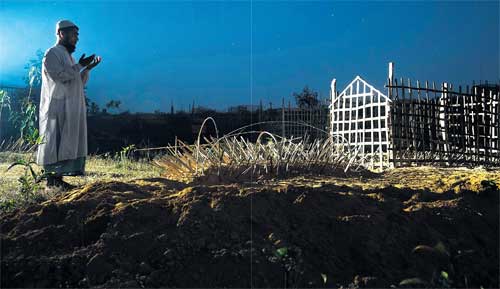
TO BETTER DAYS: A Rohingya refugee offers prayers for the dead in a makeshift camp. Unofficial camps housing thousands of Rohingyas lack sanitation and healthcare facilities as they are not under the supervision of the UN refugee agency.
"I could feel the deep distrust between ethnic minorities there _ the Buddhist Rakhine and Muslim Rohingya. I wasn't so surprised when I heard about the violence in Rakhine State; however, it came sooner that I thought," he said in a phone interview with Spectrum. He was referring to the killing and rioting that has torn through the western coastal region, separated from central Myanmar by the Arakan mountain range.
Suthep went there for his photo documentary undertaking called the Rohingya Project, which he has been working on since 2008, about the plight of the stateless ethnic group. Many have been forced to flee their hometowns in recent years for adjacent Bangladesh or Southeast Asian countries such as Thailand and Indonesia, with some going as far as Australia in search of a better life.
What he witnessed in Sittwe was mutual hatred.
Suthep recalled visiting a couple in a rural part of the district. The husband was a Rohingya who had just served time in the local prison _ for getting married to a Rakhine woman.
The wife was banished from her village after the marriage. And when the couple settled down together, they became a target of hatred.
"I was being watched by the whole town. Some villagers peeked in to see why I had anything to do with this couple. I thought I was at risk of being thrown out of the city if someone reported my visit to authorities, so I had no choice but to leave as quickly as possible," Suthep said.
The photographer believes the current loathing dividing ethnicities is a remnant of conflicts dating from imperialist times, when Myanmar was a British colony from the Anglo-Burmese (Myanmar) wars of 1824-1885 until 1948. The conflict between the Rohingya and Rakhine has turned into an open war with a massive casualty count.
CHASED AWAY: Abu Karlam, a Rohingya exile who has been living in Thailand for 31 years after fleeing Myanmar.
Both the Rakhine and Rohingya are minorities with long ties to the region, and both have been treated as second class residents by the ruling Burmese; however, the treatment of the Rohingya has been far worse than that of other ethnic groups.
The Rohingya are Muslims of South Asian descent, while most Myanmar minorities are of Southeast Asian origin and predominantly Buddhist. The Rohingya are related to the Bengali groups in the Chittagong Division of neighbouring Bangladesh. Like the Buddhist Rakhine, they traverse both sides of the border.
According to a report by the Arakan Project, a non-governmental organisation working in the area, since the military took over Myanmar in 1962 the Rohingya have increasingly faced exclusion. In 1982, they were rendered stateless by the Burma Citizenship Law, which mainly confers the right to a nationality to members of the 135 national races listed by the government. The denial of citizenship is the key mechanism to institutionalising discrimination against the group. Severe restrictions on their movement and marriages, arrests, extortion, forced labour and confiscation of land have been arbitrarily imposed.
This discrimination also causes the Rohingya to occupy the bottom economic rung in the area.
Suthep says the Rohingya in Sittwe are treated as outcasts, working menial jobs for both the Burmese and the Rakhine, such as cleaners or water carriers. They are barred from having a higher education or working as government officers or teachers. Most of all, they feel they are being badly mistreated, which generates resentment against other groups.
The Arakan Project estimates that 270,000 Rohingya have fled to neighbouring Bangladesh in recent years and ended up in shelters set up by international organisations.
Many have been turned back, however, especially in recent weeks, as Bangladesh considers Rohingya, having lived in Myanmar for centuries, as non-citizens and a potential burden on the impoverished and overpopulated country's resources. Human Rights Watch last week urged Bangladesh to open its border to Rohingya, saying it was putting lives at risk.
Some Rohingya over the years have also fled to other countries in the hope of finding a place where they can live with integrity. Among them is Abu Karlam, a 51-year-old exile who has lived in Thailand for 31 years.
Abu Karlam was from a peasant family in Mynbia, a small town close to Sittwe. He said one day a platoon of soldiers stopped at his village and coerced teenagers to work as carriers in the fighting against other ethnic groups.
He fled back to his village after being badly beaten by soldiers. Fearing severe retribution from the authorities, he left his wife and young daughter behind and started the long hard journey to Thailand.
Though his life in Thailand has been a struggle, he believe it's still far better than living in his homeland.
 Ko Ko Gyi.
According to Abu Karlam, now vice-president of the Burmese Rohingya Association in Thailand, there are around 9,000 Rohingya across Thailand, both documented and illegal immigrants. In Bangkok between 300 and 400 are registered with the association.
Currently all of them are worried about what is happening in Rakhine State.
"We are trying to contact everyone we can think of to help Rohingya. We went to the UN office and also are pleading to the media to please help our people from being killed and starved," said Abu Karlam. "We are the victims. This is a scheme by the ruling class to drive us from our land."
However, they don't know whether their move will be fruitful. Though Abu Karlam said the Rohingya were victimised, many blamed the start of the violence on his people.
The Rohingya have been accused by the state media and the Rakhine of instigating the violence. The recent unrest began when a group of Muslim men were accused of raping and murdering a Rakhine woman. Retaliation by the Rakhine and large-scale riots followed. Government media and the Rakhine also blame the Rohingya for widespread rioting, looting and killing.
Chris Lewa from the Arakan Project told Spectrum that the number of deaths is unknown but certainly far higher than that provided by the government. Moreover, Ms Lewa believed law enforcement agencies are also responsible for many deaths.
Sittwe and Maungdaw, where the army has been deployed, have become calmer since Wednesday. According to Ms Lewa, the security situation is still precarious and extremely tense, with occasional reports of shooting and looting in these areas.
"Sectarian unrest has now spread to Rathedaung. Houses have been looted and torched in five Muslim villages in Rathedaung since Thursday night. One of these villages is Choot Pyin, close to the south of Maungdaw township. Frightened villagers from Rathedaung fled to South Maungdaw where locals gave them shelter. But the Nasaka, the border security forces, chased them and forced them to return to their village," said Ms Lewa.
She also expressed fears that the communal unrest could resurface and spread to new areas.
For Ms Lewa, the causes of this communal violence are varied and complex, and rooted in longstanding institutionalised racism in Myanmar and official policies of discrimination imposed on the Rohingya in Arakan.
The hostility of the Rakhine Buddhist community in Arakan towards the Rohingya is related to the perception that overpopulation in Bangladesh could threaten their territorial integrity.
Different in ethnicity and religion from the majority population in Myanmar, successive regimes have portrayed the Rohingya as illegal foreigners who deserve no rights to citizenship. The new government has reaffirmed these policies on national security grounds during parliamentarian sessions.
Both Ms Lewa and Suthep agreed that the shift from deep distrust to extreme violence is a downside of the recent reforms implemented by the Myanmar government to promote democracy in the country.
''The loosening of constraints has provided the space for such sectarian violence to erupt, but that is not the only cause,'' said Ms Lewa.
''The recent relaxation of authoritarian rule and more freedom of expression has been the vehicle to let loose simmering tensions and bring them to boiling point. The spark was the rape of a Rakhine woman allegedly by Muslims.''
On the evening of May 28, Ma Thidar Htwe, 26 and a resident of Thapraychaung in Rambree Township, was brutally raped and killed while returning home from nearby Kyauknimaw village.
Three suspects from nearby Kyaukhtara Muslim village, are in police custody. There is some question over whether they are Rohingya, but on June 3, 10 Muslims were killed by a Buddhist mob in an apparent revenge attack. Violence then became more pronounced on both sides.
When army troops were called out to help quell the violence on June 8, a dusk-to-dawn curfew was imposed, with President Thein Sein declaring a state of emergency in the area, giving the military full administrative powers to keep order. According to Ms Lewa, though, the order to stay indoors applied only to Rohingya.
Rakhine, however, have also been badly affected by the unrest. According to the state government, tens of thousands of people have been displaced by the violence, with 31,884 displaced people being sheltered at monasteries and schools. Of 2,528 houses that were burned down, 1,192 belonged to Rakhines and 1,336 belonged to Rohingya.
It was also reported that nine Buddhist monasteries and seven mosques were burned. Unrest hit eight areas in all: Maungdaw, Buthidaung, Sittwe, Rambree Island, Mrauk Oo, Ponna Kyun, Pauk Taw and Kyauktaw, with the most damage and deaths in Maungdaw and Sittwe.
As Spectrum went to press, according to Htein Lin, security and border affairs minister for Rakhine, 29 people _ 16 Muslim and 13 Buddhists _ had been killed since riots broke out on June 8, not including the mob attack of June 3. Large numbers of people still have no access to food and other important staple goods.
There have been some conflicting theories on the origins of the violence. One prominent former political prisoner and ally of Aung San Suu Kyi, Ko Ko Gyi, has blamed the problems in Rakhine State on elements coming from across the border. The Rohingya are not an ethnic group of the country, Ko Ko Gyi said.
Myanmar expert and author Bertil Lintner told The Week that ''the violence is clearly well orchestrated and not as spontaneous as we are being led to believe''.
''The government is very worried about the support commanded by Suu Kyi,'' Mr Lintner said. ''It wants to force her into a position where she has to make a pro-Rohingya public statement that could damage her popularity among Burma's Buddhists, where anti-Muslim sentiment runs high. On the other hand, if she remains silent she will disappoint those who support her firm stand on human rights.''
One thing that is certain is that the plight of the Rohingya will not be resolved soon.
''What we can do now is only pray to God to help protect those who are affected by this deadly situation,'' Mr Abu Karlam said.
CRIPPLED DREAMS: A photo from Suthep Kristasanawarin’s Rohingya Project shows Mohammad Hussein, who fled to Malaysia three years ago hoping to find work. On the way he contracted an infection that was left untreated. When he received medical attention, his leg was amputated. He now relies on begging and help from other Rohingya for his survival.
When photographer Suthep Kristasanawarin arrived in the western state of Rakhine in Myanmar almost two years ago, he sensed tension in the relatively peaceful town of Sittwe, the state capital.
TO BETTER DAYS: A Rohingya refugee offers prayers for the dead in a makeshift camp. Unofficial camps housing thousands of Rohingyas lack sanitation and healthcare facilities as they are not under the supervision of the UN refugee agency.
"I could feel the deep distrust between ethnic minorities there _ the Buddhist Rakhine and Muslim Rohingya. I wasn't so surprised when I heard about the violence in Rakhine State; however, it came sooner that I thought," he said in a phone interview with Spectrum. He was referring to the killing and rioting that has torn through the western coastal region, separated from central Myanmar by the Arakan mountain range.
Suthep went there for his photo documentary undertaking called the Rohingya Project, which he has been working on since 2008, about the plight of the stateless ethnic group. Many have been forced to flee their hometowns in recent years for adjacent Bangladesh or Southeast Asian countries such as Thailand and Indonesia, with some going as far as Australia in search of a better life.
What he witnessed in Sittwe was mutual hatred.
Suthep recalled visiting a couple in a rural part of the district. The husband was a Rohingya who had just served time in the local prison _ for getting married to a Rakhine woman.
The wife was banished from her village after the marriage. And when the couple settled down together, they became a target of hatred.
"I was being watched by the whole town. Some villagers peeked in to see why I had anything to do with this couple. I thought I was at risk of being thrown out of the city if someone reported my visit to authorities, so I had no choice but to leave as quickly as possible," Suthep said.
The photographer believes the current loathing dividing ethnicities is a remnant of conflicts dating from imperialist times, when Myanmar was a British colony from the Anglo-Burmese (Myanmar) wars of 1824-1885 until 1948. The conflict between the Rohingya and Rakhine has turned into an open war with a massive casualty count.
CHASED AWAY: Abu Karlam, a Rohingya exile who has been living in Thailand for 31 years after fleeing Myanmar.
Both the Rakhine and Rohingya are minorities with long ties to the region, and both have been treated as second class residents by the ruling Burmese; however, the treatment of the Rohingya has been far worse than that of other ethnic groups.
The Rohingya are Muslims of South Asian descent, while most Myanmar minorities are of Southeast Asian origin and predominantly Buddhist. The Rohingya are related to the Bengali groups in the Chittagong Division of neighbouring Bangladesh. Like the Buddhist Rakhine, they traverse both sides of the border.
According to a report by the Arakan Project, a non-governmental organisation working in the area, since the military took over Myanmar in 1962 the Rohingya have increasingly faced exclusion. In 1982, they were rendered stateless by the Burma Citizenship Law, which mainly confers the right to a nationality to members of the 135 national races listed by the government. The denial of citizenship is the key mechanism to institutionalising discrimination against the group. Severe restrictions on their movement and marriages, arrests, extortion, forced labour and confiscation of land have been arbitrarily imposed.
This discrimination also causes the Rohingya to occupy the bottom economic rung in the area.
Suthep says the Rohingya in Sittwe are treated as outcasts, working menial jobs for both the Burmese and the Rakhine, such as cleaners or water carriers. They are barred from having a higher education or working as government officers or teachers. Most of all, they feel they are being badly mistreated, which generates resentment against other groups.
The Arakan Project estimates that 270,000 Rohingya have fled to neighbouring Bangladesh in recent years and ended up in shelters set up by international organisations.
Many have been turned back, however, especially in recent weeks, as Bangladesh considers Rohingya, having lived in Myanmar for centuries, as non-citizens and a potential burden on the impoverished and overpopulated country's resources. Human Rights Watch last week urged Bangladesh to open its border to Rohingya, saying it was putting lives at risk.
Some Rohingya over the years have also fled to other countries in the hope of finding a place where they can live with integrity. Among them is Abu Karlam, a 51-year-old exile who has lived in Thailand for 31 years.
Abu Karlam was from a peasant family in Mynbia, a small town close to Sittwe. He said one day a platoon of soldiers stopped at his village and coerced teenagers to work as carriers in the fighting against other ethnic groups.
He fled back to his village after being badly beaten by soldiers. Fearing severe retribution from the authorities, he left his wife and young daughter behind and started the long hard journey to Thailand.
Though his life in Thailand has been a struggle, he believe it's still far better than living in his homeland.
Ko Ko Gyi.According to Abu Karlam, now vice-president of the Burmese Rohingya Association in Thailand, there are around 9,000 Rohingya across Thailand, both documented and illegal immigrants. In Bangkok between 300 and 400 are registered with the association.
Currently all of them are worried about what is happening in Rakhine State.
"We are trying to contact everyone we can think of to help Rohingya. We went to the UN office and also are pleading to the media to please help our people from being killed and starved," said Abu Karlam. "We are the victims. This is a scheme by the ruling class to drive us from our land."
However, they don't know whether their move will be fruitful. Though Abu Karlam said the Rohingya were victimised, many blamed the start of the violence on his people.
The Rohingya have been accused by the state media and the Rakhine of instigating the violence. The recent unrest began when a group of Muslim men were accused of raping and murdering a Rakhine woman. Retaliation by the Rakhine and large-scale riots followed. Government media and the Rakhine also blame the Rohingya for widespread rioting, looting and killing.
Chris Lewa from the Arakan Project told Spectrum that the number of deaths is unknown but certainly far higher than that provided by the government. Moreover, Ms Lewa believed law enforcement agencies are also responsible for many deaths.
Sittwe and Maungdaw, where the army has been deployed, have become calmer since Wednesday. According to Ms Lewa, the security situation is still precarious and extremely tense, with occasional reports of shooting and looting in these areas.
"Sectarian unrest has now spread to Rathedaung. Houses have been looted and torched in five Muslim villages in Rathedaung since Thursday night. One of these villages is Choot Pyin, close to the south of Maungdaw township. Frightened villagers from Rathedaung fled to South Maungdaw where locals gave them shelter. But the Nasaka, the border security forces, chased them and forced them to return to their village," said Ms Lewa.
She also expressed fears that the communal unrest could resurface and spread to new areas.
For Ms Lewa, the causes of this communal violence are varied and complex, and rooted in longstanding institutionalised racism in Myanmar and official policies of discrimination imposed on the Rohingya in Arakan.
The hostility of the Rakhine Buddhist community in Arakan towards the Rohingya is related to the perception that overpopulation in Bangladesh could threaten their territorial integrity.
Different in ethnicity and religion from the majority population in Myanmar, successive regimes have portrayed the Rohingya as illegal foreigners who deserve no rights to citizenship. The new government has reaffirmed these policies on national security grounds during parliamentarian sessions.
Both Ms Lewa and Suthep agreed that the shift from deep distrust to extreme violence is a downside of the recent reforms implemented by the Myanmar government to promote democracy in the country.
''The loosening of constraints has provided the space for such sectarian violence to erupt, but that is not the only cause,'' said Ms Lewa.
''The recent relaxation of authoritarian rule and more freedom of expression has been the vehicle to let loose simmering tensions and bring them to boiling point. The spark was the rape of a Rakhine woman allegedly by Muslims.''
On the evening of May 28, Ma Thidar Htwe, 26 and a resident of Thapraychaung in Rambree Township, was brutally raped and killed while returning home from nearby Kyauknimaw village.
Three suspects from nearby Kyaukhtara Muslim village, are in police custody. There is some question over whether they are Rohingya, but on June 3, 10 Muslims were killed by a Buddhist mob in an apparent revenge attack. Violence then became more pronounced on both sides.
When army troops were called out to help quell the violence on June 8, a dusk-to-dawn curfew was imposed, with President Thein Sein declaring a state of emergency in the area, giving the military full administrative powers to keep order. According to Ms Lewa, though, the order to stay indoors applied only to Rohingya.
Rakhine, however, have also been badly affected by the unrest. According to the state government, tens of thousands of people have been displaced by the violence, with 31,884 displaced people being sheltered at monasteries and schools. Of 2,528 houses that were burned down, 1,192 belonged to Rakhines and 1,336 belonged to Rohingya.
It was also reported that nine Buddhist monasteries and seven mosques were burned. Unrest hit eight areas in all: Maungdaw, Buthidaung, Sittwe, Rambree Island, Mrauk Oo, Ponna Kyun, Pauk Taw and Kyauktaw, with the most damage and deaths in Maungdaw and Sittwe.
As Spectrum went to press, according to Htein Lin, security and border affairs minister for Rakhine, 29 people _ 16 Muslim and 13 Buddhists _ had been killed since riots broke out on June 8, not including the mob attack of June 3. Large numbers of people still have no access to food and other important staple goods.
There have been some conflicting theories on the origins of the violence. One prominent former political prisoner and ally of Aung San Suu Kyi, Ko Ko Gyi, has blamed the problems in Rakhine State on elements coming from across the border. The Rohingya are not an ethnic group of the country, Ko Ko Gyi said.
Myanmar expert and author Bertil Lintner told The Week that ''the violence is clearly well orchestrated and not as spontaneous as we are being led to believe''.
''The government is very worried about the support commanded by Suu Kyi,'' Mr Lintner said. ''It wants to force her into a position where she has to make a pro-Rohingya public statement that could damage her popularity among Burma's Buddhists, where anti-Muslim sentiment runs high. On the other hand, if she remains silent she will disappoint those who support her firm stand on human rights.''
One thing that is certain is that the plight of the Rohingya will not be resolved soon.
''What we can do now is only pray to God to help protect those who are affected by this deadly situation,'' Mr Abu Karlam said.
CRIPPLED DREAMS: A photo from Suthep Kristasanawarin’s Rohingya Project shows Mohammad Hussein, who fled to Malaysia three years ago hoping to find work. On the way he contracted an infection that was left untreated. When he received medical attention, his leg was amputated. He now relies on begging and help from other Rohingya for his survival.
Sources Here:

(Reuters) - At first, the boat bobbing in the water in the middle of the night appeared to be empty. But when Bangladeshi villagers took a closer look, they found a baby too weak to cry, a refugee from marauding mobs in Myanmar apparently abandoned by her family.
The cleft-lipped infant, just weeks old, is among hundreds of Rohingya Muslims who fled this month's sectarian violence in Myanmar's western state of Rakhine, packing themselves into rough wooden boats and heading for the shores of neighboring Bangladesh.
No one knows how many made it ashore. Bangladesh has ordered its border guards to push the boats back, determined that - with at least quarter of a million "illegal migrants" already here - there must be no more.
The baby, named Fatima by the family that has taken her in, is out of the danger that she and her family faced in Myanmar, but she joins a throng of stateless people in southeast Bangladesh who - for the most part - lead desperate lives of squalor, deprivation and discrimination.
Among them is Mohammad Kamal, a young religious leader from Rakhine's Maungdaw district, where ferocious violence erupted on June 9 between Rohingyas and ethnic Rakhine Buddhists and spread across the state. He escaped to Bangladesh in 2006 after his brother and others were jailed in a crackdown on Muslim clerics.
Kamal, now 28, settled in a makeshift "unregistered" camp, where - along with some 20,000 others - he is not recognized as a refugee and where even international aid agencies have to work under the radar because Bangladesh has not granted them legal status.
"I went out for a walk one day last year and was arrested because I had no documents," said Kamal, pulling up a trouser leg to show a line of angry sores that broke out during the following nine months he spent in jail.
Behind him, naked children play in a muddy pool and the rickety dwellings of an overcrowded shanty town - his camp - rise up, lashed by monsoon rains.
In 2010, the authorities forcibly evicted thousands from a makeshift camp. The medical charity Medecins Sans Frontieres recounted at the time that some Rohingyas had been thrown into the Naf River and told to swim the 3 km (2 miles) back to Myanmar, and the organization said it had treated many for beatings, machete wounds and even rape.
"A DESPERATE LIFE"
Craig Sanders, the U.N. High Commissioner for Refugees' representative in Dhaka, said that although Bangladesh has disowned the Rohingyas - dubbing them illegal economic migrants - it has shown "tremendous generosity over many years".
Rohingyas first came in large numbers to the South Asian nation in 1973, and over the years gained a reputation for drug-smuggling, gun-running and human trafficking.
A sudden flood of more than quarter of a million arrived in 1991-92 after a spasm of repression by the security forces in military-ruled Myanmar. Those that remain from that wave, now numbering some 30,000, live in two official camps where the U.N. provides everything from shelter and water supply to healthcare and schooling.
But at least 200,000 others - probably many more - have settled on the Bangladesh side of the 200-km (125-mile) border, mingling with the population where they struggle to find employment or squeezing into unofficial camps.
It is these "unregistered" Rohingyas who are most vulnerable.
"It's an extremely desperate life for these people," said one worker for a humanitarian group that provides assistance illegally at one camp, asking not to be named. "They have been here for such a long time and there is no prospect of change."
UNHCR's Sanders has crossed swords with the government in recent days over its decision to turn back the boatloads of traumatized Rohingyas.
"Bangladesh, one more time, is being urged to step forward to deal with a situation that is not of their making," he said. "We are not trying to push them into a corner on this issue, but there is a question of fair and right treatment here."
BANGLADESH SAYS "NO MORE"
There have been sketchy and conflicting reports of the communal violence that erupted in Rakhine, but scores are feared dead after widespread torching of houses by both sides.
Abdus Salam, one of 10 Rohingyas who reached Bangladesh and are now hiding in a coastal village to avoid arrest, told Reuters last week: "The Rakhine torched our houses, killed our relatives, assaulted our women. They were killing Muslims. When we protested, the government forces also shot our people dead. Then we started fleeing."
Muhammad Zamir, Dhaka's chief information commissioner, maintains that the authorities have treated the boat people humanely, providing those they turn away with water, medicines and fuel for the journey back, assisting a woman who gave birth on arrival and treating those with gunshot wounds in hospital.
"We want to help the refugees, they have rights," Zamir told Reuters in the coastal town of Cox's Bazar, a bumpy three-hour drive from the shores where Rohingyas are being pushed back.
"But we can only look after them to a point. We really can't handle any more."
He argues that, as a densely populated and poverty-plagued country of 150 million, Bangladesh has played its part. Now, as democracy stirs in Myanmar, it is time for its neighbor to address the root causes of the chronic exodus of Rohingyas, and for the international community to put pressure on it to do so.
SILENT CRISIS
There has been some dismay in this part of Bangladesh at the hard line taken by the government on the new arrivals. The populations share the same ethnicity, religion and dialect, and they are so close that if you call a Rohingya on a mobile phone in Myanmar it is likely to be a Bangladesh number.
Yet the plight of those already here gets little attention.
A report by U.S.-based rights group Refugees International last year described a "silent crisis" of abuse, starvation and detention faced by stateless Rohingyas in Bangladesh.
According to UNHCR, a 2011 survey in the two official camps found that 17 percent of children between six months and six years were suffering from acute malnutrition, higher than the emergency threshold set by the World Health Organisation. In the makeshift camps, malnutrition rates are even higher.
"It's a hopeless situation," said the aid worker. "You treat the children who are sick, and then they fall ill again because they are not getting the right food."
For now at least, tiny Fatima is safe. She has been taken in by a fisherman and his wife who already have four sons and two daughters. But an uncertain future awaits her, stateless in the land of her refuge.
The cleft-lipped infant, just weeks old, is among hundreds of Rohingya Muslims who fled this month's sectarian violence in Myanmar's western state of Rakhine, packing themselves into rough wooden boats and heading for the shores of neighboring Bangladesh.
No one knows how many made it ashore. Bangladesh has ordered its border guards to push the boats back, determined that - with at least quarter of a million "illegal migrants" already here - there must be no more.
The baby, named Fatima by the family that has taken her in, is out of the danger that she and her family faced in Myanmar, but she joins a throng of stateless people in southeast Bangladesh who - for the most part - lead desperate lives of squalor, deprivation and discrimination.
Among them is Mohammad Kamal, a young religious leader from Rakhine's Maungdaw district, where ferocious violence erupted on June 9 between Rohingyas and ethnic Rakhine Buddhists and spread across the state. He escaped to Bangladesh in 2006 after his brother and others were jailed in a crackdown on Muslim clerics.
Kamal, now 28, settled in a makeshift "unregistered" camp, where - along with some 20,000 others - he is not recognized as a refugee and where even international aid agencies have to work under the radar because Bangladesh has not granted them legal status.
"I went out for a walk one day last year and was arrested because I had no documents," said Kamal, pulling up a trouser leg to show a line of angry sores that broke out during the following nine months he spent in jail.
Behind him, naked children play in a muddy pool and the rickety dwellings of an overcrowded shanty town - his camp - rise up, lashed by monsoon rains.
In 2010, the authorities forcibly evicted thousands from a makeshift camp. The medical charity Medecins Sans Frontieres recounted at the time that some Rohingyas had been thrown into the Naf River and told to swim the 3 km (2 miles) back to Myanmar, and the organization said it had treated many for beatings, machete wounds and even rape.
"A DESPERATE LIFE"
Craig Sanders, the U.N. High Commissioner for Refugees' representative in Dhaka, said that although Bangladesh has disowned the Rohingyas - dubbing them illegal economic migrants - it has shown "tremendous generosity over many years".
Rohingyas first came in large numbers to the South Asian nation in 1973, and over the years gained a reputation for drug-smuggling, gun-running and human trafficking.
A sudden flood of more than quarter of a million arrived in 1991-92 after a spasm of repression by the security forces in military-ruled Myanmar. Those that remain from that wave, now numbering some 30,000, live in two official camps where the U.N. provides everything from shelter and water supply to healthcare and schooling.
But at least 200,000 others - probably many more - have settled on the Bangladesh side of the 200-km (125-mile) border, mingling with the population where they struggle to find employment or squeezing into unofficial camps.
It is these "unregistered" Rohingyas who are most vulnerable.
"It's an extremely desperate life for these people," said one worker for a humanitarian group that provides assistance illegally at one camp, asking not to be named. "They have been here for such a long time and there is no prospect of change."
UNHCR's Sanders has crossed swords with the government in recent days over its decision to turn back the boatloads of traumatized Rohingyas.
"Bangladesh, one more time, is being urged to step forward to deal with a situation that is not of their making," he said. "We are not trying to push them into a corner on this issue, but there is a question of fair and right treatment here."
BANGLADESH SAYS "NO MORE"
There have been sketchy and conflicting reports of the communal violence that erupted in Rakhine, but scores are feared dead after widespread torching of houses by both sides.
Abdus Salam, one of 10 Rohingyas who reached Bangladesh and are now hiding in a coastal village to avoid arrest, told Reuters last week: "The Rakhine torched our houses, killed our relatives, assaulted our women. They were killing Muslims. When we protested, the government forces also shot our people dead. Then we started fleeing."
Muhammad Zamir, Dhaka's chief information commissioner, maintains that the authorities have treated the boat people humanely, providing those they turn away with water, medicines and fuel for the journey back, assisting a woman who gave birth on arrival and treating those with gunshot wounds in hospital.
"We want to help the refugees, they have rights," Zamir told Reuters in the coastal town of Cox's Bazar, a bumpy three-hour drive from the shores where Rohingyas are being pushed back.
"But we can only look after them to a point. We really can't handle any more."
He argues that, as a densely populated and poverty-plagued country of 150 million, Bangladesh has played its part. Now, as democracy stirs in Myanmar, it is time for its neighbor to address the root causes of the chronic exodus of Rohingyas, and for the international community to put pressure on it to do so.
SILENT CRISIS
There has been some dismay in this part of Bangladesh at the hard line taken by the government on the new arrivals. The populations share the same ethnicity, religion and dialect, and they are so close that if you call a Rohingya on a mobile phone in Myanmar it is likely to be a Bangladesh number.
Yet the plight of those already here gets little attention.
A report by U.S.-based rights group Refugees International last year described a "silent crisis" of abuse, starvation and detention faced by stateless Rohingyas in Bangladesh.
According to UNHCR, a 2011 survey in the two official camps found that 17 percent of children between six months and six years were suffering from acute malnutrition, higher than the emergency threshold set by the World Health Organisation. In the makeshift camps, malnutrition rates are even higher.
"It's a hopeless situation," said the aid worker. "You treat the children who are sick, and then they fall ill again because they are not getting the right food."
For now at least, tiny Fatima is safe. She has been taken in by a fisherman and his wife who already have four sons and two daughters. But an uncertain future awaits her, stateless in the land of her refuge.


The United Nations top envoy for Myanmar has called for an investigation into violence that recently took place in the country’s Rakhine state.
“The Special Adviser [Vijay Nambiar] calls for a full, impartial, and credible investigation of the disturbances to be conducted urgently as well as to ensure that the rule of law is enforced in a transparent manner,” according to a UN news release.
The Secretary-General’s Special Adviser for Myanmar, Vijay Nambiar, was in the south-east Asian nation to participate in a meeting of the Peace Donor Support Group, as well as meet with government leaders, including President Thein Sein, in the capital, Naypyitaw.
While there, serious disturbances occurred in Rakhine state, in the country’s west, which led to the Government declaring a state of emergency there. The UN also temporarily relocated, on a voluntary basis, some of its staff based in the towns of Maungdaw and Buthidaung, as well as Rakhine state’s capital, Sittwe.
According to media reports, the violence in Rakhine state, between ethnic Rakhine Buddhists and Rohingya Muslims, left at least a dozen civilians dead and hundreds of homes destroyed since last Friday.
Mr. Nambiar and the UN Resident and Humanitarian Coordinator, Ashok Nigam, travelled to Maungdaw, with a Government minister. There, they accompanied the minister on a visit to camps of the internally displaced persons (IDPs), where the Special Advisor expressed concern and sympathy for their situation, and assured the support of the United Nations.
The UN officials were informed that around 15,000 people had been internally displaced in Rakhine state. On Friday, the office of UN Resident and Humanitarian Coordinator Nigam said these numbers are now reported to be over 30,000.
The team of UN officials also had an opportunity to review the situation with the aim of responding to the request from the Government for urgent humanitarian assistance for the affected people in Maungdaw, Buthidaung and Sittwe – the Government has indicated that food, shelter and medical assistance are urgently required.
According to UN Resident and Humanitarian Coordinator Nigam’s office, the UN will conduct both a security and needs assessment to respond rapidly to the needs of the people, including the deployment of staff to Rakhine state.
“The UN will work with the Government and its humanitarian partners to meet these needs,” the Resident Coordinator’s office said in a news release. “Already more than 400 bags of rice have been distributed in the last two days.”
“Additional food is being distributed by the UN to all the people in need in accordance with UN procedures which require food to be distributed according to the humanitarian principles of impartiality and neutrality,” it added.
In his meetings with President Sein, Mr. Nambiar discussed the state of emergency and the need for the Government to continue to handle the situation transparently and with respect for human rights and the rule of law, consistent with recent comments from the President, in order that the cycle of violence is broken and the country’s broader reform process is not adversely affected.
Mr. Nambiar’s visit followed the one made by Secretary-General Ban Ki-moon in late April, during which he pledged the UN’s continued support for Myanmar as it continues with the process of national reconciliation and democratic transition begun last year by President Sein.
Separately on Friday, the Office of the UN High Commissioner for Refugees (UNHCR) said it was deeply concerned about the welfare of people fleeing violence in Rakhine state and appealed to Bangladesh to offer safety and shelter.
“UNHCR recognizes that, for years, Bangladesh has been bearing the brunt of the forced displacement caused by earlier crises in Myanmar. The latest events pose new challenges and UNHCR hopes that Bangladesh will respond in line with the country's long history of compassion and solidarity,” UNHCR said in a news release.
The refugee agency said it “has first-hand, credible accounts of boats from Myanmar not being enabled to access Bangladeshi waters. These reports indicate women, children and some wounded are on board.”
It added that there were now a number of boats drifting in the mouth of the Naf River, which marks the Bangladesh-Myanmar border, and that there were “desperate people on board in need of water, food and medical care. It is vital that these people are allowed access to a safe haven and shelter.”
UNHCR said that it is encouraged by statements by Myanmar senior officials, including from President Sein, aimed at defusing the situation and appealing for calm, patience and restraint.
source here

CHIANG MAI - The timing of Myanmar opposition leader Aung San Suu Kyi's return to Europe after a 24-year absence could have been better. She leaves her country amid turmoil in its western Rakhine State, where sectarian rioting has claimed scores of victims. The period of unrest has shed a rare light on the volatile tensions that have simmered for years between the country's dominant Buddhist population and its Muslim minority.
The week of rioting has also put Myanmar's much lauded democratic transition under new international scrutiny. A realization seems to be emerging of the many shortcomings of President Thein Sein's reform program that, for all its surface glint, has failed to address the deep underlying grievances among the country's many ethnic groups.
At the same time, the situation presents the most challenging test in years of Suu Kyi's ability to heal rifts and lead her people. Her decision to press ahead with the trip to Europe, where she will belatedly receive her 1991 Nobel Peace Prize, could represent a political misstep given that the unrest marks the most clear-cut threat yet to the fragile reforms that, ironically, allowed for her election to parliament and afforded her the freedom to travel.
The violence has also spotlighted a far-reaching xenophobia within Myanmar's pro-democracy movement, long viewed by the outside world as drivers of positive change and equality. In now infamous comments, Ko Ko Gyi, a former political prisoner who led the 1988 student uprising that was crushed by military force, referred to Myanmar's long-persecuted Muslim minority group, the Rohingya, as "terrorists" who are "infringing on our sovereignty."
The Rohingya, who have consistently been denied citizenship, have borne the brunt of the rioting. Medicins Sans Frontieres says that state-sponsored abuse of the group has put them "in danger of extinction", but their protectors in Myanmar are nowhere to be seen. As the United Nations has noted, they are "virtually friendless".
Suu Kyi, who recently spoke of her solidarity with the nearly 150,000 refugees from Myanmar living in Thailand, has so far tiptoed round the status of the Rohingya, an issue that has long divided the pro-democracy movement. When pressed at the World Economic Forum in Geneva on Thursday to articulate her stance on the issue, she said only that Myanmar needed "precise laws on citizenship".
It was fear of illegal immigration that fueled the violence, she said, and not an underlying animosity prevalent across the spectrum of Myanmar politics - from the post-independence civilian governments of U Nu to successive junta leaders - that has long kept Muslims at the periphery of society and the Rohingya at an even greater length.
Suu Kyi's National League for Democracy (NLD) party is yet to release a statement on the riots, showcasing how sensitive the topic is. Her assertion that "those worthy of citizenship should get all the benefits that entails" was deliberately non-committal, and marks a rare break with her normally idealistic rhetoric built around the notion of equal rights for all.
It may be in keeping with her party's line, however: an NLD official said earlier this year that the debate over the origins of the Rohingya was "delicate", and that "even in our organization the Rohingya question has not been settled". NLD spokesperson Nyan Win was more blunt when he said, "The Rohingya are not our citizens."
Public Internet forums, meanwhile, have been awash with vitriolic, often racist, reactions to the violence. Although there are clearly two sides to the conflict - both Muslim and Buddhist mobs have torched towns and attacked one another - the inflammatory rhetoric has predominantly been directed at the Rohingya.
Myanmar's exile-run media outlets have been conspicuously tentative over their coverage of the riots, perhaps nervous to fan the flames, while leading domestic news journals have carried demeaning headlines such as "Bengali Rohingyas prowl around outside Rakhine city".
It is telling that one of the more measured responses came from Thein Sein, a man whose world view was partly shaped by a career in one of the most notorious military juntas of modern times. While others used the riots as a chance to vent against a group described as among Asia's most persecuted minority, Thein Sein warned that the situation could escalate if ethnic Burmese continue to "put racial and religious issues at the forefront".
At the same time, his government could benefit from the sectarian violence. The decision to send in the army, from which Muslims are banned from joining, is an attempt to cast the country's most vilified entity as "saviors" of the Rakhine, who, ironically, have long accused successive regimes of attempting to colonize their state through military expansion.
Moreover, it has somewhat stifled the euphoria surrounding Suu Kyi's European trip and distracted from the ongoing military conflict and rights abuses against ethnic Kachin near Myanmar's border with China.
Nevertheless, Then Sein's words are something of an anomaly from a man few considered an adept tactician. Without appearing to take sides, he has managed to portray himself as a non-partisan leader who can bridge an explosive fissure in the country's psyche - perhaps the first such head of state to do so in half a century.
What is of the greatest irony, and sadness, is that the key drivers of the crisis are the Burmese themselves. After decades of proclaiming the need for equal rights amid stifling military rule, they have now turned on one another.
Indeed, they risk turning back the clock on recent democratic gains. By announcing a state of emergency for western Myanmar, Thein Sein could spur the military into wielding greater clout only 15 months after Myanmar began its baby steps to democratic reform.
In words that now hang heavily over the country, Suu Kyi said in a 2002 interview: "Our conviction is that the majority of our people will support democracy with a greater responsibility."
To be sure, it is a small minority involved in the unrest but it highlights a wider sentiment that has continuously divided Myanmar, and raises doubts about the particular brand of democracy her movement and others profess to be fighting for.
Suu Kyi, a fierce defender of human freedoms, has been the principal moral force that has kept Myanmar moving forward. But for all her merits, she and her colleagues have not shown themselves to be the cultural adhesive that a country so rich in ethnic diversity needs.
A more substantial response from Suu Kyi to the recent rioting, as well as a clearer NLD policy on which minority groups the party believes should be afforded equal rights in Myanmar's new democracy, would be welcome and is long overdue.
Francis Wade is a freelance journalist and analyst covering Myanmar and Southeast Asia.
source here

The root cause of the problems in Rakhine State is unabated and systematic discrimination suffered by the Rohingya at the hands of government authorities, including severe restrictions on movement, employment, right to marriage, and right to a family which are linked to the Citizenship Law of 1982 that rendered them stateless.
The Myanmar government has responded to the violence by imposing a state of emergency, but there have been worrisome reports that local authorities in Maungdaw and other areas may not be applying the restrictions of the state of emergency equally, with the result of further targeting and persecuting an extremely vulnerable religious and ethnic minority.
There are also reports that the Bangladesh government has increased security on its border with Myanmar, and closed parts of the frontiers, thereby preventing people from fleeing the violence in Rakhine state.
The Asia Pacific Refugee Rights Network (APRRN) calls on:
The Government of Myanmar to,
Protect equally all people living in Rakhine State.
Initiate an independent investigation into the human rights abuses and bring the perpetrators to justice, including their trial in an independent and fair court of law.
Permit access to international monitors based in Myanmar, such as representatives of the UN Country team, and Yangon-based diplomats and the media, to assess the situation and make recommendations for further action.
Amend the 1982 Citizenship Law to accommodate the Rohingya as an ethnic group of Myanmar and guarantee that they are not excluded in the forthcoming 2014 national census.
Ensure freedom of movement, employment, right to marriage and right to a family that are now denied to the Rohingya, and also ensure that local authorities and military/police commanders cease atrocities like forced labor against the Rohingya.
The government of Bangladesh to,
Immediately open its borders, for humanitarian reasons, to allow people to escape from the violence and to provide them with basic assistance until they can return to their homes in Myanmar in safety.
The international community to,
Take appropriate measure to pressure the Myanmar government to halt the ongoing violence in Rakhine State, while also recognizing the Rohingya as legitimate citizens of Myanmar, enjoying equal protection of the state.
Encourage UNHCR and other international NGOs to maintain their presence in Rakhine State during this state of emergency.
Offer both strong support and vigorous pressure to the Bangladesh Government so that it will open its borders to refugees.
Endorsers as of 14/6/2012
ANCORW Cooperative Ltd Australia
Centre of Refugee Research Australia
Motra Hayward Australia
Refugee Council of Australia Australia
Tyrell Haberkorn Australia/US
Altsean-Burma Burma
Cambodian Volunteers for Society (CVS) Cambodia
Monireth Cambodia
University of Cambodia Cambodia
Egyptian Foundation for Refugee Rights Egypt
Development and Justice Initiative India
Loyola College India
Socio Legal Information Centre. India
LBH Jakarta Indonesia
Health Equity Initiatives Malaysia
Vivienne Chew Malaysia
Cassandra Pillay Malaysia
Pak Leh Malaysia
Lawyers For Liberty Malaysia
SEACeM Malaysia
Tenaganita Malaysia
The National Human Rights Society (HAKAM), Malaysia Malaysia
Myanmar Youth Knowledge Initiative Myanmar
SalusWorld Myanmar
Scholar Research and Development Journal Myanmar
Wimutti Volunteer Group and Political Prisoners’
Families Beneficial Network Myanmar
INHURED International Nepal
PPR Nepal Nepal
New Zealand National Refugee Network New Zealand
PIHRO Pakistan
Jose Maria Dimaandal Philippines
The Arakan Project Regional
Korean Public Interest Lawyers Group GONG-GAM Republic of Korea
Alistair D. B. Cook Singapore
The National Council of YMCAs of Sri Lanka Sri Lanka
Taiwan Association for Human Rights Taiwan
ForDIA Tanzania
Asian Forum for Human Rights and Development Thailand
Chin Human Rights Organization Thailand
COERR of Caritas Thailand Thailand
Human Security Alliance Thailand
Sara Baumann Thailand
Jesuit Refugee Service Asia Pacific Thailand
Thai Committee for Refugees Foundation (TCR) Thailand
Asylum Access Thailand Thailand
AMIT KUMAR SINGH Thailand
Fahamu Refugee Programme UK
The Equal Rights Trust UK
Nicola Tannenbaum USA
University of Southern California USA
The Asia Pacific Refugee Rights Network(APRRN)is an open and growing network of over 116 civil society groups and individuals from 18countries committed to advancing the rights of refugees in the Asia Pacific Region.
-
 "Although mass killings and exterminations of human races were some sort of things that the world experienced during Nazi German p...
 -
 RB News March 31, 2018 Minbya, Arakan State : On March 30 morning, a Prayer Leader or Imam was brutally beaten and injured by a Rakh...
 -
 ပါလီမန္အမတ္ဦးေရႊေမာင္ၿပည္သူ႔လြတ္ေတာ္တြင္ရခိုင္ၿပည္နယ္၌ၿဖစ္ပြါးခဲ့ေသာအေရးအခင္းနဲ့ ပတ္သက္၍ေဆြးေနြးတင္ၿပၿခင္း။ (14th day of regular ses...
 -
 ဇြန္လ ၁၇ ရက္ ၊ ၂၀၁၂ Source: guardian.co.uk ျမန္မာျပည္သစ္အတြက္ အနာဂတ္မွာ ေအာင္ျမင္မွာလား၊ က်ရွဳံးမွာလားဆိုသည္ကို ညႊန္ျပေသာ စမ္းသပ္မွဳ တစ...
 -
 More than 400,000 Rohingya have fled from Myanmar to neighbouring Bangladesh By BBC News September 17, 2017 Myanmar's de ...
 -
 At Baggona, a village three miles far from and lies to the South of Maung Daw of Arakan state, more than 80 Rohingya women and girls have be...
 -
 The custodian of Two Holy Mosques King Abdullah bin Abdul Aziz Al Saud Aug 11 The custodian of Two Holy M...
 -
ရက္စြဲ – ေမ ၂၉ ၊ ၂၀၁၂ သို ့ အယ္ဒီတာ၊ နိရဥၥရာ သတင္းဌာန နိရဥၥရာ သတင္းဌာနမွ ေမလ ၂၉ ရက္ေန ့ ထုတ္ျပန္သည့္ ရမ္းျဗဲတြင္ အသက္ ၁၆ ႏွ...
-
 RB ANDROID APPLICATION LAUNCHED… Now, RB News Can Be Read On Smartphone With Android OS. RB News July 4, 2013 Here is a g...
 -
 Thousands of Rohingya flee religious persecution in Myanmar, many dying along the way. Thanks to Anonymous, #RohingyaNOW is trending on ...

Popular Posts
Threatwiki

Amartya Sen: Burma's "slow genocide" of Rohingyas

Watch Professor Amartya Sen speak on what he calls Burma's 'slow genocide' of Rohingya, Harvard, 4 Nov 2014
