
Rights group Human Asia may only have been campaigning here for under six years, but the small Korean NGO aims to have a big impact on the region.
The organization which raises awareness on human rights across Asia has set out on an ambitious mission to establish a regional human rights protection mechanism, and it is starting by educating Korea.
And Human Asia program manager Lee Joo-yea thought a Seoul-based organization would be well-placed to lead a forum where representatives of many Asian countries can meet to find common ground on rights.
“Our long-term aim is to get a human rights convention for Asia,” she said. “The first step is getting a lot of human rights organizations together for an NGO-led forum.”
While Asian countries such as Thailand and the Philippines do not have the economic resources, and others have questionable human rights records to overcome, Lee believes that Korea now has the economic and diplomatic clout to lead in the field.
“We are looking to see who can be the leader of the (Asian) human rights movement,” she said.
“Japan has a past that they are not particularly proud of -― they colonized countries. China is economically successful but has so many human rights violations. It is not that Korea is totally innocent but at least the international community states that Korea is not so guilty ... In that sense we are really proud that we can come in to try to develop the human rights movement in Asia.”
The organization started in 2006 is working to educate people on human rights here and has already drawn interest from the National Human Rights Commission of Korea for a regional human rights forum, hoped to be held in the next three years.
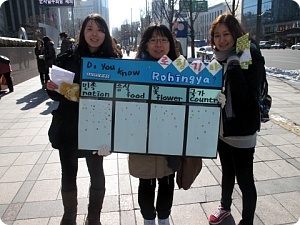
Human Asia campaigners raise awareness of the plight of Rohingya refugees in a recent demonstration in Korea. (Human Asia)
While Lee is optimistic that common ground can be found among Asian countries, she recognizes that there are many hurdles to overcome, including neighboring nations’ differing agendas such as food security in Bangladesh to migrant workers’ rights in Korea.
She also recognized that further education was needed to put human rights on the agenda here.
“It is very hard because people have very different ideas about what human rights are,” she said.
“We don’t have any general human rights teaching in schools or universities. Most of the young students don’t have any basic idea of human rights.
“They think that human rights are something that belong to others. They don’t think of human rights as something they can use to empower themselves.”To change this, the organization has focused for the last six years on education.
It holds regular workshops for activists, human rights academies and has set up a human rights course with Korea University Graduate School of International Studies, with students attending from countries including the Democratic Republic of Congo and Bangladesh as well as Korea. But now the charity is working to get more people outside of academia involved.“We are starting to run more campaigns to bring in ordinary members of the public as we want to expand our activities to include not just education but also toward more active campaigns,” Lee said. The NGO’s grassroots movement is also developing abroad with branches run by high school students cropping up in America ― in California, Pennsylvania, Virginia and Massachusetts.
In Korea, the charity has held street campaigns for Rohingya Refugees here, originally from Burma. It has also supported groups such as the Jumma people who fled persecution in Bangladesh to become refugees in Korea, and made a field trip to the country to learn more about human rights concerns there. As well as helping under-represented people, each campaign aims to accustom participants to the idea that they can become rights activists in their own way, too. “Korea has developed in various areas including economically, but you don’t have that kind of development in human rights.
We need to narrow this gap,” said Lee.“In Korea we have a very active civil rights and labor movement and the term human rights was always around but here people often associate the term with struggle, or fighting, or something political.“Even (our country’s) leaders, they think that human rights (can be used as) a tool for them to achieve a leadership position in Asia.”Lee said Human Asia aims to shift the focus from gleaning international prestige to helping people, avoiding many Asian NGOs often narrow scope that was often “very political and either right wing or left wing.”She added:
“We don’t necessarily represent the whole of Asia but by bringing together other civil society organizations and creating a forum we can discuss our different concerns.
”By Kirsty Taylor (kirstyt@heraldm.com)
By Dr.Zarni>>
All the “dramatic” developments in Burma, including the release of 6,000-plus prisoners, are, as US Assistant Secretary of State Kurt Campbell put it, certainly welcome. Likewise, the man from the International Crisis Group was singing the praise of Naypyidaw on the BBC World Service News hour with Robin Lustig on 11 Oct .
And yet despite these loud applauses of “changes” in Burma, the Burmese public is finding it very, very difficult to feel hopeful.
Not even Burma’s highly regarded political comedian Zaganar could say he was happy in spite of his new found freedom today when he was released from Myitkyina jail where he was serving 34 years behind bars. He told the Burmese local Eleven Media Group before boarding the Rangoon-bound plane, "Based on my current experiences I dare not think changes are real and big this time either."
Time magazine quoted his remark to the Associate Press: "I am not happy at all, as none of my 14 so-called political prisoner friends from Myitkyina prison are among those freed today".
So, how are we really to understand these much-trumpeted “changes” in Burma?
These changes do not include the change of heart among Burma’s rulers. They are in fact principally related to only two things.
First, the regime's felt need to realign its geopolitical interests.
The military’s uneasiness about its need to rely on China for international protection runs deep. Today China is also Burma’s number one foreign investor, all of it in mega-development, infrastructural and resource extractive projects.
And for Naypyidaw dealing with an increasingly aggressive, powerful and rich Beijing, without the backing of the West and the mainstream Burman public, is like fighting with one hand tied behind the back.
Tangible improvements on the human rights, political and development fronts are part of the price the generals have to pay to balance Beijing's growing influence.
Second, the generals and ex-generals have an acute desire to prove that they are not failures at nation-building, as the bulk of the Burmese public thinks. That’s understandable. The military has had nearly half a century to govern, develop and bring about peace and prosperity for all—not just themselves and their families. But they have turned the world’s rice basket into a basket case.
Hard facts on the ground speak louder than the military’s institutionalized fiction that the senior and junior generals vis-à-vis civilians are brilliant nation-builders. The generals’ Burma is ranked second to last, just ahead of Somalia, on Transparency International's Corruption Index. Public provision of health services exists only in name. There are no social safety nets. Period.
Public education, the largest provider of schooling, at all levels lies in ruin. Ninety-nine percent of university graduates don’t know what BA or BSc stands for, let alone how to spell Bachelor of Arts or Science correctly. And forget the home-grown PhDs.
This extremely low quality of human resources is not the exclusive problem of civilian educational and bureaucratic institutions. The bulk of the 4,000-plus graduates from the Defense Services Academy, the Defense Services Technological Academy and the Defense Services Medical Academy failed entrance examinations at Russian educational institutes where they were sent as “state scholars” under civilian disguise.
There are pockets of communities whose socioeconomic and humanitarian conditions are closer to those of countries in Sub-Saharan Africa than to those of an Asian country about to “take off” developmentally. Many spend more than 70 percent of their meager household income on food alone, while wealth is increasingly concentrated in the hands of the Chinese and a handful of cronies, who in part play the role of portfolio managers for the generals and ex-generals.
The country’s ecology and communities face serious threats to their survival from some mega-development projects such as dam construction—seven on the Irrawaddy, Burma’s Nile, alone—and the two major Chinese gas and oil pipelines and Thailand’s $13 billion Special Economic Zone construction in the country's far south.
The generals’ offer of peace is largely motivated by their strategic plan to either split these groups or placate them momentarily. They should not be misunderstood as the generals’ “quest for peace and ethnic equality” or as a political solution to the non-Burman population's six decades of ethnic grievances and thwarted federalist aspirations.
While successive military governments have paid lip service to the country’s farmers, the bulk of the country’s population, the generals don’t have enough money to endow a national agricultural bank and a rural development fund. For the money is sucked into two dozen armament projects, including German-run fiber-optic networks and the assembly work of Made-in-N. Korea missile components, and buying several squadrons of state-of-the-art Russian Mi-G 29s and Mi-24 gunship helicopters.
But while Burma's erstwhile military rulers survey the ruins they have left as their legacy, one accomplishment serves to put their minds at ease: the institutionalized ruling ethos enshrined in the Nargis Constitution of 2008.
As the winds of change are said to be blowing the public in Burma, we should be asking some fundamental questions which will allow all of us to see these changes in their proper contexts.
Here is my favorite set of bench marks:
First, is the military weaning itself from its misguided view that it is the only institution capable of keeping the country together and developing her?
The emergence of formal institutions such as “Parliament,” the “presidency,” a “human rights commission,” and so on, is all well and fine. But they don’t mean a thing unless power relations between the military at all levels and the society at large, including the cronies and the legitimate businessmen and women, change along more egalitarian lines.
If Burma is to return to normalcy—after half a century of generals’ ruinous rule—the first thing that needs to change is its Orwellian “soldiers superior, civilians inferior” attitude.
Second, the medieval self-perception as “natural rulers”—the guardians of the nation—so typical of the ruling generals and ex-generals needs to be reassessed in a nationwide open dialogue, and be binned once and for all.
The only tangible way to prove that Burma is moving from the medieval political space to the 21st century semi-liberal place is to hold a plebiscite on the Constitution, which places the military above the law and legalizes military coups d'etat.
Third, the military needs to stop viewing and treating the non-Burman ethnic minorities, who make up 35-40 percent of the total population and who control nearly half of the country, like semi-colonial people to be bossed about.
There are two different Burmas, or Burma experiences. It is not enough to talk about some positive changes or the country being on the cusps of “irreversible” changes in the “Burma Proper,” to borrow the old British colonial lingo. We need to bring in the other Burma—where people still live in active war zones and dormant conflict regions.
Fourth, the new government of President Thein Sein should do the economically and ecologically right thing.
It is a standard democratic practice for any government that claims to enjoy a popular mandate to govern to review critically all existing massive commercial contracts with foreign powers such as China, India, Thailand, South Korea and Australia, as well as with investors such as the global oil and gas companies. Because many of these contracts were signed by the previous military government without any popular input or consultation of any kind, the overall review of these contracts would send an unequivocal message to the public at home and the skeptics abroad that the new Naypyidaw means business. There should be a blanket moratorium on all mega-development projects such as the Tavoy Special Economic Zone and the two Chinese pipelines, which go through conflict zones and are poised to harm communal welfare and the environment.
Finally, there have been Russian-style massive transfers of public assets to the generals and a handful of cronies, including former drug lords and their families who have laundered their money with the generals’ knowledge. The issue of who controls the country’s wealth needs to be discussed publicly and, above all, in the new Parliament.
I know this is a tall order for both those in power and the public. Raising these issues, which some will consider “inconvenient,” in no way implies that anyone who raises them is cynical, idealistic or unrealistic. Because the issues I have identified here are of paramount importance to the public welfare and the long-term future of the country, the public and the government alike ought to start thinking and talking about them.As we say in Burma, when the situation calls for it, no issue is out of bounds.
Our country’s future and the well-being of the public depend on whether and how these fundamental issues are addressed now.

Just as it happened throughout the coastal territories from the Arabian Peninsula to the Barbary Coast and the shores of Gibraltar and Iberian Peninsula (and beyond) via Alexandria, Tripoli and Tunis to the west, and to the shores of Mozambique (originally Musa-bin-Baik) via Zanzibar and Mombasa to the south, and to the lower Gangetic Delta (Bangladesh) and beyond (to the Strait of Malacca) via the Malabar Coast of India to the east, the maritime trade route in the India Ocean in those days (pre-dating European colonization) used to be controlled by the Arab/Persian Muslims. As they traded they also created pockets of settlements, and interacting with and marrying into the local populace, which slowly changed the local customs and culture.
After the rapid expansion of Islam in the 7th century, according to Dr. Moshe Yegar, “Colonies of Muslims, both Arab and Persian, spread all along the sea trade routes… As early as the middle of the 8th century, a sizable Muslim concentration could be found in along the southern coast of China, in the commercial ports of southern India, and Southeast Asia…. Merchants brought silk, spices, perfumes, lumber, porcelain, silver and gold articles, precious jewels, jewelry, and so forth from these countries, and some of the trade made its way to Europe.” “Because sailing ships were dependent on monsoon winds and seasons, it was essential for Arabs and other Muslim traders,” writes Yegar, “to set up domiciles in ports that were located in the heart of local communities. Muslim settlements spread rapidly in Asian port cities as Muslim merchants became vital to the economy of the local communities.”
The local inhabitants of Arakan, as noted in the British Burma Gazetteer (1957), had interactions with the so-called Mohammedans – the ‘Moor Arab Muslims’ (merchants/traders), dating at least to the time of Mahataing Sandya (8th century CE). As to the Muslim settlements in Arakan, the renowned scholars of the early 20th century, Professor Enamul Haq and Abdul Karim Shahitya Visarad wrote in 1935: “The Muslim influence in Roshang [Mrohang: the capital of Arakan during the Mrauk-U kingdom] and modern Chattagram [Chittagong] has been noticeable from ancient times. The Arab traders established trade link with the East Indies in the eighth and ninth century AD. During this time Chittagong, the lone seaport of East India, became the resting place and colony of the Arabs. We know from the accounts of the ancient Arab travelers and geologists including Sulaiman (living in 851 AD), Abu Jaidul Hasan (contemporary of Sulaiman), Ibnu Khuradba (died 912 AD), Al-Masudi (died 956 AD), Ibnu Howkal (wrote his travelogue in 976 AD), Al-Idrisi (born last half of 11th century) that the Arab traders became active in the area between Arakan and the eastern bank of the Meghna River [in today’s Bangladesh]. We can also learn about this from the Roshang national history: when Roshang King, Maha Taing Chandra (788 – 810 AD) was ruling in the 9th century, some ship wrecked Muslim traders were washed ashore on ‘Ronbee’ or ‘Ramree’ Island. When they were taken to the Arakanese king, the king ordered them to live in the village (countryside) in his country. Other historians also recognized the fact that Islam and its influence developed in Arakan in the 9th and 10th century AD.” [Explanatory notes within the parentheses [ ] are mine. It is worth noting that in the dialect prevalent in Chittagong and Arakan the vocal sounds ‘Ha’ and ‘Sha’ are interchangeable. Thus the words Roshang and Rohang are interchangeable. – H.S.]
R.B. Smart writes in the British Burma Gazetteer as follows: “The local histories relate that in the ninth century several ships were wrecked on Ramree Island and the Mussalman crews sent to Arakan and placed in villages there. They differ but little from the Arakanese except in their religion and in the social customs which their religion directs, in the writing they use Burmese, but amongst themselves employ colloquially the language of their ancestors.”
As noted by renowned historian Professor Abdul Karim, “The important point to be noticed about these shipwrecked Muslims is that they have stuck to their religion, i.e. Islam and Islamic social customs. Though they used Burmese language and also adopted other local customs, they have retained the language of their ancestors (probably with mixture of local words) in dealing among themselves. Another point to be noted is that the Arab shipwrecked Muslims have retained their religion, language and social customs for more than a thousand years.”
These shipwrecked Arab Muslims became the nucleus of the Muslim population of Arakan; later other Muslims from Arabia, Persia and other countries entered into Arakan.
Dr. Moshe Yegar says, “Beginning with their arrival in the Bay of Bengal, the earliest Muslim merchant ships also called at the ports of Arakan and Burma proper… Muslim influence in Arakan was of great cultural and political importance. In effect, Arakan was the beachhead for Muslim penetration into other parts of Burma even if it never achieved the same degree of importance it did in Arakan. As a result of close land and sea contacts maintained between the two countries, Muslims played a key role in the history of the Kingdom of Arakan.”
It is no accident that Akyab (today’s Sittwe, the capital of Arakan state of Burma, situated on the south-eastern bank of the Naaf River) is a Farsi name, as are so many other towns and villages named, and how over the centuries most of these local inhabitants along the coastal towns and villages, tired of a corrupt form of their ancestral region, would convert to Islam. And this happened centuries before Muslim rulers governed some of those territories.
Professor Enamul Haq and Abdul Karim Shahitya Visarad wrote: “The Arabic influence increased to such a large extent in Chittagong during mid-10th century AD that a small Muslim kingdom was established in this region, and the ruler of the kingdom was called ‘Sultan’. Possibly the area from the east bank of the Meghna River to the Naaf was under this ‘Sultan’. We can know about the presence of this ‘Sultan’ in the Roshang [Mrohang, the capital Arakan during the Mrauk-U dynasty] national history. In 953 AD Roshang King, Sulataing Chandra (951- 957 AD) crossed his border into Bangla (Bengal) and defeated the ‘Thuratan’ (Arakanese corrupt form of Sultan), and as a symbol of victory setup a stone victory pillar at a place called ‘Chaikta-gong’ and returned home at the request of the courtiers and friends. This Chaik-ta-gong was the last border of his victory, since according to Roshang national history – ‘Chaik-ta-gong’ means ‘war should not be raised’. Many surmise that the modem name of Chittagong district originated from Chaik-ta-gong.”
If the story of Arakanese king -- mentioned in its Chronicles -- moving into Chittagong can be believed, in southern Bangladesh, especially in Chittagong, not only was there a Muslim community present but also a Muslim Sultanate ruling there in the 10th century. It may explain why Dr. Than Tun, the former Rector of Mandalay University and Professor of History at the Rangoon University, believed that the kings mentioned in the Inscription might have been Rohingyas, who lived in the eastern part of the Naaf River. He writes, “In the Kyaukza or stone inscription of 1442, it was written that some Muslim kings of Arakan were the friends of king of Ava.”
In their masterpiece, Arakan Rajshavay Bangla Shahitya, Professor Enamul Haq and Abdul Karim Shahitya Visarad continued, “In this way the religion of Islam spread and the Muslim influence slowly extended from the eastern bank of the Meghna to Roshang Kingdom in the 8th and 9th centuries. From the travelogues of the Egyptian traveler to India, Ibn Batuta (14th century AD) and from the accounts of the Portuguese pirates in the 16th century, the influence of the ‘Moors’ or Arabs was waxing till then. So it is evident that long before the Muslim race was established in Bengal in the 13th century, Islam reached to this remote region of Bengal. A conclusion may easily be drawn that after the establishment in Bengal, Islam further spread in the region. That is why Bengali literature was for the first time cultivated among the Muslim of the region. Since the 15th century onwards the Muslims of this region began to engage themselves in the study of Bengali, that is, began to write books in Bengali, of which we have lots of proofs.”
The Muslim saints, the Sufis, who came in hundreds to the shores of Bay of Bengal had a fabulous influence in proselytizing the local inhabitants to Islam. The Arakanese chronicle gives reference to the traveling of Sufis in that country at the time of the king Anawarhta (1044-1077 CE) during Pagan period. Even, a Russian merchant, Athanasius Nitikin, who traveled in the East (1470), mentions regarding activities of some Muslim Sufis of Pegu. The Merchant pictured Pegu as "no inconsiderable port, inhabited by Indian dervishes. The products derived from thence are manik, akhut, kyrpuk, which are sold by the dervishes.” As noted by Dr. Mohammed Ali Chowdhury, these dervishes were Muslims, and probably of Arab descent, and that at that time some Muslims (from nearby Muslim India) had settled in those places.
As it happened throughout history, wherever Muslims went and settled, they were able to proselytize the local people. The simplicity of their faith, views about salvation, egalitarian characteristics and ease of practice, and their ethos - morals, values, dealings, manners and customs -- had a profound effect on the local population to gravitate them to the faith of these strangers, the newcomers, away from the degenerative form of their own religion that they had endured. These migrant Muslims married into the local populace and parented children.
In his book, The Essential History of Burma, historian U Kyi writes, “The superior morality of those devout Muslims attracted large number of people towards Islam who embraced it en masse.”
This essential piece of history of the Muslims of the coastal regions of today’s Bangladesh and Arakan state of Burma is simply ignored by chauvinist elements within the Rakhine and Burmese community. They cannot imagine Islam amongst the ordinary masses without rulers being of the same faith. They also forget that Islam from its very inception has been a simple practical religion, away from the curses of racism, supremacist concepts and caste system that so overwhelmingly dominated the then Buddhist and Hindu culture. While the temples, statues, mandirs and pagodas were built with gold and precious ornaments, and monks and priests held the demigod status enjoying the benefits of the vast material resources that were endowed to them for their upkeep, ordinary people went hungry and poor, and were forced to lead a life of begging and eternal servitude. It is no accident of history either that vast majority of people in places like Malaysia, southern Philippines and Indonesia, where no Muslim army went, would one day become Muslims and abandon their ancestral religions.
The restoration of the deposed king Narameikhla (Mong Saw Mwan) to the throne of Arakan by the Muslim Sultan Jalaluddin Muhammad Shah of Bengal, thus ushering in the Mrauk-U dynasty (1430-1784 CE), is a turning point in the history of Arakan. From this time onward, many of its rulers, indebted to the Muslim Sultan adopted Muslim names (and may even have converted to Islam), a practice that would continue for the next two centuries, until 1638 CE. It is worth noting here that when Narameikhla was dethroned in 1404 CE by the Burman forces, he chose to flee to Muslim Bengal instead of either the Buddhist-ruled Tripura or the Hindu-ruled territories of India.
When the king Naramikhla reached the capital, he was widely acclaimed by his people. He was aided by two contingents of 50,000 Muslim soldiers (first under General Wali Khan and later under Sandi Khan) many of whom later settled in Arakan. They became his advisers and ministers making sure that the territory was not lost again to the Burmans.
The first thing Naramikhla did after regaining his throne was to transfer the capital from Launggyet to Mrohaung, which in the hands of Bengali poets and people became Roshang (Rohang). Those Muslims established the Sandi Khan Mosque in Mrohaung. Their descendants, as noted by the Bengali poets of the 17th century, held high positions during the Mrauk-U dynasty. During the successive centuries the Muslim population in Arakan grew in large numbers as a result of inter-marriage, immigration and conversion. [In my travels around the Diaspora communities, I have come across many of the descendants of those soldiers who came and settled in Arakan during Narameikhla’s time. As Anthony Irwin had noted some 70 years ago, these Muslims look quite different than average Bangladeshis; many of them have distinct Arab and Persian touch about them; many even have Mongoloid touch.]
As a vassal state of the Muslim Sultanate to the west, Arakan adopted the superior Muslim culture from the west in its courts, and minted coins with Arabic inscription of the Muslim article of faith (kalima). In this way, Arakan remained subordinate to Bengal until 1531. Interestingly, however, as noted above, its kings continued using Muslim titles even after they were liberated from dependency on the sultans of Bengal. As to the reason behind this practice, Dr. Yegar writes, “[T]hey were influenced by the fact that many of their subjects had become Muslims. Indeed, many Muslims served in prestigious positions in the royal administration despite its being Buddhist.” In Rakhine Maha Razwin (Great History of Arakan), Tha Thun Aung describes mass conversion of many Arakanese to Islam in the 15th and 16th centuries.
Because of her geographical proximity with the south-eastern parts of Bengal, Arakan developed both political and cultural ties with its neighbor to the north-west. Major Muslim settlements developed along the rivers of Lemru, Mingen, Kaladan, Mayu and Naaf. Its courts and royalties patronized Bengali literature. Some of the best known classical Bengali poets (Alaol, Dawlat Qazi and Mardan) came from Arakan. Its capital city essentially became the breeding ground for Bengali literature in the 17th century. This Mrauk-U period also came to be known as the ‘Golden Age’ in the history of Arakan.
It is also worth mentioning here that as a result of rather lax administrative control of Chittagong by the Mughal and Afghan rulers, and the intermittent rebellion by the Sultans of Bengal against the central government in Delhi, the territory was lost to Arakan between 1580 and 1666 CE. So the ties between Chittagong and Arakan were no less striking than those visible today in places like Texas and California with Mexico.
In their masterpiece work "Arakan Rajsabhay Bangala Shahitya,” Abdul Karim Shahitya Visarad and Dr. Enamul Haq wrote, "The way Bangali flourished in the court of the 17th century Arakan, nothing of that sort is found in its [Bengal’s] own soil. It is surprising that during the exile of Bengali language in Arakan, it was greatly appreciated by the Muslim courtiers of the Arakanese kings and the Muslim poets of East Bengal, especially those of the [greater] Chittagong Division.”
These scholars further wrote, “The study of Bengali literature that the Muslim initiated reached perfection under the aegis of the courtiers of the Roshang kings. It is needless to say that the Kings’ Court of Roshang got filled up with Muslim influence long before this. From the beginning of the 15th century AD the Kings’ Court of Roshang by luck was compelled to heartily receive the Muslim influence…
…. [T]he powerful intrusion of the Muslim influence that penetrated into the Kings’ Court of Roshang in the fifteenth century AD grew all the more in the following centuries. This influence gradually grew so strong that it reached the highest point in the seventeenth century. The Bengali literature in this century shows the full picture of the Muslim influence in the King’s Court of Roshang.”
How can this piece of history about flourishing Bengali literature and the presence of Muslim courtiers and subjects in Arakan be ignored by any objective analyst?
Nor should one forget that when the Mughal Prince Shah Shuja, the Governor of Bengal (1639-59), chose to take asylum in 1660 CE instead of submitting to the authority of Aurangzeb – the new Mughal Emperor, he chose Arakan, which already had many high ranking Muslims serving the king of Arakan. He was accompanied by his family members and retinues, which included hundreds of bodyguards. Upon arrival, however, the Mughal Prince was betrayed by the Arakanese king Sanda Sudamma. While there are competing accounts as to what had ultimately happened to the fate of the Prince, including one account that suggests that Shah Shuja and his family members were treacherously murdered (and another that suggests that he was able to flee to Manipur with some of his retinues), there is little doubt that many of his guards who were attacked savagely by the Maghs of Arakan fled to the nearby jungle. Some of the surviving guards were later made royal archers and bodyguards serving the Arakanese king. Their descendants, known as the Kamans or Kamanchis (bowman), are to be found settled mostly in Rambree Island. Some of the followers of Shah Shuja escaped the persecution of Maghs and crossed to Burma. The king of Ava settled them in Ramethin, Shwebo, Maydu and Meiktila. Their descendants can be found today in these places.
There was yet another kind of interaction between the Kingdom of Arakan with its eastern neighbor Bengal, beginning in the 17th century, when gaining strength, the kings of Arakan would allow the plunder of Bengal, and Bengali captives – tens of thousands - would be brought to work as slaves in Arakan. When the Portuguese moved to the Bay of Bengal, they were allowed to set up their military posts in Arakan. In return, the Portuguese aided the Rakhine Maghs in their piracy in Bengal, terrorizing its people and harassing the Mughal forces. The joint Magh-Portuguese marauding expeditions into Bengal continued well after they were routed out of Chittagong in 1666 by Shaista Khan, the Mughal Viceroy (Subedar) of Bengal and his son General Bujurg Umid Khan. Taking captives, most of whom were Muslims, forcing them into slavery was an important part of those raids.
Friar Manrique, a Portuguese priest who visited Bengal and Arakan and who spent six years in the Augustinian Church at Dianga (Deang, near Chittagong town), was himself a witness to such Magh-Portuguese piratical raids. He wrote, “They usually made there general attacks three or four times in the year, irrespective of minor raids which went on most of the year, so that during the five years I spent in the kingdom of Arracan, some eighteen thousand people came to the ports of Dianga and Angarcale.”
As can be seen from Manrique’s account, the number of those captives was not small, and was in excess of 3,000 per year, and continued for well over a century of piracy.
This is further evidenced by the fact that when the Chittagong fort fell into the hands of the Mughals, 10,000 Bengali (both Muslim and Hindu) captives got liberty and they went to their homes. While the Portuguese pirates sold their captives and/or forcibly baptized them into Christianity, the Magh pirates forced theirs into slave labors in the paddy fields along the Kaladan River (the river was named after these Kalas). So these captives also helped in increasing the Muslim population of Arakan. The descendants of these captives mostly reside now in Kyauktaw and Mrohaung Townships of Arakan.
According to historian Professor Abdul Karim, “In the 17th century the Muslims thronged the capital Mrohaung and they were present in the miniature courts of ministers and other great Muslim officers of the kingdom. An idea of their presence is available in the writings of Muslim poets like Alaol who wrote that people from various countries and belonging to various groups came to Arakan to be under the care of Arakanese king. The Portuguese Padre Fray Sebastien Manrique visited Arakan and stayed for some time; he was also present in the coronation ceremony of the Arakanese king held on 23 January 1635. He gives a description of the coronation procession and says that of the several contingents of army that took part in the coronation, one contingent wholly comprised of Muslim soldiers, let by a Muslim officer called Lashkar Wazir. The leader rode on Iraqi horse, and the contingent comprised of six hundred soldiers. In other contingent, led by Arakanese commanders also there were Muslim soldiers. This evidence of Sebastien Manrique combined with the fact that there were several Muslim ministers in Arakan gives a good picture of the presence of the Muslim in Arakan in the 17th century. The influence of the Muslim officers over the king of Arakan is also evident from the episodes mentioned by Sebastien Manrique.”
The Muslims of Arakan, therefore, are an amalgam of new migrants - Shaikhs, Syeds, Qazis, Mollahs, Alims, Fakirs, Arabs, Rumis (Turks), Moghuls, Pathans - from various parts of the Muslim world that settled during and before the Mrauk-U dynasty, including the captives (the so-called Kolas) brought in from various parts of Bengal and India, and the indigenous Muslims (the children of Bhumiputras who had converted to Islam over the centuries). They created the genesis of what we call the Rohingya Muslims. To put it succinctly: the Rohingya Muslims are the descendants of the indigenous 'Kalas' that either converted or mixed with the Muslim settlers/travelers/Sufis (including Arab/Persian merchants, traders) to the region, the non-returning soldiers who came to restore Narameikhla to the throne of Arakan, the unwilling captives and others that called Arakan their ancestral home. Hence, the Rohingya Muslims are not an ethnic group, which developed from one tribal group affiliation or single racial stock, but are an ethnic group that developed from different stocks of people.
As already demonstrated, the conversion of these indigenous people to Islam has been no different than what has happened throughout history in the last 14 centuries along the coastal regions from Mozambique to Malacca. It should, therefore, come as no surprise that the Rohingyas of Arakan while having some similarities in matters of physical features, and borrowing religious, linguistic and cultural heritage with their neighbors to the west would develop their own distinct identity, albeit a hybrid or mosaic one. They are neither Chittagonians nor are they Bengalis [Bangladeshis].
The Rohingya Muslims - the ‘Musulman Arakanese’ - as Anthony Irwin noted, ‘are quite unlike any other product of India or Burma that I have seen.’ Similarly, Moshe Yeager noted, “There is very little common – except common religion – between the Rohingyas of Arakan and the Indian Muslims of Rangoon or Burmese Muslims…”
While their ancestral territory would later be colonized by the Tibeto-Burman Buddhists - the ancestors of today’s Rakhines - whose cultural ties have been towards the east, it is the strength of their group character that the Rohingyas of Arakan were able to retain their linguistic and genealogical ties to the soil. After all, the Rakhines are genetically, culturally and linguistically closer to the Burmans (of Burma). On the other hand, as Dr. Yegar noted ‘the Rohingyas preserved their own heritage from the impact of the Buddhist environment, not only as far as their religion is concerned, but also in … their culture.’
As the children of the indigenous people of Arakan, the Rohingyas have as much right, if not more, as the Rakhine Buddhists, to identify themselves with the name that they prefer to describe them. If the late-coming Tibeto-Burman admixture has no problem in calling itself the Rakhaing of Arakan, no outsider (and surely not its abuser) has any right to either define the Rohingya maliciously or deny the same privilege in self-identifying itself.
To call these indigenous people of Arakan -- who identify themselves as the Rohingyas in Burma – “unwanted guests” is like calling the Native Americans unwanted refugees who had settled in America after the Europeans. As much as no massacre of yesteryears and ghettoization of the Native Americans today in designated American Indian Reservation camps can obliterate their genuine right, place, history and identity, no propaganda and government or non-government sponsored pogroms can erase the rightful identity of the Rohingya people of Burma. They are the children of the soil of Arakan.
To be continued .............
ႏိုင္ငံေက်ာ္ ဟာသအႏုပညာရွင္။ လူမွဳကူညီေရးလုပ္ငန္းလုပ္ေဆာင္သူ သရုပ္ေဆာင္ ဒါရိုက္တာ ေမာင္သူရ (ေခၚ) ဇာဂနာ ဒီကေန့ လြတ္ၿငိမ္းခ်မ္းသာခြင့္နဲ့ ကခ်င္ျပည္နယ္ျမစ္ၾကီးနားေထာင္က ျပန္လြတ္ပါတယ္၊ ျမစ္ၾကီးနားေထာင္မွာ ႏိုင္ငံေရးအက်ဥ္းသား ၁၈ ဦးရွိတဲ့အနက္ သူအပါအ၀င္ သုုံးဦးသာ လြတ္ေျမာက္တယ္လို့ သူက ေျပာပါတယ္၊
Zargana Arrival in Rangoon Airport
By AFP

Comedian Zarganar was released
Burma freed one of its most famous political prisoners on Wednesday under an amnesty that was expected to include at least dozens more dissidents jailed in the authoritarian state.
The freedom of an estimated 2,000 political prisoners, who include pro-democracy campaigners, journalists, monks and lawyers, has long been a key demand of Western powers that have slapped sanctions on Burma.
Zarganar, a prominent comedian and vocal government critic, was among those released on Wednesday as part of a pardon of more than 6,300 prisoners by the new leadership, his family said.
“I have talked to him. He is free now,” the activist’s sister-in-law Ma Nyein told AFP, adding that that he was expected to be flown home from Myitkyina in northern Kachin state where he was being held.
Zarganar was arrested in 2008 after organising deliveries of aid to victims of Cyclone Nargis, which left 138,000 people dead or missing and prompted international criticism of the regime’s slow response.
The famous satirist, who was a vocal critic of the old military junta, was sentenced to 59 years’ imprisonment, later reduced to 35 years. He is believed to suffer from heart disease.
It was not immediately clear how many dissidents were included in the amnesty.
But a government official, who did not want to be named, said about 30 political detainees would be freed in Rangoon, mostly members of Aung San Suu Kyi’s National League for Democracy (NLD).
Separately, an NLD member said about two dozen political prisoners would be released elsewhere.
A mass pardon of dissidents would be arguably the clearest sign yet of change under a new government that has reached out to critics including Suu Kyi, who was freed in November after seven straight years of detention.
State television announced on Tuesday that more than 6,300 elderly, sick, disabled or well-behaved prisoners would be granted an amnesty from Wednesday “on humanitarian grounds”.
It said freeing detainees would allow them to “help to build a new nation”.
Many political prisoners were sentenced to decades in prison and have endured “torture and other forms of cruel, inhuman or degrading treatment,” according to Amnesty International.
President Thein Sein, a former general and senior junta figure, has surprised critics by signalling a series of political reforms since taking power following a controversial election last November.
He has been applauded by international observers for holding direct talks with Suu Kyi, who spent most of the past two decades locked up by the junta.
A top US official, Kurt Campbell, on Monday hailed “dramatic developments” in Burma including what he described as “very consequential dialogue” between the Nobel Peace Prize winner and the leadership.
He hinted that concrete moves towards democracy by Burma could lead to an easing of sanctions.
“We will match their steps with comparable steps,” he said.
The new regime, which came to power after elections held a few days before Suu Kyi’s release, appears keen to improve its image and in August held the first talks between her and Thein Sein.
Suu Kyi, whose party won 1990 elections but was never allowed to take power, has said she believes Thein Sein genuinely wants to carry out reforms, but cautioned it was too soon to say whether he would succeed.

ျမစ္ျကီးနား အက်ဉ္းေထာင္က ဒီကေန့ မနက္ ၈ နာရီခြဲက ေလးျကိမ္ ေျမာက္ အက်ဉ္းက်ရာကေန ျပန္လြတ္ေျမာက္လာတဲ့ ကမၻာေက်ာ္ ျမန္မာ့ လူရွြင္ေတာ္ ဇာဂနာက အစိုးရကို စတင္ ေဝဖန္ ေျပာျကား လိုက္ပါတယ္။
zaganarဇာဂနာက အျပင္ေရာက္တာနဲ့ အစိုးရကို ခ်က္ခ်င္း သေရာ္ပါတယ္။နိုင္ငံေတာ္ သမၼတက အမ်ိုးသား ျပန္လည္ သင့္ျမတ္ေရးကို တကယ္ သြားတယ္ဆိုရင္ အခု ပံုစံထက္ နိုင္ငံေရး အက်ဉ္းသား အားလံုးကို လွြတ္ေပး သင့္တယ္လို့ အက်ဉ္းေထာင္က ထြက္ထြက္ျခင္း ဘီဘီစီနဲ႕သီးသန္႕ေမးျမန္းခန္းမွာ ေျပာသြားတာ ျဖစ္ပါတယ္။အခု ပံုစံက နိုင္ငံေက်ာ္ ေရာ့ခ္ အဆိုေတာ္ ေလးျဖဴကို ကေလးသီခ်င္း ျဖစ္တဲ့ ေရာင္စံု ေဘာလံုး သီခ်င္းကို ဆိုခိုင္းသလို ေလျဖတ္ေနတဲ့ သက္ၾကီးအမ်ိုဳးသမီးကို မိတ္ကပ္လိမ္းျပီး အရပ္ထဲ လႊတ္သလို ျဖစ္ေနတယ္လို႕ဥပမာ ဥပေမယ်ေတြနဲ့ ထိထိ ေရာက္ေရာက္ ေဝဖန္ ေျပာၾကား ပါတယ္။
သူ့အေနနဲ႕သမၼတကို ေျပာခြင့္ရမယ္ ဆိုရင္ေတာ့ သူတို႕ေတြဟာ သမၼတ ဦးေဆာင္တဲ့ အစိုးရသစ္ လက္ထက္မွာ အဖမ္းခံထားရတဲ့ သူေတြ မဟုတ္တဲ့ အေျကာင္း၊ နိုင္ငံေရး အက်ဥ္းသား ဆိုတဲ့ စကားလံုးကိုလည္း ကေလးဆန္ဆန္ အျငင္းပြား ေနတဲ့ သူေတြ မဟုတ္ ေျကာင္း ေျပာလိုျပီး အခုေတာ့ သူ လြတ္လာေပမယ့္ သူငယ္ခ်င္းေတြ ေထာင္ထဲမွာ ရွိေနဆဲ ျဖစ္လို့ စိတ္မေကာင္းေၾကာင္းေျပာပါတယ္။တျခား Media Player ျဖင့္ ဖြင့္ပါလြတ္လပ္ခြင့္ေတြ ပိုရေတာ့မလား၊ ေျပာေရးဆိုခြင့္ေတြ သာလာနိုင္မလားလို့ ဘီဘီစီက ေမးတာကိုေတာ့ ေျပာခြင့္ရေနတယ္လို့ေတာ့ သူျကားတဲ့အေျကာင္း၊ သတင္းစာေတြထဲမွာလည္း စတုတၳ မ႑ိဳင္ဆိုတဲ့ စကားလံုးကို လွိုင္လွိုင္သံုးထားေျကာင္း၊ ဒါေပမဲ့ စတုတၳ မ႑ိုင္က ဘယ္သူမ်ားလဲလို့ ေသခ်ာ ေစ့ငုလိုက္ေတာ့ ျပန္ျကားေရးဝန္ႀကီးျဖစ္ေနတာ ေတြ့ရတယ္လို့ ကမၻာေက်ာ္ ျမန္မာ့ လူရွြင္ေတာ္ျကီးက အက်ဉ္းေထာင္က ထြက္ထြက္ျခင္း အစိုးရကို သေရာ္ခဲ့ပါတယ္။
ဒီကေန႕သူတို႕ကို လႊတ္တာဟာ သမၼတ ဦးသိန္းစိန္ရဲ့ လြတ္ျငိမ္းခ်မ္းသာခြင့္ သက္သက္ေျကာင့္ မဟုတ္ဘဲ နိုင္ငံေရးမႈနဲ႕ျပန္ဖမ္းဆီး ေထာင္ခ်လို႕ရတဲ့ ၄၀၁ ကိုလည္း အေျကာင္းျပခ်က္နဲ့ ထည့္ထားတာကို လႊတ္ဝရမ္းထဲ ေတြ႕ရတယ္လို့ ဇာဂနာက ဘီဘီစီကို ေျပာပါတယ္။ (ဘီဘီစီ)
"ကိုဇာဂနာႏွင့္Eleven Media Groupအင္တာဗ်ဴး"
ျမစ္ၾကီးနားအက်ဥ္းေထာင္မွ ျပန္လည္ လြတ္ေျမာက္လာသည့္ ကိုသူရ(ေခၚ)ကိုဇာဂနာအား ရန္ကုန္သို႔ လာေရာက္ရန္ ေလယာဥ္ေပၚ မတက္မီအခ်ိန္အတြင္း Eleven Media Group မွ ေမးျမန္းခ်က္အခ်ိဳ႕ကို ေဖာ္ျပလိုက္ပါသည္။
ေမး- အခု ျပန္လြတ္လာတဲ့ အေပၚမွာ ကိုသူရအေနနဲ႕ ဘယ္လိုခံစားရပါသလဲ။
ေျဖ- ေအးေပါ့ဗ်ာ။ လြတ္လာတာေတာ့ လြတ္လာတာေပါ့။ ဒီလိုလြတ္လာေပမယ့္ က်န္ခဲ့တဲ့သူေတြအတြက္ စိတ္မေကာင္းျဖစ္မိတယ္။
ေမး- လက္ရွိအခ်ိန္မွာ ျမန္မာႏိုင္ငံက အေျပာင္းအလဲဆီသြားေနတယ္ဆိုတဲ့ အေပၚမွာ
ကိုသူရလည္း သိထားတာေတြရွိမွာပါ။ ဒီအေပၚမွာ ဘယ္လိုျမင္မိပါသလဲ။
ေျဖ- အေျပာင္းအလဲဆိုတဲ့ ကိစၥမွာ အခု ေတြ႕ၾကံဳေနရတာေတြေၾကာင့္ အေျပာင္းလဲၾကီး ျဖစ္ေနျပီလားဆိုတာကို မယံုရဲေသးဘူး ျဖစ္ေနတယ္။
ေမး- ေတြ႕ၾကံဳေနရတဲ့ အေျခအေနဆိုတာ အဲဒီက အေနအထားကိုေျပာတာလား၊ အကုန္လံုး ျပန္မလြတ္လာေသးတဲ့ အေျခအေနကို ေျပာတာလား။
ေျဖ- မစို႕မပို႔လႊတ္တာကိုပဲ ေျပာခ်င္တာပါ။
ေမး- အခုလိုလြတ္လာျပီးတဲ့ေနာက္ ဘာေတြဆက္လုပ္ဖို႕ စဥ္းစားထားတာရွိလဲ။
ေျဖ- ဘာမွေတာ့ မစဥ္းစာရေသးပါဘူး။ ကၽြန္ေတာ့္ညီေတြအတြက္ သီခ်င္းေတြ၊ ျပက္လံုးေတြ လုပ္ရပါဦးမယ္။ ကၽြန္ေတာ္တို႕ အလုပ္လုပ္ရမယ္။ လုပ္ရမယ့္ အလုပ္ေတြ မျပီးေသးဘူး။ ႏိုင္ငံေရးအလုပ္ေတြကို ဆက္လုပ္ရဦးမယ္။
ေမး- ႏိုင္ငံေရးအလုပ္ဆက္လုပ္မယ္ဆိုတာက လက္ရွိအခင္းအက်င္းထဲကေန ပါတီတစ္ခု၊ ပါတီ၀င္ တစ္ဦးအေနနဲ႕ ၀င္ပါမွာကို ေျပာတာလား။
ေျဖ- ပါတီေထာင္ဖို႕၊ ပါတီ၀င္လုပ္ဖို႕ဆိုတာထက္ ၈၈တုန္းက ကၽြန္ေတာ္တို႕ ဘာေၾကာင့္ လမ္းေပၚထြက္ခဲ့ၾကလဲ။ ပ်င္းလို႕ထြက္ခဲ့ၾကတာမဟုတ္ပါဘူး။ လိုခ်င္တာေတြ ရွိလို႕ ထြက္ခဲ့ၾကတာပါ။ ကၽြန္ေတာ္တို႕ တကယ္လိုခ်င္တာ ရျပီလား။ အျပည့္အ၀ မရေသးဘူးဆိုရင္ ရေအာင္လုပ္ၾကရမယ္။ ရန္ကုန္ေရာက္မွပဲ ဆက္ေျပာၾကတာေပါ့။ အခုေတာ့ ေလယာဥ္ေပၚတက္ရေတာ့မယ္။
Credit :weekly Media

မြန္းတည့္ ၁၂ နာရီ ၃၅ မိနစ္
(ကသာေထာင္)
ကခ်င္ျပည္နယ္ ကသာေထာင္က နိုင္ငံေရးအက်ဉ္းသား ၅ ဦး လြတ္ေျမာက္မယ္လို့ သတင္းရရွိပါတယ္။
ဦးေစာလွိဳင္(၁၉၉၀ ေရြးေကာက္ပြဲအနိုင္ရ အင္းေတာ္ကိုယ္စားလွယ္)၊ ကိုမ်ိဳးဝင္း(ရန္ကုန္)၊ ကိုေအာင္နိုင္ဦး(ပဲခူး)၊ ကိုျမင့္ေအာင္(ေကအန္ယူ) နဲ့ ေစာဘဘိုး(ေတာင္ငူ) တို့ျဖစ္ေၾကာင္း အက်ဉ္းေထာင္နဲ့ နီးစပ္သူေတြက ေျပာပါတယ္။
မြန္းတည့္ ၁၂ နာရီ ၃၀ မိနစ္
(၈၈ မ်ိဳးဆက္ေက်ာင္းသားေခါင္းေဆာင္မ်ား)
၈၈ မ်ိဳးဆက္ေက်ာင္းသားေခါင္းေဆာင္ေတြျဖစ္တဲ့ ကိုပ႑ိတ္ထြန္း လႊတ္မယ့္စာရင္းမွာ မပါဘူးလို့ ေထာင္အာဏာပိုင္ေတြက တဆင့္ၾကားတယ္လို့ သူ့အေဖက ေျပာပါတယ္။
၈၈ မ်ိဳးဆက္ေက်ာင္းသားေခါင္းေဆာင္ ကိုမင္းကိုနိုင္ လြတ္မလားဆိုတာလည္း မသိရေသးဘူးလို့ သူ့ညီ ကိုေအာင္ထြန္းက ေျပာပါတယ္။
(ေပါင္းတည္ေထာင္)
ေထာင္ဒဏ္ ၁၀၆ ခ်မွတ္ခံရၿပီး စစ္ေတြေထာင္မွာ အက်ဉ္းက်ေနသူ ရွမ္းေခါင္း ေဆာင္တဦးျဖစ္တဲ့ ဗိုလ္ခ်ုပ္ေဆးထင္ ဒီမနက္ ျပန္လည္လြတ္ေျမာက္တယ္လို့ လားရွိဳးၿမို့ ေန ေျမးျဖစ္သူက ေျပာပါတယ္။ပဲခူးတိုင္း ေပါင္းတည္ေထာင္က ကိုေက်ာ္ေက်ာ္လင္း (အဖြဲ့ခ်ုပ္လူငယ္) ကေတာ့ လြတ္ဖို့ အတြက္ ညကတည္းက လက္မွတ္ထိုးၿပီးၿပီျဖစ္ၿပီး ဒီေန့လြတ္ေျမာက္မယ္လို့ သိရပါတယ္။ ေပါင္းတည္ေထာင္မွာ နိုင္ငံေရးအက်ဉ္းသားဆိုလို့ သူတေယာက္တည္းရွိပါတယ္၊ စစ္ေထာက္လွမ္းေရးေဟာင္း ၇ ဦးလည္း ေပါင္းတည္ေထာင္ကေန ဒီေန့လြတ္မယ္လို့ သတင္းရရွိပါတယ္။
ေထာင္ဒဏ္ ၁၀၆ ခ်မွတ္ခံရၿပီး စစ္ေတြေထာင္မွာ အက်ဉ္းက်ေနသူ ရွမ္းေခါင္း ေဆာင္တဦးျဖစ္တဲ့ ဗိုလ္ခ်ုပ္ေဆးထင္ ဒီမနက္ ျပန္လည္လြတ္ေျမာက္တယ္လို့ လားရွိဳးၿမို့ ေန ေျမးျဖစ္သူက ေျပာပါတယ္။ပဲခူးတိုင္း ေပါင္းတည္ေထာင္က ကိုေက်ာ္ေက်ာ္လင္း (အဖြဲ့ခ်ုပ္လူငယ္) ကေတာ့ လြတ္ဖို့ အတြက္ ညကတည္းက လက္မွတ္ထိုးၿပီးၿပီျဖစ္ၿပီး ဒီေန့လြတ္ေျမာက္မယ္လို့ သိရပါတယ္။ ေပါင္းတည္ေထာင္မွာ နိုင္ငံေရးအက်ဉ္းသားဆိုလို့ သူတေယာက္တည္းရွိပါတယ္၊ စစ္ေထာက္လွမ္းေရးေဟာင္း ၇ ဦးလည္း ေပါင္းတည္ေထာင္ကေန ဒီေန့လြတ္မယ္လို့ သတင္းရရွိပါတယ္။
မြန္းတည့္ ၁၂ နာရီ ၂၇ မိနစ္
(ဟသၤာတေထာင္)
ဧရာဝတီတိုင္း ဟသၤတေထာင္ကေန အက်ဉ္းသား ၂၆ ဦး လြတ္ေျမာက္တဲ့အနက္ နိုင္ငံေရးအက်ဉ္းသား ၂ ဦးျဖစ္တဲ့ ရန္ကုန္တိုင္း လွိဳင္ၿမို့နယ္က အဖြဲ့ခ်ုပ္ဝင္ ကိုသန့္ေဇာ္နဲ့ မ်ိဳးဆက္သစ္လူငယ္မ်ားအဖြဲ့ဝင္ မေအးသီတာတို့ လြတ္ေျမာက္လာပါတယ္။
မေအးသီတာဟာ ၂၀၀၈ ခုႏွစ္က ေထာင္ဒဏ္ ၁၁ ႏွစ္မွတ္ခံရၿပီး ၄ ႏွစ္ျပည့္ခ်ိန္မွာ ျပန္လြတ္လာတာပါ။ လြတ္ၿငိမ္းခ်မ္းသာခြင့္နဲ့ ျပန္လြတ္လာတဲ့အတြက္ ဝမ္းသာေၾကာင္း မေအးသီတာက ဒီဗြီဘီကို ေျပာပါတယ္။
(ဗူးသီးေထာင္ေထာင္)
ရခိုင္ျပည္နယ္ ဗူးသီးေတာင္ေထာင္ကေန နိုင္ငံေရးအက်ဉ္းသား ၃ ဦးျဖစ္တဲ့ ကိုကိုႀကီး (စမ္းေခ်ာင္း)၊ ကိုသန္းထြန္းေဇ၊ ဦးေအာင္စိုးတို့ လြတ္ေျမာက္လာပါတယ္။
က်န္းမာေရးမေကာင္းတဲ့ ၈၈ မ်ိဳးဆက္ေက်ာင္းသားေခါင္းေဆာင္ ကိုေဌးၾကြယ္ ဒီေထာင္ကေန လြတ္လာမယ္လို့ မိသားစုက ယံုၾကည္ေနေပမယ့္ ဒီေန့လြတ္လာတဲ့အထဲ ကိုေဌးၾကြယ္မပါဘူးလို့ ေထာင္အာဏာပိုင္က ကိုေဌးၾကြယ္ရဲ့ႏွမ မမီမီၾကြယ္ကို ေျပာပါတယ္။
(ေတာင္ငူေထာင္)
ပဲခူးတိုင္း ေတာင္ငူေထာင္က အက်ဉ္းသား စုစုေပါင္း ၉၁ ဦး လြတ္ေျမာက္ၿပီး ေထာင္ အေခၚအေဝၚအရ သာမန္သီးသန့္နဲ့ သီးသန့္အက်ဉ္းသား ၃၂ ဦးလြတ္ေျမာက္သလို စစ္ေထာက္လွမ္းေရးနဲ့ ဆက္စပ္သူ ၁၃ ဦး လြတ္ေျမာက္တယ္လို့ ေတာင္ငူၿမို့က အဖြဲ့ခ်ုပ္ေခါင္းေဆာင္တဦးျဖစ္တဲ့ ဦးေအာင္စိုးျမင့္က ေျပာပါတယ္။
ေတာင္ငူေထာင္က လြတ္ေျမာက္သူေတြထဲမွာ ၁၉၈၉ ခုႏွစ္ သန္လ်င္ေရနံခ်က္ စက္ရံုဝင္း ဗံုးေဖာက္ခြဲမႈ သံသယနဲ့ ေထာင္ဒဏ္ အႏွစ္ ၃၀ ခ်မွတ္ခံထားရတဲ့ ကိုညီညီဦးလည္း ပါဝင္ပါတယ္။ သူဟာ အဖြဲ့ခ်ုပ္ လူငယ္တဦးျဖစ္ပါတယ္။ ၁၉၈၉ ခုႏွစ္က ဗံုးေဖာက္ခြဲမႈနဲ့ ဖမ္းဆီးေထာင္ခ်ခံရသူျဖစ္ပါတယ္။ ၁၉၈၉ ခုႏွစ္က သန္လ်င္ၿမို့နယ္က အမ်ိဳးသား ဒီမိုကေရစီအဖြဲ့ခ်ုပ္ လူငယ္ေတြ ျဖစ္ၾကတဲ့ ကိုညီညီဦး၊ ကိုသန္းေဇာ္နဲ့ ကိုမိုးေက်ာ္သူတို့ကို ဗံုးေဖာက္ခြဲမႈ တရားခံေတြအျဖစ္ ဖမ္းဆီးခဲ့ၿပီး ေသဒဏ္ခ်မွတ္ခဲ့ပါတယ္။
ဒီဗံုးခြဲမႈ တရားခံအစစ္ျဖစ္တဲ့ ကရင္အမ်ိဳးသားအစည္းအရံုး (ေကအန္ယူက) ဗိုလ္မႉးကိုကိုနိုင္က သန္လ်င္ေရနံခ်က္ စက္ရံုနဲ့ ၿမို့ေတာ္ခန္းမ တို့ကို သူကိုယ္တိုင္ ေဖာက္ခြဲခဲ့တာပါလို့ ဝန္ခံေျပာၾကားခဲ့ပါတယ္။ ဒါေပမယ့္ ကိုညီညီဦးကေတာ့ အခုမွ လြတ္ေျမာက္လာရတာပါ။
ေတာင္ငူေထာင္မွာ ပုဒ္မ ၅ ည နဲ့ ၁၉၉၉ ခုႏွစ္မွာ ႏွစ္ရွည္ေထာင္ဒဏ္ေတြ စတင္က်ခံရတဲ့ ေစာျမင့္နိုင္(ေထာင္ဒဏ္ ၂၄ ႏွစ္)၊ ဦးေအးေရႊ(ပဲခူး) (ေထာင္ဒဏ္ ၂၄ ႏွစ္) ကိုေဇာ္ရဲဝင္း (ေထာင္ဒဏ္ ၁၇ ႏွစ္) တို့လည္း ျပန္လြတ္လာပါတယ္။
အလားတူ ကိုေအာင္ေအာင္(ေအာင္သန့္ဇင္ဦး) နဲ့ ေအာင္ေဇၿဖိုး(ေဇာ္ႀကီး) တို့လည္း ေတာင္ငူ ေထာင္ကေန ျပန္လြတ္လာတယ္လို့ ေတာင္ငူၿမို့က အဖြဲ့ခ်ုပ္ေခါင္းေဆာင္တဦးျဖစ္တဲ့ ဦးေအာင္စိုးျမင့္က ေျပာပါတယ္။
မြန္းတည့္ ၁၂ နာရီ ၇ မိနစ္
(ကေလးၿမိဲဳ႕)
စစ္ကိုင္းတိုင္း ကေလးၿမို့က အက်ဉ္းေထာင္ေတြနဲ့ အလုပ္စခန္းေတြက အက်ဉ္းသား ၅၀၀ နီးပါး လြတ္ေျမာက္တဲ့အထဲမွာ နိုင္ငံေရးအက်ဉ္းသား ၆ ဦးပါဝင္တယ္လို့ ကေလးၿမို့ နိုင္ငံေရးအသိုက္အဝန္းက ေျပာပါတယ္။
ကေလးၿမိဳ႕ေထာင္မွာ နိုင္ငံေရးအက်ဉ္းသား ၂၀ ေက်ာ္ ရွိတဲ့အနက္ ဦးေအးခ်ိဳ၊ ဦးသိန္းလြင္ဦး၊ ကိုလွိဳင္မ်ိဳး၊ ကိုျမင့္နိုင္၊ ကိုေအာင္ေအာင္တို့ လြတ္ေျမာက္လာတယ္လို့ ေျပာပါတယ္။
၂၀၀၇ ေရႊဝါေရာင္ေတာ္လွန္ေရး ဦးေဆာင္သံ ဃာေတာ္ အရွင္ဂမ႓ီရကေတာ့ လြတ္ေျမာက္မလာေသးဘူးလို့ ေထာင္ေရွ့မွာ ေစာင့္ေနသူေတြက ေျပာပါတယ္။
မနက္ ၁၁ နာရီ ၃၅ မိနစ္ ၂၀ စကၠန့္
(သံတြဲေထာင္)
ရခိုင္ျပည္နယ္ သံတြဲေထာင္မွာ နိုင္ငံေရးအက်ဉ္းသား ၇ ဦးေလာက္ ရွိတဲ့အနက္ တဦးမွ လြတ္မလာေသးဘူးလို့ ဒီမနက္ ၉ နာရီမွာ သံတြဲက နိုင္ငံေရးအသိုင္း အဝိုင္းက ေျပာပါတယ္။
(ဟသၤာတေထာင္)
ဧရာဝတီတိုင္း ဟသၤတေထာင္ကေန အက်ဉ္းသား ၂၆ ဦး လြတ္ေျမာက္တဲ့အနက္ နိုင္ငံေရးအက်ဉ္းသား ၂ ဦးျဖစ္တဲ့ ရန္ကုန္တိုင္း လွိဳင္ၿမို့နယ္က အဖြဲ့ခ်ုပ္ဝင္ ကိုသန့္ေဇာ္နဲ့ မ်ိဳးဆက္သစ္လူငယ္မ်ားအဖြဲ့ဝင္ မေအးသီတာတို့ လြတ္ေျမာက္လာပါတယ္။
မေအးသီတာဟာ ၂၀၀၈ ခုႏွစ္က ေထာင္ဒဏ္ ၁၁ ႏွစ္မွတ္ခံရၿပီး ၄ ႏွစ္ျပည့္ခ်ိန္မွာ ျပန္လြတ္လာတာပါ။ လြတ္ၿငိမ္းခ်မ္းသာခြင့္နဲ့ ျပန္လြတ္လာတဲ့အတြက္ ဝမ္းသာေၾကာင္း မေအးသီတာက ဒီဗြီဘီကို ေျပာပါတယ္။
(ဗူးသီးေထာင္ေထာင္)
ရခိုင္ျပည္နယ္ ဗူးသီးေတာင္ေထာင္ကေန နိုင္ငံေရးအက်ဉ္းသား ၃ ဦးျဖစ္တဲ့ ကိုကိုႀကီး (စမ္းေခ်ာင္း)၊ ကိုသန္းထြန္းေဇ၊ ဦးေအာင္စိုးတို့ လြတ္ေျမာက္လာပါတယ္။
က်န္းမာေရးမေကာင္းတဲ့ ၈၈ မ်ိဳးဆက္ေက်ာင္းသားေခါင္းေဆာင္ ကိုေဌးၾကြယ္ ဒီေထာင္ကေန လြတ္လာမယ္လို့ မိသားစုက ယံုၾကည္ေနေပမယ့္ ဒီေန့လြတ္လာတဲ့အထဲ ကိုေဌးၾကြယ္မပါဘူးလို့ ေထာင္အာဏာပိုင္က ကိုေဌးၾကြယ္ရဲ့ႏွမ မမီမီၾကြယ္ကို ေျပာပါတယ္။
(ေတာင္ငူေထာင္)
ပဲခူးတိုင္း ေတာင္ငူေထာင္က အက်ဉ္းသား စုစုေပါင္း ၉၁ ဦး လြတ္ေျမာက္ၿပီး ေထာင္ အေခၚအေဝၚအရ သာမန္သီးသန့္နဲ့ သီးသန့္အက်ဉ္းသား ၃၂ ဦးလြတ္ေျမာက္သလို စစ္ေထာက္လွမ္းေရးနဲ့ ဆက္စပ္သူ ၁၃ ဦး လြတ္ေျမာက္တယ္လို့ ေတာင္ငူၿမို့က အဖြဲ့ခ်ုပ္ေခါင္းေဆာင္တဦးျဖစ္တဲ့ ဦးေအာင္စိုးျမင့္က ေျပာပါတယ္။
ေတာင္ငူေထာင္က လြတ္ေျမာက္သူေတြထဲမွာ ၁၉၈၉ ခုႏွစ္ သန္လ်င္ေရနံခ်က္ စက္ရံုဝင္း ဗံုးေဖာက္ခြဲမႈ သံသယနဲ့ ေထာင္ဒဏ္ အႏွစ္ ၃၀ ခ်မွတ္ခံထားရတဲ့ ကိုညီညီဦးလည္း ပါဝင္ပါတယ္။ သူဟာ အဖြဲ့ခ်ုပ္ လူငယ္တဦးျဖစ္ပါတယ္။ ၁၉၈၉ ခုႏွစ္က ဗံုးေဖာက္ခြဲမႈနဲ့ ဖမ္းဆီးေထာင္ခ်ခံရသူျဖစ္ပါတယ္။ ၁၉၈၉ ခုႏွစ္က သန္လ်င္ၿမို့နယ္က အမ်ိဳးသား ဒီမိုကေရစီအဖြဲ့ခ်ုပ္ လူငယ္ေတြ ျဖစ္ၾကတဲ့ ကိုညီညီဦး၊ ကိုသန္းေဇာ္နဲ့ ကိုမိုးေက်ာ္သူတို့ကို ဗံုးေဖာက္ခြဲမႈ တရားခံေတြအျဖစ္ ဖမ္းဆီးခဲ့ၿပီး ေသဒဏ္ခ်မွတ္ခဲ့ပါတယ္။
ဒီဗံုးခြဲမႈ တရားခံအစစ္ျဖစ္တဲ့ ကရင္အမ်ိဳးသားအစည္းအရံုး (ေကအန္ယူက) ဗိုလ္မႉးကိုကိုနိုင္က သန္လ်င္ေရနံခ်က္ စက္ရံုနဲ့ ၿမို့ေတာ္ခန္းမ တို့ကို သူကိုယ္တိုင္ ေဖာက္ခြဲခဲ့တာပါလို့ ဝန္ခံေျပာၾကားခဲ့ပါတယ္။ ဒါေပမယ့္ ကိုညီညီဦးကေတာ့ အခုမွ လြတ္ေျမာက္လာရတာပါ။
ေတာင္ငူေထာင္မွာ ပုဒ္မ ၅ ည နဲ့ ၁၉၉၉ ခုႏွစ္မွာ ႏွစ္ရွည္ေထာင္ဒဏ္ေတြ စတင္က်ခံရတဲ့ ေစာျမင့္နိုင္(ေထာင္ဒဏ္ ၂၄ ႏွစ္)၊ ဦးေအးေရႊ(ပဲခူး) (ေထာင္ဒဏ္ ၂၄ ႏွစ္) ကိုေဇာ္ရဲဝင္း (ေထာင္ဒဏ္ ၁၇ ႏွစ္) တို့လည္း ျပန္လြတ္လာပါတယ္။
အလားတူ ကိုေအာင္ေအာင္(ေအာင္သန့္ဇင္ဦး) နဲ့ ေအာင္ေဇၿဖိုး(ေဇာ္ႀကီး) တို့လည္း ေတာင္ငူ ေထာင္ကေန ျပန္လြတ္လာတယ္လို့ ေတာင္ငူၿမို့က အဖြဲ့ခ်ုပ္ေခါင္းေဆာင္တဦးျဖစ္တဲ့ ဦးေအာင္စိုးျမင့္က ေျပာပါတယ္။
မြန္းတည့္ ၁၂ နာရီ ၇ မိနစ္
(ကေလးၿမိဲဳ႕)
စစ္ကိုင္းတိုင္း ကေလးၿမို့က အက်ဉ္းေထာင္ေတြနဲ့ အလုပ္စခန္းေတြက အက်ဉ္းသား ၅၀၀ နီးပါး လြတ္ေျမာက္တဲ့အထဲမွာ နိုင္ငံေရးအက်ဉ္းသား ၆ ဦးပါဝင္တယ္လို့ ကေလးၿမို့ နိုင္ငံေရးအသိုက္အဝန္းက ေျပာပါတယ္။
ကေလးၿမိဳ႕ေထာင္မွာ နိုင္ငံေရးအက်ဉ္းသား ၂၀ ေက်ာ္ ရွိတဲ့အနက္ ဦးေအးခ်ိဳ၊ ဦးသိန္းလြင္ဦး၊ ကိုလွိဳင္မ်ိဳး၊ ကိုျမင့္နိုင္၊ ကိုေအာင္ေအာင္တို့ လြတ္ေျမာက္လာတယ္လို့ ေျပာပါတယ္။
၂၀၀၇ ေရႊဝါေရာင္ေတာ္လွန္ေရး ဦးေဆာင္သံ ဃာေတာ္ အရွင္ဂမ႓ီရကေတာ့ လြတ္ေျမာက္မလာေသးဘူးလို့ ေထာင္ေရွ့မွာ ေစာင့္ေနသူေတြက ေျပာပါတယ္။
မနက္ ၁၁ နာရီ ၃၅ မိနစ္ ၂၀ စကၠန့္
(သံတြဲေထာင္)
ရခိုင္ျပည္နယ္ သံတြဲေထာင္မွာ နိုင္ငံေရးအက်ဉ္းသား ၇ ဦးေလာက္ ရွိတဲ့အနက္ တဦးမွ လြတ္မလာေသးဘူးလို့ ဒီမနက္ ၉ နာရီမွာ သံတြဲက နိုင္ငံေရးအသိုင္း အဝိုင္းက ေျပာပါတယ္။
ဒါ့အျပင္ ဗိုလ္ခ်ုပ္ႀကီးခင္ညြန့္ ရာထူးကဖယ္ရွား အေရးယူခံရၿပီးေနာက္ ေထာင္က် ခဲ့ၾကတဲ့ စစ္ေထာက္လွမ္းေရးက ဗိုလ္မႉးတဦးနဲ့ ဗိုလ္ႀကီး ၂ ဦးလည္း သံတြဲေထာင္မွာ အက်ဉ္းက်ေနတယ္လို့ သိရပါတယ္။
ေနဘုန္းလတ္ (ဘေလာ့ဂါ)
ကရင္ျပည္နယ္ ဘားအံေထာင္က အက်ဉ္းသားေတြထဲက ၃၈ ဦး လြတ္ေျမာက္ဖို့ရွိ တယ္လို့ ဘားအံေထာင္နဲ့နီးစပ္သူေတြဆီက သိရပါတယ္။
အဲဒီထဲမွာ ႏွစ္ရွည္ ေထာင္ဒဏ္ ခ်မွတ္ခံထားရတဲ့ ဘေလာ့ဂါေနဘုန္းလတ္ ပါဝင္မႈ ရွိမရွိကိုေတာ့ မသိရေသးဘူးလို့ ဘားအံေထာင္ေရွ့မွာ ေစာင့္ဆိုင္းေနတဲ့ ညီျဖစ္သူ ကိုဘိုသူက ေျပာပါတယ္။
မနက္ ၁၁ နာရီ : ၁၇ မိနစ္ : ၃၀ စကၠန့္
ဦးသန္းလြင္ (အန္အယ္လ္ဒီ)
ကယားျပည္နယ္ လြိဳင္ေကာ္အက်ဉ္းေထာင္မွာ အက်ဉ္းက်ေနတဲ့ မတၲရာ အဖြဲ့ခ်ုပ္ ေခါင္းေဆာင္တဦးျဖစ္တဲ့ ဦးသန္းလြင္ရဲ့ အေျခအေနကို မိသားစုက ေထာင္ကို ေမးျမန္းရာ မွာ ၁၀ နာရီက်မွ ျပန္လည္ေမးျမန္းဖို့ တံု့ျပန္ေျဖၾကားတယ္လို့ မိသားစုက ေျပာပါတယ္။ လြိဳင္ေကာ္ေထာင္မွာ နိုင္ငံေရးအက်ဉ္းသား ၄ ဦး အက်ဉ္းက်ေနတယ္လို့ သိရပါတယ္။
ေဒၚဝင္းျမျမ (အန္အယ္လ္ဒီ)
ကခ်င္ျပည္နယ္ ပူတာအိုေထာင္မွာ အက်ဉ္းက်ေနတဲ့ မနၲေလးတိုင္းအဖြဲ့ခ်ုပ္ေခါင္း ေဆာင္ ေဒၚဝင္းျမျမရဲ့ ေနအိမ္ကို မနက္ ၉ နာရီက ေမးျမန္းရာမွာ သက္ဆိုင္ရာက ဘာမွ အေၾကာင္းမၾကားပါဘူးလို့ ေဒၚဝင္းျမျမရဲ့အစ္ကို ဦးဘစိုးက ေျဖပါတယ္။
ပူတာအိုေထာင္ မွာ ရွမ္းတိုင္းရင္းသားေခါင္းေဆာင္ ခြန္ထြန္းဦးအပါအဝင္ နိုင္ငံေရးအက်ဉ္းသား ၃၀ ေက်ာ္ အက်ဉ္းက်ေနပါတယ္။ စစ္ကိုင္တိုင္းေဒသႀကီး မံုရြာေထာင္က နိုင္ငံေရးအက်ဉ္းသား ၇ ဦးေလာက္ ျပန္လြတ္ဖို့ရွိ တယ္လို့ ေထာင္အာဏာပိုင္ေတြနဲ့ နီးစပ္သူေတြဆီက သိရပါတယ္။
ကိုညြန့္ေအာင္ (မံုရြာအန္အယ္လ္ဒီ) မံုရြာအန္အယ္လ္ဒီက လူငယ္တာဝန္ခံ ကိုညြန့္ေအာင္ဟာ ပူတာအိုေထာင္မွာ အက်ဉ္းက်ေနရာက ျပန္လြတ္လာမယ္လို့ မိသားစြုနဲ့ အဖြဲ့ခ်ုပ္ဝင္ေတြက ေမ်ွာ္လင့္ေနၾကပါတယ္။
ေတာင္ငူေထာင္
ေတာင္ငူေထာင္ကေန အက်ဉ္းသား ၉၁ လြတ္ေျမာက္ဖို့ရွိၿပီး နိုင္ငံေရးအက်ဉ္းသား ၃၂ ဦး ပါဝင္မယ္လို့ ေတာင္ငူေထာင္အသိုင္းအဝိုင္းက ေျပာပါတယ္။
အဲဒီထဲမွာ သန္လ်င္ ေရနံခ်က္စက္ရံု ဗံုးေဖာက္ခြဲမႈနဲ့ မွားယြင္းဖမ္းဆီးေထာင္ဒဏ္ခ်မွတ္ခံခဲ့ရၿပီး ေနာက္ပိုင္းမွာ က်ူးလြန္သူအမွန္ ေပၚေပါက္သြားေပမယ့္ မလြတ္ေျမာက္ေသးတဲ့ ကိုညီညီဦး အပါအဝင္ ဦးေအးေဆြ၊ ေစာျမင့္နိုင္၊ ဂ်ိမ္း (ေခၚ) ေအာင္ေအာင္၊ ေအာင္ေဇၿဖိုးတဲ့ ပုဂၢိဳလ္ေတြ ပါဝင္လာဖို့ရွိတယ္လို့လည္း ေတာင္ငူေထာင္ အသိုင္းအဝိုင္းက ေျပာပါတယ္။
ကိုလွမ်ိဳးေနာင္ (၈၈ မ်ိဳးဆက္ေက်ာင္းသားေခါင္းေဆာင္)
မနၲေလး အိုးဘိုအက်ဉ္းေထာင္ကေန ဒီမနက္ ၈ နာရီေလာက္မွာ အက်ဉ္းသား တခ်ိဳ့ကို မွန္လံုကားတစီးနဲ့ စတင္လႊတ္ေပးလိုက္ၿပီး ဒီအက်ဉ္းသားေတြထဲမွာ ရွမ္း၊ တရုတ္ စတဲ့အက်ဉ္းသားေတြသာ ပါဝင္ၿပီး ရွမ္းျပည္နယ္ဘက္ကို ျပန္ပို့တာလို့ အိုးဘိုေထာင္ေရွ့က မ်က္ျမင္သက္ေသေတြက ေျပာပါတယ္။
အိုးဘိုေထာင္ကေန လြတ္လာမယ့္ နိုင္ငံေရးအက်ဉ္းသားေတြထဲမွာ ၈၈ မ်ိဳးဆက္ေက်ာင္းသား ေခါင္းေဆာင္တဦး ျဖစ္တဲ့ ကိုလွမ်ိဳးေနာင္ ပါဝင္မယ္လို့လည္း သတင္းေတြ ထြက္ေပၚေနပါတယ္။
လူရႊင္ေတာ္ ဇာဂနာ
ျမစ္ႀကီးနားေထာင္မွာ ေထာင္ဒဏ္ ၃၅ ႏွစ္က်ခံေနရတဲ့ ျပည္သူ့အခ်စ္ေတာ္ လူရႊင္ေတာ္ ဇာဂနာ (ကိုသူရ) ဒီေန့လြတ္ၿငိမ္းခ်မ္းသာခြင့္နဲ့ လြတ္ေျမာက္သူေတြထဲ ပါဝင္ေၾကာင္း ျမစ္ႀကီးနားေထာင္ အာဏာပိုင္ေတြဆီက သိရတယ္လို့ ခယ္မျဖစ္သူ မၿငိမ္းက ေျပာပါတယ္။
ဒီမနက္ ၁၀ နာရီ မိနစ္ ၃၀ ျမန္မာ့ေလေၾကာင္းေလယာဉ္နဲ့ တင္ေပးလိုက္ မွာျဖစ္ၿပီး မြန္းလြဲပိုင္းမွာ ရန္ကုန္ မဂၤလာဒံုေလဆိပ္ကို ေရာက္ရွိမယ္လို့ ဆိုပါတယ္။
၂ဝဝဂ ခုႏွစ္ ေမလ နာဂစ္မုန္တိုင္းေဘးသင့္သူေတြကို ကူညီကယ္ဆယ္ေရးလုပ္ ငန္းေတြ ေဆာင္ရြက္ေနခဲ့တဲ့ ကိုဇာဂနာကို အာဏာပိုင္ေတြက အဲဒီႏွစ္ဇြန္လမွာ ဖမ္းဆီးခဲ့ပါ တယ္။
အဲဒီေနာက္ သူ့ကို အီလက္ထေရာနစ္ အက္ဥပေဒ ၃ ခုနဲ့ ေထာင္ဒဏ္ ၄၅ ႏွစ္၊ နိုင္ငံေတာ္လံုျခံုေရးကို ထိခိုက္ရန္ လွံဳ့ေဆာ္မႈနဲ့ ဗြီဒီယိုအက္ဥပေဒ အပါအဝင္ ပုဒ္မ ၅ ခုနဲ့ ေထာင္ဒဏ္ ၁၄ ႏွစ္၊ စုစုေပါင္း ေထာင္ဒဏ္ ၅၉ ႏွစ္ ခ်မွတ္ခဲ့ပါတယ္။
အီလက္ထေရာနစ္ အက္ဥပေဒ ပုဒ္မ ၃ ခုနဲ့ ေထာင္ဒဏ္ ၄၅ ႏွစ္ ခ်မွတ္ထားရာက ၂ဝဝ၉ ခုႏွစ္ ေဖေဖာ္ဝါရီလ ၁၃ ရက္မွာ တမႈကို၈ ႏွစ္စီ စုစုေပါင္း ၂၄ ႏွစ္ ေလ်ွာ့ခ်ေပး လိုက္လို့ ေထာင္ဒဏ္ ၃၅ ႏွစ္ က်န္ရွိတာျဖစ္ပါတယ္။
ကိုဇာဂနာ အက်ဉ္းက်ခံေနတုန္းမွာ မိခင္ျဖစ္သူ စာေရးဆရာမႀကီး ေဒၚၾကည္ဦးဟာ ၂၀၀၉ ခု မတ္လ ၂၀ ရက္မွာ ကြယ္လြန္ခဲ့သလို ဖခင္ စာေရးဆရာႀကီး နန္းညြန့္ေဆြဟာလည္း ၂၀၁၀ ခု ဇူလိုင္ ၁၄ ရက္မွာ ကြယ္လြန္သြားခဲ့ပါတယ္။ ကိုဇာဂနာနဲ့အတူ ျမစ္ႀကီးနားေထာင္က နိုင္ငံေရးအက်ဉ္းသား ကိုမ်ိဳးေအာင္သန္းနဲ့ ကိုဇင္မင္းထြန္းတို့လည္း လြတ္ေျမာက္လာတယ္လို့ သိရပါတယ္။ သူတို့ႏွစ္ဦးကေတာ့ လြတ္ရက္နီးေနတဲ့ နိုင္ငံေရးအက်ဉ္းသားေတြ ျဖစ္ပါတယ္။
ဦးေက်ာ္ခင္ (ျပည္သူ့လႊတ္ေတာ္ကိုယ္စားလွယ္)
ရွမ္းျပည္နယ္ ေတာင္ႀကီးေထာင္က လြတ္ေျမာက္မယ့္ အက်ဉ္းသား ၂၀၀ စာရင္း မွာ ၁၉၉၀ ေရြးေကာက္ပြဲဝင္ ေတာင္ႀကီးၿမို့နယ္ ျပည္သူ့လႊတ္ေတာ္ကိုယ္စားလွယ္ ဦးေက်ာ္ခင္ ပါဝင္တယ္လို့ ေတာင္ႀကီးၿမို့က တရားရံုးခ်ုပ္ေရွ့ေန ေဒၚခင္မိုးမိုးက ေျပာပါ တယ္။ လားရွိဳးေထာင္ကလည္း အက်ဉ္းသား ၉၂ ဦး လႊတ္မွာျဖစ္ၿပီး အဲဒီထဲက နိုင္ငံေရး အက်ဉ္းသားေတြျဖစ္တဲ့ ဦးရွိန္နိတၲ၊ ကိုေအာင္ေဇာ္ဦး(ေတာင္ႀကီး)၊ မတင္တင္ခ်ိဳ (မရမ္း ကုန္း အန္အယ္လ္ဒီ)၊ ဦးအုန္းေက်ာ္ (ေဒါပံု အန္အယ္လ္ဒီအဖြဲ့ဝင္) တို့ ၄ ဦး ျပန္လြတ္လာ တယ္လို့လည္း ေဒၚခင္မိုးမိုးက ေျပာပါတယ္။
က်ိဳင္းတံုေထာင္မွာ အက်ဉ္းသာ ၁၄၄ ဦး လြတ္တယ္လို့ ၾကားသိရေပမယ့္ နိုင္ငံေရးအက်ဉ္းသား ပါမပါ မသိရေသးပါဘူး။
မနက္ ၁၀ နာရီ : ၄၀ မိနစ္ : ၄၀ စကၠန့္
ဗိုလ္ခ်ုပ္ေဆထင္ကို ရခိုင္ျပည္နယ္ စစ္ေတြကေန ရန္ကုန္ကို ပို့ေဆာင္ေပးမွာျဖစ္တယ္လို့ ေျပာပါတယ္။ အသက္ ၇၅ ႏွစ္အရြယ္ ဗိုလ္ခ်ုပ္ေဆထင္ဟာ မ်က္စိတိမ္စြဲေနၿပီး ႏွလံုး၊ ဆီးခ်ိဳ၊ ေသြးတိုးေရာဂါေတြ ခံစားေနရပါတယ္။
ဗိုလ္ခ်ုပ္ေဆထင္ဟာ ‘နအဖ’ စစ္အစိုးရနဲ့ အပစ္အခတ္ရပ္စဲေရး လုပ္ထားခဲ့တဲ့ ရွမ္းျပည္တပ္မေတာ္ (ေျမာက္ပိုင္း) အထူးေဒသ (၃) ဥကၠ႒ျဖစ္သလို ရွမ္းျပည္နယ္ၿငိမ္းခ်မ္းေရးေကာင္စီ ဥကၠ႒လည္းျဖစ္ပါတယ္။
သူနဲ့အတူ ခြန္ထြန္းဦး၊ စိုင္းညြန့္လြင္ စတဲ့ ရွမ္းေခါင္းေဆာင္ ၈ ဦးကို “ရွမ္းျပည္ပညာရွင္မ်ားေကာင္စီ ဖြဲ့စည္းဖို့ လႈပ္ရွားၾကတယ္”ဆိုတဲ့ စြပ္စြဲခ်က္နဲ့ ႏွစ္ရွည္ေထာင္ဒဏ္ေတြ ခ်မွတ္ခဲ့တာျဖစ္ပါတယ္။ ဗိုလ္ခ်ုပ္ေဆထင္ကို ၂၀၀၅ ခုႏွစ္ နိုဝင္ဘာမွာ ေထာင္ဒဏ္ခ်မွတ္ခံခဲ့ရတာျဖစ္ၿပီး ျမန္မာနိုင္ငံ တရားစီရင္မႈသမိုင္းမွာ မၾကံုစဖူး ေထာင္ဒဏ္ (၁၀၆) ႏွစ္ စီရင္ခံရသူျဖစ္ပါတယ္။
ေနာက္ဆံုးရရွိတဲ့သတင္းအရ ဗိုလ္ခ်ုပ္ေဆထင္ကို ရန္ကုန္ကို ဒီေန့ပို့ေဆာင္မွာျဖစ္ၿပီး မနက္ျဖန္မွာ ရွမ္းျပည္နယ္ လားရွိဳးၿမို့ကို ဆက္လက္ပို့ေဆာင္မွာျဖစ္လို့ မိသားစုအေနနဲ့ လားရွိဳးေလဆိပ္ကေန ေစာင့္ႀကိုဖို့ ဒီမနက္ ၉ နာရီခြဲမွာ ဗိုလ္ခ်ုပ္ေဆထင္ကိုယ္တိုင္ ဖုန္းဆက္တယ္လို့ သူ့သမီး နန္းခမ္းေဖာင္းက ဒီဗြီဘီကို ေျပာပါတယ္။
မနက္ ၉ နာရီ : ၄၅ မိနစ္ : ၀၅ စကၠန့္
မနၲေလး အိုးဘိုေထာင္က လြတ္မယ့္ နိုင္ငံေရးအက်ဉ္းသား ေတြကိုလည္း နိုင္ငံေရးအသိုက္အဝန္းက သြားႀကိုဖို့ ျပင္ဆင္ေနၾကပါတယ္။ ပဲခူးမွာေတာ့ အေျခအေန ထူးျခားမႈ မရွိေသးဘဲ ပဲခူး အဖြဲ့ခ်ုပ္ဥကၠဌ ဦးျမတ္လွကေတာ့ အားလံုးလြတ္မယ္လို့ သိပ္မေမ်ွာ္လင့္ဘူးလို့ ေျပာပါတယ္။ အသက္ႀကီးတဲ့လူေတြေလာက္လႊတ္မယ္လို့ ထင္ၿပီး လူငယ္ေတြ အထူးသျဖင့္ ၈၈ မ်ိဳးဆက္ေတြကို လႊတ္ပါ့မလားလို့ စိုးရိမ္တယ္လို့ လည္း ေျပာပါတယ္။
မႏွင္းပြင့္ေဝ (ဗကသ)
ေမာ္လၿမိုင္ေထာင္မွာ အက်ဉ္းက်ေနတဲ့ မႏွင္းပြင့္ေဝ (နာဂစ္အေလာင္းေတြ သျဂႌုဟ္တဲ့ ဗကသ အဖြဲ့ဝင္) လည္း လြတ္မယ့္စာရင္းမွာပါတယ္။ ဒီမနက္ ၁၀ နာရီမွာ အခမ္းအနားနဲ့လြတ္မယ္လို့ သိရၿပီး သူ့ဖခင္ ေဒါက္တာေနဝင္းနဲ့ မိခင္တို့က ရန္ကုန္ကေန ေမာ္လၿမိုင္ေထာင္ေရွ့ကို သြားေရာက္ေစာင့္ဆိုင္းေနၾကပါတယ္။
မနက္ ၈ နာရီ : ၄၀ မိနစ္ : ၀၆ စကၠန့္
နိုင္ငံေက်ာ္လူရႊင္ေတာ္ ဇာဂနာ (ကိုသူရ) အပါအဝင္ နိုင္ငံေရးအက်ဉ္းသား ၃ ဦး ျမစ္ႀကီး နားေထာင္ကေန လြတ္ေျမာက္မယ္လို့ သတင္းရရွိပါတယ္။ အမ်ိဳးသားဒီမိုကေရစီ အဖြဲ့ခ်ုပ္ ကခ်င္ျပည္နယ္အတြင္းေရးမႉး ဦးေနဝင္းက ျမစ္ႀကီးနားေထာင္ကို သြားေမးရာမွာ အဲဒီလို သိလာရတာလို့ ေျပာပါတယ္။ လြတ္မယ့္လူစာရင္းမွာ ကိုဇာဂနာပါတယ္လို့ သူ့ခယ္မ မၿငိမ္းကလည္း ေျပာပါတယ္။
ပဲခူးတိုင္း သာယာဝတီေထာင္က ျပန္လႊတ္မယ့္ အက်ဉ္းသားစာရင္းထဲမွာ နိုင္ငံေရး အက်ဉ္းသားေတြ အေတာ္အတန္ပါတယ္လို့ ေထာင္အာဏာပိုင္ေတြက ေျပာတဲ့အေၾကာင္း ေထာင္ကို မေန့ကသြားၿပီး ပါဆယ္ပို့ခဲ့တဲ့ အမ်ိဳးသားဒီမိုကေရစီအဖြဲ့ခ်ုပ္ဝင္ေတြက ေျပာပါတယ္။ သာယာဝတီေထာင္ကို မေန့မြန္းလြဲပိုင္းက နိုင္ငံရးအက်ဉ္းသား ၃၃ ဦးအ တြက္ ပါဆယ္သြားပို့ရာမွာ ၁၂ ရက္ေန့မွာ လႊတ္ေပးတဲ့အခါ စာရင္းသြင္းထားရင္ ျပန္ထုတ္ ရခက္မွာစိုးလို့ မနက္ဖန္ ျပန္လြတ္ေတာ့မွေပးဖို့ ေထာင္ဝန္ထမ္းက ေျပာတယ္လို့ ဆိုပါတယ္။ သာယာဝတီေထာင္မွာ နိုင္ငံေရးအက်ဉ္းသား ၁၈၀ ကေန ၂၀၀ အၾကားရွိတယ္လို့ လည္း သိရပါတယ္။
ဒီေန့မနက္ ၇ နာရီေလာက္မွာ မနၲေလးၿမို့ အိုးဘိုအက်ဉ္းေထာင္ကို အက်ဉ္သား ေတြ ျပန္လြတ္မယ္လို့ ေမ်ွာ္လင့္ၿပီး သြားေရာက္ၾကည့္ရႈေမးျမန္းရာမွာ မနက္ ၈ နာရီမွ လႊတ္မယ့္အေၾကာင္း ေထာင္တာဝန္ရွိသူက ေျဖၾကားတယ္လို့ မနၲေလးက အမ်ိဳးသားဒီမိုကေရစီအဖြဲ့ခ်ုပ္ဝင္တဦးက ေျပာျပပါတယ္။ အိုးဘိုေထာင္ေရွ့မွာ အက်ဉ္းသားမိသားစုဝင္ ၅၀ ေလာက္ ေရာက္ရွိေစာင့္ဆိုင္းေနၾကၿပီလို့လည္း ေျပာပါတယ္။
မနၲေလးတိုင္း ေရႊဘိုေထာင္ကေန အနည္းဆံုး နိုင္ငံေရးအက်ဉ္းသား ဆယ္ဦး ျပန္လည္လြတ္ေျမာက္လာမယ္လို့ ေထာင္တြင္းက ထြက္ေပၚလာတဲ့သတင္းကို ကိုးကားၿပီး အက်ဉ္း သားေတြအက်ိဳး လိုက္ပါေဆာင္ရြက္ေနသူေတြ၊ ႀကိုဆိုေနသူေတြက ေျပာပါတယ္၊ က်ိန္း ေသလြတ္ၿပီလို့ မဆိုနိုင္ေသးေပမယ့္ သူတို့ရရွိတဲ့စာရင္းမွာ ပါဝင္သူေတြကေတာ့ …
၁။ မေလးေလးမြန္
၂။ ကိုေက်ာ္မင္းသန္း
၃။ ကိုၾကည္သာထြန္း
၄။ ကိုစိုးဝင္းေအာင္
၅။ ဦးေက်ာ္လွိဳင္
၆။ ဦးသုစိတၲ
၇။ ဦးသုဇန
၈။ ဦးေခမိႏၵ
၉။ မရင္ရင္ဝိုင္း
min kyaw khine(facebook)
9:00 AM
ေနဘုန္းလတ္ (ဘေလာ့ဂါ)
ကရင္ျပည္နယ္ ဘားအံေထာင္က အက်ဉ္းသားေတြထဲက ၃၈ ဦး လြတ္ေျမာက္ဖို့ရွိ တယ္လို့ ဘားအံေထာင္နဲ့နီးစပ္သူေတြဆီက သိရပါတယ္။
အဲဒီထဲမွာ ႏွစ္ရွည္ ေထာင္ဒဏ္ ခ်မွတ္ခံထားရတဲ့ ဘေလာ့ဂါေနဘုန္းလတ္ ပါဝင္မႈ ရွိမရွိကိုေတာ့ မသိရေသးဘူးလို့ ဘားအံေထာင္ေရွ့မွာ ေစာင့္ဆိုင္းေနတဲ့ ညီျဖစ္သူ ကိုဘိုသူက ေျပာပါတယ္။
မနက္ ၁၁ နာရီ : ၁၇ မိနစ္ : ၃၀ စကၠန့္
ဦးသန္းလြင္ (အန္အယ္လ္ဒီ)
ကယားျပည္နယ္ လြိဳင္ေကာ္အက်ဉ္းေထာင္မွာ အက်ဉ္းက်ေနတဲ့ မတၲရာ အဖြဲ့ခ်ုပ္ ေခါင္းေဆာင္တဦးျဖစ္တဲ့ ဦးသန္းလြင္ရဲ့ အေျခအေနကို မိသားစုက ေထာင္ကို ေမးျမန္းရာ မွာ ၁၀ နာရီက်မွ ျပန္လည္ေမးျမန္းဖို့ တံု့ျပန္ေျဖၾကားတယ္လို့ မိသားစုက ေျပာပါတယ္။ လြိဳင္ေကာ္ေထာင္မွာ နိုင္ငံေရးအက်ဉ္းသား ၄ ဦး အက်ဉ္းက်ေနတယ္လို့ သိရပါတယ္။
ေဒၚဝင္းျမျမ (အန္အယ္လ္ဒီ)
ကခ်င္ျပည္နယ္ ပူတာအိုေထာင္မွာ အက်ဉ္းက်ေနတဲ့ မနၲေလးတိုင္းအဖြဲ့ခ်ုပ္ေခါင္း ေဆာင္ ေဒၚဝင္းျမျမရဲ့ ေနအိမ္ကို မနက္ ၉ နာရီက ေမးျမန္းရာမွာ သက္ဆိုင္ရာက ဘာမွ အေၾကာင္းမၾကားပါဘူးလို့ ေဒၚဝင္းျမျမရဲ့အစ္ကို ဦးဘစိုးက ေျဖပါတယ္။
ပူတာအိုေထာင္ မွာ ရွမ္းတိုင္းရင္းသားေခါင္းေဆာင္ ခြန္ထြန္းဦးအပါအဝင္ နိုင္ငံေရးအက်ဉ္းသား ၃၀ ေက်ာ္ အက်ဉ္းက်ေနပါတယ္။ စစ္ကိုင္တိုင္းေဒသႀကီး မံုရြာေထာင္က နိုင္ငံေရးအက်ဉ္းသား ၇ ဦးေလာက္ ျပန္လြတ္ဖို့ရွိ တယ္လို့ ေထာင္အာဏာပိုင္ေတြနဲ့ နီးစပ္သူေတြဆီက သိရပါတယ္။
ကိုညြန့္ေအာင္ (မံုရြာအန္အယ္လ္ဒီ) မံုရြာအန္အယ္လ္ဒီက လူငယ္တာဝန္ခံ ကိုညြန့္ေအာင္ဟာ ပူတာအိုေထာင္မွာ အက်ဉ္းက်ေနရာက ျပန္လြတ္လာမယ္လို့ မိသားစြုနဲ့ အဖြဲ့ခ်ုပ္ဝင္ေတြက ေမ်ွာ္လင့္ေနၾကပါတယ္။
ေတာင္ငူေထာင္
ေတာင္ငူေထာင္ကေန အက်ဉ္းသား ၉၁ လြတ္ေျမာက္ဖို့ရွိၿပီး နိုင္ငံေရးအက်ဉ္းသား ၃၂ ဦး ပါဝင္မယ္လို့ ေတာင္ငူေထာင္အသိုင္းအဝိုင္းက ေျပာပါတယ္။
အဲဒီထဲမွာ သန္လ်င္ ေရနံခ်က္စက္ရံု ဗံုးေဖာက္ခြဲမႈနဲ့ မွားယြင္းဖမ္းဆီးေထာင္ဒဏ္ခ်မွတ္ခံခဲ့ရၿပီး ေနာက္ပိုင္းမွာ က်ူးလြန္သူအမွန္ ေပၚေပါက္သြားေပမယ့္ မလြတ္ေျမာက္ေသးတဲ့ ကိုညီညီဦး အပါအဝင္ ဦးေအးေဆြ၊ ေစာျမင့္နိုင္၊ ဂ်ိမ္း (ေခၚ) ေအာင္ေအာင္၊ ေအာင္ေဇၿဖိုးတဲ့ ပုဂၢိဳလ္ေတြ ပါဝင္လာဖို့ရွိတယ္လို့လည္း ေတာင္ငူေထာင္ အသိုင္းအဝိုင္းက ေျပာပါတယ္။
ကိုလွမ်ိဳးေနာင္ (၈၈ မ်ိဳးဆက္ေက်ာင္းသားေခါင္းေဆာင္)
မနၲေလး အိုးဘိုအက်ဉ္းေထာင္ကေန ဒီမနက္ ၈ နာရီေလာက္မွာ အက်ဉ္းသား တခ်ိဳ့ကို မွန္လံုကားတစီးနဲ့ စတင္လႊတ္ေပးလိုက္ၿပီး ဒီအက်ဉ္းသားေတြထဲမွာ ရွမ္း၊ တရုတ္ စတဲ့အက်ဉ္းသားေတြသာ ပါဝင္ၿပီး ရွမ္းျပည္နယ္ဘက္ကို ျပန္ပို့တာလို့ အိုးဘိုေထာင္ေရွ့က မ်က္ျမင္သက္ေသေတြက ေျပာပါတယ္။
အိုးဘိုေထာင္ကေန လြတ္လာမယ့္ နိုင္ငံေရးအက်ဉ္းသားေတြထဲမွာ ၈၈ မ်ိဳးဆက္ေက်ာင္းသား ေခါင္းေဆာင္တဦး ျဖစ္တဲ့ ကိုလွမ်ိဳးေနာင္ ပါဝင္မယ္လို့လည္း သတင္းေတြ ထြက္ေပၚေနပါတယ္။
လူရႊင္ေတာ္ ဇာဂနာ
ျမစ္ႀကီးနားေထာင္မွာ ေထာင္ဒဏ္ ၃၅ ႏွစ္က်ခံေနရတဲ့ ျပည္သူ့အခ်စ္ေတာ္ လူရႊင္ေတာ္ ဇာဂနာ (ကိုသူရ) ဒီေန့လြတ္ၿငိမ္းခ်မ္းသာခြင့္နဲ့ လြတ္ေျမာက္သူေတြထဲ ပါဝင္ေၾကာင္း ျမစ္ႀကီးနားေထာင္ အာဏာပိုင္ေတြဆီက သိရတယ္လို့ ခယ္မျဖစ္သူ မၿငိမ္းက ေျပာပါတယ္။
ဒီမနက္ ၁၀ နာရီ မိနစ္ ၃၀ ျမန္မာ့ေလေၾကာင္းေလယာဉ္နဲ့ တင္ေပးလိုက္ မွာျဖစ္ၿပီး မြန္းလြဲပိုင္းမွာ ရန္ကုန္ မဂၤလာဒံုေလဆိပ္ကို ေရာက္ရွိမယ္လို့ ဆိုပါတယ္။
၂ဝဝဂ ခုႏွစ္ ေမလ နာဂစ္မုန္တိုင္းေဘးသင့္သူေတြကို ကူညီကယ္ဆယ္ေရးလုပ္ ငန္းေတြ ေဆာင္ရြက္ေနခဲ့တဲ့ ကိုဇာဂနာကို အာဏာပိုင္ေတြက အဲဒီႏွစ္ဇြန္လမွာ ဖမ္းဆီးခဲ့ပါ တယ္။
အဲဒီေနာက္ သူ့ကို အီလက္ထေရာနစ္ အက္ဥပေဒ ၃ ခုနဲ့ ေထာင္ဒဏ္ ၄၅ ႏွစ္၊ နိုင္ငံေတာ္လံုျခံုေရးကို ထိခိုက္ရန္ လွံဳ့ေဆာ္မႈနဲ့ ဗြီဒီယိုအက္ဥပေဒ အပါအဝင္ ပုဒ္မ ၅ ခုနဲ့ ေထာင္ဒဏ္ ၁၄ ႏွစ္၊ စုစုေပါင္း ေထာင္ဒဏ္ ၅၉ ႏွစ္ ခ်မွတ္ခဲ့ပါတယ္။
အီလက္ထေရာနစ္ အက္ဥပေဒ ပုဒ္မ ၃ ခုနဲ့ ေထာင္ဒဏ္ ၄၅ ႏွစ္ ခ်မွတ္ထားရာက ၂ဝဝ၉ ခုႏွစ္ ေဖေဖာ္ဝါရီလ ၁၃ ရက္မွာ တမႈကို၈ ႏွစ္စီ စုစုေပါင္း ၂၄ ႏွစ္ ေလ်ွာ့ခ်ေပး လိုက္လို့ ေထာင္ဒဏ္ ၃၅ ႏွစ္ က်န္ရွိတာျဖစ္ပါတယ္။
ကိုဇာဂနာ အက်ဉ္းက်ခံေနတုန္းမွာ မိခင္ျဖစ္သူ စာေရးဆရာမႀကီး ေဒၚၾကည္ဦးဟာ ၂၀၀၉ ခု မတ္လ ၂၀ ရက္မွာ ကြယ္လြန္ခဲ့သလို ဖခင္ စာေရးဆရာႀကီး နန္းညြန့္ေဆြဟာလည္း ၂၀၁၀ ခု ဇူလိုင္ ၁၄ ရက္မွာ ကြယ္လြန္သြားခဲ့ပါတယ္။ ကိုဇာဂနာနဲ့အတူ ျမစ္ႀကီးနားေထာင္က နိုင္ငံေရးအက်ဉ္းသား ကိုမ်ိဳးေအာင္သန္းနဲ့ ကိုဇင္မင္းထြန္းတို့လည္း လြတ္ေျမာက္လာတယ္လို့ သိရပါတယ္။ သူတို့ႏွစ္ဦးကေတာ့ လြတ္ရက္နီးေနတဲ့ နိုင္ငံေရးအက်ဉ္းသားေတြ ျဖစ္ပါတယ္။
ဦးေက်ာ္ခင္ (ျပည္သူ့လႊတ္ေတာ္ကိုယ္စားလွယ္)
ရွမ္းျပည္နယ္ ေတာင္ႀကီးေထာင္က လြတ္ေျမာက္မယ့္ အက်ဉ္းသား ၂၀၀ စာရင္း မွာ ၁၉၉၀ ေရြးေကာက္ပြဲဝင္ ေတာင္ႀကီးၿမို့နယ္ ျပည္သူ့လႊတ္ေတာ္ကိုယ္စားလွယ္ ဦးေက်ာ္ခင္ ပါဝင္တယ္လို့ ေတာင္ႀကီးၿမို့က တရားရံုးခ်ုပ္ေရွ့ေန ေဒၚခင္မိုးမိုးက ေျပာပါ တယ္။ လားရွိဳးေထာင္ကလည္း အက်ဉ္းသား ၉၂ ဦး လႊတ္မွာျဖစ္ၿပီး အဲဒီထဲက နိုင္ငံေရး အက်ဉ္းသားေတြျဖစ္တဲ့ ဦးရွိန္နိတၲ၊ ကိုေအာင္ေဇာ္ဦး(ေတာင္ႀကီး)၊ မတင္တင္ခ်ိဳ (မရမ္း ကုန္း အန္အယ္လ္ဒီ)၊ ဦးအုန္းေက်ာ္ (ေဒါပံု အန္အယ္လ္ဒီအဖြဲ့ဝင္) တို့ ၄ ဦး ျပန္လြတ္လာ တယ္လို့လည္း ေဒၚခင္မိုးမိုးက ေျပာပါတယ္။
က်ိဳင္းတံုေထာင္မွာ အက်ဉ္းသာ ၁၄၄ ဦး လြတ္တယ္လို့ ၾကားသိရေပမယ့္ နိုင္ငံေရးအက်ဉ္းသား ပါမပါ မသိရေသးပါဘူး။
မနက္ ၁၀ နာရီ : ၄၀ မိနစ္ : ၄၀ စကၠန့္
ဗိုလ္ခ်ုပ္ေဆထင္ကို ရခိုင္ျပည္နယ္ စစ္ေတြကေန ရန္ကုန္ကို ပို့ေဆာင္ေပးမွာျဖစ္တယ္လို့ ေျပာပါတယ္။ အသက္ ၇၅ ႏွစ္အရြယ္ ဗိုလ္ခ်ုပ္ေဆထင္ဟာ မ်က္စိတိမ္စြဲေနၿပီး ႏွလံုး၊ ဆီးခ်ိဳ၊ ေသြးတိုးေရာဂါေတြ ခံစားေနရပါတယ္။
ဗိုလ္ခ်ုပ္ေဆထင္ဟာ ‘နအဖ’ စစ္အစိုးရနဲ့ အပစ္အခတ္ရပ္စဲေရး လုပ္ထားခဲ့တဲ့ ရွမ္းျပည္တပ္မေတာ္ (ေျမာက္ပိုင္း) အထူးေဒသ (၃) ဥကၠ႒ျဖစ္သလို ရွမ္းျပည္နယ္ၿငိမ္းခ်မ္းေရးေကာင္စီ ဥကၠ႒လည္းျဖစ္ပါတယ္။
သူနဲ့အတူ ခြန္ထြန္းဦး၊ စိုင္းညြန့္လြင္ စတဲ့ ရွမ္းေခါင္းေဆာင္ ၈ ဦးကို “ရွမ္းျပည္ပညာရွင္မ်ားေကာင္စီ ဖြဲ့စည္းဖို့ လႈပ္ရွားၾကတယ္”ဆိုတဲ့ စြပ္စြဲခ်က္နဲ့ ႏွစ္ရွည္ေထာင္ဒဏ္ေတြ ခ်မွတ္ခဲ့တာျဖစ္ပါတယ္။ ဗိုလ္ခ်ုပ္ေဆထင္ကို ၂၀၀၅ ခုႏွစ္ နိုဝင္ဘာမွာ ေထာင္ဒဏ္ခ်မွတ္ခံခဲ့ရတာျဖစ္ၿပီး ျမန္မာနိုင္ငံ တရားစီရင္မႈသမိုင္းမွာ မၾကံုစဖူး ေထာင္ဒဏ္ (၁၀၆) ႏွစ္ စီရင္ခံရသူျဖစ္ပါတယ္။
ေနာက္ဆံုးရရွိတဲ့သတင္းအရ ဗိုလ္ခ်ုပ္ေဆထင္ကို ရန္ကုန္ကို ဒီေန့ပို့ေဆာင္မွာျဖစ္ၿပီး မနက္ျဖန္မွာ ရွမ္းျပည္နယ္ လားရွိဳးၿမို့ကို ဆက္လက္ပို့ေဆာင္မွာျဖစ္လို့ မိသားစုအေနနဲ့ လားရွိဳးေလဆိပ္ကေန ေစာင့္ႀကိုဖို့ ဒီမနက္ ၉ နာရီခြဲမွာ ဗိုလ္ခ်ုပ္ေဆထင္ကိုယ္တိုင္ ဖုန္းဆက္တယ္လို့ သူ့သမီး နန္းခမ္းေဖာင္းက ဒီဗြီဘီကို ေျပာပါတယ္။
မနက္ ၉ နာရီ : ၄၅ မိနစ္ : ၀၅ စကၠန့္
မနၲေလး အိုးဘိုေထာင္က လြတ္မယ့္ နိုင္ငံေရးအက်ဉ္းသား ေတြကိုလည္း နိုင္ငံေရးအသိုက္အဝန္းက သြားႀကိုဖို့ ျပင္ဆင္ေနၾကပါတယ္။ ပဲခူးမွာေတာ့ အေျခအေန ထူးျခားမႈ မရွိေသးဘဲ ပဲခူး အဖြဲ့ခ်ုပ္ဥကၠဌ ဦးျမတ္လွကေတာ့ အားလံုးလြတ္မယ္လို့ သိပ္မေမ်ွာ္လင့္ဘူးလို့ ေျပာပါတယ္။ အသက္ႀကီးတဲ့လူေတြေလာက္လႊတ္မယ္လို့ ထင္ၿပီး လူငယ္ေတြ အထူးသျဖင့္ ၈၈ မ်ိဳးဆက္ေတြကို လႊတ္ပါ့မလားလို့ စိုးရိမ္တယ္လို့ လည္း ေျပာပါတယ္။
မႏွင္းပြင့္ေဝ (ဗကသ)
ေမာ္လၿမိုင္ေထာင္မွာ အက်ဉ္းက်ေနတဲ့ မႏွင္းပြင့္ေဝ (နာဂစ္အေလာင္းေတြ သျဂႌုဟ္တဲ့ ဗကသ အဖြဲ့ဝင္) လည္း လြတ္မယ့္စာရင္းမွာပါတယ္။ ဒီမနက္ ၁၀ နာရီမွာ အခမ္းအနားနဲ့လြတ္မယ္လို့ သိရၿပီး သူ့ဖခင္ ေဒါက္တာေနဝင္းနဲ့ မိခင္တို့က ရန္ကုန္ကေန ေမာ္လၿမိုင္ေထာင္ေရွ့ကို သြားေရာက္ေစာင့္ဆိုင္းေနၾကပါတယ္။
မနက္ ၈ နာရီ : ၄၀ မိနစ္ : ၀၆ စကၠန့္
နိုင္ငံေက်ာ္လူရႊင္ေတာ္ ဇာဂနာ (ကိုသူရ) အပါအဝင္ နိုင္ငံေရးအက်ဉ္းသား ၃ ဦး ျမစ္ႀကီး နားေထာင္ကေန လြတ္ေျမာက္မယ္လို့ သတင္းရရွိပါတယ္။ အမ်ိဳးသားဒီမိုကေရစီ အဖြဲ့ခ်ုပ္ ကခ်င္ျပည္နယ္အတြင္းေရးမႉး ဦးေနဝင္းက ျမစ္ႀကီးနားေထာင္ကို သြားေမးရာမွာ အဲဒီလို သိလာရတာလို့ ေျပာပါတယ္။ လြတ္မယ့္လူစာရင္းမွာ ကိုဇာဂနာပါတယ္လို့ သူ့ခယ္မ မၿငိမ္းကလည္း ေျပာပါတယ္။
ပဲခူးတိုင္း သာယာဝတီေထာင္က ျပန္လႊတ္မယ့္ အက်ဉ္းသားစာရင္းထဲမွာ နိုင္ငံေရး အက်ဉ္းသားေတြ အေတာ္အတန္ပါတယ္လို့ ေထာင္အာဏာပိုင္ေတြက ေျပာတဲ့အေၾကာင္း ေထာင္ကို မေန့ကသြားၿပီး ပါဆယ္ပို့ခဲ့တဲ့ အမ်ိဳးသားဒီမိုကေရစီအဖြဲ့ခ်ုပ္ဝင္ေတြက ေျပာပါတယ္။ သာယာဝတီေထာင္ကို မေန့မြန္းလြဲပိုင္းက နိုင္ငံရးအက်ဉ္းသား ၃၃ ဦးအ တြက္ ပါဆယ္သြားပို့ရာမွာ ၁၂ ရက္ေန့မွာ လႊတ္ေပးတဲ့အခါ စာရင္းသြင္းထားရင္ ျပန္ထုတ္ ရခက္မွာစိုးလို့ မနက္ဖန္ ျပန္လြတ္ေတာ့မွေပးဖို့ ေထာင္ဝန္ထမ္းက ေျပာတယ္လို့ ဆိုပါတယ္။ သာယာဝတီေထာင္မွာ နိုင္ငံေရးအက်ဉ္းသား ၁၈၀ ကေန ၂၀၀ အၾကားရွိတယ္လို့ လည္း သိရပါတယ္။
ဒီေန့မနက္ ၇ နာရီေလာက္မွာ မနၲေလးၿမို့ အိုးဘိုအက်ဉ္းေထာင္ကို အက်ဉ္သား ေတြ ျပန္လြတ္မယ္လို့ ေမ်ွာ္လင့္ၿပီး သြားေရာက္ၾကည့္ရႈေမးျမန္းရာမွာ မနက္ ၈ နာရီမွ လႊတ္မယ့္အေၾကာင္း ေထာင္တာဝန္ရွိသူက ေျဖၾကားတယ္လို့ မနၲေလးက အမ်ိဳးသားဒီမိုကေရစီအဖြဲ့ခ်ုပ္ဝင္တဦးက ေျပာျပပါတယ္။ အိုးဘိုေထာင္ေရွ့မွာ အက်ဉ္းသားမိသားစုဝင္ ၅၀ ေလာက္ ေရာက္ရွိေစာင့္ဆိုင္းေနၾကၿပီလို့လည္း ေျပာပါတယ္။
မနၲေလးတိုင္း ေရႊဘိုေထာင္ကေန အနည္းဆံုး နိုင္ငံေရးအက်ဉ္းသား ဆယ္ဦး ျပန္လည္လြတ္ေျမာက္လာမယ္လို့ ေထာင္တြင္းက ထြက္ေပၚလာတဲ့သတင္းကို ကိုးကားၿပီး အက်ဉ္း သားေတြအက်ိဳး လိုက္ပါေဆာင္ရြက္ေနသူေတြ၊ ႀကိုဆိုေနသူေတြက ေျပာပါတယ္၊ က်ိန္း ေသလြတ္ၿပီလို့ မဆိုနိုင္ေသးေပမယ့္ သူတို့ရရွိတဲ့စာရင္းမွာ ပါဝင္သူေတြကေတာ့ …
၁။ မေလးေလးမြန္
၂။ ကိုေက်ာ္မင္းသန္း
၃။ ကိုၾကည္သာထြန္း
၄။ ကိုစိုးဝင္းေအာင္
၅။ ဦးေက်ာ္လွိဳင္
၆။ ဦးသုစိတၲ
၇။ ဦးသုဇန
၈။ ဦးေခမိႏၵ
၉။ မရင္ရင္ဝိုင္း
min kyaw khine(facebook)
9:00 AM
စစ္ေတြေထာင္မွ ဗိုလ္ခ်ဳပ္ေဆထင္ (SSPC ဥကၠဌ ) လြတ္ေျမာက္လာေၾကာင္း သိရိွရပါသည္။
9:36 AM
ကိုမင္းကိုႏိုင္ႏွင့္ ကိုေဌးၾကြယ္တို႔မွာ ယံုၾကည္ခ်က္ေၾကာင့္ အက်ဥ္းက်ခံရၿပီး ျပန္လည္လြတ္ေျမာက္လာသည့္ အက်ဥ္းသားမ်ားထဲတြင္ မပါ၀င္ေသးေၾကာင္း ၄င္းတို႔ႏွင့္ နီးစပ္သူတစ္ဦးက ယေန႔နံနက္ ၉ နာရီတြင္ ေျပာၾကားသည္။
9:40 AM
အင္းစိန္ေထာင္ေရွ႔တြင္ နံနက္ (၄)နာရီ အခ်ိန္မွစတင္ၿပီး လာေရာက္ေစာင့္ၾကိဳေနသူ (၇၀၀) ခန္႕ ရွိေနၿပီး ထူးၿခားခ်က္ မရွိေသးေၾကာင္း သိရပါသည္။ သိရွိရေသာ သတင္းမ်ားအရ အင္စိန္ေထာင္တြင္ ယံုၾကည္ခ်က္ေၾကာင့္ အက်ဥ္းက် ခံေနရသူ အမ်ိဳးသား (၂၅၀) ေက်ာ္ အမ်ိဳးသမီး (၁၀) ဦးေက်ာ္ စုစုေပါင္း (၂၆၀) ေက်ာ္ ရွိေနေၾကာင္း သိရွိရပါသည္။ယံုၾကည္ခ်က္ေၾကာင့္ အက်ဥ္းက်ခံေနရၿပီး ယေန႕နံနက္ ၿပန္လည္ လြတ္ေၿမာက္လာသူမ်ားထဲတြင္ NLD ပါတီ၀င္ (၆) ဦးလည္း ပါ၀င္ေၾကာင္းသိရသည္။
9:55 AM
ေတာင္ၾကီးအက်ဥ္းေထာင္မွ ဦးေရႊထူး ၊စစ္ေတြအက်ဥ္းေထာင္မွ ကို၀င္းေမာ္ ၊ ဘူးသီးေတာင္အက်ဥ္းေထာင္မွ ကိုကိုၾကီး (စမ္းေခ်ာင္း) ၊ ေရႊဘိုအက်ဥ္းေထာင္မွ မလင္းလင္းေမာ္ တို႔ ဆက္လက္ လြတ္ေျမာက္လာေၾကာင္း သိရိွရပါသည္။
10:00 AM
ဘူးသီးေတာင္ေထာင္မွ ကိုကိုၾကီး(စမ္းေခ်ာင္း)၊ ကိုသန္းထြန္းေဇ ၊ ဦးေအာင္စိုး တို႔လြတ္ေျမာက္လာေၾကာင္း သိရိွရပါသည္။
10:08 AM
အင္းစိန္အက်ဥ္းေထာင္မွ ယေန႔တြင္(12.10.2011) က်ား ၅၆၄ ဦး၊ မ ၇၈ ဦး စုစုေပါင္း ၆၄၂ ဦး ကို အသုတ္လိုက္ခြဲ၍ လႊတ္ေပးမည္ျဖစ္ေၾကာင္းသိရသည္။
10:17 AM
ႏိုင္ငံေရးအက်ဥ္းသားေဟာင္းမ်ား၏ ပထမအၾကိမ္ ဂါရ၀ျပဳကန္ေတာ့ပြဲကို ၂၀၁၁ ခုႏွစ္ ေအာက္တိုဘာလ ၁၂ ရက္ေန႔တြင္ ရန္ကုန္ျမိဳ႕ ေတာ္၀င္ႏွင္းဆီ စားေသာက္ဆိုင္တြင္ က်င္းပရန္စီစဥ္ထားျပီး ယခုအခါ စီစဥ္သူမ်ား၊ ႏိုင္ငံေရးအက်ဥ္းသားမ်ား ၊ ေထာက္ခံသူမ်ားႏွင့္ စိတ္ပါ၀င္စားသူ ၁၀၀ ေက်ာ္ တက္ေရာက္လွ်က္ရိွသည္ကို ေတြ႔ရသည္္။ ဦးတင္ဦး ဦး၀င္းတင္ႏွင့္ ေဒၚေအာင္ဆန္းစုၾကည္ တို႔ ဂါရ၀ျပဳကန္ေတာ့ၾကမည္ ျဖစ္သည္။
10:22 AM
၂၀၀၅ ခုႏွစ္က ၀န္ထမ္းမ်ား လစာနည္းပါးမႈႏွင့္ ပတ္သက္၍ မဲေဆာက္ရိွ ILO အဖြဲ႔ႏွင့္ သြားေရာက္ေတြ႔ဆံုခဲ့သူ အမ်ိဳးသမီး မေအးသီခိုင္ ၊မေအးခ်မ္း ၊မယဥ္ၾကည္ ၊ ေဒၚသန္းသန္းေဌး တို႔ အင္းစိန္ေထာင္မွ လြတ္ေျမာက္လာေၾကာင္း သိရပါသည္။
10:23 AM
ေထာင္ဒဏ္ အႏွစ္ ၂၀ က်ခံေနရသူ NLD ပါတီ၀င္ ဦးဘတင့္ ျပန္လည္လြတ္ေျမာက္လာေၾကာင္း သိရိွရသည္။
10:24 AM
9:36 AM
ကိုမင္းကိုႏိုင္ႏွင့္ ကိုေဌးၾကြယ္တို႔မွာ ယံုၾကည္ခ်က္ေၾကာင့္ အက်ဥ္းက်ခံရၿပီး ျပန္လည္လြတ္ေျမာက္လာသည့္ အက်ဥ္းသားမ်ားထဲတြင္ မပါ၀င္ေသးေၾကာင္း ၄င္းတို႔ႏွင့္ နီးစပ္သူတစ္ဦးက ယေန႔နံနက္ ၉ နာရီတြင္ ေျပာၾကားသည္။
9:40 AM
အင္းစိန္ေထာင္ေရွ႔တြင္ နံနက္ (၄)နာရီ အခ်ိန္မွစတင္ၿပီး လာေရာက္ေစာင့္ၾကိဳေနသူ (၇၀၀) ခန္႕ ရွိေနၿပီး ထူးၿခားခ်က္ မရွိေသးေၾကာင္း သိရပါသည္။ သိရွိရေသာ သတင္းမ်ားအရ အင္စိန္ေထာင္တြင္ ယံုၾကည္ခ်က္ေၾကာင့္ အက်ဥ္းက် ခံေနရသူ အမ်ိဳးသား (၂၅၀) ေက်ာ္ အမ်ိဳးသမီး (၁၀) ဦးေက်ာ္ စုစုေပါင္း (၂၆၀) ေက်ာ္ ရွိေနေၾကာင္း သိရွိရပါသည္။ယံုၾကည္ခ်က္ေၾကာင့္ အက်ဥ္းက်ခံေနရၿပီး ယေန႕နံနက္ ၿပန္လည္ လြတ္ေၿမာက္လာသူမ်ားထဲတြင္ NLD ပါတီ၀င္ (၆) ဦးလည္း ပါ၀င္ေၾကာင္းသိရသည္။
9:55 AM
ေတာင္ၾကီးအက်ဥ္းေထာင္မွ ဦးေရႊထူး ၊စစ္ေတြအက်ဥ္းေထာင္မွ ကို၀င္းေမာ္ ၊ ဘူးသီးေတာင္အက်ဥ္းေထာင္မွ ကိုကိုၾကီး (စမ္းေခ်ာင္း) ၊ ေရႊဘိုအက်ဥ္းေထာင္မွ မလင္းလင္းေမာ္ တို႔ ဆက္လက္ လြတ္ေျမာက္လာေၾကာင္း သိရိွရပါသည္။
10:00 AM
ဘူးသီးေတာင္ေထာင္မွ ကိုကိုၾကီး(စမ္းေခ်ာင္း)၊ ကိုသန္းထြန္းေဇ ၊ ဦးေအာင္စိုး တို႔လြတ္ေျမာက္လာေၾကာင္း သိရိွရပါသည္။
10:08 AM
အင္းစိန္အက်ဥ္းေထာင္မွ ယေန႔တြင္(12.10.2011) က်ား ၅၆၄ ဦး၊ မ ၇၈ ဦး စုစုေပါင္း ၆၄၂ ဦး ကို အသုတ္လိုက္ခြဲ၍ လႊတ္ေပးမည္ျဖစ္ေၾကာင္းသိရသည္။
10:17 AM
ႏိုင္ငံေရးအက်ဥ္းသားေဟာင္းမ်ား၏ ပထမအၾကိမ္ ဂါရ၀ျပဳကန္ေတာ့ပြဲကို ၂၀၁၁ ခုႏွစ္ ေအာက္တိုဘာလ ၁၂ ရက္ေန႔တြင္ ရန္ကုန္ျမိဳ႕ ေတာ္၀င္ႏွင္းဆီ စားေသာက္ဆိုင္တြင္ က်င္းပရန္စီစဥ္ထားျပီး ယခုအခါ စီစဥ္သူမ်ား၊ ႏိုင္ငံေရးအက်ဥ္းသားမ်ား ၊ ေထာက္ခံသူမ်ားႏွင့္ စိတ္ပါ၀င္စားသူ ၁၀၀ ေက်ာ္ တက္ေရာက္လွ်က္ရိွသည္ကို ေတြ႔ရသည္္။ ဦးတင္ဦး ဦး၀င္းတင္ႏွင့္ ေဒၚေအာင္ဆန္းစုၾကည္ တို႔ ဂါရ၀ျပဳကန္ေတာ့ၾကမည္ ျဖစ္သည္။
10:22 AM
၂၀၀၅ ခုႏွစ္က ၀န္ထမ္းမ်ား လစာနည္းပါးမႈႏွင့္ ပတ္သက္၍ မဲေဆာက္ရိွ ILO အဖြဲ႔ႏွင့္ သြားေရာက္ေတြ႔ဆံုခဲ့သူ အမ်ိဳးသမီး မေအးသီခိုင္ ၊မေအးခ်မ္း ၊မယဥ္ၾကည္ ၊ ေဒၚသန္းသန္းေဌး တို႔ အင္းစိန္ေထာင္မွ လြတ္ေျမာက္လာေၾကာင္း သိရပါသည္။
10:23 AM
ေထာင္ဒဏ္ အႏွစ္ ၂၀ က်ခံေနရသူ NLD ပါတီ၀င္ ဦးဘတင့္ ျပန္လည္လြတ္ေျမာက္လာေၾကာင္း သိရိွရသည္။
10:24 AM
က်ိဳင္းတံုအက်ဥ္းေထာင္မွ အက်ဥ္းသား ရာေက်ာ္လႊတ္ေပးမည္ျဖစ္ေသာ္လည္း အဆိုပါ လြတ္ေျမာက္မည့္သူမ်ားတြင္ ကိုေပၚဦး (ေခၚ) ကိုမင္းကိုႏုိင္ မပါ၀င္ေသးေၾကာင္း က်ိဳင္းတံုအက်ဥ္းေထာင္မွာ တာ၀န္ရွိသူတစ္ဦးက Eleven Media Group သို႔ အတည္ျပဳ ေျပာၾကားခဲ့ပါသည္။ ကိုမင္းကိုႏိုင္သည္ ေထာင္ဒဏ္ ၆၅ႏွစ္ က်ခံေနရသူျဖစ္ပါသည္။ မည္သည့္ေန႕ရက္တြင္ ကိုမင္းကိုႏိုင္ ျပန္လည္လြတ္ေျမာ က္မည္ကို မသိရွိရေသးေၾကာင္းလည္း က်ိဳင္းတံုအက်ဥ္းေထာင္မွ တာ၀န္ရွိသူက ေျပာၾကားခဲ့ပါသည္။
10:30 AM
မေကြးတိုင္ေဒသၾကီး နတ္ေမာက္ျမိဳ႕နယ္ NLD လူငယ္ ပါတီ၀င္ ကိုေအာင္မိုးလြင္ အင္စိန္ေထာင္မွ ျပန္လည္လြတ္ေျမာက္လာသည္။
သာယာ၀တီအက်ဥ္းေထာင္ မွ ယံုၾကည္ခ်က္ေၾကာင့္ အက်ဥ္းက်ခံေနရသူအခ်ိဳ႕ ျပန္လည္လြတ္ေျမာက္ရန္ရိွေသာ္လည္း အမည္၊ လူဦးေရ အတိအက် မသိရေသးေၾကာင္း သိရသည္။
မေကြးတိုင္းေဒသၾကီး နတ္ေမာက္ျမိဳ႕နယ္ NLD လူငယ္ ပါတီ၀င္ ကိုေအာင္မိုးလြင္ အင္စိန္ေထာင္မွ ျပန္လည္လြတ္ေျမာက္လာသည္။ သာယာ၀တီအက်ဥ္းေထာင္ မွ ယံုၾကည္ခ်က္ေၾကာင့္ အက်ဥ္းက်ခံေနရသူအခ်ိဳ႕ ျပန္လည္လြတ္ေျမာက္ရန္ရိွေသာ္လည္း အမည္၊ လူဦးေရ အတိအက် မသိရေသးေၾကာင္း သိရသည္။
10:42 AM
သာယာ၀တီအက်ဥ္းေထာင္ မွ ယံုၾကည္ခ်က္ေၾကာင့္ အက်ဥ္းက်ခံေနရသူအခ်ိဳ႕ ျပန္လည္လြတ္ေျမာက္ရန္ရိွေသာ္လည္း အမည္၊ လူဦးေရ အတိအက် မသိရေသးေၾကာင္း သိရသည္။
မႏၱေလးေထာင္မွ ယံုၾကည္ခ်က္ေၾကာင့္ အက်ဥ္းက်ခံေနရသူ ၄၆ ဦး ျပန္လည္လြတ္ေျမာက္လာေၾကာင္း သိရိွပါသည္။
10:50 AM
ဂါရဝျပဳအခမ္းအနားသို႔ ဦးဝင္းတင္ ၁၀း၅၀ မိနစ္တြင္ ေရာက္ရွိလာသည္။ ေဒၚေအာင္ဆန္းစုၾကည္ႏွင့္ ဦးတင္ဦးတို႔ မိနစ္ပိုင္းအတြင္း ေရာက္ရွိမည္။
11:00 AM
အင္းစိန္အက်ဥ္းေထာင္ေရွ႕ လမ္းမေပၚတြင္ လြတ္ေျမာက္လာသူမ်ားကို လာေရာက္ေစာင့္ဆိုင္းသူမ်ား အေယာက္ ၁၀၀၀ ေက်ာ္ ရိွေနေၾကာင္းႏွင့္ အဆိုပါလမ္းကို ယာယီပိတ္ထားေၾကာင္းသိရသည္။ NDF ပါတီ၀င္အခ်ိဳ႕က လြတ္ေျမာက္လာသူမ်ားအား ၀မ္းေျမာက္စြာၾကိဳဆိုေၾကာင္း စာတန္းကို ကိုင္ေဆာင္ ၾကိဳဆိုေနေၾကာင္း သိရသည္။ အက်ဥ္းေထာင္မွ လြတ္ေျမာက္လာသူမ်ားကို အစားအေသာက္မ်ားေကၽြးေမြးျခင္း၊ လိုအပ္ေသာ ေငြေၾကးကူညီေထာက္ပံ့မႈမ်ား ျပဳလုပ္ျခင္းကိုလည္း လာေရာက္ေစာင့္စားၾကည့္ရႈေနသည့္ လူအမ်ားက ကူညီျပဳလုပ္ေပးေနေၾကာင္း သိရိွရပါသည္။
( Eleven Media Group )
သာယာ၀တီအက်ဥ္းေထာင္ မွ ယံုၾကည္ခ်က္ေၾကာင့္ အက်ဥ္းက်ခံေနရသူအခ်ိဳ႕ ျပန္လည္လြတ္ေျမာက္ရန္ရိွေသာ္လည္း အမည္၊ လူဦးေရ အတိအက် မသိရေသးေၾကာင္း သိရသည္။
မေကြးတိုင္းေဒသၾကီး နတ္ေမာက္ျမိဳ႕နယ္ NLD လူငယ္ ပါတီ၀င္ ကိုေအာင္မိုးလြင္ အင္စိန္ေထာင္မွ ျပန္လည္လြတ္ေျမာက္လာသည္။ သာယာ၀တီအက်ဥ္းေထာင္ မွ ယံုၾကည္ခ်က္ေၾကာင့္ အက်ဥ္းက်ခံေနရသူအခ်ိဳ႕ ျပန္လည္လြတ္ေျမာက္ရန္ရိွေသာ္လည္း အမည္၊ လူဦးေရ အတိအက် မသိရေသးေၾကာင္း သိရသည္။
10:42 AM
သာယာ၀တီအက်ဥ္းေထာင္ မွ ယံုၾကည္ခ်က္ေၾကာင့္ အက်ဥ္းက်ခံေနရသူအခ်ိဳ႕ ျပန္လည္လြတ္ေျမာက္ရန္ရိွေသာ္လည္း အမည္၊ လူဦးေရ အတိအက် မသိရေသးေၾကာင္း သိရသည္။
မႏၱေလးေထာင္မွ ယံုၾကည္ခ်က္ေၾကာင့္ အက်ဥ္းက်ခံေနရသူ ၄၆ ဦး ျပန္လည္လြတ္ေျမာက္လာေၾကာင္း သိရိွပါသည္။
10:50 AM
ဂါရဝျပဳအခမ္းအနားသို႔ ဦးဝင္းတင္ ၁၀း၅၀ မိနစ္တြင္ ေရာက္ရွိလာသည္။ ေဒၚေအာင္ဆန္းစုၾကည္ႏွင့္ ဦးတင္ဦးတို႔ မိနစ္ပိုင္းအတြင္း ေရာက္ရွိမည္။
11:00 AM
အင္းစိန္အက်ဥ္းေထာင္ေရွ႕ လမ္းမေပၚတြင္ လြတ္ေျမာက္လာသူမ်ားကို လာေရာက္ေစာင့္ဆိုင္းသူမ်ား အေယာက္ ၁၀၀၀ ေက်ာ္ ရိွေနေၾကာင္းႏွင့္ အဆိုပါလမ္းကို ယာယီပိတ္ထားေၾကာင္းသိရသည္။ NDF ပါတီ၀င္အခ်ိဳ႕က လြတ္ေျမာက္လာသူမ်ားအား ၀မ္းေျမာက္စြာၾကိဳဆိုေၾကာင္း စာတန္းကို ကိုင္ေဆာင္ ၾကိဳဆိုေနေၾကာင္း သိရသည္။ အက်ဥ္းေထာင္မွ လြတ္ေျမာက္လာသူမ်ားကို အစားအေသာက္မ်ားေကၽြးေမြးျခင္း၊ လိုအပ္ေသာ ေငြေၾကးကူညီေထာက္ပံ့မႈမ်ား ျပဳလုပ္ျခင္းကိုလည္း လာေရာက္ေစာင့္စားၾကည့္ရႈေနသည့္ လူအမ်ားက ကူညီျပဳလုပ္ေပးေနေၾကာင္း သိရိွရပါသည္။
( Eleven Media Group )
ေဆာင္းပါးရွင္။ ေအာင္လင္းထြဋ္
၁၉၉၁ ခုႏွစ္ ေမ လ ၂၁ ရက္ ေန႔ Tamil Nadu State တြင္ အိႏိၵယ ၀န္ႀကီးခ်ဳပ္ Rajiv Gandhi လုပ္ႀကံခံခ့ဲရျပီးေနာက္ပိုင္း ျမန္မာႏိုင္ငံသားတို႔၏ ဒီမိုကေရစီေရးလွဳပ္ရွားမွဳ မ်ားအေပၚ အိႏိၵယႏိုင္ငံ ေခါင္းေဆာင္အဆက္ဆက္သည္ ယေန႔ထိတိုင္ လစ္လ်ဴရွဳခ့ဲႀကပါသည္။ ကမၻာ့ လူအင္အားအမ်ားဆံုး ဒီမိုကေရစီႏိုင္ငံေတာ္ ဟုေႀကြးေႀကာ္ေနေသာ အိႏိၵယႏိုင္ငံ သည္ ျမန္မာ့ဒီိမိုကေရစီအေရးကို မ်က္ကြယ္ျပဳ ၍ တရုတ္အေရး ႏွင့္ စီးပြါးေရးကို ေရွ႔တန္းတင္ျပီး ၁၉၉၂ ခုႏွစ္ မွစကာ ျမန္မာစစ္အာဏာရွင္အစိုးရကို ဆက္သြယ္မွဳမ်ားျပဳလုပ္ခ့ဲပါသည္။
၁၉၈၈ ခုႏွစ္ အေရးအခင္းျပီးကာစ တြင္ တရုတ္ ႏွင့္ အေမရိကန္ သည္ ျမန္မာႏိုင္ငံ၏ ရန္သူျဖစ္လာ ဖြယ္ႏိုင္ငံ (Potential Enemy Country) ဟု သတ္မွတ္ခဲ့ျပီး တရုတ္နယ္စပ္ ႏွင့္ ထိုင္းနယ္စပ္ တို႔အား ျမန္မာ စစ္အာဏာရွင္တို႔အေနျဖင့္ ကာကြယ္ေရးစစ္ေရးစီမံခ်က္မ်ားေရးဆြဲ ျပင္ဆင္မွဳမ်ားရိွခ့ဲပါသည္။ သို႔ေသာ္ ၁၉၈၉-၁၉၉၀ ခုႏွစ္ တရုတ္နယ္စပ္ တိုင္းရင္းသားလက္နက္ကိုင္မ်ားျဖင့္ ျငိမ္းခ်မ္းေရးရရွိသြားျခင္း ထိုင္းတပ္မေတာ္ဦးစီးခ်ဳပ္General Chavalit Yongchaiyudh ပထမဦးဆံုး ႏိုင္ငံျခားဧည္႔သည္အျဖစ္ ေရာက္ရွိလာျပီးေနာက္ထိုင္း-ျမန္မာ ဆက္ဆံေရးေကာင္း လာျခင္း တို႔ေႀကာင့္ ထိုစဥ္အခ်ိန္အခါက တရုတ္ ႏွင့္ အေမရိကန္ သည္ ရန္သူျဖစ္မလာႏိုင္ ျမန္မာ့ ဒီမိုကေရစီေရးလွဳပ္ရွားမွဳ ကို ျပင္းျပင္းထန္ထန္ အားေပးေနေသာ အိႏိၵယႏိုင္ငံ သည္သာ ရန္သူျဖစ္လာႏိုင္ဖြယ္ရွိသည္ဟုသုံးသပ္ကာ ရန္သူျဖစ္လာ ဖြယ္ႏိုင္ငံ (Potential Enemy Country) ဟုေျပာင္းလဲသတ္မွတ္ခဲ့ပါသည္။
၁၉၉၂ ခုႏွစ္ ဧျပီ လ ဗိုလ္ခ်ဳပ္မႉးႀကီးသန္းေရႊ အာဏာရယူခဲ့ျပီးေနာက္ ရန္ကုန္ ရွိ အိႏိၵယႏိုင္ငံ သံအမတ္ႀကီး ႏွင့္ သံရုံးရွိ အိႏၵိယေထာက္လွမ္းေရးအရာရွိ တို႔မွ ျမန္မာစစ္ေထာက္လွမ္းေရးကိုဆက္ သြယ္လာခ့ဲျပီး အိႏိၵယႏိုင္ငံ၏ အေရွ႔ေမ်ာ္ေပၚလစီ (Look East Policy) ကိုရွင္းျပ၍ ျမန္မာ-အိႏိၵယ ဆက္ဆံေရးေကာင္းမြန္ေအာင္ ေဆာင္ရြက္လိုေႀကာင္းစတင္ကမ္းလွမ္းမွဳမ်ား အိႏိၵယႏိုင္ငံ ဘက္မွစခ့ဲ ပါသည္။၁၉၉၂ ခုႏွစ္ ႀသဂုတ္ လတြင္ စစ္ေထာက္လွမ္းေရးမွ ဒုတိယဗိုလ္မႉးႀကီးေက်ာ္သိန္း (ဗိုလ္မႉးခ်ဳပ္ေက်ာ္သိန္း) ၊ ႏိုင္ငံျခားေရး၀န္ႀကီးဌာနမွ ညႊန္ႀကားေရးမႉး ဦးေအး (အျငိမ္းစား ကေနဒါ ႏွင့္ ႀသစေႀတးလ် ႏိုင္ငံ သံအမတ္ႀကီး) တို႔ ၂ ဦးကို ဗိုလ္ခ်ဳပ္မႉးႀကီးသန္းေရႊ မွ အိႏိၵယႏိုင္ငံ သို႔ေစလႊတ္ခ့ဲပါ သည္။ ၎တို႔ ၂ ဦးသည္ အိႏိၵယႏိုင္ငံ အစိုးရ ၊ တပ္မေတာ္ႏွင့္ေထာက္လွမ္းေရး ဆိုင္ရာအဆင့္ျမင့္ တာ၀န္ရွိသူမ်ားမွအထူးကိုယ္စားလွယ္အေနျဖင့္ လက္ခံ ေတြ႔ ဆံုခ့ဲျပီး အိႏိၵယႏိုင္ငံ ဘက္မွ စစ္ေရးပူးေပါင္းေဆာင္ရြက္မွဳ ႏွင့္ပတ္သက္၍ နယ္စပ္ေဒသ နာဂ ႏွင့္ ကသည္း လူမိ်ဳးစုသူပုန္မ်ားပူး ေပါင္းႏွိမ္နင္းေရး စစ္ဘက္ဆိုင္ရာပစၥည္းမ်ားေထာက္ပ့ံေရး စစ္ဘက္အရာရွိမ်ား အိႏိၵယႏိုင္ငံတြင္ သင္တန္းတက္ေရာက္ခြင့္အေရး ေထာက္လွမ္းေရးသတင္းမ်ား အျပန္အလွန္ဖလွယ္ေရး စီးပြါးေရးအတြက္ အိႏိၵယႏိုင္ငံ နယ္စပ္ မိုးေရးျမိဳ႔ မွ တမူး ၊ ကေလး ကားလမ္းျပဳျပင္ေရး အစရွိသည္တို႔ကို အိႏိၵယႏိုင္ငံ ဘက္မွကမ္းလွမ္းလာခ့ဲပါသည္။
ျမန္မာကိုယ္စားလွယ္အဖြဲ႔ ျမန္မာႏိုင္ငံျပန္ေရာက္ျပီး ဗိုလ္ခ်ဳပ္မႉးႀကီးသန္းေရႊ ကိုသတင္းပို႔သည္႔အခါ ဗိုလ္ခ်ဳပ္မႉးႀကီးသန္းေရႊ ၏မွတ္ခ်က္က` ဒီ ကုလားေတြစိတ္ခ်ရတာမဟုတ္ဘူး မင္းတို႔ သတိထားျပီး ဆက္ဆံႀက´ ဟု ေျပာခ့ဲပါသည္။ အဲဒီေနာက္ပိုင္း ျမန္မာစစ္တပ္ဘက္က စစ္ေရးအရလိုက္ေလ်ာသည္႔ အေနျဖင့္ အိႏိၵယ ၏ ရန္သူ နာဂ သူပုန္တို႔ ဘဂၤလားေဒ့ႏိုင္ငံ စစ္တေကာင္းေတာင္တန္း တြင္စစ္သင္တန္းတက္ေရာက္ျပီးအျပန္ အင္္အား ၁၀၀ ေက်ာ္ ျမန္မာႏိုင္ငံနယ္နမိတ္ အတြင္း က ျဖတ္မည္ဟူေသာသတင္းကို အိႏိၵယေထာက္လွမ္းေရး က ေပးခ့ဲသျဖင့္ ဗိုလ္ခ်ဳပ္မႉးႀကီးသန္းေရႊ ကိုတင္ ျပခ့ဲရာ ကာကြယ္ေရးဦးစီးခ်ဳပ္ရုံး(ႀကည္း)၏ ကြပ္ကဲမွဳျဖင့္ ေျမာက္ပိုင္းတိုင္းစစ္ဌာနခ်ဳပ္ႏွင့္ အေနာက္ေျမာက္တိုင္း စစ္ဌာနခ်ဳပ္ လက္ေအာက္ခံ ေျခလ်င္ ေျချမန္ တပ္ရင္းမ်ားေစလႊတ္ကာ တိုက္ခိုက္ခ့ဲသျဖင့္နာဂသူပုန္၇၅ ေယာက္ေက်ာ္ေသဆံုးခ့ဲျပီးအမ်ားအျပားဒဏ္ရာရရွိေစခ့ဲပါသည္။ျမန္မာစစ္တပ္ဘက္မွ အနည္းငယ္သာထိခိုက္ ဒဏ္ရာရရွိခ့ဲပါသည္။ ထိုစဥ္က လက္ရွိ ႏိုင္ငံေတာ္သမၼတႀကီး ဗိုလ္ခ်ဳပ္ႀကီးသိန္းစိန္ မွာ ကာကြယ္ေရး ဦးစီးခ်ဳပ္ရုံး(ႀကည္း) ၏ စစ္ဦးစီးဗိုလ္မႉးႀကီး (Colonel General Staff ) ျဖစ္ပါသည္။ အလားတူ နာဂ၊ ကသည္း သူပုန္ တို႔၏သတင္းမ်ားကို ယခင္ မႀကာခဏ ျမန္မာစစ္ေထာက္လွမ္းဌာန ကရရွိ၍ ကာကြယ္ေရး ဦးစီးခ်ဳပ္ရုံး(ႀကည္း) သို႔ တင္ျပခ့ဲေသာ္လဲ ယခုလိုတစ္ႀကိမ္တစ္ခါမွ် ဗိုလ္ခ်ဳပ္မႉးႀကီးသန္းေရႊ အေနျဖင့္ ခြင့္မျပဳခ့ဲပါ။
၁၉၉၃ ခုႏွစ္မွစ၍ အိႏိၵယႏိုင္ငံ ကာကြယ္ေရးတကၠသိုလ္ ၌ ဗိုလ္မႉးမိုးဟိန္း ( ဗိုလ္ခ်ဳပ္ မိုးဟိန္း၊အျငိမ္းစား ႏိုင္ငံေတာ္ကာကြယ္ေရးတကၠသိုလ္ ေက်ာင္းအုပ္ႀကီး ) ၊ ဗိုလ္မႉးဉာဏ္၀င္း (ဗိုလ္ခ်ဳပ္ ဉာဏ္၀င္း၊ႏိုင္ငံျခားေရး၀န္ႀကီးေဟာင္း၊ပဲခူးတိုင္းေဒသႀကီး၀န္ႀကီးခ်ဳပ္) တို႔အပါ၀င္ ျမန္မာတပ္မေတာ္အရာရွိမ်ား ႏွစ္စဥ္သင္တန္းတက္ေရာက္ခ့ဲႀကပါသည္။
နာဂသူပုန္မ်ားကိုႏိွမ္နင္းေပးျခင္း ကိုအေႀကာင္းျပဳ၍ ျမန္မာ-အိႏိၵယ ဆက္ဆံေရးေကာင္းေတာ့မည္ ဟုထင္ခ့ဲႀကေသာ္လဲ ၁၉၉၃ ခုႏွစ္အတြင္း၌ ေဒၚေအာင္ဆန္းစုႀကည္ အား အိႏိၵယအစိုးရ မွ ၁၉၉၂ ခုႏွစ္အတြက္ Jawaharlal Nehru Award ကိုေပးခ့ဲသျဖင့္ ဗိုလ္ခ်ဳပ္မႉးႀကီးသန္းေရႊ အႀကီးအက်ယ္ေဒါသထြက္ခဲ့ပါသည္။ `ဒီကုလားေတြ ကုလားမူလာမူတိုင္း မင္းတို႔မယံုႀကန႔ဲ ၊ ေနာင္ဒီ ေကာင္ေတြေတာင္းတိုင္းမေပးန႔ဲေတာ့´ ဟုေျပာခ့ဲသည္ကိုသိရွိခ့ဲရပါသည္။အဲဒီေနာက္ပိုင္းျမန္မာ-အိႏိၵယဆက္ဆံေရးမွာ ျမန္မာဘက္ကခပ္ခြာခြာေနခ့ဲျပီး ႏိုင္ငံတကာအေရးေတြ မွာ လိုအပ္သည္႔ ေထာက္ခံမွဳေတြရဖို႔ကိစၥေတြ ႀကမွသာ တရုတ္ႏွင့္ဆက္ဆံေရး ၊ သဘာ၀ဓါတ္ေငြ႔အေရး ေတြကို အေႀကာင္းျပ ဆက္ဆံခ့ဲႀကပါသည္။ ႏိုင္ငံတကာႏိုင္ငံေရးပထ၀ီမဟာဗ်ဴဟာ အရ အိႏိၵယ ကို တရုတ္ ႏွင့္ ထိန္းညွိ (Balance) လုပ္ထားျခင္းသာျဖစ္ပါသည္။ အိႏိၵယ သည္ ျမန္မာစစ္တပ္မွ သတင္းလႊင့္ထားေသာ ျမန္မာပိုင္ကိုးကိုးကြ်န္းေရဒါစခန္း ၌ တရုတ္မ်ားက အိႏၵိယကို ေထာက္လွမ္းမွဳမ်ား ျပဳလုပ္ေနသည္ဆိုေသာ သတင္းကိုယခုအထိ ယံုေနႀကဆဲဟုယူဆပါသည္။နာဂ၊ကသည္း သူပုန္မ်ားႏိွမ္နင္းေရး အတြက္ အိႏိၵယဘက္မွ သတင္းထပ္မံေပးခ့ဲေသာ္လဲ ယခုအခ်ိန္ထိအေရးယူေဆာင္ရြက္ျခင္း ျပဳလုပ္ရန္ ခြင့္မျပဳေတာ့ပါ။ ၁၉၉၃ ခုႏွစ္ ေႏွာင္းပိုင္းေလာက္ကစျပီး ျမန္မာနယ္နမိတ္တြင္ရွိေသာ အိႏၵိယ သူပုန္မ်ားကို အားလဲမေပး ေႏွာက္လဲမေႏွာက္ယွက္ေသာ မူကိုယခုအထိ က်င့္သံုးေနဆဲျဖစ္ပါသည္။ ရန္ဖန္ရန္ခါ အိႏၵိယ သူပုန္မ်ား ျမန္မာနယ္ေျမမွျဖတ္၍ လက္နက္၀ယ္ယူမွဳကိစၥမ်ား ရွိခ့ဲေသာ္လဲ ကာကြယ္ေရး ဦးစီးခ်ဳပ္ရုံး(ႀကည္း) အမိန္႔ျဖင့္ မသိခ်င္ေယာင္ေဆာင္ခိုင္းခ့ဲသည္မ်ားရွိခ့ဲပါသည္။ ၁၉၉၄ ခုႏွစ္ေလာက္ကစျပီး ပါကစၥတန္ ေထာက္လွမ္းေရး မွ လည္း ျမန္မာအစိုးရအားခ်ဥ္းကပ္ျပီး ပါကစၥတန္တြင္ ျမန္မာတပ္မေတာ္အရာရွိမ်ားႏွင့္ ေထာက္လွမ္းေရးမ်ား အားသင္တန္းေပးေရး အဆင့္ျမင့္အရာရွိမ်ားလည္ပတ္ေရး အိႏိၵယနယ္စပ္ အဆင့္ျမင့္ ဆက္သြယ္ေရးကရိယာမ်ားတပ္ဆင္ေပးေရး တို႔ကိုကမ္းလွမ္းလာခ့ဲမွဳမ်ားရွိခ့ဲပါသည္။
နာဂသူပုန္မ်ားကိုႏိွမ္နင္းေပးျခင္း ကိုအေႀကာင္းျပဳ၍ ျမန္မာ-အိႏိၵယ ဆက္ဆံေရးေကာင္းေတာ့မည္ ဟုထင္ခ့ဲႀကေသာ္လဲ ၁၉၉၃ ခုႏွစ္အတြင္း၌ ေဒၚေအာင္ဆန္းစုႀကည္ အား အိႏိၵယအစိုးရ မွ ၁၉၉၂ ခုႏွစ္အတြက္ Jawaharlal Nehru Award ကိုေပးခ့ဲသျဖင့္ ဗိုလ္ခ်ဳပ္မႉးႀကီးသန္းေရႊ အႀကီးအက်ယ္ေဒါသထြက္ခဲ့ပါသည္။ `ဒီကုလားေတြ ကုလားမူလာမူတိုင္း မင္းတို႔မယံုႀကန႔ဲ ၊ ေနာင္ဒီ ေကာင္ေတြေတာင္းတိုင္းမေပးန႔ဲေတာ့´ ဟုေျပာခ့ဲသည္ကိုသိရွိခ့ဲရပါသည္။အဲဒီေနာက္ပိုင္းျမန္မာ-အိႏိၵယဆက္ဆံေရးမွာ ျမန္မာဘက္ကခပ္ခြာခြာေနခ့ဲျပီး ႏိုင္ငံတကာအေရးေတြ မွာ လိုအပ္သည္႔ ေထာက္ခံမွဳေတြရဖို႔ကိစၥေတြ ႀကမွသာ တရုတ္ႏွင့္ဆက္ဆံေရး ၊ သဘာ၀ဓါတ္ေငြ႔အေရး ေတြကို အေႀကာင္းျပ ဆက္ဆံခ့ဲႀကပါသည္။ ႏိုင္ငံတကာႏိုင္ငံေရးပထ၀ီမဟာဗ်ဴဟာ အရ အိႏိၵယ ကို တရုတ္ ႏွင့္ ထိန္းညွိ (Balance) လုပ္ထားျခင္းသာျဖစ္ပါသည္။ အိႏိၵယ သည္ ျမန္မာစစ္တပ္မွ သတင္းလႊင့္ထားေသာ ျမန္မာပိုင္ကိုးကိုးကြ်န္းေရဒါစခန္း ၌ တရုတ္မ်ားက အိႏၵိယကို ေထာက္လွမ္းမွဳမ်ား ျပဳလုပ္ေနသည္ဆိုေသာ သတင္းကိုယခုအထိ ယံုေနႀကဆဲဟုယူဆပါသည္။နာဂ၊ကသည္း သူပုန္မ်ားႏိွမ္နင္းေရး အတြက္ အိႏိၵယဘက္မွ သတင္းထပ္မံေပးခ့ဲေသာ္လဲ ယခုအခ်ိန္ထိအေရးယူေဆာင္ရြက္ျခင္း ျပဳလုပ္ရန္ ခြင့္မျပဳေတာ့ပါ။ ၁၉၉၃ ခုႏွစ္ ေႏွာင္းပိုင္းေလာက္ကစျပီး ျမန္မာနယ္နမိတ္တြင္ရွိေသာ အိႏၵိယ သူပုန္မ်ားကို အားလဲမေပး ေႏွာက္လဲမေႏွာက္ယွက္ေသာ မူကိုယခုအထိ က်င့္သံုးေနဆဲျဖစ္ပါသည္။ ရန္ဖန္ရန္ခါ အိႏၵိယ သူပုန္မ်ား ျမန္မာနယ္ေျမမွျဖတ္၍ လက္နက္၀ယ္ယူမွဳကိစၥမ်ား ရွိခ့ဲေသာ္လဲ ကာကြယ္ေရး ဦးစီးခ်ဳပ္ရုံး(ႀကည္း) အမိန္႔ျဖင့္ မသိခ်င္ေယာင္ေဆာင္ခိုင္းခ့ဲသည္မ်ားရွိခ့ဲပါသည္။ ၁၉၉၄ ခုႏွစ္ေလာက္ကစျပီး ပါကစၥတန္ ေထာက္လွမ္းေရး မွ လည္း ျမန္မာအစိုးရအားခ်ဥ္းကပ္ျပီး ပါကစၥတန္တြင္ ျမန္မာတပ္မေတာ္အရာရွိမ်ားႏွင့္ ေထာက္လွမ္းေရးမ်ား အားသင္တန္းေပးေရး အဆင့္ျမင့္အရာရွိမ်ားလည္ပတ္ေရး အိႏိၵယနယ္စပ္ အဆင့္ျမင့္ ဆက္သြယ္ေရးကရိယာမ်ားတပ္ဆင္ေပးေရး တို႔ကိုကမ္းလွမ္းလာခ့ဲမွဳမ်ားရွိခ့ဲပါသည္။
၁၉၉၆ ခုႏွစ္ ေနာက္ပိုင္းတြင္ ေအးတိေအးဆက္ျဖစ္ေနေသာ ဆက္ဆံေရး ကို ျပန္လည္အသက္သြင္းသည္႔ အေနျဖင့္ အိႏိၵယ စစ္ေထာက္လွမ္းေရး မွ ျမန္မာႏိုင္ငံဖြား ဒုဗိုလ္မႉးႀကီးအဆင့္ရွိ ဂရိတ္ေ၀ါ ျမန္မာအမည္ မ်ိဳးျမင့္ ကိုေစလႊတ္၍ ျမန္မာအစိုးရကိုဆန္႔က်င္ေသာ ကရင္ ႏွင့္ ရခိုင္ သူပုန္မ်ားကို အိႏိၵယစစ္တပ္အေနျဖင့္ ႏိွမ္နင္းေပးမည္ဟုကမ္းလွမ္းလာခ့ဲပါသည္။ အလားတူ ထိုစဥ္က ျမန္မာႏိုင္ငံ ဆိုင္ရာ အိႏိၵယသံအမတ္ႀကီး (ယခုအိႏိၵယႏိုင္ငံျခားေရး၀န္ႀကီးဌာနအတြင္း၀န္)အေနျဖင့္ ဆက္ဆံေရးျပန္လည္ ေကာင္းမြန္ေရး အထူးႀကိဳးစား ခ့ဲပါသည္။ အိႏိၵယ စစ္ေထာက္လွမ္းေရး ဂရိတ္ေ၀ါ (ေခၚ) မ်ိဳးျမင့္ သည္ ထိုင္းႏိုင္ငံ ေတာင္ပိုင္းရွိ အိႏိၵယ စစ္ေထာက္လွမ္းေရးသတင္းေပးမ်ားအကူအညီျဖင့္ ကရင္ ရခိုင္ သူပုန္မ်ား ႏွင့္ အဆက္အသြယ္ရယူခ့ဲျပီး ဘဂၤလားေဒ့ႏိုင္ငံစစ္တေကာင္းေတာင္တန္းတြင္ သင္တန္းတက္ေနေသာ နာဂ ၊ ကသည္း သူပုန္မ်ားအတြက္ လက္နက္ေမွာင္ခို၀ယ္ယူေရး အသြင္ယူေတြ႔ဆံုမွဳမ်ားလုပ္ခ့ဲသလို ကရင္ ရခိုင္ သူပုန္မ်ားကိုလည္း ယင္းအေနျဖင့္လွည္႔ျဖားကာ ႏိုင္ငံေရးအရအကူအညီေပးမေရာင္ေရာင္ စည္းရုံးသိမ္းသြင္းခ့ဲပါသည္။ မ်ိဳးျမင့္ အေနျဖင့္ ယင္း၏လွဳပ္ရွားမွဳအေသးစိပ္ကို ႏွစ္ႏွင့္ခ်ီ၍ ျမန္မာအစိုးရ ကိုသတင္းပို႔ကာ ယုံႀကည္မွဳတည္ေဆာက္ခ့ဲ ပါသည္။
၁၉၉၈ ခုႏွစ္ေဖေဖၚ၀ါရီလ တြင္ သက္ေသျပသည္႔အေနျဖင့္ ျမန္မာအစိုးရကိုဆန္႔က်င္ေသာ ကရင္ ႏွင့္ ရခိုင္ သူပုန္မ်ားကို အိႏၵိယ မွ ႏွိမ္နင္းေပးသည္ဟု သေဘာသက္၀င္ေအာင္ သတ္သူကိုသတ္ျပီး ဖမ္းသူကို ဖမ္းကာ ျမန္မာအစိုးရ ကို ျပသခ့ဲပါသည္။ ထို႔ျပင္ မ်ိဳးျမင့္၏သတင္းေပးခ်က္အရ ျမန္မာေရျပင္နယ္နမိတ္ ခရစ္စတီးကြ်န္း တြင္လက္နက္မ်ားရွိသည္ဟု သတင္းမ်ားေပးသျဖင့္ ဗိုလ္ခ်ဳပ္မႉးႀကီးသန္းေရႊ ၏ ကာကြယ္ေရး ဦးစီးခ်ဳပ္ရုံး(ႀကည္း) အမိန္႔ျဖင့္ ၁၉၉၈ခုႏွစ္ ဧျပီလ တြင္ စစ္ဦးစီးအရာရွိခ်ဳပ္(ေရ) ဗိုလ္မႉးခ်ဳပ္ႀကည္မင္း (ကာကြယ္ေရးဦးစီးခ်ဳပ္(ေရ)ေဟာင္း၊ယခုထား၀ယ္ျပည္သူ႔လႊတ္ေတာ္ကိုယ္စားလွယ္)၊စစ္ဦးစီးအရာရွိခ်ဳပ္(ေလ) ဗိုလ္မႉးခ်ဳပ္ျမင့္ေဆြ (ကာကြယ္ေရးဦးစီးခ်ဳပ္ (ေလ) ေဟာင္း ၊ဦးေန၀င္း ၏ ေျမးမ်ားကိစၥျဖင့္အျဖဳတ္ခံရသူ)၊ အမွတ္ (၁၃) စစ္ဆင္ေရးကြပ္ကဲမွဳအဖြဲ႔ခ်ဳပ္ တပ္မမႉး ဗိုလ္မႉးခ်ဳပ္ျမင့္ေအာင္ (စစ္ေရးခ်ဳပ္ေဟာင္း၊ ကာကြယ္ေရး၀န္ႀကီးမလုပ္လို၍အျဖဳတ္ခံရသူ) တို႔ဦးစီးသည္႔ႀကည္း၊ေရ၊ေလ ပူးေပါင္းစစ္ဆင္ေရး ကိုျပဳလုပ္ခ့ဲပါ သည္။ ထိုစစ္ဆင္ေရးတြင္ ခရစ္စတီးကြ်န္း ေပၚ သစ္ခုတ္ ၀ါးခုတ္ ငါးဖမ္း လုပ္ကိုင္စားေသာက္ေနေသာ ခေလးငယ္မ်ား၊ အမ်ိဳးသမီးမ်ား အပါ၀င္ သာမန္အရပ္သူအရပ္သား ၈၁ ဦးကိုဖမ္းဆီးမိခ့ဲပါသည္။
၁၉၉၈ ခုႏွစ္ ေမလတြင္ အဆိုပါသာမန္အရပ္သူအရပ္သား (၈၁) ဦးကို ဗိုလ္ခ်ဳပ္မႉးႀကီးသန္းေရႊ အမိန္႔ျဖင့္ ပူးေပါင္းစစ္ဆင္ေရးကြပ္ကဲမဳွ အဖြဲ႔ မွ ေကာ့ေသာင္အေျခခ်စစ္ဗ်ဴဟာမႉး ဗိုလ္မႉးႀကီးေဇာ္မင္း (လက္ရွိ အမွတ္(၁)လွ်ပ္စစ္၀န္ႀကီး ႏွင့္ ယခင္ တြဲဘက္ အေထြေထြအတြင္းေရးမႉး ႀကံ႔ခိုင္ဖြံ႔ျဖိဳးေရးအသင္း) ကို အားလံုးသတ္ပစ္ရန္ ဆက္လက္အမိန္းေပးခ့ဲပါသည္။ တာ၀န္ယူပစ္သတ္ခ့ဲသည္႔ တပ္ရင္းမႉး (၂) ဦးမွာ ဒုဗိုလ္မႉးႀကီးစိုးတင္ (အမွတ္ ၂၆၂ ေျခလ်င္တပ္ရင္း၊) ၊ ဒုဗိုလ္မႉးႀကီး၀င္းေဆြ (အမွတ္ ၄၀၃ ေျခလ်င္တပ္ရင္း၊) တို႔ျဖစ္ပါသည္။ထိုအခ်ိန္က ကာကြယ္ေရး ဦးစီးခ်ဳပ္ရုံး(ႀကည္း) ၏ စစ္ဦးစီး ဗိုလ္မႉးခ်ဳပ္ မွာ ဗိုလ္မႉးခ်ဳပ္ျမင့္ေဆြ (ဒုဗိုလ္ခ်ဳပ္ႀကီးေဟာင္း၊ လက္ရွိ ရန္ကုန္တိုင္ေဒသႀကီး၀န္ႀကီးခ်ဳပ္) ျဖစ္ပါသည္။
အဆိုပါျဖစ္စဥ္မ်ားျပီးေနာက္ အိႏိၵယ ေရနံကုမၼဏီမ်ားကို ရခိုင္ကမ္းလြန္ေရနံႏွင့္သဘာ၀ဓါတ္ေငြ႔ ရွာေဖြေရးလုပ္ ကိုင္ခြင့္မ်ားတြင္ ပါ၀င္ခြင့္မ်ားခ်ေပးခ့ဲပါသည္။ တစ္ကယ္ သဘာ၀ဓါတ္ေငြ႔ မ်ားထြက္လာသည္႔အခါ အိႏိၵယ ႏိုင္ငံ အားဦးစားေပး၍ ေရာင္းခ်ေပးမေရာင္မက္လုံမ်ား ေပးခ့ဲပါသည္။ နယ္စပ္သူပုန္မ်ား အေရးႏွင့္ပတ္သက္၍ ကိုယ္တိုင္၀င္ေရာက္ မတိုက္ေပးေသာလည္း သူပုန္မ်ားကို အတိုင္တာတစ္ခုထိ အားေပးအားေျမွာက္ မျပဳလုပ္ေတာ့ပါ။ ဒီလိုႏွင့္ အိႏိၵယအစိုးရ ကို စစ္ေခါင္းေဆာင္ႀကီးအေနျဖင့္ မေလ်ာ့မတင္းေပၚလစီကိုက်င့္သံုးျပီး ႏိုင္ငံဆကာဆက္ဆံေရးအတြက္ ေထာက္ခံမဲတစ္မဲ အိတ္ကပ္ထဲသို႔ထည္႔ထားႏိုင္ခ့ဲပါသည္။
၂၀၀၄ ခုႏွစ္ ေအာက္တိုဘာလ ဗိုလ္ခ်ဳပ္ႀကီးခင္ညြန္႔ ႏွင့္ စစ္ေထာက္လွမ္းေရးအဖြဲ႔ ကိုဖမ္းဆီးျပီး ရက္ပိုင္းအတြင္း ဗိုလ္ခ်ဳပ္မႉးႀကီးသန္းေရႊ သည္ အိႏိၵယႏိုင္ငံ သို႔ သြားေရာက္လည္ပတ္ခ့ဲပါသည္။ အဆိုပါခရီးစဥ္ တြင္ ျမန္မာအစိုးရ ႏွင့္ အိႏိၵယအစိုးရ အႀကား သမရုိးက်မဟုတ္ေသာလုံျခံဳေရးကိစၥမ်ားပူးေပါင္းေဆာင္ရြက္ေရး သေဘာတူညီခ်က္ ၊ ထမံသီေရအားလွ်ပ္စစ္ထုတ္လုပ္ေရးစီမံကိန္း သေဘာတူညီခ်က္ ၊၂၀၀၄-၂၀၀၆ အတြက္ယဥ္ေက်းမွဳဖလွယ္ေရးအစီအစဥ္သေဘာတူညီခ်က္၊စုစုေပါင္း သေဘာတူညီခ်က္ (၃)ခု လက္မွတ္ေရး ထိုး ခ့ဲႀကပါသည္။အဆိုပါ သေဘာတူညီခ်က္ (၃)ခု အနက္ အိႏိၵယဘက္မွနယ္စပ္လုံျခံဳေရးႏွင့္ပတ္သက္၍ ဦးစားေပးေဆာင္ရြက္ေစခ်င္သလို၊ ျမန္မာဘက္မွလည္း ထမံသီေရအားလွ်ပ္စစ္ထုတ္လုပ္ေရးစီမံကိန္းကိုအျမန္ အေကာင္ထည္ေဖၚေစခ်င္ပါသည္။
၂၀၀၆ ခုႏွစ္ မတ္လ တြင္ အိႏိၵယသမၼတ Dr APJ Abdul Kalam ႏွင့္အဖြဲ႔ ျမန္မာႏိုင္ငံ သို႔လာေရာက္စဥ္အခိ်န္တြင္လည္း အိႏိၵယအစိုးရ မွ နယ္စပ္ နာဂ ၊ ကသည္း သူပုန္မ်ားထံ လက္နက္ခဲယမ္းမ်ား ေရာက္ရွိေနမွဳ တပ္မေတာ္ခ်င္းပူးေပါင္း၍ သူပုန္မ်ားအားႏွိမ္နင္းလိုေႀကာင္း ကုလားတန္ျမစ္ ဘက္စံုစီမံကိန္း ႏွင့္ စစ္ေတြျမိဳ႔တြင္ ေရနက္ဆိပ္ကမ္း တည္ေဆာက္ေရးစီမံကိန္း အျမန္အေကာင္ ထည္ေဖၚလိုေႀကာင္း မဲေခါင္- ဂဂၤါ ပူးေပါင္းေဆာင္ရြက္ေရးအတြက္ အိႏိၵယ ျမန္မာ ထိုင္း လမ္းမႀကီးကိုအျမန္ အေကာင္ ထည္ေဖၚလိုေႀကာင္း ကြန္ျပဴတာနည္းပညာမ်ားအကူအညီေပးသြားမည္ျဖစ္ ေႀကာင္းျမန္မာႏိုင္ငံရွိ သိပၸံဓါတ္ခြဲခန္းမ်ားအဆင့္ျမင့္ေစေရးအကူညီေပးသြားမည္ျဖစ္ေႀကာင္း e-government စီမံကိန္းမ်ားအတြက္ ျမန္မာအရာရွိမ်ားအား သင္တန္းမ်ားပို႔ခ်ေပးသြားမည္ျဖစ္ေႀကာင္း ၊ မႀကာမွီကာလတြင္ ျမန္မာႏိုင္ငံ ၌ Entrepreneurship Development Center တည္ေဆာက္ေပးသြားမည္ျဖစ္ပါေႀကာင္း လံုျခံဳေရးေကာင္စီတြင္ အိႏိၵယႏိုင္ငံ အျမဲတန္းအဖြဲ႔၀င္အျဖစ္၀င္ခြင့္ရရွိရန္အဆိုျပဳထားခ်က္အေပၚ ျမန္မာႏိုင္ငံ မွ ေထာက္ခံမွဳေပးျခင္းအတြက္ ေက်းဇူးတင္ေႀကာင္း အိႏိၵယႏိုင္ငံ အေနျဖင့္လဲ ျမန္မာႏိုင္ငံ ကို ကုလသမဂၢ ညီလာခံအစည္းအေ၀းမ်ား ILO အစည္းအေ၀းမ်ား Human Right Council အစည္းအေ၀းမ်ားတြင္ ေထာက္ခံမွဳေပးသြားမည္ျဖစ္ေႀကာင္း ေျပာႀကားသြားခ့ဲသည္ဟုသိရွိခ့ဲရပါသည္။ျမန္မာအစိုးရ မွ ျပန္လည္ ေဆြးေႏြးရာ တြင္ နယ္စပ္ရွိ နာဂ ၊ကသည္း သူပုန္မ်ားထံေရာက္ရွိေနေသာ လက္နက္ခဲယမ္းမ်ားသည္ ထိုင္း ႏွင့္ ကေမၻာဒီးယား ႏိုင္ငံမ်ား မွ လာေရာက္ျခင္းသာျဖစ္ေႀကာင္း ရန္သူသတင္းမ်ား ကို အသိေပးသြား မည္ျဖစ္ေႀကာင္း အိႏိၵယ ျမန္မာ ထိုင္း လမ္းမႀကီးအတြက္ ျမန္မာႏိုင္ငံအတြင္းတံတားႀကီး ၅ စင္းတည္ေဆာက္ ရန္ အိႏိၵယအစိုးရ မွ အေမရိကန္ေဒၚလာသန္း ၂၅၀ ေခ်းေငြထုတ္ေပးေစလိုေႀကာင္း ကြန္ျပဴတာနည္းပညာမ်ား အကူအညီေပးေရးႏွင့္ပတ္သက္၍ မႏၱေလးတြင္ ICT Park တည္ေဆာက္ရန္ အိႏိၵယအစိုးရ မွ ေငြေႀကး ႏွင့္ နည္းပညာ အကူညီေတာင္းလိုေႀကာင္း သံ ၊ ေႀကးနီ ၊ နီကယ္ သတၱဳရိုင္းမ်ား တန္ခ်ိန္သန္းေပါင္းမ်ားစြာ ျမန္မာ ႏိုင္ငံအထက္ပိုင္းတြင္ ထုတ္လုပ္ရန္ လွ်ပ္စစ္ဓါတ္အားလိုပါေႀကာင္း ထို႔ေႀကာင့္ ၂၀၀၄ ခုႏွစ္ ဗိုလ္ခ်ဳပ္မႉးႀကီးသန္းေရႊ အိႏိၵယႏိုင္ငံ သို႔လည္ပတ္စဥ္ သေဘာတူလက္မွတ္ေရးထိုးခ့ဲေသာ ထမံသီစီမံကိန္းကို အျမန္အေကာင္ထည္ေဖၚလိုေႀကာင္း ျမန္မာအစိုးရ၏ လမ္းျပေျမပုံကိုရွင္းျပျပီး အိႏိၵယႏိုင္ငံ အေနျဖင့္ အေနာက္ ႏိုင္ငံမ်ားကိုအေႏွာက္အယွက္မေပးေရး တိုက္တြန္းေျပာႀကားေပးေစလိုေႀကာင္း ႏိုင္ငံတကာတြင္ ျမန္မာအစိုးရ ဘက္မွေထာက္ခံ ရပ္တည္ေပးသည္႔အတြက္ ေက်းဇူးတင္ပါေႀကာင္း တို႔ကိုေဆြးေႏြးခဲ့ႀကေႀကာင္းသိရပါသည္။
၂၀၁၀ ခုႏွစ္ ဇူလိုင္လ ဒုတိယအႀကိမ္ ဗိုလ္ခ်ဳပ္မႉးႀကီးသန္းေရႊ ၏ အိႏိၵယႏိုင္ငံ သို႔လည္ပတ္သည္႔ခရီးစဥ္တြင္ ၂၀၁၀ ေရြးေကာက္ပြဲ ႏွင့္ အစိုးရသစ္ကို အိႏိၵယႏိုင္ငံ မွ ေထာက္ခံေပးေရး၊ ႏိုင္ငံတကာ၏အသိအမွတ္ျပဳမွဳခံရ ေရးတို႔ကို ကူညီေဆာင္ရြက္ေပးရန္ ေမတၱာရပ္ခံခ့ဲျခင္းႏွင့္ ယခင္အတိုင္း ေနာင္အစိုးရလက္ထက္တြင္လည္း ခ်စ္ႀကည္ေရး ကို ထိန္းသိမ္းသြားရန္ တို႔ျဖစ္ျပီး အဓိက ခရီးစဥ္၏ရည္ရြယ္ခ်က္မွာ မိသားစု ဘုရားဖူး လည္ပတ္ျခင္းသာျဖစ္ပါသည္။
ႏွစ္ေပါင္း (၂၀) နီးပါး ျမန္မာ-အိႏိၵယ ဆက္ဆံေရး ကို ေလ့လာႀကည္႔မည္ဆိုလွ်င္ အေပၚယံအဆင္ေျပသေရာင္ ထင္ရေသာလည္း အမွန္တစ္ကယ္ေတာ့ ေနာက္ကြယ္တြင္ မရုိးသားမွဳအမ်ားျပားရွိေနသည္ ကို ေတြ႔ရမွာ ျဖစ္ပါသည္။ ျမန္မာ-အိႏိၵယ ေခါင္းေဆာင္ခ်င္း သေဘာတူညီခ်က္မ်ားစြာ လက္မွတ္ထိုးခ့ဲႀကေသာ္လဲ ယေန႔အခ်ိန္ထိ ပီပီျပင္ျပင္ အေကာင္အထည္ေပၚလာေသာ စီမံကိန္းမ်ားမေတြ႔ရေသးပါ။ အဆင္ေျပလိုက္ မေျပလိုက္ ႏွင့္ ေဆြးေႏြးေနသည္႔အဆင့္သာရွိေနပါသည္။ အိႏိၵယ ကလဲ ကုလားမူကုလားခြ်ဲ လုပ္ေနသလို ျမန္မာစစ္အာဏာရွင္ တို႔ကလဲ လိမ္လိုက္ညာလိုက္လွည္႔ဖ်ားေန သည္ကိုေတြ႔ရမွာျဖစ္ပါသည္။ႏွစ္ေပါင္း (၂၀) နီးပါး ျမန္မာ-အိႏိၵယ ဆက္ဆံေရး မွာေတာ့ ျမန္မာစစ္အာဏာရွင္တို႔ မရွံဳးဟုယူဆပါသည္ ၊ ကမၻာ အႀကီးဆံုး ဒီမိုကေရစီႏိုင္ငံႀကီးျဖစ္သည္႔ အိႏိၵယႏိုင္ငံ ကို အာဏာရွင္စနစ္က်င့္သုံးသည္႔စစ္တပ္အစိုးရက အရင္းအႏွီးသိပ္ မစိုက္ရဘဲ လက္မွက္ (Ticket) တစ္ေစာင္ကို အိတ္ကပ္အတြင္းထည္႔ထားျပီး အေနာက္ႏိုင္ငံမ်ားႏွင့္ႏိုင္ငံတကာ ညီလာခံမ်ားကို ႏုိင္ငံေရးကစားခြင့္ရခ့ဲပါသည္။ ျမန္မာစစ္အာဏာရွင္တို႔အေနျဖင့္ တရုတ္ႏိုင္ငံ ၏ ေထာက္ခံမွဳ လက္မွတ္ရရွိရန္အတြက္မူစီးပြါးေရး ၊ ႏိုင္ငံေရး ၊ လူမွဳေရး အရင္းအႏွီးမ်ားစြာေပးျပီးမွ ရသည္ကိုေတြ႔ရမည္ျဖစ္ပါ သည္။ျမန္မာစစ္ေခါင္းေဆာင္မ်ားအေနျဖင့္ အိႏိၵယ ကို အဆိပ္မရွိေသာ ေရေျမြ လိုသေဘာထားျပီး တရုတ္ ကို ေတာ့ အဆိပ္ျပင္းေသာ ေျမြေပြး လိုသေဘာထားျပီး ဆက္ဆံႀကပါသည္။
ျမန္မာ-အိႏိၵယ သည္ အဂၤလိပ္ ၏ကိုလိုနီကြ်န္အျဖစ္ႏွစ္ေပါင္းရာခ်ီ၍ေနခ့ဲႀကရျပီး လြတ္လပ္ေရး တိုက္ပြဲ၀င္စဥ္ အခ်ိန္ကာလ တြင္လည္း အိႏိၵယ ေခါင္းေဆာင္ႀကီးမ်ားျဖစ္သည္႔ မဟတၱမ ဂႏီၵ ၊ ဂ်၀ါလာေနရူး တို႔သည္ ျမန္မာ ေခါင္းေဆာင္ႀကီးမ်ားျဖစ္သည္႔ ဗိုလ္ခ်ဳပ္ေအာင္ဆန္း ၊ ဦးႏု တို႔ႏွင့္ လုပ္ေဖၚကိုင္ဘက္မ်ား ျဖစ္ခ့ဲႀကသည္႔အျပင္ ပုဂိၢလ္ေရး အားျဖင့္လည္း ရင္းႏွီးခ့ဲႀကသူမ်ားျဖစ္ပါသည္။လြတ္လပ္ေရး ၊ ဒီမိုကေရစီအေရး တို႔အတြက္ အသက္ ေပး၍တိုက္ပြဲ ၀င္ခ့ဲႀကသူ မ်ားလဲျဖစ္ႀကပါသည္။ ထို႔ေႀကာင့္ သမိုင္းေႀကာင္းအရ ဒီမိုကေရစီအတြက္ တိုက္ပြဲ၀င္ခ့ဲေသာ ျမန္မာ-အိႏိၵယ ဆက္ဆံေရးကိုေထာက္ရွဳျပီး ၎ အိႏိၵယ အေပၚ စိတ္ရင္းေစတနာ မမွန္ လိမ္လည္ လွည္႔ဖ်ားေန ေသာ စစ္အာဏာရွင္တို႔၏လုပ္ရပ္ ကို ေထာက္ရွဳ၍ ၎ ဒီမိုကေရစီစနစ္ ကိုက်င့္သံုးေနသည္႔ ကမၻာ အႀကီးဆံုး ဒီမိုကေရစီႏိုင္ငံႀကီးျဖစ္သည္႔ အိႏိၵယ အစိုးရ အေနျဖင့္ ျမန္မာစစ္အာဏာရွင္အစိုးရအား ေထာက္ခံေနမွဳအေပၚျပန္လည္စဥ္းစားသံုးသပ္သင့္ပါသည္။
ျမန္မာျပည္သူလူထု စစ္ကြ်န္ဘ၀မွလြတ္ေျမာက္ေရး အိႏိၵယ အေနျဖင့္ အေမရိကန္ ၊ ဥေရာပ ႏိုင္ငံမ်ားႏွင့္အတူ ၀ိုင္း၀န္း အကူညီေပးပရန္ ေမတၱာရပ္ခံအပ္ပါသည္။
၂၀၁၁ ခုႏွစ္ ဇြန္ လ (ရ) ရက္
ဝါရွင္တန္ျမိဳ႔
By ေအာင္လင္းထြဋ္
ဧရာဝတီျမစ္ဆံု ေရအားလွ်ပ္စစ္စီမံကိန္းႀကီးအားသမၼတဦးသိန္းစိန္မွဆိုင္းငံ့ေၾကာင္း ေၾကညာခ်က္သည္ ျမန္မာ တမ်ိဳးသားလုံး၏ ညီညြတ္မႈေၾကာင့္ ေအာင္ျမင္မႈရသည္ဟု ေျပာရပါမည္။ ဧရာဝတီျမစ္ဆံု စီမံကိန္း ရပ္စဲေရး လႈပ္ရွားမႈႀကီးသည္ ျမန္မာႏိုင္ငံ၏ အမ်ိဳးသားေရးစိတ္ဓာတ္ ျမင့္မားစြာ ႏိုးႂကြမႈျဖစ္ခ့ဲသကဲ့သို႔ အစိုးရအေနျဖင့္လည္း ပထမဦးဆုံး ျပည္သူ၏ဆႏၵကို လိုက္ေလ်ာခ့ဲရျခင္း ျဖစ္သည္။
၁၉၆၂ ခုႏွစ္ေနာက္ပိုင္း စစ္သားတပိုင္းအစိုးရအေနျဖင့္ ဓားဓားခ်င္း လွံလွံခ်င္းဆိုသည့္ သေဘာထားမွ ျပည္သူ၏သေဘာထားကို လက္ခံလာသည္ဟု ေျပာရပါမည္။ ဧရာဝတီျမစ္ဆံုစီမံကိန္းသည္ ဗိုလ္ခ်ဳပ္မႉးႀကီး သန္းေရႊ လက္ထက္ သေဘာတူ လက္မွတ္ေရးထိုးခ့ဲေသာ စာခ်ဳပ္ျဖစ္သည္။ အဆိုပါစာခ်ဳပ္ကို ဆိုင္းငံ့ပစ္ခ့ဲေသာ သမၼတဦးသိန္းစိန္၏ ဆံုးျဖတ္ခ်က္ကို ေလးစားပါသည္။
ယေန႔ျဖစ္ေပၚေနေသာ အေျခအေနမွ ဒီမိုကေရစီခရီး ဆက္လက္ေလွ်ာက္လွမ္းေရးႏွင့္ ပတ္သက္၍ ယခင္ စစ္တပ္၏ သေဘာသဘာဝ၊ အေျခခံ ခံယူထားသည့္စိတ္ဓာတ္တို႔ကို ေဆြးေႏြးတင္ျပလိုပါသည္။ ယေန႔ ျမန္မာ့တပ္မေတာ္၏ ကာကြယ္ေရးဦးစီးခ်ဳပ္သည္ပင္လွ်င္ ၁၉၇၄ ခုႏွစ္မွစ၍ စစ္တကၠသိုလ္ဗိုလ္ေလာင္း အမွတ္စဥ္ (၁၉) ကို တက္ေရာက္ၿပီး တပ္မေတာ္တြင္ စတင္တာဝန္ ထမ္းေဆာင္ခ့ဲသူျဖစ္သည္။ စာေရးသူတို႔၏ အသက္အရြယ္တန္းမ်ား ျဖစ္ၾကပါသည္။
က်ေနာ္တို႔ႏွင့္ေခတ္ၿပိဳင္ အရာရွိမ်ားသည္ ေတာ္လွန္ေရးေကာင္စီေခတ္မွ ျမန္မာ့ဆိုရွယ္လစ္ လမ္းစဥ္ပါတီေခတ္ ေျပာင္းကာစတြင္ တပ္မေတာ္၌ ဝင္ေရာက္အမႈထမ္းခ့ဲၾကသည္။ ဆိုရွယ္လစ္စနစ္၏ ဝါဒမိႈင္းအတိုက္ခံထားရေသာ ေတဇလူငယ္၊ ေရွ႕ေဆာင္လူငယ္၊ လမ္းစဥ္လူငယ္ ဘဝတို႔ျဖင့္ ႀကီးျပင္းလာခ့ဲရၿပီးမွ စစ္တပ္အတြင္း ေရာက္ခ့ဲၾကသူမ်ားျဖစ္သည္။ တံခါးပိတ္ဝါဒ က်င့္သံုးစဥ္ ႀကီးျပင္းလာခ့ဲသူမ်ားျဖစ္၍ ေပးတာယူ၊ ေကြ်းတာစား၊ ျပန္မေျပာနဲ႔၊ ခိုင္းတာလုပ္ ဆိုသည့္ ေဆာင္ပုဒ္ျဖင့္ ေခါက္႐ိုးကိ်ဳးေနၿပီး စစ္အာဏာရွင္ႀကီးမ်ား ခိုင္းတာမွန္သမွ်ကို တပ္မေတာ္သစၥာ (၄) ခ်က္တြင္ တခ်က္ျဖစ္သည့္ အထက္မွေပးအပ္ေသာ အမိန္႔ႏွင့္ တာဝန္ဝတၱရားမ်ားကို နာခံရမည္ ဆိုသည္ကို လြဲမွားစြာ မွတ္ယူလိုက္နာခ့ဲၾကရသူမ်ား ျဖစ္သည္။
ႏိုင္ငံတကာအေတြ႔အႀကံဳရွိသူႏွင့္ ေလ့လာသူ စစ္အရာရွိတခ်ိဳ႕မွလြဲ၍ အမ်ားစုသည္ စစ္အာဏာရွင္ႀကီးမ်ားေျပာသမွ် ဝါဒမိႈင္းတိုက္မႈ (Brain Wash) ကိုသာ ၾကားေနရၿပီး သူတို႔ေျပာသမွ်ကိုသာ အမွန္ထင္ခဲ့ၾကပါသည္။ အစိုးရ၏လမ္းစဥ္ မွားမွန္းသိေနသူ အရာရွိမ်ားအေနျဖင့္လည္း စိတ္ထားတူသူ အခ်င္းခ်င္းေတြ႔ေသာအခါမွ ေရွ႕ေနာက္ၾကည့္ၿပီး ပုန္းလွ်ိဳးကြယ္လွ်ိဳး ေျပာဆိုဝံ့ၾကသည္။
စစ္ေထာက္လွမ္းေရးက စစ္ဘက္နယ္ဘက္ အရာရွိႀကီးမ်ားအျပင္ စစ္ေထာက္လွမ္းေရး အဖြဲ႔အတြင္းမွာပင္ ဖုန္းၾကားျဖတ္နားေထာင္ျခင္း၊ သူလွ်ိဳမ်ားထားျခင္းျဖင့္ အစိုးရေပၚလစီအေပၚ ေဝဖန္သူမ်ားကို ေထာက္လွမ္းေလ့ရွိသည္။ အလားတူ တပ္မေတာ္ ကာကြယ္ေရးဦးစီးခ်ဳပ္ကလည္း အထူးၾကားျဖတ္ ေထာက္လွမ္းေရးအဖြဲ႔ကို ဖြဲ႔စည္းၿပီး တပ္မေတာ္အရာရွိႀကီးမ်ားႏွင့္ နယ္ဘက္ဝန္ႀကီးမ်ား၊ စစ္ေထာက္လွမ္းေရးမ်ား၏ လႈပ္ရွားမႈကို တပ္မေတာ္ဆက္သြယ္ေရးတပ္အား တာဝန္ေပး ေထာက္လွမ္းေစခ့ဲသည္။ အျပန္အလွန္ ေထာက္လွမ္းမႈမ်ား ရွိခ့ဲၾက၍ အစိုးရကို နည္းနည္းေဝဖန္မိသည္ႏွင့္ ဒုကၡေရာက္သြားၾကရသည္။
ယေန႔အေျခအေနကို ေလ့လာသုံးသပ္မည္ဆိုလွ်င္ အတိတ္ကာလႏွင့္ မတူေတာ့သည္ကို ေတြ႔ျမင္ရသည္။ တခ်ိန္က ဗိုလ္ခ်ဳပ္မႉးႀကီး သန္းေရႊ၏ အမိန္႔မွန္သမွ်ကို နာခံခ့ဲေသာ သမၼတ ဦးသိန္းစိန္သည္ ျမန္မာႏိုင္ငံ၏ အသက္ေသြးေၾကာ ဧရာဝတီျမစ္အတြက္ ဗိုလ္ခ်ဳပ္မႉးႀကီး သန္းေရႊက တ႐ုတ္တို႔ႏွင့္ အေပးအယူလုပ္၊ လက္ျဖင့္ခ်ဳပ္ဆိုခ့ဲေသာ ျမစ္ဆုံစီမံကိန္းစာခ်ဳပ္ကို ျပည္သူတို႔၏ဆႏၵအရ ရဲရဲဝံ့ဝံ့ ေျချဖင့္ဖ်က္လိုက္ပါသည္။ အဆိုပါ အလုပ္မ်ိဳးကို ဦးေနဝင္း ျပဳတ္ၿပီးေနာက္ ဗိုလ္ခ်ဳပ္ႀကီး ေစာေမာင္ႏွင့္ ဗိုလ္မႉးခ်ဳပ္ ခင္ညြန္႔တို႔ မလုပ္ရဲခ့ဲၾကပါ။ လက္ရွိ ကာကြယ္ေရးဦးစီးခ်ဳပ္ ဗိုလ္ခ်ဳပ္ႀကီး မင္းေအာင္လိႈင္အေနျဖင့္ တခ်ိန္က ေမာ့္၍မၾကည့္ဝ့ံသူ၊ မေအႏွမႏွင့္ အဆဲသန္သူ၊ တပ္မေတာ္တြင္ မိုက္႐ိုင္းသူဟူ၍ နာမည္ႀကီးေသာ ဗိုလ္ခ်ဳပ္ႀကီးေဟာင္း ရွစ္လံုး ေခၚ ယခု ဒု သမၼတ ဦးတင္ေအာင္ျမင္ဦးအား ယခုအခါ ျပန္ေျပာဝံ့သည္ဟု သိရပါသည္။
အစိုးရဝန္ႀကီး အဖြဲ႔အတြင္းမွာလည္း မွားသည္ မွန္သည္ကို ပြင့္ပြင့္လင္းလင္း ေျပာဆိုလာၾကသည္ကို ျမင္ေတြ႔ေနရပါသည္။ လက္ရွိ အစိုးရအဖြဲ႔အတြင္းႏွင့္ တပ္မေတာ္အတြင္း အရာရွိ ႀကီးငယ္မ်ားသည္လည္း ျမန္မာႏိုင္ငံသည္ အိမ္နီးခ်င္းႏိုင္ငံမ်ားထက္ မ်ားစြာေခတ္ေနာက္က်ေနရသည္ကို ဝန္ခံရဲသည့္သတၱိ၊ ေဝဖန္ရဲသည့္သတၱိမ်ား ရွိလာၾကသည္ကို ေတြ႔ျမင္ရပါသည္။
တပ္မေတာ္သည္ ၁၉၆၂ ခုႏွစ္မွ ယေန႔အထိ ႏွစ္ေပါင္း ၅၀ နီးပါး စစ္အာဏာရွင္ႀကီးမ်ား၏ ကြ်န္ျပဳခံထားရေသာ စစ္ကြ်န္မ်ားသဖြယ္ ျဖစ္ခဲ့ၾကပါသည္။ ယေန႔အခ်ိန္တြင္ တပ္မေတာ္ႏွင့္ အစိုးရထိပ္ပိုင္းေခါင္းေဆာင္မ်ားကပါ ႏိုင္ငံေရး အေျပာင္းအလဲ လိုလားေနသည္ကို ေတြ႔ျမင္ရပါသည္။ မေျပာင္းလဲလိုသူ၊ သေဘာထားတင္းမာသူမ်ား လက္ရွိ တပ္မေတာ္ႏွင့္ အစိုးရအဖြဲ႔အတြင္း ရွိေနေသးသည္ကိုလည္း သတိထားရမည္ျဖစ္သည္။
မၾကာေသာႏွစ္ကာလမ်ားအတြင္း နအဖအဖြဲ႔တြင္ သေဘာထားေပ်ာ့ေျပာင္းသူဟု ႏိုင္ငံတကာက အထင္္ခံခ့ဲရသူ ဗိုလ္ခ်ဳပ္ႀကီး ခင္ညြန္႔သည္ သေဘာထားတင္းမာသူမ်ား၏ ဖိအားေပးမႈေၾကာင့္ လက္ရွိ အေျခအေနသို႔ ဆိုက္သြားရပါသည္။ ထို႔ေၾကာင့္ ထိုအျဖစ္မ်ိဳး သမၼတႀကီး ဦးသိန္းစိန္ ေရာက္ခ့ဲမည္ဆိုပါက ျမန္မာ့ႏိုင္ငံေရးသည္ ပိုေနၿမဲ က်ားေနၿမဲဘဝမ်ိဳး ျပန္ေရာက္ၿပီး အဆိုးဝါးဆုံး အေျခအေနမ်ားႏွင့္ ရင္ဆိုင္သြားရႏိုင္ပါသည္။
ႏြားကြဲလွ်င္ က်ားကိုက္မည္ဆိုသည့္ ျမန္မာစကားပုံကို မေမ့သင့္ပါ။ ႏိုင္ငံတခ်ိဳ႕သည္ ျမန္မာႏိုင္ငံ၏ သယံဇာတ ႂကြယ္ဝမႈကို မ်က္ေစ့က်လ်က္ ရွိပါသည္။ အိမ္နီးနားခ်င္း တ႐ုတ္၊ အိႏၵိယတို႔သည္ စီးပြားေရးအင္အားႀကီးလာသည့္ ႏိုင္ငံမ်ားျဖစ္လာၾကၿပီး ၿပိဳင္ဘက္ရန္ဘက္မ်ားလည္း ျဖစ္ၾကသည္။ စြမ္းအင္ရရွိေရးအတြက္ ျမန္မာႏိုင္ငံကို အာ႐ံုက်လ်က္ရွိသည္။
တ႐ုတ္ႏိုင္ငံဆိုလွ်င္ ျမစ္ဆုံစီမံကိန္း ရပ္ဆိုင္းမႈေၾကာင့္ မေက်မနပ္ျဖစ္ကာ ဗိုလ္သန္းေရႊ ကာလတေလွ်ာက္လုံး ဘာျဖစ္ျဖစ္ေထာက္ခံခ့ဲရာမွ ယေန႔ အျပစ္တင္ေျပာဆိုလာသည္ကို ျမင္ေတြ႔ေနရသည္။ အိႏိၵယအေနျဖင့္လည္း ျမန္မာႏိုင္ငံ၏စြမ္းအင္ကို ေစ်းေပါေပါျဖင့္ရရန္ ေစာင့္ေနသည္ကို သတိခ်ပ္ေစလိုပါသည္။
စာေရးသူ ယခင္က တင္ျပခ့ဲဖူးပါသည္။ ၁၉၈၈ ခုႏွစ္ အေရးခင္းကာလ အေမရိကန္ေလယာဥ္တင္သေဘၤာ ျမန္မာေရပိုင္နက္ ေရာက္ရွိလာခ်ိန္တြင္ တ႐ုတ္တို႔သည္ “ဝ” ကိုးကန္႔ နယ္ေျမသို႔ တ႐ုပ္တပ္မမ်ားေစလႊတ္ၿပီး ျမန္မာႏိုင္ငံအထက္ပိုင္း မႏၲေလးတိုင္းအထိသိမ္းပိုက္ေရး မဟာဗ်ဴဟာမ်ား ခ်မွတ္ခ့ဲဖူးပါသည္။
အိႏၵိယအေနျဖင့္လည္း ၿခိမ္းေျခာက္လာႏိုင္သည့္အတြက္ စစ္ေရးအရ ျမန္မာႏိုင္ငံ၏ ဦးတည္ရန္သူ (Potential Enemy) ျဖစ္သည္ဟု သတ္မွတ္ၿပီး စစ္နည္းဗ်ဴဟာမ်ားကို ေလ့က်င့္ခ့ဲၾကရသည္။ စစ္အာဏာရွင္ႀကီးမ်ား၏ ကိုယ္ကိ်ဳးစီးပြားအတြက္ လူ႔အခြင့္အေရး ခ်ိဳးေဖာက္မႈမ်ားေၾကာင့္ အေနာက္ႏိုင္ငံႀကီးမ်ား၏ လ်စ္လ်ဴ႐ႈျခင္းခံရၿပီး အိမ္နီးခ်င္း ၂ ႏိုင္ငံစလံုးကို မယံုရေသာ္လည္း မ်က္ႏွာခ်ိဳေသြးေနရပါသည္။
ယေန႔ ဗီယက္နမ္ ၊ ဖိလစ္ပိုင္၊ မေလးရွား၊ ဘ႐ူႏိုင္း စသည့္ အာဆီယံႏိုင္ငံမ်ားပင္လွ်င္ တ႐ုတ္တို႔၏ရန္ကို ခုခံႏိုင္ရန္ အေမရိကန္၏ အကူအညီကို လိုေနၾကသည္။ တ႐ုတ္ႏိုင္ငံသည္ ဗီယက္နမ္၊ ဖိလစ္ပိုင္၊ မေလးရွား၊ ဘ႐ူႏိုင္းတို႔ႏွင့္ ျပႆနာျဖစ္ေနေသာ ေတာင္တ႐ုတ္ပင္လယ္ျပင္အတြင္း Spratly ကြ်န္းစုအေရးကိစၥႏွင့္ ပတ္သက္၍ အာဆီယံအဖြဲ႔ဝင္ ျမန္မာႏိုင္ငံအား တ႐ုတ္ႏိုင္ငံဘက္မွ ေထာက္ခံရပ္တည္ေပးရန္ သမၼတ ဦးသိန္းစိန္ကို ဖိအားေပးလ်က္ရွိေၾကာင္း သိရသည္။ သမၼတဦးသိန္းစိန္အေနျဖင့္ တ႐ုတ္ႏိုင္ငံ၏ ေတာင္းဆိုခ်က္ကို လက္ခံလိုစိတ္မရွိဘဲ အာဆီယံႏိုင္ငံမ်ားႏွင့္သာ လက္တြဲသြားလိုသည့္ဆႏၵရွိသျဖင့္ တ႐ုတ္ေခါင္းေဆာင္မ်ား မေက်မနပ္ျဖစ္ေနၾကသည္။ Spratly ကြ်န္းစုအေရးကိစၥ ျဖစ္ေနေသာ ႏိုင္ငံမ်ားအေနျဖင့္လည္း လက္ရွိအေနအထားအရ တ႐ုတ္တို႔ကို ရင္ဆိုင္ရန္ အေမရိကန္ထံမွ စစ္ေရးအကူညီရေရး ခ်ဥ္းကပ္ေနၾကပါသည္။
သို႔ေသာ္ ျမန္မာအစိုးရအေနျဖင့္မူ တ႐ုတ္အစိုးရကို အလြန္အမင္း မဆန္႔က်င္ရဲသကဲ့သို႔ လူ႔အခြင့္အေရး ခ်ိဳးေဖာက္မႈမ်ားေၾကာင့္ အေမရိကန္အစိုးရကိုလည္း ခ်ဥ္းကပ္ရန္ မဝံ့မရဲျဖစ္ေနသည့္ အေျခအေနမ်ိဳး ျဖစ္ေနသည္ဟု သံုးသပ္မိသည္။ ထို႔ေၾကာင့္ ျမန္မာႏိုင္ငံျခားေရးဝန္ႀကီး ဦးဝဏၰေမာင္လြင္သည္ အေမရိကန္ႏိုင္ငံ ဝါရွင္တန္ၿမိဳ႕သို႔ ေရာက္ရွိလာၿပီး သမၼတအိမ္ေတာ္မွ တာဝန္ရွိသူမ်ား၊ ျမန္မာႏိုင္ငံဆိုင္ရာ အေမရိကန္ အထူးကိုယ္စားလွယ္ ဒဲရက္ မစ္ခ်ယ္တို႔ႏွင့္ ေတြ႔ဆံုေဆြးေႏြးခဲ့ရသည္။ ေနာက္ေၾကာင္းျပန္လွည့္မည့္ အေျပာင္းအလဲမ်ား မဟုတ္ပါေၾကာင္း အာမခံခ်က္မ်ားေပးၿပီး အေမရိကန္၏ အကာကြယ္ကို ေတာင္းဆိုေနရၿပီျဖစ္သည္။
စစ္ဆိုသည္မွာ မည္သည့္အခါမွ မေကာင္းပါ။ ျပည္ပစစ္ျဖစ္ေစ၊ ျပည္တြင္းစစ္ျဖစ္ေစ၊ ျပည္သူျပည္သားအားလုံး ဒုကၡေရာက္ၾကရပါသည္။ တိုင္းျပည္၏ တိုးတက္ဖြံ႔ၿဖိဳးမႈအားလုံး၊ ၿငိမ္းခ်မ္းမႈအားလုံး ဆုံး႐ံႈးသြားပါသည္။ ယေန႔ အေရွ႕အလယ္ပိုင္းေဒသ စစ္ပြဲမ်ားႏွင့္ ျမန္မာႏိုင္ငံအတြင္း ျဖစ္ပြားေနေသာ စစ္ပြဲမ်ားအတြင္း ႀကံဳေတြ႔ေနရသည့္ ျပည္သူမ်ား၏ဒုကၡကို မွ်ေဝခံစားၾကည့္လွ်င္ စစ္၏အနိ႒ာ႐ုံကို သိရွိႏိုင္သည္။ ျပည္တြင္းစစ္ပြဲမ်ား ရပ္စဲေရးႏွင့္ ျပည္ပစစ္ပြဲမ်ား မျဖစ္ေရး လက္ရွိအစိုးရႏွင့္ ျမန္မာႏိုင္ငံသားအားလုံးတြင္ တာဝန္ရွိသည္။
ပထမဦးစြာ အစိုးရအေနျဖင့္ ကိုယ့္တိုင္းရင္းသားခ်င္းမ်ားအား ႐ိုးသားမႈ၊ သေဘာထားႀကီးမႈကိုျပၿပီး ထိုးစစ္ဆင္မႈမ်ား ရပ္ဆိုင္းေၾကာင္း ေၾကညာသင့္သည္၊ ေဆြးေႏြးပြဲမ်ား ေခၚသင့္သည္။ အဆိုပါ ေဆြးေႏြးပြဲတြင္လည္း ေဒၚေအာင္ဆန္းစုၾကည္ အပါအဝင္ သမာသမတ္ရွိေသာ၊ လူအမ်ား ေလးစားယံုၾကည္မႈရွိေသာ တိုင္းရင္းသားမ်ား၊ ဘာသာေရးဆိုင္ရာပုဂိၢဳလ္မ်ား၊ စစ္ဘက္၊ နယ္ဘက္ အၿငိမ္းစားအရာရွိႀကီးမ်ား၊ အစိုးရတာဝန္ရွိသူမ်ားႏွင့္ အဖြဲ႔ဖြဲ႔ၿပီး တာဝန္ေပးသင့္သည္။ ျပည့္အားသည္ ျပည္တြင္းမွာသာရွိသည္အဆိုအရ မိမိတို႔အခ်င္းခ်င္း ညီညြတ္မႈကို ပထမဦးစြာ တည္ေဆာက္ဖို႔လိုပါမည္။
ျပည္ပရန္မ်ားကို ေက်ာ္လႊားႏိုင္ရန္ ျပည္တြင္းအင္အားသည္ အဓိကလိုအပ္ပါသည္။ အေနာက္ႏိုင္ငံႀကီးမ်ား လိုလားေသာ လူ႔အခြင့္အေရးႏွင့္ ဒီမိုကေရစီအေရးကို အလုပ္ျဖင့္ သက္ေသျပရပါလိမ့္မည္။ အဆိုပါကိစၥမ်ားကို အေကာင္အထည္ေဖာ္ရန္ ျပည္သူမ်ားဘက္မွလည္း သမၼတဦးသိန္းစိန္အား နားလည္မႈတစံုတရာေပးၿပီး ေဒၚေအာင္ဆန္းစုၾကည္၏ ဦးေဆာင္မႈကို ခံယူကာ ဝန္းရံေပးဖို႔ လိုအပ္သည္။ အေရးႀကီးသည္မွာ သမၼတ ဦးသိန္းစိန္အား အစိုးရအဖြဲ႔အတြင္းမွ သေဘာထားတင္းမာသည့္အုပ္စုက အႏိုင္မရရွိသြားေရးျဖစ္သည္။ ထို႔ေၾကာင့္ ျပည္သူလူထုအေနျဖင့္ ျဖစ္လိုသည္မ်ားကို ဆႏၵေစာၿပီး ေန႔ခ်င္းညခ်င္းျဖစ္ရမည္ဟု သေဘာမထားဘဲ အစိုးရ၏ ေျခလွမ္းမ်ားကို တဆင့္ခ်င္း ေစာင့္ၾကည့္ ေထာက္ျပေဝဖန္၍ သမၼတ ဦးသိန္းစိန္အစိုးရကို အျပဳသေဘာျဖင့္ တြန္းအားေပး၊ ေတာင္းဆိုသင့္ေၾကာင္း တင္ျပအပ္ပါသည္။
(ဗိုလ္မႉးေဟာင္း ေအာင္လင္းထြဋ္သည္ တန္ျပန္ေထာက္လွမ္းေရး အရာရွိ၊ အေမရိကန္ႏိုင္ငံ ၀ါရွင္တန္ၿမိဳ႕ရွိ ျမန္မာသံ႐ံုး၌ သံမႉးႀကီး စသည့္ တာ၀န္မ်ား ထမ္းေဆာင္ခဲ့ၿပီး ၂၀၀၅ ခုႏွစ္တြင္ အေမရိကန္၌ ႏိုင္ငံေရးခိုလႈံခြင့္ ေတာင္းခံခဲ့သည္။)
ဧရာဝတီျမစ္ဆံု ေရအားလွ်ပ္စစ္စီမံကိန္းႀကီးအားသမၼတဦးသိန္းစိန္မွဆိုင္းငံ့ေၾကာင္း ေၾကညာခ်က္သည္ ျမန္မာ တမ်ိဳးသားလုံး၏ ညီညြတ္မႈေၾကာင့္ ေအာင္ျမင္မႈရသည္ဟု ေျပာရပါမည္။ ဧရာဝတီျမစ္ဆံု စီမံကိန္း ရပ္စဲေရး လႈပ္ရွားမႈႀကီးသည္ ျမန္မာႏိုင္ငံ၏ အမ်ိဳးသားေရးစိတ္ဓာတ္ ျမင့္မားစြာ ႏိုးႂကြမႈျဖစ္ခ့ဲသကဲ့သို႔ အစိုးရအေနျဖင့္လည္း ပထမဦးဆုံး ျပည္သူ၏ဆႏၵကို လိုက္ေလ်ာခ့ဲရျခင္း ျဖစ္သည္။
၁၉၆၂ ခုႏွစ္ေနာက္ပိုင္း စစ္သားတပိုင္းအစိုးရအေနျဖင့္ ဓားဓားခ်င္း လွံလွံခ်င္းဆိုသည့္ သေဘာထားမွ ျပည္သူ၏သေဘာထားကို လက္ခံလာသည္ဟု ေျပာရပါမည္။ ဧရာဝတီျမစ္ဆံုစီမံကိန္းသည္ ဗိုလ္ခ်ဳပ္မႉးႀကီး သန္းေရႊ လက္ထက္ သေဘာတူ လက္မွတ္ေရးထိုးခ့ဲေသာ စာခ်ဳပ္ျဖစ္သည္။ အဆိုပါစာခ်ဳပ္ကို ဆိုင္းငံ့ပစ္ခ့ဲေသာ သမၼတဦးသိန္းစိန္၏ ဆံုးျဖတ္ခ်က္ကို ေလးစားပါသည္။
ယေန႔ျဖစ္ေပၚေနေသာ အေျခအေနမွ ဒီမိုကေရစီခရီး ဆက္လက္ေလွ်ာက္လွမ္းေရးႏွင့္ ပတ္သက္၍ ယခင္ စစ္တပ္၏ သေဘာသဘာဝ၊ အေျခခံ ခံယူထားသည့္စိတ္ဓာတ္တို႔ကို ေဆြးေႏြးတင္ျပလိုပါသည္။ ယေန႔ ျမန္မာ့တပ္မေတာ္၏ ကာကြယ္ေရးဦးစီးခ်ဳပ္သည္ပင္လွ်င္ ၁၉၇၄ ခုႏွစ္မွစ၍ စစ္တကၠသိုလ္ဗိုလ္ေလာင္း အမွတ္စဥ္ (၁၉) ကို တက္ေရာက္ၿပီး တပ္မေတာ္တြင္ စတင္တာဝန္ ထမ္းေဆာင္ခ့ဲသူျဖစ္သည္။ စာေရးသူတို႔၏ အသက္အရြယ္တန္းမ်ား ျဖစ္ၾကပါသည္။
က်ေနာ္တို႔ႏွင့္ေခတ္ၿပိဳင္ အရာရွိမ်ားသည္ ေတာ္လွန္ေရးေကာင္စီေခတ္မွ ျမန္မာ့ဆိုရွယ္လစ္ လမ္းစဥ္ပါတီေခတ္ ေျပာင္းကာစတြင္ တပ္မေတာ္၌ ဝင္ေရာက္အမႈထမ္းခ့ဲၾကသည္။ ဆိုရွယ္လစ္စနစ္၏ ဝါဒမိႈင္းအတိုက္ခံထားရေသာ ေတဇလူငယ္၊ ေရွ႕ေဆာင္လူငယ္၊ လမ္းစဥ္လူငယ္ ဘဝတို႔ျဖင့္ ႀကီးျပင္းလာခ့ဲရၿပီးမွ စစ္တပ္အတြင္း ေရာက္ခ့ဲၾကသူမ်ားျဖစ္သည္။ တံခါးပိတ္ဝါဒ က်င့္သံုးစဥ္ ႀကီးျပင္းလာခ့ဲသူမ်ားျဖစ္၍ ေပးတာယူ၊ ေကြ်းတာစား၊ ျပန္မေျပာနဲ႔၊ ခိုင္းတာလုပ္ ဆိုသည့္ ေဆာင္ပုဒ္ျဖင့္ ေခါက္႐ိုးကိ်ဳးေနၿပီး စစ္အာဏာရွင္ႀကီးမ်ား ခိုင္းတာမွန္သမွ်ကို တပ္မေတာ္သစၥာ (၄) ခ်က္တြင္ တခ်က္ျဖစ္သည့္ အထက္မွေပးအပ္ေသာ အမိန္႔ႏွင့္ တာဝန္ဝတၱရားမ်ားကို နာခံရမည္ ဆိုသည္ကို လြဲမွားစြာ မွတ္ယူလိုက္နာခ့ဲၾကရသူမ်ား ျဖစ္သည္။
ႏိုင္ငံတကာအေတြ႔အႀကံဳရွိသူႏွင့္ ေလ့လာသူ စစ္အရာရွိတခ်ိဳ႕မွလြဲ၍ အမ်ားစုသည္ စစ္အာဏာရွင္ႀကီးမ်ားေျပာသမွ် ဝါဒမိႈင္းတိုက္မႈ (Brain Wash) ကိုသာ ၾကားေနရၿပီး သူတို႔ေျပာသမွ်ကိုသာ အမွန္ထင္ခဲ့ၾကပါသည္။ အစိုးရ၏လမ္းစဥ္ မွားမွန္းသိေနသူ အရာရွိမ်ားအေနျဖင့္လည္း စိတ္ထားတူသူ အခ်င္းခ်င္းေတြ႔ေသာအခါမွ ေရွ႕ေနာက္ၾကည့္ၿပီး ပုန္းလွ်ိဳးကြယ္လွ်ိဳး ေျပာဆိုဝံ့ၾကသည္။
စစ္ေထာက္လွမ္းေရးက စစ္ဘက္နယ္ဘက္ အရာရွိႀကီးမ်ားအျပင္ စစ္ေထာက္လွမ္းေရး အဖြဲ႔အတြင္းမွာပင္ ဖုန္းၾကားျဖတ္နားေထာင္ျခင္း၊ သူလွ်ိဳမ်ားထားျခင္းျဖင့္ အစိုးရေပၚလစီအေပၚ ေဝဖန္သူမ်ားကို ေထာက္လွမ္းေလ့ရွိသည္။ အလားတူ တပ္မေတာ္ ကာကြယ္ေရးဦးစီးခ်ဳပ္ကလည္း အထူးၾကားျဖတ္ ေထာက္လွမ္းေရးအဖြဲ႔ကို ဖြဲ႔စည္းၿပီး တပ္မေတာ္အရာရွိႀကီးမ်ားႏွင့္ နယ္ဘက္ဝန္ႀကီးမ်ား၊ စစ္ေထာက္လွမ္းေရးမ်ား၏ လႈပ္ရွားမႈကို တပ္မေတာ္ဆက္သြယ္ေရးတပ္အား တာဝန္ေပး ေထာက္လွမ္းေစခ့ဲသည္။ အျပန္အလွန္ ေထာက္လွမ္းမႈမ်ား ရွိခ့ဲၾက၍ အစိုးရကို နည္းနည္းေဝဖန္မိသည္ႏွင့္ ဒုကၡေရာက္သြားၾကရသည္။
ယေန႔အေျခအေနကို ေလ့လာသုံးသပ္မည္ဆိုလွ်င္ အတိတ္ကာလႏွင့္ မတူေတာ့သည္ကို ေတြ႔ျမင္ရသည္။ တခ်ိန္က ဗိုလ္ခ်ဳပ္မႉးႀကီး သန္းေရႊ၏ အမိန္႔မွန္သမွ်ကို နာခံခ့ဲေသာ သမၼတ ဦးသိန္းစိန္သည္ ျမန္မာႏိုင္ငံ၏ အသက္ေသြးေၾကာ ဧရာဝတီျမစ္အတြက္ ဗိုလ္ခ်ဳပ္မႉးႀကီး သန္းေရႊက တ႐ုတ္တို႔ႏွင့္ အေပးအယူလုပ္၊ လက္ျဖင့္ခ်ဳပ္ဆိုခ့ဲေသာ ျမစ္ဆုံစီမံကိန္းစာခ်ဳပ္ကို ျပည္သူတို႔၏ဆႏၵအရ ရဲရဲဝံ့ဝံ့ ေျချဖင့္ဖ်က္လိုက္ပါသည္။ အဆိုပါ အလုပ္မ်ိဳးကို ဦးေနဝင္း ျပဳတ္ၿပီးေနာက္ ဗိုလ္ခ်ဳပ္ႀကီး ေစာေမာင္ႏွင့္ ဗိုလ္မႉးခ်ဳပ္ ခင္ညြန္႔တို႔ မလုပ္ရဲခ့ဲၾကပါ။ လက္ရွိ ကာကြယ္ေရးဦးစီးခ်ဳပ္ ဗိုလ္ခ်ဳပ္ႀကီး မင္းေအာင္လိႈင္အေနျဖင့္ တခ်ိန္က ေမာ့္၍မၾကည့္ဝ့ံသူ၊ မေအႏွမႏွင့္ အဆဲသန္သူ၊ တပ္မေတာ္တြင္ မိုက္႐ိုင္းသူဟူ၍ နာမည္ႀကီးေသာ ဗိုလ္ခ်ဳပ္ႀကီးေဟာင္း ရွစ္လံုး ေခၚ ယခု ဒု သမၼတ ဦးတင္ေအာင္ျမင္ဦးအား ယခုအခါ ျပန္ေျပာဝံ့သည္ဟု သိရပါသည္။
အစိုးရဝန္ႀကီး အဖြဲ႔အတြင္းမွာလည္း မွားသည္ မွန္သည္ကို ပြင့္ပြင့္လင္းလင္း ေျပာဆိုလာၾကသည္ကို ျမင္ေတြ႔ေနရပါသည္။ လက္ရွိ အစိုးရအဖြဲ႔အတြင္းႏွင့္ တပ္မေတာ္အတြင္း အရာရွိ ႀကီးငယ္မ်ားသည္လည္း ျမန္မာႏိုင္ငံသည္ အိမ္နီးခ်င္းႏိုင္ငံမ်ားထက္ မ်ားစြာေခတ္ေနာက္က်ေနရသည္ကို ဝန္ခံရဲသည့္သတၱိ၊ ေဝဖန္ရဲသည့္သတၱိမ်ား ရွိလာၾကသည္ကို ေတြ႔ျမင္ရပါသည္။
တပ္မေတာ္သည္ ၁၉၆၂ ခုႏွစ္မွ ယေန႔အထိ ႏွစ္ေပါင္း ၅၀ နီးပါး စစ္အာဏာရွင္ႀကီးမ်ား၏ ကြ်န္ျပဳခံထားရေသာ စစ္ကြ်န္မ်ားသဖြယ္ ျဖစ္ခဲ့ၾကပါသည္။ ယေန႔အခ်ိန္တြင္ တပ္မေတာ္ႏွင့္ အစိုးရထိပ္ပိုင္းေခါင္းေဆာင္မ်ားကပါ ႏိုင္ငံေရး အေျပာင္းအလဲ လိုလားေနသည္ကို ေတြ႔ျမင္ရပါသည္။ မေျပာင္းလဲလိုသူ၊ သေဘာထားတင္းမာသူမ်ား လက္ရွိ တပ္မေတာ္ႏွင့္ အစိုးရအဖြဲ႔အတြင္း ရွိေနေသးသည္ကိုလည္း သတိထားရမည္ျဖစ္သည္။
မၾကာေသာႏွစ္ကာလမ်ားအတြင္း နအဖအဖြဲ႔တြင္ သေဘာထားေပ်ာ့ေျပာင္းသူဟု ႏိုင္ငံတကာက အထင္္ခံခ့ဲရသူ ဗိုလ္ခ်ဳပ္ႀကီး ခင္ညြန္႔သည္ သေဘာထားတင္းမာသူမ်ား၏ ဖိအားေပးမႈေၾကာင့္ လက္ရွိ အေျခအေနသို႔ ဆိုက္သြားရပါသည္။ ထို႔ေၾကာင့္ ထိုအျဖစ္မ်ိဳး သမၼတႀကီး ဦးသိန္းစိန္ ေရာက္ခ့ဲမည္ဆိုပါက ျမန္မာ့ႏိုင္ငံေရးသည္ ပိုေနၿမဲ က်ားေနၿမဲဘဝမ်ိဳး ျပန္ေရာက္ၿပီး အဆိုးဝါးဆုံး အေျခအေနမ်ားႏွင့္ ရင္ဆိုင္သြားရႏိုင္ပါသည္။
ႏြားကြဲလွ်င္ က်ားကိုက္မည္ဆိုသည့္ ျမန္မာစကားပုံကို မေမ့သင့္ပါ။ ႏိုင္ငံတခ်ိဳ႕သည္ ျမန္မာႏိုင္ငံ၏ သယံဇာတ ႂကြယ္ဝမႈကို မ်က္ေစ့က်လ်က္ ရွိပါသည္။ အိမ္နီးနားခ်င္း တ႐ုတ္၊ အိႏၵိယတို႔သည္ စီးပြားေရးအင္အားႀကီးလာသည့္ ႏိုင္ငံမ်ားျဖစ္လာၾကၿပီး ၿပိဳင္ဘက္ရန္ဘက္မ်ားလည္း ျဖစ္ၾကသည္။ စြမ္းအင္ရရွိေရးအတြက္ ျမန္မာႏိုင္ငံကို အာ႐ံုက်လ်က္ရွိသည္။
တ႐ုတ္ႏိုင္ငံဆိုလွ်င္ ျမစ္ဆုံစီမံကိန္း ရပ္ဆိုင္းမႈေၾကာင့္ မေက်မနပ္ျဖစ္ကာ ဗိုလ္သန္းေရႊ ကာလတေလွ်ာက္လုံး ဘာျဖစ္ျဖစ္ေထာက္ခံခ့ဲရာမွ ယေန႔ အျပစ္တင္ေျပာဆိုလာသည္ကို ျမင္ေတြ႔ေနရသည္။ အိႏိၵယအေနျဖင့္လည္း ျမန္မာႏိုင္ငံ၏စြမ္းအင္ကို ေစ်းေပါေပါျဖင့္ရရန္ ေစာင့္ေနသည္ကို သတိခ်ပ္ေစလိုပါသည္။
စာေရးသူ ယခင္က တင္ျပခ့ဲဖူးပါသည္။ ၁၉၈၈ ခုႏွစ္ အေရးခင္းကာလ အေမရိကန္ေလယာဥ္တင္သေဘၤာ ျမန္မာေရပိုင္နက္ ေရာက္ရွိလာခ်ိန္တြင္ တ႐ုတ္တို႔သည္ “ဝ” ကိုးကန္႔ နယ္ေျမသို႔ တ႐ုပ္တပ္မမ်ားေစလႊတ္ၿပီး ျမန္မာႏိုင္ငံအထက္ပိုင္း မႏၲေလးတိုင္းအထိသိမ္းပိုက္ေရး မဟာဗ်ဴဟာမ်ား ခ်မွတ္ခ့ဲဖူးပါသည္။
အိႏၵိယအေနျဖင့္လည္း ၿခိမ္းေျခာက္လာႏိုင္သည့္အတြက္ စစ္ေရးအရ ျမန္မာႏိုင္ငံ၏ ဦးတည္ရန္သူ (Potential Enemy) ျဖစ္သည္ဟု သတ္မွတ္ၿပီး စစ္နည္းဗ်ဴဟာမ်ားကို ေလ့က်င့္ခ့ဲၾကရသည္။ စစ္အာဏာရွင္ႀကီးမ်ား၏ ကိုယ္ကိ်ဳးစီးပြားအတြက္ လူ႔အခြင့္အေရး ခ်ိဳးေဖာက္မႈမ်ားေၾကာင့္ အေနာက္ႏိုင္ငံႀကီးမ်ား၏ လ်စ္လ်ဴ႐ႈျခင္းခံရၿပီး အိမ္နီးခ်င္း ၂ ႏိုင္ငံစလံုးကို မယံုရေသာ္လည္း မ်က္ႏွာခ်ိဳေသြးေနရပါသည္။
ယေန႔ ဗီယက္နမ္ ၊ ဖိလစ္ပိုင္၊ မေလးရွား၊ ဘ႐ူႏိုင္း စသည့္ အာဆီယံႏိုင္ငံမ်ားပင္လွ်င္ တ႐ုတ္တို႔၏ရန္ကို ခုခံႏိုင္ရန္ အေမရိကန္၏ အကူအညီကို လိုေနၾကသည္။ တ႐ုတ္ႏိုင္ငံသည္ ဗီယက္နမ္၊ ဖိလစ္ပိုင္၊ မေလးရွား၊ ဘ႐ူႏိုင္းတို႔ႏွင့္ ျပႆနာျဖစ္ေနေသာ ေတာင္တ႐ုတ္ပင္လယ္ျပင္အတြင္း Spratly ကြ်န္းစုအေရးကိစၥႏွင့္ ပတ္သက္၍ အာဆီယံအဖြဲ႔ဝင္ ျမန္မာႏိုင္ငံအား တ႐ုတ္ႏိုင္ငံဘက္မွ ေထာက္ခံရပ္တည္ေပးရန္ သမၼတ ဦးသိန္းစိန္ကို ဖိအားေပးလ်က္ရွိေၾကာင္း သိရသည္။ သမၼတဦးသိန္းစိန္အေနျဖင့္ တ႐ုတ္ႏိုင္ငံ၏ ေတာင္းဆိုခ်က္ကို လက္ခံလိုစိတ္မရွိဘဲ အာဆီယံႏိုင္ငံမ်ားႏွင့္သာ လက္တြဲသြားလိုသည့္ဆႏၵရွိသျဖင့္ တ႐ုတ္ေခါင္းေဆာင္မ်ား မေက်မနပ္ျဖစ္ေနၾကသည္။ Spratly ကြ်န္းစုအေရးကိစၥ ျဖစ္ေနေသာ ႏိုင္ငံမ်ားအေနျဖင့္လည္း လက္ရွိအေနအထားအရ တ႐ုတ္တို႔ကို ရင္ဆိုင္ရန္ အေမရိကန္ထံမွ စစ္ေရးအကူညီရေရး ခ်ဥ္းကပ္ေနၾကပါသည္။
သို႔ေသာ္ ျမန္မာအစိုးရအေနျဖင့္မူ တ႐ုတ္အစိုးရကို အလြန္အမင္း မဆန္႔က်င္ရဲသကဲ့သို႔ လူ႔အခြင့္အေရး ခ်ိဳးေဖာက္မႈမ်ားေၾကာင့္ အေမရိကန္အစိုးရကိုလည္း ခ်ဥ္းကပ္ရန္ မဝံ့မရဲျဖစ္ေနသည့္ အေျခအေနမ်ိဳး ျဖစ္ေနသည္ဟု သံုးသပ္မိသည္။ ထို႔ေၾကာင့္ ျမန္မာႏိုင္ငံျခားေရးဝန္ႀကီး ဦးဝဏၰေမာင္လြင္သည္ အေမရိကန္ႏိုင္ငံ ဝါရွင္တန္ၿမိဳ႕သို႔ ေရာက္ရွိလာၿပီး သမၼတအိမ္ေတာ္မွ တာဝန္ရွိသူမ်ား၊ ျမန္မာႏိုင္ငံဆိုင္ရာ အေမရိကန္ အထူးကိုယ္စားလွယ္ ဒဲရက္ မစ္ခ်ယ္တို႔ႏွင့္ ေတြ႔ဆံုေဆြးေႏြးခဲ့ရသည္။ ေနာက္ေၾကာင္းျပန္လွည့္မည့္ အေျပာင္းအလဲမ်ား မဟုတ္ပါေၾကာင္း အာမခံခ်က္မ်ားေပးၿပီး အေမရိကန္၏ အကာကြယ္ကို ေတာင္းဆိုေနရၿပီျဖစ္သည္။
စစ္ဆိုသည္မွာ မည္သည့္အခါမွ မေကာင္းပါ။ ျပည္ပစစ္ျဖစ္ေစ၊ ျပည္တြင္းစစ္ျဖစ္ေစ၊ ျပည္သူျပည္သားအားလုံး ဒုကၡေရာက္ၾကရပါသည္။ တိုင္းျပည္၏ တိုးတက္ဖြံ႔ၿဖိဳးမႈအားလုံး၊ ၿငိမ္းခ်မ္းမႈအားလုံး ဆုံး႐ံႈးသြားပါသည္။ ယေန႔ အေရွ႕အလယ္ပိုင္းေဒသ စစ္ပြဲမ်ားႏွင့္ ျမန္မာႏိုင္ငံအတြင္း ျဖစ္ပြားေနေသာ စစ္ပြဲမ်ားအတြင္း ႀကံဳေတြ႔ေနရသည့္ ျပည္သူမ်ား၏ဒုကၡကို မွ်ေဝခံစားၾကည့္လွ်င္ စစ္၏အနိ႒ာ႐ုံကို သိရွိႏိုင္သည္။ ျပည္တြင္းစစ္ပြဲမ်ား ရပ္စဲေရးႏွင့္ ျပည္ပစစ္ပြဲမ်ား မျဖစ္ေရး လက္ရွိအစိုးရႏွင့္ ျမန္မာႏိုင္ငံသားအားလုံးတြင္ တာဝန္ရွိသည္။
ပထမဦးစြာ အစိုးရအေနျဖင့္ ကိုယ့္တိုင္းရင္းသားခ်င္းမ်ားအား ႐ိုးသားမႈ၊ သေဘာထားႀကီးမႈကိုျပၿပီး ထိုးစစ္ဆင္မႈမ်ား ရပ္ဆိုင္းေၾကာင္း ေၾကညာသင့္သည္၊ ေဆြးေႏြးပြဲမ်ား ေခၚသင့္သည္။ အဆိုပါ ေဆြးေႏြးပြဲတြင္လည္း ေဒၚေအာင္ဆန္းစုၾကည္ အပါအဝင္ သမာသမတ္ရွိေသာ၊ လူအမ်ား ေလးစားယံုၾကည္မႈရွိေသာ တိုင္းရင္းသားမ်ား၊ ဘာသာေရးဆိုင္ရာပုဂိၢဳလ္မ်ား၊ စစ္ဘက္၊ နယ္ဘက္ အၿငိမ္းစားအရာရွိႀကီးမ်ား၊ အစိုးရတာဝန္ရွိသူမ်ားႏွင့္ အဖြဲ႔ဖြဲ႔ၿပီး တာဝန္ေပးသင့္သည္။ ျပည့္အားသည္ ျပည္တြင္းမွာသာရွိသည္အဆိုအရ မိမိတို႔အခ်င္းခ်င္း ညီညြတ္မႈကို ပထမဦးစြာ တည္ေဆာက္ဖို႔လိုပါမည္။
ျပည္ပရန္မ်ားကို ေက်ာ္လႊားႏိုင္ရန္ ျပည္တြင္းအင္အားသည္ အဓိကလိုအပ္ပါသည္။ အေနာက္ႏိုင္ငံႀကီးမ်ား လိုလားေသာ လူ႔အခြင့္အေရးႏွင့္ ဒီမိုကေရစီအေရးကို အလုပ္ျဖင့္ သက္ေသျပရပါလိမ့္မည္။ အဆိုပါကိစၥမ်ားကို အေကာင္အထည္ေဖာ္ရန္ ျပည္သူမ်ားဘက္မွလည္း သမၼတဦးသိန္းစိန္အား နားလည္မႈတစံုတရာေပးၿပီး ေဒၚေအာင္ဆန္းစုၾကည္၏ ဦးေဆာင္မႈကို ခံယူကာ ဝန္းရံေပးဖို႔ လိုအပ္သည္။ အေရးႀကီးသည္မွာ သမၼတ ဦးသိန္းစိန္အား အစိုးရအဖြဲ႔အတြင္းမွ သေဘာထားတင္းမာသည့္အုပ္စုက အႏိုင္မရရွိသြားေရးျဖစ္သည္။ ထို႔ေၾကာင့္ ျပည္သူလူထုအေနျဖင့္ ျဖစ္လိုသည္မ်ားကို ဆႏၵေစာၿပီး ေန႔ခ်င္းညခ်င္းျဖစ္ရမည္ဟု သေဘာမထားဘဲ အစိုးရ၏ ေျခလွမ္းမ်ားကို တဆင့္ခ်င္း ေစာင့္ၾကည့္ ေထာက္ျပေဝဖန္၍ သမၼတ ဦးသိန္းစိန္အစိုးရကို အျပဳသေဘာျဖင့္ တြန္းအားေပး၊ ေတာင္းဆိုသင့္ေၾကာင္း တင္ျပအပ္ပါသည္။
(ဗိုလ္မႉးေဟာင္း ေအာင္လင္းထြဋ္သည္ တန္ျပန္ေထာက္လွမ္းေရး အရာရွိ၊ အေမရိကန္ႏိုင္ငံ ၀ါရွင္တန္ၿမိဳ႕ရွိ ျမန္မာသံ႐ံုး၌ သံမႉးႀကီး စသည့္ တာ၀န္မ်ား ထမ္းေဆာင္ခဲ့ၿပီး ၂၀၀၅ ခုႏွစ္တြင္ အေမရိကန္၌ ႏိုင္ငံေရးခိုလႈံခြင့္ ေတာင္းခံခဲ့သည္။)
-
 "Although mass killings and exterminations of human races were some sort of things that the world experienced during Nazi German p...
 -
 ဇြန္လ ၁၇ ရက္ ၊ ၂၀၁၂ Source: guardian.co.uk ျမန္မာျပည္သစ္အတြက္ အနာဂတ္မွာ ေအာင္ျမင္မွာလား၊ က်ရွဳံးမွာလားဆိုသည္ကို ညႊန္ျပေသာ စမ္းသပ္မွဳ တစ...
 -
ရက္စြဲ – ေမ ၂၉ ၊ ၂၀၁၂ သို ့ အယ္ဒီတာ၊ နိရဥၥရာ သတင္းဌာန နိရဥၥရာ သတင္းဌာနမွ ေမလ ၂၉ ရက္ေန ့ ထုတ္ျပန္သည့္ ရမ္းျဗဲတြင္ အသက္ ၁၆ ႏွ...
-
 More than 400,000 Rohingya have fled from Myanmar to neighbouring Bangladesh By BBC News September 17, 2017 Myanmar's de ...
 -
 ပါလီမန္အမတ္ဦးေရႊေမာင္ၿပည္သူ႔လြတ္ေတာ္တြင္ရခိုင္ၿပည္နယ္၌ၿဖစ္ပြါးခဲ့ေသာအေရးအခင္းနဲ့ ပတ္သက္၍ေဆြးေနြးတင္ၿပၿခင္း။ (14th day of regular ses...
 -
 The custodian of Two Holy Mosques King Abdullah bin Abdul Aziz Al Saud Aug 11 The custodian of Two Holy M...
 -
MP U Shwe Maung Explained on Amendment 1982 Citizenship Law on 25 July 2012. MP U Shwe Maung explained on amendment of 1982 Citizenship Law...
-
 RB ANDROID APPLICATION LAUNCHED… Now, RB News Can Be Read On Smartphone With Android OS. RB News July 4, 2013 Here is a g...
 -
 Thousands of Rohingya flee religious persecution in Myanmar, many dying along the way. Thanks to Anonymous, #RohingyaNOW is trending on ...
 -
 At Baggona, a village three miles far from and lies to the South of Maung Daw of Arakan state, more than 80 Rohingya women and girls have be...

Popular Posts
Threatwiki

Amartya Sen: Burma's "slow genocide" of Rohingyas

Watch Professor Amartya Sen speak on what he calls Burma's 'slow genocide' of Rohingya, Harvard, 4 Nov 2014
