

Since May of this year, Burma has witnessed an escalation of simmering tension between two groups in Rakhine state.Photo: REUTERS
Since May of this year, Burma has witnessed an escalation of simmering tension between two groups in Rakhine state. The violence between the Rakhines (Arakans) and Rohingyas has led to the death of 88 people (official figure as of August 22) and displacement of thousands of others.
Unofficial reports, however, put the number of deaths in the hundreds.
The immediate cause of the violence was the rape and murder of a Buddhist-Arakan woman on May 28 by Rohingyas. This was followed by the retaliatory killing of 10 Rohingyas by ethnic Rakhines on June 3. It must be noted here that the tension between these two groups has existed for decades.
Questions have been asked as to why little has been done to resolve the conflict and if there is a possibility of permanent solution to the protracted problem. Much of the blame has been assigned to both the Burmese government and the opposition.
As the international community is at the stage of promoting their own national interests in this fledgling democracy, sectarian violence such as this has not been paid serious attention to, especially by the Western powers.
While Human Rights Watch criticized the Burmese government for failing to prevent the initial unrest, nations such as Indonesia, Egypt, Saudi Arabia, Pakistan and Malaysia criticized alleged discrimination against the Rohingya Muslims because of their religious belief.
The sensitivity of the issue has prevented many, including the mavericks, from discussing it publicly. Even the internationally acclaimed human rights champion and leader of the Burmese opposition Aung San Suu Kyi has made only brief comments emphasizing the need for establishing proper citizenship law to address the problem.
THE ROOT of the problem begins with the nomenclature itself. Although they call themselves Rohingyas, the Burmese government calls them illegal Bengali migrants.
Since the governments of both Burma and Bangladesh have refused to accept them as citizens, the Rohingyas automatically become stateless people under international law. Under such circumstances, are there any possible solutions? President Thein Sein suggested that the United Nations Refugee Agency should consider resettling the Rohingyas to other countries. Although such proposal may sound ideal, there are challenges facing its implementation.
For example, will there be nations willing to welcome about a million Rohingyas? Moreover, the United Nations High Commissioner for Refugees (UNHCR) chief, Antonio Guterres, has rejected the idea of resettlement. Even if the agency reconsiders the case, do the UNHCR offices in Burma and Bangladesh have adequate resources to process such large number of refugees? One possible solution is for the governments of Burma and Bangladesh to reach an amicable arrangement to integrate the Rohingya population into their respective societies. Currently, there are approximately 800,000 Rohingyas inside Burma and another 300,000 in Bangladesh.
Similar to the first, this proposition has its own challenges. Will the indigenous Rakhines accept Rohingyas as their fellow citizens and live peacefully with them? On the other hand, will the Bangladesh government be willing to offer citizenship to the Rohingyas? Another possible solution is that Burma can amend its 1982 citizenship law to pave the way for the Rohingyas to apply for citizenship.
Under existing law, there are three categories of citizenship: full, associate and naturalized. In addition the governments of Burma and Bangladesh need to secure their porous international borders to prevent illegal movements.
None of the above suggested policies are simple or easy to achieve. Despite the challenges and difficulties, the problem of Rohingyas cannot be ignored for too long.
Without addressing the crux of the issue, the May incident could possibly be one of a series of events that would trigger greater consequences.
Before a solution is achieved, international institutions such as the United Nations and the Association of Southeast Asian Nations must put pressure on the Burmese government to resolve the problem. The conundrum needs to be addressed holistically rather than inciting hatred along religious or racial divide.
The writer is general secretary of the US-based Kuki International Forum. His general research interests include political transition, democratization, human rights, ethnic conflict and identity politics. His research focuses on the politics of South and Southeast Asia, with a concentration on Burma/Myanmar. He has written numerous academic (peer-reviewed) and nonacademic analytical articles on the politics of Burma and Asia that have been widely published internationally.

Turkey has collected roughly 60 million Turkish lira (US $33 million) for Rohingya Muslims in Arakan State, according to the Sunday Zaman, a Turkish newspaper. The money was collected by the prime minister’s Disaster and Emergency Management Directorate, the Turkish Religious Affairs Foundation and the Kimse Yok Mu Association, a charitable foundation. Earlier this month, Turkish Foreign Minister Ahmet Davutoglu and the wife of the Turkish prime minister traveled to Arakan State amid outrage in the Muslim world over alleged atrocities committed against the Rohingyas.
Sources Here :
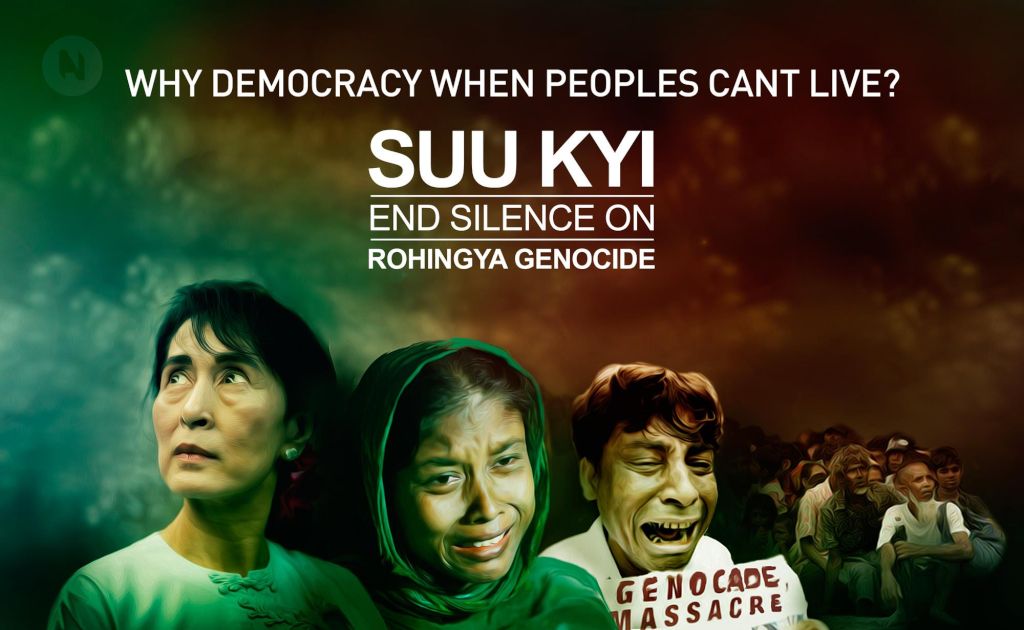
FOR the first time anyone could remember, Nobel Peace Prize laureate Aung San Suu Kyi has become the subject of criticism by the same pro-democracy advocates in the international community who have supported her and helped her rise into prominence on the world stage.
The sudden backlash came undone following her continuous dodging of the issue involving the systematic oppression and violence against the Muslim Rohingya minority by the Myanmar government.
Suu Kyi, who won the adoration of many human right advocates worldwide for championing democracy in strife-torn Myanmar, uncharacteristically chose the ‘safe way out’ when asked on her response on the routine discrimination against the Rohingya including the government’s refusal to grant them citizenship despite having lived in Burma for generations.
At a recent news conference held with singer Bono of rock band U2 in Dublin, she said, “The root of the problem is lack of rule of law (in Myanmar).”
Asked whether the Rohingya should be granted Myanmar citizenship, Suu Kyi replied curtly: “I don’t know.”
The news report from UK daily The Independent also described her responses to the issue at hand as “vague” and “scripted”.
Forsaking Democracy for Majority Buddhist Vote
No one except perhaps her closest supporters would have thought ‘The Lady’, who became widely known as the voice of Myanmar's downtrodden, would turn a blind eye on the plight of the Rohingya following the intensified conflict between the Muslim minority and Buddhist Rakhine in the last few months.
The Oxford-educated political activist-turned politician, who has been placed under house arrest for a total of 15 of the past 21 years since she began her political career, is apparently willing to forsake being labeled a hypocrite by the international community for political gain. Analysts say many of her political allies themselves vehemently oppose the Rohingya hence speaking out on the matter would only risk alienating the former and, ultimately, the Buddhist voters who make up the majority in Myanmar.
“She is no longer a political dissident trying to stick to her principles. She's a politician and her eyes are fixed on the prize, which is the 2015 majority Buddhist vote,” said a Myanmar expert and visiting fellow at the London School of Economics, Maung Zarni.
Plight of the Rohingya
Fighting between Buddhists and Muslims in the western coast state of Rakhine has left about 87 people from both sides dead since June, according to an official estimates, although rights groups fear the real toll is much higher. According to reports, the two groups attacked each other with spears and machetes and went on rampages burning homes and razing entire villages.
The Rohingya, who have been described as “among the world’s least wanted” and “one of the world’s most persecuted minorities”, have continued to suffer from human rights violations under the Burmese junta since 1978. They have been stripped of their citizenship since a 1982 citizenship law. They are also not allowed to travel without official permission, are banned from owning land and are required to sign a commitment to have not more than two children.
The government has been blamed by rights groups which claimed it did little to stop the violence in Rakhine initially before turning its security forces on the Rohingya with targeted killings, rapes, mass arrests and torture. Human Rights Watch which estimated that 100,000 people were displaced by the fighting has accused Burmese forces of opening fire on Rohingya. The New York-based organization also claimed that the government’s tally of 78 dead is “undoubtedly conservative.”
Last weekend, the government finally appointed a 27-member commission to look into the causes of the conflict and to propose solutions to the community mistrust between Muslims and Buddhists.
News reports claimed that the recent violence in Rakhine was initially triggered by allegations that a gang of Rohingya men had raped a local Arakanese woman. Apparently, the lynching of ten Muslims in response sparked days of rioting in the state formerly known as Arakan.
However, the tension between the immigrant minorities, namely from India, and majority Burmese have existed since the early part of last century. According to historian Thant Myint-U, the growing resentment against the minorities was due to the huge influx of Indian immigrants that resulted in the settlers outnumbering the Burmese (hence the two children per family restriction).
"At the beginning of the 20th century, Indians were arriving in Burma at the rate of no less than a quarter million per year. The numbers rose steadily until the peak year of 1927, immigration reached 480,000 people, with Rangoon exceeding New York City as the greatest immigration port in the world. This was out of a total population of only 13 million; it was equivalent to the United Kingdom today taking 2 million people a year." By then, in most of the largest cities in Burma, Rangoon (Yangon), Akyab (Sittwe), Bassein (Pathein), Moulmein, the Indian immigrants formed a majority of the population. The Burmese under the British rule felt helpless, and reacted with a "racism that combined feelings of superiority and fear."
The World Finally Responds
The long-standing conflict between the Rohingya Muslims and ethnic Rakhine Buddhists finally caught the attention of the international community following recent violence in Rakhine after decades of systematic persecution of the Rohingya. Various human rights, pro-democracy groups and Muslim nations have voiced deep concerns over the treatment of the stateless group.
The 57-nation Organization of Islamic Cooperation (OIC) condemned the violence at an emergency summit recently and said it will present its concerns to the upcoming United Nations General Assembly. At the summit, Saudi Arabia accused Myanmar of launching an "ethnic cleansing campaign" and King Abdullah announced that he would donate US$50 million in aid to the Rohingya in Myanmar. Meanwhile, Islamic hardliners in Indonesia and Pakistan have threatened attacks against the Myanmar government.
Democracy vs Hypocrisy
Sadly, the outrage against the persecution of the Rohingya stops at Myanmar's borders. As a politician, Suu Kyi is playing a different ballgame now that her opposition party is trying to consolidate political gains attained after they entered Parliament for the first time in April.
Suu Kyi is well aware that speaking out for the Rohingya is the right thing to do but Myanmar’s Buddhist majority appear to have resentment against these stateless Muslim minority. According to The Associated Press, the Rohingya are a deeply unpopular cause inside Burma, where much of the country's majority Buddhist population views them as illegal immigrants from Bangladesh. Not only that, the Muslim minority have also been labeled as terrorists.
On the first day of the Muslim Eid ul-Fitr celebration, up to 100 ethnic Rakhine held a rally near a regional parliament building in Rangoon to protest against the UN and various non-government organizations’ for providing assistance to the Rohingya . The protesters held signs and banners that said: “Stop Creating Conflicts” and “Don't Bring Terrorists to Our Land.”
Myanmar and the rest of the world are aware that if there was anyone who could effectively take on the Rohingya cause it would be Suu Kyi. However, the problem for Suu Kyi is, how would she, as the most celebrated champion of democracy and human rights, justify hatred towards a certain ethnic minority, especially in these day and age. Any attempt to do so will not only not fly well with the international community which will won’t hesitate to condemn her for being a hypocrite, it could also potentially have repercussions on her vote counts come election in 2015.
Christians Also Targeted
It also appears as if the widespread resentment against minorities has been deeply imbedded in the psyche of the Burmese population and, apparently, the Muslims are not the only ones being targeted. According to the Chin Human Rights Organization’s (CHRO) latest report, ‘Threats to Our Existence: Persecution of Ethnic Chin Christians in Burma’, there exist “a serious ongoing human rights violations, even as the government claims to deepen its reforms in the country.”
“For years, state-sanctioned deep-rooted discrimination against the Chin on the dual basis of their ethnicity and religion has given rise to widespread and systematic violations of fundamental human rights, particularly religious freedom. … the Chin continue to be denied religious freedom and are targeted for induced and coerced conversion to Buddhism, in pursuance of an unwritten State policy of forced assimilation.”
All eyes are on Suu Kyi now as the world waits for her to come out with an unequivocal stand over the Rohingya issue. People want to know what the National League for Democracy (NLD) leader has to say about being selective in her championing of democracy and human rights.
So far, as the world sees it, Suu Kyi has failed to live up to her stature as one of the world's most celebrated pro-democracy campaigners. To the dismay of many, she may well be an angel in disguise who is the lesser of two evils.

It's great that US Ambassador to Myanmar, Derek Mitchell, has finally spoken out on the ethno-religious riots between Rohingyas and Buddhist people in the Rakhine state.
He points out racism in Myanmar society at large, something some of us have been saying for so long.
But the problem with shifting the new focus onto popular racism is that it lets the real culprits - the generals and their troops - off the hook.
The Myanmar regime has a direct and immediate hand in the recent communal riots between the Rakhines and the Rohingya - who it only refers to as "Bengali Muslims" - by sending the message that these people do not belong in Myanmar, even though they were born on Rakhine soil and have been in the country for generations.
For the record, I place the ultimate responsibility for the outbreak of ethno-racial violence squarely on the Thein Sein government. Successive military regimes since Ne Win's reign (1962-1988) have used the tactic of ethnic and religious divide and rule. Precedents and contemporary cases abound. In 1967, Ne Win reportedly diverted attention from the failings of his socialist economy - which resulted in rice shortages across the country - by blaming "greedy Chinese merchants". That sparked anti-Chinese riots. When the mob in Yangon stormed the Chinese Consulate, the generally trigger-happy Burmese troops (when it comes to "restoring law and order") simply stood by and watched the mob kill the deputy chief of mission on the Chinese Consulate's premises. The regime is pursuing a scorched-earth military operation against the Kachins in the north while offering ceasefire deals to the other armed ethnic resistance groups.
This is the regime that has specialised in "law and order" for the past 50 years, since 1962. It deliberately let all hell break loose in western Myanmar because it suited the regime in multiple ways for the Rakhine and the Rohingyas to slaughter one another.
Burmese generals have never liked the Rakhines people, especially those who are ethno-nationalistic and want to push for genuine political autonomy for the Rakhine state.
Troops and all other security units stationed in western Myanmar, on the other hand, have turned all kinds of severe restrictions - in place for at least 30-40 years - into the basis for extorting and abusing the Rohingyas. For instance, the Rohingyas' physical movements and their ability to marry and have children were restricted, requiring permission from the authorities and security units. In effect, the Rohingyas were turned into cash cows by the local security units in western Myanmar.
For their part, the Rakhine people felt angry that the government security troops and authorities were benefitting economically from the Rohingya. (The Rohingya population in general are very poor, while there are a handful of wealthy Rohingya business families. Many Rohingyas who work abroad, however, remit money back to their families in western Myanmar.) Also, forced labour among the Rohingya population is disproportionately higher than in any other ethnic community including those in Myanmar's active war zones in the eastern and northern regions of the country. So, the authorities extract both cash and labour from the captive Rohingya population.
But the Rakhine people felt powerless in the face of the overwhelming might of the security forces on their soil, despite their perception of the regime's favouritism to the Rohingyas, whom the Rakhine have come to consider as "animals" on their soil.
So, naturally, the Rakhine people grew more hateful of the Rohingyas and the state security apparatus, and finally took it out on the weaker of the two - the Rohingyas.
When violence broke out, not only did the security forces not intervene to keep order and nip the initial violence in the bud, but troops - some Burmese and some Rakhine themselves - in places like Maungdaw decided to turn against their cash cows and forced labourers - the Rohingyas.
This time it wasn't the greed of the troops, who had long milked the Rohingyas for their money and extracted labour that led them to directly participate in the slaughter of the Rohingyas. Rather it was the Burmese and Rakhine people's general dislike of Muslims that finally compelled the troops in Maungdaw to machine-gun the Rohingyas in large numbers.
Evidence of the attacks keeps surfacing from various independent eyewitnesses. According to one local researcher in the country - whose account of the Rohingya slaughter at the hands of the Burmese and Rakhine security forces was published in Al Jazeera English ("Mass graves for Myanmar's Rohingya, August 9) - the troops that he interviewed openly talked about "how much they hate Muslims" and described coldly the manner in which they machine-gunned down the Rohingya.
This directly corresponds with the policies of Nay Pyi Daw. This is not simply troops in local areas shooting without orders from above and getting away with mass murder. In fact, the widespread view within the military is: "the bottom line is, we do not want more Muslims in our country". So there is not simply popular racism but vertical and official hatred of Muslims in general and the Rohingya Muslims in western Myanmar in particular.
To deny this is to add insult to injury. The focus of the current riot inquiry by the presidential commission and the international media coverage needs to focus on this direct connection between popular racism and the regime's racist and violent policies and practices of the last 40 years since Operation Snake King (or Nagamin) killed hundreds, if not thousands, of Rohingyas and drove hundreds of thousands more out of western Myanmar into Bangladesh in the 1970s, under the Ne Win-Sein Lwin regime. Ne Win was the godfather, and Sein Lwin was the butcher.
Muang Zarni is a visiting fellow at the Civil Society and Human Security Research Unit, the London School of Economics. A veteran founder of the Free Burma Coalition, Zarni advocated "principled and strategic engagement" with the regime as early as 2003. @ m.zarni@lse.ac.uk.
Sources Here:

On 19th June 2012, armed Rakhine terrorists, security forces and police (Note: security forces and police in Arakan state are made up of mostly Rakhines, no Rohingya at all) raided Baggona village in Maung Daw and arrested young and old Rohingyas alike which numbered almost 100 (age: 12-80). (They were taken to unknown locations and nothing had been heard from them since then.) Therefore while the remaining Rohingya men were on hiding in the fear of being arrested, they raped and ganged raped the Rohingya women left behind to their heart’s content. Besides, they robbed and looted 700 houses and took away gold, silver, money and whatever possible. For the worse, these terrorists destroyed furniture, cooking pots and other properties which they could not take away. Currently the people in the village are having serious crises and the raped Rohingya women are in troubles such as being pregnant with these unknown terrorists and others. Therefore, they plead international communities to help them out from the hands of evils rather than giving mere lips services.
Now President U Thein Sein has set up an inquiry commission into the violence of Arkan, which has 27 members, to investigate and find out the culprits of the violence. But sadly, the commission itself has the people who have committed the crimes against Rohingyas themselves. Therefore, the government will only be able to find out the real cause and culprits of the violence if they replenish the inquiry team with the representatives from the political parties of local Rohingyas and Union Solidarity Development Party (USDP) and use them to thoroughly investigate the real victims in the ongoing violence whether as a means of refilling to the present commission or to exactly find out the masterminds behind the brutal treatments of Rohingyas.
Below is the list of some Rohingya women and under-aged girls raped by military, Rakhine terrorists, police and security forces.
The list of Rohingya Women Raped in Baggona, a village three miles far from Maung Daw to its South
Reported by Khin Nyein Chan
Translated into English by M.S. Anwar
Reported by Khin Nyein Chan
Translated into English by M.S. Anwar

KUALA LUMPUR: Kelab Putera 1Malaysia (KP1M)'s humanitarian mission to Myanmar/ Bangladesh will be launched on Friday to help the oppressed Rohingya refugees.
KP1M president Datuk Abdul Azeez Abdul Rahim, who is also the head of the mission, said: "We are not going to interfere with the politics, we just want to help the Rohingya community.
"We hope this effort by KP1M will get Malaysians' blessing. Please pray that we will come back safely so that we can give more help in the future," he said yesterday.
KP1M's observer team had left for the border of Myanmar and Bangladesh yesterday to gauge the situation at the refugee camps there.
Its purpose is to coordinate and make preparations for the main team.
The main team will depart from Port Klang on a Royal Malaysian Navy ship to Chittagong Port in Bangladesh, bringing along 450 tonnes of aid. The team will consist of 40 members, including doctors and the media.
KP1M will set up a clinic in Myanmar, with medicines worth RM310,000 for treatment.
There are two camps under the auspices of the United Nations High Commissioner for Refugees (UNHCR) in Kutupalog and Nayapara on the border of Bangladesh with 30,000 refugees.
There are also camps that are not recognised in the vicinity with 100,000 refugees.
In Myanmar, there are two refugees camps in Maungdaw and Bathidaung under the UNHCR as well.
At the press conference here yesterday, about 2,000 Rohingya working in Malaysia came to give donations and moral support to the mission.
Sources Here :

Allegation #6
Rohingyas are terrorists. They have links with Al-Qaeda.
Refutation
It is really ridiculous to see how all Rohingyas are called terrorists as a whole. Why? Maybe because to some bigotry and ignorant people, all Muslims are terrorists. And on what basis are Rohingyas called terrorists? Those racist and ignorant people show a video leaked out on Wikileaks as their proof. [This information sent to US in 2002 by US embassy in Yangon was provided by the former MI (Military Intelligence) supervised by ex-general Khin Nyunt, who has been long known as anti-Rohingya] May be because their scholars dress like Arabs or Indians?
Some accuse them as terrorists because they have armed groups like RSO or ARNO. They had these groups but they don’t have them now. They were freedom fighters for the world’s most persecuted Rohingyas. When Karens, Kachins, Shans, even Rakhines take arms, they are called freedom fighters. But when Rohingyas take arms to save their lives and dignity, they are called terrorists. Why double standard?
What is the definition of the terrorist? If “terrorist” is a word used for people who are terrorized again and again, then Rohingyas are terrorists. It is quite natural that, when one is severely persecuted, made unemployed and restricted access to modern education, he or she might have tendency to behave like a terrorist or join terrorist gangs. Just like when someone is kept starved without any food, he or she will eat anything to survive. Who is responsible for that? Shouldn’t their government give them a good education to leave the way of extremism instead of killing them (human beings)? Yet till date, no terrorism occurred in Arakan because of Rohingyas. All are baseless and wrong-propaganda spread by the state-sponsored media and some extremists. No International Media or Independent Observers are given access to the region where the riot has been taking place. Therefore, the only terrorists there, I think, are the Military who have been playing games for their own benefits.
Allegation #7
Rohingyas have too many wives, too many children and too many grand children. And now they are outnumbering Rakhines in Arakan state.
Refutation
Islam itself only allows one marrying more than one woman but doesn’t encourage doing so. Permission is given only to those people who can treat their women equally in all aspects including sex and finance. Hardly any Rohingyas have four wives in Arakan. Restriction on their marriage is so much so that a Rohingya has to wait for permission (to marry even one) from the authority for one to two years despite the fact that they need to bribe huge amount of money. Yes, there are few Rohingyas who have two wives. What is it to other people? Rohingyas do not have “too many” Children and grandchildren but “many.”
Accusation against Rohingyas outnumbering Rakhines is a baseless one. Carry out a survey on the ground to know who outnumber whom. Contrary to accusations against Rohingyas, they are not Rohingyas who are sneaking into Arakan but Rakhines taking the advantage of the presence of their people in immigration in Arakan and other departments. Rohingyas have only been leaving Arakan to escape the persecutions since 1962. Rakhines are citizens of both Bangladesh and Burma but Ronhigyas are citizens of none.
Allegation #8
Rohingyas are lazy, don’t want to work and have low IQ.
Refutation
Rohingyas are not lazy. They are not given any opportunity either in government or in private companies in Burma. They work whenever and wherever they get opportunities unlike those useless Burmese (not referring to all Burmese) who waste their time in tea-shops, karaoke, gambling, watching movies, walking to and fro and drinking alcohol all the night and sleep all the day while making their women work for their daily income. Besides, inside Burma, Rohingyas are not given any opportunity to do tertiary education (especially professional courses) and banned from any kinds of educational campaigns to be able to show their intelligence. Outside Burma or in exile, Rohingyas excel. Carry out a survey if one finds it hard to believe.
Mohammed Sheikh Anwar is an activist, studying Bachelor of Arts in Business Studies at Westminster International College in Malaysia.
 |
| Members of the Organization of Islamic Cooperation (OIC) delegation meet Myanmar President Thein Sein in Yangon, Saturday. — Courtesy photo |
This was disclosed by Professor Wakar Uddin, director general of Arakan Rohingya Union (ARU), in an exclusive interview with The Gulf Today on Monday.
He was in the UAE for a short period after attending the fourth extraordinary OIC summit on August 14-15.
“Two weeks ago, the OIC had sent the first ever delegation along with the Red Crescent officials and others to Myanmar, who visited camps full of Rohingya Muslims after they were forced to leave their houses and stay in these camps in a pathetic condition. The second delegation is all set to leave for Myanmar next week and that will be led by the secretary general, OIC, as an exploratory visit to find out facts about the atrocities by the Myanmarese police and other groups on the Rohingya Muslims,” he said.
The ARU was formed on the directives of Dr Ekmeleddin Ihsanoglu, secretary general of the OIC, who called on the Myanmarese Muslims around the world to form a union.
“The ARU was formed in May 2011 and initially we had 25 organisations of Myanmarese Muslims working worldwide and soon others will joined us as a single platform to represent Rohingya Muslims,” he added.
Professor Wakar, while shedding light on the objectives of the ARU, said that they had three main objectives. “Our first objective is to engage with the Myanmarese government to reclaim our basic rights as minority, especially the citizenship right they have stopped since 1962.
“The second major task we have to fulfil is to bring overall development for the Rohingya Muslims in the sectors of education and economy, by providing them with basic infrastructure and the third is to start a dialogue between other Muslim minorities who arrived from China, India and other parts of the world and are residing in different parts of Myanmar and other minorities,” he said.
According to Professor Wakar, Myanmar has around 3 million Muslims of which 1.5 million are Rohingyas and are living in the Arakan state.
“The literacy rate among Rohingya Muslims is very low and only one per cent has higher education facility. We have a huge challenge in front of us to target this sector on a long-term basis once peace is restored in Arakan,” he said.
He further said that Dr Ekmeleddin Ihsanoglu had invited him to the recent session. “I was there to testify on behalf of ARU and present a 45-minute speech in front of the executive body and they were very emotional when they listened to accounts of atrocities by ethnic groups and now by the Myanmarese police against Rohingya Muslims,” he shared.
He added that next week a Malaysia-based NGO is planning to sent a flotilla consisting of over a dozen ships with relief goods to Myanmar. “This will be a major breakthrough and massive help for the Rohingya Muslims who are facing every type of discrimination, from proper food supply to a decent accommodation,” he added.
He stated that soon the Islamic Society of North America (ISNA) would organise a massive convention in Washington DC from Aug.31 to Sept.2 with the expected participation of 10,000 to 15,000 representatives from around the world to focus on Rohingya Muslims.
“All major Muslim bodies, humanitarian organisations and NGOs will have their representation in this annual three-day convention to raise the issue of Rohingya Muslims on a wide scale,” he said.

TEHRAN – During a meeting with Myanmar’s Foreign Minister Wunna Maung Lwin in Tehran, Iranian Foreign Minister Ali Akbar Salehi expressed concern about the conditions that the Rohingya Muslims are experiencing in Myanmar, it was reported on Monday.
Salehi said that Iran is ready to send humanitarian aid for the Muslims in Myanmar and will welcome a decision to use Iran’s influence to help defuse tensions in the country.
Myanmar’s foreign minister who has visited Iran to participate in the Non-Aligned Movement meeting briefed Salehi on the incidents that have taken place in his country and said that efforts are underway to restore peace.
He also assured Salehi that Myanmar is committed to respecting people of all religions and does not regard discrimination against Muslims as appropriate.
Sources Here:

The conference criticized the attitude of the so-called democracy leaders in Myanmar who through endorsement or silence thereof on-going extermination campaign against the Rohingya minorities have proven to be closet fascists. They were warned about the serious consequence of their actions and that if they did not correct their ways, they could face prosecution in the international courts (much like what has happened with Julius Streicher of the Nazi era in the Nuremburg Trial)."
Violence against the Rohingya people, who are overwhelmingly Muslim and comprise slightly less than half the total population in the Arakan (now Rakhine) state, located in the western part of Myanmar (formerly Burma), close to Bangladesh, is not new in the Buddhist-majority country. The government media suggested that it was a communal riot triggered by the alleged rape and murder of a Rakhine woman by a Rohingya youth.
As usual, the regime failed to provide any concrete evidence proving that such a crime was committed by the alleged rapist. In the past, racial riots were known to have been orchestrated by the regime when such crimes would be committed by its own forces and then the body of the unfortunate victim dumped in a sensitive area. The fact that the alleged rapist was later found dead by hanging himself in the closely monitored prison cell once again shows that this may probably be the case here as well. As expected, with deep-seated racism that the majority Rakhine Buddhists entertain against the Rohingya Muslims, within days of the rape crime, ten Tablighi Burmese Muslims (who were not even Rohingya) were lynched to death on June 3 by an organized Rakhine mob, while the police stood by and did nothing to stop such horrendous crimes.
Then on June 8 when a peaceful funeral gathering of the Rohingya people was fired upon by the police, a wholesale riot ensued. Since then dozens of Muslim villages and hundreds of mosques have also been totally burned down by the Buddhist mob, aided often by government riot police Lon Htin and NASAKA security forces. Hundreds of Muslim owned businesses, schools and madrasas have also been destroyed. The Rohingya people were even barred from attending the Eid prayer, the happiest of Muslim festivals celebrating the end of the fasting month of Ramadhan. Curfew has been imposed by the government, which does not allow the Rohingya people to move and buy essential life saving food and medicine, while the Rakhine mobs are allowed to rob and destroy Muslim owned homes and businesses. And what is worse, Buddhist monks, encouraged by racist Rakhine politicians have blocked the sale and movement of life-saving drugs and food materials from reaching the Rohingya people who now face starvation and serious dehydration.
In the absence of reliable estimates but based on internal evidences, gathered by international human rights monitoring groups, tens of thousands of Rohingya people may have perished in this latest pogrom. Nearly a hundred thousand Rohingyas are internally displaced and many have been pushed to seek refuge or asylum in any country willing to provide them shelter.
Since the days of hated dictator Ne Win who stepped down in 1988 in the midst of violent student protests, the regimes (military or a quasi-civil-military) have exploited racism and bigotry to divide and rule the Buddhist-majority country. The on-going violence against the Rohingya people show that it is part of a very sinister and calculated national project towards ethnically cleansing them that is orchestrated by the Myanmar government and widely supported and promoted at the central and local levels by the ultra-racist elements within the government and civilian population of the Rakhine state. So pervasive is this national project that even Daw Suu Kyi, previously deemed a voice of humanity and conscience within Myanmar, is accused of silently approving of this ethnic cleansing. Many of her NLD party members have openly encouraged violence against the Rohingya people.
In the midst of international outcry, the Thein Sein government has lately announced the formation of a 27-member internal inquiry commission to investigate the causes behind the latest riot. However, its inclusion of certain Rakhine and Burmese members who had openly encouraged violence against the targeted Rohingya shows that his government is not serious about dealing with the problem honestly but is doing everything as a face-saving measure to avoid an international independent inquiry requested by the world community.
To find probable solutions to the existing problems, Arakan Rohingya Organization - Japan (JARO) and Rohingya National Organization in Thailand (RNOT) jointly sponsored an International Rohingya Conference in Bangkok, Thailand. The theme of the conference was “Contemplating Burma’s Rohingya People’s Future in Reconciliation and (Democratic) Reform.”
The conference was held on August 15, 2012 at Thammasat University, Thaprachan, Bangkok, and was attended by nearly a hundred participants who came from Thailand, Japan, Canada, USA, Myanmar, Malaysia, Australia, Bangladesh, Cambodia and Singapore. Several members from the local/international media, NGOs, ASEAN countries, and Thai-based foreign embassies also attended the conference.
The conference was moderated by Mrs. Chalida Tajaroensuk, Director of People’s Empowerment Foundation and started with an opening speech from Mr. Salim Ullah, President of JARO. I was invited as the keynote speaker. The other speakers included Professor Abid Bahar (author of the book - Burma's Missing Dots) from Canada, Mr. Muhammad Anwar Burmi of RNOT, Mr. Suja Uddin (a human rights activist) from Australia and Mr. Noor Alam (a human rights activist) from Thailand.
In my keynote speech I cited evidences proving that the Rohingyas are victims of an apartheid policy that has no parallel in our time. The 1982 Burma Citizenship Law has effectively rendered them stateless, thus denying all rights to them – including of movement, marriage, reproduction, education, health and employment. They are viewed as invaders or illegal immigrants from nearby Bangladesh since the British colonial period (post-1826).
In his speech, Prof. Abid Bahar challenged this false notion. With ample of historical evidences, he demonstrated that the Rohingya people were neither implanted by the British administration since 1826 nor did they intrude into Arakan from Bangladesh after the Union of Burma (Myanmar) had achieved her independence in 1948.
I noted that until and unless the 1982 Law, which violates every Article of the Universal Declaration of Human Rights, is amended, this on-again and off-again pogrom to exterminate the Rohingya people would continue; they would become an extinct community. As such the world community has a duty to stop this ethnic cleansing one way or another.
In his speech, Mr. Azmi Abdul Hamid, Secretary General of MAPIM, from Malaysia mentioned that his organization is organizing an aid flotilla to be sent next month to help alleviate the serious humanitarian crisis prevailing now in Arakan.
The conference called upon the Myanmar government to immediately amend or repeal the 1982 Burma Citizenship Law thereby removing the burdensome standard of proof for attaining citizenship, and thus granting the Rohingya and other minority entities full citizenship and accompanying rights. It asked the government to sign and ratify the 1954 Convention relating to the Status of Stateless Persons and the 1961 Convention on the Reduction of Statelessness and fulfill its international obligation to prevent statelessness of all affected people.
The Myanmar government was called upon by the conference to address the other fundamental human rights problems which have caused the Rohingya and other minority communities to flee to Bangladesh and other countries, including abolishing the practice of forced labor in compliance with the 1930 International Labor Organization (ILO) Convention on Forced Labor, which the Burmese government signed in 1955. Towards this end, as recommended by the ILO, the government was called upon to amend or repeal the sections of the Village and Towns Acts that legally sanction the conscription of labor.
The conference also called upon Myanmar government to protect the rights of the children, in accordance with the government's commitment to children's rights through its ratification of the Convention on the Rights of the Child in 1991. In particular, it demanded that all children born of Rohingya parents (and other "stateless" minorities) should be granted Myanmar nationality, including those born in refugee camps in Bangladesh, Thailand and elsewhere. It asked the government to ensure that children are not forced to work under any circumstance, and that it does not discriminate against Muslim (and non-Buddhist) children in its provision of education benefits.
Since nearly half the Rohingya population is forced now to a life of refugee outside, the conference called upon the Myanmar government to ensure that all refugees are able to exercise their right to return and to guarantee their full reintegration with full respect for their human rights.
While Thein Sein’s gesture in releasing some political prisoners was appreciated, the conference called upon his government to release all its political prisoners and dropping all charges against them and their family members.
The conference called upon the Myanmar government to pay due compensation for the loss of lives and properties of the victims of the current pogrom, and to repatriate and rehabilitate each one of the fleeing refugees who had fled or sought refugee status outside. Furthermore, the conference called upon the government to allow international NGOs and aid agencies to provide material and medical aid to the suffering people, plus allowing the presence of international monitors, e.g., human rights groups and journalists, to continuously monitor the restive region so as to provide needed and accurate information on a timely manner.
In my talk, I also mentioned that the protection of minorities against injustice and intolerance was not a matter of compassion or sympathy of the majority. Human rights in a democracy are held to be inalienable – no human being could be deprived of those rights in a democracy by the will of the majority of the sovereign people. As such, I called upon the government to correct its age-old xenophobia, hatred and intolerance of the Rohingya people through all means necessary including education and media outlets, plus punishing the culprits – both the perpetrators and promoters of hatred.
The conference criticized the attitude of the so-called democracy leaders in Myanmar who through endorsement or silence thereof on-going extermination campaign against the Rohingya minorities have proven to be closet fascists. They were warned about the serious consequence of their actions and that if they did not correct their ways, they could face prosecution in the international courts (much like what has happened with Julius Streicher of the Nazi era in the Nuremburg Trial).
In my closing talk on finding solution, I discussed the problems with the ideology of new “Myanmarism”, which promotes ultra-nationalism of the dominant race and religious intolerance against the minority races, which are sure recipes for a failed state in our time. I also mentioned that citizenship based on ethnicity or race is a feudal concept that has no place in the 21st century. As such, if Myanmar were to avoid becoming a failed state, it must abandon this toxic ideology and promote a series of dialogues between the leaders of the Rohingya and Rakhine community immediately towards reconciliation, inclusion and integration within Myanmar without any prejudice.
The conference also warned the Myanmar government that its failure to resolve the crisis -- by amending or removing the Citizenship Law, which is at the heart of the Rohingya problem -- could result in its leaders being pursued in the International Criminal Court (similar to those faced by the likes of Slobodan Milosevic of former Yugoslavia) for serious violations of international humanitarian laws against the Rohingyas of Myanmar.
It further noted that if Myanmar were to survive as a Federal Union, enough trust-building provisions were necessary so that every minority community – religious, ethnic, or otherwise – could feel equal with other dominant races and groups. The true spirit of Republicanism, in clear distinction to 'Myanmarism', must be embraced as the only alternative for survival of a future democratic Myanmar.
As to the treatment of the refugees, the conference, called upon the member states of the United Nations to stop the ‘push back’ of fleeing refugees from Myanmar against their wishes, and instead, to ensure adequate provisions for food, education, job and healthcare. They should not be barred from seeking asylum in a third country.
The conference also noted the cat-and-mouse tactics of the Myanmar regime and as such called upon the UN member states, esp. the veto-wielding powers, to press the Myanmar government to immediately repeal its 1982 Citizenship Act that is highly discriminatory and in violations of several international laws and charters of the UN and its member agencies. It also asked the world body to press the Myanmar government to stop its inhuman and degrading treatment of all minorities, esp. the Rohingyas of the Rakhine State. It also called upon the UNSC to put a time limit of six months to amend the citizenship issue, thus, restoring citizenship rights of the Rohingya, failing which to prosecute the regime in the Hague for its horrible records of crimes against humanity, and to declare the Mayu Frontier Territories (in northern Arakan) a ‘safe’ territory for the Rohingyas of Myanmar so that they could live there with honor, dignity, safety and security.
In my concluding remarks I duly noted that unless Myanmar government corrects the Rohingya problem allowing them to live as equal citizens the agenda could be hijacked by extremists on both sides of the Muslim-Buddhist divide which could lead to war of secession of the troubled region.
How serious is the so-called reform minded government of Thein Sein to take his poverty-stricken country to the twenty first century which is increasingly becoming plural and open to possibilities? If he is serious, he ought to listen to the voices heard in the Bangkok international conference which while discussing the problem of current violence plaguing his western frontier territory did not shy away from offering needed recommendations that could help stabilize the country and attract much needed foreign investment.
Sources Here :

Muslim NGOs and one of the UK’s most high profile Muslim MP have urged the British Government to intervene in the growing humanitarian crises in Rakhine, Myanmar (Burma) where Muslim Rohingyas were massacred by Buddhists and Myanmar security forces. Meanwhile, Nobel Prize winner, Aung San Suu Kyi, has refused to condemn the killings of Muslims.
Since May 29, large numbers of Muslim Rohingyas have been killed and the fate of thousands who have gone missing is unknown.
The Burmese Government does not consider Rohingya Muslims as citizens and instead regards them as illegal immigrants from neighbouring Bangladesh.
Eight Muslim pilgrims along with one escort – a Muslim lady – and one helper, were hauled off a bus and killed in Taungup on June 3 by a gang of hundreds of Buddhist Rakhines.
The murder of the Muslims was apparently in retaliation for the gang rape and murder of a Buddhist woman six days earlier, an attack they had no connection with.
Human Rights Watch said the state of emergency resulted in a concerted period of violence being used against Rohingya communities by state security forces causing many to seek safety in neighbouring Bangladesh.
At a recent visit to Myanmar, UN Special Rapporteur on Human Rights in Myanmar, Tomás Ojea Quintana, said discrimination against Rohingya Muslims was the cause of the violence, stressing the need for the authorities to take steps to address “long-standing issues of deprivation of citizenship, freedom of movement, and other fundamental rights” for the Rohingyas.
Even Aung San Suu Kyi, who has been an icon of human rights in Myanmar and now an MP, does not consider Muslims as citizens. Speaking at London School of Economics meeting during her visit to the UK recently, she said Rohingya Muslims should be considered as permanent residents but not as citizens. During a press conference in Downing Street she did not condemn the killings of Rohingya Muslims, instead she said, “Ethnic conflict plaguing the country” should be investigated and “dealt with wisdom.” (see The Muslim News Issue No 278)
Sadiq Khan, MP for Tooting, has written to the High Commissioner for Bangladesh asking him to respond to reports that the refugees are being turned away by Bangladeshi authorities.
Khan has written to the UK Foreign Secretary twice, and also the Secretary of State for International Development to ask what the British Government will be doing to ensure that a humanitarian crisis does not develop.
Khan said: “It is important that the British Government uses all its influence to end this savage treatment of the Rohingya community by the Burmese authorities as a matter of urgency.”
In the letter released on August 14, charities have also urged Prime Minister, David Cameron, to “ensure that British NGOs active in the area have free access to assist the suffering Rohingya population.”
The UK’s Foreign Secretary, William Hague, called on the Myanmar Government to take “lawful steps to prevent any further violence, in accordance with international human rights law. We have also called upon the communities based there to act with restraint.”
On August 15, 57-nation group, Organization of Islamic Cooperation at a summit in Makkah, Saudi Arabia, condemned “the continued recourse to violence by the Myanmar authorities against the members of this minority and their refusal to recognize their right to citizenship.”
There are 3 million Muslim Rohingyas, half of them residing in Myanmar. While 500,000 of them have taken shelter in Bangladesh, nearly 1 million others have scattered to other surrounding countries.
 |
| Abul Kasim: Claims death toll higher than reported in mediaable |
ROHINGYAS in Malaysia are claiming that media reports on the death toll in the Arakan region of Myanmar are grossly inaccurate, saying thousands of Rohingya villagers have become casualties of the growing unrest.
Contractor Abul Kasim, 34. who has been staying in Malaysia for the past 10 years, said the reported numbers were played down by the Myanmar authorities.
"This (the violence) is nothing new. It has been going on for some time, many years, in fact. All these years, there has been only discrimination, but the mass murders only started recently," said Abul Kasim, who fled Myanmar about a decade ago to escaped the mistreatment of Rohingyas by the Myanmar junta.
"They (army personnel) raped my cousin in front of me. They were hunting me down after realising I witnessed the incident. I couldn't take it any longer and decided to come to Malaysia to start a new life.
"I later learned that my cousin committed suicide." Abul Kasim was one of 30 Rohingyas who volunteered to pack supplies provided by Kelab Putera 1Malaysia, bound for the Rohingya refugees in Bangladesh next week.
"This is the only way I can help my fellow Rohingyas," he said. Abul Kasim said his father still lived in Yangon but had been stripped off all his property and land.
"My uncle still lives in villages near Arakan. From my last conversation with him, their homes have been burned and they are homeless," he said.
"We don't want anything from the government of Myanmar. We just want our freedom and citizenship." Abul Kasim said the Rohingyas who left Myanmar were not refugees trying to escape poverty as thought by many.
"It's not about money. We have millions worth of properties in Myanmar but they have been burnt down," he said.
"We were forced to travel all over the world, yet our hearts were never at peace because of what is happening."
He said he was hopeful that pro-democracy icon Aung San Suu-Kyi would be able to address the issue.
"We still support her. We understand her difficult situation."
Sources Here:

European Commission (EC) has requested Myanmar to provide citizenship to Rohingya people and ensure their fundamental rights for a sustainable solution to the issue, an EC official said on Sunday.
European Commission Humanitarian Aid and Civil Protection office’s Director General Esko Kentrschynskyj said EC as well as the international community have been maintaining contacts to solve the problems of the ethnic community of Myanmar.
He said this to Bangladesh’s Food and Disaster Management Minister Abdur Razzaque during a call on at the latter’s office on Sunday, says a food ministry press release.
Such remarks came following recent sectarian violence in Myanmar’s Rakhaine State that left dozens of Rohingyas dead. Many tried to enter Bangladesh, but Bangladesh border forces returned them in line with the government policy.
Bangladesh repeatedly and clearly said it could not accept the Rohingyas, saying that sheltering them in Bangladesh would not bring any solution. It said there are still some 25,000 Rohingyas who took shelters in two refugee camps in Cox’s Bazar two decades back, but are not returning. Besides, nearly 4 lakh unregistered Rohingyas are staying in Bangladesh.
Instead, Bangladesh urged the international community to put pressure on Myanmar for a sustainable solution to the longstanding Rohingya problem. However, some powerful countries and human rights bodies criticized Bangladesh for its stance.
While talking to Dr Razzaque, Esko Kentrschynskyj said they have already talked to Myanmar’s foreign and social welfare ministries, immigration and border forces on the Rohingya problem.
Esko said they want to make sure that the Rohingya refugees are provided with humanitarian aid including food, nutrition and social security and helped for a sustainable solution.
Food Minister Abdur Razzaque said though Bangladesh has huge population and 31 percent people live below poverty line, the government is trying its level best to ensure humanitarian assistance to the refugees.
However, continuing such help for long is very difficult for Bangladesh, he said, adding: “The only solution of the Rohingyas is their returning home.”
Razzaque asked the delegation led by Esko to deeply engage the international community for repatriation of the Rohingya refugees in Bangladesh.
Disaster Management Division Secretary Dr M Aslam Alam, European Commission for Humanitarian Aid Office’s Charge De Affaires Andrew Barnard, its Dhaka office’s technical expert Oliver Brouant and Regional Support Office Head Peter Burgess were also present.
source here

There is a violation still going on against the people called Rohingya whom were described as stateless in their own land by many. But today, they really have no homes and no foods and are living their lives under extreme sorrow due to lawlessness in their country. Besides, they are living chaotic, helpless, hopeless lives resulting from the killings and tortures of Thein Sein’s regime and its security forces in collaboration with Rakhine extremists.
Although Thein Sein’s regime has to organize an inquiry mission into the violence in an attempt to cover up their crimes of ethnic cleansing, yet in reality on the ground, they are letting more violence be occurred against Rohingyas and other ethnic Muslims in Arakan state. Sadly, the inquiry mission team is made up with the people who themselves have committed the crimes against Rohingyas. Therefore, it is nothing but an attempt to deceive the world in general and OIC in particular.
After all, what is this fraud inquiry mission is doing?
Why couldn’t Thein Sein government halt the violence yet?
In fact, what he has done so far is just beating around the bush by saying that the situation is being handled well and under control while he is neglecting what is happening on the ground. On daily basis, Rohingya elderly people and children are dying due to starvation, malnutrition and lack of medical access. Extreme weather is causing cold and floods in the places where displaced Rohingyas are living in fragile and vulnerable tents now full of mud. Rohingya youths have been being arrested by Burmese authority on lame reasons and sometimes they are abused in the custodies and prisons by Rakhine extremists.
Above all, how can one expect from this inquiry mission that they will carry out an impartial investigation when they themselves involved in the genocide? Therefore, we invite International and OIC Inquiry Missions to Arakan to do investigation on the violence.
Additionally, if we review why Thein Sein’s regime rejected International aids and media to the region and made Rakhine extremists protest against NGOs and INGOs etc, it is obvious that there is something they don’t want to expose or reveal. If they want justice and are not trying to cover up anything, why dare they not have such kinds of favorable international supports for the country?
Moreover, when Malaysian Foreign Minister proposed Myanmar to offer humanitarian aids to all displaced people regardless of religion, Thein Sein’s regime refused the proposal saying that they don’t need any foreign aids and can solve their problems on their own. Contrary to this statement, Thein Sein said in his interview to VOA “we need foreign helps as we can’t alone help all the displaced people.” This trick has come after OIC’s proposal to offer humanitarian helps and to send a fact finding team to Arakan. It is another attempt to melt down the anger of International community towards Thein Sein regime concerning what he said to UNHCR Chief Antonio Guterres to put all Rohingyas into refugee camps or to deport them to third countries.
Regarding the Rohingya issue, Thein Sein has always one-sidedly followed the desire of Rakhine National Development Party (RNDP). Like the members of RNDP, he, too, had accused Rohingyas as illegal Bengali immigrants from Bangladesh. Quite contrarily recently, he said “there are only a few Bengalis who migrated to Arakan and most of Bengalis have been living in Myanmar for decades. We need to see human as human. We need to follow human rights.” Why are there contradictions? Is not he an oxymoron? Why is he talking about human rights at this time and simultaneously continuing the genocide on the ground? Why is he so hypocritical? These are enough to prove their deception and hoax to the world. They fear that they will be punished for their crimes against humanity. That’s the reason why they are up to deceive the world again.
When some Myanmar Buddhist Volunteer Organizations, Film Stars and 88 Generation Students Group visited the affected and affecting areas in Arakan state, they have only given aids Rakhines and neglected Rohingyas and other ethnic Muslims totally as if they are not human beings. But when Turkish Foreign Minister helped the affected people in Arakan and Saudi Arabia raised funds for all of them irrespective to race and religions, all the Buddhist racists showed their hatred and jealousy towards them and condemned their kind helps. The world should wonder how racist and extremist people they are!
One more crucial point needs to be pointed out. On 17th August 2012, Thein Sein released an 18-paged statement in which he said “some political parties, monks and individuals incited extreme racial hatred and encouraged people to commit irrational racial attacks against Bengali Muslims (his own term for Rohingya Muslims).” But under the heading of religious affairs at point number 34, he said “Mosques, Islamic Schools and Religious scholars (Molvis) should be reduced within the boundary of law and legitimacy.” What is he trying to say? Is he indirectly saying that they will make every effort to eliminate Islam from Arakan gradually? So, at least taking this point into consideration, can we say Rohingyas are persecuted on account of their faith, Islam? Now, it has become very transparent why Rohingyas are persecuted. Besides, if one goes through this 18-paged statement, one can find many discriminatory and bigotry citations against Rohingyas.
To sum up, by now it has become crystal clear to anyone who has humane sense that Rohingyas and other ethnic Muslims in Arakan are being tortured by administration authority, military and security forces in cooperation with Rakhine Buddhist extremists. Hence, the government itself is involving in the crimes. Therefore, we request to UN, OIC and all other international communities to send investigation teams to Arakan to find out the criminals against humanity in general and Rohingyas in particular. Or else, justice will never be done and evil doers will escape forever. And they will ignite conflicts again and again. Now, it is the high time to combat such kinds of genocides and atrocities altogether as “Injustice somewhere is the threat to justice everywhere.”
Written by Snowy
Revised by Mohammed Sheikh Anwar

President Zillur Rahman addresses the 4th Extra-ordinary Session of the organisation of Islamic Conference (OIC) held in Mekka on August 15, 2012 and says: "We must take a pro-active role towards a lasting solution to this long-standing (Rohingya) problem both bilaterally and multilaterally."
There has been a spate of commentaries in different news outlets on the happenings in the Rakhine state of Myanmar. The comments of Prime Minister Sheikh Hasina to British newspaper Sunday Express on July 28 during her visit to London to attend the inaugural ceremony of 30th Olympics Games and her interview to Al-Jazeera TV network on July 28 drew my particular attention. By and large, the Prime minister shrugged off her responsibility to take more Rohingya refugees because Bangladesh is an overpopulated country. She was warned of possible terrorist connections among thousands of Muslim refugees trying to enter Bangladesh. A new theme has been added to the most persecuted human beings by the military-backed civil government of General Thein Sein of Myanmar.
The comment by the Prime Minister has created a hue and cry in theinternational arena. Brad Adams, Director of the Asia chapter of New York-based Human Rights Watch, blamed the government of Bangladesh for "violating its international legal obligations by callously pushing asylum seekers in the rickety boats back into open sea putting them at grave risk of drowning or starvation at sea or persecution in Myanmar".
The fact of the matter is that the Bangladesh government has no legal obligation because it neither acceded to the 1951 United Nations convention relating to the status of refugees nor the 1967 protocol relating to the status of refugees.
From humanitarian point of view, the Bangladesh government should have behaved responsibly to take fleeing Rohingya refugees to save their lives temporarily and seek solution of the problem through the United Nations High Commission for Refugees. Presently, Rohingya and other Muslim communities in Myanmar are spending nightmarish days because of ruthless ethnic cleansing allegedly by police, para-military forces and army in collaboration with Arakanese Buddhists. They are fleeing the country because of oppression. Many were arrested on flimsy grounds and are being tortured in jail. The ethnic cleansing operation was strengthened when President Thien Sien told Head of the United Nations High Commission for Refugees on July 12 that the only solution to the sectarian strife was to expel Rohingya to a third country or to camps to be looked after by the United Nations High Commission for Refugees. This means the President is walking away from the real crisis in his own country and passing the buck on to someone else and he appears to be deviating from his commitment made to Prime Minister Sheikh Hasina while she paid a visit to Myanmar in December, 2011 to take back the Rohingyas from Bangladesh who entered the country in 1990.
The 56-page report of the Asia chapter of Human Rights Watch released on July 31, 2012 gives a graphic picture of attack and counter-attack following the reported rape of a Buddhist woman by three Muslim Rohingyas at Rakhine state of western Myanmar. That incident led to the eruption of a sectarian riot on June 3. Rohingyas have been singled out for attacks by Rakhine Buddhists as a result of "inflammatory anti-Muslim news media accounts and local propaganda". News media in Myanmar has no independence and is controlled by the Myanmar authorities. Human Rights Watch reported that "the army, police, Nasaka border guard forces, and Lon Thien para-military have committed killings, mass arrests, and other abuses against the Rohingya. They have operated in concert with local Arakan (Rakhine) residents to loot food stocks and valuables from Rohingya homes. Nasaka and soldiers have fired upon crowds of Rohingya villagers as they attempted to escape the violence, leaving many dead and wounded".
The July 18 report of the Amnesty International corroborated the report of the Human Rights Watch by saying "six weeks after state of emergency was declared in Myanmar Rakhine state, targeted attacks and other violations by security forces against minority Rohingya and other Muslims have increased".
By now between 500,000 and 90,000 people are reportedly displaced because sectarian violence. Although officially Myanmar National Human Rights commission acknowledged death of 78 persons, the Human Rights Watch estimates the death toll must have been exceeded 100. Displaced persons are in dire need of food, shelter and medical assistance.
The Amnesty International further adds that "Myanmar has not only added to a long litany of human rights violation against Rohingya, but also has done an about-turn on the situation of political imprisonment". It means the government of Myanmar has backed out from their commitments of reform in political arena. Instead of releasing all political prisoners, the number of political prisoners are on the rise.
Western powers, particularly Great Britain and the US, should take note of the trend of persecution of ethnic minorities in Myanmar and consider not withdrawing economic sanctions immediately. The United Nations, on the other hand, should ensure that the Myanmar government should honour and respect ethnic minorities in Myanmar. A process of reconciliation with ethnic minorities like Rohingya, who are being tortured and persecuted ruthlessly for several decades, and Karen, against whom civil war has continued for 40 years, should begin in earnestness under the umbrella of the internationalcommunities. They should be rehabilitated in their country with roof on their heads and food and necessary paraphernalia to survive. Releasing pro-democracy leader Aung San Suu Kyi and holding free and fair bye-election in 2011 is not enough to demonstrate sincerity of the army-backed civilian government in Myanmar in carrying out political reform and removing social injustices against its ethnic and religious minorities.
The horrible sectarian violence in Myanmar is the result of Myanmar's illogical 1982 amendment of the constitution depriving citizenship to Rohingya. Rohingyas have in fact has been living for centuries in Burma, now known as Myanmar. Rohingys have become stateless people. Burma's first democratic leader U Ne recognised Rohingya as ethnic citizens of Burma in 1951 immediately after Burma gained independence from the British colonial rule in 1948. Historically, Rohingya are the mixtures of Moguls, Turks and Persians and racially mixed with Bengalees, Hindus and Buddhists. Persian was the court language of Arakan state, now known as Rakhine state, till the 18th century. Until 1784 Arakan was an independent kingdom. Arakan and Tenasserim were annexed by the British after the first Anglo-Burmese war on 5 March, 1824 and became part of Burma. According to a legend as described by Jerome Taylor, religious affair correspondent of The Independent of London, and Oliver Wright, Whitehall editor of the same paper, Rohingya people are descendants of Arab traders whose ship wrecked on the coast of Burma in the 8th century.
It is heartening to note that the Organisation of Islamic Conference (OIC) has taken a decision at its extraordinary session in Mecca on August 16 to bring the issue of Rohingya Muslims in Myanmar to the notice of the UN General Assembly, highlighting crimes against humanity and the refusal of the Myanmar government to recognise the Rohingya their right to citizenship. Indonesia played a vital role to push the OIC to take a concrete action to stop violence in the Rakhine state in Myanmar. The governments of Indonesia, Turkey, Saudi Arabia, Egypt, United Arab Emirates and Iran have shown special commitments toward Rohingya Muslim while Saudi King Abdullah has announced $50 million on August 18 to assist Rohingya Muslims describing them "as victims of several right violations, including ethnic cleansing, murder, rape and forced displacement". The Society for threatened peoples welcomed the decision of the OIC.
President Zillur Rahman diluted the issue of the most persecuted Rohingya Muslim with that of other minority Muslims around the world at the extra-ordinary session of the Organisation of Islamic Conference (OIC) in Mecca on August 16. Bangladesh missed the opportunity to take up this vital humanitarian problem the country has been faced with since 1990. The government of Bangladesh should step up diplomatic manoeuvre to form international opinion against Myanmar government for mistreatment of their citizens and restore citizenship of Rohingya people in line with the call of the Amnesty International either to amend or repeal 1982 citizenship law of Mynamar.
Like many others, I am also disappointed by the silence of Aung San Suu Kyi, the democracy icon of Myanmar, whom I received at Dhaka airport sometime in 1982 at the request of Bangladesh Ambassador to Burma Syed Najmuddin Hashim while she stopped over on way to London to join her husband.
The writer is a retired Bangladesh diplomat and former President of Nova Chapter of Toastmasters International Club
Reported by : Mohammad Amjad Hossain from Virginia, USA
-
 ဇြန္လ ၁၇ ရက္ ၊ ၂၀၁၂ Source: guardian.co.uk ျမန္မာျပည္သစ္အတြက္ အနာဂတ္မွာ ေအာင္ျမင္မွာလား၊ က်ရွဳံးမွာလားဆိုသည္ကို ညႊန္ျပေသာ စမ္းသပ္မွဳ တစ...
 -
 MP U Shwe Maung Explained on Amendment 1982 Citizenship Law on 25 July 2012. MP U Shwe Maung explained on amendment of 1982 Citizenship Law...
 -
ရက္စြဲ – ေမ ၂၉ ၊ ၂၀၁၂ သို ့ အယ္ဒီတာ၊ နိရဥၥရာ သတင္းဌာန နိရဥၥရာ သတင္းဌာနမွ ေမလ ၂၉ ရက္ေန ့ ထုတ္ျပန္သည့္ ရမ္းျဗဲတြင္ အသက္ ၁၆ ႏွ...
-
 Read letter here Read history of Rohingya here Download letter PDF here Download History of Rohingya PDF here credi...
 -
 RB News March 31, 2018 Minbya, Arakan State : On March 30 morning, a Prayer Leader or Imam was brutally beaten and injured by a Rakh...
 -
 လူသားတိုင္း ရသင့္ရထိုက္ေသာ ရပိုင္ခြင့္၊ ခံစားခြင့္ မ်ားကို လူမ်ိဳးဘာသာမေရြး ရရွိသင့္ပါသည္။ သို႔မွသာ Human Rights – (လူ႔အခြင့္အေရး) ကိုတန္ဖို...
 -
More than 40% of people living in Burma belong to one of the military-ruled nation's different minority groups. The government recognis...
-
 12/07/2012 Joint press release HUMANITY GONE ...
 -
Even if the Rohingyas were not native to what we call Burma today, our birthplace, the inhuman and inhumane treatment of nearly 1 million Ro...
-
 By Dr. Maung Zarni Since the first wave of Rohingya genocide in Feb 1978 which expelled nearly 200,000 refugees from all across Wester...

Popular Posts
Threatwiki

Amartya Sen: Burma's "slow genocide" of Rohingyas

Watch Professor Amartya Sen speak on what he calls Burma's 'slow genocide' of Rohingya, Harvard, 4 Nov 2014
