
 |
| Foreign Secretary stresses need to end violence in Burma |
“Whilst the reform process has already borne many fruits, we remain seriously concerned about the nature and extent of the recent violence. We have urged the government to resolve the crisis by taking effective and lawful steps to prevent any further violence, in accordance with international human rights law. We have also called upon the communities based there to act with restraint. We have done the same with our international partners, and in international institutions, such as the European Union and the United Nations.
“We join Mr Quintana in stressing the need to end the violence; to grant full and unhindered humanitarian access to the areas affected; to allow the affected communities to safely return to their homes; and to support the restitution of property that was seriously damaged or destroyed. We encourage the government to ensure that it treats the affected communities fairly and equitably and to ensure that the authorities prevent any further bloodshed. There is also a need to seek a long term solution to the problems they face in a manner which recognises their human rights, including their right to nationality, and to take effective steps which prevents any further forced or involuntary displacement and which does not leave them permanently displaced.
“Furthermore, we also join Mr Quintana in calling for the release of all those people who have been arbitrarily detained, irrespective of their ethnic background, and express the need for the government to carry out an independent, fair and prompt investigation in to the violence, in particular the allegations of serious crimes within the communities and human rights violations by the security forces, and for those found guilty of such crimes and human rights violations to be held accountable. In addition we repeat our calls on the government to release and rehabilitate all remaining political prisoners.”
Foreign Secretary William Hague welcomes the results from the elections and the progress they represent.
Foreign Secretary William Hague said:
"This is a historic result for Burma. We congratulate the people of Burma, and Aung San Suu Kyi for her personal victory which means so much to her people and people around the world, including in Britain.
“I welcome these remarkable results and the progress they represent. I congratulate President Thein Sein and encourage him to continue to pursue the path to reform he has set out. It will be important for his Government to continue to work with Aung San Suu Kyi, the NLD and other democratic forces, to bring about lasting and irreversible reform. The UK, as the largest bilateral donor of aid to Burma, stands ready to support this process.”
Source here

Foreign & Commonwealth Office Written Ministerial Statement
16 January 2012
The Foreign Secretary’s Visit to Burma
The Secretary of State for Foreign and Commonwealth Affairs (William Hague): I would like to update the House on my visit to Burma on 5-6 January.
This was a historic visit; the first by a British Foreign Secretary since 1955. It was an pportunity to show that we recognise the efforts of opposition leader Aung San Suu Kyi and the government to drive forward important reforms. I also wanted to set out clearly to the government the changes that we would want to see before we could support lifting EU sanctions.
I met the President, the Foreign Minister and the Speaker of the Lower House. I welcomed progress made so far, including the dialogue between the government and opposition leader
Aung San Suu Kyi and the changes in the law that allowed her party to register for the forthcoming by-elections, the initial releases of political prisoners, and the moves towards greater media freedom. I informed them of the allocation from the Department for International Development of £10 million of existing aid for microfinance for the Burmese people, and announced an additional £2 million of humanitarian aid to benefit people in Kachin State, the site of some of the worst ethnic conflict.
I set out clearly with all my interlocutors the steps which would be needed before a more fundamental shift in our relationship could take place. These are: the release of all political prisoners in time for the by-elections on 1 April; the free and fair conduct of those by elections; and humanitarian access to conflict areas, particularly in Kachin State, alongside a clear process of reconciliation. I made clear that if these three conditions were met the UK would support the easing of the EU sanctions.
I was assured by the President that the reforms would continue, that further political prisoner releases would go ahead, and that by-elections would be free and fair. He was confident that the Burmese government would soon achieve ceasefires nationwide, and acknowledged the need for humanitarian assistance in conflict areas.
I raised with the Foreign Minister the discrimination suffered by the Rohingya community, who have been denied citizenship and access to basic services and rights. We will continue to press the Burmese government on this issue.
I held two meetings with opposition leader Aung San Suu Kyi, and assured her of the UK's continued support for her efforts to promote reform and democracy in Burma. She repeated her core priorities: the release of all political prisoners and an improvement in the rule of law; and the need for the by-elections to be free and fair as well as progress on the complex ethnic situation.
I met representatives from other opposition groups, including the 88 Generation Leaders and former political prisoners. I also met a range of representatives from ethnic communities, including the Kachin, Rohingya, Shan, Rakhine, Chin, Mon, Karen and Karenni to hear more bout their concerns and aspirations. We will continue to stay close to these and other ethnic groups to ensure we remain seized of the issues they face.
I am delighted to say that following my visit, there have been significant further developments on some of the issues I raised with the government.
On 12 January, the government and the Karen National Union signed a cease-fire after 63 years of conflict. There is still a long way to go to rebuild fully trust between the parties, but
this is an important step in the right direction.
I also warmly welcome the release of a significant number of political prisoners on 13 January. Exact numbers are still being verified but those released include Generation 88 and ethnic leaders. This is another positive step on the road to reform in Burma.
The British Government will continue to follow developments in Burma closely. We will support progress, while remaining vigilant on human rights issues, especially in areas, affected by ethnic conflict.
---
Zoya Phan
Campaigns Manager
Burma Campaign UK
28 Charles Square
London
N1 6HT
Direct Tel: 020 7324 4712
Main Office: 020 7324 4710
Fax: 020 7324 4717
Email: zoya.phan@burmacampaign.org.uk
Foreign Secretary William Hague: "I am delighted to hear that a significant number of political prisoners in Burma have today been released, including 88 Generation and ethnic leaders."
"The release of all political prisoners is a long-standing demand of the international community and I warmly welcome these releases as a further demonstration of the Burmese government’s commitment to reform.
"This is exactly the kind of measure I called for in all my meetings with Burmese government leaders last week. So is this week's much needed ceasefire in the conflict with the Karen people. I hope these positive steps will contribute to greater democratic participation in the upcoming Parliamentary by-elections."
Speaking on 12 January, the Foreign Secretary welcomed the ceasefire between the Burmese government and Karen National Union:
"I welcome the reports that the Burmese government and Karen National Union have signed a ceasefire after 63 years of fighting. This is good news for the people of Burma. It has been a longstanding goal of the international community to see a ceasefire, and indeed it was one of the key issues on which I urged the Burmese government to make progress during my visit last week when I also met with Karen representatives. There is still a long way to go fully to rebuild trust between the parties after so many years of conflict, but this is an important step in the right direction."
Credit here
"If reforms continue we are ready to build a new relationship with Burma"
Foreign Secretary William Hague writes about his historic visit to Burma on 5-6 January.
British Foreign Secretary William Hague
The Foreign Secretary has concluded his visit to Burma, the first for a UK Foreign Secretary in over 50 years.
He writes about this historic occasion:
"I have been a Member of Parliament for 23 years. For the vast majority of that time, Daw Aung San Suu Kyi was prisoner in her own home; confined, guarded and separated from her family and the outside world. Throughout my whole political career she has been a potent symbol of hope and dignity in the face of injustice and oppression, a heroine to me and to countless other people around the world.
In 2010 she was finally freed, amid signs that the situation in Burma was at last changing for the better. Since then some political prisoners have been released, restrictions on the media and political parties have been eased and by-elections will be held in April this year. Aung San Suu Kyi herself has made the courageous decision to engage in political dialogue with a Government descended from the military regime that put her under arrest, and her party will run in the by-elections.
On Thursday I arrived in Burma. Until that point, no British Foreign Secretary had set foot in the country in over 50 years, for good reason.
My visit was made possible by the changes now underway which - although it is only right to view them with caution at this early stage - offer the chance, if they are continued and entrenched, for Burma and her people to escape the tragedy of recent decades.
I went to meet the Government and opposition figures to gauge for myself what is happening on the ground and to encourage further reform. I met the President, Speaker of the Lower House and Foreign Minister, as well as leaders of ethnic groups, former political prisoners, and Aung San Suu Kyi and her Party, the National League for Democracy.
We still have very serious concerns about the human rights situation in Burma. Hundreds of men and women still remain in jail there for their beliefs and must be released. Minorities like the Rohingya in many cases lack basic civil and political rights. The country’s border regions are scarred by conflict and suffering, particularly in Kachin state, where fighting has displaced tens of thousands of people in recent months. The UN urgently needs to be allowed to deliver humanitarian assistance there, the fighting must stop and the Government needs to begin meaningful political dialogue with ethnic armed groups. And the by-elections in April must be open, credible and fair. I raised these issues with the Burmese leaders I met.
But it is right that we react in good faith to the changes that are taking place.
My message to the Government was that we will respond to measures they take to open up the country.
If real and lasting reform continues, we are ready to offer a new relationship based on friendship and prosperity.
This is the approach that Aung San Suu Kyi herself favours, and which we discussed at length. She believes the President's commitment to reform is sincere and has embarked with him on a dialogue to bring about change. Her commitment to her people is beyond question, and I believe it is right to back her judgement.
Britain is the biggest bilateral aid donor to Burma. During the visit I announced funding for microfinance initiatives to help up to 55,000 more people, and additional support in food, nutrition, shelter, water and sanitation to 13,000 people displaced by conflict in Kachin State, as a sign of our commitment to the people of Burma.
The hours I spent with Aung San Suu Kyi at her home, where she spent some of her most difficult years, and at the British Embassy in Rangoon were memorable and inspiring. I gave her a letter from Prime Minister David Cameron, a copy of my biography of William Wilberforce and a photograph taken in London of her father, Burma’s independence leader, who was later tragically assassinated.
We spoke about her hopes for the future of country. I was struck by her self-discipline and profound sense of duty. As she put it to me, the key to Burma's future lay in two words: hard work. She had a clear message for the people of Britain: the people of Burma valued our friendship and knew they could count on our continued support. Burma’s struggle for freedom and democracy has been long and it still continues. Its people have suffered grievously. In Aung San Suu Kyi's own words: “The quest for democracy in Burma is the struggle of a people to live whole, meaningful lives as free and equal members of the world community”. Today, if these reforms continue, the people of Burma and its friends overseas can finally dare to hope that her vision may become a reality. Burma is a beautiful country with a remarkable people and enormous economic and social potential. Our Government will use Britain’s diplomatic support and development assistance in every way we can to help bring this about."
He writes about this historic occasion:
"I have been a Member of Parliament for 23 years. For the vast majority of that time, Daw Aung San Suu Kyi was prisoner in her own home; confined, guarded and separated from her family and the outside world. Throughout my whole political career she has been a potent symbol of hope and dignity in the face of injustice and oppression, a heroine to me and to countless other people around the world.
In 2010 she was finally freed, amid signs that the situation in Burma was at last changing for the better. Since then some political prisoners have been released, restrictions on the media and political parties have been eased and by-elections will be held in April this year. Aung San Suu Kyi herself has made the courageous decision to engage in political dialogue with a Government descended from the military regime that put her under arrest, and her party will run in the by-elections.
On Thursday I arrived in Burma. Until that point, no British Foreign Secretary had set foot in the country in over 50 years, for good reason.
My visit was made possible by the changes now underway which - although it is only right to view them with caution at this early stage - offer the chance, if they are continued and entrenched, for Burma and her people to escape the tragedy of recent decades.
I went to meet the Government and opposition figures to gauge for myself what is happening on the ground and to encourage further reform. I met the President, Speaker of the Lower House and Foreign Minister, as well as leaders of ethnic groups, former political prisoners, and Aung San Suu Kyi and her Party, the National League for Democracy.
We still have very serious concerns about the human rights situation in Burma. Hundreds of men and women still remain in jail there for their beliefs and must be released. Minorities like the Rohingya in many cases lack basic civil and political rights. The country’s border regions are scarred by conflict and suffering, particularly in Kachin state, where fighting has displaced tens of thousands of people in recent months. The UN urgently needs to be allowed to deliver humanitarian assistance there, the fighting must stop and the Government needs to begin meaningful political dialogue with ethnic armed groups. And the by-elections in April must be open, credible and fair. I raised these issues with the Burmese leaders I met.
But it is right that we react in good faith to the changes that are taking place.
My message to the Government was that we will respond to measures they take to open up the country.
If real and lasting reform continues, we are ready to offer a new relationship based on friendship and prosperity.
This is the approach that Aung San Suu Kyi herself favours, and which we discussed at length. She believes the President's commitment to reform is sincere and has embarked with him on a dialogue to bring about change. Her commitment to her people is beyond question, and I believe it is right to back her judgement.
Britain is the biggest bilateral aid donor to Burma. During the visit I announced funding for microfinance initiatives to help up to 55,000 more people, and additional support in food, nutrition, shelter, water and sanitation to 13,000 people displaced by conflict in Kachin State, as a sign of our commitment to the people of Burma.
The hours I spent with Aung San Suu Kyi at her home, where she spent some of her most difficult years, and at the British Embassy in Rangoon were memorable and inspiring. I gave her a letter from Prime Minister David Cameron, a copy of my biography of William Wilberforce and a photograph taken in London of her father, Burma’s independence leader, who was later tragically assassinated.
We spoke about her hopes for the future of country. I was struck by her self-discipline and profound sense of duty. As she put it to me, the key to Burma's future lay in two words: hard work. She had a clear message for the people of Britain: the people of Burma valued our friendship and knew they could count on our continued support. Burma’s struggle for freedom and democracy has been long and it still continues. Its people have suffered grievously. In Aung San Suu Kyi's own words: “The quest for democracy in Burma is the struggle of a people to live whole, meaningful lives as free and equal members of the world community”. Today, if these reforms continue, the people of Burma and its friends overseas can finally dare to hope that her vision may become a reality. Burma is a beautiful country with a remarkable people and enormous economic and social potential. Our Government will use Britain’s diplomatic support and development assistance in every way we can to help bring this about."
Credit here
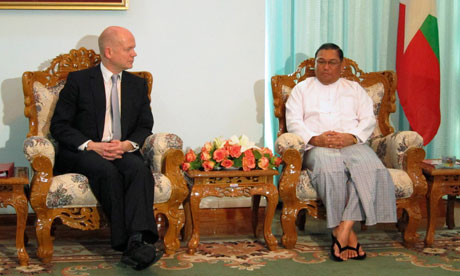
William Hague holds talks with Burma's foreign minister, Wunna Maung Lwin, in Naypyitaw. Photograph: Reuters
The UK will continue to reward further signs of political reform in Burma with closer ties, William Hague has said at the start of the first visit to the country by a British foreign secretary in more than half a century.
A day after Aung San Suu Kyi, the Burmese opposition pro-democracy leader, made an impassioned appeal to her followers "to continue the march on the road to freedom", Hague met Burma's foreign minister, Wunna Maung Lwin, in Naypyidaw, the new capital city constructed six years ago by the then-ruing military junta.
After the meeting Hague told reporters he had told the minister, part of a still military-dominated civilian regime which took power almost a year ago, that the UK wished to see definite progress on the release of political prisoners, fair byelections to the country's parliament – Aung San Suu Kyi's National League for Democracy has said it will take part in these after boycotting a general election in November 2010 – as well the resolution of conflict with armed ethnic groups and humanitarian access to conflict areas.
"I have assured him that if they do, there will be a strongly positive response from the UK and, I believe, the rest of the European Union," Hague said.
"The foreign minister has reaffirmed commitments that have been made to release political prisoners. He said the changes are irreversible and I welcome that way of thinking. I stressed that the world will judge the government by its actions."
Later on Thursday Hague was due to meet Thein Sein, the former general who was appointed president last year. He will then travel to Rangoon for talks with leaders of the country's ethnic minorities.
He will have two meetings there with Aung San Suu Kyi: a private dinner on Thursday and more substantive discussions on Friday, followed by an encounter with another famous former political prisoner, an actor and director known as Zarganar, who was among 250 political prisoners freed in October as part of the government's political reforms.
During Wednesday's celebrations of Burma's independence day at her party's headquarters, Aung San Suu Kyi told members of her NLD that "all Burmese people deserve freedom".
"We have to struggle for more freedom. What we do is anchored by our belief in freedom. Sometimes we face many difficulties. Now we cannot say we are free so we must work for more freedom," she said.
Burma is undergoing rapid political changes as a new nominally civilian government pursues what a key aide to Thein Sein told the Guardian was "a mission of democratisation". However, many analysts and campaigners are sceptical about the depth of recent reforms and the willingness of the military, which has ruled the country since 1962, to relinquish power.
Hague's visit follows that of Hillary Clinton, the US secretary of state, last month and Aung San Suu Kyi's recent decision, following reforms, to stand in April's parliamentary byelections and seek entry to the new national assembly, even though it is dominated by the army.
Min Yaing, a founder of the youth protest movement Generation Wave, said he welcomed the succession of foreign diplomats visiting Burma, which is also known as Myanmar, because they would counter Chinese influence in the country.
With American and European Union sanctions in place, Beijing has been able to build a major presence in Burma in recent years.
"This is good for our movement. Before, the government was just looking to China all the time. Now they are not just listening to one voice," Min Yaing, 31, said.
Thi Ha Saw, editor of a newspaper in Rangoon, added that Hague's visit would "help reformers within the regime" as it would be seen as "evidence of recognition by western powers".
There was a danger of a backlash against the reforms, he warned. "The president is a moderate but there are hardliners who could take over. There is pressure to move fast and get as much change done as possible so a point of no return is reached," Thi Ha Saw told The Guardian.
Nay Zin Latt, the president's political adviser, acknowledged resistance within the regime to recent changes. Beyond the gradual acceptance of the NLD as a legitimate opposition party, there have been new labour laws and a reduction in media censorship as well as reduced surveillance of democratic activists.
"There is always resistance to change. But it is a question of the speed of that change and differing points of view. No one within the government is opposing change entirely. Some want it to go faster than others," Nay Zin Latt said.
Sceptics point out that somewhere between 600 and 2,000 political prisoners remain in jail and that military operations are still continuing against Burmese ethnic minorities. There was widespread disappointment at the limited extent of an amnesty announced on Tuesday which saw sentences cut but resulted in the actual release of only between 10 and 30 political prisoners.
None of the most important dissidents or ethnic minority leaders currently held in extremely harsh conditions on often arbitrary or trivial charges were released. The limited scope of the amnesty, the fourth in a series that has seen more than 200 prisoners freed, has put Aung Sun Suu Kyi in a difficult position, with many campaigners unhappy at continued dialogue with the authorities while fellow activists remain in jail.
"This is just playing a political game. If they were serious they would release everybody," said Than Naing Oo, who was released from Insein jail near Rangoon on Tuesday. He was serving a three-year sentence for distributing pro-democracy leaflets.
Hla Soe, a politician from the Arakhai minority, said that he distrusted the government and the "deal" they had done with Aung San Suu Kyi. "The government is still ignoring ethnic rights. That is what I want to tell Mr Hague and the international community," he said.
However, on one central street in Rangoon on Wednesday night, crowds witnessed a daring bid to force the speed of change as images of police repression during unrest in 2007 were projected on a big screen as part of a film festival. Inside a nearby conference hall thousands had gathered to watch a series of politically charged films that provoked gasps and applause from an audience unused to such open defiance of Burma's strict censors. A banner read: "Free Art, free thought, freedom."
The event was organised by Zarganar, who is due to meet with Hague. "This is free expression. This is a step in the right direction. And we are not afraid. We are never afraid," he declared.
Min Thai Ke, winner of best short film for his depiction of the plight of the poor and political prisoners, said Burma was living "through a very fragile time" but that he too was not afraid.
-
 ဇြန္လ ၁၇ ရက္ ၊ ၂၀၁၂ Source: guardian.co.uk ျမန္မာျပည္သစ္အတြက္ အနာဂတ္မွာ ေအာင္ျမင္မွာလား၊ က်ရွဳံးမွာလားဆိုသည္ကို ညႊန္ျပေသာ စမ္းသပ္မွဳ တစ...
 -
 MP U Shwe Maung Explained on Amendment 1982 Citizenship Law on 25 July 2012. MP U Shwe Maung explained on amendment of 1982 Citizenship Law...
 -
ရက္စြဲ – ေမ ၂၉ ၊ ၂၀၁၂ သို ့ အယ္ဒီတာ၊ နိရဥၥရာ သတင္းဌာန နိရဥၥရာ သတင္းဌာနမွ ေမလ ၂၉ ရက္ေန ့ ထုတ္ျပန္သည့္ ရမ္းျဗဲတြင္ အသက္ ၁၆ ႏွ...
-
 Read letter here Read history of Rohingya here Download letter PDF here Download History of Rohingya PDF here credi...
 -
 RB News March 31, 2018 Minbya, Arakan State : On March 30 morning, a Prayer Leader or Imam was brutally beaten and injured by a Rakh...
 -
More than 40% of people living in Burma belong to one of the military-ruled nation's different minority groups. The government recognis...
-
 "Although mass killings and exterminations of human races were some sort of things that the world experienced during Nazi German p...
 -
 12/07/2012 Joint press release HUMANITY GONE ...
 -
 By Dr. Maung Zarni Since the first wave of Rohingya genocide in Feb 1978 which expelled nearly 200,000 refugees from all across Wester...
 -
 လူသားတိုင္း ရသင့္ရထိုက္ေသာ ရပိုင္ခြင့္၊ ခံစားခြင့္ မ်ားကို လူမ်ိဳးဘာသာမေရြး ရရွိသင့္ပါသည္။ သို႔မွသာ Human Rights – (လူ႔အခြင့္အေရး) ကိုတန္ဖို...

Popular Posts
Threatwiki

Amartya Sen: Burma's "slow genocide" of Rohingyas

Watch Professor Amartya Sen speak on what he calls Burma's 'slow genocide' of Rohingya, Harvard, 4 Nov 2014
