

Humanitarian Aid Desperately Needed; Crisis Situation in Burma Continues
AUGUST 22, 2012
(New York) – The government of Bangladesh should immediately cease its punitive restrictions on international organizations providing lifesaving humanitarian aid to the more than 200,000 Rohingya Muslims in Bangladesh, Human Rights Watch said today. The government should also open its borders to Rohingya fleeing sectarian violence and abuses by Burmese security forces in Arakan State in western Burma.
In late July 2012, the Bangladesh government ordered three prominent international aid organizations – Medecins Sans Frontieres (Doctors Without Borders), Action Contre la Faim (Action Against Hunger), and Muslim Aid – to cease providing assistance to Rohingya living in Cox’s Bazaar and surrounding areas.
“The Bangladeshi government is trying to make conditions for Rohingya refugees already living in Bangladesh so awful that people fleeing brutal abuses in neighboring Burma will stay home,” said Bill Frelick, director of the Refugees Program at Human Rights Watch. “This is a cruel and inhumane policy that should immediately be reversed. The government should be welcoming aid organizations that provide life-saving aid, not shutting down their programs to assist refugees.”
Since mid-June, Bangladesh authorities have admitted to forcing back at least 1,300 Rohingya trying to flee to Bangladesh, though the actual number is likely substantially higher, Human Rights Watch said. Rohingya are escaping killings, looting, and other sectarian violence in Arakan State, as well as abuses by the Burmese authorities, including ethnically motivated attacks and mass arrests.
The Bangladesh government contends that the presence of aid groups in Cox’s Bazaar encourages Burmese Rohingya to come to Bangladesh, and that it cannot afford to host them. The government accused the three aid groups of encouraging the Rohingyas’ flight by providing medical and other assistance. It also raised concerns about criticisms of Bangladesh in the international media. However, as a party to the International Covenant on Economic, Social and Cultural Rights, Bangladesh is prohibited from denying those within its borders, including refugees and asylum seekers, access to food and healthcare, among other protections.
The three aid organizations provide water, healthcare, sanitation, and other basic assistance to Rohingya refugees and asylum seekers in Bangladesh. Approximately 30,000 Rohingya who are officially recognized refugees are living in two camps; 40,000 who are unregistered live in a makeshift refugee camp, and the remaining 130,000 live in surrounding areas. All of the settlements are squalid and overcrowded.
The conditions for the Rohingya include overcrowding, shortages of food leading to widespread malnourishment among the children, a lack of clean water and sanitation resulting in disease, and restrictions on movement coupled with extortion and human rights abuses. These conditions have created an ongoing humanitarian emergency in the official and unofficial camps, and surrounding areas.
Seasoned aid workers have told Human Rights Watch that the conditions in the makeshift camps for Rohingya are among the worst they have seen anywhere in the world.
“Bangladesh authorities are placing the lives of Rohingya refugees at grave risk by forcing aid groups to stop their feeding and health programs,” Frelick said. “It is unthinkable that the government would actively attempt to make the terrible conditions faced by Rohingya even worse by stopping aid from reaching them.”
The sectarian violence in Arakan state broke out in early June between ethnic Arakan Buddhists and both Rohingya and non-Rohingya Muslims, displacing over 100,000 people. Burmese authorities failed to protect both communities from violent mobs and committed killings, beatings, rape, mass arrests, and other abuses against Rohingya, in some cases alongside armed Arakan.
United Nations agencies still lack full and unfettered access to affected areas of Arakan State. On August 4, following a visit to affected areas, the UN special rapporteur on human rights in Burma, Tomas Quintana, described the human rights situation in Arakan State as “serious.”
As a result of the violence and abuses, thousands of Rohingya attempted to flee to Bangladesh for safety. But they have been met with a sealed border and a Bangladesh government policy of pushbacks that constitute refoulement, forced return, in violation of international law. Images and video show Bangladesh border guards forcing pleading Rohingya back to sea in tiny, barely seaworthy boats. On June 18, a Human Rights Watch researcher witnessed the Bangladesh coast guard push nine boats into Burmese waters from the jetty in the port town of Shah Pori Deep. Senior officers in the Bangladesh Border Guards have told Human Rights Watch they have pushed back as many as 1,300 people.
In a July 28 media interview, Prime Minister Sheikh Hasina of Bangladesh disavowed any responsibility for the Rohingya, claiming the responsibility was with the Burmese government.
“Bangladesh is already an overpopulated country,” Hasina said. “We cannot bear this burden.” She denied that Rohingya were being forced back to Burma, saying, “It isn’t true, [the border guard force] didn’t force them. They persuaded them that they should go back to their own country, and they went back.” In the same interview, she added the Burma authorities are “creating a congenial atmosphere” and “providing all the [needed] assistance and everything” to the Rohingya.
In June, the Bangladesh foreign minister, Dipu Moni, had told a news conference in Dhaka that, “It is not in our interest that new refugees come from Myanmar [Burma].”
While Bangladesh is not a party to the 1951 Refugee Convention or its 1967 Protocol, customary international law establishes the obligation of governments to respect the principle of nonrefoulement, which holds that refugees should not be forcibly returned to a place where their lives or freedom would be threatened. Bangladesh also is a party to several treaties – including the Convention against Torture, the International Covenant on Civil and Political Rights, and the Convention on the Rights of the Child – that provide that no one, including refugees and asylum seekers, should be returned to a place where they face a genuine risk of being subjected to torture.
The Bangladesh government should immediately allow humanitarian agencies, human rights organizations, and the media free and unfettered access to the border areas, Human Rights Watch said. Donor governments and UN agencies should be ready to provide assistance and other support for the refugees and asylum seekers. They should also press the Burmese government to fully respect the rights of the Rohingya, including ensuring equal treatment under Burma’s citizenship law, which effectively denies them Burmese citizenship.
“Bangladesh’s refugee camps are no tourist resorts and the government should recognize that the Rohingya arriving are fleeing Burma for their lives,” Frelick said. “Rather than meeting its international obligations by assisting Rohingya who have fled deadly sectarian violence, the Bangladesh government is compounding their suffering. It should change its policy and provide temporary protection and allow aid or it will create an even greater humanitarian disaster.”
Source : Human Rights Watch

“The Government Could Have Stopped This”
Burma: Violence in Arakan State
Burmese security forces failed to protect the Arakan and Rohingya from each other and then unleashed a campaign of violence and mass roundups against the Rohingya. The government claims it is committed to ending ethnic strife and abuse, but recent events in Arakan State demonstrate that state-sponsored persecution and discrimination persist.
Brad Adams, Asia director
(Bangkok) – Burmese security forces committed killings, rape, and mass arrests against Rohingya Muslims after failing to protect both them and Arakan Buddhists during deadly sectarian violence in western Burma in June 2012. Government restrictions on humanitarian access to the Rohingya community have left many of the over 100,000 people displaced and in dire need of food, shelter, and medical care.
The 56-page report, “‘The Government Could Have Stopped This’: Sectarian Violence and Ensuing Abuses in Burma’s Arakan State,” describes how the Burmese authorities failed to take adequate measures to stem rising tensions and the outbreak of sectarian violence in Arakan State. Though the army eventually contained the mob violence in the state capital, Sittwe, both Arakan and Rohingya witnesses told Human Rights Watch that government forces stood by while members from each community attacked the other, razing villages and committing an unknown number of killings.
“Burmese security forces failed to protect the Arakan and Rohingya from each other and then unleashed a campaign of violence and mass roundups against the Rohingya,” said Brad Adams, Asia director at Human Rights Watch. “The government claims it is committed to ending ethnic strife and abuse, but recent events in Arakan State demonstrate that state-sponsored persecution and discrimination persist.”
The Burmese government should take urgent measures to end abuses by their forces, ensure humanitarian access, and permit independent international monitors to visit affected areas and investigate abuses, Human Rights Watch said.
The “Government Could Have Stopped This,” is based on 57 interviews conducted in June and July with affected Arakan, Rohingya, and others in Burma and in Bangladesh, where Rohingya have sought refuge from the violence and abuses.
The violence erupted in early June after reports circulated that on May 28 an Arakan Buddhist woman was raped and killed in the town of Ramri by three Muslim men. Details of the crime were circulated locally in an incendiary pamphlet, and on June 3 a large group of Arakan villagers in Toungop stopped a bus and brutally killed 10 Muslims on board. Human Rights Watch confirmed that nearby local police and army stood by and watched but did not intervene. In retaliation, on June 8 thousands of Rohingya rioted in Maungdaw town after Friday prayers, killed an unknown number of Arakan, and destroyed considerable Arakan property. Violence between Rohingya and Arakan then swept through Sittwe and surrounding areas.
Marauding mobs from both Arakan and Rohingya communities stormed unsuspecting villages and neighborhoods, brutally killed residents, and destroyed and burned homes, shops, and houses of worship. With little to no government security present to stop the violence, people armed themselves with swords, spears, sticks, iron rods, knives, and other basic weaponry. Inflammatory anti-Muslim media accounts and local propaganda fanned the violence. Numerous Arakan and Rohingya who spoke to Human Rights Watch reached the conclusion that the authorities could have prevented the violence and the ensuing abuses could have been avoided.
A 29-year-old Arakan man and an older Rohingya man each told Human Rights Watch, separately but in the same words, “The government could have stopped this.”
The Burmese army’s presence in Sittwe eventually stemmed the violence. However, on June 12, Arakan mobs burned down the homes of up to 10,000 Rohingya and non-Rohingya Muslims in the city’s largest Muslim neighborhood while the police and paramilitary Lon Thein forces opened fire on Rohingya with live ammunition.
A Rohingya man in Sittwe, 36, told Human Rights Watch that an Arakan mob “started torching the houses. When the people tried to put out the fires, the paramilitary shot at us. And the group beat people with big sticks.” Another Rohingya man from the same neighborhood said, “I was just a few feet away. I was on the road. I saw them shoot at least six people – one woman, two children, and three men. The police took their bodies away.”
In Sittwe, where the population was about half Arakan and half Muslim, most Muslims have fled the city or were forcibly relocated, raising questions about whether the government will respect their right to return home. Human Rights Watch found the center of the once diverse capital now largely segregated and devoid of Muslims.
In northern Arakan State, the army, police, Nasaka border guard forces, and Lon Thein paramilitaries have committed killings, mass arrests, and other abuses against Rohingya. They have operated in concert with local Arakan residents to loot food stocks and valuables from Rohingya homes. Nasaka and soldiers have fired upon crowds of Rohingya villagers as they attempted to escape the violence, leaving many dead and wounded.
“If the atrocities in Arakan had happened before the government’s reform process started, the international reaction would have been swift and strong,” said Adams. “But the international community appears to be blinded by a romantic narrative of sweeping change in Burma, signing new trade deals and lifting sanctions even while the abuses continue.”
Since June, the government has detained hundreds of Rohingya men and boys, who remain incommunicado. The authorities in northern Arakan State have a long history of torture and mistreatment of Rohingya detainees, Human Rights Watch said. In the southern coastal town of Moulmein, 82 fleeing Rohingya were reportedly arrested in late June and sentenced to one year in prison for violating immigration laws.
“The Burmese authorities should immediately release details of detained Rohingya, allow access to family members and humanitarian agencies, and release anyone not charged with a crime recognized under international law in which there is credible evidence,” Adams said. “This is a test case of the government’s stated commitment to reform and protecting basic rights.”
Burma’s 1982 Citizenship Law effectively denies Burmese citizenship to the Rohingya population, estimated at 800,000 to 1 million people. On July 12, Burmese President Thein Sein said the “only solution” to the sectarian strife was to expel the Rohingya to other countries or to camps overseen by the United Nations refugee agency.
“We will send them away if any third country would accept them,” he said.
Burmese law and policy discriminate against Rohingya, infringing on their rights to freedom of movement, education, and employment. Burmese government officials typically refer to the Rohingya as “Bengali,” “so-called Rohingya,” or the pejorative “Kalar,” and Rohingya face considerable prejudice from Burmese society generally, including from longtime democracy advocates and ethnic minorities who themselves have long faced oppression from the Burmese state.
Burma’s new human rights commission – led by chairman Win Mra, an ethnic Arakan – has not played an effective role in monitoring abuses in Arakan State, Human Rights Watch said. In a July 11 assessment of the sectarian violence, the commission reported on no government abuses, claimed all humanitarian needs were being met, and failed to address Rohingya citizenship and persecution.
“The Burmese government needs to urgently amend its citizenship law to end official discrimination against the Rohingya,” Adams said. “President Thein Sein cannot credibly claim to be promoting human rights while calling for the expulsion of people because of their ethnicity and religion.”
The sectarian violence has created urgent humanitarian needs for both Arakan and Rohingya communities, Human Rights Watch said. Local Arakan organizations, largely supported by domestic contributions, have provided food, clothing, medicine, and shelter to displaced Arakan. By contrast, the Rohingya population’s access to markets, food, and work remains dangerous or blocked, and many have been in hiding for weeks.
The government has restricted access to affected areas, particularly Rohingya areas, crippling the humanitarian response. United Nations and humanitarian aid workers have faced arrest as well as threats and intimidation from the local Arakan population, which perceives the aid agencies as biased toward the Rohingya. Government restrictions have made some areas, such as villages south of Maungdaw, inaccessible to humanitarian agencies.
“The authorities should immediately grant unfettered humanitarian access to all affected populations and begin work to prevent future violence between the communities,” Adams said. “The government should assist both communities with property restitution and ensure all of the displaced can return home and live in safety.”
Since the June violence, thousands of Rohingya have fled to neighboring Bangladesh where they have faced pushbacks from the Bangladeshi government in violation of international law. Human Rights Watch witnessed Rohingya men, women, and children who arrived onshore and pleaded for mercy from Bangladesh authorities, only to be pushed back to sea in barely seaworthy wooden boats during rough monsoon rains, putting them at grave risk of drowning or starvation at sea or persecution in Burma. It is unknown how many died in these pushbacks. Those who were able to make it into Bangladesh live in hiding, with no access to food, shelter, or protection.
Bangladesh is obligated to open its borders and provide the Rohingya at least temporary refuge until it is safe for them to return, in accordance with international human rights norms. Human Rights Watch called on concerned governments to assist Bangladesh in doing so and press both Burma and Bangladesh to end abuses and ensure the safety of Rohingyas.
“Bangladesh is violating its international legal obligations by callously pushing asylum seekers in rickety boats back into the open sea,” Adams said.
Accounts From “The Government Could Have Stopped This”
“We discussed it and decided to burn down some [Rohingya] villages that all the Muslims used as a headquarters. For example, Narzi and Bhumi. We first started to set fire to Bhumi village, the headquarters of the Muslim people. We burned down the houses and then they burned down ours. In some areas, we did not burn down houses. It would have been foolish in some areas where most houses are near Arakan houses. They would all catch fire. It was a three-day offensive. It started near Bhumi village near Sittwe University because Bhumi is their headquarters.”
– Arakan man, 45, Sittwe, Arakan State, June 2012
“The first Muslim people [who arrived] used guns. At that time, we heard the shooting and my husband tried to attack the Muslim people. They killed him right there in the village. His arm was cut off and his head was nearly cut off. He was 35 years old.”
– Arakan mother of five children, 31, Sittwe, Arakan State, June 2012
“I fell down and couldn’t breathe I was so scared. I saw all the violence. Around 300 Muslims came to attack our village. They came and burned the houses. I saw them burning the houses.... The police did not come during the violence. When the Muslims came and burned the village, I fled. It was not until I got to Sittwe that I saw any police.”
– Arakan woman, 40, Sittwe, Arakan State, June 2012
“In front of my eyes, first the Lon Thein [paramilitaries] came and said they came to protect us, but when the Arakan came and torched the houses, we tried to put out the fires and they started beating us. A lot of people were shot [by the police] at a close distance. I saw people get shot at close range. The whole village witnessed it. They were people from my village. They were 15 or 20 feet away from me.... I saw at least 50 people killed.... When we tried to go put out the fire, we were not allowed to go. First they shot once in the air, and then at the people.”
– Rohingya man, 28, Sittwe, Arakan State, June 2012
“The government did not return the dead bodies to our family. They took them and cremated them in the monastery. I did not get the bodies of my two brothers-in-law.... They were killed by the Arakan in front of me. The police were there. It was not far from the police. They were killed in front of me and the police did nothing.”
– Rohingya man, 65, Sittwe, Arakan State, June 2012
DOWNLOAD THE REPORT HERE

Brutal and Biased Police Response to Sectarian Violence in Arakan State
The Burmese government needs to put an immediate end to the abusive sweeps by the security forces against Rohingya communities. Anyone being held should be promptly charged or released, and their relatives given access.
Elaine Pearson, deputy Asia director
(New York) – Burmese security forces have responded to sectarian violence in northern Arakan State with mass arrests and unlawful force against the Rohingya Muslim population, Human Rights Watch said today. Local police, the military, and a border security force known as Nasaka have committed numerous abuses in predominantly Muslim townships while combating the violence between the Rohingya and ethnic Arakan, who are predominantly Buddhist, that broke out in early June 2012.
Human Rights Watch urged the Burmese government to end arbitrary and incommunicado detention, and redeploy and hold accountable security forces implicated in serious abuses. Burmese authorities should ensure safe access to the area by the United Nations (UN), independent humanitarian organizations, and the media.
“The Burmese government needs to put an immediate end to the abusive sweeps by the security forces against Rohingya communities,” said Elaine Pearson, deputy Asia director at Human Rights Watch. “Anyone being held should be promptly charged or released, and their relatives given access.”
Burmese security forces have been implicated in killings and other abuses since the sectarian violence in northern Arakan State began, Human Rights Watch said. For instance, on June 23, in a village near the town of Maungdaw, security forces pursued and opened fire on two dozen Rohingya villagers who had been hiding from the violence in fields and forest areas. The total killed or wounded is unknown, but one survivor told Human Rights Watch that out of a group of eight young men who were fleeing, only two managed to escape unharmed after the security forces fired on them.
“Everybody was so scared,” he told Human Rights Watch. “We saw them entering and we left, trying to get out of the village. There was a canal, but some people could not cross it and the army shot at them and killed them.”
The recent sectarian violence began after an ethnic Arakan woman was allegedly raped and killed by three Muslim men on Ramri island in southern Arakan State in late May, which was followed by the June 3 killing of 10 Muslims by an Arakan mob in Toungop. On June 8, thousands of Rohingya rioted in the town of Maungdaw, destroying Arakan property and causing an unknown number of deaths. Groups of Rohingya subsequently committed killings and other violence elsewhere in the state, burning down Arakan homes and villages. Arakan groups, in some cases with the collusion of local authorities and police, committed violence against Rohingya communities, including killings and beatings, and burning down Muslim homes and villages.
On June 10, President Thein Sein declared a state of emergency in northern Arakan State, which permits the armed forces to carry out arrests and detain people without fundamental due process protections. While the Burmese army has largely contained the sectarian violence, abuses by security forces against Rohingya communities appear to be on the upsurge in recent weeks, Human Rights Watch said.
Local police and the Nasaka, claiming to be searching for Rohingya criminal suspects involved in the sectarian strife, have conducted mass round-ups of Rohingya. On July 1, the state-run New Light of Myanmar reported that 30 Arakan suspects were arrested for the June 3 killings. Nevertheless, the mass arrests ongoing in northern Arakan State seem to be discriminatory, as the authorities in these townships do not appear to be investigating or apprehending Arakan suspected of criminal offenses, Human Rights Watch said. The total number of people arrested, their names, and any charges against them have not been reported.
Witnesses told Human Rights Watch that state security forces violently raided predominately Rohingya villages in Maungdaw township, firing on villagers and looting homes and businesses. In several villages, police and Nasaka dragged Rohingya from their homes and violently beat them. Witnesses in villages outside of Maungdaw said dozens of people, including women and children, were taken away in mid-June in Nasaka trucks to unknown locations, and have not been heard from since. Mass arrests of Rohingya have also taken place in Buthidaung and Rathedaung townships. Witnesses in Maungdaw township described several instances in which Arakan men wielding sticks and swords accompanied the security forces in raids on Rohingya villages. A 27-year-old Rohingya man told Human Rights Watch, “Twenty-five of my relatives have been arrested.… I saw with my own eyes, two of my nephews were taken by the military and Nasaka. They tried to hide themselves in the large embankments in the paddy fields, but some Arakan found them and stabbed them with long knives. They stabbed them and took them to the jail.”
Human Rights Watch documented the destruction of Buddhist temples, mosques, and thousands of Arakan and Rohingya houses that were burned to the ground during the sectarian violence, leaving an estimated 90,000 people displaced and taking segregated refuge in temporary camps and community sites. Hundreds of Rohingya fled across the nearby border to Bangladesh, where many were forced back by Bangladeshi border guards.
“The violence in Arakan State has devastated both the Rohingya and Arakan communities, but government efforts to identify and arrest those responsible should not result in further abuses,” Pearson said. “The sectarian violence and state of emergency provides no excuse for the security forces to continue their past record of abuses and discrimination against the Rohingya community.”
(New York) – Burmese security forces have responded to sectarian violence in northern Arakan State with mass arrests and unlawful force against the Rohingya Muslim population, Human Rights Watch said today. Local police, the military, and a border security force known as Nasaka have committed numerous abuses in predominantly Muslim townships while combating the violence between the Rohingya and ethnic Arakan, who are predominantly Buddhist, that broke out in early June 2012.
Human Rights Watch urged the Burmese government to end arbitrary and incommunicado detention, and redeploy and hold accountable security forces implicated in serious abuses. Burmese authorities should ensure safe access to the area by the United Nations (UN), independent humanitarian organizations, and the media.
“The Burmese government needs to put an immediate end to the abusive sweeps by the security forces against Rohingya communities,” said Elaine Pearson, deputy Asia director at Human Rights Watch. “Anyone being held should be promptly charged or released, and their relatives given access.”
Burmese security forces have been implicated in killings and other abuses since the sectarian violence in northern Arakan State began, Human Rights Watch said. For instance, on June 23, in a village near the town of Maungdaw, security forces pursued and opened fire on two dozen Rohingya villagers who had been hiding from the violence in fields and forest areas. The total killed or wounded is unknown, but one survivor told Human Rights Watch that out of a group of eight young men who were fleeing, only two managed to escape unharmed after the security forces fired on them.
“Everybody was so scared,” he told Human Rights Watch. “We saw them entering and we left, trying to get out of the village. There was a canal, but some people could not cross it and the army shot at them and killed them.”
The recent sectarian violence began after an ethnic Arakan woman was allegedly raped and killed by three Muslim men on Ramri island in southern Arakan State in late May, which was followed by the June 3 killing of 10 Muslims by an Arakan mob in Toungop. On June 8, thousands of Rohingya rioted in the town of Maungdaw, destroying Arakan property and causing an unknown number of deaths. Groups of Rohingya subsequently committed killings and other violence elsewhere in the state, burning down Arakan homes and villages. Arakan groups, in some cases with the collusion of local authorities and police, committed violence against Rohingya communities, including killings and beatings, and burning down Muslim homes and villages.
On June 10, President Thein Sein declared a state of emergency in northern Arakan State, which permits the armed forces to carry out arrests and detain people without fundamental due process protections. While the Burmese army has largely contained the sectarian violence, abuses by security forces against Rohingya communities appear to be on the upsurge in recent weeks, Human Rights Watch said.
Local police and the Nasaka, claiming to be searching for Rohingya criminal suspects involved in the sectarian strife, have conducted mass round-ups of Rohingya. On July 1, the state-run New Light of Myanmar reported that 30 Arakan suspects were arrested for the June 3 killings. Nevertheless, the mass arrests ongoing in northern Arakan State seem to be discriminatory, as the authorities in these townships do not appear to be investigating or apprehending Arakan suspected of criminal offenses, Human Rights Watch said. The total number of people arrested, their names, and any charges against them have not been reported.
Witnesses told Human Rights Watch that state security forces violently raided predominately Rohingya villages in Maungdaw township, firing on villagers and looting homes and businesses. In several villages, police and Nasaka dragged Rohingya from their homes and violently beat them. Witnesses in villages outside of Maungdaw said dozens of people, including women and children, were taken away in mid-June in Nasaka trucks to unknown locations, and have not been heard from since. Mass arrests of Rohingya have also taken place in Buthidaung and Rathedaung townships. Witnesses in Maungdaw township described several instances in which Arakan men wielding sticks and swords accompanied the security forces in raids on Rohingya villages. A 27-year-old Rohingya man told Human Rights Watch, “Twenty-five of my relatives have been arrested.… I saw with my own eyes, two of my nephews were taken by the military and Nasaka. They tried to hide themselves in the large embankments in the paddy fields, but some Arakan found them and stabbed them with long knives. They stabbed them and took them to the jail.”
Human Rights Watch documented the destruction of Buddhist temples, mosques, and thousands of Arakan and Rohingya houses that were burned to the ground during the sectarian violence, leaving an estimated 90,000 people displaced and taking segregated refuge in temporary camps and community sites. Hundreds of Rohingya fled across the nearby border to Bangladesh, where many were forced back by Bangladeshi border guards.
“The violence in Arakan State has devastated both the Rohingya and Arakan communities, but government efforts to identify and arrest those responsible should not result in further abuses,” Pearson said. “The sectarian violence and state of emergency provides no excuse for the security forces to continue their past record of abuses and discrimination against the Rohingya community.”
The Burmese government restricts international access to northern Arakan State – an area comprising the predominantly Muslim townships of Maungdaw, Buthidaung, and Rathedaung – and severely curtails freedom of movement for Rohingya residents. The Nasaka’s long history of arbitrary detentions, torture, and other ill-treatment of Rohingya detainees heightens concerns about the recent mass arrests, Human Rights Watch said.
The government has not allowed independent investigations in the affected areas since the violence began. On June 6, Thein Sein ordered a high-level government committee to investigate the causes of the violence, identify the perpetrators, and issue recommendations. The committee is scheduled to present its findings by August 30. However, there are concerns about the independence and objectivity of the investigation committee, given that it includes local security forces and Arakan State officials, Human Rights Watch said.
The government should invite the UN special rapporteur on human rights in Burma, Tomas Quintana, to Arakan State to conduct an urgent visit to investigate the violence and conduct of the security forces, Human Rights Watch said. The authorities should immediately disclose the location of all detention centers, provide the names of all detainees, bring them promptly before a judge, and allow independent humanitarian agencies access to all facilities.
The government has not allowed independent investigations in the affected areas since the violence began. On June 6, Thein Sein ordered a high-level government committee to investigate the causes of the violence, identify the perpetrators, and issue recommendations. The committee is scheduled to present its findings by August 30. However, there are concerns about the independence and objectivity of the investigation committee, given that it includes local security forces and Arakan State officials, Human Rights Watch said.
The government should invite the UN special rapporteur on human rights in Burma, Tomas Quintana, to Arakan State to conduct an urgent visit to investigate the violence and conduct of the security forces, Human Rights Watch said. The authorities should immediately disclose the location of all detention centers, provide the names of all detainees, bring them promptly before a judge, and allow independent humanitarian agencies access to all facilities.
Human Rights Watch urged the United States, European Union, ASEAN, Australia, Japan, and other countries concerned about human rights in Burma to press the government to allow an independent and thorough investigation of the violence, and to ensure that the basic rights of those detained are respected. They should also call upon the Bangladesh authorities not to return or push back those fleeing violence and to provide them temporary protection.
“The Burmese government should demonstrate that the political changes taking place in the country extend to the ethnic areas, and that abuses by local authorities will not be tolerated,” Pearson said. “This means stopping the violations, holding abusive officials to account, and promptly permitting an independent investigation.”
Source : HRW NewYork
“The Burmese government should demonstrate that the political changes taking place in the country extend to the ethnic areas, and that abuses by local authorities will not be tolerated,” Pearson said. “This means stopping the violations, holding abusive officials to account, and promptly permitting an independent investigation.”
Source : HRW NewYork

Burma’s new law on assembly rejects the previous ban on demonstrations, but still allows the government to trump the Burmese people’s basic rights. There is a lot of excitement about changes in Burma these days, but the government shouldn’t be given credit for allowing some freedom just because none existed before. Instead, it should be pressed to make sure its laws meet international standards.
Brad Adams, Asia director at Human Rights Watch
(New York) – Burma’s new law on the right to peaceful assembly falls far short of international standards, Human Rights Watch said today. President Thein Sein signed the assembly law, the Law Relating to Peaceful Assembly and Peaceful Procession,on December 2, 2011.
Human Rights Watch urged Burma’s parliament to repeal the law’s provisions that fail to meet international human rights standards, such as imprisonment as a penalty for permit violations. In the meantime, the Home Affairs Ministry should consult with international organizations as it drafts regulations to mitigate some of the law’s harsh effects.
“Burma’s new law on assembly rejects the previous ban on demonstrations, but still allows the government to trump the Burmese people’s basic rights,” said Brad Adams, Asia director at Human Rights Watch. “There is a lot of excitement about changes in Burma these days, but the government shouldn’t be given credit for allowing some freedom just because none existed before. Instead, it should be pressed to make sure its laws meet international standards.”
The Burmese government has long used laws banning marches, demonstrations, and gatherings of more than five people to arrest, prosecute, and imprison peaceful protesters. While ostensibly accepting the right of peaceful assembly, the new law makes the right subject to the overbroad control and the discretion of the authorities, Human Rights Watch said. Under international law, legal restrictions on basic freedoms should be clearly and narrowly identified, strictly necessary, and proportionate.
The new assembly law requires anyone planning a demonstration to seek permission from the township police chief five days in advance. Permission is required for any gathering of “more than one person in a public area … in order to express their opinions.” The authorities are required to respond 48 hours before the planned gathering. If permission is denied, the authorities must offer reasons.
The law states that the police chief may only refuse a permit if the application is “contrary to Union security, prevalence of law and order, community peace and tranquility or public order and morality.” Organizers may appeal the decision to the state or regional level police authorities. The administrative appeals process is final, with no appeal to the courts allowed.
Holding an assembly without permission can result in a one-year prison sentence. Even if permission is granted, theassembly lawprovides criminal penalties of up to six months in prison for various types of conduct, such as giving speeches that contain false information, saying anything that could hurt the state and union, or “doing anything that causes fear, a disturbance or blocks roads, vehicles or the public.” These offenses are articulated in vague and uncertain terms, Human Rights Watch said.
The original bill banned shouting slogans at public assemblies. Parliament amended the final bill to allow slogans, but only if they are pre-approved.
“Requiring approval for the content of slogans shows just how far the government needs to go to understand basic freedoms,” Adams said. “Peaceful protesters shouldn’t go to jail just because a police officer may not like what they said.”
Burma has a long history of repression of peaceful protests. Pro-democracy marches in 1988 were put down by the authorities with lethal force. Security forces killed an estimated 2,000 protesters. Peaceful marches led by the opposition 88 Generation Students group in August 2007 and Buddhist monks in September 2007 were violently broken up. Human Rights Watch’s investigation documented killings by the security forces and hundreds of arbitrary arrests. Some protest leaders were sentenced to over 65 years in prison, and only released in the government’s January 2012 amnesty.
In 2011, the police forcibly dispersed several protests in Rangoon, the former capital. One small protest on October 27 led to the arrest of eight landless farmers and their lawyer, activist Phoe Phyu, for illegal assembly after they protested the forcible acquisition of their land by government-backed companies. Phoe Phyu, now free on bail pending trial, is also defending a group of farmers who led protests in the Irrawaddy Delta region in September. The authorities also arrested and briefly detained a rights activist, Myint Naing, in Bassien in November for filming the farmers’ protest and charged him with distributing unauthorized material under the Electronics Transactions Act.
The assembly law will not go into force until regulations are drafted. Human Rights Watch urged the Home Affairs Ministry to consult with relevant international organizations in drafting the guidelines to mitigate the harsh effects of the law. For instance, the regulations could provide guidance to police chiefs about criteria for granting a permit and the exercise of discretion in the administrative appeals process.
The regulations should state clearly that the assembly law is meant to facilitate gatherings and processions, and the enjoyment of the constitutional right to assembly, Human Rights Watch said. They should make clear that permits should not be refused merely because the gathering might disturb “community peace and tranquility.”
The regulations should clearly define, based on objective criteria terms such as to “frighten” or “disturb” the public, or “hurt the state.” They should clarify that criminal penalties should only be sought for acts of violence or incitement and not for the peaceful exercise of rights to expression, association, and assembly, such as giving false information in a speech or using unapproved slogans.
Since taking office in March 2011, Burma’s new government has introduced many bills into the national bicameral assembly, debating these laws in the three parliamentary sessions to date in a manner not seen in Burma for decades. Nevertheless, the passage of some laws has been shrouded in secrecy. Full drafts of legislation are often not distributed outside the parliament, and there has been little community consultation.
“The real test of new laws will be to see what happens when Burmese attempt to use them,” Adams said. “Burma’s government will deserve kudos for legal reform only when people are allowed to exercise their basic rights.”
Source here
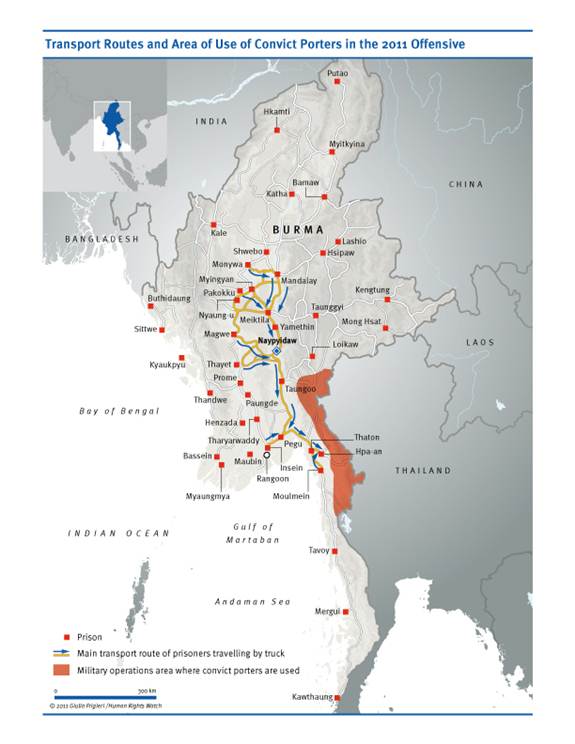 Convict Porters on the Front Lines in Eastern Burma
(Bangkok) - The Burmese army's abusive treatment of convicts who are forced to serve as porters under dangerous front-line conditions constitutes war crimes, Human Rights Watch and the Karen Human Rights Group said in a joint report released today.
The 70-page report, "Dead Men Walking: Convict Porters on the Front Lines in Eastern Burma," details abuses against convict porters including summary executions, torture, and the use of the convicts as "human shields." The military should stop forcibly recruiting prisoners as porters and mistreating them, and those responsible for ordering or participating in such treatment should be prosecuted, Human Rights Watch and the Karen Human Rights Group said.
-
 ဇြန္လ ၁၇ ရက္ ၊ ၂၀၁၂ Source: guardian.co.uk ျမန္မာျပည္သစ္အတြက္ အနာဂတ္မွာ ေအာင္ျမင္မွာလား၊ က်ရွဳံးမွာလားဆိုသည္ကို ညႊန္ျပေသာ စမ္းသပ္မွဳ တစ...
 -
 MP U Shwe Maung Explained on Amendment 1982 Citizenship Law on 25 July 2012. MP U Shwe Maung explained on amendment of 1982 Citizenship Law...
 -
ရက္စြဲ – ေမ ၂၉ ၊ ၂၀၁၂ သို ့ အယ္ဒီတာ၊ နိရဥၥရာ သတင္းဌာန နိရဥၥရာ သတင္းဌာနမွ ေမလ ၂၉ ရက္ေန ့ ထုတ္ျပန္သည့္ ရမ္းျဗဲတြင္ အသက္ ၁၆ ႏွ...
-
 Read letter here Read history of Rohingya here Download letter PDF here Download History of Rohingya PDF here credi...
 -
 RB News March 31, 2018 Minbya, Arakan State : On March 30 morning, a Prayer Leader or Imam was brutally beaten and injured by a Rakh...
 -
More than 40% of people living in Burma belong to one of the military-ruled nation's different minority groups. The government recognis...
-
 12/07/2012 Joint press release HUMANITY GONE ...
 -
 By Dr. Maung Zarni Since the first wave of Rohingya genocide in Feb 1978 which expelled nearly 200,000 refugees from all across Wester...
 -
 လူသားတိုင္း ရသင့္ရထိုက္ေသာ ရပိုင္ခြင့္၊ ခံစားခြင့္ မ်ားကို လူမ်ိဳးဘာသာမေရြး ရရွိသင့္ပါသည္။ သို႔မွသာ Human Rights – (လူ႔အခြင့္အေရး) ကိုတန္ဖို...
 -
 "Although mass killings and exterminations of human races were some sort of things that the world experienced during Nazi German p...

Popular Posts
Threatwiki

Amartya Sen: Burma's "slow genocide" of Rohingyas

Watch Professor Amartya Sen speak on what he calls Burma's 'slow genocide' of Rohingya, Harvard, 4 Nov 2014
