
 |
| Dr. C.R. Abrar |
Dr. C.R. Abrar
The Daily Star
December 1, 2012
After years of indifference the Rohingya issue has drawn interest nationally as well as internationally. While the recent plight of the members of the community has attracted huge international attention and compassion, it generated a negative reaction among the government circles and also in a section of the influential media in Bangladesh.
The Daily Star
December 1, 2012
After years of indifference the Rohingya issue has drawn interest nationally as well as internationally. While the recent plight of the members of the community has attracted huge international attention and compassion, it generated a negative reaction among the government circles and also in a section of the influential media in Bangladesh.
The
policy of denying entry and shelter to the Rohingyas has so far been
justified on legal and practical grounds. While these may appear to be
logical, a close scrutiny lays bare the gaps in such line of reasoning,
an issue that has been treated by this author previously (The Daily Star, June 26).
While
an individual or an institution is at liberty to subscribe to certain
opinions, one would expect those to be grounded in reason. This
anticipation would be more so from those who hold high position in
statutory bodies, particularly those mandated to uphold human rights.
One further wishes that when intolerance and prejudice become
pronounced, against a vulnerable community without protection,
institutions such as the National Human Rights Commission would plead
for compassion and empathy, and extend support to those who stand up for
their rights and dignity.
The NHRC Chair's statement at the
recent RMMRU dialogue on the Rohingyas was disappointing for several
reasons. They were contradictory, not based on proper interpretation of
refugee law, and overtly partisan. At the outset, he questioned the
intent of "the drawing room-centric intellectuals for putting the
government and the state named Bangladesh in the dock."
Referring
to 1971, several participants noted that Bangladesh had a moral
compulsion to provide asylum to the Rohingyas. The Commission Chair
strongly disagreed with such position on grounds that "the context of
1971 is very different from the one Rohingyas are facing today." He went
on to explain that after the war ended in 1971; the millions of
Bangladeshis who went to India returned home. As against that scenario
the Rohingyas have remained in Bangladesh since 1990s. He claimed
Bangladesh had set a unique example of allowing integration after
illegal infiltration and there was no such example anywhere else in the
world.
There is a major flaw in this line of reasoning.
Bangladeshis came back because the successful end of the war ensured
that not only the brutal Pakistani army regime and their cohorts were
defeated and deposed but also that a new state was born with the
professed aim to protect its citizens. A pertinent question is, what
would have happened if the war had dragged on for years, our neighbour
did not have any geopolitical and strategic interests to pursue and its
patience in hosting Bangladeshi refugees wore thin? As against 1971
scenario, the sources of oppression of the Rohingyas are still
controlling the state apparatus in Myanmar, their citizenship issue has
remained unaddressed, and not only has the state shunned their claims to
protection, Nobel Peace Laureate Aung San Suu Kyi has refused to take
any responsibility. Under such circumstances, it is no wonder that the
Rohingyas continue to flee Arakan and those in the squalid camps and
outside in Bangladesh refuse to go back.
The Commission Chair
observed that, "today the Rohingya children are taking benefits in our
schools, colleges and in workplaces." In frustration, he posed the
question, "but do we want that these things increase?"
One wonders
whether the Chair is aware that under the Convention of the Rights of
the Child, Bangladesh is obliged to ensure access to education to any
child on its territory. Needless to say, acquiring education and skills
would allow the community members to stand on their feet and help them
anchor in their country of origin once they return.
Nothing can
be further than the truth to claim that Bangladesh has set an example by
"providing integration even after illegal infiltration." In the face of
beefed-up security in the recent months, the Rohingyas outside camps
are living in constant fear of deportation. By government diktat three
international NGOs were barred from providing basic services to the
unregistered Rohingyas in the makeshift camp. It is not difficult to
find examples where, in protracted refugee situations, host countries
allowed integration of refugees, in varying degrees -- Palestinians in
the Gulf states, Tibetans and Tamils in India and Afghans in Pakistan.
The
NHRC Chair cautioned the audience, that "the groups that you are
favouring and supporting and for whom the international community is
exerting pressure (on the government) had close connection with the
recent Ramu incident." However, almost in the same breath, he observed
that the Rohingyas "have been used … by some of our leaders or political
parties. But ultimately the consequence is that our nation has to bear
this burden. We have to repay for their ill deeds."
In his
reaction to a comment by the law advisor of the last caretaker
government, who argued that common people of Bangladesh favoured
allowing entry to the Rohingyas instead of floating in the high seas,
the Rights Commissioner said that he had contra evidence that "if asked,
the whole of Bangladesh will opine in unison that not a single Rohingya
should be allowed to infiltrate into Bangladesh."
The Chair
rightly acknowledged that the Rohingyas "are in danger and they need our
assistance. …This is our ethical, moral and legal compulsion. …As a
student of International Law I should say that we have to ensure asylum
to anyone who seeks it. The next step is to recognise him as an asylee
(sic) and ensure him the services and benefits that we can afford."
Despite such clear understanding of the efficacy of claims to asylum of
the incoming Rohingyas and the responsibility of the host government,
instead of shaping public opinion for a just cause the Chair
rationalised that one "can never expect that a democratically elected
government to forcibly carry out tasks contrary to expectations of
common people." "That is the harsh reality…Considering the political
atmosphere in which we live, it would be logical and consistent with the
greater interests of the state," he reasoned.
The Commission
chief vented his frustration that some people were "trying to put the
country on the dock especially at a time when the whole nation is going
through a critical phase. There is no scope to dismiss the fact that
trial of war crimes is not a separate matter at all. Everything is now
linked to this." His final salvo was reserved for the organisers. He
said: "At this very moment, this is a newly acquired agenda of our
intellectuals to denigrate and put the government on dock. We have to be
careful of this."
One wonders if it falls within the mandate of
the NHRC Chair to protect the government from the alleged ill designs of
motivated quarters. My own understanding is: human rights stands above
group, party or country's interest. It is universal and inalienable. One
wishes the Chair reflects on his own posting of NHRC website homepage, “shobar upore manush shotto." He is very right; human beings are truly above everything.
The
writer teaches at Dhaka University and coordinates Refugee and
Migratory Movements Research Unit. He is the President of Odhikar.
 |
| In this photo taken on Nov. 10, 2012, Muslim refugees walk as Myanmar police officers stand guard at Sin Thet Maw relief camp in Pauktaw township, Rakhine state, western Myanmar (Photo - Khin Maung Win/AP) |
TODD PITMAN
Associated Press
November 30, 2012
SIN THET MAW, Myanmar (AP) -- Guarded by rifle-toting police, immigration authorities in western Myanmar have launched a major operation aimed at settling an explosive question at the heart of the biggest crisis the government has faced since beginning its nascent transition to democracy last year.
Associated Press
November 30, 2012
SIN THET MAW, Myanmar (AP) -- Guarded by rifle-toting police, immigration authorities in western Myanmar have launched a major operation aimed at settling an explosive question at the heart of the biggest crisis the government has faced since beginning its nascent transition to democracy last year.
It's a question that has helped fuel two bloody spasms of sectarian unrest between ethnic Rakhine Buddhists and Rohingya Muslims since June, and it comes down to one simple thing: Who has the right to be a citizen of Myanmar, and who does not?
A team of Associated Press journalists that traveled recently to the remote island village of Sin Thet Maw, a maze of bamboo huts without electricity in Myanmar's volatile west, found government immigration officials in the midst of a painstaking, census-like operation aimed at verifying the citizenship of Muslims living there, one family at a time.
Armed with pens, stacks of paper and hand-drawn maps, they worked around low wooden tables that sat in the dirt, collecting information about birth dates and places, parents and grandparents - vital details of life and death spanning three generations.
The operation began quietly with no public announcement in the township of Pauktaw on Nov. 8, of which the village of Sin Thet Maw is a part. It will eventually be carried out across all of Rakhine state, the coastal territory where nearly 200 people have died in the last five months, and 110,000 more, mostly Muslims, have fled.
The Thailand-based advocacy group, the Arakan Project, warns the results could be used to definitively rule out citizenship for the Rohingya, who have suffered discrimination for decades and are widely viewed as foreigners from Bangladesh. Muslims in Sin Thet Maw echoed those concerns, and said they had not been told what the operation was for.
"What we know is that they don't want us here," said one 34-year-old Muslim named Zaw Win, who said his family had lived in Sin Thet Maw since 1918.
So far, more than 2,000 Muslim families have gone through the process, but no "illegal settlers have been found," said state spokesman Win Myaing.
It was not immediately clear, however, what would happen to anyone deemed to be illegal. Win Myaing declined to say whether they could deported or not. Bangladesh has regularly turned back Rohingya refugees, as have other countries, including Thailand.
Few issues in Myanmar are as sensitive as this.
The conflict has galvanized an almost nationalistic furor against the Rohingya, who majority Buddhists believe are trying to steal scarce land and forcibly spread the Islamic faith. Myanmar's recent transition to democratic rule has opened the way for monks to stage anti-Rohingya protests as an exercise in freedom of expression, and for vicious anti-Rohingya rants to swamp Internet forums.
In the nearby town of Pauktaw, where all that remains of a once-significant Muslim community are the ashes of charred homes and blackened palm trees, the hatred is clear. Graffiti scrawled inside a destroyed mosque ominously warns that the "Rakhine will drink Kalar blood." Kalar is a derogatory epithet commonly used to refer to Muslims here.
Myanmar's reformist leader, President Thein Sein, had set a harsh tone over the summer, saying that "it is impossible to accept those Rohingya who are not our ethnic nationals."
But this month, he appeared to change course, penning an unprecedented and politically risky letter to the U.N. promising to consider new rights for the Rohingya for the first time.
In the letter, Thein Sein said his government would address contentious issues "ranging from resettlement of displaced populations to granting of citizenship," but he gave no timeline and stopped short of fully committing to naturalize them.
The operation observed by the AP in Sin Thet Maw appeared to be part of an effort to resolve the issue.
By law, anyone whose forefathers lived in Myanmar prior to independence in 1948 has the right to apply for citizenship. But in practice, most Rohingya have been unable to. They must typically obtain permission to travel, and sometimes even to marry.
Discrimination has made it hard to obtain key documents like birth certificates, according to rights groups. Many Rohingya, having migrated here during the era of British colonial rule, speak a Bengali dialect and resemble Muslim Bangladeshis, with darker skin than other ethnic groups in Myanmar.
The road to naturalization grew more difficult with a 1982 citizenship law that excluded the Rohingya from a list of the nation's 135 recognized ethnicities. Since Bangladesh also rejects them, the move effectively rendered the Rohingya living in Myanmar stateless - a population the U.N. estimates at 800,000.
The issue is so fraught that even the word "Rohingya" itself is widely disputed. Buddhists say the term was made up to obscure the Muslim population's South Asian heritage; they do not accept the Rohingya as a separate ethnic group, and instead call them "Bengali" - a reference to the belief they are in fact Bangladeshis who entered illegally.
While some Rohingya have lived in Myanmar for generations and have documents to prove it, others arrived more recently. There is little distinction between these two groups, though. During the last official census in 1983, the Rohingya were excluded.
In places like Sit Thet Maw, Rakhine Buddhist elders believe they are on the front line of a population explosion, and they are worried.
Some 70 years ago, there were about 1,000 Buddhist and 100 Muslim inhabitants here, according to Said Thar Tun Maung, a 59-year-old Rakhine who works as a local government administrator. Today, the Buddhists are a minority: They number just 1,900, compared to 4,000 Rohingya residents.
Tun Maung blamed the demographic changes on higher birth rates among Muslim families, and the illegal arrival of new migrants hunting for fertile farmland and good fishing. Several thousand more Muslims arrived in October after Rakhine mobs burned their homes in the town of Kyaukphyu, swelling the Muslim population here even further. The refugees' presence is considered temporary - they are currently camped along the beach beside their ships.
"This is our land," Tun Maung said. But "it's slowly being taken away from us, and nobody is doing anything to stop it."
The AP team that visited Sin Thet Maw observed four-man government teams conducting interviews with dozens of Muslim families. The Rohingya live in a separate part of Sin Thet Maw that is completely segregated from the Buddhist side of the village by a wide field running hundreds of meters (yards) inland.
Most of those interviewed had temporary national registration cards that were issued by authorities ahead of elections in 2010 in an apparent effort to secure their support. The cards granted the Rohingya the right to vote, but they were stamped with a major caveat that read: "Not proof of citizenship." Most also showed government-issued forms on which their family members had been registered.
There was one question, though, that the officers did not ask - the one that mattered above all the rest. It was represented on the forms by a blank line beside the entry: "Race/Nationality."
After each interview, the officers filled in the empty space with the words: "Bengali," or, "Bengali/Islam."
The consequence of such answers is unclear. One officer, Kyi San, said only: "We're collecting data, not making decisions on nationality."
But several Muslims interviewed by the AP complained that officers refused to classify them as Rohingya, declaring that "the Rohingya do not exist." One man said he was beaten after refusing to sign a form identifying himself as Bengali.
"Being Bengali means we can be arrested and deported. It means we aren't part of this country," said Zaw Win, one of the Muslims who had been interrogated. "We are not Bengali. We are Rohingya."
Associated Press writers Aye Aye Win and Yadana Htun contributed to this report.
Jayshree Bajoria
The Indian Express
November 30, 2012
It is in India’s interest to encourage Burma’s efforts to reconcile with its ethnic minorities
Burmese leader Aung San Suu Kyi’s visit to India this month spotlighted the shared histories between the two nations and the need for a stronger alliance between them. A new reform agenda and Suu Kyi’s election to parliament offers New Delhi a chance to recalibrate its Burma policy to include greater focus on human rights, rule of law and democratic governance.
Burma is crucial to India’s stability in the Northeast. India’s decision to cooperate with Burma’s military regime, replacing its previous unequivocal support for Suu Kyi and her democracy movement, a choice that she said “saddened her,” was in a large part to ensure that Northeast insurgent groups are denied a safe haven. The decision was also based on India’s need for energy resources and the competition with China for Burma’s oil and gas riches. It is thus in India’s interest to encourage and support Burma’s efforts to reconcile with its ethnic minorities and develop the border regions, currently some of the poorest in both countries. To this end, the plight of ethnic Rohingya Muslims in Arakan State in western Burma should worry Delhi.
Sectarian violence — in an area where Indian oil and gas firms have sizeable investments — has displaced more than one lakh people, mostly Rohingya. The violence between ethnic Arakanese Buddhists and Rohingya Muslims in June and again in October killed an unknown number and forced thousands of desperate Rohingya to flee to neighbouring Bangladesh, which has sealed its borders. The Rohingya, effectively denied citizenship under Burma’s 1982 citizenship law, remain one of world’s most persecuted minorities.
Unfortunately, Suu Kyi has also failed to speak out on the abuses against the Rohingya. While in India, she reiterated her position that violence has been committed by both sides and she prefers not to “take sides.” But in reality, no one is asking her to take sides. Speaking out about the abuses and discrimination against the Rohingya, the killings, destruction of their property, of which there is hard evidence, is not taking sides. It is merely standing up for fundamental human rights. Sectarian violence has devastated both the Arakanese and Rohingya populations, but as Human Rights Watch and others have documented, it is the Rohingya who have been targeted by state security forces. The Rohingya are also in dire need of food, shelter and medical care after the government restricted humanitarian access to Arakan’s displaced Muslim communities.
Suu Kyi, during an interview to an Indian news channel, said that those entitled to citizenship should be given the “full rights of citizens.” At the same time, she called for an end to the illegal immigration of the Rohingya from Bangladesh. She has said nothing meaningful on Rohingya statelessness.
While the government and much of Burmese society rejects the claims of the Rohingya to Burmese citizenship, the fact remains that there have been Muslim inhabitants in western Burma for centuries. Suu Kyi also failed to put the current violence in context: Rohingya have faced decades of state-sponsored discrimination and abuses that encourages intolerance and violence from the general population.
Just before US President Barack Obama’s visit to Burma on November 19, the Burmese government announced measures toward more openness, including addressing the violence in Arakan. It said it will take decisive action to prevent violent attacks against civilians; hold accountable the perpetrators of such attacks; and work with the international community to meet the humanitarian needs of the people. Crucially, it promised to “address contentious political dimensions, ranging from resettlement of displaced populations to granting of citizenship.”
This is a welcome step toward improving human rights of everyone in Burma, and India should work to make sure that these promises of reform are implemented. India is in an enviable position, where it has good relations with the new government in Burma and strong emotional ties with Suu Kyi. It should use this wisely to push for a more democratic Burma where the Rohingya and other ethnic minorities can enjoy equal rights.
The writer is a Delhi-based South Asia researcher at Human Rights Watch.
 |
| A school for Rohingya kids without a building in Myanmar (Photo - IHH Turkey) |
November 29, 2012
PHUKET: An alarming report from Dan Rivers of CNN this week said in
summary: ''We have come to Rahkine state in Burma (Myanmar) to report
on the latest threat to the Rohingya. What we have found is shocking.
''I was expecting the displaced persons camps to be grim - but I wasn't
prepared to see children starving to death. This isn't journalistic
hyperbole. Thousands of kids are starving to death.''
Concerns about children dying in camps come as ethnic cleansing in Burma
forces teenage boys and men to take to the sea in barely seaworth
vessels to sail past Phuket seeking sanctuary.
The nightmare of malnutrition, deaths at sea and possibly genocide is
taking place on what, in a small world, can be categorised as Phuket's
doorstep.
NOW this media release comes from UNICEF:
UNICEF scales-up response, calls for stronger combat against child malnutrition in Rakhine State
Rakhine State - While precise information about nutrition levels in
Rakhine State is still difficult to obtain, UNICEF is very concerned
about the extent and severity of child malnutrition, which has been
exacerbated by the ongoing conflict.
Child nutrition levels were not good prior to the outbreak of the
Rakhine conflict in June, and subsequent population displacement and the
security situation has hampered access to affected children.
UNICEF is scaling up its ongoing efforts to reach children across ethnic lines in need with life-saving nutrition interventions.
''We are working with the government and other partners for unabated
access and for additional funding to address the key issue of child
malnutrition in the Rakhine state to reverse the risk faced by the
children affected by conflict,'' said UNICEF Representative Bertrand
Bainvel.
On November 20, the UN Humanitarian Coordinator in Burma has launched an
additional US$41 million Revised Response Plan for Rakhine. The Revised
Plan will support urgent humanitarian aid to 115,000 internally
displaced persons, living in camps with little or no access to basic
services, up till June 2013.
A joint rapid nutrition assessment, carried out in Sittwe in early July
indicated a 23.4 percent prevalence of Global and 7.5 percent of Severe
Acute Malnutrition in the locations where displaced people are
congregated.
Findings indicated that some 2000 acutely malnourished children were
facing a high risk of mortality, with 650 of these children in a severe
condition and in urgent need of therapeutic feeding, and an additional
nearly 9000 children in need of micronutrient supplements.
A further 2500 children were likely to develop acute malnutrition if
adequate food, healthcare and water and sanitation was not provided.
UNICEF has been working with the Government and partners to examine the
nutritional status of children in Sittwe, both to confirm the initial
estimates of the severity of the situation and to ensure that those in
need receive help as a matter of priority.
In late October, of 4066 children examined using the Middle and Upper
Arm Circumference (MUAC) measurement screening method, 413 were found to
be severely acute malnourished and 649 moderately malnourished.
All these children were treated but they require ongoing nutritional
support and UNICEF expects there are more children in similar situations
that have not yet been identified and reached.
In response to the situation, UNICEF, through the State Health
Department, provided Ready-to-Use Therapeutic Food and supplementary
food for 6-59 months old children along with micronutrient supplements
and continued to promote young child feeding practices including
breastfeeding and complementary feeding.
At the point when the second outbreak of unrest broke out in Rakhine in
October, expert estimates suggested around 2900 acutely malnourished
children were at high risk of mortality; 930 of these children were in
severe condition that required therapeutic feeding and some 2000
children were suffering from Moderate Acute Malnutrition and in need of
supplementary feeding.
A further 12,000 children aged 6-59 months old and some 5,400 pregnant
and lactating women were in need of micronutrient supplementation. Some
challenges in terms of access still exist, with 29 percent of IDP
population still unreachable by partners as of October.
More resources are urgently needed to continue and strengthen the
nutrition response including for assessments, case identification,
referral, monitoring and surveillance.
Therapeutic feeding must be provided urgently to save the lives of 930
severely acute malnourished children identified thus far and urgent
supplementary feeding is needed for the 2000 moderately malnourished
children is essential to stop them from falling into severe acute
malnutrition.
Micronutrient supplement must be provided to a further 5400 pregnant and
lactating women and 12,400 under-five children to avoid serious
malnutrition deficiency and the risk of consequent mortality.
The various organisations working to provide nutrition aid estimate that
to respond to the need of a total of 115,000 IDPs for one year, total
funding of some US$1.28 million is required . With around $400,000
already secured by partners, the immediate nutrition funding gap is
$880,000.
Over the past decades UNICEF adopted a community-based nutrition
intervention approach to address persistent child malnutrition in
Rakhine, the second poorest state in Myanmar, in the host communities as
well as in the displaced population.
The already vulnerable situation was exacerbated by ethnic conflict that started in June this year.
UNICEF is committed to supporting the health, education, protection
rights and prospects of all children in Rakhine State and across
Myanmar, based on its humanitarian principles of neutrality and
impartiality.
About UNICEF
UNICEF works in 190 countries and territories to help children survive
and thrive, from early childhood through adolescence. The world's
largest provider of vaccines for developing countries, UNICEF supports
child health and nutrition, good water and sanitation, quality basic
education for all boys and girls, and the protection of children from
violence, exploitation, and AIDS. UNICEF is funded entirely by the
voluntary contributions of individuals, businesses, foundations and
governments.
For more information about UNICEF and its work visit: www.unicef.org

Dr Tun Aung and Family were arrested because they are among very few educated Rohingya who have access to modern technology to inform the world about ethnic cleanisng and genocide in Arakan Burma. Read his case profile here
He is 65 years old and a patient of Pituitary Tumor and received Nauru surgery twice, one in 1997 and again in 2004 because of the recurrence of tumor. The condition remains serious and still under vital medication and suffering from serious side effect of the medicines. He has very limited eye vision due to the tumors on both sides of the eyes. He recently received varicose vein surgery on his both legs.
Sittwe Provincial Court sentenced religious leader Dr. Tun Aung (aka) Nu Hauk to a total of 12 years imprisonment on Wednesday for his role in the communal strife which erupted in Maungdaw, Arakan (Rakhine) State, on June 8.
Dr. Tun Aung faced six charges, including instigating a riot and fraud, stemming from a request he made to the local authorities on June 8 to hold a gathering to pray for 10 Muslims killed by an Arakanese mob in Taunggok Township on June 3. Despite giving assurances that the gathering would not result in violence, a riot broke out and Htun Aung was later arrested on June 11.
He was sentenced to seven years under the Section 5(j) of the Emergency Provision Act, two years each under the Sections 153(a) and 505(c) of the Criminal Code as well as an additional year under Section 6(1) of Wireless and Telegraph Act of 1933.
Please Sign Petition here

Mahan Min Khant
RB News
November 29, 2012
Maung Daw - On 26/11/12, paramilitary officer of (3) mile NaKaSa headquarter, MaungDaw has compellingly ordered to Mr. Ayub Khan (f) Mr. Du Du Mya, head of Myo-Thu-Gyi village track to arrange five pairs of drought cattle to harrow the lands of NaSaKa and Na-Ta-La villagers and to put altogether (5) manual workers. The NaSaKa has been arranging every year a free labor facility such odds and ends in fields which were confiscated from Rohingyas for 20 years ago for NaTaLa villagers --who were feebly brought from Burma proper and are intentionally being implanted among Rohingyas villagers since 1992 -- to get reek and then mole the affairs of Rohingya Muslims villagers to and --- create mess at the same time to play coordinated filthy political game on Rohingyas in accord with government directions from time to time.
On 28/11/12, NaSaKa forces of 3 miles, MaungDaw Township summoned Mr.Zakaria (f) Mr.Abdul Amin, age 27 years, who is running a shop in MaungDaw market, without any reason and kept in its custody at (3) mile NaSaKa station and as of now no family member has got any exact information and they are gravely concerned about his safety and security in NaSaKa custody.
 |
| Muslim people pass the time at their house in Paik Thay, the site of recent violence between Muslim Rohingyas and Buddhist Rakhine people in Burma, November 2, 2012. |
VOA News
November 29, 2012
Burma's government has promised to take steps to restore peace in Rakhine state, where violence between Rakhine Buddhists and Rohingya Muslims has flared up twice in the past six months. In particular, the government has pledged to restore the rule of law, but the decision made in a Sittwe court this week calls the sincerity of that pledge into question.
November 29, 2012
Burma's government has promised to take steps to restore peace in Rakhine state, where violence between Rakhine Buddhists and Rohingya Muslims has flared up twice in the past six months. In particular, the government has pledged to restore the rule of law, but the decision made in a Sittwe court this week calls the sincerity of that pledge into question.
During a news conference last week, Burmese Border Affairs Minister
Thein Htay, the top official overseeing efforts to bring peace to
Rakhine state, promised law enforcement authorities in the region are
ensuring those accused of inciting the violence that first started in
June are brought to justice.
"There are some activities to restore the rule of law so we have
appointed some administrators in the region and also we have some units
for special investigations," the minister announced.
Despite those pledges, international rights groups are concerned that
there is mounting evidence that prisoners are being held without due
process. Matthew Smith of Human Rights Watch was recently in Rakhine
state, formerly known as Arakan.
"I do know hundreds have been rounded up in northern Arakan state," Smith said.
"There are detention facilities throughout northern Arakan, Buthidaung,
Maungdaw, Rathedaung and all these places are alleged to be home to
detainees now so there's definitely a big need to get some independent
eyes into these prisons to talk to people and find out what's going on."
This week Tun Aung, an ethnic Rohingya, was sentenced to 15 years in
prison as part of the inquiry into the Rakhine unrest. However, he was
convicted of the rarely-prosecuted charge of possessing foreign currency
and for transmitting photos of the violence by e-mail. Amnesty
International reports he has not been able to seek legal counsel, nor
been able to receive medical care for a pituitary tumor.
Tun Aung’s daughter, who works for the United Nations refugee agency,
was also arrested and remains in jail at Insein prison in Rangoon.
Abu Tahay, a Rohingya community leader and former MP-elect, says Tun
Aung is not the only ethnic Rohingya to receive a hefty jail sentence
without a fair trial.
"Not only Tun Aung there is almost hundred people also from Buthidaung
and Maungdaw also sentences eight to 12 years within months by the
courts. So no lawyers are allowed as per court procedures," he said.
Kyaw Hla Aung, a local administrator for Doctors Without Borders, was in
prison with Tun Aung until he gained release in August. He says they
were tortured while in jail and were forced to deny their Rohingya
ethnicity and say they were, in fact, Bengali.
"Very bad condition. 185 accused were still in jail custody under trial
of other cases and two accused were also tortured in jail and killed
last 10 days ago," he said.
The two dead men were identified as 56-year-old Shukur Gyi and
60-year-old Fur Ahmed. Kyaw Hla Aung said, when their bodies arrived at
their village for burial, they bore signs of torture.
Rights activists say the inquiry into the Rakhine violence is another
reminder that the Burmese judicial system has remained largely untouched
by recent reforms, and still lacks the independence required for an
impartial investigation.

Mizzima News
November 28, 2012
The ASEAN Inter-Parliamentary Myanmar Caucus (AIPMC) on Wednesday released a statement saying it welcomed the United Nations General Assembly (UNGA) resolution on human rights in Burma, and backed the UN’s calls for urgent action to be taken to ensure humanitarian aid is delivered to displaced peoples across the country.
The ASEAN Inter-Parliamentary Myanmar Caucus (AIPMC) on Wednesday released a statement saying it welcomed the United Nations General Assembly (UNGA) resolution on human rights in Burma, and backed the UN’s calls for urgent action to be taken to ensure humanitarian aid is delivered to displaced peoples across the country.
AIPMC, which
is formed of parliamentarians from ASEAN member states, said it welcomed
the UN resolution’s statement “expressing particular concern about the
situation of the Rohingya minority in Rakhine State” where a
humanitarian crisis is unfolding.
“Tens of thousands of displaced
Rohingya Muslims are suffering under continued persecution and remain
too fearful of further attacks to return to their villages, many of
which have been burned to the ground by Rakhine mobs. Those who do
remain are too afraid to leave their enclaves,” AIPMC said.
“The
UN’s Rakhine Response Plan, which was revised this month, is facing a
shortfall of over $40 million, there is an urgent need to provide
humanitarian assistance to Rakhine State. There is a very real threat
that children will soon start dying in large numbers from disease and
malnutrition,” said Ms Sundari.
According to UNOCHA, there are
more than 400,000 IDPs in Myanmar: some 115,000, chased from their homes
in Rakhine State on ethnic grounds since inter-communal violence broke
out in June, as well as over 235,000 displaced by conflict in Karen
state and more than 75,000 displaced by the ongoing war between the
Burmese Army and the Kachin Independence Army in the country’s far
north.
AIPMC Vice President Kraisak Choonhavan spoke out against the prejudices in Burma directed at the Muslim Rohingya community.
“The
government’s denial of the very legitimacy of the Rohingya ethnic group
constitutes a major barrier to finding a long-term solution to the
inter-communal problems in Rakhine State and betrays an inherent
ethno-nationalist superiority complex of the predominantly
Buddhist-Burman government of Myanmar,” he said.
“The immediate
concern is rightly the need to get urgent humanitarian assistance to
those displaced by the recent violence, but the greater fear is that if
the government, ethno-nationalist political parties as well as elements
in the Buddhist clergy continue to label these people as ‘Bengali’
interlopers with no rights, then this violence could spread so much
further, putting the safety, dignity and lives of hundreds of thousands
of people at risk,” he said.

Nyi Nyi Aung
RB News
November 28, 2012
Pauktaw, Arakan: A joint operation of Police, Immigration, NaSaKa (Border Security Force), and In-Charges of the Pauktaw township administration together with the Rakhine Extremists from Rakhine National Development Party (RNDP) is being carried out against Rohingyas and Kamans in the township. The joint department is threatening Rohingyas and Kamans that their access lines to foods and medicines will be cut off if they don’t identify and name the illegal Bengalis among them.
Some
members of this operation are:
- Aung Myint Oo and Maung Yan Htun, R.N.D.P (Rakhine National Development Party) members of Pauktaw Township,
- Than Shwe (Chairman) and Aung Myint Shwe (Secretary) of Ponna Kyi Village Tract, Pautaw Township,
- NaSaKa and Police staffs of Pauktaw Township.
The irony is that there no Bengalis among them as
they are out and out Rohingyas and Kamans. However, torturing, harassing and
forcefully making them to say something unreal is a method of genocide and
expulsion of these people that the government and Rakhine terrorists have been
using for quite a long time.
The question is what RNDP members are doing with Police and Immigration and others? They are neither from neither governmental bodies in Burma nor from the military. They are just members of a political party that doesn’t hold any authoritarian power. So, all in all, it is no longer secret to anyone that it is a state-sponsored ethnic cleansing in cooperation with Rakhine extremists from RNDP intended to annihilate Rohingyas and Kamans from Arakan.
Edited by M.S. Anwar

M.S. Anwar
RB Article
November 28, 2012
“If you tell a lie big enough and keep repeating
it, people will eventually come to believe it. The lie can be maintained only
for such time as the State can shield the people from the political, economic
and or military consequences of the lie. It thus becomes vitally important for
the State to use all of its powers to repress dissent, for the truth is the
mortal enemy of the lie, and thus by extension, the truth is the greatest enemy
of the State.”
- Joseph Goebbels, Minister of Public Enlightenment and Propaganda, Cabinet Hitler
In Burma (or Myanmar), it all began in 1962 with the ascendance of
Gen. Ne Win to the power, who led a military coup and seized the power from its
first and ever democratically elected government. He was a believer in
superstitions, delusional ideologist and ultranationalist. So naturally, he was
always hostile to the people of different origin and religion in the country.
Therefore, that altogether led him, during his reign, to kill thousands of
innocent people and commit countless crimes against humanity. To escape the
punishments for his crimes, he used to lie with a straight face so much so that
he achieved ultimate happiness and pleasure in doing so. His 26-year-long reign
came to the end after the nationwide uprising in 1988. However, the dictators
who succeeded him have proven to be the world-class sociopaths, oxymoronic and
the most brutal.
Being hostile to
Non-Tibeto-Burman-Mongoloid Buddhists, Ne Win implemented exclusionary policies
and carried out numbers of operations against Muslim Rohingyas of Indo-Aryan
origin in Arakan. Consequently, it led to mass exodus of Rohingyas to
neighbouring Bangladesh and other countries. Simultaneously, he brought in
thousands of Bengali Magh (Rakhine) Buddhists to replace the leaving Rohingyas.
Though his reign came to the end in 1988, his legacy of racism has grown
stronger under his successors Gen. Saw Maung, Gen.Than Shwe and the current
Pseudo President Thein Sein.
Rohingyas,
Kamans and Kachins under the Neo-Nazi Regime
As of today, as a part of genocide, a new wave of atrocities against and mass killings of Rohingyas and Kamans have been being carried out in large scale since 8th June 2012. Following are some instances of the atrocities being carried out against them.
- More than seven thousands of them were killed through various means, be in the prisons or outside, while displacing several thousand on their own land.
- Their women and under-aged girls were or are either raped or gang-raped by Military and others.
- Their properties are looted on daily basis and their mosques and religious have been locked down.
- Their educated people and other innocent people have been detained for nothing.
- They are inhumanely tortured in the secret cells where they are locked up. The latest method created to torture the newly arrested Rohingyas is that each and every Rohingya is stroked 57 times with a rope made up of Iron Wire before he/she is locked in. It is reported that each shot of stroke is for each member country of OIC.
- Their access to foods and medicines are blocked. They are starving to death.
Above all, only about 40% of atrocities against them including the losses of lives, properties etc could have been documented. Other about 60% of atrocities would have been successfully covered up by Burmese Regime and Magh (Rakhine) extremists. They had already plotted and conspired to conceal their each and every crime against Rohingyas and Kamans before the violence actually started to take place. Denial of access or free access to Independent Observers, International Investigations, Foreign Media and Humanitarian Workers to Arakan clearly shows that they want to conceal the grave crimes they have been committing. The continual heinous crimes against these people makes their situation worse than the situation of Jews in Nazi Extermination Camps during WWII, Muslims in Bosnia in the late 90s and Hindus in Sri Lanka in the recent years.
Moreover, there has been a hot Genocidal War going on in Kachin State, Nothern Burma for more than a year. Hundreds of innocent Kachins civilians were killed and thousands were displaced. Vandalizing and looting the properties of Kachins and raping their women by Bama military are common now. They are being attacked and killed just because they practice a different religion, demand equal rights and dignity to Bamas and reject their Big-Brother Policy. Meanwhile, Western Capitalist Nations and their Agencies are busy in deciding what Peace Award should be given to the heartless Barbarians in Burmese regime. The outcries of the innocent people are ignored.
The Legacy of Lying
Yet to keep the legacy of lying alive and escape the punishments at ICCJ, Burmese regime is leaving no stone unturned to portray the violence against Rohingyas and Kamans as a SPONTANEOUS eruption of violence. They are trying to portray the violence against these people as “Ethic Clash or Strife, Communal Clash or Strife, Clash Between and so on.” The fact remains is that it is out and out genocide sponsored by the state and propagated by Neo-Nazi Propaganda Minister Bomuu Zaw Htay, the director of Thein Sein’s Office. And it is no longer a secret to anyone. The violence against Rohingyas and Kamans in Arakan is a result of systematic persecutions, implementation of Genocide and Deep-Rooted Islamophobia. Nevertheless, no way can it be said that there were no Maghs dead during this violent period. But those few who died were in their attempts to genocide Rohingyas and Kamans. Likewise, no one can say that no Nazi German Soldiers died in their attempts to genocide Jews during WWII.
Above all, the most awkward and awful accusation against Rohingyas is that they are being labelled as illegal Bengali settlers of British Colonial Period as well as of Post Independence of Burma. It is normal for the general Burmese to think of Rohingyas as so because they were and are kept in the darkness of ignorance and delusion for the longest time in the history. However, it is really pathetic to see some learnt and scholarly people bluffing such meaningless accusations and turning racists.
Daw Aung San Suu Kyi: An Oxymoron and Mother of Ignorance
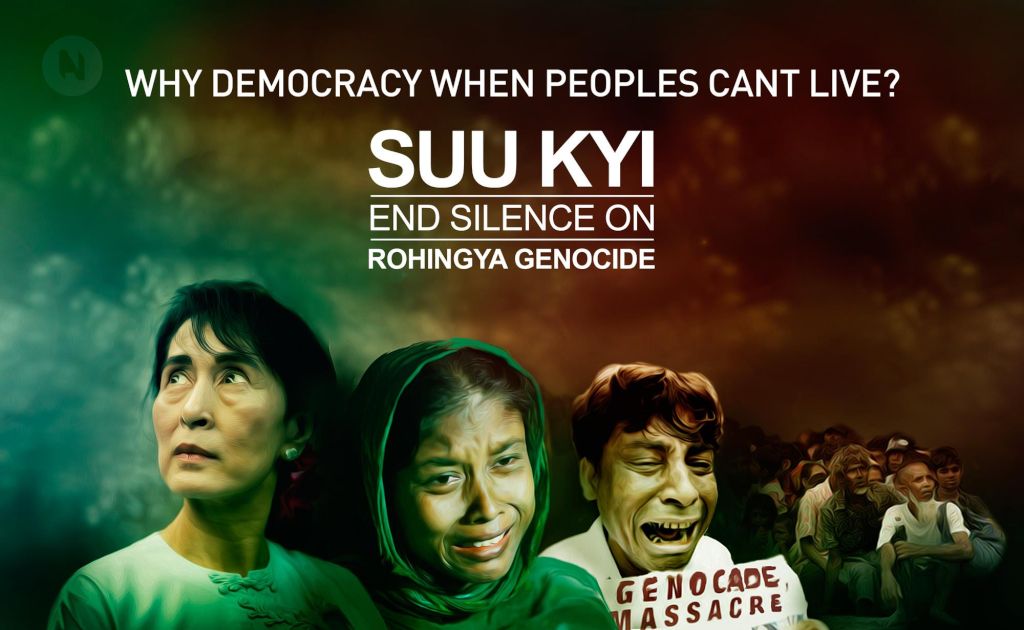
The latest person to join the gang of delusion and fanaticism is none other than Daw Aung San Suu Kyi herself. She recently, in India, described the violence as an international tragedy caused by the illegal immigration of Bengalis through the porous border between Burma and Bangladesh. To quell the violence, hence, illegal immigrations into Arakan, Burma had to be stopped. Is she intentionally lying like her counterparts, Generals in Bama military-Pathological liars, who blatantly lie that no Burmese governments in the past had recognized Rohingyas and the term “Rohingya?” Or doesn’t she really have any clue about the history of Arakan and its situation? Or has her colleague, Ex-General U Tin Oo, a puppet of Ne Win and mass murderer of Rohingyas himself, wrongfully narrated the history of Rohingyas to her?
Besides, she is hypocritically silent on the genocides against Kachins. Upon a question posed by a Kachin Student at LSE Conference during her trip to London, she replied ‘Condemning anyone is not the Solution and we need to find out the root-causes to the problems.” I wonder what she was saying! Doesn’t she know what root-cause to the problem is at a time when every Burmese knows who are behind it and why?
Whatever the cases maybe, it is really pathetic to see her doing mindless stuffs just for the sake of a fixed political target. Her behaviour today is really demeaning to the titles “Democratic Icon and Human Rights Advocate” given to her. She should play straight forward and match her actions to her words. She should stop beating around the bush and being oxymoronic. It is understandable if the Generals in the Bama Military lie. It is not justifiable at all if someone who utters the words of human rights and speaking on behalf of the VOICELESS turns a racist herself and supports the human rights abuses.
Anti-Rohingya Propaganda by Sociopaths in Burma
Neither Rohingyas are illegal immigrants nor is any Bangladeshi migrating into Burma. It is a completely false propaganda spread by Burmese Regime and Magh racists to scapegoat Rohingyas to achieve their respective political targets. After all, why should any Bengali with his/her good and right sense come on a land which has been being ruled by one of the world’s most tyrannical governments, is relatively poor and has poorer infrastructures? Just because Bangladesh has a big population, it can’t be assumed that Bengalis are emigrating to Arakan. Bordering China and India have the biggest populations in the world and both countries have the huge income gaps among their populations!!! Bengalis don’t come to another third-world nation but try to go to the first-world nations. Ask any Bengali in Bangladesh or abroad.
Rohingyas are descendents of aboriginal Proto-Australoid Negritos and indigenous Indo-Aryan people of Arakan, who later came to mix with the people of different ethnic origin. The term “Rohingya” in the form of “Rooinga” existed as early as 17th Century. Yet, they are not treated as human beings in the predominantly fanatic Buddhist country with the majority people of Tibeto-Burman of Mongoloid origin simply because they are of Indo-Aryan Descends and practice a different religion, Islam. After systematically committing crimes against these people and others for decades, they still keep lying to conceal their crimes against humanity. It seems that Burmese regime really matches the steps of their admired Hitler’s Nazis. Therefore, lying comes naturally to them and they have become generation liars and world-class sociopaths.
M.S. Anwar is an activist and student studying Bachelor of Arts in Business Studies at Westminster International College, Malaysia
 |
| Aung San Suu Kyi |
South Asia Monitor
November 28, 2012
During her recent trip to India, Daw Aung San Suu Kyi visited her alma mater the Lady Sri Ram College, where activists protesting the plight of the Rohingya Muslims in Myanmar are reported to have told Ms. Suu Kyi “to come out of her cocoon and take a stand on the Rohingya issue.” Some political analysts have described the Rohingya issue as a test of Suu Kyi’s ‘credentials and commitment’, her Buddhist faith and even as the true proof of her being worthy of the Nobel Peace prize . It is time to take a step back and look at Myanmar, take in the big picture and focus on Suu Kyi and the challenges that confront her.
Ms Suu Kyi today, is a popular leader of Myanmar. After winning 43 of the 45 parliamentary seats contested in the by-elections held in April this year, she is expected to gain control of the government after the elections scheduled for 2015; about three years from now. The world has been delighted to see Ms. Suu Kyi in the Myanmar parliament. She is an international symbol of courage and non-violent opposition to the military rule, having struggled bravely for human rights and political freedom while under house arrest for almost 15 of the 21 years from 20 July 1989 until her most recent release on 13 November 2010.
US president Obama, during his first trip abroad post re-election remarked in Bangkok last week, “Democratic transition in Burma is an ongoing process and the process needs to be in the spotlight.” Ms. Suu Kyi idolized by her people and the world, has what it takes to leverage this attention and bring about real and lasting change in Myanmar.
However, Ms. Suu Kyi cannot assume that her overwhelming popularity in Myanmar today will remain intact over the next few years and see her through to the elections in 2015. Her party, the National League for Democracy (NLD), needs to have a clear understanding of the country's priorities and come to grips with these issues at the earliest. Ms. Suu Kyi, on the other hand, will have to evolve from being a resistance icon to a national leader; a challenging prospect.
According to the International Crisis Group, ethnically, Myanmar is one of the most diverse countries in the world. Consequently, since independence it has experienced a complex set of conflicts between the central government and ethnic minority groups seeking autonomy. Ethnic minorities constitute about one-third of the population and occupy roughly half of the country in terms of area. At present, despite almost all ethnic groups having accepted the Union of Myanmar and their demands being limited to increased local authority and equality within the federal state structure, the country is not beyond strife.
UNHRC data indicates that there are 777,859 refugees, asylum seekers and IDPs of Myanmar- origin displaced to its neighbours. There are a further 1,147,275 persons including 808,075 stateless persons within the country itself. The Myanmar refugee population in India is mainly from the Chin ethnic minority group, with a smaller proportion of Kachins, Rakhines, and Bamars.
Over 140,000 Myanmarese, mostly Karen, Karenni, Mon and Shan, among others are presently confined in camps in Thailand. Many have been displaced since the mid-1980s. In addition, there are probably at least 300,000 refugees outside these Camps in Thailand, including 250,000 Shan refugees. Suu Kyi has visited Mae La refugee camp on the Thai border, telling thousands of people that their plight has not been forgotten. She has also visited the town of Mahachai, outside Bangkok, home to Thailand's largest population of Myanmar migrants.
It is in this country, torn by internal conflict and racked by armed ethnic insurgencies of various scales and intensities that Suu Kyi is trying to make the shift from opposition leader to a party, parliamentary and a national leader. Further as a Member of Parliament, Suu Kyi is now carries the cross of being part of Myanmar’s state establishment. Suu Kyi alone cannot solve the complex ethnic problems of Myanmar that have existed for decades. Her ultimate challenge will be to keep the country unified while addressing the demands of the minorities.
She has also to revitalise the grass root-level infrastructure of her party, the NLD. She has to find common grounds with the Military that would support the necessary amendments to the present Constitution without which she cannot assume leadership in the Myanmar.
Suu Kyi’s stance on the Rohingya issue has been influenced by three key factors: the public opinion in her own constituency, the collective view of her party, and the mainstream opinion in Myanmar. Incidentally her constituency, the rural township of Kawhmu, is known to have an extremely anti-Rohingya stance. Yet there is a requirement of articulating a coherent policy for the future, policy that diffuses the situation in Rakhine State and allows for humanitarian aid to flow in to refugees.
Staying on the Rohingya issue, Suu Kyi in one of her interviews to the media in New Delhi made three important points. One, the immediate step is for the violence to stop, effect de-escalation of the situation and allow access to humanitarian aid. Second, both communities have resorted to violence hence restrain has to be exercised by all stakeholders. Rhetoric and provocation has not helped either side. Third, was regarding the responsibility of Bangladesh on the issue.
A Danish Immigration Service fact finding mission in 2011 found that the Bangladesh government was concerned about the ‘pull factor’ related to the Rohingya’s exodus to Bangladesh. This was the reason the government did not want to provide support to development activities aimed at improving the living conditions of the Rohingya. A Joint Initiative by five UN agencies to develop for Cox’s Bazar, a two-year, $33 million development plan to strengthen education, health, livelihood ect could not get the Bangladesh Government’s approval. If Pakistan and Iran were to adopt a similar position on Afghan refugees, their plight would have been akin to the Rohingyas.
Suu Kyi’s endorsement of the Rohingya struggle at this stage will not get the Rohingyas what they want but for Suu Kyi anything more than balanced position on the Rohingya issue will definitely impact her position adversely in 2015. So let’s be fair and grant ‘Daw Suu’ some political manoeuvre space and her rightful place in Myanmar history.
The author is an independent strategic analyst. He can be contacted at m_gulati_2001@yahoo.com
 |
| A Rohingya woman at a camp for displaced persons on the outskirts of Sittwe, Nov. 2, 2012. Photo - AFP
Radio Free Asia
November 28, 2012 Local residents in Burma's violence-wracked Rakhine state are against plans to set up a temporary shelter for Rohingyas.
Buddhist Rakhines in western Burma are opposing plans by authorities to
set up a refugee camp for Muslim Rohingyas who fled recent deadly
violence between the two communities, officials and residents say, as a
U.N. panel expressed concern over the government's treatment of the
Rohingya stateless group.
The proposed temporary shelter in
Pauktaw township, east of the Rakhine state capital Sittwe, is part of
plans to resettle more than 100,000 homeless people, mostly Rohingyas,
following the communal violence in June and October.
“Local
people don’t want them [Rohingyas] to be relocated in the town,” Pauktaw
resident Aung Myint told RFA’s Burmese service. “If they are resettled
close to the town, there will be problems with them.”
Instead of
setting up the camp in their township, residents of Pauktaw, where
clashes occurred in October, want authorities to investigate whether any
of the displaced Rohingyas are living in Burma illegally, he said.
“We want transparency … on what will be done if they are not yet Burmese citizens,” Aung Myint said.
“We
want the authorities to investigate them according to the 1982
Citizenship Law and decide to replace them in appropriate location when
they become Burmese citizens.”
“They are not trustworthy. It is impossible to live together with them [Rohingyas] in the same area,” Aung Myint said.
The
1982 Citizenship Law, which limits citizenship to those who can prove
their ancestors lived in the country, bars citizenship rights to many
Rohingya, whom the U.N. considers one of the world’s most persecuted
minorities.
The Rohingyas have been long viewed by the
authorities and by many Burmese as illegal immigrants from neighboring
Bangladesh even though many have lived in the country for generations.
Rights
groups said many of Burma's 800,000 stateless Rohingyas bore the brunt
of the violence. Rakhines were also among those killed and made homeless
during the clashes.
Earlier this month, authorities launched operations to track down illegal Rohingyas, beginning with inspections in Pauktaw.
No decision yet Rakhine state’s Minister of Social Affairs Aung Kyaw Min said the authorities had not yet decided on the location of the proposed camp in Pauktaw and that they were considering views from “both sides.”
“We are still choosing the appropriate location for them Rohingyas. It might be in the villages,” he told RFA’s Burmese service.
“This plan is not settled yet,” he said. “To fulfill the requests of people from both sides, they need to be fair.”
He added that those who would be settled in the camp had been living in Pauktaw township before they were displaced.
“We
are thinking to replace the refugees who were living in Pauktaw
township in an appropriate place in the same township because
[neighboring] Sittwe township is much more crowded,” he said.
Around
180 killed were killed in the communal clashes in June and October,
according to official figures, with displaced about 111,000 people,
officials have said.
U.N. concern The U.N. General Assembly’s Third Committee, which focuses on rights concerns, adopted a resolution on Monday raising the sensitive issue of citizenship for the stateless Rohingyas and calling on the Burmese government to address human rights abuses on the group.
The committee’s resolution
"express[es] particular concern about the situation of the Rohingya
minority in Rakhine state [and] urges the government to take action to
bring about an improvement in their situation and to protect all their
human rights, including their right to a nationality,” according to
Reuters news agency.
Burma’s mission to the U.N. told the
committee it would accept the resolution but rejected the
characterization of the Rohingya as one of Burma’s ethnic groups.
"There
has been no such ethnic group as Rohingya among the ethnic groups of
Burma," a representative of the mission said, according to Reuters.
"Despite
this fact, the right to citizenship for any member or community has
been and will never be denied if they are in line with the law of the
land."
The Burma representative said that the two outbreaks of violence were not rooted in any persecution of Rohingyas.
"The
violence in Rakhine state was just a violent communal clash affecting
both sides of the community. It is not an issue of religious
persecution," he said.
Reported by RFA’s Burmese service. Translated by Khet Mar. Written in English by Rachel Vandenbrink.
|
.png)
Mahan Min Khant
RB News
November 28, 2012
“In accord the section of an act 436/512, the following listed persons (Rohingyas) from Maung-Daw Township are regarded as absconders from the law by the Judge of Buthidaung township court and that of the court lawyers”
The Union government, Rakhine state government and entire RNDP party members’ manipulated outburst has affected the whole Rakhine state where there are more or less Rohingyas and Kaman people -- the tortured, burned alive, forcefully evicted, dislocated, looted, oppressed, displaced, mass dead in sea water, and multi designed helplessly sufferers are almost all Rohingyas if compared to some Rakhine fake victims who are being stationed in some well arranged camps as merely to show up.
Though, some Rakhine Buddhists people were surely faced with fatality as they intruded and fought with Rohingyas in respective townships --- for instance AnaukPyin village, Rathedaung Township and Yinthay village in Mrauk-Oo Township -- in all about the state for the last six months. No one can deny the evidences while these have even been shown by the satellite photos for further proofs and reminder.
We, the entire Rohingyas people have been simply cheated by the series of statement (how to handle the case of Rakhine state) of President Thein Sein from time to time. U Thein Sein’s occasional statements and announcements in regard the violence and chaos in Rakhine state through radios and official directives have totally been ridiculous and insensible to meet the organized cooperative and destructive effort of the whole Rakhine assailants against the innocent Rohingyas people’ lives and that of the social livelihoods. If president was an honest person and wished to suppress the chaos, he would have done it with in couple of days as did in 2007 against the saffron revolution. Instead, he does drift the subject to prolong into more mess for nonsense chit-chat from every corner of the world.
All Rakhine perpetrators who have blissfully and obediently involved in chaos-- torching the Rohingyas villages and killing innocent people-- be arrested soon and put in long term jails in several prisons of the country in accord the laws. As almost all entire Rakhine mass people have dutifully involved in the massacre of the Rohingyas innocent people, no Rakhine ladies and gentlemen would abscond from an un-arrested if each Rakhine individual involvement is thoroughly investigated. Almost all Rakhine are guilty-less in the last chaos.
Before and after the one sided attack was launched on Rohingyas in accord their preplanned harmonized action, soon all relevant perpetrators from local and abroad have set up to propagate the attack through their several local journals and oversea Burmese programs such as VOA, RFA, BBC and DVA as if the chaos was run by Rohingyas.
To recoil from their (state government, Rakhine state government, RNDP party and mass Rakhine people) sadism and brutal inhumane activities committed on Rohingyas along Rakhine state for the last six months, the respective governments’ tools such as township courts Judges and the lawyers have knowingly designed their own laws to arbitrarily arrest innocent Rohingyas people from each township to shoulder the wrongdoing of the Union government, Rakhine state government, RNDP and mass Rakhine people to over innocent Rohingyas.
The following Rohingyas from MaungDaw Township are being warranted to arrest by the Judge of Buthidaung Township under section of an act 436/512.
Details are as the following mentioned.

“The Rohingya hold themselves- within themselves the same dignity as you do, and I do. There’s no excuse for violence against innocent people” The President of the United States, Barack H. Obama speech on Rohingya issue at Rangoon University. However US based broadcasting services such as VOA (Voice of America) and RFA (Radio Free Asia) censored the president’s historic speech in the Burmese language broadcasting session. Why did they censored? Where is the media ethic?
Since 1962, when General Ne Win coup Burma with his military forces and grab the power of the nation; the brutal dictator Ne Win was strongly back by the communist China. Therefore, people of Burma have felt China has swallowed their country. Whenever there were upraising against the regime, Burmese army brutally cracked down and China was always backing by the side of Burma at UN. After many years passed by the situation is fell in to chocking level that the people of Burma expecting United States and Western countries to help them escape of their impoverished suppressive lives. In the conscious and unconscious mind of Burmese people hoping that the US is the savior and the impression of United States is humongous also.
The economic embargo implied on Burma by US and Western countries, the collapsed of the Burmese economy to the ground and the regime could not stand loyal to the China’s policy to stay inward and supply only to china with raw materials and county’s natural resources. Therefore, they started shifting to gain US and The West favor to open the trading opportunities. For that reason, the regime has transformed themselves form military clothed person to civilian and also transformed command control centers to parliament. Once the transformation was completed, the extended their hands and praise to The West with cruel intention for their survival purposes as if they are listening the people voice and wishes that people of Burma desire to defeat China’s economic and political influence with the power of The United States.
Soon after President Thein Sein opened up the county and create relationship with US and The West , Buddhist Extremists, The underground Monks’ Gang, Nationalists and the hardliners within the government of Thein Sein and the regional governments started strategic planning for the Muslims population of Burma to be extinct to build the greatest Buddhist Nation. This plan is the dream of Burmen’s great pioneer Master Hmine ( Tha Khin Ko Daw Hmine) . Ko Daw Hmine was the founding father and famous influential leader of Doh Ba Ma Asi-A-Yone (We, Burmese Association ). General Aung San, the independent leader of Burma was one of the member at the beginning of the movement of the organization. Therefore, the network of the Buddhist extremists and nationalists started Anti-Muslims propaganda to gain trust of US and the West showing that Muslims are the common enemy to them as well without knowing that west does not have this policy. In order to promote the Nationalistic and Buddhist Dominated agenda, they proposed the local news agency to create more news on US Ambassador to Burma is about to convert to Buddhism. This is to confuse the people of Burma mostly targeting to the uneducated population. That way, people will impress Buddhism more and monk will gain trust of the people.
Secondly, Buddhist extremists and nationalists created the story as they traditionally did as Muslims men raping a Buddhist woman knowing that this kind of story is sensitive to all society. This provocation can lead to huge violence against Muslims all around Burma and people may have justifiable reasons to kills Muslims and driven out from their homes. They have believed mistakenly that doing so will result in US favor and trust towards Burma. Therefore, the extremists implemented the plan by burning Muslims houses and making the Muslims displaced from their lands and hundreds of innocent Muslims were killed.
When the international community demanded to stop the violence and declare that harming innocent people regardless of religion, color of their skin and where they came from is a crime against humanity, they calmed down showing that things are getting to a normality however , the continuation of anti-Muslims propaganda to drive out the Muslims from Burma is still going underway.
The famous monks, A Lo Daw Pyei, Shwe Nya War and Wira Thu publicly organize their fellow Buddhists to attack against Muslims. Pro Democracy Monk Shwe Nya War ( currently in Canada ) claimed in his YouTube post on October 28, 2012 that his superior monk A Lo Daw Pyei was in meeting with the senior US official in Burma and explained what they are doing and US official listened carefully and kind of agreed upon their actions . The Monk has misinterpreted the officials respectful attitude on religious leader. However, this misinterpretation have become political tools for extremists to create second round of violence happened in Rakhine State as it was under US endorsement. By looking at this process, pictures taken or videos of the extremist leaders meeting with senior foreign officials are being abused as a tools for violence.
On the other hand, they have organized the media wings such as local and foreign based Burmese media employees to promote their agenda by creating the same voice. That is to say, all media must voice that Muslims in Burma are invaders from Bangladesh and not to use the term “ Rohingya” for the Muslims people who are originally form Rakhine State of Burma. Due to the limited access to the unrestricted , fair and ethical media, Burmese people usually listen and depend on the foreign based media stations such as VOA, RFA, BBC-Burmese and DVB (Democratic Voice of Burma) to learn what the US and The West said about Burma. Telephone, Internet access, Social media such as FaceBook, Myspace and Linkedin other social network are not commonly used nationwide. In addition , most of them grown up under very poor level of education for generations and rural life style media access is over word of mouth.
Since the beginning of the violence until now, Burmese session of the foreign based broadcasting services such as RFA-Burmese, VOA- Burmese, BBC- burmese and DVB locate in US and Western countries firmly stand on the side of Buddhist Extremists and Nationalist. The Burmese language services bias on reporting that Muslims of Burma are invaders, illegal- immigrants and infidels from Bangladesh. In addition, Burmese broadcasting services all around the world reported Muslims torched their own houses and killing Bhuddists and run away to from the land they lived for many years .In reality on the ground is totally opposite. Buddhists extremists burn down the whole compound of Muslim houses and villages, killing Muslims and forcing the Muslims to flee from the villages.
Now it comes to the level that, the foreign based Burmese media VOA, RFA running under support of US and DVB , BBC running under western governments fund started censoring the speech of the President of the United States at Rangoon University in their Burmese translation of the speech. Even though, the western media corporation hired contracted Burmese employees to work in the US and EU countries to promote democracy and human rights in Burma, however, these media wings of the extremists intruded into the pro-democracy foreign media corporation and abused media tools to prevent poor Burmese population to go near the truth. It is an insult to the nations funding them.
Htay Lwin Oo
Leading Activist
Myanmar Muslim Civil Rights Movement (USA)
-
 ဇြန္လ ၁၇ ရက္ ၊ ၂၀၁၂ Source: guardian.co.uk ျမန္မာျပည္သစ္အတြက္ အနာဂတ္မွာ ေအာင္ျမင္မွာလား၊ က်ရွဳံးမွာလားဆိုသည္ကို ညႊန္ျပေသာ စမ္းသပ္မွဳ တစ...
 -
 MP U Shwe Maung Explained on Amendment 1982 Citizenship Law on 25 July 2012. MP U Shwe Maung explained on amendment of 1982 Citizenship Law...
 -
ရက္စြဲ – ေမ ၂၉ ၊ ၂၀၁၂ သို ့ အယ္ဒီတာ၊ နိရဥၥရာ သတင္းဌာန နိရဥၥရာ သတင္းဌာနမွ ေမလ ၂၉ ရက္ေန ့ ထုတ္ျပန္သည့္ ရမ္းျဗဲတြင္ အသက္ ၁၆ ႏွ...
-
 Read letter here Read history of Rohingya here Download letter PDF here Download History of Rohingya PDF here credi...
 -
 12/07/2012 Joint press release HUMANITY GONE ...
 -
More than 40% of people living in Burma belong to one of the military-ruled nation's different minority groups. The government recognis...
-
 လူသားတိုင္း ရသင့္ရထိုက္ေသာ ရပိုင္ခြင့္၊ ခံစားခြင့္ မ်ားကို လူမ်ိဳးဘာသာမေရြး ရရွိသင့္ပါသည္။ သို႔မွသာ Human Rights – (လူ႔အခြင့္အေရး) ကိုတန္ဖို...
 -
 RB News March 31, 2018 Minbya, Arakan State : On March 30 morning, a Prayer Leader or Imam was brutally beaten and injured by a Rakh...
 -
 By Dr. Maung Zarni Since the first wave of Rohingya genocide in Feb 1978 which expelled nearly 200,000 refugees from all across Wester...
 -
Even if the Rohingyas were not native to what we call Burma today, our birthplace, the inhuman and inhumane treatment of nearly 1 million Ro...

Popular Posts
Threatwiki

Amartya Sen: Burma's "slow genocide" of Rohingyas

Watch Professor Amartya Sen speak on what he calls Burma's 'slow genocide' of Rohingya, Harvard, 4 Nov 2014
